

A workplace should not force a person to choose between earning a living and protecting dignity. Yet workplace harassment is often misunderstood as something that exists only when there is physical touching, an explicit sexual proposal, or an indecent message. Pakistani law is wider than that in important situations.
In PLD 2023 Supreme Court 588, Nadia Naz and another v. President of Islamic Republic of Pakistan and others, the Supreme Court revisited section 2(h) of the Protection against Harassment of Women at the Workplace Act, 2010. The Court held that the earlier interpretation had been too narrow because it treated “sexual” mainly as conduct involving physical intimacy or sexual overture and failed to consider its gender-related meaning. The review judgment explains why sex-based discrimination and sexually demeaning attitudes can also fall within workplace harassment law when the statutory conditions are met.
This guide covers the judgment, the 2022 federal amendment, who may be protected, complaint forums, evidence, employer duties, penalties, and the federal-provincial jurisdiction problem.
Table of Contents
Judgment at a Glance: Workplace Harassment Case
| Point | Detail |
|---|---|
| Case | Nadia Naz and another v. President of Islamic Republic of Pakistan and others |
| Citation | PLD 2023 Supreme Court 588 |
| Court | Supreme Court of Pakistan |
| Bench | Yahya Afridi, Muhammad Ali Mazhar and Ayesha A. Malik, JJ |
| Decision | 14 March 2023 |
| Proceedings | Civil Review Petitions Nos. 255 and 570 of 2021 |
| Main Provision | Section 2(h), Protection against Harassment of Women at the Workplace Act, 2010 |
| Central Issue | Whether harassment was limited to sexual conduct or also included gender-based discrimination and sexually demeaning attitudes |
| Result | Review petitions allowed; earlier decisions set aside; matter remanded to the President for fresh decision |
The citation, bench and date are confirmed by the reported judgment.
The last point is critical. The Supreme Court did not finally decide every factual allegation in Nadia Naz’s favour. It corrected the legal interpretation and remanded the representation for a fresh decision.
IRAC Summary of PLD 2023 Supreme Court 588
| IRAC | Simple Explanation |
|---|---|
| Issue | Did section 2(h) cover only conduct with a sexual intention or overture, or could gender-based discrimination and sexually demeaning attitudes also amount to workplace harassment? |
| Rule | The statutory definition covered unwelcome sexual advances, requests for sexual favours, certain verbal, written or physical conduct, sexually demeaning attitudes, interference with work performance, hostile or offensive conditions, retaliation and employment-linked pressure. |
| Analysis | The Court examined section 2(h), the two meanings of “sexual,” the purpose of the Act, parliamentary material, international standards and the definitions of employee and complainant. It concluded that the earlier judgment had wrongly excluded the gender-related meaning. |
| Conclusion | The review petitions succeeded. The earlier Supreme Court judgment, Islamabad High Court judgment and President’s order were set aside, and the matter was remanded for fresh decision. |
Why the Case Reached the Supreme Court Again
The 2023 decision was a review judgment. Nadia Naz and the Attorney General for Pakistan challenged the Supreme Court’s earlier judgment dated 5 July 2021. The matter had already passed through the Ombudsperson, the President and the Islamabad High Court.
The Attorney General argued that section 2(h) had been interpreted too narrowly. In his submission, “sexual” could refer not only to physical attraction or intimacy but also to sex or gender. Ignoring that second meaning could exclude serious gender-based discrimination from workplace harassment protection.
The respondents supported the earlier judgment and argued that no new interpretation was needed.
The review was therefore mainly about law, not a new trial of every alleged incident.
What the Supreme Court Actually Decided
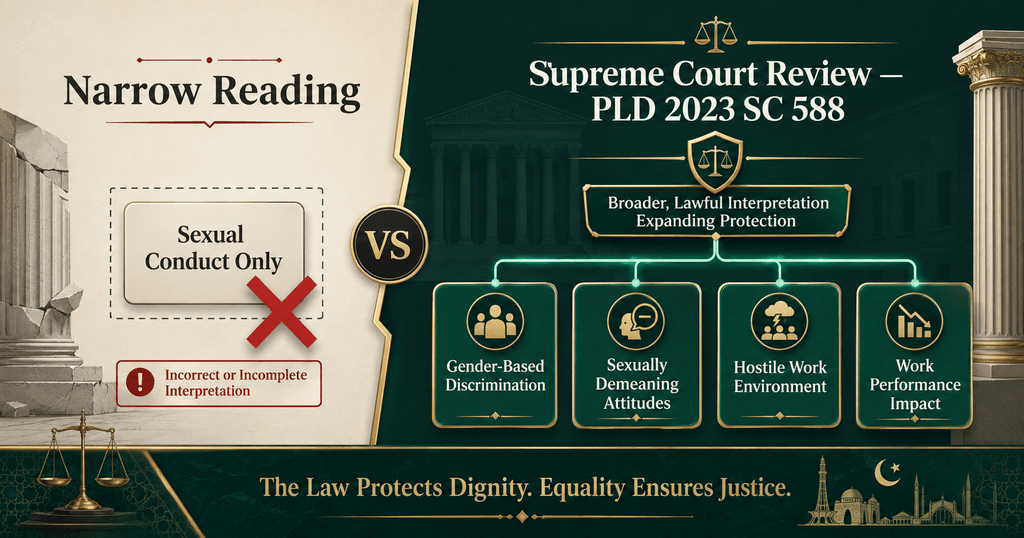
The Supreme Court accepted that the earlier interpretation contained an error serious enough to justify review. Workplace harassment was not confined to physical intimacy or conduct motivated by sexual desire. Sex-based discrimination and sexually demeaning attitudes could also be legally relevant.
The Court linked sexual harassment with unequal power, humiliation, hostility and interference with equal participation at work. Justice Yahya Afridi’s concurring note stressed that sexually demeaning attitudes can involve degradation, exploitation, humiliation and hostility based on gender.
Such conduct becomes actionable when the statutory conditions are satisfied, including interference with work performance or creation of an intimidating, hostile or offensive environment.
This does not mean every insult, rude manager, poor appraisal or office dispute automatically becomes workplace harassment. The conduct must still fit the applicable law and be proved.
Why the Word “Sexual” Changed the Case
The earlier judgment had largely read “sexual” as referring to sexual acts, physical attraction or sexual overtures. The review judgment examined another meaning: relating to sex or gender.
That distinction changed the analysis. If workplace harassment were limited to sexual desire, a person repeatedly demeaned because of gender could be left outside protection even where the treatment harms work performance or creates a hostile environment.
The Supreme Court explained that sex-based discrimination does not have to be a product of sexual activity. Conduct motivated by gender-based power dynamics may be harmful even without sexual desire.
The Court therefore used a purposive approach. It looked at the statutory words together with the object of the legislation, parliamentary material and the goal of protecting dignity and equality at work.
The Victim’s Perspective Matters — But Evidence Still Matters Too
PLD 2023 Supreme Court 588 also said the victim’s perspective is relevant. The Court referred to the standard of a reasonable woman when considering whether conduct made the workplace hostile, and said relevant circumstances should be viewed objectively and subjectively.
This does not mean a workplace harassment complaint is proved merely because someone felt offended. The forum must still examine the statutory definition, evidence, context and both sides’ positions.
The point is that a case cannot be judged only through statements such as “it was a joke” or “this is normal office culture.” Workplace power, repetition, gender-based meaning, employment consequences and the effect on the environment may all matter.
The 2022 Amendment Changed the Federal Definition
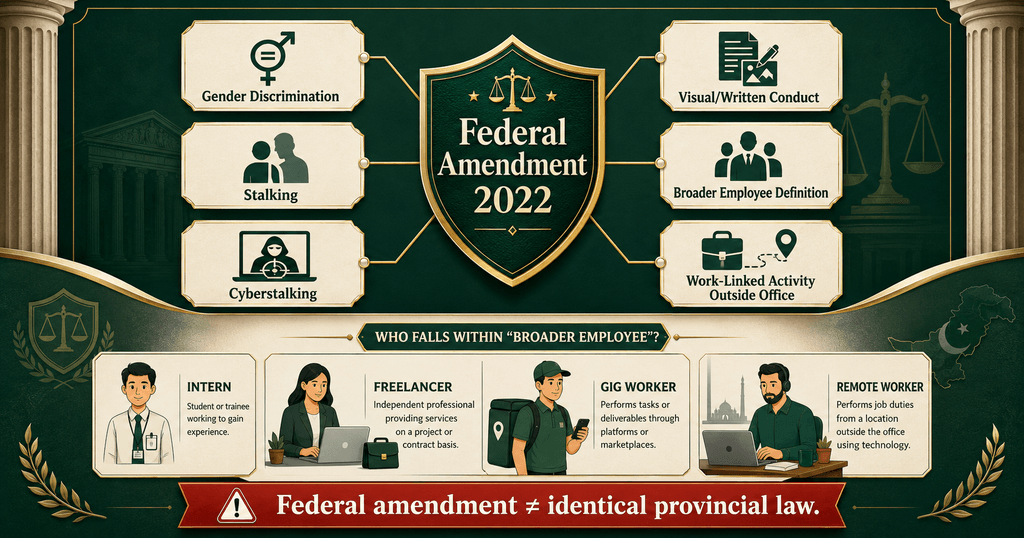
The federal law became materially broader through the Protection against Harassment of Women at the Workplace (Amendment) Act, 2022.
The amended federal section 2(h) includes stalking and cyberstalking, certain verbal, visual or written communication, physical conduct of a sexual nature, sexually demeaning attitudes, derogatory gestures or expressions, retaliation, employment-linked pressure and gender discrimination that may or may not be sexual in nature.
The amendment also expanded “employee” and “workplace.” This matters because workplace harassment can be connected with remote work, field activity, education, gigs, training, domestic work, sport or work-linked activity outside a traditional office. The official federal text includes work-linked situations outside the office within its expanded definition of workplace.
You can check the amended federal statute through the official Pakistan Code text of the Act.
The judgment itself recorded the Attorney General’s position that the substituted federal definition was prospective and that provincial laws had not necessarily changed in the same way.
Federal and Provincial Law Must Not Be Mixed
This distinction is essential in any workplace harassment dispute.
The federal statute and provincial versions are not necessarily identical. Punjab’s published law, for example, is an adapted provincial statute and its currently published definition is not word-for-word the same as amended federal section 2(h). The Punjab legislation also records the post-18th Amendment adaptation of the federal law for Punjab.
Before filing a workplace harassment complaint, identify:
- the legal status of the employer;
- where the employment relationship is based;
- whether federal or provincial law applies;
- the competent Inquiry Committee or Ombudsperson;
- the current statutory text and rules; and
- the correct appeal or representation route.
Punjab readers can check the official Punjab workplace-harassment statute.
Do not copy a federal definition or deadline and assume it automatically governs every provincial case.
Who Is Protected Under the Federal Law?
The amended federal definition of “complainant” uses the words “any person.” It also includes certain former employees who were removed, dismissed or resigned, and a parent or guardian where the complainant is a minor.
The federal definition of “employee” includes regular, contractual, piece-rate, gig, temporary, part-time and freelance workers. It can also cover students, performers, artists, sportspersons, interns, trainees, domestic workers, home-based workers, apprentices and some volunteers.
So federal protection is not limited to a permanent female employee in a conventional office.
The Supreme Court had already noted in PLD 2023 Supreme Court 588 that the earlier statutory scheme also contemplated male complainants.
Provincial wording should still be checked separately.
What Can Count as Workplace Harassment?
Depending on the applicable law and facts, workplace harassment may involve:
- an unwelcome sexual advance or request for sexual favour;
- repeated sexual or gender-based remarks;
- sexually demeaning attitudes;
- stalking or cyberstalking under amended federal law;
- derogatory gestures or visual material;
- gender-based discriminatory treatment;
- making an employment benefit conditional on compliance;
- punishment for refusing an improper demand;
- an intimidating, hostile or offensive work environment; or
- retaliation after complaint or refusal.
The correct question is not simply whether behaviour was unpleasant. The question is whether the proved conduct fits the applicable statutory definition.
A difficult supervisor, personality clash or fair disciplinary action is not automatically workplace harassment.
Where Can a Workplace Harassment Complaint Be Filed?
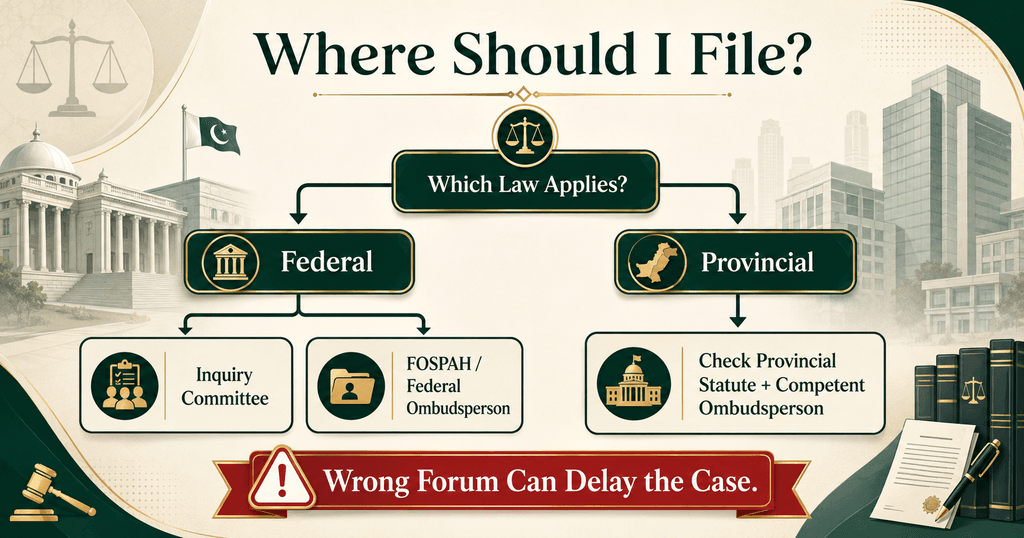
Under section 8 of the amended federal Act, a complainant may file either before the Ombudsperson or the organization’s Inquiry Committee. The federal law therefore does not always require an employee to exhaust an internal HR route first.
FOSPAH currently operates an online harassment complaint form asking for details including the complainant, department, accused person, address, main points of complaint and an affidavit.
For a matter falling within federal jurisdiction, use the official FOSPAH complaint registration page. Provincial employment requires the competent provincial mechanism after jurisdiction is confirmed.
For a practical step-by-step explanation, see Qanooni Dastak’s Harassment Complaint Pakistan guide.
How the Internal Inquiry Works Under Federal Law
After a written complaint, the Inquiry Committee is to communicate the charges and allegations to the accused within three days. The accused is ordinarily given seven days to submit a written defence.
The Committee may examine oral and documentary evidence, and each party may cross-examine witnesses appearing against them. Evidence obtained during inquiry is to remain confidential, and adverse action should not be taken against the complainant or witnesses.
The Committee is to submit findings and recommendations to the Competent Authority within thirty days of initiation of the inquiry. If guilt is found, statutory penalties may be recommended.
These are federal statutory timelines. Check provincial law separately before relying on them.
What Evidence Should You Preserve?
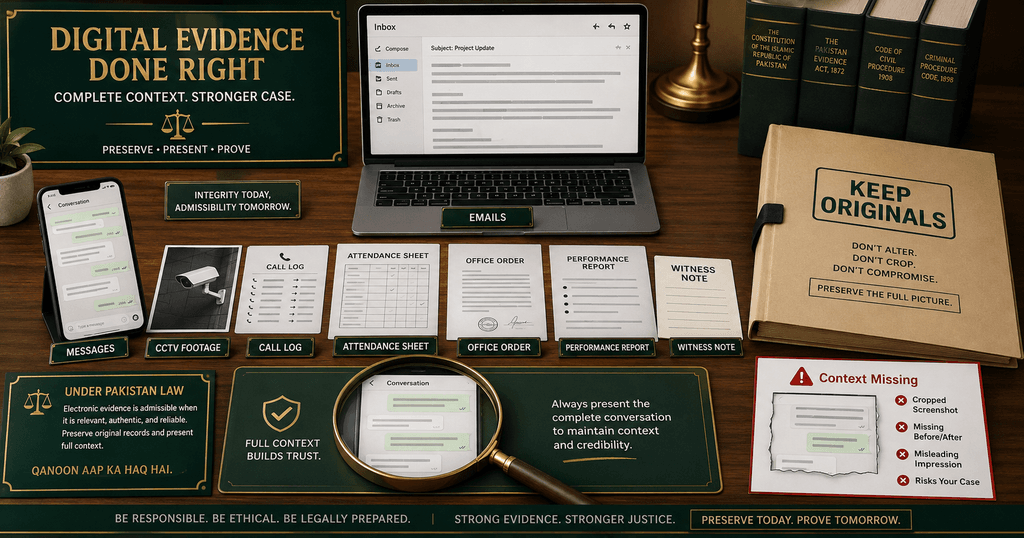
Evidence should be preserved before important material disappears. In a workplace harassment matter, keep where relevant:
- complete WhatsApp, SMS or email conversations;
- original voice notes, images and videos;
- call logs and timestamps;
- CCTV preservation requests;
- attendance, visitor or access records;
- meeting invitations and duty rosters;
- transfer, suspension or show-cause orders;
- performance reports before and after the dispute;
- earlier complaints and management replies;
- witness names and what each personally observed; and
- proof of retaliation.
The federal Act allows the Inquiry Committee to require documentary, audio or video evidence.
Avoid relying only on cropped screenshots. Keep original files, full conversations and secure backups. Do not edit recordings or reconstruct messages.
How to Draft a Strong Complaint
A strong workplace harassment complaint is specific, chronological and easy to verify.
Start with the employment relationship. Then state each incident separately with the date or approximate period, location, words or conduct, witnesses and supporting material.
Explain why the conduct was unwelcome and how it was connected with work. If promotion, transfer, salary, evaluation, training, termination or another employment benefit was used as pressure, identify it clearly.
Record retaliation after refusal or complaint. If there was delay, explain it truthfully.
Do not add allegations simply to make the complaint sound stronger. Consistency and verifiable detail matter more than dramatic language.
Retaliation Is a Serious Warning Sign
Retaliation may appear as sudden poor evaluations, blocked promotion, gossip, unnecessary transfer, isolation, threats, removal of duties or pressure to withdraw a complaint.
If treatment changes after refusal or complaint, preserve the before-and-after record. Earlier appraisals, emails, assignments and promotion history may become relevant.
The federal inquiry procedure says adverse action should not be taken against the complainant or witnesses and that pressure through a hostile environment should not be used to stop a complaint.
What Employers Must Do
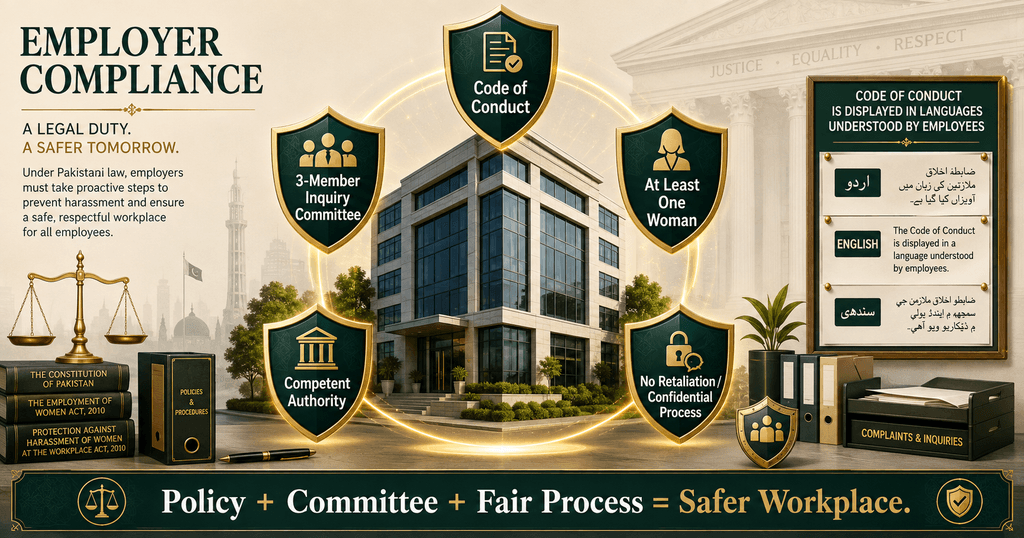
Under section 11 of the federal Act, an employer must implement the law, incorporate the Code of Conduct into management policy, form an Inquiry Committee and designate a Competent Authority. The Code must also be displayed in English and in a language understood by the majority of employees.
The federal Inquiry Committee has three members, at least one of whom must be a woman. It includes senior-management and employee representation.
An anti-harassment policy that exists only on paper is not enough if employees cannot identify the committee, reporting route or competent authority.
For further background, read Qanooni Dastak’s Protection Against Harassment of Women at Workplace Act 2010 guide.
Penalties, Appeals and Other Remedies
Under the federal Act, minor penalties can include censure, withholding promotion or increment, stoppage at an efficiency bar and recovery of compensation.
Major penalties can include reduction to a lower post or time scale, compulsory retirement, removal, dismissal, suspension or cancellation of a professional licence where applicable, and fine.
An aggrieved party may generally appeal a Competent Authority decision to the Ombudsperson within thirty days of written communication. A person aggrieved by an Ombudsperson’s decision may make a representation to the President or Governor, as applicable, within thirty days. The amended federal law gives ninety days for the Ombudsperson to decide a case or appeal and ninety days for the President or Governor to decide a representation.
The Act also operates in addition to other laws. Depending on the conduct, section 509 of the Pakistan Penal Code may apply. That provision carries punishment that may extend to three years’ imprisonment, a fine up to Rs500,000, or both for conduct falling within its terms.
The official Pakistan Penal Code text should be checked before relying on a criminal remedy.
What PLD 2023 Supreme Court 588 Did Not Decide
Three limits matter.
First, the Court did not rule that every form of hostility is workplace harassment.
Second, it did not finally determine every factual allegation in Nadia Naz’s case. The representation was remanded.
Third, it did not hold that the 2022 federal amendment automatically rewrote every provincial statute.
These limits prevent the judgment from being overstated and help separate a legal interpretation from a final factual finding.
Practical Action Plan Before You File
If you believe harassment at work has occurred:
- Write a dated chronology.
- Preserve original digital and documentary evidence.
- Identify witnesses and what each actually saw or heard.
- Record any employment threat, benefit or retaliation.
- Check whether federal or provincial law applies.
- Confirm the correct Inquiry Committee or Ombudsperson.
- Read the current statute and rules.
- File a factual complaint with organized attachments.
- Keep every notice, hearing document and order.
- Calculate appeal or representation deadlines immediately.
No checklist can guarantee an outcome, but it can prevent avoidable evidentiary and procedural mistakes.
Conclusion: Dignity at Work Is a Legal Issue
Workplace harassment in Pakistan is not confined to physical touching or an explicit sexual demand. PLD 2023 Supreme Court 588 made clear that gender-based discrimination and sexually demeaning attitudes cannot be excluded merely because conduct is not driven by sexual desire.
The 2022 federal amendment now states more clearly that gender discrimination may fall within harassment whether or not it is sexual in nature. At the same time, correct law, forum, evidence and jurisdiction remain essential.
The practical lesson is simple: preserve the record, identify the correct statute, explain the workplace connection and use the proper forum. A strong workplace harassment case is built on accurate facts, reliable evidence and correct procedure.
FAQs About Workplace Harassment
1. Can workplace harassment exist without physical contact?
Yes. Physical touching is not necessary in every case. PLD 2023 Supreme Court 588 explains that gender-based discrimination and sexually demeaning attitudes can fall within the statutory framework. The amended federal definition is broader and expressly includes gender discrimination that may or may not be sexual in nature.
2. Did Nadia Naz finally win her harassment case in PLD 2023 Supreme Court 588?
No final factual victory was declared. The Supreme Court allowed the review petitions and set aside the earlier Supreme Court judgment, Islamabad High Court judgment and President’s order. It then remanded the representation to the President for fresh decision under the corrected interpretation.
3. Can a man file a workplace harassment complaint?
Under the amended federal Act, “complainant” means “any person.” The Supreme Court also noted that the earlier statutory scheme contemplated male as well as female complainants. Provincial wording can differ, so the applicable law should be checked.
4. Can an intern, freelancer or gig worker be protected?
Under amended federal law, the employee definition expressly includes interns, trainees, freelancers, gig workers, part-time workers, domestic workers and other categories. Whether protection applies in a particular matter still depends on jurisdiction and the facts.
5. Must I complain to HR before going to the Ombudsperson?
Not necessarily under the federal Act. Section 8 gives a complainant the option to prefer a complaint either to the Ombudsperson or the Inquiry Committee. Provincial procedure should be checked separately.
6. What evidence is useful in a workplace harassment case?
Useful evidence can include complete messages, emails, voice notes, call logs, CCTV, attendance records, office orders, performance reports, earlier complaints, witness evidence and proof of retaliation. Preserve originals and context rather than relying only on cropped screenshots.
7. What should I check before filing?
Check the correct federal or provincial statute, employer status, competent forum, current definition, available evidence, applicable rules and appeal deadlines. Filing under the wrong law or before the wrong forum can create avoidable difficulty.
8. Can workplace harassment also lead to criminal proceedings?
Potentially, yes. The workplace statute operates in addition to other laws. Depending on the actual conduct, section 509 of the Pakistan Penal Code or another criminal provision may be relevant. Workplace proceedings and criminal liability are separate legal questions.
Disclaimer
This article is for general legal awareness and does not constitute legal advice. Workplace harassment cases depend on facts, evidence, employment relationship, jurisdiction, applicable federal or provincial law, limitation and later amendments. Obtain case-specific legal advice before taking or defending formal proceedings.