

A cruel message can take seconds to send, but its fear can follow a person into the classroom, workplace, bedroom and every notification on a phone. Cyber bullying is not always a harmless joke. It may involve threats, fake profiles, humiliation, stalking, misuse of private images, impersonation or coordinated online attacks.
For Pakistani families, students, employees and social-media users, the real questions are practical: When does online cruelty become a legal issue? Which PECA section may apply? What evidence should be saved? Where should a complaint be filed? And what should a parent do when a child is involved?
This guide explains cyber bullying in Pakistan in simple English. It covers the current PECA framework, NCCIA complaint route, child-related rules, digital evidence, common mistakes and immediate safety steps without assuming that every rude comment is automatically a criminal offence.
Urgent safety note: If an online threat mentions violence, abduction, a weapon, a forced meeting, someone approaching a home or school, or another immediate physical danger, contact the police or relevant emergency service first. An online form should never delay physical safety.
Table of Contents
Cyber Bullying at a Glance
| Question | Practical answer |
|---|---|
| Main federal cybercrime law | Prevention of Electronic Crimes Act, 2016, as amended |
| Specific provision | PECA Section 24A |
| Investigation agency | National Cyber Crime Investigation Agency (NCCIA) |
| NCCIA helpline | 1799 |
| Child cyberbullying punishment | 1–5 years plus Rs100,000–Rs500,000 fine |
| Other possible provisions | Sections 16, 20, 21, 22A and 24, depending on facts |
| Useful evidence | Full chats, URLs, usernames, dates, original files and timeline |
| Immediate danger | Police or emergency response first |
Pakistan’s current consolidated PECA text includes Section 24A on cyberbullying and Section 29 on NCCIA. Read the official Prevention of Electronic Crimes Act, 2016.
What Cyber Bullying Means Under Pakistan’s Law
In everyday language, cyber bullying means using digital technology to threaten, shame, harass or target another person. It can happen through social media, messaging apps, gaming platforms, group chats, blogs or other electronic communication.
Pakistan’s statutory wording is more specific. Section 24A says a person commits cyberbullying when, with intent to harass, threaten or target another person, the person posts or sends electronic messages, including pictures or videos, through a social-media platform, chatroom, blog or instant messaging.
One unpleasant disagreement is not automatically a crime. Investigators and courts still have to examine the exact message, intention, context, identity, evidence and legal ingredients. At the same time, Section 24A does not expressly say repetition is always required. A serious threat or harmful upload should therefore not be dismissed merely because it happened once.
The safer rule is simple: facts decide the section, not the label.
For a wider explanation of hacking, fraud, identity misuse and other electronic offences, read Qanooni Dastak’s Cyber Crime in Pakistan guide.
9 Warning Signs That Deserve Immediate Attention
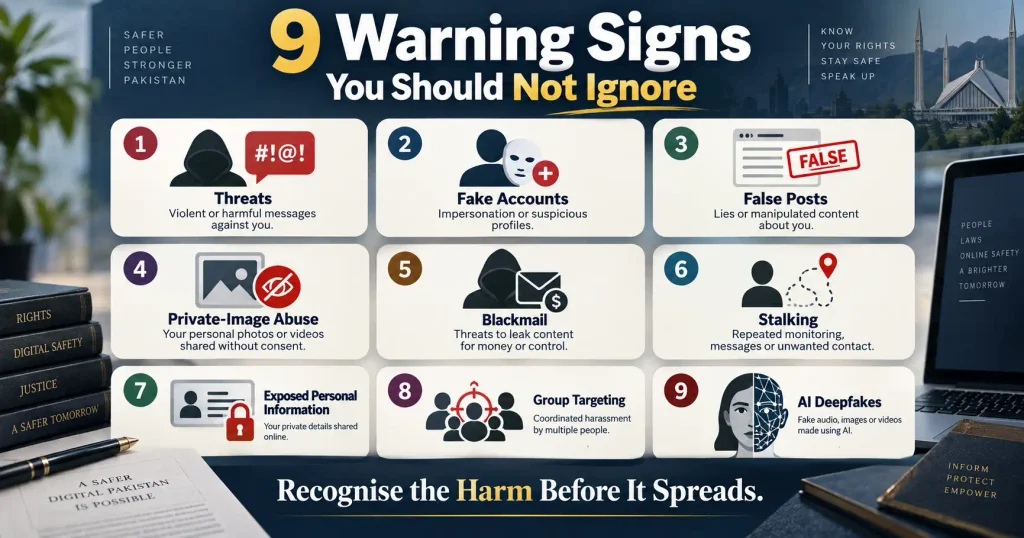
The same conduct may be called online bullying, cyber harassment or digital abuse. The legal route depends on what actually happened.
1. Threatening Messages Keep Returning
Repeated WhatsApp, Instagram, Facebook, TikTok, SMS or gaming messages may create serious fear, especially when the sender continues after the target clearly shows no interest.
Where repeated unwanted contact, monitoring or spying is involved, PECA Section 24 on cyberstalking may also become relevant. Save the full conversation before blocking where it is safe to do so.
2. A Fake Profile Speaks in Your Name
A person may copy another user’s photograph, name or identifying details and create a profile pretending to be that person.
Where identity information is obtained, possessed, transmitted or used without authority, Section 16 may become relevant. The current PECA text provides punishment of up to three years, a fine up to Rs5 million, or both.
In a cyber bullying complaint involving impersonation, preserve the profile URL, username, posts and messages before the account disappears or changes its name.
3. False Posts Are Used to Damage Reputation
A fabricated accusation may spread rapidly through a group, page or public account.
Section 20 of the current PECA text concerns intentional public transmission of information known to be false where it intimidates or harms the reputation or privacy of a natural person. The statutory text provides imprisonment up to three years, a fine up to Rs1 million, or both.
An unpopular opinion, criticism or bad review is not automatically the same as knowingly false information. Context, falsity, intention, publicity and harm matter.
4. Private Images Become a Weapon
Private or intimate material can be used to humiliate, punish, threaten or control a person.
Where sexually explicit images, manipulated sexual imagery, sexual threats, revenge or blackmail are involved, PECA Section 21 may become more relevant than the general label cyber bullying. Do not forward intimate material to relatives or friends merely to prove that it exists.
5. Blackmail Demands Money or Obedience
Online blackmail often sounds like: “Pay me or I will publish this,” or “Meet me or I will send this to your family.”
Do not assume payment will end the threat. Preserve the demand, account, number, payment details and conversation. If money has already been sent, also follow the urgent steps in Qanooni Dastak’s Online Fraud guide.
6. Someone Tracks or Contacts You Repeatedly
Section 24 on cyberstalking can cover specified forms of repeated unwanted contact, monitoring electronic communications, spying that causes fear or serious alarm, and certain harmful non-consensual distribution of photographs or videos.
A complaint should not merely say, “He is bullying me.” State how often contact occurred, which accounts were used, whether the person was asked to stop, what threats were made and what fear or harm followed.
7. Personal Information Is Shared to Create Fear
A home address, school, phone number, workplace, family information or live location can be posted to intimidate a victim or invite others to harass them.
Preserve the original URL and surrounding context. Do not respond by publishing the suspected offender’s own CNIC, address or family details.
8. A Group Turns One Person into a Target
Digital attacks can grow quickly when classmates, co-workers, gaming users or group members repeat insults, share edited images or encourage others to attack one person.
Not every participant automatically commits the same offence. Individual conduct and intention still matter. However, group amplification can increase the harm and make cyber bullying harder to escape.
9. AI Is Used to Manufacture Humiliation
A deepfake image, cloned voice or manipulated video can make it appear that a person said or did something that never happened.
The correct law depends on the content and purpose. Identity misuse, dignity, sexual-image offences, fraud or another PECA provision may be relevant. Keep the original file or link where safely possible.
Which PECA Sections May Apply?
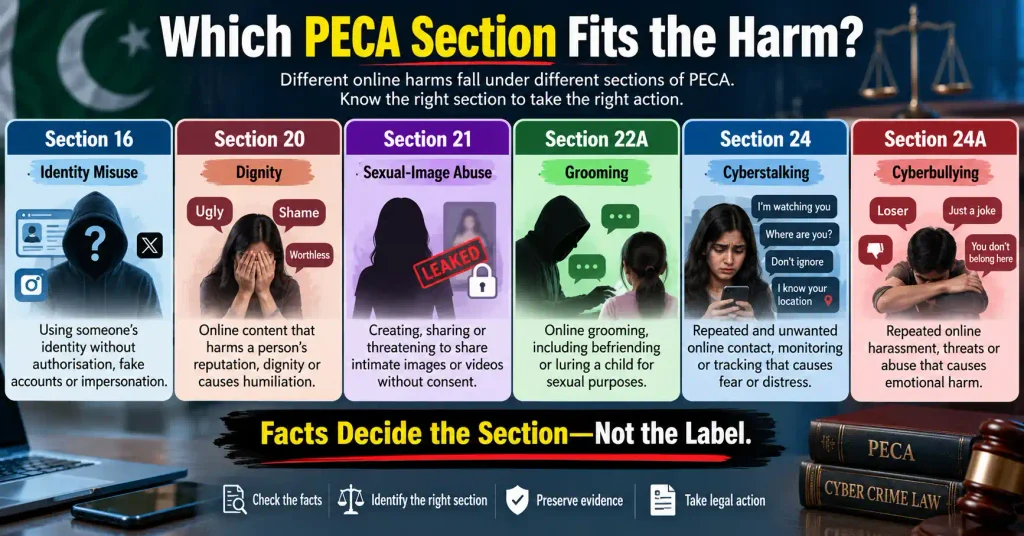
One incident can involve more than one legal issue. This table is a guide to possible classification, not a finding that an offence has been proved.
| PECA provision | Conduct it may cover | Current statutory punishment |
|---|---|---|
| Section 16 | Unauthorized use of identity information | Up to 3 years and/or fine up to Rs5 million |
| Section 20 | Specified false public information harming dignity or privacy | Up to 3 years and/or fine up to Rs1 million |
| Section 21 | Sexual-image abuse or sexual intimidation | Up to 5 years and/or fine up to Rs5 million; stronger rule for minor victim |
| Section 22A | Online grooming or cyber enticement of a minor | 5–10 years plus statutory fine range |
| Section 24 | Cyberstalking | Up to 3 years and/or fine up to Rs1 million; higher exposure for minor victim |
| Section 24A | Cyberbullying | Specific punishment clause for child cyberbullying |
The full wording and exceptions should always be checked in the official PECA text before relying on a punishment figure.
The Section 24A Child Rule People Often Misread
This is one of the most important points in cyber bullying law in Pakistan.
Section 24A(1) defines cyberbullying generally. But subsection (5) expressly states a punishment for child cyberbullying: imprisonment of at least one year and up to five years, together with a fine of at least Rs100,000 and up to Rs500,000.
So it is unsafe to tell every adult victim that Section 24A automatically carries exactly the same punishment. An adult may still have a serious complaint, but cyberstalking, dignity, identity misuse, sexual-image abuse or another provision may fit the conduct more closely.
A strong complaint should describe the conduct first instead of forcing every situation into one section.
What If the Alleged Bully Is Under 18?
The victim’s age is not the only age that matters.
If the person accused of an offence is under eighteen, Pakistan’s Juvenile Justice System Act, 2018 may affect the criminal process. The Act defines a child, for its purposes, as a person who has not attained eighteen years of age.
This is particularly important in school and teenage cyber bullying cases. Parents should protect the victim and preserve evidence, but they should not turn an allegation against another child into a public online trial. An under-18 accused also has legal protections and due-process rights.
7 Urgent Steps Before Evidence Disappears
When cyber bullying is discovered, panic can cause a second problem: the victim deletes, resets or forwards the material needed later.
- Protect safety first. For immediate physical danger, contact police or emergency services.
- Preserve the source. Capture the account, URL, date, time and full conversation.
- Stop unnecessary circulation. Do not forward humiliating or intimate material.
- Secure the account. Change compromised passwords, remove unknown sessions and enable multi-factor authentication.
- Write a timeline. Record the first incident, later incidents, threats, witnesses and reports.
- Report to the platform. Platform moderation can help restrict content or accounts.
- Use NCCIA where a PECA offence is suspected. Attach useful evidence and state the facts in date order.
For a detailed filing walkthrough, read Qanooni Dastak’s Cyber Crime Online Complaint Pakistan guide.
Build a Cyber Bullying Evidence File
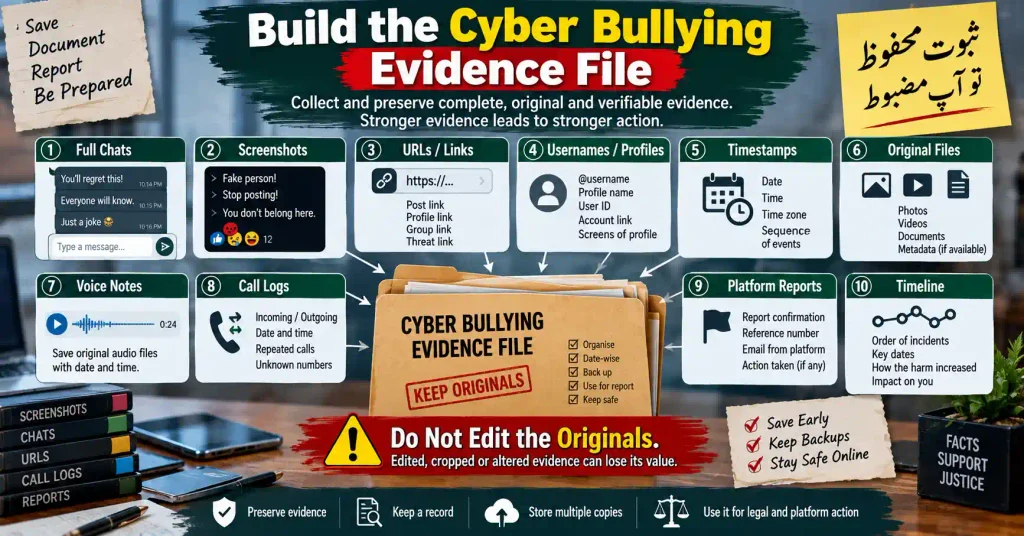
A useful cyber bullying evidence file is not the one with the most screenshots. It is the one that shows what happened, when it happened and where the original material came from.
Preserve, where relevant:
- a one-page timeline;
- full screenshots with account, date and context;
- profile, post, group and channel URLs;
- usernames and account IDs where visible;
- exported chats;
- original emails with full headers;
- original images, videos and voice notes;
- call logs;
- login alerts;
- blackmail or payment demands;
- transaction references;
- platform-report acknowledgements;
- school or employer correspondence;
- witness details; and
- an untouched backup.
Do not edit the only copy merely to make it clearer or more dramatic. A tightly cropped screenshot can remove the username, timestamp or surrounding messages and create avoidable authenticity questions.
For a broader explanation of electronic proof, see Qanooni Dastak’s Qanun-e-Shahadat Order 1984 guide.
How to Report Cyber Bullying to NCCIA
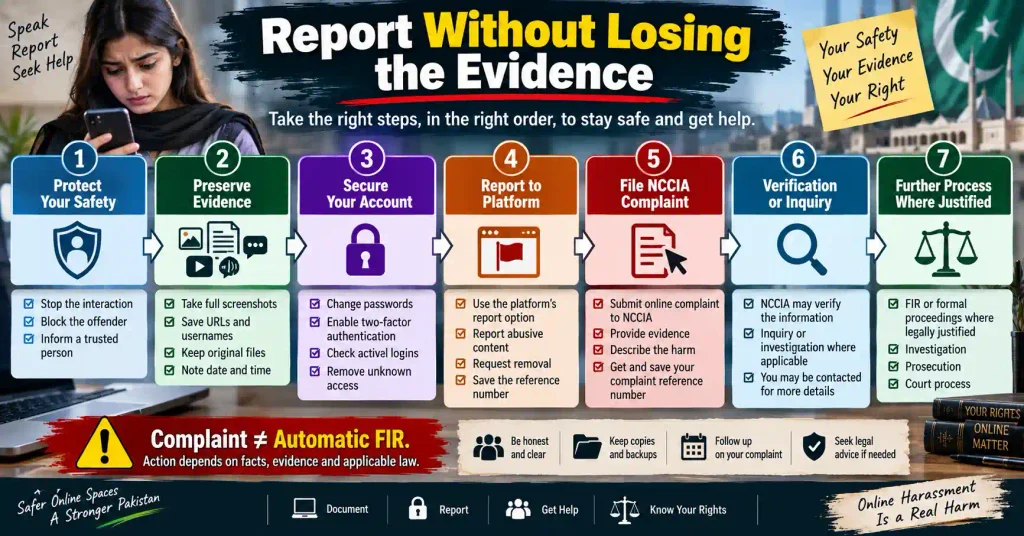
Under current PECA Section 29, the National Cyber Crime Investigation Agency is the investigation agency for inquiry, investigation and prosecution of offences under the Act. The provision also transfers the former FIA Cyber Crime Wing’s relevant matters to NCCIA.
Old guides directing every complainant only to the former FIA cybercrime structure should therefore not be treated as current instructions.
The official NCCIA website currently lists helpline 1799 and an online complaint system. Use these official routes:
A useful cyber bullying complaint in Pakistan should state who was targeted, relevant dates, the platform or account, what was posted or threatened, what evidence exists, and what earlier reports were made. Ask for lawful inquiry and action according to the facts.
Do not write that someone is “proved guilty” when identity or responsibility still requires investigation.
The current NCCIA FAQ lists a written application, CNIC copy and evidence copy among the documents for formal complaint registration. It also states that personal verification at a Cybercrime Reporting Centre may be required under the process described on the site. Check the current FAQ before relying on an old social-media post.
Complaint Does Not Automatically Mean FIR
Filing a cyber bullying complaint in Pakistan is an intake step. It does not by itself prove the allegation or guarantee an FIR, arrest, takedown or conviction.
The next legal step depends on whether the conduct falls within PECA, whether the correct person can be identified, what electronic evidence exists, whether more records are required and whether the ingredients of an offence are present.
Do not trust anyone who promises that payment can guarantee an FIR or arrest.
Which Route Fits the Harm?
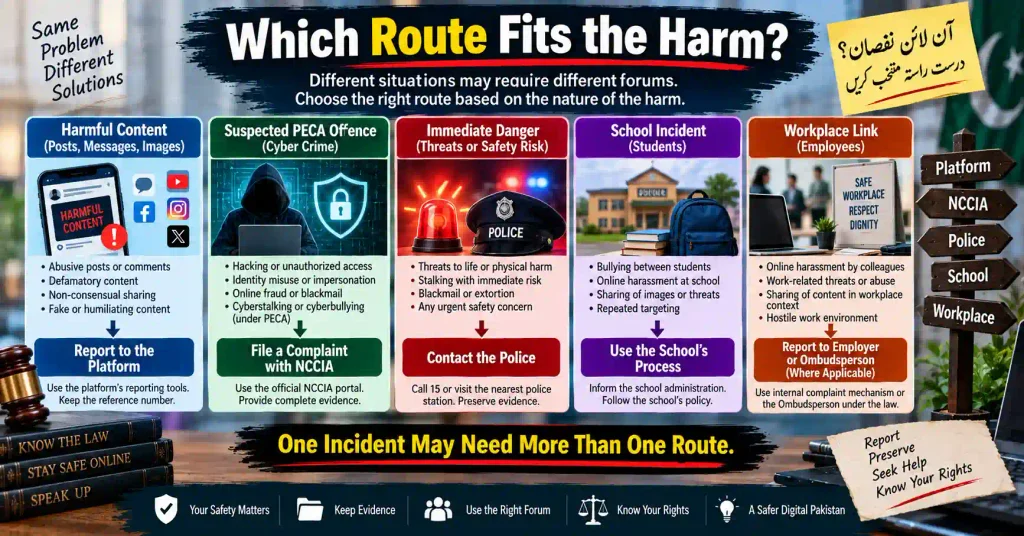
| Problem | Practical route |
|---|---|
| Harmful post or fake account | Preserve evidence, then report to the platform |
| Suspected PECA offence | NCCIA |
| Immediate physical danger | Police or emergency response |
| School-related online incident | School policy or safeguarding route, plus legal route where needed |
| Work-connected online harassment | Employer/Ombudsperson route where applicable |
| Compromised account | Platform recovery and NCCIA where an offence is suspected |
A school may be able to act under its own rules or student-safety framework, but every school in Pakistan does not necessarily follow one identical process.
Similarly, work-related messages may overlap with workplace harassment without every online argument becoming an Ombudsperson case. For employment-linked conduct, see Qanooni Dastak’s Harassment Complaint Pakistan guide.
8 Mistakes That Can Weaken a Genuine Complaint
Avoid deleting the full conversation after saving one screenshot, cropping away usernames or dates, resetting the phone too early, threatening or hacking back, publicly naming an unverified suspect, publishing private details in retaliation, forwarding intimate material, or filing repeated complaints without a clear timeline.
A viral accusation is not a substitute for proof. Preserve the trail and let the lawful process test identity and responsibility.
Parents: Your First Reaction Can Change Everything
A child may hide cyber bullying because they fear losing the phone, being blamed, being pulled out of school or embarrassing the family.
Start with: “Show me what happened. We will handle it carefully.”
Ask whether the child feels physically safe, listen without blame, preserve the evidence, stop unnecessary sharing, review privacy settings, involve the school where there is a genuine student connection, and consider NCCIA where a suspected PECA offence exists.
If a child speaks about suicide, self-harm or an immediate plan to hurt themselves, treat that as an urgent safety matter and obtain appropriate emergency or professional help.
Prevention Starts Before the First Threat
No setting can eliminate cyber bullying, but sensible habits reduce risk.
Keep profiles private where public access is unnecessary, remove public school and routine details, use unique passwords, enable multi-factor authentication, review active sessions, limit live-location sharing, ask permission before posting another person’s picture, and teach children that an online friend may hide age or identity.
The most useful family rule is simple: pause, preserve, protect, report.
FAQs About Cyber Bullying in Pakistan
1. What is cyber bullying in simple words?
Cyber bullying means using digital technology to deliberately harass, threaten, shame or target another person through messages, pictures, videos, fake profiles, private information or similar online conduct. PECA Section 24A gives cyberbullying a specific legal definition, so the exact facts and intention still matter.
2. Is cyber bullying a crime in Pakistan?
It can be. PECA Section 24A expressly defines cyberbullying. Depending on the facts, other provisions dealing with cyberstalking, identity misuse, false harmful information, sexual-image abuse or online grooming may also apply. A rude comment or ordinary disagreement is not automatically a criminal offence.
3. What is the punishment for cyber bullying in Pakistan?
Section 24A expressly provides a punishment for child cyberbullying of one to five years’ imprisonment plus a fine between Rs100,000 and Rs500,000. Adult cases should not automatically be assigned that child-specific punishment; the applicable section depends on the actual conduct.
4. How do I report cyber bullying in Pakistan?
Preserve important evidence first, then use the official NCCIA complaint system where a suspected PECA offence is involved. NCCIA currently lists its complaint portal, helpline 1799 and Cybercrime Reporting Centres. If there is immediate physical danger, contact police or emergency services first.
5. What evidence is needed for a cyber bullying complaint?
Useful evidence may include full conversations, screenshots, URLs, account names, phone numbers, emails, dates, original files, call logs, platform reports and a short timeline. The official NCCIA FAQ also lists a written application, CNIC copy and evidence copy for formal complaint registration.
6. Can parents report cyber bullying against a child?
Yes. Parents or guardians can help a minor preserve evidence and approach the appropriate authority. Section 24A also allows a minor through a guardian to seek the content-removal remedy stated in the provision. Avoid unnecessarily circulating humiliating material.
7. What if the cyber bully uses a fake account?
Save the profile URL, username, posts, messages and any connected contact details before the account disappears. Do not publicly guess who controls it. A fake display name does not prove the real operator’s identity; investigation and platform or subscriber records may be needed.
8. Can a school act if the post was made after school?
Potentially, depending on the school’s rules, safeguarding responsibilities and the connection between the online conduct and school life. Preserve the evidence and check the applicable policy. A school process does not replace NCCIA or police action where a suspected offence or immediate threat is involved.
Conclusion: Act Before the Screen Controls the Story
Cyber bullying can make a victim feel that the phone, school, workplace and home have all become one unsafe space. The answer is neither silence nor a public online war.
Protect immediate safety. Preserve original evidence. Stop unnecessary circulation. Secure compromised accounts. Use platform reporting where useful. Approach NCCIA when a suspected electronic offence exists. In child cases, protect the victim while respecting fair process for everyone involved.
A fake account, repeated unwanted contact, a private-image threat, a false public accusation and online grooming may all feel like cyber bullying to the victim, but Pakistani law can treat them differently.
The strongest complaint tells the facts in order and lets the evidence speak.
Legal and Safety Disclaimer
This article provides general legal-awareness and digital-safety information. It is not individual legal advice, a finding that any person committed an offence, medical advice, or a guarantee of an FIR, arrest, content removal, prosecution or conviction. Laws, procedures and official contact details can change. For an active investigation, intimate-content case, child-safety issue, arrest risk or serious threat, consult the competent authority and a qualified Pakistani lawyer promptly.