
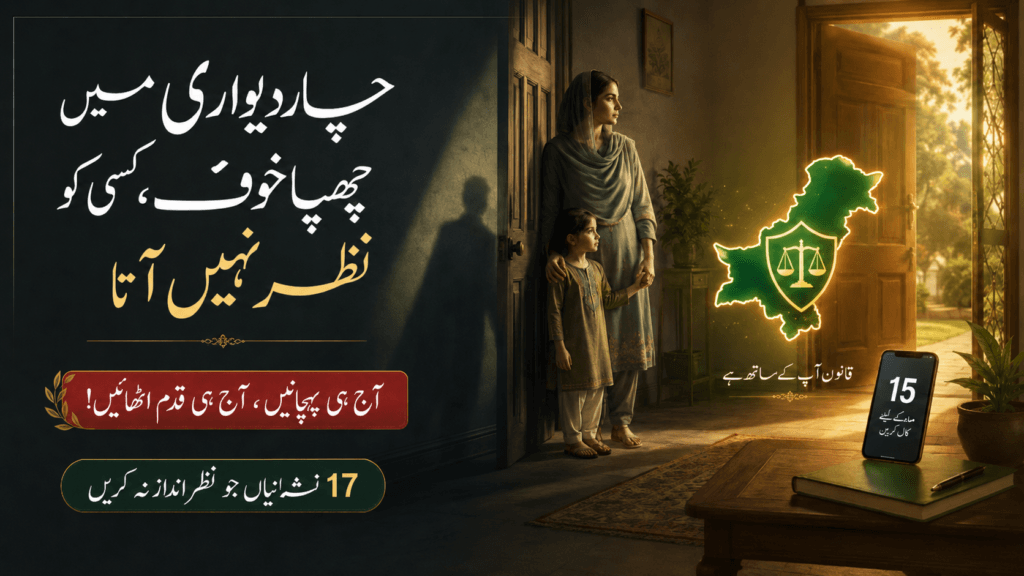
A door closes. The shouting stops, but the fear does not. A phone is checked, a salary is taken, a mother is threatened, or a child learns to stay silent. There may be no visible bruise. Yet one person is controlling how another person speaks, moves, spends, sleeps and lives.
That can be domestic violence.
This guide is for every household in Pakistan: women and men, young and old, married and unmarried, people with disabilities, transgender persons, relatives, neighbours and friends. It explains hidden warning signs, Pakistan’s latest legal position, safe first steps, useful evidence and verified helplines in simple English.
If someone may be hurt now: move to a safer place if you can do so without increasing danger and call Police Emergency 15. Use a safer phone or device if your calls, location or browsing may be monitored. Do not delay emergency help to collect proof.
Table of Contents
The Quick Answer: What Does Domestic Violence Really Mean?
Domestic violence is not limited to hitting a wife. It may be one severe act or a pattern of physical harm, sexual coercion, humiliation, threats, stalking, isolation, financial control or technology-based monitoring within a family or domestic relationship.
The common thread is power. One person creates fear or dependence so that another person feels unable to say no, seek help, keep money, meet family, use a phone or make ordinary decisions.
International health sources use a broad power-and-control approach. Pakistan’s legal definition, however, depends on where the incident happened. Islamabad Capital Territory, Punjab, Sindh, Khyber Pakhtunkhwa, Balochistan and Azad Jammu and Kashmir do not all use identical laws, protected groups, courts or filing periods. A foreign website can explain domestic violence, but it cannot tell a Pakistani survivor which local court has jurisdiction.
Domestic Violence, an Argument or a Difficult Marriage?
Not every disagreement is domestic violence. Healthy conflict allows both people to speak, disagree and remain safe. Domestic violence uses fear, punishment or control.
| A difficult but non-abusive conflict | A warning pattern of domestic violence |
|---|---|
| Both people can speak without fearing harm | One person stays silent to avoid punishment |
| Either person can meet family and friends | Contact, movement or work is restricted |
| Money decisions can be questioned | Money, food or medicine is withheld as control |
| An apology is followed by real change | Apologies are followed by the same or worse conduct |
| Privacy is respected | Phones, messages, passwords or location are secretly checked |
| Either person can safely seek advice | Help-seeking brings threats, shame or retaliation |
The table is a guide, not a legal test. A single act such as strangulation, forced sex, unlawful confinement or a serious threat may be dangerous even without a long history.
Five Main Types—and Why Bruises Tell Only Part of the Story
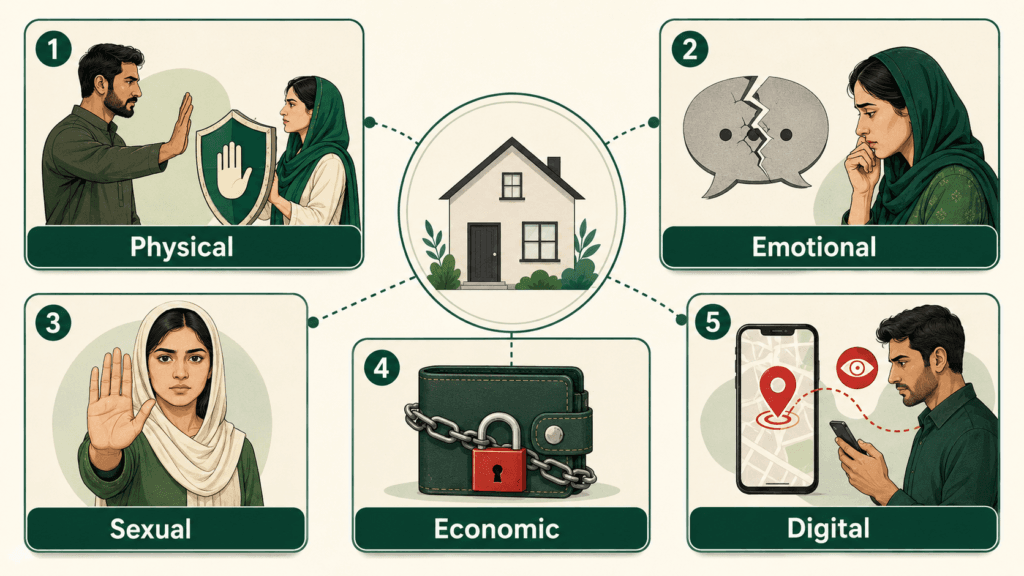
People often ask for the five main types of violence. The categories can overlap, but the following framework makes domestic violence easier to recognise. Each form of domestic violence can occur alone or reinforce another form.
1. Physical Abuse
This includes slapping, punching, kicking, pushing, burning, choking, restraining, attacking with an object, denying needed medicine or placing someone in physical danger. Blocking a doorway or driving dangerously to frighten a passenger can also be part of the pattern.
Choking or strangulation is especially serious. A person can have dangerous internal injury even when marks are faint or absent. Seek urgent medical care after any pressure on the neck, breathing difficulty, fainting, confusion, voice change or trouble swallowing.
2. Psychological, Emotional and Verbal Abuse
This may include constant insults, ridicule, character accusations, threats of harm, threats involving children, obsessive jealousy, public humiliation, stalking, sleep disruption or making a person doubt their own memory and judgment.
Pakistan’s statutes use different wording. Some expressly recognise psychological, emotional or verbal harm, but their legal thresholds are not identical. Do not assume that every cruel sentence automatically proves the same offence in every province. Record the pattern and obtain advice under the law that applies locally.
3. Sexual Abuse
Sexual abuse includes forced or coerced sexual activity, degrading acts, reproductive pressure and contact without free consent. Marriage or a close relationship does not make fear, force or injury harmless. A survivor deserves medical care, privacy and legal advice without blame.
4. Economic Abuse
Economic abuse happens when money or basic needs become tools of control. Examples include taking salary, withholding food or medicine, preventing work, forcing debt, destroying documents, refusing legally required support, selling belongings or demanding a complete account of every rupee while hiding household finances.
For many survivors, this is the lock on the door. Leaving may mean losing shelter, school fees, transport, medicine or access to children. Advice that says “just leave” ignores this reality and can increase risk.
5. Digital Abuse, Stalking and Social Isolation
An abuser may track GPS, demand passwords, read messages, place hidden cameras, impersonate someone online, threaten to share private material or repeatedly call from new numbers. They may also stop the survivor from seeing parents, studying, working or visiting a doctor.
Technology-facilitated domestic violence can overlap with Pakistan’s cybercrime and criminal laws. Read the related guide to cyber crime in Pakistan for the correct reporting route, but use a safer device before opening any help page if monitoring is suspected.
17 Warning Signs People Explain Away Too Soon
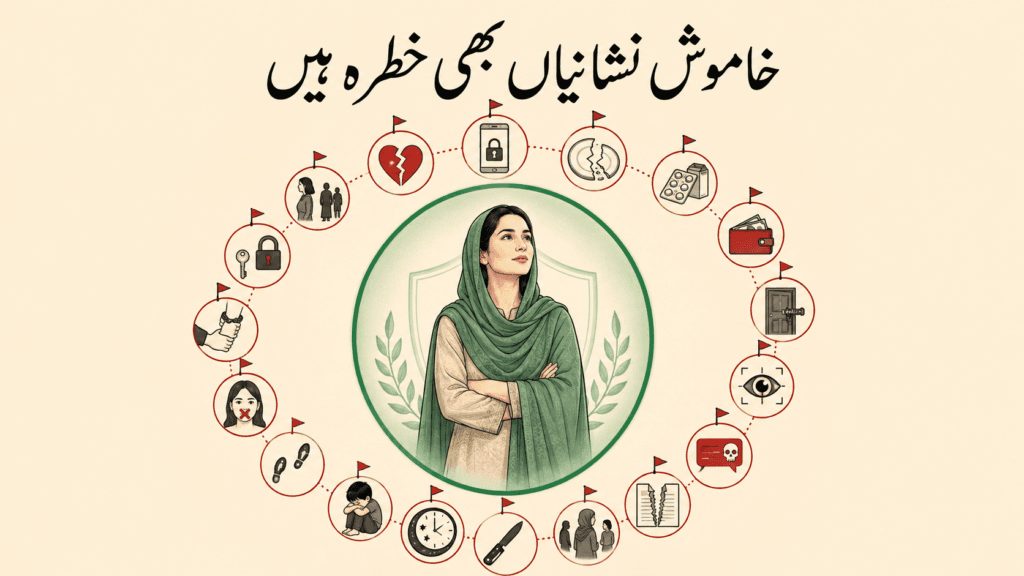
Domestic violence often grows behind familiar excuses: “It was only anger,” “He pays the bills,” “She is just jealous,” or “Family matters should stay inside the home.” Look at the pattern, the fear and the effect.
- You change your words, clothes or movements because you fear the person’s reaction.
- They insult you, mock your body, intelligence, fertility, family or character.
- They decide whom you may call, visit, marry, study with or work for.
- They check your phone, passwords, location, call history or social media without free consent.
- They take your income, identity papers, jewellery, bank access or property documents.
- They withhold food, medicine, transport, school fees or other basic needs to punish you.
- They push, slap, choke, burn, restrain or threaten you with a weapon or object.
- They pressure or force sexual contact or punish refusal.
- They threaten to hurt themselves, you, children, relatives or pets to control a decision.
- They repeatedly accuse you of affairs without basis and use the accusation to invade privacy.
- They stop you from sleeping, leaving a room or getting medical help.
- They follow you, appear at work, send repeated unwanted messages or recruit relatives to watch you.
- They destroy a phone, clothes, certificates, household items or sentimental belongings.
- They apologise, promise change and then repeat the harm—often with greater control.
- Children hide, freeze, wet the bed, become aggressive or try to protect an adult during incidents.
- An older or disabled person is neglected, overmedicated, confined or deprived of their pension.
- You feel that seeking help will make the situation more dangerous.
One sign does not decide a court case. Several signs, escalating harm or one severe incident demand attention. Trust the fear signal. Safety can begin before you have perfect evidence or a final legal label.
Who Can Be a Survivor?
Women and girls experience a disproportionate share of intimate-partner abuse, but domestic violence can also affect men, children, transgender persons, older people, people with disabilities, parents, siblings and other relatives. The available statutory remedy depends on the territory and the relationship covered by the relevant Act.
A “survivor” is a person who has experienced domestic violence and is living with its effects. Some people prefer “victim” when describing a crime or legal complaint; others prefer “survivor” because it recognises agency. Use the person’s own choice.
Being educated, financially comfortable or socially respected does not provide immunity. Domestic violence can occur in a mansion, a rented room, a village home or an online relationship. Nor does being male erase fear or injury. Help should be based on risk, not stereotypes.
What the Numbers Tell Pakistan—and What They Cannot Tell Us
The UNFPA Pakistan country page, citing the Pakistan Demographic and Health Survey 2017–18, reports that 34% of ever-married women had experienced spousal physical, sexual or emotional violence. It also says 56% of women who experienced physical or sexual violence neither sought help nor told anyone.
These are serious findings, but they are not a live 2026 national case count. Pakistan does not publish police data in one fully standardised, comparable nationwide format that captures every form of domestic violence. Silence, stigma, unsafe reporting, different legal definitions and uneven record systems mean official complaints cannot show the complete scale.
Global evidence adds context, not a Pakistan-specific total. The World Health Organization’s 2026 fact sheet estimates that about one in three women aged 15 or older worldwide have experienced physical or sexual intimate-partner violence or non-partner sexual violence during their lifetime. WHO also reports a high regional burden in Southern Asia. Those statistics concern violence against women; they should not be relabelled as a count of all victims in Pakistan.
Honest domestic violence data matters. Inflated numbers may attract clicks, but they weaken trust and can hide people who do not fit the most common profile.
The Damage Can Continue After the Incident Ends
Domestic violence can affect the whole body and the whole household. Possible effects include injuries, chronic pain, headaches, digestive problems, sleep loss, anxiety, depression, post-traumatic stress, unwanted pregnancy, sexually transmitted infections and suicidal thoughts. These outcomes are possible, not automatic, and a qualified clinician should assess them.
Children do not need to be physically struck to be affected. They may hear threats, see injuries, lose sleep, miss school, change homes or feel responsible for protecting a parent. UNICEF reported in 2025 that around one in four children globally live with mothers experiencing intimate-partner violence. Exposure can affect safety, health and learning, although supportive adults and timely help can strengthen recovery.
If a child talks about harm, listen calmly. Do not coach an account, promise absolute secrecy or make the child confront the accused person. Move toward safety and contact appropriate professional help.
Pakistan’s Law Is a Map, Not One Single Road
Pakistan now has territory-specific protective laws alongside the Pakistan Penal Code. Conduct such as hurt, criminal intimidation, wrongful confinement or other criminal acts may trigger the ordinary criminal process. A protective petition may seek no-contact, residence, monetary, custody or interim orders. Family-law claims may deal separately with maintenance, custody, dissolution or dower.
For a deeper section-by-section explanation, read the site’s complete domestic violence law in Pakistan guide. The table below is a practical starting map, not a substitute for advice on the facts.
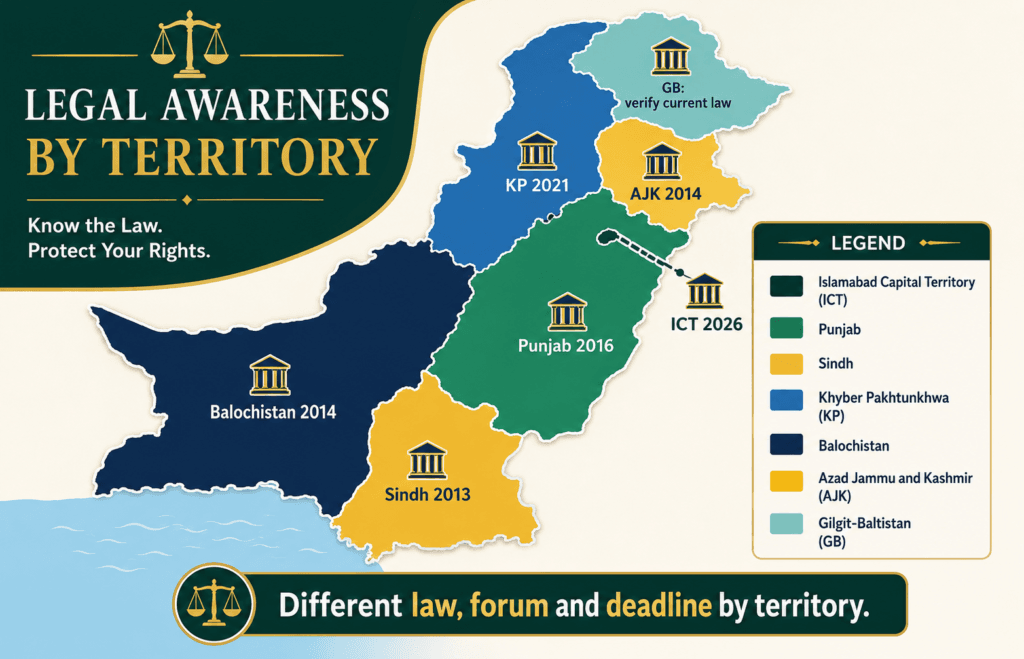
| Place of incident | Main official law | Who the special law principally protects | Court/forum and urgent timing point |
| Islamabad Capital Territory | Domestic Violence (Prevention and Protection) Act, 2026 | Women, men, transgender persons, children and vulnerable persons within covered domestic relationships | Family Court with Judicial Magistrate First Class powers; first hearing within 7 days and a 90-day decision target |
| Punjab | Punjab Protection of Women against Violence Act, 2016, as amended | Women; relief may also address dependent children | Family Court; first hearing within 7 days and a 90-day target |
| Sindh | Domestic Violence (Prevention and Protection) Act, 2013 and Rules, 2016 | Women, children and vulnerable persons in covered relationships | Judicial Magistrate First Class; first hearing within 7 days and a 90-day target |
| Khyber Pakhtunkhwa | Khyber Pakhtunkhwa Domestic Violence Against Women (Prevention and Protection) Act, 2021 | Women in covered domestic relationships | Notified District and Sessions Judge or Additional District and Sessions Judge; the Act directs an application within 15 days of the incident and sets a 60-day disposal target |
| Balochistan | Balochistan Domestic Violence (Prevention and Protection) Act, 2014, read with the 2023 amendment | Women, children, men and vulnerable persons in covered relationships | Sub-Divisional Magistrate exercising Judicial Magistrate First Class powers; first hearing within 3 days and a 30-day target. The Act states an exception for Tribal Areas |
| Azad Jammu and Kashmir | Domestic Violence (Prevention and Protection) Act, 2014 | Women, men, children and vulnerable persons in covered relationships | Judicial Magistrate First Class; first hearing within 7 days and a 90-day target |
| Gilgit-Baltistan | Confirm the latest regional position with a local lawyer, court or official legal service | A dedicated current regional Act was not verified in the official material reviewed for this article | Criminal, family, child-protection and other remedies may still apply; absence from this table is not a statement that no protection exists |
The stated periods are statutory directions or targets, not a promise that every case will finish on that day. Jurisdiction turns on details such as where the incident occurred, where the parties live or work, their relationship and where they last lived together.
The 2026 Islamabad Law: The Update Older Articles Miss
The federal Domestic Violence (Prevention and Protection) Act, 2026 received assent on 26 January 2026 and applies only to Islamabad Capital Territory. It did not create one uniform law for every province.
Domestic violence under the Act includes physical, psychological and sexual abuse within covered domestic relationships and conduct such as stalking, harassment, obsessive jealousy that invades privacy, humiliation, threats and false character allegations. Where conduct is already an offence under the Pakistan Penal Code or another law, punishment remains under that law in the competent court. For conduct punishable under the special Act but not already an offence elsewhere, section 4 provides imprisonment from six months to three years and a fine from Rs20,000 to Rs100,000, payable to the aggrieved person as compensation.
An aggrieved person, or an authorised person through a Protection Officer, may petition the Family Court. The Act permits interim, protection, residence, monetary and temporary custody orders. Depending on the facts, a court can stop communication, require distance, protect possession of the shared household, direct the return of documents or valuables, award expenses and seek police assistance.
The right to reside in the shared household is not the same as property ownership. It is an immediate protective idea: a person should not automatically lose safety and shelter only because the title is in someone else’s name. The person may instead choose shelter.
A breach of an interim, protection, residence or custody order has its own consequence under the Act: imprisonment for one year and a Rs100,000 fine payable to the aggrieved person. Implementation arrangements can change, so confirm the current Protection Officer, committee or filing process through the court or the Ministry of Human Rights helpline before travelling.
Four Legal Routes May Work Side by Side
One of the biggest misunderstandings about domestic violence is that every problem has only one door. Depending on the facts, several routes may operate together.
1. Emergency and Criminal Route
Call Police 15 when there is immediate danger. Ask for medical help when injured. If the facts disclose a cognisable offence, the police process under the criminal law may be relevant. Give a clear account of what happened, when, where, who was present, what threat continues and whether weapons, children or serious injuries are involved.
2. Protection-Order Route
The applicable special Act may allow an interim or final protection order. Relief can include no contact, distance, entry restrictions, police help, safe residence, return of property, monetary relief and temporary child custody. The exact menu differs by territory.
3. Family-Law Route
Protection does not automatically dissolve a marriage, decide permanent custody or settle every maintenance and dower question. A separate Family Court case may be needed. The site’s guides to the divorce procedure in Pakistan and the khula process in Pakistan explain those different remedies.
4. Medical, Shelter, Counselling and Legal-Support Route
Safety is more than litigation. A survivor may need a medical examination, confidential shelter, transport, counselling, child support and free legal guidance. A helpline can assist with referral even when the caller is not yet ready to file a case.
What to Do in the First 24 Hours
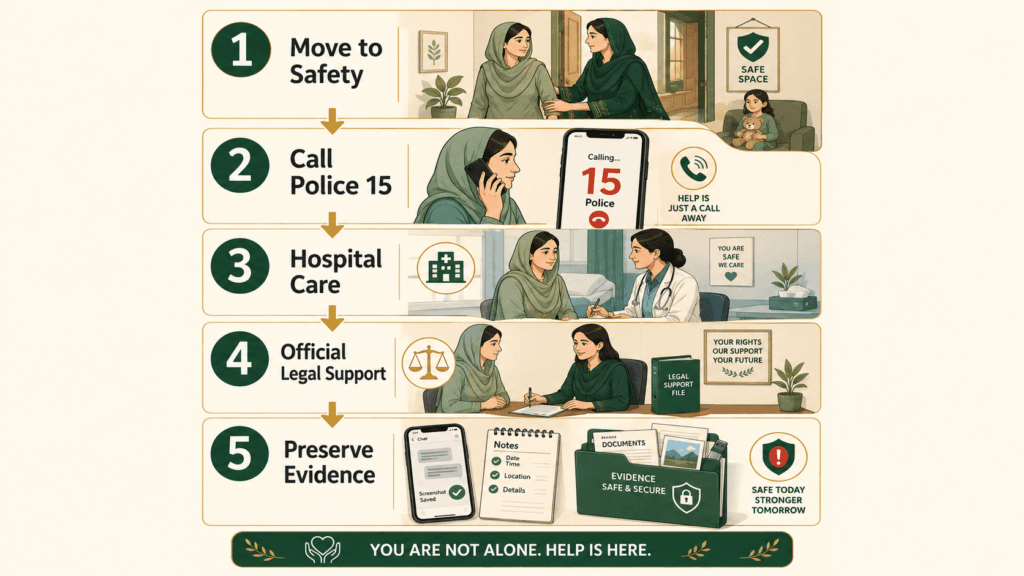
There is no perfect checklist for domestic violence. Use only the steps that are safe and possible.
Step 1: Decide Whether This Is an Emergency
Treat threats to kill, strangulation, weapons, forced confinement, escalating attacks, stalking after separation, threats involving children and attempts to force entry as high-risk signs. Call Police 15 or move toward a staffed public place, police station, hospital or trusted safe location when possible.
Do not announce a plan to leave if doing so may trigger harm. Separation can be a dangerous period. A quiet, supported plan may be safer than a confrontation.
Step 2: Seek Medical Care
Tell the clinician what caused the injury. Ask that the history, symptoms and injury details be recorded accurately. After neck pressure, a head injury, sexual assault, pregnancy-related harm, loss of consciousness, severe pain or breathing trouble, seek urgent assessment even if the person looks “fine.”
Medical care is for health first. A record may later support a complaint, but lack of a medical document does not make every other form of domestic violence unreal.
Step 3: Contact a Verified Service
| Need | Official contact | What to know |
| Immediate police emergency | 15 | Use for danger requiring urgent police response. Islamabad Police and Punjab Police publish 15 as the emergency number |
| Free human-rights legal advice and referral across Pakistan | 1099 — Ministry of Human Rights | The current official site lists service hours as 8:30 a.m. to 9:00 p.m. on weekdays; it is not a replacement for Police 15 in an emergency |
| Punjab women’s advice and complaint support | 1043 — Punjab Women’s Helpline | The official page says it is available 24/7 and covers domestic violence, property, inheritance, harassment and other gender-based issues |
| Islamabad women’s police assistance | 1815 — Islamabad Police | Islamabad Police lists an Online Women Police service; use 15 for immediate danger |
| Shelter, medical, legal and psychosocial support in Islamabad | 051-9101256, 051-9101257 or 051-9101258 — MoHR Women’s Centre | Confirm availability and safe travel before going |
Numbers and hours can change. Check the linked official page before publication and during any non-emergency call. Do not publish foreign hotlines as if they serve Pakistan.
Step 4: Choose the Correct Territory and Forum
Write down the place of the latest incident, current safe residence, workplace, relationship and last shared home. These facts help a lawyer, Protection Officer or court identify the correct law and forum. In Khyber Pakhtunkhwa, the special Act’s 15-day filing direction makes early advice particularly important.
Step 5: Ask for a Reference and Preserve Papers
Keep the complaint number, diary number, medical documents, application copy and court order. Note the name and office of the person who received the complaint. If an order is breached, report the breach and identify the exact order, date and prohibited conduct.
Build a Safety Plan Before the Next Crisis
A safety plan prepares for domestic violence without assuming that everyone can leave immediately.
- Choose two trusted people and agree on a code word that means “call for help.”
- Identify exits and safer rooms. Avoid places with weapons or no exit during escalation.
- Keep essential medicine, spare keys, a little cash, clothes and children’s necessities ready if safe.
- Copy CNICs, B-Forms, passports, Nikahnama, medical papers, prescriptions, bank details and court orders.
- Plan transport and one or two destinations. Do not reveal the location to people who may pass it on.
- Teach children how to call for help without asking them to physically intervene.
- Review school pickup permissions and tell only the staff who need to know.
- If a phone may be monitored, use a trusted device. Check location sharing, linked accounts and cloud photo access when safe.
- Change passwords from a safer device and use two-factor authentication that the other person cannot access.
- Do not rely only on deleting browser history. Account logs, bills, spyware or sudden changes may reveal help-seeking.
The National Domestic Violence Hotline’s safety resources and Mayo Clinic’s safety guidance offer useful general planning ideas, but their US services and legal procedures do not apply in Pakistan.
Evidence That Can Help—Without Risking Your Life
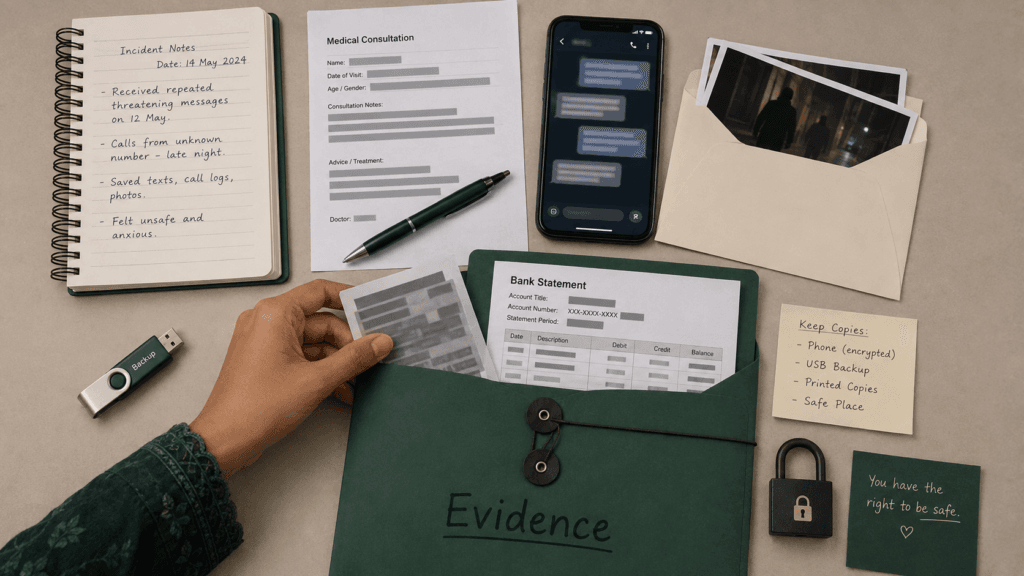
Evidence can show the pattern, urgency and financial effect of domestic violence. Collect it only when safe.
- A dated incident log with place, conduct, words used, injuries, witnesses and what happened next.
- Clear photographs of injuries or damaged property, ideally showing date and context.
- Medical records, prescriptions, test results and bills.
- Threatening messages, emails, call logs, voice notes or social media posts saved with full sender details and dates.
- Bank statements, salary records, forced loans, withheld expenses or proof of damaged or removed property.
- Copies of police complaints, helpline references and earlier court orders.
- Names and contact details of people who saw an incident, injury, distress or immediate aftermath.
- Original identity, marriage, birth, school, property and financial documents, or safe copies where originals are withheld.
Keep originals unchanged. Store a backup with a trusted person or secure account the suspected abuser cannot access. A cropped screenshot can lose context; preserve the full conversation and device data when possible. Do not fabricate, edit or provoke evidence. Admissibility and authentication are legal questions, so show the material to a qualified lawyer.
How to Help Someone Without Taking Away Their Control
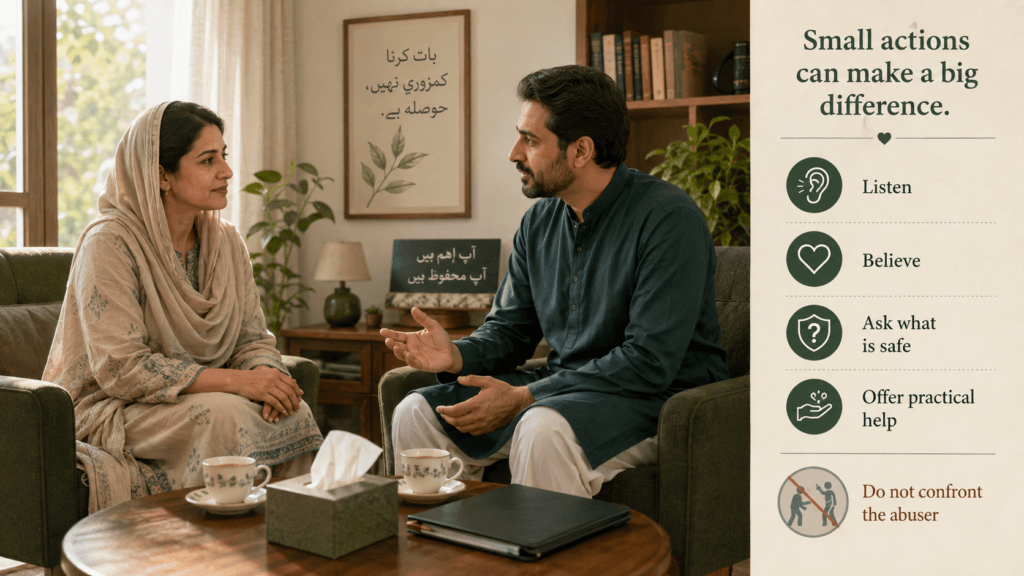
When a person discloses domestic violence, the first response can open or close the door to safety.
Say:
- “I believe you.”
- “This is not your fault.”
- “Are you safe to talk right now?”
- “What kind of help would feel safest today?”
- “Can I keep documents, arrange transport or sit with you while you call?”
Avoid:
- “Why didn’t you leave?”
- “Think of the family’s reputation.”
- “Go home and compromise.”
- Calling or confronting the accused person without consent.
- Posting details, photos or the safe location online.
- Giving an ultimatum when the survivor is not in immediate control of money, children or housing.
Listen without interrogation. Offer options, not orders. Keep contact in the safest agreed way and continue support after separation. Healthdirect’s guidance on helping an adult and the NHS overview of domestic violence signs both stress listening and safety, but Pakistani callers should use the local official contacts listed above.
Seven Myths That Keep Harm Hidden
| Myth | Reality |
| “It counts only when there is a bruise.” | Threats, sexual coercion, stalking, confinement, humiliation and economic control may also be serious. |
| “Educated families do not have this problem.” | Income, education and status do not remove abusive behaviour. |
| “Alcohol caused it.” | Alcohol may increase risk, but it does not excuse a person’s choice to harm or control. |
| “A good spouse should tolerate it.” | Safety and dignity are not failures of loyalty. |
| “Leaving always ends the danger.” | Risk can rise during separation, so planning and support matter. |
| “A police complaint automatically ends the marriage.” | Criminal, protection and family-law proceedings have different purposes. |
| “No eyewitness means no case.” | Domestic violence often happens privately. Courts assess testimony, circumstances, records and other available material under the applicable standard. |
Myths turn domestic violence into a private shame. Law and health evidence treat it as a safety, rights and public-health issue.
A Simple Complaint Outline
Do not copy a template blindly. Dates, relationships, territory and requested relief must be accurate. This outline can help organise a first conversation with police, a lawyer or a Protection Officer:
I, [name], state that [respondent and relationship] harmed or threatened me on [date/time] at [place]. The conduct included [clear acts and exact threats]. I fear further harm because [recent escalation, weapons, stalking, children or order breach]. Injuries, witnesses or records include [brief list]. I am currently at [safe contact method; do not disclose an unsafe location]. I request [emergency police help, medical assistance, protection/no-contact relief, safe residence, return of documents, monetary relief or child-safety order] under the law that applies.
Use plain facts. Separate what you saw or heard from what another person told you. If you do not know an exact date, say so rather than guessing.
Frequently Asked Questions
How should a domestic violence case be handled?
Start with immediate safety, not paperwork. Call Police 15 for urgent danger, obtain medical care, use a safe device, preserve available evidence and contact the correct local service. Then identify whether the facts need a criminal complaint, a protection petition, a Family Court claim or several routes together. Do not mediate face-to-face where violence or serious threats are present.
What is a domestic violence survivor?
A survivor is a person who has experienced domestic violence and is living with its effects. The person may be a woman, man, child, transgender person, older adult or person with a disability. The exact legal protection depends on the applicable territory and relationship.
What are the five main types of violence?
The clearest five-part framework for domestic violence is physical; psychological, emotional or verbal; sexual; economic; and digital abuse, stalking or social isolation. Categories overlap. A controlling pattern may use several at once.
Why is it important to talk about domestic abuse?
Silence allows risk to grow and makes survivors feel alone. Safe, non-judgmental discussion helps people recognise domestic violence without physical injury, reach medical or legal support earlier, protect children and challenge the belief that family reputation matters more than safety.
Is domestic violence only between a husband and wife?
No. It can occur between current or former partners and, under some Pakistani statutes, among relatives or other people in a covered household relationship. The definition is territory-specific, so confirm that the relationship fits the local Act.
Can emotional or economic abuse lead to legal protection?
It can, because several Pakistani Acts expressly recognise psychological, emotional or economic forms. However, definitions and proof thresholds vary. Record the pattern, financial effect, threats and available supporting material, then obtain local advice.
Can a survivor remain in the shared home?
Some protective laws allow residence orders or protect the right to remain in a shared household even without ownership. A court may also restrict the respondent or arrange alternative shelter. The safe option depends on risk and the applicable Act.
Is an FIR the same as a protection order?
No. An FIR begins the criminal process for a disclosed cognisable offence. A protection petition seeks preventive or supportive court orders. One does not automatically replace the other, and family-law proceedings are separate again.
What if there are no photographs or witnesses?
Seek help anyway. A case may involve the survivor’s account, medical history, messages, surrounding circumstances, later observations, financial records or earlier complaints. Evidence strength is fact-specific; emergency protection should not wait for a perfect file.
Can a family member file or seek help for the survivor?
Some statutes allow an authorised person or Protection Officer to act, but the wording differs. In an emergency anyone can call Police 15. Outside an emergency, preserve the survivor’s privacy and choices while confirming the correct local procedure.
Does filing a complaint automatically cause divorce?
No. A criminal complaint or protection case does not automatically dissolve a marriage. Talaq, khula, statutory dissolution, maintenance, dower and permanent custody follow their own legal processes.
What should I do if my phone is monitored?
Use a trusted device or a safe public device, avoid saving plans in shared accounts, review location sharing only when safe and agree on a neutral contact method. Do not make sudden digital changes if they may alert the abuser and increase danger.
The One Decision That Cannot Wait
Domestic violence survives when fear is renamed as patience, control is renamed as care and silence is renamed as family honour. Recognition does not force a survivor to make every decision today. It creates the first safe choice.
If danger is immediate, call Police 15. If the situation is not an emergency but legal guidance is needed, contact MoHR 1099 or the relevant provincial service. Use the law for the place where the incident occurred, protect children without asking them to intervene, and remember: needing help is not a moral failure.
No article can see the room, the weapon, the children, the finances or the safest exit. A personalised safety assessment from police, a trained support service, a clinician or a qualified Pakistani lawyer is the next step when risk is real.
References and Editorial Standard
This article uses official Pakistani laws and government contacts for Pakistan-specific legal and helpline information. General health and safety concepts were cross-checked against the United Nations, World Health Organization, UNICEF, Mayo Clinic, NHS, Healthdirect Australia and the clinical review in NCBI Bookshelf. Foreign emergency numbers and procedures were deliberately not transplanted into the Pakistan section.
Legal and safety disclaimer: This is public legal education, not legal representation, medical diagnosis or an individual safety assessment. Laws, rules, notifications, services and phone hours may change. Verify the current official text and obtain advice on the facts. In immediate danger, call Police 15.