
A Succession Certificate is often treated like a final answer to every inheritance problem. But a Succession Certificate has a defined legal purpose. A bank asks for it, one heir applies, family members give statements, and everyone may assume that the entire estate has been finally settled.
That assumption can become dangerous when bank money, houses, gifts, inheritance shares, and earlier statements are mixed together.
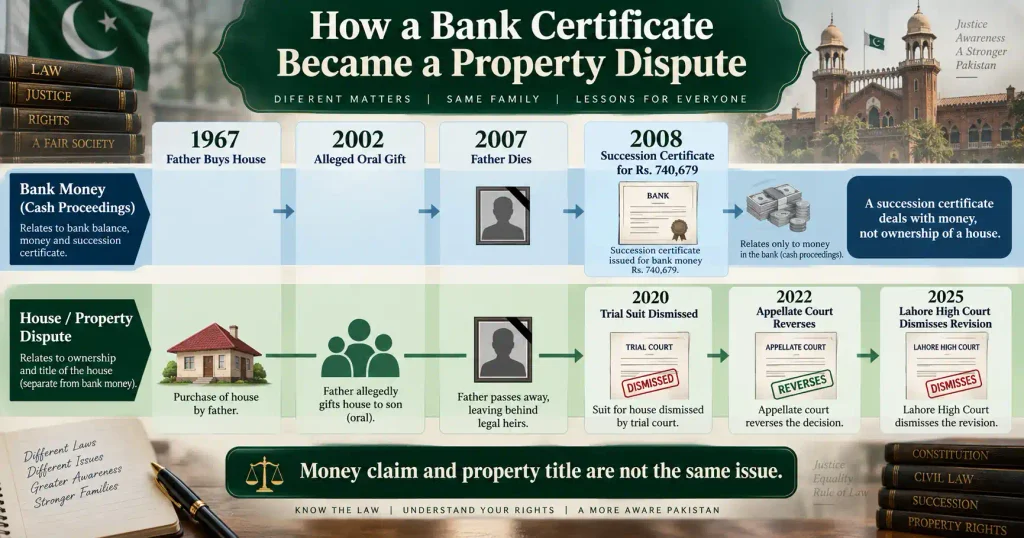
The Lahore High Court judgment reported as 2026 MLD 1001 (Lahore) shows the danger. A sister had made a conceding statement in proceedings concerning her late father’s Post Office savings. Her brothers later argued that the same statement also defeated her inheritance share in their father’s house.
The High Court rejected that argument.
The case gives two important lessons. Summary succession proceedings do not finally determine every disputed property right, and today the practical route must also be understood through the NADRA succession system operating under the respective federal and provincial laws.
Table of Contents
Judgment at a Glance: 2026 MLD 1001 (Lahore)
| Point | Verified Detail |
|---|---|
| Case | Muhammad Irfan Butt and another v. Aliya Nawaz |
| Citation | 2026 MLD 1001 (Lahore) |
| Court | Lahore High Court |
| Judge | Muzamil Akhtar Shabir, J. |
| Case number | Civil Revision No. 13153 of 2022 |
| Decision date | 12 November 2025 |
| Main law | Succession Act, 1925, ss. 372–373 |
| Other law | Specific Relief Act, 1877, ss. 42 and 54 |
| Earlier certificate | Rs. 740,679 in a Post Office account |
| Property dispute | Sister’s share vs alleged oral gift |
| Result | Revision dismissed; preliminary decree remained |
The reported judgment expressly identifies sections 372 and 373 of the Succession Act and sections 42 and 54 of the Specific Relief Act.
IRAC: Why the Sister’s Property Claim Survived
| IRAC | Analysis |
|---|---|
| Issue | Did the sister’s earlier statement in Succession Certificate proceedings prevent her from claiming inheritance in her father’s house? |
| Rule | Succession proceedings are summary. Complicated disputes about title and entitlement may require a civil court exercising full jurisdiction. |
| Analysis | The earlier certificate concerned Post Office money, not the house. The alleged oral gift of the house was also not satisfactorily proved. |
| Conclusion | The High Court found no legal or jurisdictional error requiring interference and dismissed the brothers’ revision. |
What Happened Before the High Court?
Aliya Nawaz filed a partition suit against her two real brothers. Their father, Muhammad Ali Butt, had purchased the disputed house through a sale deed dated 20 February 1967.
He died on 12 April 2007, leaving Aliya and her two brothers as his legal heirs. Aliya claimed a 1/5 share in the inherited property.
The brothers disputed her claim. They alleged that their father had orally gifted the house to them on 4 October 2002 at about 5:00 p.m., that they had accepted the gift, and that possession had been delivered.
They also claimed that Aliya had received Rs. 500,000 and another Rs. 40,000 from their father.
The trial court dismissed her suit. The appellate court reversed that result, found the alleged gift unproved, recognized the parties as legal heirs, and directed a preliminary decree for partition. The issue of delivery of possession to Aliya according to her share was sent back for further proceedings.
The earlier cash certificate became crucial
The brothers then relied on an earlier Succession Certificate obtained in 2008.
That certificate concerned Rs. 740,679 lying in their father’s Post Office Savings Bank account. Aliya had made a conceding statement in those proceedings.
The brothers argued that by making that statement she had also surrendered her inheritance in the house.
The High Court rejected that leap.
The Court noted that the statement concerned money in the Post Office account, not the immovable property. It therefore could not automatically be treated as relinquishment of her inheritance share in the house.
What Evidence Changed the Case?
The alleged oral gift mattered because if the father had validly gifted the house during his lifetime, the property would not have remained part of his estate at death.
But saying “our father gifted it to us” was not enough.
The appellate court found that the brothers had failed to satisfactorily establish the relevant circumstances of the alleged gift, including the date, time and place, offer, acceptance, and delivery of possession. Their supporting evidence was disbelieved, and the High Court found no misreading or non-reading justifying interference.
They also failed to prove that the Rs. 500,000 deposit or the additional Rs. 40,000 allegedly received by Aliya had been given in lieu of her share in the inherited house.
This is an important evidence lesson: a family statement such as “she already received her share” is not itself proof of the legal transaction said to extinguish an inheritance right.
For the gift principles involved here, see Oral Gift in Pakistan.
What Law Governs a Succession Certificate?
Part X of the Succession Act, 1925 deals with succession certificates. Section 373 describes determination of the right to a certificate through the court procedure as summary in nature.
Even more important is section 387. It says that a decision under Part X on a question of right does not bar trial of the same question in a suit or another proceeding between the same parties.
That statutory principle fits closely with 2026 MLD 1001. A finding or statement made in summary succession proceedings does not automatically become a final civil adjudication of every disputed property right.
You can check the official statute here: Succession Act, 1925 — Pakistan Code.
The modern NADRA route also matters
Today the legal position cannot be explained only by discussing the old court procedure.
NADRA states that federal and provincial governments have authorised it under their respective succession laws to issue a Succession Certificate for movable property and a Letter of Administration for immovable property.
For Islamabad Capital Territory, the Letters of Administration and Succession Certificates Act, 2020 authorises NADRA, establishes the succession facilitation mechanism, provides for summary assessment, and addresses cases where a factual controversy cannot be resolved administratively.
Official federal law: Letters of Administration and Succession Certificates Act, 2020.
Because provincial legislation and amendments can differ, a procedural rule applicable in Islamabad should not automatically be presented as the exact rule for every province.
What a Succession Certificate Actually Covers
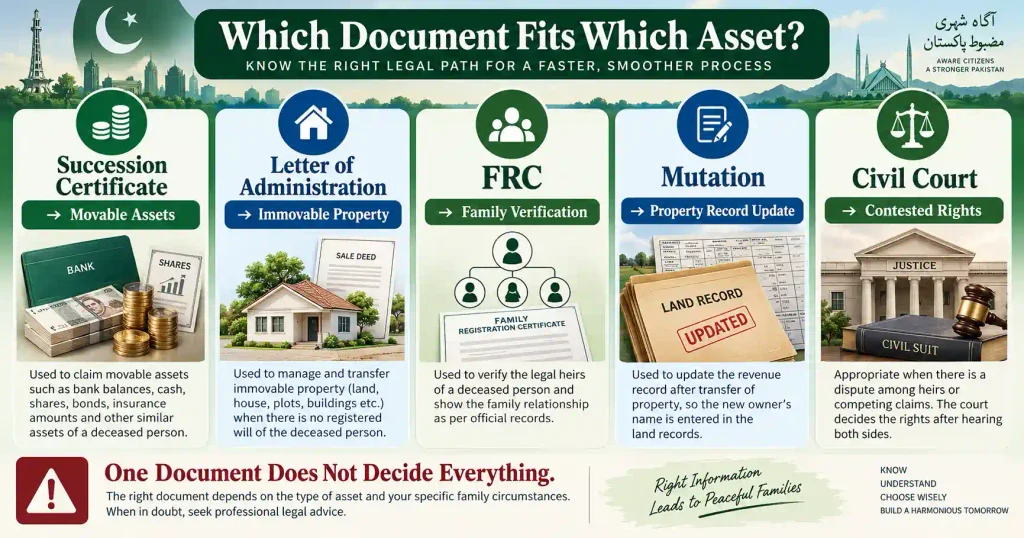
One of the most common inheritance mistakes is using one document as if it covers every asset.
| Document | Main Purpose |
|---|---|
| Succession Certificate | Movable assets, including specified debts and securities |
| Letter of Administration | Immovable property under the current NADRA framework |
| FRC | Family-composition record used for verification |
| Mutation / transfer record | Updates land or property records |
| Civil decree | Resolves disputed title, heirship or other contested rights |
NADRA currently describes the Succession Certificate as the document for movable property and the Letter of Administration as the corresponding document for immovable property.
An FRC is useful in establishing family composition, but it should not be confused with a final judicial determination of a contested title.
For inherited land, read Inheritance Mutation in Pakistan.
If the property is jointly inherited and division is required, see Partition of Inherited Land in Pakistan.
How to Apply Through NADRA in Pakistan
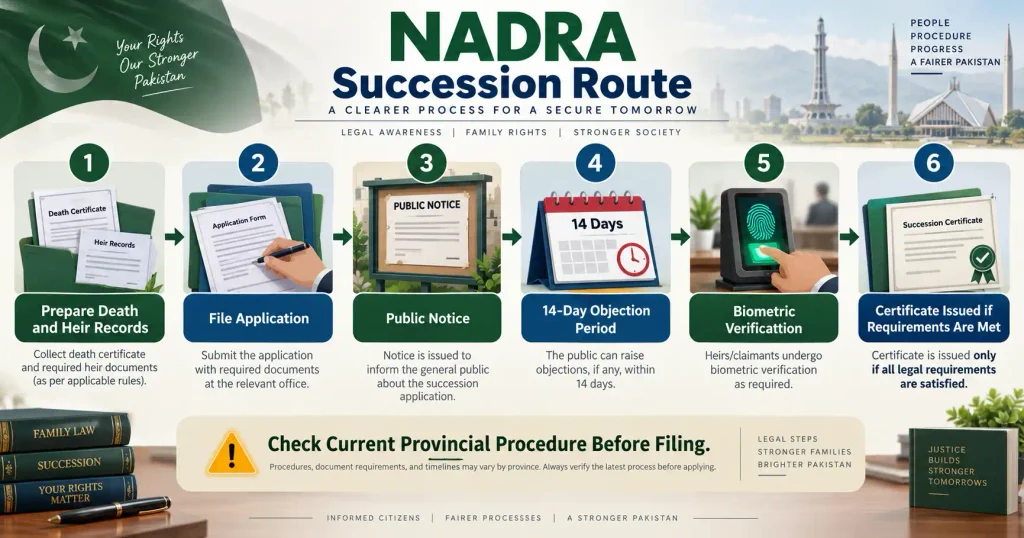
NADRA says that succession services are available through Succession Facilitation Units, NADRA Registration Centres and designated units. One legal heir initiates the application after completing the required documentation.
The exact sequence should be checked under the applicable provincial or federal law. Under the federal 2020 framework for Islamabad Capital Territory, the basic process is straightforward.
The legal heirs file the application with the required death, heir and asset information. Public notice is then issued. If no objection or claim is received within 14 days of publication, biometric verification of the applicant and legal heirs follows. After satisfactory completion of the statutory formalities, the certificate is issued with the heirs and their respective shares.
NADRA’s current page also advises applicants to check the designated filing arrangements and notes special filing arrangements for Sindh and Balochistan.
Official service page: NADRA Succession Certificate Service.
Documents to Prepare Before You Apply
For a Succession Certificate application, NADRA currently lists the following core records:
| Document | Why It Matters |
|---|---|
| Death certificate | Establishes death of the asset holder |
| CNIC cancellation certificate | Updates the deceased’s NADRA identity status |
| Family Registration Certificate | Helps verify family composition |
| Heirs’ CNIC copies | Establishes identities of legal heirs |
| List of legal heirs | Identifies persons claiming succession |
| Asset details | Defines what is being claimed |
| Authorization / affidavit | Authorises the applicant as required |
NADRA also states that the authorization or affidavit should be attested by an Oath Commissioner.
For movable assets, obtain the underlying asset evidence as well. Depending on the case, this could include a bank certificate, account details, shares, securities, investment records or written confirmation from the institution holding the deceased’s money.
Every heir should read the asset schedule and authorization before signing. A document meant for one bank account should not be carelessly worded as though the signer is surrendering rights in an entire estate.
Succession Certificate Fees and Processing Time
NADRA’s current fee schedule lists Rs. 20,000 for a fresh application where the asset value is Rs. 100,000 or more, with the fresh fee shown as Rs. 22,000 in Sindh.
For assets worth less than Rs. 100,000, the listed fee is Rs. 10,000.
The same official schedule currently lists:
| Service | Current Listed Fee |
|---|---|
| Duplicate application | Rs. 5,000 |
| Amended application | Rs. 5,000 |
| Decline on processed application | Rs. 15,000 |
| Office mistake | No fee |
NADRA describes the processing time as 14 days after publication. That should not be read as a guarantee that every estate will finish exactly 14 days after the applicant’s first visit. Objections, missing documents or identity disputes can affect the timeline.
Check the filing-day fee here: NADRA Official Fee Structure.
What If an Heir Objects?
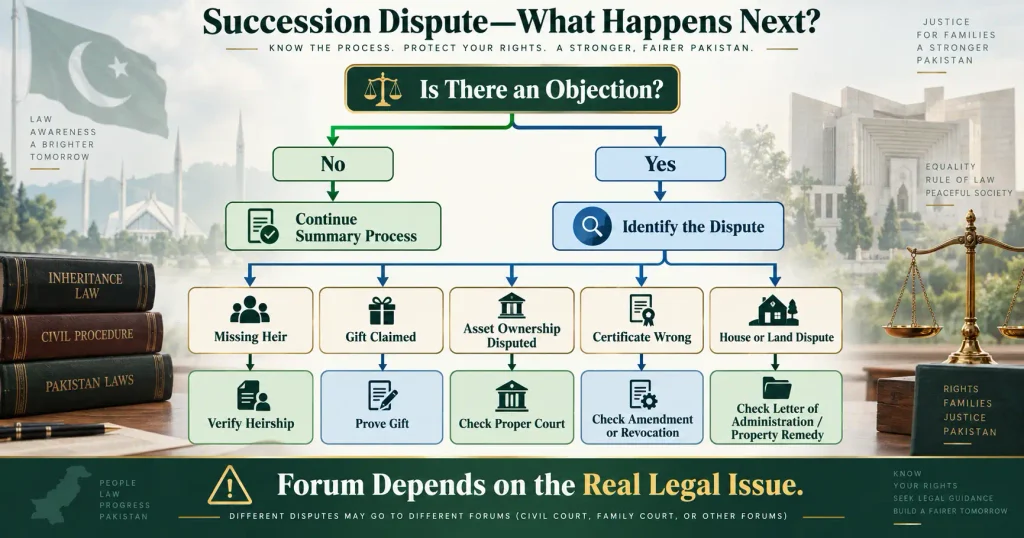
An objection can change a routine administrative application into a real inheritance dispute.
Under the federal 2020 framework for Islamabad Capital Territory, the Succession Facilitation Unit conducts a summary assessment and may decline to process a matter where a factual controversy requires adjudication.
The correct next forum then depends on the applicable law and the nature of the dispute.
For example, a disagreement may concern whether someone is actually a legal heir, whether an alleged gift occurred, whether a person already transferred a right, or whether the disputed asset even belonged to the deceased.
Those issues may require evidence that cannot properly be resolved through a short administrative inquiry.
Do not conceal a real dispute simply to make an application appear uncontested.
Can One Statement Give Up Property Rights?
This is the central lesson of 2026 MLD 1001.
Aliya’s conceding statement related to proceedings concerning cash in her father’s Post Office account. Her brothers tried to convert that statement into proof that she had also surrendered her right in their father’s house.
The Lahore High Court refused to do so.
The Court also noticed that one of the brothers had himself made a similar conceding statement in favour of the other brother in the same proceedings. Applying the brothers’ argument consistently would therefore create problems for their own position as well.
The Court ultimately held that Aliya’s statement in the earlier proceedings did not amount to surrender of her inheritance share in the immovable property.
This does not mean every statement by an heir is harmless.
A properly proved gift, release, transfer, family settlement, admission or other legally effective transaction may have serious consequences. The legal effect depends on the wording, asset, circumstances and proof.
What the Lahore High Court Decided
The High Court found no illegality, jurisdictional defect, misreading or non-reading of the relevant record that justified setting aside the appellate judgment.
The revision petition was therefore dismissed.
The appellate court’s preliminary partition decree remained intact. The alleged oral gift had not been proved, and Aliya’s earlier statement concerning Post Office money did not automatically deprive her of inheritance in the house.
The Court also reaffirmed the distinction between summary Succession Certificate proceedings and adjudication of complicated disputes over title or entitlement.
What the Court Did Not Decide
The judgment did not hold that a Succession Certificate is useless.
It did not cancel the earlier certificate concerning the Post Office money.
It did not hold that statements made in succession proceedings can never be relevant evidence.
It also did not decide that every inheritance matter must start with a civil suit. The current NADRA framework now provides an administrative route for qualifying cases.
Most importantly, the Court did not treat a certificate relating to cash as a final adjudication of title to the house.
That is the legally safer way to understand 2026 MLD 1001.
If a Certificate Is Wrong, What Can Be Done?
The remedy depends on who issued the certificate, what is wrong with it, and what right is being challenged.
Under the Succession Act, 1925, section 383 permits revocation of a court-granted certificate on specified grounds. These include substantial defects in the proceedings, fraud, concealment of material facts, certain untrue allegations, later circumstances making the certificate useless, or a competent court order affecting the relevant debts or securities.
Section 376 also permits a court certificate to be extended to a debt or security that was not originally included.
For a NADRA-issued certificate, the applicable federal or provincial succession statute and the available remedy must be checked.
The federal 2020 Act expressly provides that a person objecting after issuance may pursue remedies available under other applicable law.
Do not choose “revocation,” “declaration,” “partition,” or “injunction” merely because the label sounds suitable. First identify the legal defect and the right that actually needs protection.
Build the Evidence File Before the Dispute Grows
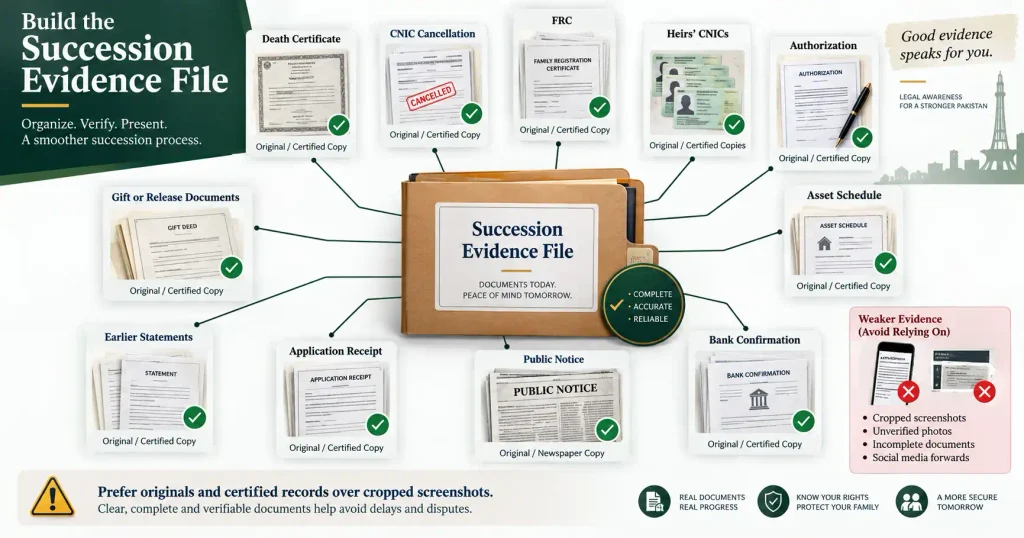
A Succession Certificate case becomes much easier to understand when documents are organised by issue.
Keep the death certificate, CNIC cancellation record, FRC, heirs’ identity documents, authorization, complete asset schedule, bank or investment confirmation, application receipt, public notice, biometric record where available, and final certificate.
If there is a dispute, preserve the document causing it: an alleged gift, release, family settlement, will, bank nomination, property deed, earlier statement, court order or written objection.
For a connected female-inheritance issue, see Inheritance Law in Pakistan: Women’s Rights.
7 Checks Before Filing the Application
| Check | Why It Matters |
|---|---|
| Identify every legal heir | An omitted heir may trigger a later dispute |
| Separate movable and immovable assets | Different succession documents may apply |
| Verify every asset | The certificate should match the actual claim |
| Read every authorization | Avoid unintended broad wording |
| Confirm the correct filing route | Province and asset can matter |
| Preserve disputed documents | Gift or relinquishment may need proof |
| Recheck current fees | NADRA charges can change |
These seven checks are safer than rushing to obtain a certificate before understanding what the document will—and will not—do.
Practical Effect for Families and Institutions
For an uncontested movable estate, the modern NADRA route can make the Succession Certificate process more direct than the old assumption that every family must begin in court.
For a contested estate, however, speed cannot replace adjudication.
If one heir alleges a gift, another claims to have been omitted, or an earlier statement is being used to defeat rights in a different asset, the real controversy may need determination by the competent forum.
For a Succession Certificate, the practical value of 2026 MLD 1001 is this distinction: collecting an asset through summary succession proceedings is not the same thing as finally deciding a contested property right.
Conclusion: Know What the Certificate Does Before You Sign
A Succession Certificate can be essential after a death, but its legal purpose should remain clear.
Under NADRA’s present framework, the certificate is used for movable property, while a Letter of Administration is used for immovable property under the relevant succession system.
In 2026 MLD 1001, the Lahore High Court refused to let a sister’s statement concerning Post Office money become an automatic surrender of her share in her father’s house. The alleged oral gift was also not proved.
Before applying for a Succession Certificate, identify every heir, classify the assets correctly, verify the applicable procedure, read every authorization before signing, and preserve the evidence behind any disputed claim.
One short statement can become the centre of years of litigation when its real legal scope is misunderstood.
FAQs about 2026 MLD 1001 (Lahore)
What is a Succession Certificate in Pakistan?
A Succession Certificate is a legal instrument used for specified movable assets of a deceased person, including debts, securities and similar financial assets. Under NADRA’s current framework, eligible heirs can use the administrative succession service for qualifying cases. It should not be treated as a universal declaration deciding every disputed right in an estate.
Is a Succession Certificate used for a house or land?
Under NADRA’s current guidance, a Succession Certificate is for movable property, while a Letter of Administration is used for immovable property. Other processes such as mutation, transfer or partition may still be necessary. A disputed title, gift or heirship question may also require adjudication by the competent forum.
Where can legal heirs apply for the certificate?
NADRA states that succession applications are processed through designated Succession Facilitation Units and NADRA centres. One legal heir initiates the process with the required documentation and authorization. Applicants should check the official NADRA page immediately before filing because designated locations and province-specific filing arrangements can change.
What documents does NADRA currently require?
NADRA currently lists the death certificate, CNIC cancellation certificate, FRC, heirs’ CNIC copies, details of the assets, and the required authorization or affidavit. Evidence of the underlying bank account, security or other movable asset should also be collected so the asset schedule can be prepared accurately.
What happens if another legal heir objects?
An objection may prevent the application from remaining a simple summary matter. If the dispute involves a factual controversy that the applicable NADRA process cannot determine, the parties may have to approach the competent legal forum. The exact remedy depends on the province or territory, the disputed fact and the applicable succession law.
Can a Succession Certificate be revoked later?
A court-granted Succession Certificate may be revoked under section 383 of the Succession Act, 1925 on specified grounds such as substantial procedural defect, fraud or concealment of material facts. For a NADRA-issued certificate, the applicable federal or provincial statute and the available legal remedy should be checked before taking action.
Did Aliya Nawaz surrender her right in the house?
No. In 2026 MLD 1001, the Lahore High Court held that her conceding statement in proceedings concerning her father’s Post Office savings did not amount to relinquishment of her inheritance share in the house. The earlier proceeding concerned a different asset.
What did 2026 MLD 1001 establish?
The judgment reinforces that summary Succession Certificate proceedings do not finally settle complicated disputes concerning title and inheritance rights in unrelated immovable property. The High Court dismissed the brothers’ revision and found no reason to interfere with the appellate court’s preliminary partition decree.
Disclaimer
This article is for general legal awareness only and is not a substitute for advice on a specific estate. Succession procedure, personal law, heirship, fees, jurisdiction, objections and remedies can vary according to the province or territory, asset type, family circumstances and the law in force when proceedings begin.