
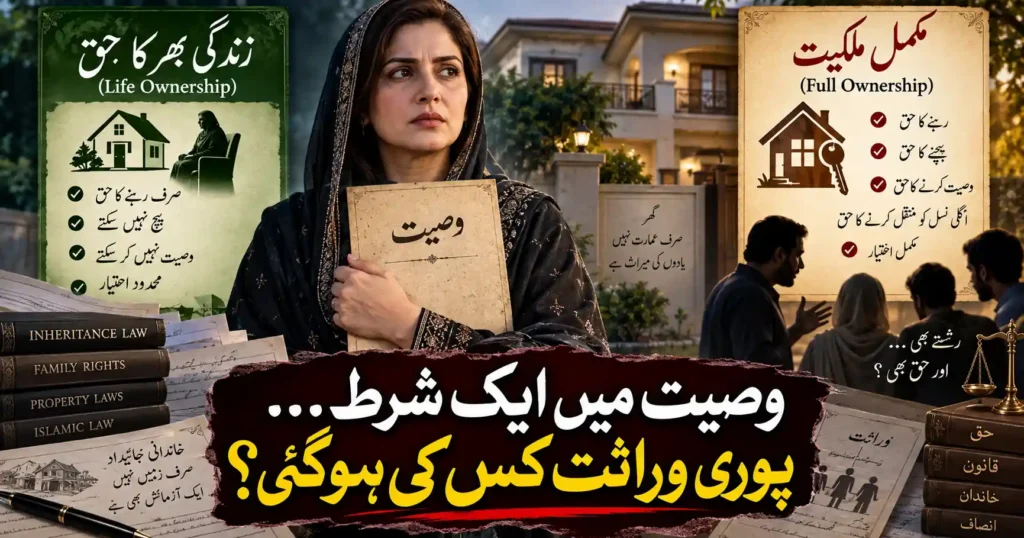
A single condition in a Will in Pakistan can create a property dispute lasting generations. A parent may intend to protect a child for life, while other relatives later argue that the property must return to the original family after that child dies.
The Supreme Court confronted exactly this problem in Ehsan-ul-Haq and others v. Muhammad Nawaz and others, 2025 SCMR 1673. The dispute concerned a 1934 will in favour of a daughter, Mst. Ghulam Zohra, with a condition that she would remain only a life owner.
The Court held that the restrictive condition could not prevent her from becoming absolute owner on the facts and law before it. But the judgment also teaches broader lessons about the one-third rule, old customary estates, proof, inheritance and careful estate planning.
Table of Contents
Judgment at a Glance of 2025 SCMR 1673
| Point | Details |
|---|---|
| Citation | 2025 SCMR 1673 |
| Court | Supreme Court of Pakistan |
| Case | Ehsan-ul-Haq and others v. Muhammad Nawaz and others |
| Appeal | Civil Appeal No. 184 of 2013 |
| Decision Date | 20 February 2025 |
| Earlier High Court | Lahore High Court, Rawalpindi Bench |
| Original Owner | Kala Khan |
| Beneficiary | His daughter, Mst. Ghulam Zohra |
| Main Dispute | Whether she was only a life owner |
| Supreme Court Result | Appeal dismissed |
| Practical Effect | Ghulam Zohra was treated as absolute owner |
Kala Khan died in 1934. His property had been mutated in favour of his daughter through two mutations based on his will. She later dealt with portions of the property during her lifetime and died in 1988. Her property was thereafter mutated in favour of her husband and children.
IRAC: Why the Life-Interest Claim Failed
| IRAC | Explanation |
|---|---|
| Issue | Did the condition in the will restrict Ghulam Zohra to lifetime ownership only? |
| Rule | Muslim testamentary rights are subject to Muslim Personal Law, including limits on testamentary disposition and rules affecting invalid conditions. |
| Analysis | The Court examined the will, customary-law background, Muslim inheritance principles, the pedigree evidence and statutory changes concerning limited estates. |
| Conclusion | The restrictive condition did not prevent Ghulam Zohra from becoming absolute owner; the Supreme Court dismissed the appeal. |
The Court expressly concluded that Kala Khan’s condition making his daughter only a life owner was void and that she took the property free from that restriction.
How the Property Dispute Began
Kala Khan owned land in District Jhelum. He died in 1934 leaving his wife, Mst. Jewani, and daughter, Mst. Ghulam Zohra.
His property was entered in Ghulam Zohra’s name through mutation Nos. 2482 and 838 on the basis of his will. After Kala Khan’s death, his widow married Muhammad Yousaf, who was Kala Khan’s nephew.
During her lifetime, Ghulam Zohra sold nine marlas and transferred another 10 kanals and 4 marlas to the respondents. After her death, mutation No. 1616 dated 20 May 1990 transferred the remaining property to her husband and children.
The appellants were heirs of Muhammad Yousaf. Their theory was that Ghulam Zohra had received only a limited estate under the will. Therefore, they argued, part of the property should ultimately devolve towards Muhammad Yousaf’s line.
That argument initially succeeded before the Trial Court.
What Happened Before the Supreme Court?
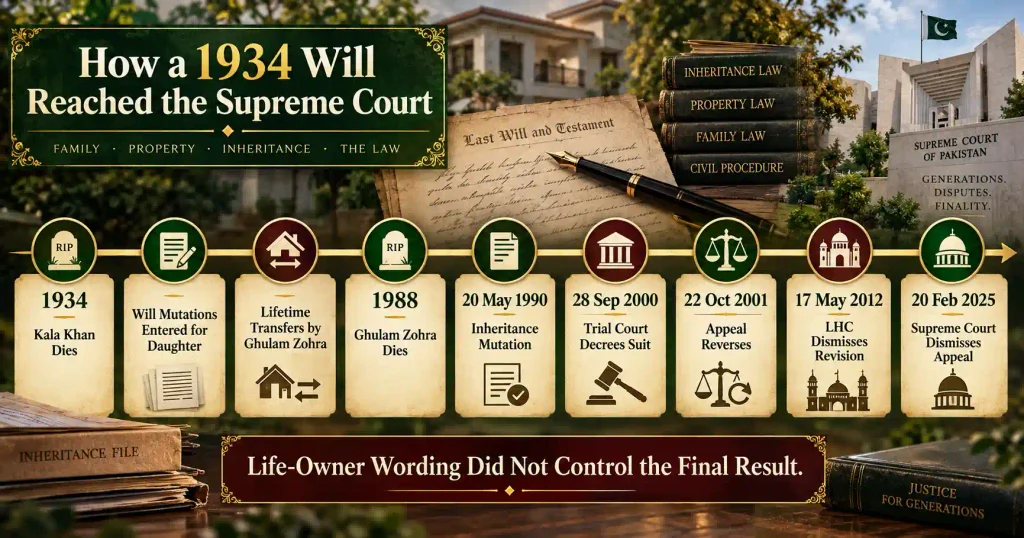
The Trial Court decreed the appellants’ suit on 28 September 2000.
The respondents appealed, and the First Appellate Court reversed the decree on 22 October 2001. The appellants then filed a civil revision before the Lahore High Court, Rawalpindi Bench, which dismissed the revision on 17 May 2012.
The dispute then reached the Supreme Court.
This procedural history matters because the Supreme Court did not reverse a fresh factual finding in isolation. It declined to interfere with the conclusions already reached by the First Appellate Court and the High Court.
What the Appellants Actually Argued
The appellants maintained that Ghulam Zohra had never become absolute owner.
Their argument was that the Will in Pakistan created only a limited estate and that she therefore lacked full power to alienate the property. They also claimed that after her death part of the estate should pass to the heirs of Muhammad Yousaf, whom they described as the relevant male heir of Kala Khan.
The respondents defended the appellate and High Court judgments and argued that there was no legal error requiring Supreme Court interference.
The Pedigree Evidence Also Hurt the Appellants
The life-interest issue was not the only weakness in the appellants’ case.
Their pedigree table omitted Faqeer, son of Qasim, a cousin of Kala Khan who was alive when Kala Khan died in 1934. The Supreme Court noted that no independent evidence properly corroborated the pedigree table.
The First Appellate Court had held that while Faqeer was alive, Muhammad Yousaf could not claim the position asserted for him when Kala Khan’s succession opened.
The Court also noted that the disputed property had been shown to be acquired property, while the appellants had not pleaded that it was ancestral property. That weakened their reliance on the customary-law theory they were advancing.
This part was largely missing from the old article, yet it is important to understanding why the appellants’ overall claim failed.
What Will in Pakistan Means Under Muslim Law
For Muslims, section 2 of the West Pakistan Muslim Personal Law (Shariat) Application Act, 1962 expressly includes succession, wills and legacies among matters governed by Muslim Personal Law, notwithstanding contrary custom or usage, subject to other applicable enactments.
Official Muslim Personal Law Act, 1962
A Will in Pakistan is therefore not simply a private instruction that automatically overrides inheritance law. For Muslim estates, testamentary freedom operates within Muslim Personal Law.
The Supreme Court relied heavily on Hanafi authorities, including Hedaya, Fatawa Alamgiri and established texts of Muslim law, while explaining the limits of testamentary disposition.
How the One-Third Rule Works
One of the most important rules in a Muslim Will in Pakistan is the one-third limit.
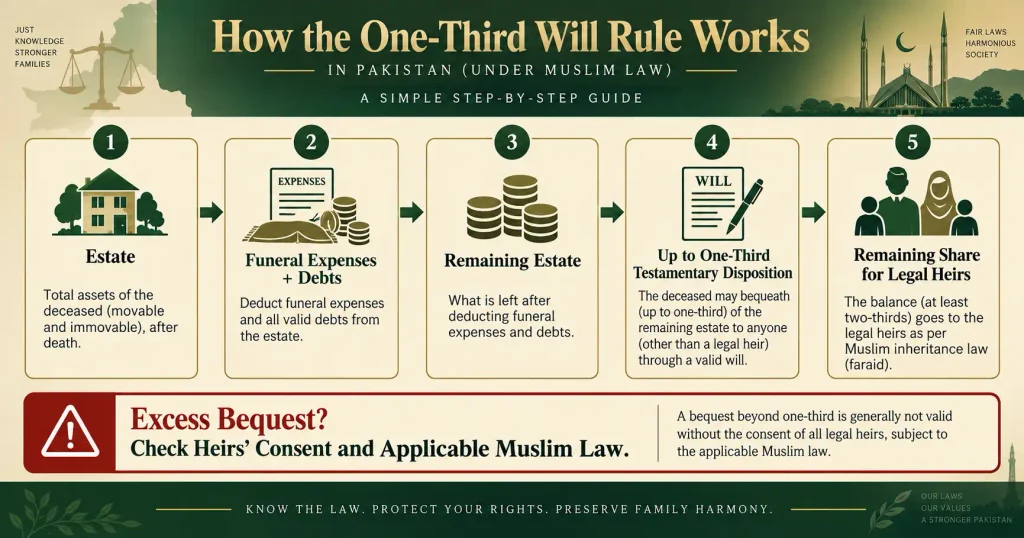
The Supreme Court recorded that under Hanafi Muslim law a Muslim may make a will verbally or in writing, but ordinarily cannot dispose by will of more than one-third of the surplus estate after funeral expenses and debts.
The judgment further explained that a bequest exceeding the legal one-third can be validated through the consent of the heirs. It also recorded that the remaining estate must otherwise go to the heirs in their prescribed shares.
This distinction is critical.
A person cannot safely write:
“I leave my entire estate to X”
and assume the sentence automatically defeats the rights of Muslim heirs.
The estate, debts, beneficiaries, applicable school of Muslim law and consent questions must all be examined.
Can a Will Benefit a Legal Heir?
This question requires more care than the old article gave it.
The Supreme Court, while discussing Hanafi authorities, stated that the straightforward binding testamentary disposition is one within the legal third made to a person who is not an heir. It separately discussed consent where the normal testamentary limits are exceeded.
A Will in Pakistan benefiting an existing legal heir should therefore not be treated as automatically valid merely because it falls within one-third.
The applicable Muslim-law rule, the beneficiary’s status at the testator’s death and legally relevant consent should be checked. Personal-law differences can also matter, so a generic template copied from the internet is risky.
Can a Muslim Will Be Oral?
Yes, the judgment records the Hanafi-law position that a will may be verbal or written.
But legal possibility and evidentiary safety are not the same thing.
An oral Will in Pakistan can produce serious proof problems after the testator dies. The person who allegedly made the statement is no longer available to explain what was intended. Family witnesses may disagree, memories change and property details may be uncertain.
A written, dated and carefully witnessed document is usually far easier to prove than an alleged conversation.
Does a Will Need Registration?
For wills, registration should not be confused with registration of a sale deed or gift deed.
Section 17 of the Registration Act, 1908 deals mainly with compulsory registration of specified instruments, including gifts and other non-testamentary instruments affecting immovable property. Wills are separately dealt with under the Act.
Section 27 states that a will may be presented or deposited at any time, while sections 40 to 45 provide procedures for presentation, registration and sealed deposit of wills.
Official Registration Act, 1908
So registration is available and may strengthen the documentary trail, but registration does not automatically cure a will that violates substantive Muslim Personal Law.
Likewise, an unregistered Muslim will is not automatically invalid merely because it was not registered.
Provincial amendments and local registration practice should still be checked for the property concerned.
Is Probate Mandatory for a Muslim Will?
This is another major point missing from the existing article.
Section 58 of the Succession Act, 1925 states that the testamentary-succession provisions in Part VI do not apply to the property of Muslims. (Pakistan Code)
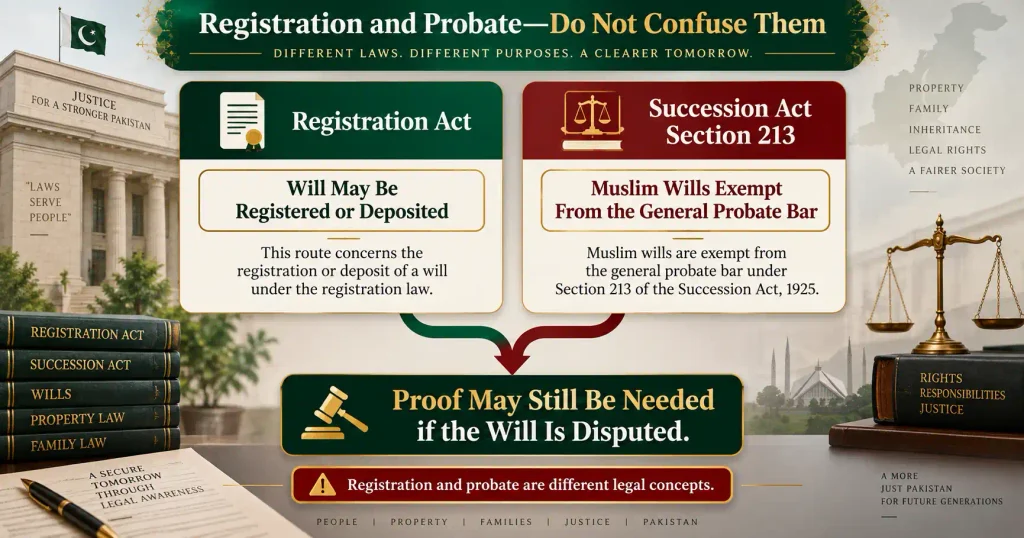
Section 213(1) generally requires probate or letters of administration before certain rights as executor or legatee can be established in court, but section 213(2) expressly says that subsection (1) does not apply to wills made by Muslims. (Pakistan Code)
That does not mean every property authority must accept every alleged Muslim will without proof.
It means the specific probate bar in section 213(1) does not apply to Muslim wills. Where a will is disputed, title, mutation, declaration or administration proceedings may still become necessary depending on the facts.
Why the Life-Interest Condition Failed
The disputed will attempted to give Ghulam Zohra the property while restricting her to a life interest.
The Supreme Court treated the restriction as legally ineffective. It held that she took the property free from the condition and became absolute owner.
This is an important lesson for Will in Pakistan drafting.
A testator cannot assume that adding words such as:
“for lifetime only”
or
“she may use it but never own it fully”
will automatically achieve the intended legal result.
The legal effect of the clause depends on Muslim Personal Law, the nature of the bequest, the statutory background and the facts of the estate.
Section 2-A Needs a More Careful Explanation
The old article said that Section 2-A simply abolished limited estates. That is too broad.
The Supreme Court judgment discusses section 2-A of the 1962 Act in its historical analysis of customary inheritance and the 1983 amendment.
However, the current consolidated Pakistan Code separately states in section 3 that limited estates in immovable property held by Muslim females under customary law are terminated. Sections 4 and 5 deal with certain successive wills and devolution following termination.
Official Federal Shariat Court material also confirms that section 2-A was introduced through the 1983 amendment in the historical agricultural-succession context. (Federal Shariat Court)
The safer explanation is therefore:
Do not use Section 2-A alone as a universal shorthand for every life-interest dispute.
The statutory provisions and the specific Supreme Court reasoning should be read together.
Why Ghulam Zohra Became Absolute Owner
Once the restrictive condition failed, the foundation of the appellants’ case disappeared.
The Supreme Court found that Ghulam Zohra had become absolute owner. Therefore, property remaining with her at death devolved upon her own legal heirs.
This also explained why her lifetime dealings with the property could not simply be attacked on the theory that she possessed only a temporary customary estate.
Ultimately, the Court found no error of law or jurisdiction in the High Court judgment that warranted interference and dismissed the appeal.
What Evidence Should Be Preserved?
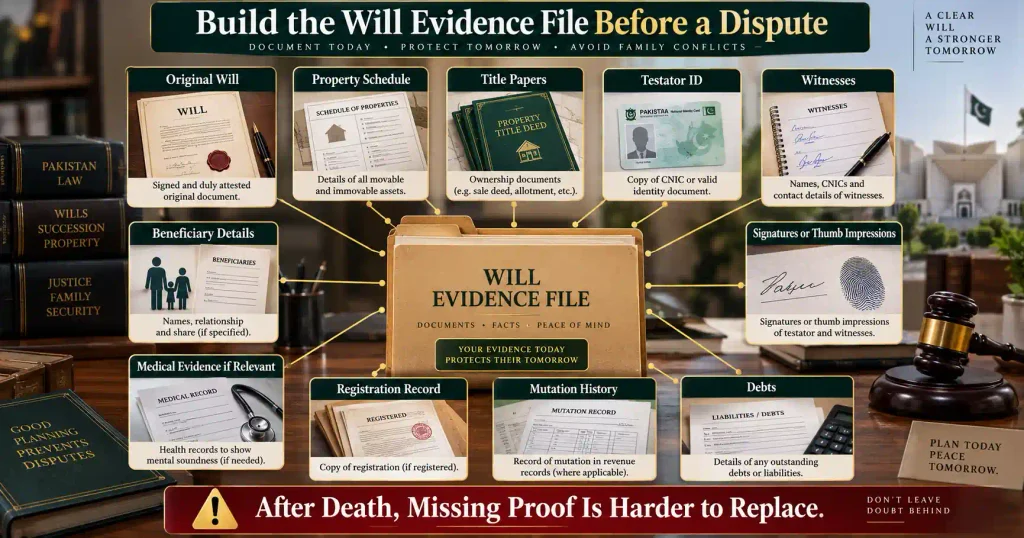
A disputed Will in Pakistan is often won or lost through evidence rather than family recollection.
Preserve:
- the original will;
- every page and annexure;
- CNIC and identity evidence of the testator;
- complete property descriptions;
- title deeds and mutations;
- evidence identifying beneficiaries;
- signatures or thumb impressions;
- witnesses and their contact details;
- medical or other contemporaneous evidence of capacity where relevant;
- registration or deposit record, if used;
- correspondence showing the testator’s intention;
- records showing debts and liabilities.
The Qanun-e-Shahadat Order, 1984 governs proof in judicial proceedings and treats writings as documentary evidence. (Pakistan Code)
Official Qanun-e-Shahadat Order, 1984
Do not rely only on a WhatsApp image or cropped photocopy when the original or certified record can be preserved.
How to Draft a Safer Will in Pakistan
Before signing a Will in Pakistan, first identify what property the testator actually owns. A person cannot effectively plan succession around property belonging to someone else or an undefined joint share.
Then identify liabilities and likely heirs.
A practical drafting file should clearly record:
- testator’s identity;
- date and place of execution;
- property being discussed;
- beneficiaries;
- whether any beneficiary is already a legal heir;
- the proposed portion of the estate;
- debts and known liabilities;
- any condition attached to the bequest;
- witnesses or other proof of execution;
- safe custody of the original.
Avoid vague phrases such as “all my property” where ownership itself is complicated.
If a condition is important, ask whether Muslim Personal Law actually permits the condition rather than assuming wording alone will control property after death.
How a Will Can Be Challenged
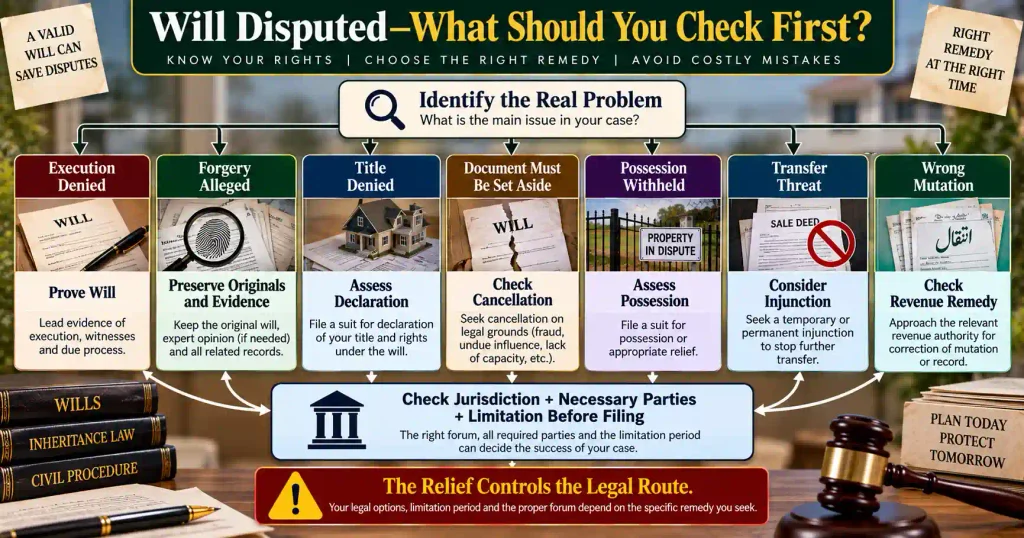
A dispute may involve several different questions:
- Was the will genuinely executed?
- Was it forged or fabricated?
- Was the testator competent and acting freely?
- Does it exceed the permitted testamentary share?
- Does it improperly affect a legal heir?
- Is a condition legally enforceable?
- Is the property actually owned by the testator?
- Was the relevant mutation lawful?
The correct remedy depends on the real dispute.
Section 42 of the Specific Relief Act, 1877 permits a person claiming a right to property to seek a declaration against someone denying that right. Its proviso also warns against seeking declaration alone where further relief is available but omitted. (Pakistan Code)
Official Specific Relief Act, 1877
A claimant may therefore require declaration, cancellation, possession, injunction, mutation correction or another consequential remedy.
Territorial and pecuniary jurisdiction must also be checked before filing.
Do Not Ignore Limitation
There is no single limitation period for every Will in Pakistan dispute.
The deadline depends on the relief.
For example, Article 91 of the Limitation Act provides three years for a suit to cancel or set aside an instrument not otherwise provided for, running from when the relevant facts become known to the plaintiff. (Pakistan Code)
But not every inheritance or will case is a simple Article 91 cancellation suit.
A title declaration, possession claim, fraud allegation or challenge to a mutation can involve a different starting point or provision.
Therefore, do not delay merely because the disputed document is old.
What the Supreme Court Actually Decided
The Supreme Court did three important things in 2025 SCMR 1673.
First, it rejected the appellants’ claim that Ghulam Zohra remained merely a limited owner.
Second, it treated the restrictive life-interest condition as ineffective and recognised her as absolute owner.
Third, it declined to interfere with the judgment of the Lahore High Court and dismissed the appeal.
The result meant that the property did not revert to the line claimed by the appellants simply because Kala Khan’s old will had described his daughter as a life owner.
What the Court Did Not Decide
The judgment does not mean every condition in every Will in Pakistan is void.
It does not mean a Muslim can freely bequeath the entire estate.
It does not say registration is compulsory for every Muslim will.
It does not establish that every beneficiary automatically becomes absolute owner regardless of the wording or applicable law.
It also does not make pedigree evidence irrelevant. In fact, defective pedigree proof was another weakness in the appellants’ case.
Most importantly, the judgment involved a very old succession history beginning in 1934 and the transition from customary law to Muslim Personal Law. Its reasoning should not be stretched beyond those legal issues.
Seven Rules Families Should Remember
For a safer Will in Pakistan, remember these seven rules:
- A will is not unlimited. Muslim testamentary power is subject to substantive personal-law rules.
- The one-third limit matters. Debts and funeral expenses are dealt with before calculating the relevant surplus.
- A legal heir needs special scrutiny. Do not assume an heir can receive a testamentary benefit like an unrelated beneficiary.
- Conditions may fail. “Lifetime only” wording does not guarantee a valid life estate.
- Registration is evidence, not magic. It cannot cure a substantively invalid provision.
- Preserve the original. Proof problems become much harder after the testator dies.
- Check the remedy early. Limitation, title, mutation and jurisdiction can change the correct case.
Practical Effect for Families
The biggest lesson from this judgment is that estate planning should be done before family relationships become hostile.
A careful Will in Pakistan should make the testator’s intention clear without attempting to defeat mandatory inheritance principles. It should also identify the property accurately and leave a reliable evidence trail.
Legal heirs should not accept or reject an old will merely because its language looks formal.
Check the donor’s actual title, the one-third calculation, beneficiary status, conditions, execution, mutation history and statutory background.
That is far safer than allowing one sentence written decades earlier to control a modern property dispute without legal scrutiny.
Related Property and Inheritance Guides
A Will in Pakistan often overlaps with gifts, partition and later family arrangements. If the owner transferred property during life rather than after death, see the Gift in Pakistan guide and the Gift Deed in Pakistan guide. Where heirs later agree on distribution, the Family Settlement in Pakistan guide is relevant, while joint inherited property may require the procedure explained in Partition of Inherited Land in Pakistan.
Frequently Asked Questions of 2025 SCMR 1673
1. What did 2025 SCMR 1673 decide?
The Supreme Court held that the condition restricting Mst. Ghulam Zohra to lifetime ownership did not prevent her from becoming absolute owner. Her property therefore devolved upon her own legal heirs after her death, and the Supreme Court dismissed the appeal.
2. Did the Supreme Court validate every life-interest will?
No. The judgment decided the particular condition and historical statutory setting before it. It does not create a rule that every Will in Pakistan containing a life-interest clause produces the same outcome. The wording, property, personal law and statutory context must still be examined.
3. How much property can a Muslim give by will?
The judgment records the Hanafi rule that a Muslim generally cannot dispose by will of more than one-third of the surplus estate after funeral expenses and debts without the legally relevant consent of heirs. The remaining estate devolves according to inheritance law.
4. Can a Muslim make an oral will?
The Supreme Court noted that under the Hanafi law discussed in the case, a will may be verbal or written. An oral Will in Pakistan, however, may be far harder to prove after death, so reliable witnesses and contemporaneous evidence become especially important.
5. Is registration compulsory for a Muslim will?
The Registration Act treats wills separately from compulsory non-testamentary instruments and permits a will to be presented or deposited. Registration can improve the documentary trail, but an unregistered Muslim will is not automatically invalid merely because it was not registered.
6. Is probate compulsory for a Muslim will?
Section 213(2) of the Succession Act excludes Muslim wills from the probate prerequisite imposed by section 213(1). However, a disputed will may still require court proceedings or proof before a revenue, property or other authority depending on the relief claimed.
7. What evidence should be kept with a will?
Keep the original document, property schedule, title papers, testator’s identity evidence, beneficiary details, witnesses, signatures or thumb impressions, relevant registration or deposit papers, mutation history and documents showing debts. Strong contemporaneous evidence can become crucial if execution, capacity or authenticity is later challenged.
8. Where should a disputed will be challenged?
The forum depends on the property and remedy. A serious title dispute may require the competent civil court for declaration, cancellation, possession or injunction, while revenue entries may also require the relevant revenue procedure. Check jurisdiction, necessary parties, limitation and consequential relief before filing.
Conclusion
A Will in Pakistan can protect a family only when its legal effect is understood correctly.
The lesson of 2025 SCMR 1673 is not that every restriction in a will can be ignored. It is that a testator cannot assume that one sentence will override Muslim Personal Law or historical statutory rules.
The safest approach is to identify the estate, calculate testamentary limits, check beneficiary status, avoid doubtful conditions, preserve strong evidence and obtain the correct legal advice before the document becomes the centre of an inheritance battle.
Disclaimer
This article is for general legal awareness in Pakistan. Muslim personal law can depend on the applicable school of law, property history, provincial procedure and the relief claimed. Registration, succession, evidence and limitation issues should be checked against the original documents and current law before taking legal action.