

A public office is not an ordinary chair that can be pulled away whenever power changes hands. It carries trust, independence, responsibility, and the confidence of people who come to that office seeking justice. This Lahore High Court judgment, reported as PLD 2025 Lahore 759, is a strong reminder that the Protection Against Harassment of Women at Workplace Act 2010 is not only about filing harassment complaints. It also protects the independence of the forum that hears those complaints.
This case was filed by Nabila Hakim Ali Khan, who was serving as Ombudsperson Protection against Harassment of Women at Workplace, Punjab. She challenged a notification dated 04.08.2023 issued by the Caretaker Government of Punjab. Through that notification, her services were de-notified before completion of her tenure.
The emotional point is simple. If the officer who decides workplace harassment complaints can be removed without lawful procedure, how will that office remain fearless? And if the office becomes insecure, how will ordinary complainants trust the system? That is why this judgment is important for employees, women, lawyers, public officials, and every citizen who wants legal institutions to remain independent.
The Court examined the Protection Against Harassment of Women at Workplace Act 2010, the Elections Act 2017, the Election Rules 2017, Article 10A, Article 199, and the constitutional role of the Election Commission of Pakistan.
Table of Contents
IRAC Analysis: Could the Ombudsperson Be Removed Early?
| IRAC Element | Explanation |
|---|---|
| Issue | Whether the Caretaker Government and ECP could remove a fixed-term Ombudsperson before expiry of her tenure. |
| Rule | The Protection Against Harassment of Women at Workplace Act 2010 gives the Ombudsperson a four-year tenure and mentions resignation, but does not provide ordinary removal by Government or ECP. |
| Analysis | The Court held that a tenure post cannot be ended casually. Caretaker Government has limited powers under Section 230 of the Elections Act 2017, and ECP’s election powers do not include permanent removal of a statutory office holder. |
| Conclusion | The notification de-notifying the petitioner was declared null and void. She was deemed to be in office as if the notification had never been issued. |
Judgment at a Glance: Ombudsperson Tenure and Removal Dispute
| Point | Detail |
|---|---|
| Case Title | Nabila Hakim Ali Khan v. Government of the Punjab and others |
| Citation | PLD 2025 Lahore 759 |
| Court | Lahore High Court |
| Judge | Raheel Kamran, J. |
| Petition | Writ Petition No. 51439 of 2023 |
| Decision Date | 12 June 2025 |
| Main Law | Protection Against Harassment of Women at Workplace Act 2010 |
| Connected Law | Elections Act 2017, Election Rules 2017, Constitution of Pakistan |
| Final Result | Petition allowed; de-notification set aside |
Case Background: How the Punjab Ombudsperson Was De-Notified
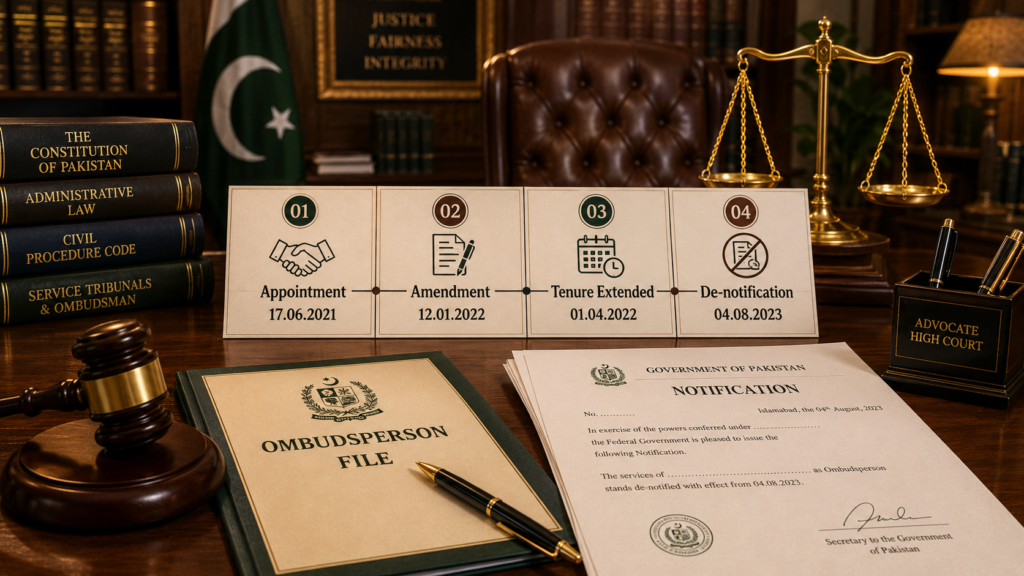
The petitioner was initially appointed as Ombudsperson on 17.06.2021 for a term of two years. Later, the law was amended through the Protection against Harassment of Women at the Workplace Amendment Act, 2021. This amendment inserted subsections (5) and (6) in Section 7.
Section 7(5) fixed the term of the Ombudsperson at four years and also stated that the Ombudsperson would not be eligible for extension or re-appointment. Section 7(6) allowed the Ombudsperson to resign by writing to the Governor.
The amendment was published in the Punjab Gazette on 12.01.2022 and came into force at once. Because the petitioner was still serving when the amendment came into force, the Government issued a notification on 01.04.2022, treating her tenure as four years from the date she had taken charge.
Then came the notification dated 04.08.2023. The Caretaker Government de-notified her services. The reason mainly given was that she was allegedly a political appointee and that the Election Commission had authorized removal of such appointees during the election period.
This is where the Protection Against Harassment of Women at Workplace Act 2010 became central. The Court did not treat this as a simple transfer or routine administrative decision. It treated it as a serious matter of statutory tenure, institutional independence, and constitutional due process.
Petitioner’s Arguments
The petitioner argued that the notification was without lawful authority. Her counsel submitted that a Caretaker Government does not enjoy the same authority as an elected government. Its role is limited to running day-to-day affairs and helping the Election Commission conduct free, fair, and just elections.
The petitioner also argued that the Protection Against Harassment of Women at Workplace Act 2010 contains no provision allowing the Government or ECP to remove the Ombudsperson before expiry of tenure. Section 7(6) only talks about resignation. It does not say that the Ombudsperson can be removed at pleasure.
Another strong argument was about independence. The Ombudsperson performs quasi-judicial functions. She receives complaints, examines evidence, hears parties, and passes orders. If such an office can be removed without notice or inquiry, its independence may be seriously damaged.
The petitioner also relied on the concept of security of tenure. A person who holds a fixed statutory office must be allowed to perform duties without fear of sudden removal. This is especially important in workplace harassment matters, where complaints may involve powerful people, departments, or influential employers.
Government and ECP’s Arguments

The Government of Punjab argued that the petitioner’s appointment had a political background. It stated that she had contested elections from a political party’s platform and therefore her appointment was political in nature.
The Government also argued that the petitioner had originally been appointed for two years and that the later four-year tenure should not apply to her retrospectively. The Election Commission supported the Government’s position.
However, the Court looked deeper. It asked whether the Protection Against Harassment of Women at Workplace Act 2010 disqualified a person merely because of past political association. It also examined whether any material showed that the petitioner could influence the general election if she remained in office.
The Court found no such material. There was no proper proof that her continuation as Ombudsperson would affect elections. There was also no material showing that she had been given an opportunity of hearing before adverse action was taken.
Did the Four-Year Tenure Apply?
The Court held that when a law says it shall come into force at once, its provisions become enforceable immediately unless the law says otherwise. The amendment to the Protection Against Harassment of Women at Workplace Act 2010 came into force while the petitioner was still serving.
There was no wording in the amendment saying that the four-year tenure would apply only to future appointments. Therefore, the petitioner could get the benefit of the amended Section 7(5).
This finding is very important. The Court accepted that the notification dated 01.04.2022, through which her tenure was treated as four years, was lawful. In simple words, the petitioner’s office did not end after two years. Her tenure had been extended under the amended law.
The Court relied on the principle that if an Act comes into force at once, every provision becomes enforceable from the day the Act receives assent, unless the Act itself suggests a different intention.
Can an Ombudsperson Be Removed Before Tenure Ends?
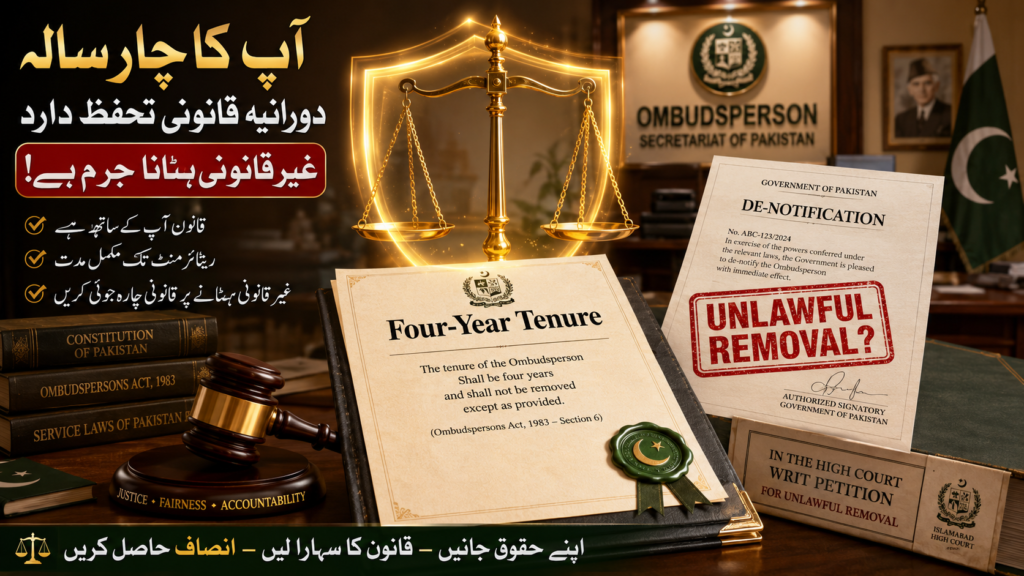
The Court made a clear distinction between resignation and removal. Section 7(6) of the Protection Against Harassment of Women at Workplace Act 2010 mentions resignation. But the Act does not provide an ordinary removal procedure.
The Court held that a fixed-term Ombudsperson cannot be removed before expiry of tenure except on recognized grounds such as proven misconduct or incapacity. Even then, due process is necessary.
This means fixed tenure is not decoration. It has legal value. If the Ombudsperson knows that she can be removed at any time without stated cause, her ability to act independently may be affected. She may hesitate in sensitive cases involving Government departments or influential persons.
A harassment forum must be trusted. Trust comes when the office is independent, stable, and protected from unlawful pressure.
Article 10A and Due Process
Article 10A of the Constitution protects fair trial and due process. The Court explained that Article 10A must be read into every law where civil rights or obligations are determined.
This point gives constitutional strength to the Protection Against Harassment of Women at Workplace Act 2010. Even if the Act does not write a detailed removal procedure, constitutional due process still applies.
Due process means the person must know the allegations, must be given an opportunity to respond, and must be dealt with by a competent authority. Removal from a statutory office cannot be based only on assumptions, political labels, or administrative convenience.
In this case, the record did not show that the petitioner was given proper hearing. No proved misconduct or incapacity was established. No convincing material was produced to show that her continuation would damage the election process.
The Court therefore treated the de-notification as legally untenable.
Limits of Caretaker Government
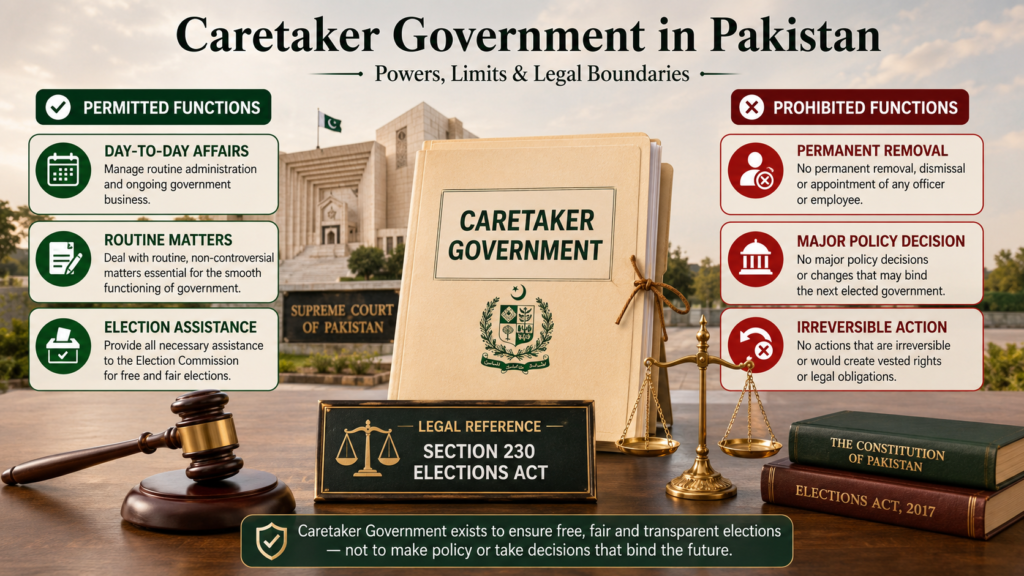
Section 230 of the Elections Act 2017 was a major part of the judgment. It says that a Caretaker Government must perform day-to-day functions, assist the Election Commission, and restrict itself to routine, non-controversial, urgent, and reversible matters.
A Caretaker Government should not make major policy decisions. It should not make decisions that affect the authority of the future elected government. It should also remain impartial.
The Court held that removing an Ombudsperson appointed under the Protection Against Harassment of Women at Workplace Act 2010 was not a routine matter. It was not merely a temporary transfer. It was a permanent and serious action affecting a statutory office.
The Court also observed that such removal could disturb the independence of a quasi-judicial forum. Therefore, the Caretaker Government lacked lawful authority to de-notify the petitioner in this manner.
Did ECP Have Power to Order Permanent Removal?

The Court examined Articles 218, 219, and 220 of the Constitution and Sections 4, 5, and 8 of the Elections Act 2017. These provisions empower the ECP to conduct elections honestly, justly, fairly, and according to law.
But the Court clarified that ECP’s election powers do not automatically include power to order permanent removal of any statutory office holder. At most, during election time, ECP may deal with transfer or shuffling of public officials where necessary to protect election fairness.
Permanent termination is different.
The Court found no material showing that the petitioner’s continuation as Ombudsperson could influence the general election. The ECP did not properly determine that her office could affect election results.
Therefore, ECP’s authority could not be stretched into power to remove an Ombudsperson appointed under the Protection Against Harassment of Women at Workplace Act 2010.
This part of the judgment is very helpful for public law. It tells us that even powerful constitutional institutions must stay within the purpose for which the law gives them power.
Political Background Is Not Automatic Disqualification
The Government argued that the petitioner had political association. The Court rejected this as a standalone ground.
Section 7 of the Protection Against Harassment of Women at Workplace Act 2010 lists qualifications for appointment as Ombudsperson. It does not say that past political association automatically disqualifies a person.
The Court explained that if the legislature wanted such a bar, it could have written it into the law. Courts cannot add a disqualification that the legislature itself did not create.
However, the Court also made one thing clear. After appointment, an Ombudsperson must act with complete impartiality. If political preference affects official conduct, that may amount to misconduct. But past association alone, without proof of misconduct or election influence, is not enough for removal.
This is a balanced approach. The Court did not say politics can enter the office. It said actual conduct in office matters more than past labels.
Final Decision of the Court

The Lahore High Court accepted the petition. It declared the notification dated 04.08.2023 issued by the Government of Punjab as null and void. The Court set aside the de-notification.
The Court further held that the petitioner would be deemed to be in office as if the notification had never been issued.
This result strengthened the Protection Against Harassment of Women at Workplace Act 2010. It protected not only one office holder, but also the independence of the institution created to handle workplace harassment complaints.
The Court also noticed a serious gap in the law. It observed that the Act does not contain a clear appointment procedure for Ombudsperson. To avoid subjective appointments and strengthen trust, the Court directed the relevant authorities to formulate a comprehensive, transparent, and merit-based appointment procedure.
The Court said this process should include public advertisement through newspapers, electronic media, and social media. It also suggested that an evaluation process, preferably involving the Public Service Commission, would help assess candidates objectively.
Why This Judgment Matters for Ordinary People
Many people think the Protection Against Harassment of Women at Workplace Act 2010 is only about filing complaints against harassment. This judgment shows that the law also needs strong institutions.
If the Ombudsperson is weak, complainants may feel weak. If the forum is insecure, public confidence suffers. If a person hearing harassment complaints can be removed without process, the whole system becomes vulnerable.
For employees, especially women, this judgment sends a message that the harassment forum should remain independent. For public officials, it says that fixed tenure has legal protection. For governments, it says that statutory offices cannot be disturbed without lawful authority.
The judgment is also important because it connects workplace dignity with constitutional due process. It tells us that justice is not only about final orders. Justice also depends on the independence of the person who hears the case.
Practical Lessons from This Case
The first lesson is that a fixed-term statutory office cannot be treated like an ordinary seat. The second lesson is that the Caretaker Government must remain within its limited role. The third lesson is that ECP’s election powers must remain connected with election fairness and cannot automatically become removal powers.
The fourth lesson is that Article 10A due process is not optional. If a person’s civil rights, statutory tenure, or public office are affected, fair procedure must be followed.
The fifth lesson is that appointments to sensitive quasi-judicial offices should be transparent. Public advertisement, clear criteria, merit evaluation, and institutional independence are necessary for public trust.
The Protection Against Harassment of Women at Workplace Act 2010 cannot achieve its purpose if the forum created under it is exposed to arbitrary executive interference.
Checklist for Similar Cases
If a statutory office holder is removed before completion of tenure, these questions should be checked:
- What law created the office?
- Does the law give fixed tenure?
- Does the law mention removal grounds?
- Was misconduct or incapacity proved?
- Was notice issued?
- Was opportunity of hearing given?
- Was the action taken by the competent authority?
- Was the action routine and reversible, if taken by a Caretaker Government?
- Did ECP connect the action with election influence?
- Is the order reasoned and lawful?
In cases involving the Protection Against Harassment of Women at Workplace Act 2010, these questions become even more important because the Ombudsperson’s independence directly affects workplace harassment justice.
Official Legal Resources
For readers who want to verify the law, the Protection Against Harassment of Women at Workplace Act 2010 can be checked from the official Pakistan Code website. The connected election law discussed in this judgment can also be read from the Election Commission of Pakistan’s official Elections Act 2017 resource. This helps readers understand how the Court connected workplace harassment law, Ombudsperson tenure, due process, and caretaker government powers.
Also read our related guides on workplace harassment law in Pakistan, harassment complaint procedure in Pakistan, and writ petition in Pakistan for better legal awareness.
Conclusion
This Lahore High Court ruling gives a clear message: temporary power cannot defeat statutory tenure. The Court protected due process, limited caretaker authority, and clarified that ECP cannot order permanent removal unless such action is legally connected with election functions.
The Protection Against Harassment of Women at Workplace Act 2010 gives the Ombudsperson a serious and sensitive role. That role requires courage, neutrality, and independence. A person holding that office cannot be removed casually, politically, or without lawful procedure.
For Pakistan’s legal system, this judgment is more than a service matter. It is a reminder that institutions created to protect dignity must themselves be protected from unlawful interference.
When the office of Ombudsperson stands secure, citizens who approach that office also feel more secure. That is the real value of this judgment.
Disclaimer
This article is for legal awareness and educational purposes only. It is not legal advice. For any workplace harassment complaint, constitutional petition, service matter, or statutory office dispute, consult a qualified lawyer with complete documents.
FAQs on Protection Against Harassment of Women at Workplace Act 2010
What was the main issue in this judgment?
The main issue was whether the Caretaker Government and ECP could remove a fixed-term Ombudsperson before completion of tenure.
What did the Lahore High Court decide?
The Court declared the de-notification illegal, null and void, and set it aside.
Why is the Protection Against Harassment of Women at Workplace Act 2010 important in this case?
Because the petitioner was appointed as Ombudsperson under this law, and her tenure was governed by Section 7 of the Act.
Can an Ombudsperson resign?
Yes. Section 7(6) allows the Ombudsperson to resign by writing addressed to the Governor.
Can the Government remove an Ombudsperson at any time?
No. The Court held that a fixed-term Ombudsperson cannot be removed casually before expiry of tenure.
What grounds may justify removal?
The Court referred to recognized grounds such as proven misconduct or incapacity, but due process is necessary.
Did the Caretaker Government have authority in this case?
No. The Court held that the Caretaker Government lacked authority to de-notify the petitioner.
Did ECP have authority to order permanent removal?
No. The Court held that ECP’s powers relate to fair elections and do not include permanent removal of such office holders.
Does past political association automatically disqualify an Ombudsperson?
No. Past political association alone is not automatic disqualification unless the law says so or misconduct is proved.
What future reform did the Court suggest?
The Court directed that a transparent, comprehensive, and merit-based appointment procedure should be framed for future Ombudsperson appointments.