

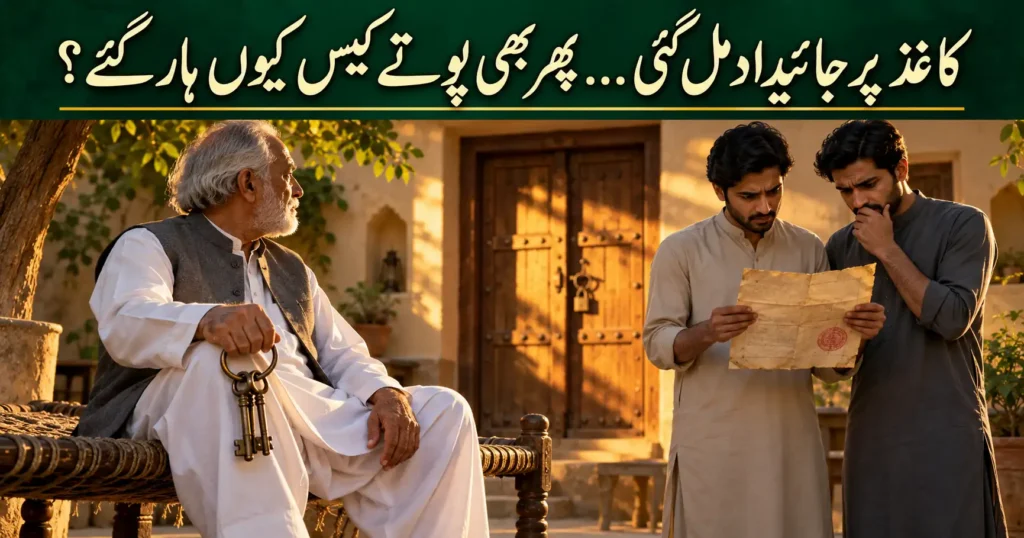
In 1988, a man named Dawai Khan signed a paper that seemed to give his property to his grandsons. One line in it was quietly dangerous: he would keep possession for as long as he lived. Decades later, that line sat at the heart of a Supreme Court case.
If you hold a gift deed in Pakistan, or plan to make one for your children, this ruling is worth ten minutes. In Hidayat Khan v. Mst. Nasreen (PLD 2025 Supreme Court 502), the trial court, the appellate court, the Peshawar High Court and finally the Supreme Court all refused to accept the 1988 deed.
The courts found four gaps: possession never changed hands, the deed was never registered, no marginal witness or scribe came to court, and nobody explained why the donor bypassed his own sons. Below, we explain the judgment in plain words, the hiba (gift) law behind it, how to make a gift that survives a challenge, and what to do if a doubtful gift is used against your inheritance.
Table of Contents
Judgment at a Glance: PLD 2025 SC 502
| Detail | Information |
|---|---|
| Case title | Hidayat Khan and others v. Mst. Nasreen and others |
| Citation | PLD 2025 Supreme Court 502 |
| Court | Supreme Court of Pakistan |
| Bench | Syed Hasan Azhar Rizvi, Musarrat Hilali and Shahid Bilal Hassan, JJ. |
| Order written by | Shahid Bilal Hassan, J. |
| Case number | C.P.L.A. No. 287-P of 2025 |
| Date of decision | 24 April 2025 |
| Arising from | Peshawar High Court order dated 4 February 2025 in C.R. No. 342 of 2022 |
| Law involved | Specific Relief Act 1877; Transfer of Property Act 1882; Registration Act 1908; Qanun-e-Shahadat 1984; CPC |
| Result in one line | Leave to appeal refused; petition dismissed; findings of three courts below left intact |
IRAC Summary: Issue, Rule, Analysis, Conclusion
| Element | Summary |
|---|---|
| Issue | Did a 1988 deed, under which the donor kept possession for life, make the grandsons owners and undo later inheritance mutations? |
| Rule | A valid hiba needs declaration, acceptance and delivery of possession. A deed creating future rights must be registered (section 49, Registration Act, with section 123, Transfer of Property Act) and, if challenged, proved through two marginal witnesses (Article 79, Qanun-e-Shahadat). The donee must explain why heirs were left out. |
| Analysis | The donor kept possession; the deed was unregistered; no marginal witness or scribe testified; the grandsons never explained why the sons were bypassed. |
| Conclusion | This gift deed in Pakistan was incomplete and unproved. Leave was refused and the concurrent findings stand. |
What Is a Gift Deed in Pakistan (Hiba Nama)?
A gift deed (hiba nama) is a written record of a gift of property made without any price. Under Muslim law, which section 129 of the Transfer of Property Act, 1882 keeps intact, a hiba need not be in writing at all; an oral gift can be valid. The courts look at substance: did the gift really happen?
The Three Pillars: Offer, Acceptance and Possession
The Supreme Court repeated that whoever relies on a gift must plead and prove three ingredients (para 4(b)):
- Declaration (ijab): the owner clearly says he is giving the property now, as a gift.
- Acceptance (qabool): the person receiving it, called the donee, accepts the gift.
- Delivery of possession (qabza): control of the property actually passes to the donee.
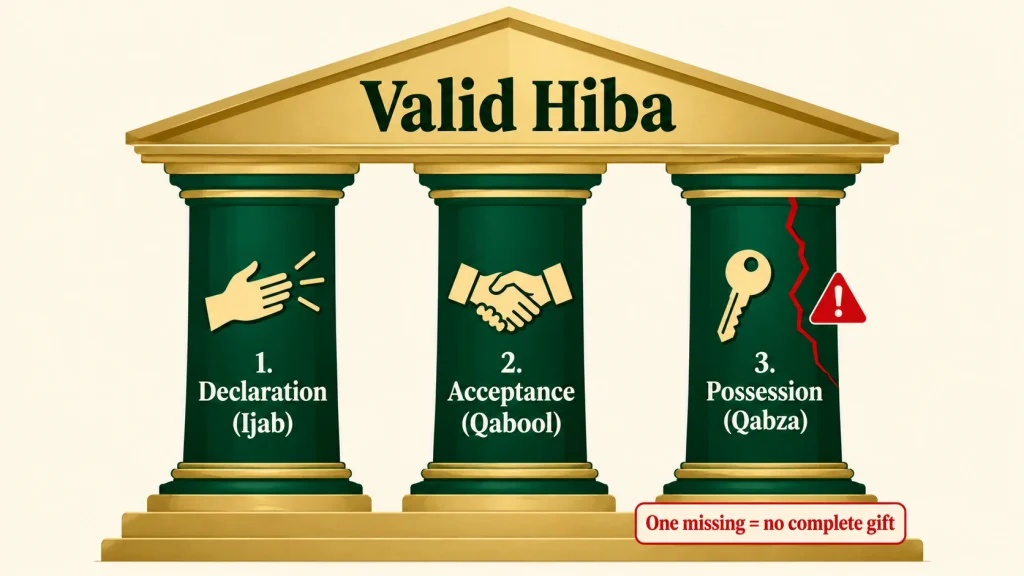
If any one pillar is missing, even a carefully written gift deed in Pakistan cannot complete the hiba. A gift that only takes effect after the donor’s death looks more like a will (wasiyat), which follows stricter limits under Muslim law.
Oral Hiba vs Written Deed: When Registration Is Compulsory
An oral hiba may be valid without paper. But section 17(1)(a) of the Registration Act, 1908 lists “instruments of gift of immovable property” among documents that must be registered, and section 49 says an unregistered document of this kind cannot create or transfer any right in the property.
Here, the Supreme Court held that because the 1988 document created future obligations and rights, it had to be compulsorily registered; unregistered, it gave the grandsons nothing (para 4). So if your family relies on paper, make it a registered gift deed in Pakistan. Registration also records who appeared before the Sub-Registrar and admitted signing, which helps if the gift is ever questioned.
The 1988 Deed That Started a Family Dispute
The petitioners sued for declaration and injunction under sections 42 and 54 of the Specific Relief Act, 1877, relying on a gift deed dated 2 October 1988 said to have been executed by their predecessor, Dawai Khan. They also challenged Dawai Khan’s inheritance mutation (intiqal) and inheritance Mutation No. 7030 in favour of Mst. Nasrin Begum, attested on 21 January 2014.
Only Madad Khan contested the suit; the other defendants filed conceding written statements. Even so, the claim failed at every level:
| Date | Court | What happened |
|---|---|---|
| 2 Oct 1988 | — | Alleged gift deed signed |
| 21 Jan 2014 | Revenue record | Mutation No. 7030 attested |
| 31 Jan 2019 | Trial court | Suit dismissed |
| 3 Jan 2022 | First appellate court | Appeal dismissed |
| 4 Feb 2025 | Peshawar High Court | Civil Revision No. 342 of 2022 dismissed |
| 24 Apr 2025 | Supreme Court | Leave to appeal refused |
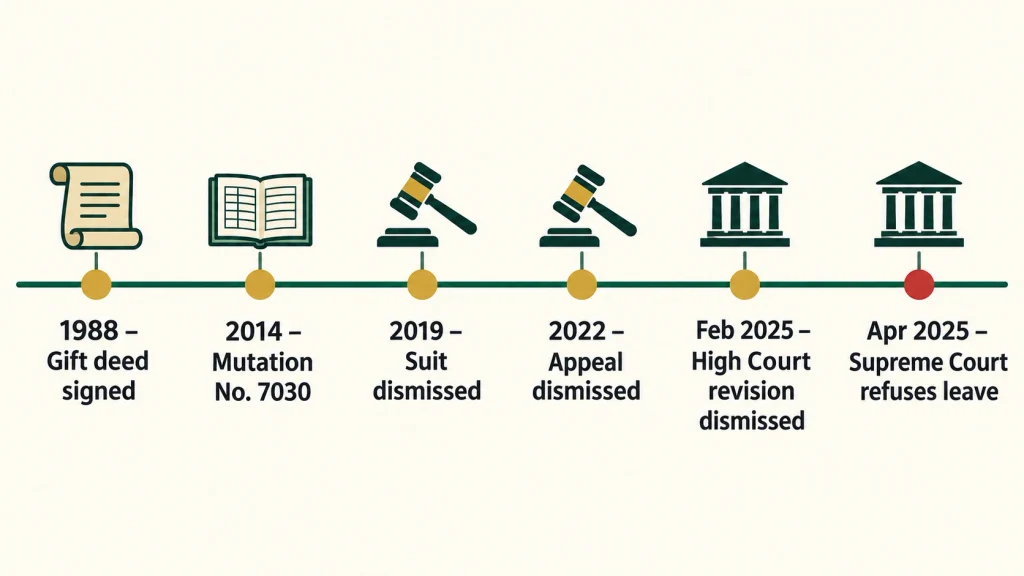
The central question: did this gift deed in Pakistan complete a real transfer in 1988, or only promise ownership for some later day?
What Each Side Argued Before the Courts
The petitioners argued that the 1988 deed made them owners, so the later inheritance mutations should be set aside. Their counsel, Manzoor Khan Khalil, ASC, sought leave under Article 185(3) of the Constitution. Madad Khan contested the claim in the courts below. No one appeared for the respondents in the Supreme Court (“Nemo”), but the bench examined the record itself. The order focuses on evidence rather than listing arguments.
The Evidence That Failed the Grandsons
This gift deed in Pakistan collapsed on proof (para 4):
- The deed’s own wording: the donor would retain possession during his lifetime.
- No marginal witnesses: neither attesting witness was produced.
- No secondary-evidence route: other witnesses only identified signatures, and no application explained that the marginal witnesses were dead, unavailable or incapable.
- No scribe: the deed writer never testified. His grandson (PW-2) admitted that the scribe’s immediate successor, his own father, was alive, yet the father did not appear.
- No proper register: the scribe’s register was not brought on record through proper custody.
- No reason for excluding heirs: nothing was pleaded or proved on why Dawai Khan would bypass his own sons (para 5).
The court found no “unimpeachable, confidence inspiring and strong evidence” behind the deed (para 4).
The Law the Supreme Court Applied
Five provisions decided the fate of this gift deed in Pakistan:
| Law | What it deals with | How it decided this case |
|---|---|---|
| Section 123, Transfer of Property Act 1882 | How a gift of immovable property is made | Read with section 49 to require registration of a deed creating future rights |
| Sections 17 and 49, Registration Act 1908 | Which documents must be registered, and the effect of non-registration | The unregistered 1988 deed could not confer title |
| Article 79, Qanun-e-Shahadat 1984 | Proof of a document that must be attested | Two marginal witnesses were needed; none was produced |
| Section 115, CPC | High Court’s revision power | The High Court rightly refused to disturb concurrent findings |
| Article 185(3), Constitution | Leave to appeal to the Supreme Court | No ground for leave was made out |
The 8 Rules the Supreme Court Set for Disputed Gifts
Before weighing the facts, the court restated eight rules that apply whenever a gift deed in Pakistan, or any other transfer by a deceased owner, is challenged by heirs (para 4):
- Heavy burden: the beneficiary of the gift must prove it.
- Three ingredients: offer, acceptance and delivery of possession must all be pleaded and proved.
- Shared possession: one heir’s occupation counts as possession for all heirs, unless proved otherwise.
- Oral transfers need details: time, date, place and witnesses must be pleaded and proved by solid evidence.
- Mutation is not title: the original transaction must be proved separately from its revenue entry.
- Excluding an heir needs a reason: even under a registered deed, the donee must prove the transaction and justify the exclusion.
- Pleadings bind parties: evidence beyond the pleadings is discarded.
- Time does not erase inheritance: mere passage of time does not end inheritance rights, and limitation is not attracted in cases of inheritance and fraud.
The court also remarked that, despite being a Muslim society, many have, “out of greed, shunned the teachings of Islam” in inheritance matters, often using gifts (tamleek) to cut heirs out (para 4).
The 4 Mistakes That Sank the 1988 Hiba
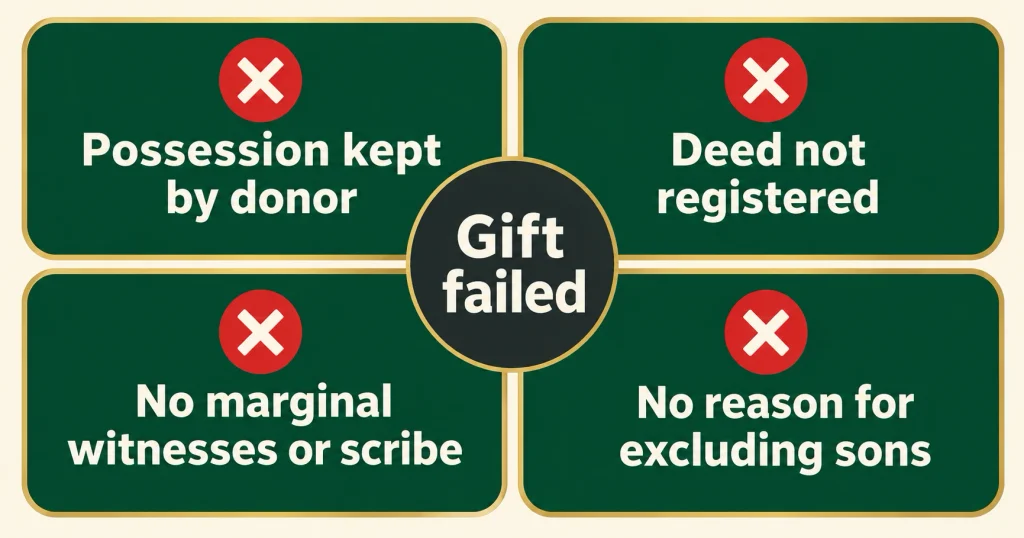
Put simply, this gift deed in Pakistan failed for four reasons:
1. Possession stayed with the donor. The court called the gift conditional, because one ingredient of a valid hiba was missing.
2. No registration. A document creating future rights had to be registered; unregistered, it conferred no right.
3. No marginal witnesses, no scribe. Article 79 required two marginal witnesses; none came, and no secondary-evidence application was moved.
4. No reason for bypassing the sons. The court called pleading and proving this a sine qua non, meaning an essential condition (para 5).
Final Decision: Leave Refused, Petition Dismissed
The court held that the concurrent findings of the trial and appellate courts, upheld by the High Court in revision under section 115 CPC, were not open to interference. Leave was refused and the petition dismissed (para 6).
Because leave was refused, this is a short reasoned order rather than a full appeal judgment. Its value is that it gathers decades of settled rules on any disputed gift deed in Pakistan in one place. You can find similar rulings in our Supreme Court judgments section.
What the Court Did and Did Not Decide
| The court decided | The court did not decide |
|---|---|
| The 1988 deed did not prove a complete, valid gift | That every gift to a grandchild is invalid |
| Keeping possession for life made this gift conditional and incomplete | That an oral hiba always needs registration |
| An unregistered document creating future rights confers no right | Each heir’s exact share in the estate |
| A challenged document of this kind needs two marginal witnesses, or a proper secondary-evidence route | That the deed was forged; it held only that the deed was not proved |
| The donee must plead and prove why legal heirs were excluded | The inheritance mutations on their own merits; dismissal of the suit simply left them in place |
What This Judgment Means for Pakistani Families
If you are receiving a gift: a signed paper is not enough. A gift deed in Pakistan protects you only with possession in your hands, a registered deed, and witnesses who can still come to court years later.
If you are a legal heir left out: you do not have to disprove a gift deed in Pakistan used against you. The person relying on it must prove the whole transaction and explain your exclusion, and delay alone does not end your right. Our guide to inheritance law and women’s shares explains how courts protect daughters and sisters.
If most of the family agrees: here, every defendant but one conceded, yet the suit was still dismissed because the gift was not proved. Family support does not replace evidence.
How to Make a Gift Deed in Pakistan That Holds Up in Court
These steps follow the Registration Act and Stamp Act as they apply in Punjab. Other provinces are similar, but rates and offices differ.
- Check the title. Confirm from the record of rights (fard) or society file that the donor is the recorded owner and no case is pending.
- Gift now, not “after my death”. The donor must give up control in his lifetime; a life-possession clause is exactly what failed here.
- Draft a clear deed. Name both parties, describe the property precisely (khewat, khatooni and khasra, or plot number), and record the declaration, acceptance and delivery of possession.
- Be honest about heirs. If some heirs are left out, record the real reason. Courts will ask.
- Pay the stamp duty. Under section 29(j) of the Stamp Act, 1899 as applied in Punjab, the donee pays, usually by e-stamp.
- Use two traceable witnesses. If the deed is ever challenged, their evidence may decide the case.
- Register within four months. Present the deed to the Sub-Registrar where the property lies (sections 23 and 28, Registration Act). Late presentation is allowed for four more months only with a fine (section 25).
- Complete the mutation and hand over control. Enter the transfer in the land record or society file, then move keys, rent, utility and tax records to the donee.
Overseas Pakistanis: to register a gift deed in Pakistan’s Punjab province, an overseas party no longer has to appear in person. Since the Registration (Amendment) Act 2024, the registering officer can examine them through a commission (section 38(1)(d)).
Stamp Duty and Registration Costs in Punjab
| Item | What the law says |
|---|---|
| Who pays | The donee, i.e. the person in whose favour the gift is made (section 29(j)) |
| Urban property | 2% of value, including gifts between spouses, parents, children, grandparents and siblings (Article 33, Schedule I) |
| Other areas | 3% in the published Schedule; check the current rate on the Punjab e-Stamping portal before you pay |
| Extra duty on registration | Rs 500 up to Rs 500,000 of value; Rs 1,000 above that |
| Memorandum of oral gift | Also chargeable under Article 33 |
| Value used | District Collector’s valuation table, or the declared value if higher (section 27-A) |
Stamp rates for a gift deed in Pakistan change through budgets and amendments, so confirm them on the e-stamp challan before you pay. Also note that if a Punjab public office records a transfer on an unregistered instrument, section 40 of the Stamp Act charges ten times the deficient duty.
Challenging a Doubtful Gift Deed: Evidence and Next Steps
Whether a gift is valid is decided by the civil court, usually in a suit for declaration, cancellation, possession or partition, with an injunction where needed. Our guide on cancellation of a gift deed in Pakistan explains how courts test consent, fraud and mutations.
Time Limits: Do Not Wait
To challenge a gift deed in Pakistan, timing matters. Many declaration suits are tested against six years under Article 120 of the Limitation Act, 1908, and cancellation of an instrument against three years from knowledge under Article 91. But this judgment repeats that limitation is not attracted in cases of inheritance and fraud (para 4(h)). Still, every year of delay costs witnesses. More rulings are collected in our limitation in inheritance judgments section.
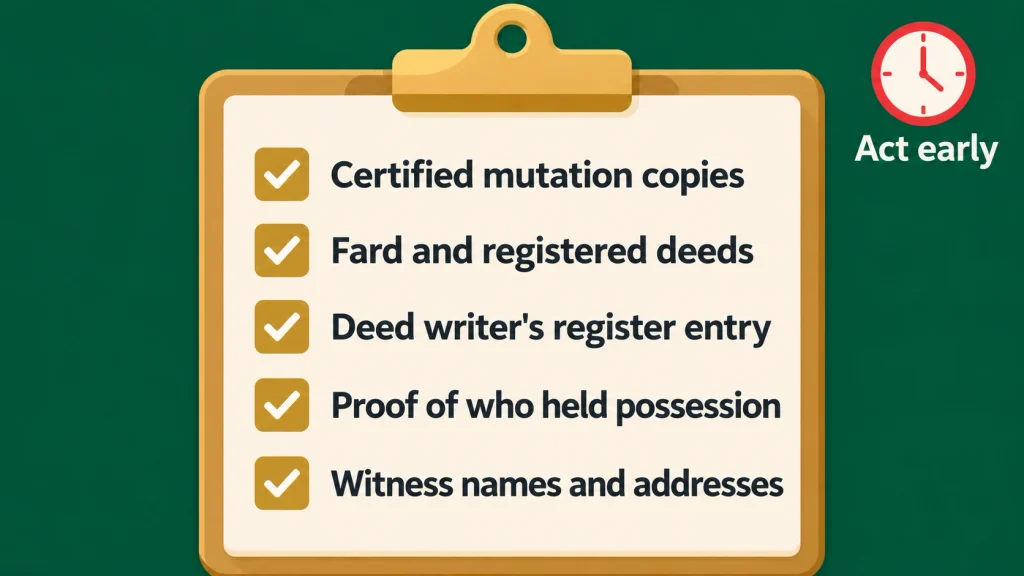
Evidence to Collect and Preserve
- Certified copies of every mutation (intiqal), the fard and any registered deed.
- The deed writer’s register entry, obtained through its proper custodian.
- Proof of who controlled the property: rent receipts, crop records, utility bills and tax payments.
- Names and addresses of the marginal witnesses and others present.
- Records of the donor’s health or dependence, if pressure or fraud is alleged.
Common Mistakes That Lose Cases
Most failed challenges to a gift deed in Pakistan repeat the same errors:
- Relying on the mutation alone instead of proving the original gift.
- Vague pleadings without the date, time, place and witnesses.
- Not producing the marginal witnesses, or not seeking secondary evidence when they are unavailable.
- Leading evidence on facts that were never pleaded.
- Waiting while witnesses die and records disappear.
Your next step is to collect these certified copies and consult a qualified civil lawyer. You can also browse our gift and hiba disputes section for similar cases.
Time matters as much as evidence. In PLD 2025 Lahore 581, a 1981 gift deed was challenged 34 years later, and the Lahore High Court upheld the rejection of the suit as time-barred. Read how limitation works under gift deed law in Pakistan.
Gift Deed in Pakistan: Frequently Asked Questions
Can a donor keep possession of the property after a hiba?
Generally not, if the gift is to stand. Delivery of possession is an essential ingredient of a valid hiba. In PLD 2025 SC 502, the deed said the donor would keep possession for life, and the Supreme Court treated the gift as conditional and incomplete.
Is a gift mutation enough to prove ownership?
No. A mutation (intiqal) is a revenue entry, not a document of title. The Supreme Court restated that the original gift must be proved separately from its revenue entry, through evidence of the declaration, the acceptance and the delivery of possession.
Is registration of a gift deed in Pakistan compulsory?
An oral hiba can be valid without registration. But a written instrument that itself gifts immovable property must be registered under section 17(1)(a) of the Registration Act, 1908, and section 49 says an unregistered one creates no right. So if you put a gift deed in Pakistan on paper, register it.
How much stamp duty is paid on a gift deed in Punjab?
Under Article 33 of the Stamp Act as applied in Punjab, a gift of urban property attracts 2% of its value, family gifts included. The published rate for other areas is 3%, but rates can change, so check the current rate on the Punjab e-Stamping portal before you pay. Registration adds Rs 500 or Rs 1,000, and the donee pays.
Can a gift deed in Pakistan be cancelled or revoked later?
Under Muslim law, a donor can withdraw a gift before possession is delivered. After a complete hiba, revocation generally needs the donee’s consent or a court decree, and gifts to a spouse or close blood relatives are usually irrevocable. Separately, a civil court can cancel a deed obtained by fraud, pressure or forgery.
Can a father gift all his property to one child?
A Muslim owner can make a lifetime gift, and the courts do not ban it outright. But when other heirs are cut out, the Supreme Court requires the donee to prove the original transaction and the circumstances behind the exclusion, even under a registered deed. An unexplained exclusion weakens the gift heavily.
How many witnesses does a gift deed in Pakistan need?
Use at least two reliable attesting witnesses. Article 17 of the Qanun-e-Shahadat requires instruments of financial or future obligations to be attested by two men, or one man and two women. If the deed is challenged, Article 79 requires two attesting witnesses to be called; if they have died, apply for secondary evidence.
What is the time limit to challenge a gift deed in Pakistan?
It depends on the relief: often six years for a declaration (Article 120, Limitation Act) and three years from knowledge to cancel an instrument (Article 91). The Supreme Court has repeated that limitation is not attracted in inheritance and fraud cases, but file early while the evidence is fresh.
Conclusion: A Gift Is Proved by Conduct, Not Paper
The 1988 deed in this case looked like a gift, but it behaved like a promise for the future. The donor kept possession, the paper was never registered, its witnesses never came to court, and the exclusion of his sons was never explained. Four gaps, four lost rounds in court.
A gift deed in Pakistan works when the gift is real: possession changes hands, the deed is registered, the witnesses can be found and the reasons are honest. For heirs, the message is just as clear. A doubtful gift cannot quietly replace lawful inheritance.
Disclaimer: This article is for legal awareness only and is not legal advice. Every case depends on its own facts, documents and evidence. For your specific matter, consult a qualified lawyer.