


Imagine this. The government takes your family’s land for a new sector. You are told an award has been made, so you wait for the money. Years pass. Your house is pulled down. And the payment still has not come.
That is the story behind the latest land acquisition ruling of the Federal Constitutional Court (FCC). Families from Islamabad’s Sectors C-13 to C-16 went to court saying their land was acquired in 2008 but they were never fully paid. The Islamabad High Court ordered a fresh valuation at today’s market rates. On 17 November 2026, the FCC set that part aside.
But this is not a simple loss for landowners. The court also said CDA cannot hide behind the award to avoid paying what it owes. It explained what counts as proof when CDA itself has demolished a house. And it said who must decide each claim, and how.
If the government has taken your land, or is about to, these seven rules can decide whether you get paid and how much. Read them before you sign or file anything.
Table of Contents
Judgment at a Glance: F.C.P.L.A. 624 of 2026
| Point | Detail |
|---|---|
| Court | Federal Constitutional Court of Pakistan, Islamabad |
| Bench | Chief Justice Amin-ud-Din Khan and Justice Ali Baqar Najafi |
| Case | Capital Development Authority v. Maqbool Hussain & others, F.C.P.L.A. 624 of 2026 and 23 connected petitions |
| Appeal against | Islamabad High Court’s common judgment dated 18.11.2025 in W.P. 4634 of 2022 and connected petitions |
| Filed under | Article 175F(1)(c) of the Constitution |
| Heard / Announced | Heard 15.10.2026; announced 17.11.2026 |
| Citation | Not yet reported (approved for reporting) |
| Law involved | Articles 4, 10-A, 23 and 24 of the Constitution; CDA Ordinance 1960; CDA (Amendment) Act 2025 |
| Land | 14,944 kanals and 9 marlas in four revenue estates, Sectors C-13 to C-16, Islamabad |
| Result | CDA’s appeals allowed. Delay alone does not justify revaluation at today’s market rates, but CDA must pay verified dues. |
The judgment is available on the FCC’s official judgments page. To understand this new court, its judges and its powers, read our complete guide to the Federal Constitutional Court of Pakistan. For more rulings of this court in simple words, see our Federal Constitutional Court judgments.
IRAC Breakdown of the CDA Land Acquisition Case
| Step | What it means in this case |
|---|---|
| Issue | Can a delay in paying a land acquisition award justify paying today’s market value? Does a later survey or a commission report, by itself, give a right to compensation or a plot? Did the High Court’s remedies fit the CDA Ordinance? |
| Rule | Article 24 requires compensation under a law. Section 30(1) of the CDA Ordinance, read with section 2(k)(iii), fixes the valuation date. Section 32-A gives additional compensation for unpaid amounts. Section 36 gives an appeal and a limited review. |
| Analysis | An award binds both CDA and the landowner. Delay does not move the valuation date. Surveys, satellite images and commission reports are evidence, not decisions. Each disputed claim needs its own reasoned finding by the competent forum. |
| Conclusion | Appeals allowed. The awards of 02.12.2008 and 17.08.2023 stay in force. CDA must pay verified, subsisting dues and additional compensation under section 32-A when its conditions are met. Disputed claims go to the statutory forums. |
What Is Land Acquisition in Pakistan?
Land acquisition (husool-e-arazi) is when the government takes private land for a public purpose, even if the owner does not want to sell. In return, the law must pay compensation (muawza).
Article 24 of the Constitution protects property. Land can be taken compulsorily only under a law that provides for compensation. The FCC repeated this basic promise: the power to take land carries a matching duty to pay.
But the court also drew a clear line. The Constitution requires compensation “in accordance with law”. It does not allow a court to replace the formula Parliament made with a formula of its own.
In most of Pakistan, the acquisition of land by government runs under the Land Acquisition Act 1894, with each province’s amendments. In Islamabad’s CDA areas, it runs under the Capital Development Authority Ordinance 1960. So the first question is always: under which law was your land taken? That law decides your deadlines and your forum.
How CDA Land Acquisition Works, Step by Step
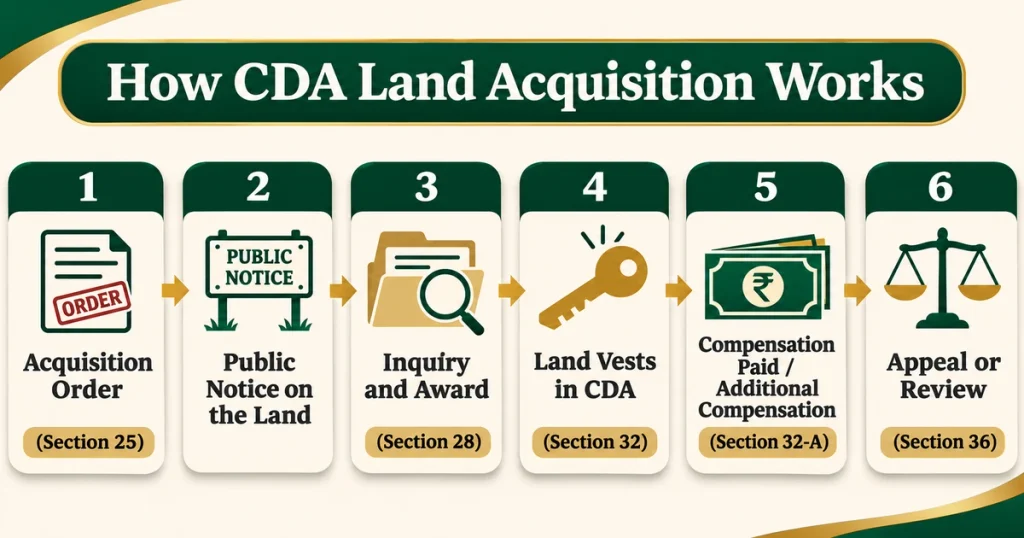
- CDA issues a directive, and the Deputy Commissioner (CDA) passes an acquisition order under section 25.
- A public notice is put up on or near the land, and interested persons can raise objections.
- The Deputy Commissioner holds an inquiry and makes an award covering area, compensation and each person’s share (section 28).
- On the award, the land vests in CDA (section 32).
- Compensation is paid. If it stays unpaid, additional compensation becomes due under section 32-A.
- An aggrieved person can appeal or seek review under section 36.
The Story Behind Sectors C-13 to C-16
The land acquisition in this case was for four new sectors of Islamabad. Here is how it unfolded, as recorded in the judgment:
| Date | What happened |
|---|---|
| 25.02.2008 | Proceedings start under CDA Directive No. 1337 and its addendum. |
| 02.12.2008 | Land award for 14,944 kanals and 9 marlas in four revenue estates. It offers money and developed plots under the land-sharing scheme. |
| 17.08.2023 | A separate award is made for built-up properties (BUPs), meaning houses and other structures. |
| 18.11.2025 | Islamabad High Court decides 25 writ petitions and one contempt petition together. |
| 17.11.2026 | FCC allows CDA’s appeals and sets aside the High Court judgment to the extent challenged. |
The affectees told the High Court that compensation was still unpaid. They said some structures were left out of the BUP award, rehabilitation benefits were denied and houses were demolished unlawfully. They asked for compensation at current market rates and for their structures to be included in the 2023 award.
What the Islamabad High Court Ordered
The High Court did not stop at the files. It called for surveys and appointed a commission, which filed a report. Then it decided all the petitions through one consolidated judgment.
Its directions covered payment, plot allotment, a fresh market assessment, additional compensation under section 32-A, and the use of statutory remedies followed by declaratory suits. One key paragraph treated the delay since 2008 as a ground to value the land again at current rates.
For many families, this felt like justice after years of waiting. CDA, however, took the matter to the FCC.
CDA vs the Affectees: What Each Side Argued
| Point | CDA’s position | Affectees’ position |
|---|---|---|
| Houses and structures | Structures built after acquisition were not eligible. | Their structures were wrongly left out of the BUP award. |
| Rate of compensation | The award fixed the value; it cannot be reopened. | After years of delay, today’s market rate is fair. |
| Remedies | Statutory remedies were available and should be used. | The record showed an appeal against the BUP award and many review applications. |
| Additional compensation | The High Court’s interest and reassessment orders went beyond the law. | Payment was delayed for years, so they deserve more. |
The FCC accepted part of each side’s case. That balance is what makes this ruling so important.
Land Acquisition Act 1894 or CDA Ordinance: Which Law Applies?
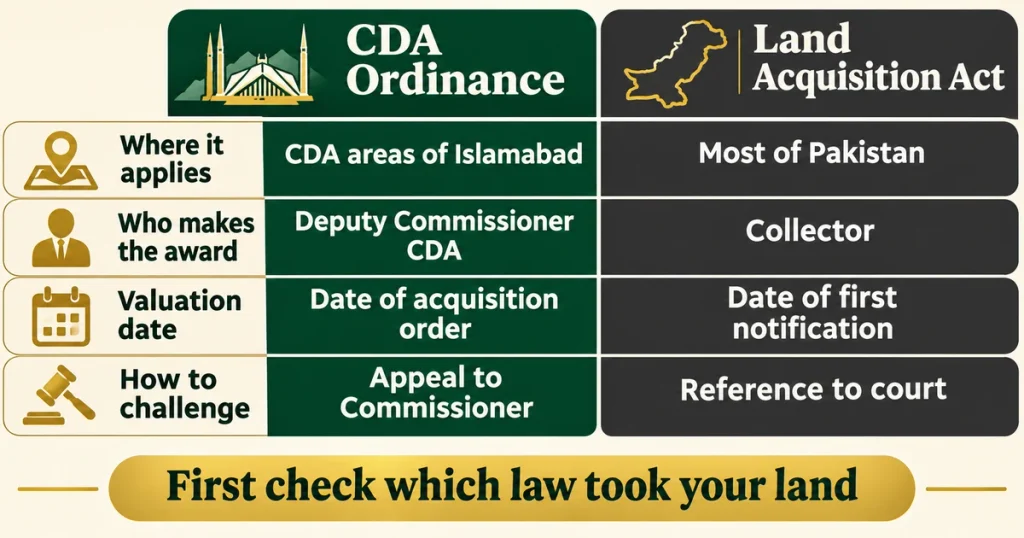
Many people search for the Land Acquisition Act 1894 when CDA takes their land. The FCC made it clear that, in CDA cases, this is the wrong starting point.
The court said this acquisition was governed by the CDA Ordinance. That special law cannot be pushed aside by treating the case as one under the 1894 Act. The 1894 Act comes in only where the Ordinance itself points to it, such as section 2(k)(iii), and only to that extent.
| Point | CDA Ordinance 1960 | Land Acquisition Act 1894 |
|---|---|---|
| Where it is used | CDA’s specified areas in Islamabad | Most acquisitions across Pakistan, with provincial amendments |
| Who makes the award | Deputy Commissioner (CDA) | Collector |
| Valuation date | Date of the acquisition order under section 25 (section 30(1)) | Date of the section 4 notification (section 23) |
| Main way to challenge | Appeal to the Commissioner and a limited review (section 36) | Reference to court (section 18), then appeal (section 54) |
| Extra for late payment | Additional compensation (section 32-A) | Interest (section 34) |
You can read the CDA Ordinance 1960 on CDA’s website and the Land Acquisition Act 1894 on Pakistan Code.
What the CDA Amendment Act 2025 Adds
Parliament amended the CDA Ordinance through the Capital Development Authority (Amendment) Act, 2025. It was published as Act No. I of 2026 on 02.01.2026. The FCC looked at two of its parts:
- Section 29-A: rehabilitation and resettlement cases pending on 30.10.2024 are dealt with under the policy that applied at the relevant time.
- Section 30(4): safeguards for compensation given in a non-cash form, such as land.
The court said neither part gives occupants an automatic right. Neither allows old awards to be revalued at today’s rates. Each pending claim must be decided under the right provision, the relevant policy and the award.
7 Rules the FCC Laid Down on Compensation
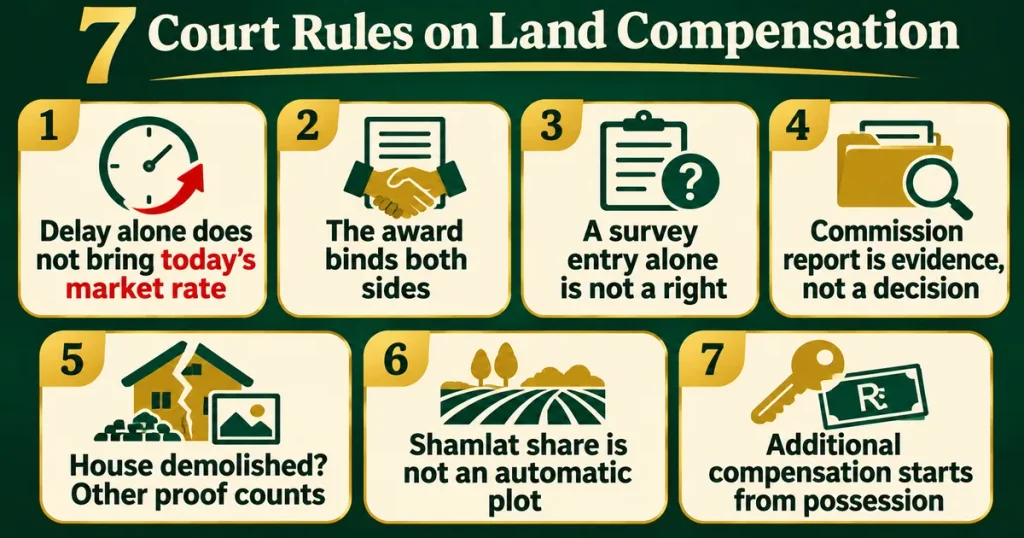
1. Delay Alone Does Not Bring Today’s Market Rate
This is the heart of the ruling. The High Court had treated the delay since 2008 as a reason to value the land again at present rates. The FCC said this mixed up two different things: the value of the land and compensation for late payment.
Section 30(1), read with section 2(k)(iii), fixes the date on which land is valued. Office delay does not move that date. Price rises caused by Islamabad’s later development cannot be added to an old award either. The court said such reassessment cannot be sustained “seventeen years after the award” (para 11).
The High Court had relied on an older case, CDA v. Sub. Faqir Shah (PLD 2002 SC 243). The FCC explained that the case does not allow revaluation at current rates just because compensation is unpaid.
2. The Award Binds CDA Too
Landowners should not lose heart, because the court was just as firm with CDA. An award decides everyone’s rights. CDA cannot use the “finality” of the award to escape paying it.
In the court’s words, “The principle of finality binds the acquiring authority and the claimant alike” (para 8). So if compensation was lawfully awarded and not paid, a direction for payment can follow, along with any additional compensation the law allows.
3. A Survey Entry Does Not Create a Right
Many affectees rely on later surveys. The FCC said eligibility for built-up property benefits must be shown at the date fixed by the award and the rehabilitation scheme. CDA relies on 02.12.2008 as the cut-off date. Whether that date applies, and whether a qualifying structure existed, must be shown from the record.
Neither the 2021 survey nor the 2023 award, on its own, creates eligibility. But the court added a balancing line: CDA cannot simply presume a house was built after acquisition. Owning land does not prove a house existed. And one house does not give a separate rehabilitation benefit to everyone living in it.
4. A Commission Report Helps, but Does Not Decide
The High Court had leaned on satellite images and a court-appointed commission’s report. The FCC called them evidentiary aids, not substitutes for a decision.
One image was dated 19.01.2009, which is after the award. Comparing images can show physical change, but not ownership, household status or the date of construction. Under section 75 and Order XXVI, rules 9 and 10 of the CPC, a commission report helps the court but cannot itself decide title or legal entitlement.
5. If CDA Demolished Your House, Other Proof Counts
This part is good news for many families. Where CDA itself demolished a structure, it cannot insist that physical inspection is the only proof.
The existence and size of a house can be proved through earlier surveys, photographs, utility records, witnesses and technical evidence. Still, demolition does not prove every later claim. The competent forum must weigh the material and give reasons. A separate claim for unlawful demolition must also be proved before the competent forum. If you face a wider possession dispute, see our guides on illegal possession and dispossession.
6. A Shamlat Share Is Not an Automatic Plot
Shamlat (shamilat) is village common land. The court said a share in shamlat does not, by itself, give title to a particular site or a right to a separate plot.
Under section 28, the people entitled, their interests and their shares must be identified. This comes from the revenue record, the nature of common rights and any proven individual interest. Mere occupation is not enough.
7. Additional Compensation Starts From Possession
Section 32-A gives additional compensation where compensation stays unpaid. Under its earlier text, this was 8% a year from the date CDA actually took possession. The amended section also uses possession as the starting point.
Vesting of the land or announcement of the award does not fix that date. The owner also does not need to have handed over possession voluntarily. The court said CDA’s liability is mandatory once the conditions are met. But there is no flat calculation from 2008, and none on today’s values.
The competent authority must work out four things: the interest that qualifies, the possession date, any payments or deposits already made, and the period. In land-sharing cases, it must first find what is still outstanding.
The Final Decision in Plain Words
The FCC granted leave, turned the petitions into appeals and allowed them. Here is what the order says:
- The High Court judgment of 18.11.2025 is set aside to the extent challenged concerning the respondents.
- The awards of 02.12.2008 and 17.08.2023 stay in force unless a competent forum lawfully changes them. Delay alone shall not justify revaluation at current market rates.
- Disputed claims must be decided quickly through the proper statutory proceedings, subject to jurisdiction, limitation, the awards and the amendments.
- CDA must pay verified, subsisting liabilities and decide section 32-A additional compensation once its conditions are met.
- Possession and removal must follow the safeguards in the law. Finished proceedings and people outside this appeal are not affected. No order as to costs.
What the FCC Did and Did Not Decide
| The FCC decided | The FCC did not decide |
|---|---|
| Delay alone does not justify a market-rate revaluation. | Whether any single affectee is or is not eligible. |
| The award binds CDA and landowners alike. | That CDA was right to leave anyone out. The court said its ruling does not validate any unlawful exclusion. |
| Surveys, images and commission reports are evidence, not decisions. | The value of any particular house, plot or share. |
| Civil suits cannot be used as a general appeal route. | A wider rule on the retrospective effect of the 2025 amendment. |
| CDA must pay verified dues and section 32-A compensation when due. | Cases already concluded, or people outside this appeal. |
On civil suits, the court explained that a civil court’s power under section 9 CPC can be excluded by statute. Sections 36 and 49-E of the Ordinance had to be considered first. A suit may still raise its own question where someone claims an independent civil right or challenges action taken without lawful authority. You can read more about a civil suit for declaration.
What This Ruling Means for Landowners and Affectees
For families hit by land acquisition in CDA sectors, the message is mixed but clear. You will not get today’s price just because CDA paid late. But money that was lawfully awarded and verified must be paid, with additional compensation when the law’s conditions are met.
The ruling also protects people whose homes were demolished. CDA cannot demand an inspection of a house that it has already pulled down.
For landowners elsewhere in Pakistan, this case was decided under the CDA Ordinance. If your land was taken under the Land Acquisition Act 1894, your deadlines and forums are different. Do not copy the CDA route. The common lesson is simple: land compensation follows the law and the award, and you must use the right forum on time.
Evidence to Keep if Your Land or House Was Taken
Strong land acquisition claims are built on paper, not on promises. Collect and keep copies of:
- The land award or BUP award, and the page showing your name and share.
- The acquisition order, public notices and any letters from CDA or the Deputy Commissioner.
- Revenue record: fard, jamabandi, khasra girdawari and inheritance mutation entries.
- Proof your house existed before the cut-off date: old photos, electricity and gas bills, meter numbers and earlier survey lists.
- Satellite images, preferably authenticated, and any technical analysis.
- Names of witnesses, such as neighbours or the village lambardar.
- Receipts for any amount paid or deposited, and plot allotment letters under land sharing.
- Photos, videos and notices of any demolition, with dates.

Your Next Steps: Appeal, Review and the Right Forum
- Find your award. Check whether your claim falls under the land award or the BUP award, and what it says about you.
- Appeal fast. Under the version of section 36 published on CDA’s website, an appeal against an award or order lies to the Commissioner within 15 days. This window is very short, so see a lawyer at once.
- Know the limits of review. The same published text lets the Deputy Commissioner or Commissioner review an award or order within five years. A review cannot raise compensation, except to correct an arithmetical, clerical or obvious error.
- Claim unpaid amounts. If a lawful award is unpaid, apply for payment and section 32-A additional compensation. Keep proof of the date CDA took possession.
- High Court writ only in the right case. A writ under Article 199 may still lie for excess of jurisdiction, serious denial of due process or an inadequate remedy. The need to record evidence, by itself, is not enough.
- Watch limitation. The court said a challenge to the 2023 BUP award does not reopen the 2008 land award or revive limitation for settled matters.
- Heirs must prove heirship. If the owner has died, the legal heirs must establish their status and shares.

Common Land Acquisition Mistakes That Cost Affectees Their Claim
- Waiting for land prices to rise, thinking delay will increase the award.
- Relying only on a name in a later survey list.
- Missing the short appeal window under section 36.
- Filing a civil suit where the Ordinance gives a special remedy.
- Not recording proof of a house before it was demolished.
- Claiming a separate plot for every family member living in one house.
- Mixing up the 2008 land award and the 2023 BUP award.
- Taking a land-sharing plot and then claiming cash for the same interest again.
FAQs About Land Acquisition and Compensation
What is land acquisition in Pakistan?
Land acquisition is the legal process by which the government compulsorily takes private land for a public purpose and pays compensation. Article 24 of the Constitution allows this only under a law providing for compensation. Most cases run under the Land Acquisition Act 1894, while CDA uses its own 1960 Ordinance in Islamabad.
Which law applies to land acquisition in Islamabad’s CDA sectors?
The CDA Ordinance 1960, recently amended by the CDA (Amendment) Act 2025. The FCC said this special law cannot be replaced by treating a CDA case as one under the Land Acquisition Act 1894. The 1894 Act applies only where the Ordinance itself refers to it.
Will I get today’s market rate if CDA paid my compensation late?
Not because of delay alone. The FCC held that late payment does not move the valuation date or reopen an award at current rates. Delay can bring additional compensation under section 32-A, counted from the date CDA took possession, once the conditions are met.
Does CDA still have to pay after this judgment?
Yes. The court said CDA cannot hide behind the finality of a land acquisition award to avoid paying it. CDA must clear verified, subsisting liabilities and work out section 32-A additional compensation. The court also said its ruling does not validate any unlawful exclusion by CDA.
How is land acquisition compensation calculated under CDA law?
Land is valued at its market value on the date of the acquisition order under section 25, as section 30(1) with section 2(k)(iii) provides. The version of section 30 on CDA’s website adds 15% for compulsory acquisition. Houses, land-sharing plots and rehabilitation benefits follow the award and the policy.
CDA demolished my house. How can I prove it existed?
Where CDA itself demolished a structure, it cannot insist on physical inspection as the only proof. Use earlier surveys, photographs, electricity and gas bills, witnesses and authenticated satellite images. The forum will weigh this material and give reasons, so collect it early and keep certified copies.
How do I challenge a CDA land acquisition award?
Under the version of section 36 on CDA’s website, you can appeal to the Commissioner within 15 days of the award or order. A review is possible within five years, but it cannot raise compensation except to fix clear errors. Deadlines are short, so see a lawyer immediately.
Can heirs claim land acquisition compensation if the owner died?
Yes. Compensation goes to the persons interested in the land, and heirs step into the deceased owner’s share. Heirs should complete the inheritance mutation, keep succession proof and apply to the Deputy Commissioner (CDA). Under section 28, the award must name the persons entitled and their shares.
Conclusion
This land acquisition ruling does two things at once. It shuts the door on revaluation at today’s prices just because CDA delayed payment. And it keeps CDA firmly bound to pay what was lawfully awarded, with additional compensation from the date of possession.
For affectees, the real battle now moves to proof and to the right forum. Find your award, gather your documents and act within the time the law gives you. Waiting will not raise your compensation, but a strong file can secure it.
For more rulings that shape property rights in Pakistan, read our landmark judgments.
Disclaimer: This article is for legal awareness only and is not legal advice. Every case depends on its own facts, documents and evidence. For your specific matter, consult a qualified lawyer.