

Online fraud does not always begin with a mysterious hacker. It may begin with a WhatsApp message from a “relative,” a cheap product advertised on Facebook, a call from a “bank officer,” a fake job interview, or an investment group promising daily profit. One hurried click can expose a password, while one trusted voice can persuade a family to transfer its savings.
The victim often feels ashamed after discovering the deception. That shame helps the offender, not the victim. If online fraud has happened, the right response is to act quickly, preserve the digital trail and report the incident through the correct channels. This guide explains the warning signs, Pakistan’s current complaint system, the relevant law, the evidence that matters and a recent Sindh High Court lesson in simple English.
Table of Contents
Quick Answer: What Should You Do First?
In an online fraud emergency, if money has just left your bank account or mobile wallet, immediately call the bank or wallet provider through its official helpline. Ask it to block further access, register a fraud complaint and consider a hold, recall or trace of the disputed transfer. Obtain a complaint reference number. Recovery is never guaranteed, but delay can reduce the available options.
At the same time, preserve the complete chat, advertisement, profile link, phone number, transaction ID and beneficiary details. File the cybercrime complaint through the official NCCIA complaint portal, which lists 1799 as its 24/7 helpline. Report a scam number first to the mobile service provider and, where necessary, through the PTA complaint system. Contact the police or emergency services as well if there is an immediate physical threat.
| Your immediate problem | First practical action |
|---|---|
| Bank, card or wallet transfer | Call the official bank or wallet helpline and obtain a reference number |
| Hacked account or exposed password | Use a clean device to change credentials, end other sessions and enable two-factor authentication |
| Digital deception or identity misuse | Preserve evidence and submit a written NCCIA complaint |
| Fraud call or SMS number | Report it to the operator, then PTA if required |
| Threat to life, home or physical safety | Contact local police or emergency services immediately |
What Is Online Fraud?
Online fraud is deliberate deception carried out through the internet, a phone, an app, email, social media, an online marketplace or another digital system to obtain money, property, account access or personal information. Fortinet’s internet-fraud explanation treats phishing, identity theft, spoofed websites and malicious software as common forms of the wider problem. A general internet-fraud reference also correctly explains that the expression covers a range of acts rather than one single offence.
That distinction matters in Pakistan. The words “online fraud” describe the harm, but investigators and courts examine the exact conduct. A fake payment receipt may involve electronic forgery. A fraudulent investment message may involve electronic fraud and cheating. Use of another person’s CNIC or account may involve identity misuse. Hacking, blackmail or money laundering may add further offences.
Not every failed online purchase is automatically online fraud. A late delivery, poor product or genuine business failure may create a consumer or civil dispute. Criminal fraud normally requires proof of deception and dishonest intention, not merely disappointment after a transaction. State the facts honestly and let the competent authority determine the legal provisions.
Why Online Fraud Can Trick Intelligent People
The psychology of online fraud is simple: scammers do not only attack computers; they attack human emotions. They create urgency so that the victim has no time to verify. They copy official logos to borrow authority. They offer an unusually high reward, threaten account closure, exploit loneliness, or tell the victim to keep the conversation secret.
The Pakistan Telecommunication Authority’s scam guidance warns that scammers target people of every background, age, and income level and may use believable stories to obtain money or personal details. Becoming a victim is not proof of foolishness. It is proof that the deception worked. The useful question is what can still be protected and proven.
11 Common Types of Online Fraud in Pakistan
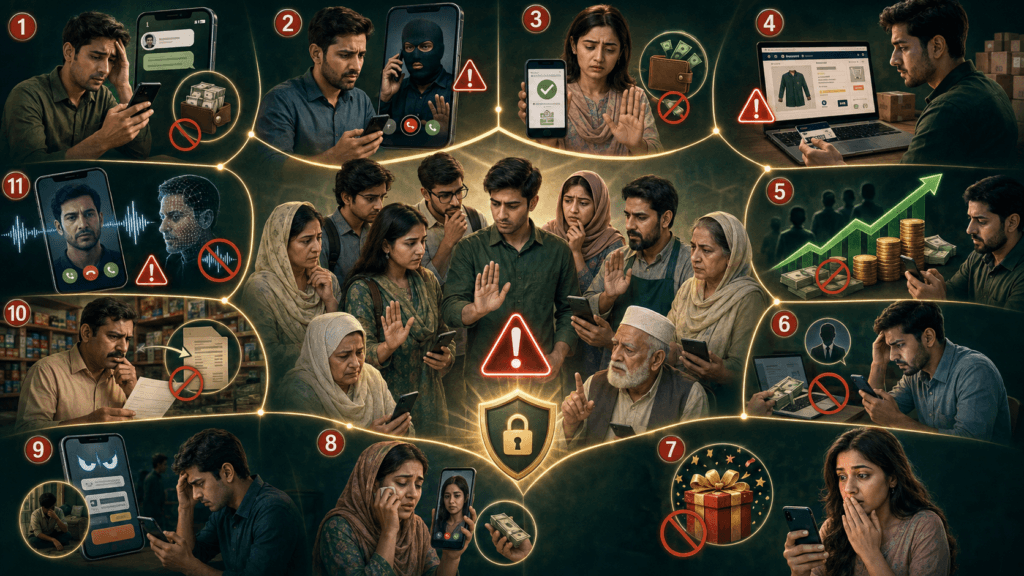
The platform used for online fraud changes, but the pressure tactics remain similar. These are the schemes Pakistani users should recognise.
| Scam | How the trap works | A warning sign |
| 1. WhatsApp impersonation | A criminal copies a relative’s picture or claims to have a new number and asks for emergency money | The sender prevents a voice call or wants payment to an unrelated account |
| 2. Fake bank, OTP or KYC call | A caller claims that an account, card or biometric record will be blocked | The caller asks for an OTP, PIN, password or remote access |
| 3. JazzCash or Easypaisa deception | A fake receipt, reversal story or “mistaken transfer” is used to obtain money | The message screenshot does not match the balance shown inside the official app |
| 4. Social-media shopping scam | An attractive product is offered at a deep discount and advance payment is demanded | A new page has copied reviews, no verifiable address and refuses a secure payment method |
| 5. Investment, forex or crypto scheme | A group shows manufactured profits and promises fixed or daily returns | Returns are guaranteed, withdrawals require another “tax,” or funds go to personal accounts |
| 6. Fake job, visa or task scam | The victim is offered easy work, overseas employment or paid online tasks | Registration, security, training or release fees are demanded before genuine verification |
| 7. Prize, lottery or government-aid scam | A message claims that the victim has won money or qualifies for assistance | A fee or OTP is required to receive a prize never entered for |
| 8. Romance or emergency scam | A fake relationship is built before requests for medical, travel or customs money begin | Every crisis needs money, but an in-person meeting or independent identity check never happens |
| 9. Fake loan or recovery app | An app collects contacts and identity data, then demands unlawful charges or uses threats | It seeks unnecessary permissions and has no verifiable regulated entity behind it |
| 10. Business invoice redirection | A supplier’s email or identity is copied and payment details are quietly changed | The IBAN changes suddenly and the request discourages a telephone confirmation |
| 11. AI voice, video or recovery scam | A cloned voice creates a family emergency, or a “recovery agent” promises to return lost money | The caller demands secrecy, instant payment or a second fee to recover the first loss |
Students are frequently targeted through fake profiles, online jobs, shopping offers and investment claims. This form of online fraud is illustrated usefully on the Prime Minister’s Youth Programme awareness page. Its complaint details refer to the former FIA Cyber Crime Wing, however, so the present NCCIA route explained below should be used for a current cybercrime complaint.
Crypto-related online fraud can look like an ordinary investment opportunity. Before handing money to a social-media trader or “account manager,” readers should understand the difference between personal trading, a regulated service and a deceptive investment arrangement in Qanooni Dastak’s guide on whether crypto is legal in Pakistan.
Online Fraud Red Flags That Should Stop a Payment
Online fraud often reveals itself through a detail that cannot be independently verified. Pause the transaction if even one important fact is doubtful. Several red flags together make the danger stronger:
- “Act in the next ten minutes or your account will close.”
- “Do not call your family, bank or employer.”
- “Share the OTP so I can cancel the transaction.”
- “Install this screen-sharing or remote-control app.”
- “Send a small fee before your prize, loan, refund or profit is released.”
- “Pay into my brother’s, agent’s or employee’s personal account.”
- “The investment is risk-free and the return is guaranteed.”
- “The QR code will receive money for you,” when scanning it actually authorises payment.
- A government or bank logo appears, but the domain, email or account title is different.
- The person becomes abusive when asked for a written contract, licence or video verification.
- A second person suddenly appears to confirm the first person’s story.
- After the loss, an unknown “officer” or “hacker” guarantees recovery for an advance fee.
No genuine bank employee needs your complete PIN, password or one-time password. NCCIA’s own financial-fraud safety page similarly tells citizens to keep PINs, passwords and OTPs private, even when the caller claims to represent a bank.
Online Fraud: Follow These 11 Urgent Steps

Step 1: Stop the Loss Without Sending a “Final Fee”
Online fraud victims should end the payment process immediately. Do not send a tax, unlocking fee, verification amount or recovery charge merely because the offender says the first payment will otherwise be lost. Do not threaten the suspect, attempt to hack the account or publicly publish unverified identity details.
If remote access is still active, disconnect the affected device from the internet. Use a different, trusted device for banking and password changes.
Step 2: Call the Bank or Wallet Provider Immediately
In online fraud involving money, use the number printed on the card, shown inside the official app or published on the institution’s real website. Tell the representative whether the transfer was unauthorised, induced by deception, made through a card, or sent to a bank or wallet account.
Ask for:
- blocking of cards, tokens or compromised access;
- registration of a formal fraud complaint;
- a complaint or ticket number;
- consideration of a beneficiary hold, recall, dispute or trace; and
- written guidance on the documents required.
Do not rely only on “we have noted it.” Record the time of the call and the name or ID of the representative where available.
Step 3: Secure Every Connected Account
Online fraud can spread from one compromised account to several connected services. Change the email password first if that email controls password resets. Then change banking, wallet, social-media and marketplace credentials. Sign out of unknown sessions, remove unrecognised devices, disable suspicious forwarding rules and enable two-factor authentication.
If an OTP, card number or CNIC image was exposed, tell the relevant institution exactly what was shared. Do not factory-reset the affected phone before preserving evidence or receiving appropriate guidance, unless continued access creates an immediate safety risk.
Step 4: Preserve the Original Digital Evidence
For online fraud evidence, before blocking or deleting, save the complete conversation with dates, times and account details. Take full screenshots, export chats where possible, preserve voice notes and retain original emails with headers. Write down profile, post, website and payment links separately because a screenshot may not preserve the underlying address.
The strongest record shows both the deception and the transfer it caused. Readers who need a broader explanation of originals, copies, expert evidence and modern-device material can consult Qanooni Dastak’s Qanun e Shahadat Order 1984 evidence guide.
Step 5: Build a Clear Money Trail
Collect the bank statement, debit alert, transaction ID, date, exact amount, beneficiary name, bank or wallet, IBAN or account number and any fake receipt. If several transfers occurred, list each one in a table. Do not combine them into one estimated figure.
A strong online fraud money trail is often the bridge between a convincing story and legally useful evidence. It can help the bank, investigator and court see where the funds moved and why the payment was made.
Step 6: Write a One-Page Chronology
Begin with the first contact and move forward by date and time. Explain what the person represented, why you believed it, what action you took, when money or data was transferred and how the deception was discovered.
Use facts rather than labels. “On 6 August at 3:10 p.m., the account sent a bank-logo message and asked for an OTP” is more useful than “a dangerous cybercriminal attacked me.” A clear chronology makes an online fraud complaint easier to understand and verify.
Step 7: File the Complaint With NCCIA
Under the current law, the National Cyber Crime Investigation Agency is the specialised investigation agency for PECA offences. Submit the online fraud incident through the official NCCIA form, save the confirmation and keep the reference number. The form asks for identity and contact details, city, a cybercrime category and a description of the incident.
NCCIA also publishes regional office details, the helpline 1799, and helpdesk@nccia.gov.pk. A telephone call can provide guidance, but it should not be mistaken for a written complaint. For a complete screen-by-screen filing and follow-up guide, read Qanooni Dastak’s Cyber Crime Online Complaint Pakistan article.
Step 8: Report the Scam Number or Link Through the Correct Route
Report the phone number to its mobile or telephone service provider first. PTA advises citizens to escalate an unresolved scam-number report through its complaint mechanism or helpline 0800-55055. This step may help block a number or device, but PTA is not a substitute for the bank’s payment response or NCCIA’s criminal investigation.
Also use the platform’s private reporting tool for a fake page, impersonating profile, phishing advertisement or malicious shop. Removing an online fraud page can protect other users, but preserve the URL and screenshot before the content disappears.
Step 9: Use the Banking Complaint Ladder
When online fraud causes a banking loss, a cybercrime complaint and a banking complaint perform different jobs. NCCIA investigates alleged criminal conduct. The bank examines the account, transaction and its own service obligations.
The State Bank’s SUNWAI portal routes complaints involving banks, microfinance banks and development finance institutions. SBP explains that the institution is the first forum, Banking Mohtasib Pakistan is the second forum and SBP handles certain cases. The Banking Mohtasib’s current procedure says a written bank complaint should be made first; if the bank does not resolve it within 30 days, a complaint may be lodged with the Mohtasib. An immediate bank decline can also affect the route.
Keep copies, not originals, of everything submitted. Do not wait 30 days to alert the bank about a fresh fraudulent transfer; the 30-day period concerns escalation of the unresolved grievance, not the first emergency report.
Step 10: Contact Police When the Facts Require It
Some online fraud incidents develop into physical threats. Call the police or emergency service if the offender threatens violence, knows the victim’s location, attempts physical entry, abducts someone, or commits another immediate offence outside the purely digital space. Tell NCCIA about the connected police report and tell police about the cybercrime reference so that the facts are not presented as unrelated stories.
If fake profiles, threats or blackmail are connected with employment authority, a workplace complaint may exist alongside the cybercrime route. Qanooni Dastak’s Harassment Complaint Pakistan guide explains why workplace, cybercrime and ordinary criminal proceedings should not be confused.
Step 11: Track the Case and Avoid a Second Scam
Keep one file containing the bank ticket, NCCIA reference, PTA or operator complaint, platform report and police entry. Record every follow-up date. Verify the identity and official contact of anyone asking for further information.
Online fraud victims are often targeted again by people promising guaranteed recovery, arrest or account tracing for a fee. No private person can honestly guarantee the result of an online fraud investigation or the return of money. Never share an OTP, password or remote access with someone claiming to be an investigator.
FIA or NCCIA: Which Portal Is Current?

The distinction is now clear in the consolidated Prevention of Electronic Crimes Act, 2016. Amended section 29 establishes NCCIA for inquiry, investigation and prosecution of PECA offences. It also provides that the former FIA Cyber Crime Wing ceased to exist and its cases, inquiries, staff and related matters transferred to NCCIA.
The FIA general complaint form remains online and covers several FIA categories. Its continued existence does not replace NCCIA’s specialised statutory role for cybercrime. Some older awareness pages still create confusion. For example, the Punjab Women Development Department cybercrime page links to the former NR3C/FIA route. Such pages may remain useful as awareness material, but a current online fraud report should start with NCCIA’s official channels.
Which Pakistani Laws May Apply to Online Fraud?

Online fraud can engage more than one legal provision in a single event. The following table is a public-awareness guide, not a charge sheet.
| Provision | What it may cover in simple words | Maximum punishment stated in the current published text |
| PECA section 13 | Electronic forgery, including unauthentic electronic data created or altered for fraud or an illegal claim | Up to 3 years, or fine up to Rs250,000, or both; higher consequences apply to critical infrastructure |
| PECA section 14 | Use of a system, device or data, or deception/inducement, for wrongful gain where harm is likely | Up to 2 years, or fine up to Rs10 million, or both |
| PECA section 16 | Obtaining, possessing, transmitting or using another person’s identity information without authority | Up to 3 years, or fine up to Rs5 million, or both |
| PPC sections 419 and 420 | Cheating by personation and cheating that dishonestly induces delivery of property | Application depends on proof of the ingredients and the established facts |
| PECA section 45 | Court-ordered compensation for damage or loss, without destroying an additional civil remedy | Compensation is discretionary; it is not an automatic refund on filing a complaint |
Amended sections 29 and 30 deal with NCCIA and investigation powers. Sections 31 and 32 provide mechanisms for preservation of specified data and retention of traffic data within the statutory process. This is why quick reporting can matter: the ordinary victim should preserve what is under his or her control, while the authorised agency can pursue data through legal powers.
A victim does not need to guess every section. Describe the deception, digital method, loss and evidence accurately. Investigators, prosecutors and courts determine the appropriate offences. False exaggeration can damage a genuine claim.
A Sindh High Court Lesson: An Allegation Is Not a Money Trail

In Usman son of Samad v. The State, Criminal Bail Application No. 2276 of 2025, decided on 7 November 2025, the Sindh High Court considered a post-arrest bail request arising from an alleged online lottery scheme and a connected money-laundering case.
The prosecution alleged that victims in Pakistan and abroad had been induced to transfer funds through online platforms and that alleged proceeds were later linked with bank transactions and a Toyota Revo. The Court did not conduct the final trial. At the bail stage, it found that the record then available did not sufficiently trace the alleged cyber-fraud funds to the vehicle or deposits through a conclusive audit trail. It granted post-arrest bail on surety of Rs500,000 and expressly said that its observations were tentative and would not control the trial.
This was not an acquittal and it did not declare lottery scams lawful. Its practical lesson is that an online fraud allegation still requires proof: serious labels and large bank figures cannot replace a connected money trail. A useful investigation needs the victim’s payment, date, transaction reference, recipient account, surrounding communication and later movement of funds to be linked through evidence.
| Court point | Practical lesson for a victim |
| An alleged predicate offence must be connected to the claimed proceeds | Preserve the exact transfer and the deception that caused it |
| Bank statements alone may not explain the criminal origin of funds | Identify the victim payment, beneficiary and transaction reference |
| Delay may weaken the immediacy of an allegation | Alert the bank and authority promptly |
| Bail observations are tentative | Do not report a bail order as a conviction or final innocence |
The judgment makes the evidence checklist below more than administrative paperwork. It is the chain that may connect the screen, the victim, the payment and the suspected beneficiary.
Evidence Checklist for an Online Fraud Complaint
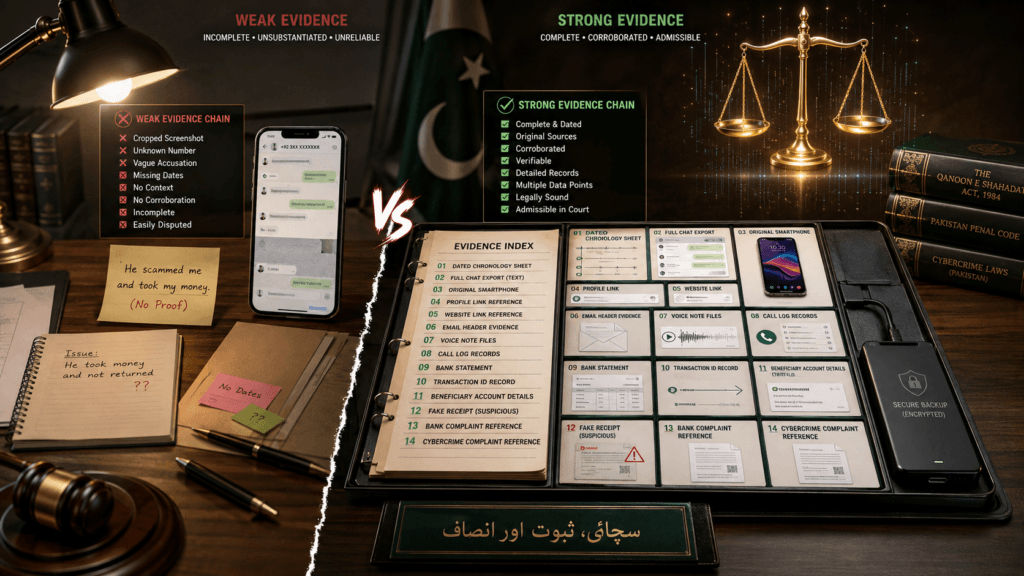
A strong online fraud complaint should connect the deception, the payment, the suspect’s visible identifiers and every report made afterward.
- CNIC and current contact details of the complainant.
- A one-page chronology with exact or honestly approximate dates and times.
- Full screenshots showing the account, number, date, time and conversation context.
- Exported chat and the original phone where reasonably available.
- Profile username, user ID, page link, advertisement URL and website address.
- Original emails with headers and login-security alerts.
- Voice notes, call logs and the number used for contact.
- Fake invoice, payment receipt, offer letter, licence, identity card or investment dashboard.
- Bank statement, card alert, transaction ID, amount, beneficiary title, IBAN/account number and wallet details.
- Bank, wallet, NCCIA, PTA, platform and police complaint references.
- Names of witnesses and a short note of what each person personally saw or heard.
- A numbered index that explains every file without altering the original.
- A secure backup separate from the affected device.
Never crop out useful context merely to make a screenshot look stronger. Do not edit the original file, invent a witness, create a later conversation or accuse an account holder only because money passed through an account. An account may be a mule account, a compromised account or one part of a wider chain. The investigation must establish responsibility.
A Clear Complaint Format You Can Adapt
Subject: Complaint regarding online fraud through [platform] and transfer of Rs[amount]
I, [full name], CNIC [number], resident of [address], state that on [date and time] I was contacted through [phone number, account, email or URL]. The person represented that [state the exact claim]. Relying on that representation, I transferred Rs[amount] on [date/time] through [bank/wallet] to [beneficiary title and account/IBAN/wallet], transaction ID [number].
I discovered the deception when [state what happened]. The account then [blocked contact/demanded another fee/disappeared/sent threats]. I reported the transaction to [bank/wallet] on [date/time] under reference [number].
I have preserved the complete conversation, advertisement/profile link, transaction record, beneficiary details, call log and other material listed in the attached index. I request lawful inquiry, preservation and examination of relevant digital and financial records, and action according to the established facts and applicable law.
Attachments: numbered chronology, screenshots/chat export, transaction proof, beneficiary details, bank complaint, and identity document.
Keep the wording factual. Do not paste passwords, PINs or OTPs into a complaint attachment. Ask NCCIA how highly sensitive material should be delivered securely.
How to Prevent Online Fraud Before Money Moves
Use a Ten-Minute Verification Rule
Urgency is the favourite weapon of online fraud. Pause for ten minutes. Call the relative, bank, seller or supplier through a number obtained independently—not the number supplied inside the suspicious message.
Verify the Beneficiary, Not Only the Screenshot
Read the account title shown by the official banking app before authorising payment. A logo, receipt image or WhatsApp name can be copied in seconds. For a business invoice change, confirm the new account through a known telephone contact.
Protect the Keys to Your Accounts
Never share an OTP, PIN, password, card security code, recovery phrase or screen-sharing access. Enable transaction alerts, use different passwords, keep software updated and review active sessions regularly.
Verify Investments Through the Regulator
Do not treat a celebrity video, social-media group or profit screenshot as a licence. Check the legal entity, regulator, licence category, withdrawal terms and named bank account. Guaranteed returns and pressure to recruit others are strong danger signs.
Create a Family Safety Code
Families can choose a private word or question for genuine emergencies. A cloned voice may sound convincing, but it may not know the family’s private verification method.
Teach Without Shaming
Older persons, students and first-time digital users should know that reporting quickly is more important than hiding a mistake. A calm family response preserves evidence and may stop a second payment.
Frequently Asked Questions
Where should online fraud be reported in Pakistan?
Report the cybercrime element to NCCIA through complaint.nccia.gov.pk and preserve the reference number. For a financial transfer, inform the bank or wallet provider immediately. Report a scam number to the service provider and PTA where required. Contact police as well for immediate physical threats or connected ordinary offences.
Is FIA or NCCIA responsible for a cyber-fraud complaint now?
NCCIA is the investigation agency established under amended section 29 of PECA. The former FIA Cyber Crime Wing ceased to exist and its matters transferred to NCCIA. FIA’s general complaint portal still serves other FIA complaint categories.
Can money sent voluntarily after deception still be reported?
Yes. “Voluntary” pressing of the transfer button does not make deception lawful. Tell the bank and NCCIA exactly how the payment was induced. A bank reversal may be more difficult where the customer authorised the transfer, but the facts should still be reported promptly and truthfully.
Can the bank guarantee reversal of an online fraud transfer?
No. Recovery depends on timing, payment method, availability of funds, beneficiary status, bank procedures, evidence and legal action. Ask for a hold, recall, dispute or trace, but do not state that recovery is guaranteed.
What should a JazzCash or Easypaisa victim do?
Contact the wallet provider through its official channel immediately, secure the account, obtain a complaint reference and preserve the transaction ID and beneficiary details. A regulated financial complaint may also be routed through SBP’s SUNWAI system, while the alleged crime should be reported to NCCIA.
Is one screenshot enough to prove the case?
Usually, one cropped screenshot is a weak starting point. Preserve the full chat, original device or export, profile link, timestamps and the financial record. Authenticity, context and connection to the transaction matter.
Should the scammer be blocked immediately?
Safety comes first. Preserve the important identifiers and evidence before blocking where it is safe to do so. If communication is causing danger or severe distress, block it after recording what is reasonably possible and seek official help.
What if the offender is outside Pakistan?
PECA can apply in specified circumstances to conduct outside Pakistan that affects a person, property, information system or data in Pakistan. File the complaint with full cross-border identifiers. International tracing and cooperation depend on the facts and lawful process.
Can an anonymous NCCIA complaint be filed online?
The current online form asks for identifying details including the complainant’s full name and CNIC. If disclosure creates a special safety concern, seek guidance through 1799 or an official NCCIA office rather than entering false information.
Does filing a complaint automatically create an FIR or conviction?
No. A portal submission may be scrutinised, followed by an inquiry or investigation according to jurisdiction and evidence. It is not an automatic FIR, recovery order, arrest, or conviction.
Final Word: Shame Protects the Scammer, Evidence Protects the Victim
Online fraud succeeds when urgency defeats verification and shame prevents reporting. The safest response is calm and documented: stop further payment, alert the financial institution, secure the accounts, preserve the original evidence and submit the facts to the correct authority.
For an online fraud victim, Pakistan now has a dedicated NCCIA complaint route, while banks, SBP, Banking Mohtasib, PTA and police perform different supporting roles. Using the correct forum does not guarantee recovery, but it prevents avoidable delay and builds a record capable of being investigated.
Share this guide with parents, students, shopkeepers, employees and overseas relatives. One warning received before a transfer may protect a family’s entire savings.
Disclaimer
This article provides general legal awareness and was reviewed against publicly available material on 8 August 2026. It is not a substitute for advice on a specific case. Applicable offences, banking remedies, jurisdiction, limitation and evidence depend on the facts. Seek advice from a qualified Pakistani lawyer where the loss is substantial, identity material is compromised, threats are involved or court proceedings may be required.