
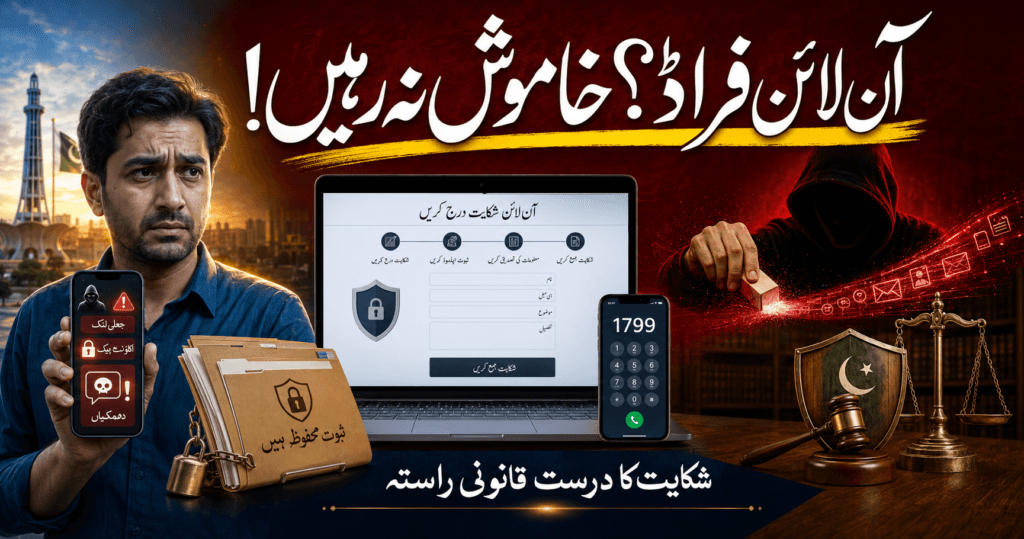
Searching for cyber crime online complaint Pakistan usually begins at a frightening moment. Money may have vanished from a bank account, a social-media profile may have been hacked, or a stranger may be threatening to publish private photographs. In that moment, a victim needs the correct authority, a safe reporting method and steps that can be taken immediately.
Pakistan’s cybercrime system changed after the Prevention of Electronic Crimes (Amendment) Act, 2025. The National Cyber Crime Investigation Agency (NCCIA) now provides the official complaint route, while many older pages still direct people to the former FIA Cyber Crime Wing or NR3C. This guide explains the current NCCIA procedure, the evidence you should preserve, the difference between a complaint and an FIR, and the lessons emerging from recent Sindh High Court judgments.
Quick answer: To file a cyber crime online complaint Pakistan, visit the official NCCIA Complaint Portal, enter your details, describe the incident chronologically, submit the form, and save its confirmation or reference number. For guidance, call 1799 or email helpdesk@nccia.gov.pk. A call does not replace a written complaint.
Table of Contents
Need Help Right Now? Use Only These Official NCCIA Channels
| Purpose | Current official route |
|---|---|
| File online | NCCIA Complaint Registration Form |
| Seek guidance | NCCIA 24/7 helpline: 1799 |
| Send a written complaint or ask about evidence submission | helpdesk@nccia.gov.pk |
| Find a reporting centre | NCCIA Offices Across Pakistan |
| Download a written form | NCCIA Urdu and English Complaint Proforma |
| Read official reporting options | NCCIA Frequently Asked Questions |
The form asks for the complainant’s identity, contact and address details, city, crime category and incident narrative, followed by a declaration of truth. If no evidence-upload field appears, submit the facts, preserve every original file and ask NCCIA’s official email or nearest office how to deliver the material securely.
NCCIA’s published channels do not include a general WhatsApp complaint number. Never trust a random account merely because it displays a government logo.
FIA or NCCIA? The 2025 Legal Change Most Older Guides Miss
The original Prevention of Electronic Crimes Act, 2016 remains Pakistan’s central cybercrime law, but it must now be read with the Prevention of Electronic Crimes (Amendment) Act, 2025.
The 2025 amendment made several changes relevant to a complainant:
- Section 29 provides for NCCIA to inquire into, investigate and prosecute PECA offences. The former FIA Cyber Crime Wing ceased to exist and its pending matters, staff and assets transferred to NCCIA.
- Amended section 30 gives PECA investigation power to an authorised agency officer, subject to any lawfully constituted joint investigation team.
- The amendment defines a complainant broadly enough to include a victim or a person who has substantial reason to believe that an offence has been committed.
- New section 26A covers intentional public dissemination of information known or believed to be false or fake and likely to create fear, panic, disorder or unrest. Punishment may extend to three years, a fine of two million rupees, or both.
- The law also provides new structures concerning social-media regulation, complaints and tribunals. Their role should not be confused with NCCIA’s criminal investigation function.
This is why a current cyber crime online complaint Pakistan guide should lead with NCCIA, not the former FIA Cyber Crime Wing. Older FIA pages may still appear in search results, but they do not replace the present statutory position and NCCIA’s published channels.

Cyber Crime Online Complaint Pakistan: Follow These 7 Urgent Steps
Step 1: Stop the Harm Before It Spreads
If an account was hacked, change its password from a secure device, sign out of other sessions and enable two-factor authentication. For a transfer, call the bank or wallet provider and obtain a complaint reference. For an immediate physical threat, contact police or emergency services as well. Safety comes before screenshots.
Do not pay a blackmailer merely because the person promises to delete the material. Payment may not end the threat. Avoid angry threats, public accusations or attempts to hack the suspect in return; those actions can create further risk and complicate the evidence.
Step 2: Preserve Evidence Before Deleting or Blocking Anything
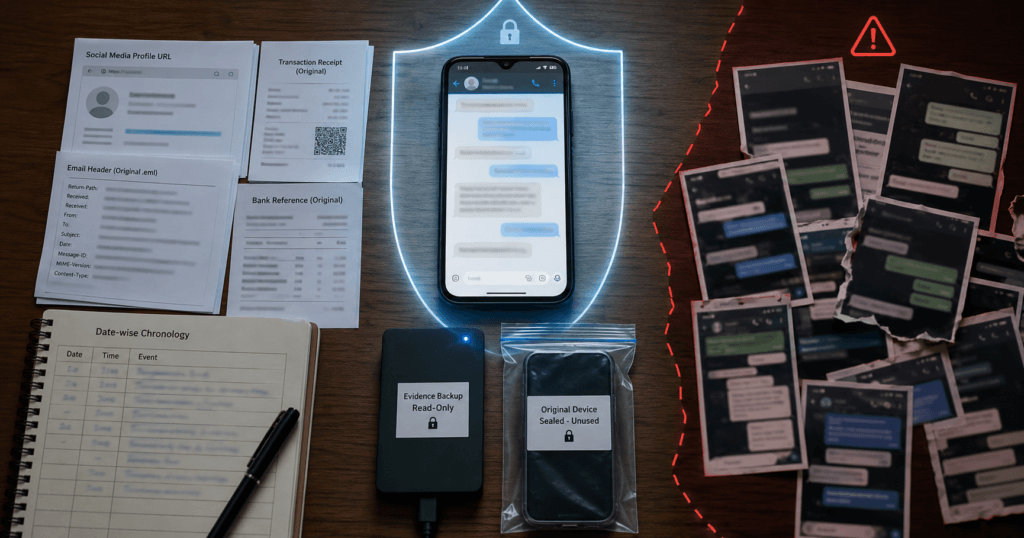
Capture full screenshots showing the account, date, time and conversation. Save profile and post URLs, email, number and username separately; export chats where possible. Keep receipts, transaction IDs, account or IBAN details, wallet identifiers and alerts.
Do not rely only on cropped screenshots. Keep the original files and the device on which they were received. Do not edit, annotate or repeatedly forward sensitive images. If you must block the suspect for safety, record the relevant information first.
Step 3: Open the Correct Government Portal, Not a Lookalike Page
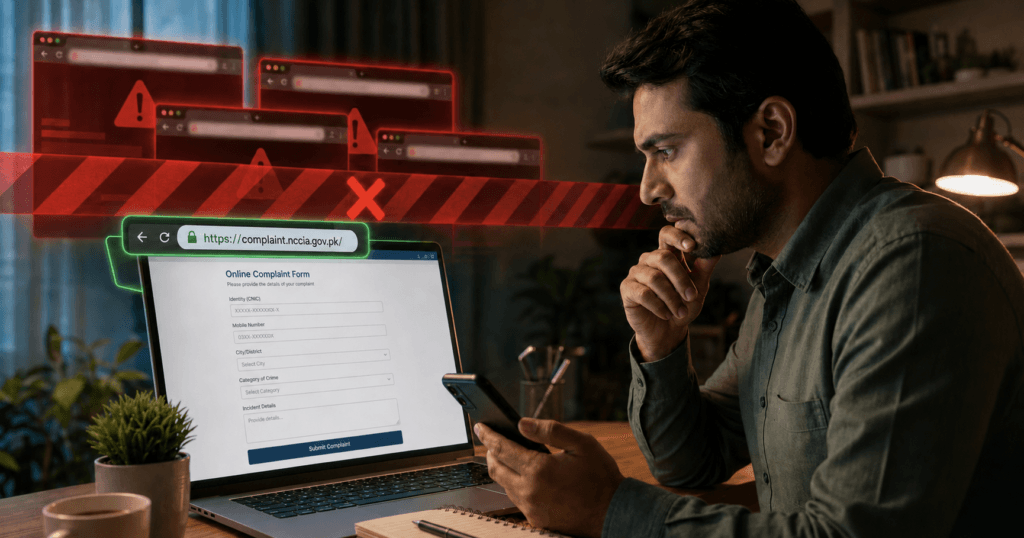
Type complaint.nccia.gov.pk yourself or use the official NCCIA complaint link. Check the domain before entering your CNIC. Avoid sponsored lookalikes and private services that imply they can register a government complaint automatically.
The legitimate form identifies NCCIA under the Government of Pakistan and displays 1799. Filing a cyber crime online complaint Pakistan should never require paying a stranger, sharing an OTP or installing remote-access software.
Step 4: Complete the Identity and Contact Fields Carefully
Enter your name and CNIC exactly as they appear on your identity document. Give an active mobile number and email address because the agency may need clarification. Select the correct city and the cybercrime category.
If the form offers one broad “Cybercrime” category, clearly identify the incident type in the crime-details box, such as:
- Electronic fraud
- Hacked account
- Cyberstalking
- Identity misuse
- Private-image blackmail
Enter the suspect’s identifiers in the incident narrative, not in your own contact field.
Step 5: Write a Chronology an Investigator Can Understand
A strong complaint answers six questions: who, what, when, where, how and what loss or threat followed.
Start with the first contact and move date by date. State the platform used, the suspect’s visible identifiers, the words or conduct complained of, the amount lost and the evidence available.
Avoid conclusions that you cannot support. Instead of writing only “He is a cybercriminal,” write that on a particular date a named account sent a link, induced a transfer to a specified account and then blocked communication. Facts are more useful than labels.
Step 6: Submit the Evidence Through a Secure Official Channel
If no upload option appears, keep an indexed evidence folder and ask NCCIA how it should be delivered. An email can list the attachments; provide a storage device in person only if an authorised officer requests it.
For intimate or highly sensitive material, do not attach it casually or circulate it among relatives. Explain that such material exists and ask for a secure method of submission. Courts have stressed that sensitive photographs must be handled confidentially and only on a need-to-know basis.
Step 7: Save Proof of Submission and Follow Up Without Guesswork
Screenshot the confirmation and preserve the reference number. Record the date, channel and office. If an officer contacts you, note the name, designation and official contact details. Verify any request involving credentials or money.
There is no universal public deadline guaranteeing that every cyber crime online complaint Pakistan will become an inquiry or FIR within a fixed period. Complexity, jurisdiction and evidence differ. Follow up through 1799 or the relevant office using your reference details.
Which Online Acts Can Be Reported? Match the Harm With the Evidence
| Incident | Potential PECA area | Evidence that may matter |
|---|---|---|
| Account or email hacking | Sections 3–5: unauthorised access, copying or interference | Login alerts, recovery emails, device history and changed credentials |
| Fake payment proof or online scam | Sections 13–14: electronic forgery or electronic fraud | Transaction record, fake receipt, account details, chats and advertisement |
| Misuse of CNIC, photograph or identity | Section 16: unauthorised use of identity information | Fake profile URL, original identity material and impersonating messages |
| False public allegations harming dignity or privacy | Section 20, subject to its legal ingredients | Public post URL, publication date, screenshots and proof connecting the account |
| Intimate images or sexual blackmail | Section 21 and related provisions | Threats, publication links, original messages and device evidence |
| Repeated online following or harassment | Section 24: cyberstalking | Repeated contacts, clear refusal, dates, calls, messages and fear or distress caused |
| Spoofed source or fake online identity | Section 26 and other applicable provisions | Email headers, fake page, number, domain and technical alerts |
| False information creating public fear or unrest | Section 26A introduced in 2025 | Original post, audience, context and proof relevant to knowledge and likely effect |
This table is a guide, not a final charge sheet. One incident can involve PECA, the Pakistan Penal Code, banking law or another statute. The precise provisions depend on the facts established during inquiry.
A Complaint Is Not an FIR: What Happens After You Press Submit?
A portal submission begins the process; it is not an automatic FIR, recovery order or conviction. NCCIA may scrutinise jurisdiction, request documents, contact the complainant, preserve data or conduct an inquiry before formal investigation follows.
A complaint supplies information; an inquiry tests it; an FIR or formal case records the alleged offence; and a challan places prosecution material before the court. Not every complaint becomes an FIR, so missing dates, assumptions and altered evidence can be costly.
For a cybercrime offence, the amended law gives NCCIA the investigating role. A local police station may still be relevant where the same incident contains an immediate physical threat or a separate PPC offence.
An official Senate of Pakistan committee report also recorded the post-amendment position that cybercrime complaints are forwarded to NCCIA rather than being investigated as PECA FIRs by ordinary police stations.
Copy This Clear Cybercrime Complaint Format
Subject: Complaint regarding [online fraud / hacking / cyberstalking / identity misuse]
To: The In-charge, National Cyber Crime Investigation Agency
Relying on that representation/following the continued threats, [explain what happened in chronological order]. I suffered [financial loss, account loss, harassment, privacy violation or threat]. The identifiers connected with the incident are [URLs, usernames, phone numbers, account/IBAN or wallet details].
I have preserved the following material: [numbered list of screenshots, original messages, transaction records, emails, recordings and witness details].
I request NCCIA to examine the complaint, preserve relevant electronic data and take action in accordance with PECA and other applicable law.
I affirm that the information supplied is true to the best of my knowledge.
Name / CNIC / Mobile / Email / Date / Signature
Money Has Gone? The First Hour Can Matter More Than the First Week
An NCCIA complaint does not automatically reverse a transaction. Immediately report the fraud to the sending bank, receiving institution if known, or wallet provider. Ask for a fraud reference, beneficiary-account hold or recall request where available. Change compromised credentials and block affected cards or accounts.
Submit the cyber crime online complaint Pakistan with the transaction ID, amount, date, beneficiary details and deception used. Never pay a supposed refund fee, tax, verification deposit or account-unfreezing charge.
For banking-related complaints, use the State Bank of Pakistan’s official Consumer Protection Helpdesk, which provides an online complaint form and access to the SUNWAI Customer Complaint Service. If money was transferred fraudulently, contact your bank immediately and obtain a complaint reference.
SBP explains that the concerned bank’s Complaint Management Unit is ordinarily the first forum. Where its response is delayed or unsatisfactory, the Banking Mohtasib or another appropriate forum may become available. Banking redress and NCCIA’s criminal investigation serve different purposes, so one should not be mistaken for the other.
Blackmail or Private Images? Protect Dignity While Preserving Proof
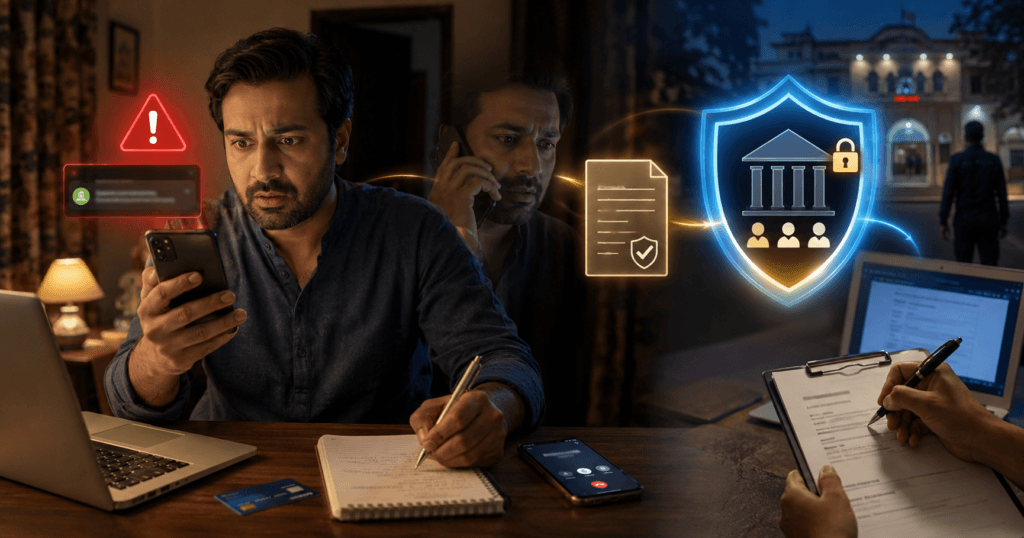
Do not publicly repost the image to prove that it exists. Preserve the threat, profile link and message context, then report through a secure official route.
If a platform allows a private report for non-consensual intimate material, use it alongside the NCCIA complaint, but retain proof of the original publication and the report submitted.
Tell NCCIA if the victim is a child, if the offender knows the home or workplace, or if the threats suggest immediate physical harm. Such facts affect urgency and may require other protective action.
A victim should not be shamed for seeking help. The law protects dignity, and investigative bodies and courts must handle sensitive material responsibly.

Three Court Decisions Every Cybercrime Complainant Should Understand
Mst. Alia Rani — Missing Dates Can Weaken Even a Serious Allegation
In Mst. Alia Rani, Criminal Miscellaneous Application No. 691 of 2025, the Sindh High Court dealt with allegations involving secretly taken photographs and blackmail.
The application failed because the narrative lacked crucial dates, supporting information and credible material. However, the Court expressly recognised that hidden smartphone data requires digital-forensic expertise, identified NCCIA as distinct from the dissolved FIA Cyber Crime Wing, and noted that a PECA complaint could be pursued.
The practical lesson is simple: state the timeline precisely and approach the authority equipped to examine electronic evidence.
Adeel Rehman Memon — Electronic Evidence Cannot Be Repaired at the End
In Adeel Rehman Memon v. The State, Criminal Miscellaneous Application No. 43 of 2025, a disputed USB audio recording became the centre of a post-evidence forensic request.
The Sindh High Court set aside the orders permitting that belated process. It stressed procedural fairness and discussed authenticity, integrity, origin and chain of custody, while holding that the prosecution could not receive a late opportunity to cure material gaps after closing its evidence.
For a complainant, the lesson is to preserve originals and disclose important digital material at the proper stage rather than producing an unexplained copy much later.
Anees Ahmed — Screenshots, Call Records and Assumptions Are Not the Same as Proof
In Anees Ahmed v. The State, Criminal Jail Appeal No. D-11 of 2023, decided in 2026, the Sindh High Court found defects in unauthenticated call records, unlinked WhatsApp screenshots and the recovery history of mobile phones.
It held that public dissemination, blackmail and the required intent under sections 21 and 24 were not proved, and acquitted the appellant. The Court also noted the transfer of responsibility to NCCIA and protected sensitive photographs.
The lesson for a cyber crime online complaint Pakistan is to connect every account, message and file to the alleged conduct instead of relying on suspicion.

Evidence Checklist: Save What the Investigator and Court May Need
Electronic material does not become reliable merely because it appears on a screen. Readers who want to understand primary evidence, expert opinion and Article 164 concerning modern-device evidence may also read our complete Qanun e Shahadat Order 1984 evidence guide.
- A one-page chronology with exact dates and times.
- Full, uncropped screenshots plus the original device or export.
- Profile, post, website and payment URLs written separately.
- Usernames, email addresses, telephone numbers and account identifiers.
- Bank statement, transaction ID, beneficiary details and complaint reference.
- Original emails with headers and login-security notifications.
- Witness names and what each witness personally saw or received.
- Copies of reports made to the platform, bank, wallet provider or police.
- A numbered index explaining each file without altering the original.
- A secure backup stored separately from the affected phone.
Never manufacture a conversation, edit a screenshot to make it clearer, or add a person merely because you suspect involvement. A truthful complaint with limited but authentic evidence is stronger than a dramatic allegation built on material that cannot be verified.
Avoid These Mistakes That Quietly Damage Genuine Complaints
- Filing through a private website instead of the official NCCIA domain.
- Writing conclusions without dates, account details or a chronology.
- Deleting chats immediately after taking one cropped screenshot.
- Publicly sharing private images while asking for help.
- Treating helpline advice as proof that a formal complaint was registered.
- Assuming that every complaint automatically becomes an FIR.
- Waiting days before alerting a bank about an unauthorised transfer.
- Sending OTPs, passwords or fees to someone claiming to be an officer.
- Submitting unrelated screenshots that cannot be linked to the parties.
- Promising or expecting guaranteed arrest, recovery or completion within a fixed period.
Frequently Asked Questions About Cyber Crime Online Complaint Pakistan
What is the official portal for a cyber crime online complaint Pakistan?
The official online form is available at complaint.nccia.gov.pk. Check the domain carefully before entering your CNIC or contact information.
What is the current cybercrime helpline number in Pakistan?
NCCIA publishes 1799 as its 24/7 helpline. Use it for official guidance, but submit a written complaint through the portal, email or reporting centre so that a record exists.
Is FIA or NCCIA responsible for cybercrime complaints now?
NCCIA is the specialised investigation agency under amended sections 29 and 30 of PECA. The 2025 amendment transferred the former FIA Cyber Crime Wing’s cases and related matters to NCCIA.
Can I file a complaint through WhatsApp?
The official NCCIA sources reviewed for this article do not list a general WhatsApp complaint number. Use the official portal, 1799, helpdesk email, or a listed NCCIA office. Never trust an unverified number merely because it uses a government logo.
Can I make an anonymous online complaint?
The official online form requires identifying information including full name and CNIC. If personal safety creates a special concern, contact NCCIA through 1799 or its official email for guidance rather than entering false information.
Can an overseas Pakistani submit a complaint?
PECA has application beyond Pakistan in specified circumstances, including conduct affecting a person, property, information system or data in Pakistan. Overseas complainants should use the online or written channels and contact NCCIA where the form’s CNIC, city or attendance requirements create difficulty.
Can a person report cybercrime suffered by someone else?
The 2025 definition of “complainant” includes a victim and a person having substantial reasons to believe an offence occurred. Give only verified facts and explain your connection to the victim or incident.
Does submitting the form automatically register an FIR?
No. A complaint can first be scrutinised or converted into an inquiry. Formal investigation or an FIR depends on jurisdiction, facts, evidence and the applicable procedure.
How can I track my cybercrime complaint?
Save the confirmation and reference number. Follow any instructions shown in the confirmation, or contact 1799 or the relevant regional office. Do not expect meaningful tracking without the complaint reference and submission date.
Can NCCIA recover money lost in an online scam?
NCCIA can investigate an alleged cybercrime, but recovery is not automatic or guaranteed. Prompt bank reporting, availability of funds, account tracing, evidence and later legal proceedings all affect the outcome.
Should I visit local police or NCCIA?
Report the PECA/cyber element to NCCIA. Contact local police as well when there is an immediate physical threat or a distinct offence under general criminal law. The correct combination depends on the facts.
What if the online form has no option to upload evidence?
Submit an accurate narrative, preserve the originals and ask NCCIA through its official email or nearest office how to deliver them securely. Do not upload sensitive material to unofficial websites or public social-media posts.
Final Word: Speed Matters, but Reliable Evidence Matters More
A cyber crime online complaint Pakistan is most useful when it reaches the correct authority quickly and tells a verifiable story. Use NCCIA’s official portal, preserve original evidence and explain the incident date by date. Alert your bank immediately in financial fraud and contact police where physical safety is threatened.
The 2025 legal changes and recent judgments carry the same message from different directions: cybercrime requires specialised investigation, while electronic evidence must be authentic, connected and handled lawfully.
Acting early cannot guarantee a particular result, but it can prevent avoidable gaps from destroying a genuine case.
Disclaimer: This article provides general legal information and does not constitute legal advice. Cybercrime complaints, evidence, and remedies depend on the facts of each case. Obtain advice from a qualified Pakistani lawyer where urgent protection, substantial financial loss or court proceedings are involved.