

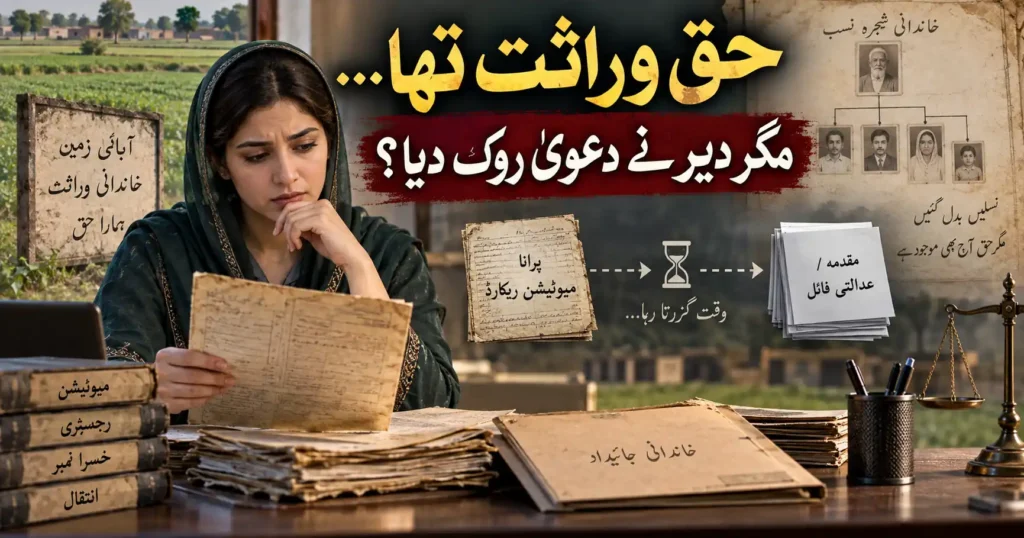
An inheritance dispute in Pakistan often begins long before anyone enters a courtroom. A daughter’s name may be missing from an old mutation, one brother may control the land for decades, or family members may keep saying, “We will settle it later.” The real danger appears when a lawful share is openly denied and nobody records the date or takes timely legal action.
PLD 2023 Supreme Court 362, Saadat Khan and others v. Shahid-ur-Rehman and others, explains that inheritance rights and limitation must be understood together. The Supreme Court accepted that a lawful heir’s ownership does not depend on an inheritance mutation. But it also held that a declaratory claim may become time-barred after a clear, known and overt denial of that right.
This distinction matters in every inheritance dispute in Pakistan. An old wrong entry may not by itself destroy ownership, yet a sale, compensation claim, transfer or other outward act asserting exclusive ownership can change the limitation analysis. The question is not only, “How old is the mutation?” It is: What was the first legally relevant denial, when did the claimant know about it, and what relief is now required?
Table of Contents
Judgment at a Glance: PLD 2023 SC 362
| Point | Detail |
|---|---|
| Case | Saadat Khan and others v. Shahid-ur-Rehman and others |
| Citation | PLD 2023 Supreme Court 362 |
| Court | Supreme Court of Pakistan |
| Petition | Civil Petition No. 262-P of 2017 |
| Decision date | 23 September 2021 |
| Bench | Umar Ata Bandial, Syed Mansoor Ali Shah and Muhammad Ali Mazhar, JJ. |
| Author judge | Syed Mansoor Ali Shah, J. |
| Property | Agricultural land measuring 19 kanal 17 marla |
| Disputed mutation | Inheritance Mutation No. 327 dated 23 March 1935 |
| Main question | When did the right to sue accrue for excluded female heirs? |
| Key laws | Section 42 Specific Relief Act; Article 120 and Sections 9 and 18 Limitation Act |
| Final result | Petition dismissed; leave to appeal declined |
IRAC: Why the Decades-Old Claim Failed
| IRAC | Analysis |
|---|---|
| Issue | Could successors of two daughters challenge the inheritance entries and later transfers through a 2004 declaratory suit, or had limitation expired? |
| Rule | A Section 42 declaratory suit may fall under Article 120 where no other specific limitation article applies. Time runs from accrual of the right to sue. Section 18 addresses concealed fraud; Section 9 addresses continuous running once time begins. |
| Analysis | A wrong mutation alone did not automatically oust the sisters. But in 1960–61 Abdur Rehman received acquisition compensation, a share was demanded, and he refused. The Supreme Court treated this as a known overt denial. |
| Conclusion | The six-year period expired during the sisters’ lifetime. Their successors could not restart it, so leave to appeal was declined. |
How a 1935 Mutation Became a 2004 Lawsuit
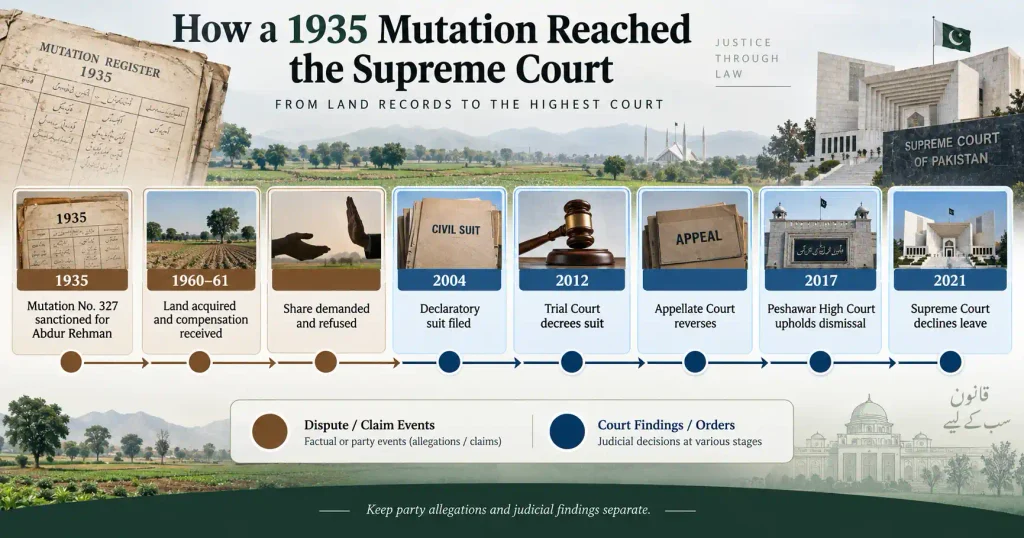
Isa Khan owned 19 kanal and 17 marla of agricultural land. After his death, Inheritance Mutation No. 327 was sanctioned on 23 March 1935 in favour of his son, Abdur Rehman. The petitioners later alleged that Isa Khan had also left two daughters, Mst. Mehro and Mst. Afsro, who were excluded from the entry.
In 1960–61, part of the property was acquired by the Small Industries Corporation of West Pakistan, and Abdur Rehman received the compensation. After his death, his legal heirs inherited the remaining property and almost all of it was later sold to numerous purchasers.
On 19 November 2004, the successors of the two daughters filed a suit for a declaration that the 1935 inheritance mutation, the later inheritance entry and subsequent transfers were void and ineffective against their rights. The reported judgment describes the action as declaratory; it should not be simplified into a generic “cancellation of mutation” suit.
For an inheritance dispute in Pakistan, the complete chain matters. Death, mutation, first demand, refusal, acquisition, sale, knowledge and filing may all have different legal significance.
What Each Side Actually Argued
The heirs relied on succession and co-sharer rights
The petitioners argued that the daughters inherited from their father and that omission from the revenue mutation could not erase ownership. They relied on principles protecting co-sharers and female heirs and challenged the findings on limitation.
Their position was that an inheritance dispute in Pakistan should not fail merely because a very old mutation omitted lawful heirs.
The respondents relied on knowledge and open denial
The respondents said Abdur Rehman had possessed the property as exclusive owner to the sisters’ knowledge. Their strongest fact was the 1960–61 acquisition compensation. They relied on knowledge of the compensation and later dealings with the land to support their limitation defence.
The limitation argument therefore depended on a known outward repudiation, not simply on the age of the mutation.
What Evidence Can Decide an Inheritance Dispute in Pakistan?
Saadat Khan, appearing as PW-5, admitted that Abdur Rehman had received compensation for the acquired land and that a share was demanded from him but he refused to pay it.
The Supreme Court treated receipt of the compensation, in these facts, as dealing with that portion as exclusive owner. The refusal showed express repudiation. Because the sisters knew of the conduct in 1960–61, the Court held that their right to sue for declaration had accrued then.
Evidence of knowledge can therefore decide an inheritance dispute in Pakistan. A legal notice, deed, acquisition award, compensation receipt, mutation proceeding, written refusal, earlier pleading or witness admission may prove both the denial and the date on which it became known.
The Law: Inheritance Starts at Death, But Time Still Matters
Muslim succession is not created by a mutation
For Muslim parties, section 2 of the West Pakistan Muslim Personal Law (Shariat) Application Act, 1962 makes Muslim Personal Law the rule of decision on succession, subject to applicable enactments. Pakistan Code’s published text expressly includes testate and intestate succession.
PLD 2023 Supreme Court 362 also explains that ownership devolves on legal heirs immediately on death and does not depend upon sanction of an inheritance mutation.
This matters in an inheritance dispute in Pakistan because a wrong revenue entry can be important evidence without being the source of title itself.
For a dispute focused on a missing or incorrect inheritance entry, see our Inheritance Mutation in Pakistan guide. If the first question is who the heirs actually are, Proof of Legal Heirs in Pakistan may also help.
Section 42: declaration must match the real injury
Section 42 of the Specific Relief Act, 1877 permits a person claiming a right in property to seek a declaration against someone denying, or interested to deny, that right.
Its proviso is equally important: a court should not grant a bare declaration where the plaintiff is able to seek further relief but omits it.
In an inheritance dispute in Pakistan, a claimant who has lost possession, faces a disputed instrument, needs partition, or seeks to stop a transfer should not assume one standard prayer is enough. The relief must fit the real legal injury.
Pakistan Code’s currently published text of Section 42, substituted by Act XXXIII of 2023, also states a six-month disposal timeline for the suit and ninety days for the appeal. Those are court-disposal timelines, not the limitation period for instituting the claim, and the amendment came after the 2021 Saadat Khan decision.
Article 120: six years in this declaratory claim
Article 120 of the Limitation Act, 1908 is residuary. Pakistan Code lists a six-year period for a suit for which no limitation period is provided elsewhere in the Schedule, beginning when the right to sue accrues.
In Saadat Khan, the Supreme Court held that Article 120 governed the Section 42 declaratory suit before it.
That does not mean every inheritance dispute in Pakistan automatically carries six years. Limitation depends on the cause of action, relief claimed, applicable statutory article and facts that trigger accrual. Possession, cancellation of an instrument, partition or another remedy may require a different analysis.
Section 18: concealed fraud can postpone time
Section 18 addresses fraud that keeps a claimant from knowledge of the right or title, including fraudulent concealment of a necessary document. In qualifying circumstances, limitation may be computed from when the fraud first became known.
But a wrongful act is not automatically a concealed act. The Supreme Court stressed that deliberate concealment can attract Section 18, while an open act cannot be treated as fraudulent concealment simply because it was allegedly unlawful. It also noted the statutory protection concerning a transferee claiming in good faith and for valuable consideration.
In an inheritance dispute in Pakistan involving fraud, identify what was concealed, who concealed it, how discovery was prevented, when it was discovered and what evidence proves that date.
Section 9: the clock does not simply restart
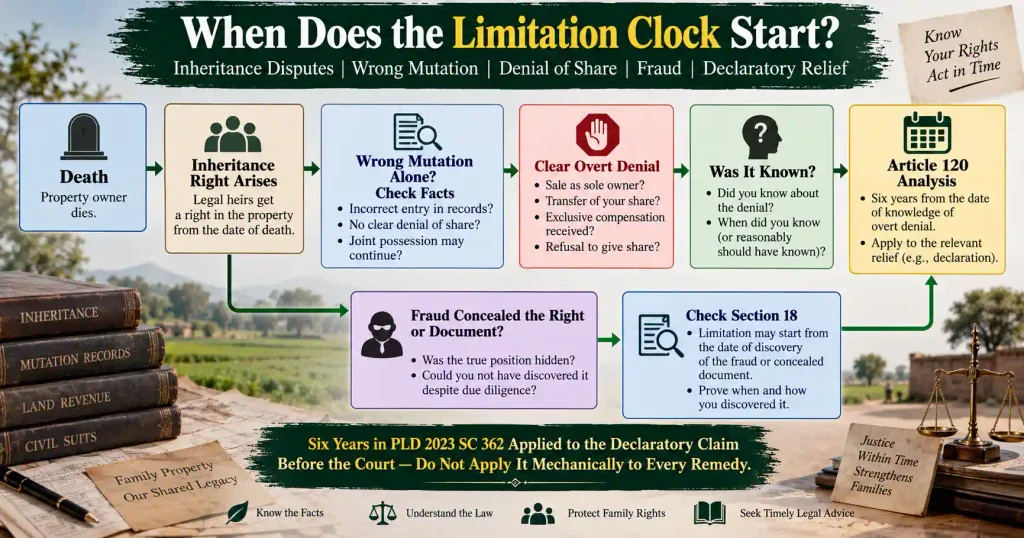
Section 9 states, subject to its proviso, that once limitation has begun to run, a later disability or inability to sue does not stop it.
In Saadat Khan, once limitation had begun in the sisters’ lifetime, their successors did not receive a fresh period simply because the right later passed to them.
That is a serious warning in any delayed inheritance dispute in Pakistan.
Wrong Mutation: When Can an Inheritance Dispute in Pakistan Begin?
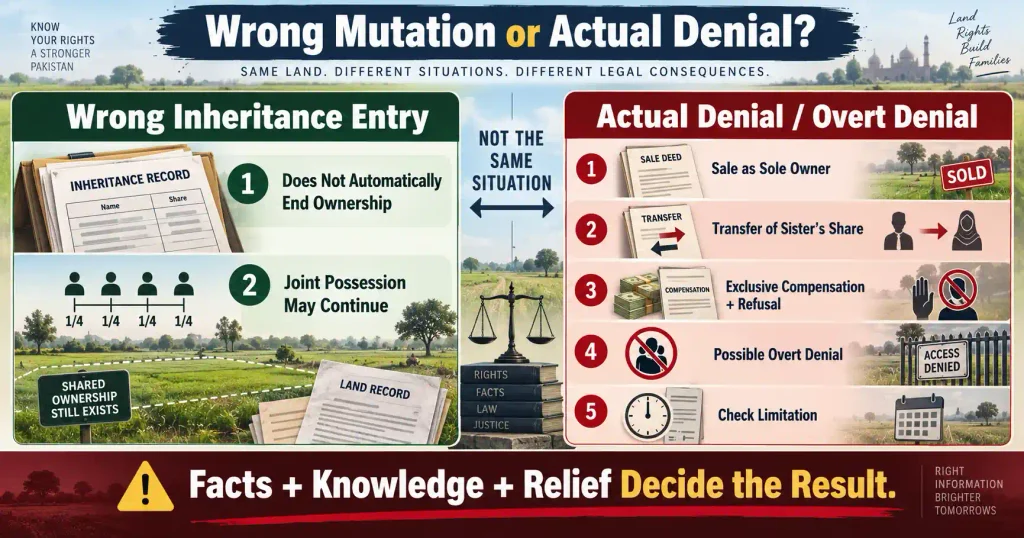
The judgment requires a careful distinction between a wrong revenue entry and an overt act denying title.
| Situation | Possible Significance Under the Judgment |
|---|---|
| Sister omitted from inheritance mutation | Does not by itself extinguish ownership |
| Brother remains in joint possession | Normally not enough alone to prove hostile exclusion |
| Profits are not shared | Not automatically a repudiation of ownership |
| Mere oral negation in family disputes | May not be actual denial without an overt act |
| Mutation claims the sister transferred her share | May amount to an overt act requiring limitation analysis |
| Property sold as if one heir is sole owner | Can amount to express repudiation |
| Compensation taken exclusively and share refused | On these case facts, it was actual denial |
| Property transferred to outsiders | Can affect parties, remedies and limitation |
The Supreme Court explained that actual denial between co-sharers should not be inferred too readily. Mere oral negation, without an overt act ousting another co-sharer from ownership, does not necessarily amount to actual denial.
Co-Sharer Possession Is Not Easily Hostile
Possession of joint property by one co-sharer is generally considered possession on behalf of all. A co-sharer who is not physically present may remain in constructive possession.
This can protect an heir in an inheritance dispute in Pakistan where one family member cultivated or managed the property for years. Silence, non-possession or failure to receive profits does not automatically prove legal ouster.
The Supreme Court specifically observed, in the brother-sister context before it, that mere failure to give sisters profits and a wrong inheritance entry did not by themselves repudiate their ownership.
But constructive possession is not unlimited. A fraudulent sale or gift, a mutation asserting that the sister transferred her share, or disposal of property while claiming exclusive ownership may amount to an overt denial.
Can Buyers Change an Inheritance Dispute in Pakistan?
Section 18 distinguishes persons guilty of or accessory to fraud from a person claiming through them in good faith and for valuable consideration. The Supreme Court also distinguished cases where property remains with the allegedly defrauding family from cases involving further alienation to third parties.
Before filing an inheritance dispute in Pakistan, obtain the transfer chain and identify the present owners. Ignoring later purchasers, registered deeds or present possession can mean missing necessary parties or necessary relief.
If the property remains joint and the immediate issue is its physical division, see Partition of Inherited Land in Pakistan.
A Succession Certificate, meanwhile, should not automatically be treated as a substitute for determining disputed title to immovable property.
What the Supreme Court Finally Decided
The Supreme Court agreed with the appellate court and the Peshawar High Court on limitation.
It held that the 1960–61 acquisition and receipt of compensation were open acts known to Mst. Mehro and Mst. Afsro. PW-5’s evidence showed that a share in the compensation had been demanded and refused. The Court treated receipt of the compensation as an express overt act repudiating the sisters’ rights.
The six-year period under Article 120 therefore expired during the sisters’ lifetime. Their successors could not restart it.
The Supreme Court found the petition meritless, dismissed it and declined leave to appeal.
What the Court Did Not Decide
The Court did not hold that daughters lose inheritance merely because they are missing from a mutation.
It did not hold that a wrong mutation automatically destroys title. It did not hold that a brother’s possession of joint land automatically becomes hostile to his sister. And it did not create a rule that every old inheritance dispute in Pakistan is barred simply because decades have passed.
The result depended on specific facts: open acquisition, compensation, demand, refusal, knowledge, later alienations and a declaratory suit filed after the Court found that the right to sue had accrued.
Different facts can produce a different limitation result. Our Women Inheritance Rights guide discusses other Pakistani judgments involving female heirs and denial of inheritance shares.
Which Forum Fits an Inheritance Dispute in Pakistan?
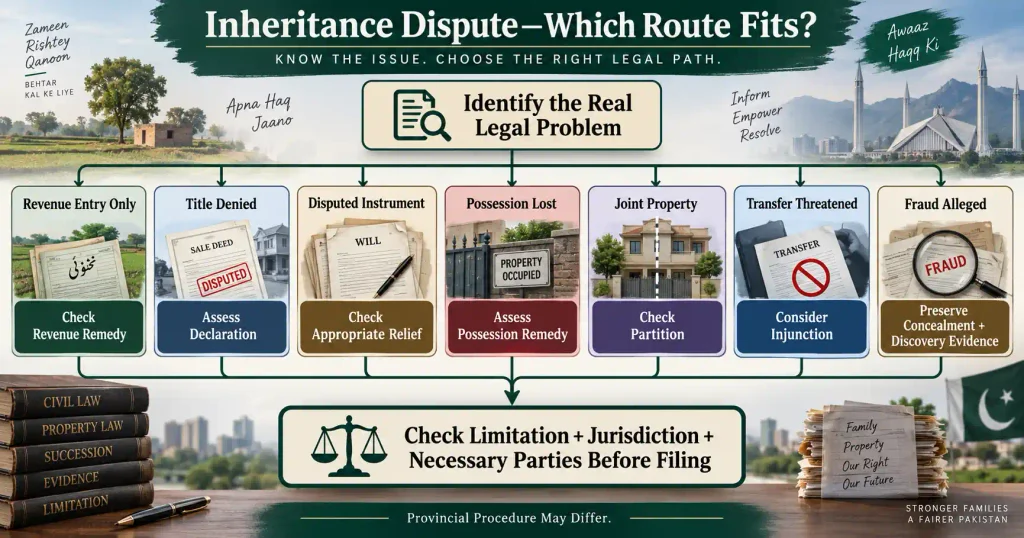
There is no single filing route for every inheritance dispute in Pakistan. The forum and relief depend on what is actually contested and on the applicable provincial or territorial revenue law.
A revenue-record issue without a genuine title contest may involve the relevant revenue remedy. If ownership itself is denied, civil declaratory relief may need to be considered. A disputed instrument may require appropriate relief against that instrument. Lost possession may require possession relief. Joint property may require partition. A threatened transfer may justify considering an injunction.
Section 42 itself warns against seeking only a declaration where further relief is available but omitted.
The case should therefore be framed around the real legal injury, not the generic label “inheritance case.” Provincial land-revenue procedure should also be checked before selecting a forum.
Build the Evidence File Before You File
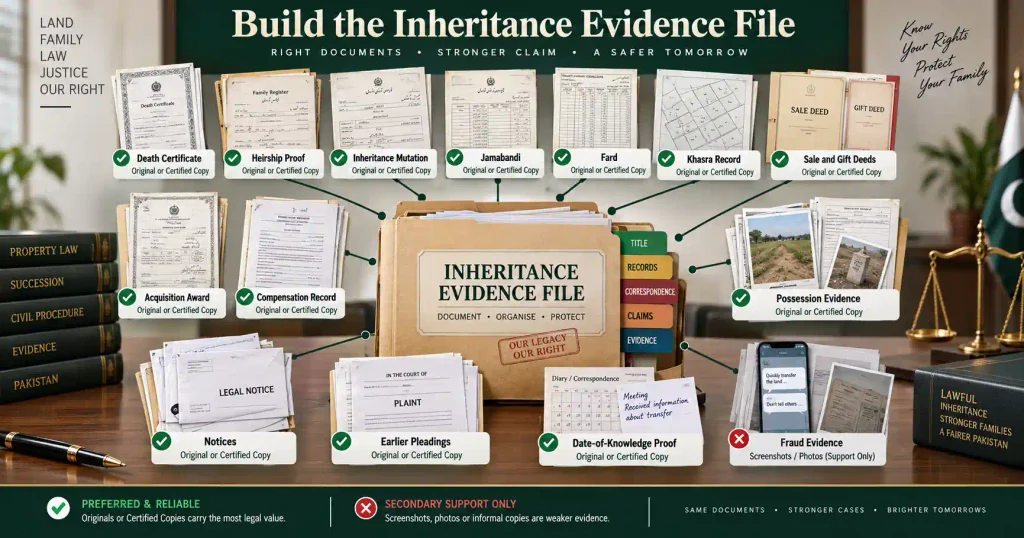
For an inheritance dispute in Pakistan, preserve the complete record:
- Death certificate and reliable proof of relationship.
- CNICs and family-registration material where relevant.
- Certified inheritance mutation and later mutation history.
- Jamabandi, fard, khasra and applicable land records.
- Registered sale, gift, release or relinquishment documents.
- Acquisition award and compensation-payment record.
- Possession and partition material.
- Written demands, replies, notices and admissions.
- Earlier pleadings and certified court orders.
- Proof showing when the claimant learned of the disputed act.
- Evidence supporting any allegation of concealment or fraud.
- Details of present transferees and current owners.
Certified records are usually more useful than cropped screenshots because authenticity, chronology and the exact wording of a transaction may become disputed.
Seven Checks Before Taking the Next Legal Step
First, identify every legal heir and trace title from the deceased owner.
Second, prepare a chronology from death to the present dispute.
Third, separate the wrong mutation from the first overt denial.
Fourth, identify evidence proving knowledge—or lack of knowledge—of that denial.
Fifth, trace every later sale, gift, acquisition or transfer.
Sixth, determine the correct forum, necessary parties and complete relief before filing.
Seventh, calculate limitation against the actual relief instead of assuming inheritance claims remain open forever.
These checks do not guarantee success. They reduce the risk of filing the wrong case, against the wrong parties, with the wrong limitation theory.
Practical Effect of PLD 2023 Supreme Court 362
The judgment gives both protection and warning.
It protects co-sharers by refusing to treat every wrong mutation, family possession or oral quarrel as legal ouster. But it warns that a clear and known act of exclusive ownership can mature the right to sue and activate limitation.
That is the central lesson for an inheritance dispute in Pakistan: lawful inheritance and an available court remedy are related, but they are not identical questions.
A person may have a genuine grievance about the original distribution yet still face a serious limitation defence because of what happened later and when it became known.
Conclusion: Protect Your Share in an Inheritance Dispute in Pakistan
An inheritance dispute in Pakistan should never be evaluated from the age of a mutation alone. Start with succession, then trace possession, transfers, knowledge, fraud, denial, present ownership, correct forum and the relief required.
PLD 2023 Supreme Court 362 avoids two dangerous extremes. It does not allow a wrong mutation by itself to erase a lawful co-sharer, but it also does not treat inheritance litigation as permanently immune from limitation.
If an heir has been excluded, obtain certified records early, identify the first overt denial, preserve proof of when it became known and have the proposed relief checked before filing.
One misunderstood date can change the entire inheritance dispute in Pakistan.
Frequently Asked Questions about PLD 2023 Supreme Court 362
What did PLD 2023 Supreme Court 362 actually decide?
The Supreme Court held that the particular declaratory claim was time-barred because the sisters’ side knew in 1960–61 that Abdur Rehman had received acquisition compensation and refused their claimed share. The Court treated that conduct as an overt denial. The six-year period under Article 120 expired during the sisters’ lifetime, so their successors could not restart it decades later.
Did the Court say an old mutation defeats daughters?
No. The judgment distinguishes a wrong inheritance entry from an overt denial of title. Inheritance devolves on lawful heirs independently of sanction of a mutation, and one co-sharer’s possession is ordinarily treated as possession for the others. The claim failed because the Court found a later, known repudiation and resulting limitation—not simply because the mutation dated from 1935.
When can limitation begin in an inheritance dispute in Pakistan?
For the Section 42 declaratory claim in Saadat Khan, the Supreme Court applied Article 120 and counted six years from accrual of the right to sue. Actual denial can create a compulsory cause of action; threatened denial may operate differently. The exact starting date depends on facts, knowledge and relief, so no single limitation period should be applied mechanically to every inheritance case.
Does a wrong inheritance mutation cancel ownership?
Not by itself. The Supreme Court stated that inheritance devolves on legal heirs on death and does not depend on sanction of the mutation. Later conduct can still matter. A sale, transfer, compensation claim or mutation asserting that another heir transferred the share may amount to an overt denial depending on the evidence and may affect limitation and remedies.
Can fraud postpone limitation in an inheritance case?
It can where Section 18 of the Limitation Act applies. The claimant must establish facts bringing the case within that provision, such as fraud keeping the relevant right, title or necessary document from his or her knowledge. An open act cannot become fraudulent concealment merely because it was allegedly wrongful. The date of discovery therefore needs careful pleading and proof.
Can children revive a time-barred claim of their mother?
Not merely because they inherited through her. In Saadat Khan, the Supreme Court held that the predecessors’ knowledge had already triggered limitation. Since the period expired in their lifetime, the successors could not obtain a fresh limitation period simply by filing after the right passed to them.
Where should an inheritance dispute in Pakistan be filed?
It depends on the real controversy. A revenue-record issue may involve the relevant revenue authority, while a genuine title dispute may require civil relief. Partition, possession, a disputed instrument or injunctive relief can involve different procedures and limitation rules. Before filing, identify the disputed act, present title, possession, necessary parties and exact relief instead of choosing a forum from the word “inheritance” alone.
What evidence should be preserved before filing?
Keep certified mutation and land records, title deeds, death and heirship material, transfer documents, acquisition and compensation records, possession evidence, notices, replies, prior pleadings and proof of the date of knowledge. If fraud is alleged, preserve evidence showing what was concealed and when it was discovered. In a delayed inheritance dispute in Pakistan, chronology can be as important as proof of the original share.
Disclaimer: This article is for general legal awareness and does not provide case-specific legal advice. Inheritance rights, limitation, forum, relief and procedure depend on the facts, evidence, applicable personal law and current provincial or territorial law. Obtain professional legal advice before filing, defending, transferring or surrendering a property right.