
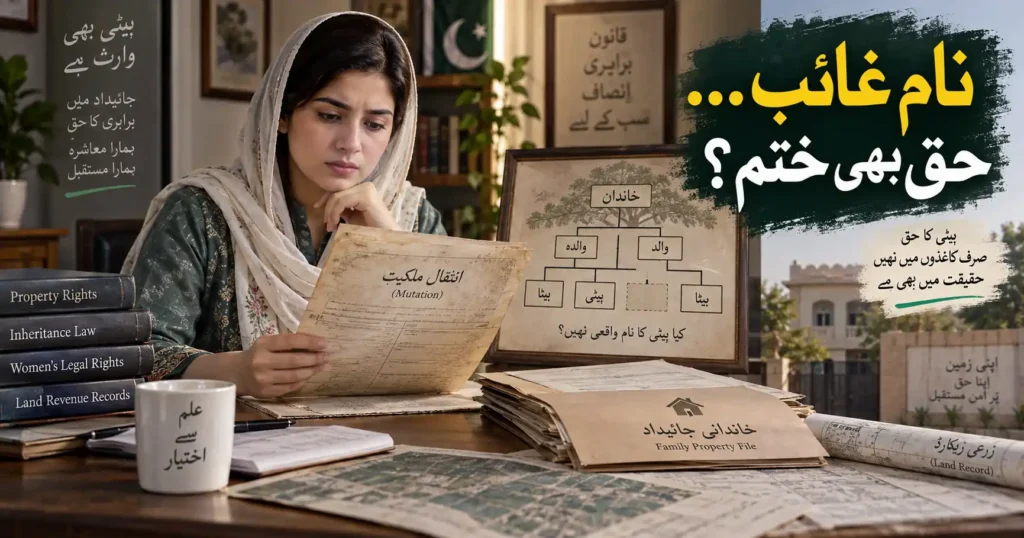
A death in the family can become a property dispute years later because of one missing name in the revenue record. A daughter may be left out, a widow may be shown with the wrong share, or one branch may quietly control the record. That is why Inheritance Mutation in Pakistan is more than a Patwari entry. It records a right that has already arisen under inheritance law.
The Supreme Court decision in Noor Din (deceased) through LRs v. Pervaiz Akhtar and others, reported as 2023 SCMR 1928, shows why an old mutation is not automatically final. A daughter was excluded from a 1958 inheritance mutation, and her legal heirs later challenged it. The Court examined title, constructive possession, limitation, proof of relinquishment, and the effect of a wrong mutation.
The warning is equally important: Inheritance Mutation in Pakistan should never be read as a “no limitation” rule. The date of knowledge, a clear denial, later transfers, third-party interests, and the exact relief can change the result.
Table of Contents
Judgment at a Glance: 2023 SCMR 1928
| Point | Verified Detail |
|---|---|
| Case | Noor Din (deceased) through LRs v. Pervaiz Akhtar and others |
| Citation | 2023 SCMR 1928 |
| Court | Supreme Court of Pakistan |
| Appeal | Civil Appeal No. 130 of 2016 |
| Decision date | 1 August 2023 |
| Bench | Muhammad Ali Mazhar, Syed Hasan Azhar Rizvi and Musarrat Hilali, JJ. |
| Author judge | Musarrat Hilali, J. |
| Original owner | Qaim Din |
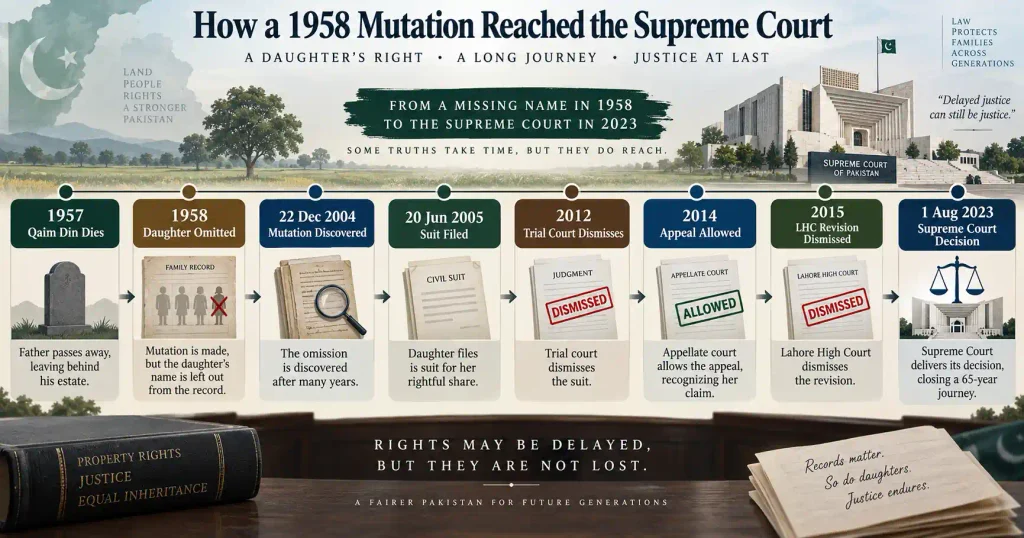
| Death | 1957 |
| Disputed mutation | Inheritance Mutation No. 18 dated 5 April 1958 |
| Excluded heir | Mst. Mir Jan, daughter of Qaim Din |
| Suit filed | 20 June 2005 |
| Main defence | Limitation and alleged lifetime transfer |
| Supreme Court result | No interference; claim confined to Qaim Din’s estate |
IRAC: Why the 1958 Mutation Did Not End the Claim
| IRAC | Analysis |
|---|---|
| Issue | Could the legal heirs of an excluded daughter challenge a 1958 mutation through a suit filed in 2005? |
| Rule | Succession opens on death. A wrong mutation does not itself create title. One heir’s possession may be constructive possession for all. Limitation can matter after a clear denial, acquiescence, or creation of third-party rights. |
| Analysis | Mir Jan’s relationship was not denied. The defendants alleged that Qaim Din transferred the property to his sons during his lifetime, but they produced no reliable proof. There was also no proof that Mir Jan relinquished or transferred her share. The plaintiffs pleaded first discovery of the wrong entry on 22 December 2004. |
| Conclusion | The Supreme Court declined to disturb the appellate and revisional conclusions and confined the inheritance claim to Qaim Din’s estate. |
How a Daughter Disappeared from the Record
Qaim Din died in 1957 leaving two sons, Fazal Ellahi and Noor Din, and one daughter, Mst. Mir Jan. Inheritance Mutation No. 18 was attested on 5 April 1958 in favour of the sons, while Mir Jan was omitted. Later, Fazal Ellahi died issueless and his estate was also devolved upon Noor Din.
After Mir Jan’s death, her legal heirs filed a suit seeking declaration, cancellation of the 1958 mutation and the later inheritance mutation, permanent injunction against further alienation, and correction of the revenue record. The trial court dismissed the suit in 2012, the Additional District Judge allowed the appeal in 2014, and the Lahore High Court dismissed the defendants’ revision in 2015.
For Inheritance Mutation in Pakistan, this procedural history matters because the Supreme Court was reviewing whether the lower appellate and revisional conclusions should be disturbed, especially on limitation.
What Each Side Actually Argued
The defendants relied on delay and an alleged transfer
The defendants argued that the suit was hopelessly time-barred because the mutation was from 1958 and the suit came in 2005. They also stressed that Mir Jan had not challenged the entry during her lifetime.
They further pleaded that Qaim Din had transferred the whole property to his sons while alive. If proved, that fact could have changed the inheritance picture because property validly transferred during life would not remain in the deceased’s estate.
The heirs relied on status, discovery, and denial
The respondents relied on Mir Jan’s admitted status as Qaim Din’s daughter. Their case was that a wrong entry could not erase a lawful heir. They pleaded that they first obtained the mutation copy and discovered the exclusion on 22 December 2004.
In Inheritance Mutation in Pakistan disputes, three dates should therefore be separated: death, mutation, and the first clear denial or discovery. They are not always legally the same date.
What Evidence Weakened the Defence
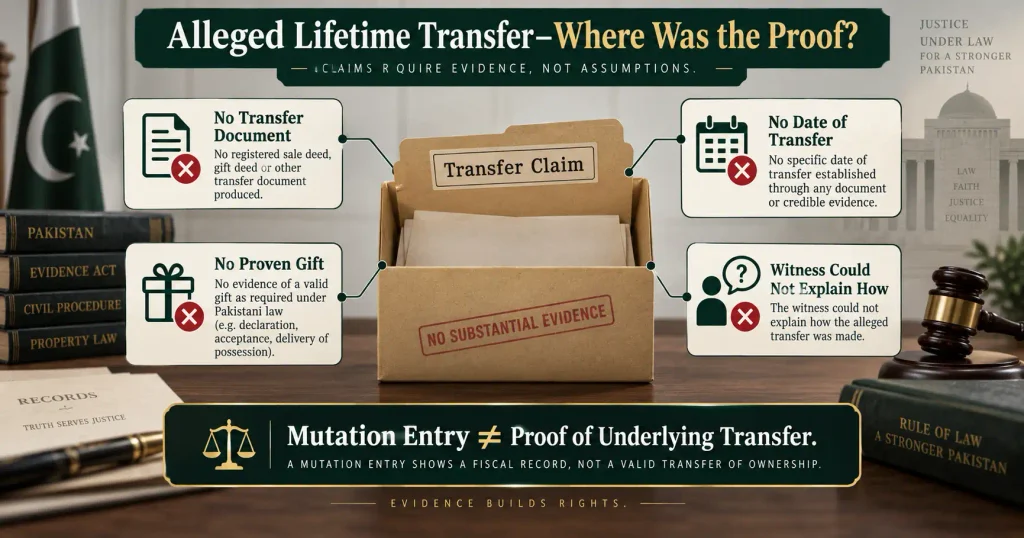
The defendants did not deny the relationship. Their difficulty was proving the alleged lifetime transfer.
Allah Ditta appeared as DW-1, but he produced no document showing that Qaim Din had transferred the property to Noor Din. He did not establish a gift, and in cross-examination he could not explain when or how the alleged transfer occurred.
The Supreme Court therefore had an admitted daughter, an inheritance mutation excluding her, and no positive proof that she had relinquished or transferred her share. Inheritance Mutation in Pakistan cannot substitute for proof of the underlying transaction when title itself is disputed.
The Law Behind Inheritance Mutation in Pakistan
Mutation records a right; it does not create one
The Supreme Court repeated that succession opens on the owner’s death and that a wrong mutation does not itself confer title. Revenue records serve fiscal and administrative purposes; they should reflect legal entitlement, not create it.
This is the first major rule of Inheritance Mutation in Pakistan. Mutation is important evidence and an important record, but it cannot validate an unlawful exclusion merely because it is old.
One co-heir’s possession may count for all
The Court also relied on constructive possession. One heir’s possession may be treated as possession on behalf of all heirs, so a brother cultivating inherited land does not automatically become the sole owner simply because a sister is not physically present.
That protection is not unlimited. A clear repudiation, proven transfer, express denial, or another positive act can change the legal position.
Limitation still applies after a clear denial
The judgment did not say inheritance suits are timeless. It said limitation becomes relevant where conduct shows acquiescence, particularly when third-party interests are created. In this case, no relinquishment or transfer by Mir Jan was proved, and the pleaded first discovery was in December 2004.
Article 120 of the Limitation Act, 1908 provides six years for a suit where no other period is prescribed, running from when the right to sue accrues. The exact starting point depends on the facts and relief. This is why the date of an old mutation should never be examined in isolation.
For a deeper limitation analysis, read Limitation in Inheritance Cases in Pakistan. Limitation in Inheritance Cases in Pakistan
That is why Inheritance Mutation in Pakistan should never be assessed by looking only at the age of the mutation.
What the Supreme Court Finally Decided
The Supreme Court found no reason to interfere with the appellate and revisional conclusions. The old mutation and an unproved allegation of lifetime transfer were not enough to defeat Mir Jan’s position.
However, the Court accepted an important boundary. Counsel for the respondents stated that the inheritance claim would remain confined to Qaim Din’s estate and would not extend to property independently purchased by the defendants. The appeal was disposed of in those terms.
This is a more accurate description than saying the heirs “won everything.” Inheritance Mutation in Pakistan only concerns property that legally forms part of the deceased’s estate.
What the Court Did Not Decide
The Court did not hold that every old inheritance mutation can be challenged forever. It did not say mutation has no evidentiary value. It did not decide ownership of property independently purchased by the defendants.
It also did not create one nationwide administrative process for every province, development authority, cantonment, housing society, or urban property system.
These limits are essential. Inheritance Mutation in Pakistan involves broad inheritance principles, but the record-changing procedure depends on the province, property type, and authority maintaining the property record.
How Inheritance Mutation in Pakistan Works Today
The inheritance right and the mutation process are related but different. Personal or succession law decides who inherits. The relevant land or property authority then updates its record.
Punjab: report the right and verify all heirs
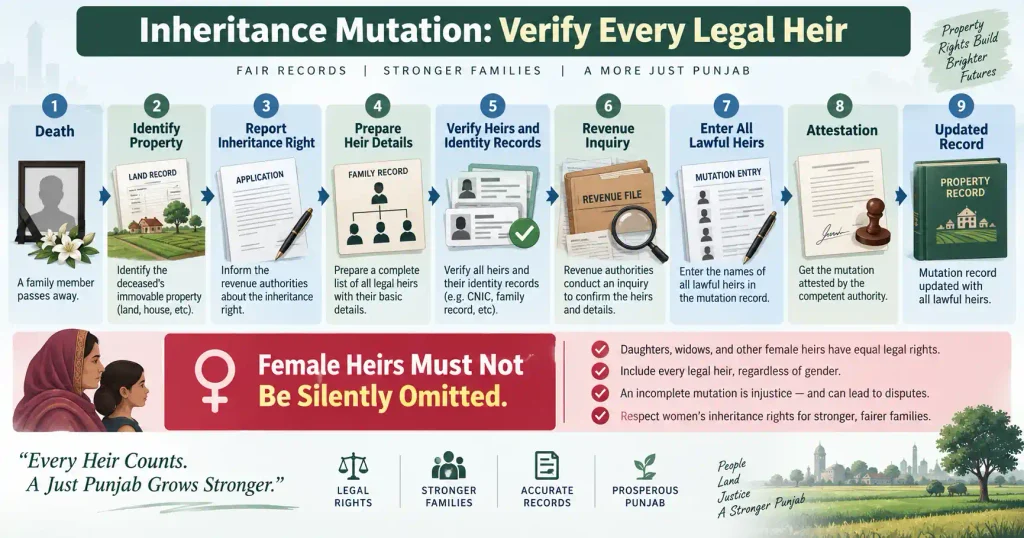
For land governed by the Punjab Land Revenue Act, section 42 provides for reporting acquisition of a right by inheritance. The official text states that the acquisition should be reported within three months.
Punjab’s official Land Revenue Rules require a summary inquiry into the legal heirs. The Revenue Officer is to record statements of at least two respectable persons about the heirs and obtain the prescribed identity records. The inheritance is first to be sanctioned in favour of all legal heirs, including female heirs. (Punjab Land Records Authority)
The rules also separate inheritance from a later gift or relinquishment by a female heir. This is important because a woman should first receive recognition of her inheritance before any separate transfer of that share is processed.
The Punjab Land Records Authority currently provides mutation entry and attestation services through its land-record system. Applicants should verify the latest checklist, fee, service centre, identity verification, and supporting papers before filing.
Other provinces and authorities use different routes
Punjab procedure should not be copied blindly across Pakistan.
The property may fall under a provincial Board of Revenue, a development authority, a cantonment, a housing authority, a cooperative society, or another statutory record system. Each may require a different application, supporting papers, verification process, and competent officer.
For Inheritance Mutation in Pakistan, the first procedural question should therefore be: which authority legally maintains this property record?
Documents for Inheritance Mutation in Pakistan
The exact checklist varies, but a strong file should prove four things: death, identity, family relationship, and ownership of the deceased.
Common records include the death certificate, identity records of the deceased and heirs, FRC or other family proof where applicable, CNICs or Form-B for relevant heirs, latest fard or ownership record, earlier mutation history, title documents, and correct khasra, khewat, khata, plot, or property identifiers.
Depending on the property and authority, additional succession or administration documents may be required.
Never omit a daughter, widow, mother, minor, or another possible legal heir merely because the family has reached an informal understanding. Inheritance Mutation in Pakistan should first identify the lawful heirs. A later gift, release, sale, relinquishment, or family settlement should be processed separately where law requires it.
Wrong Inheritance Mutation in Pakistan: Which Remedy Fits?
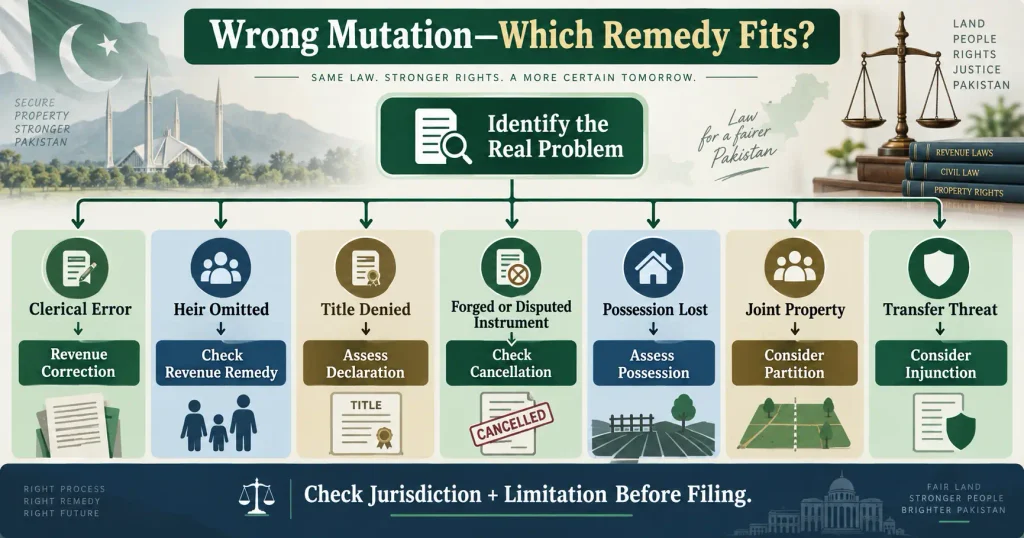
A wrong inheritance entry does not always require the same legal remedy.
If the problem is a clerical or record error, a correction, appeal, review, revision, or other revenue remedy may be appropriate under the applicable provincial law.
If the dispute concerns title, a forged instrument, disputed gift, alleged relinquishment, hostile third-party transfer, or denial of ownership, civil proceedings may become necessary.
Depending on the facts, a claimant may need declaration, cancellation of an instrument, injunction, possession, partition, or consequential correction of the revenue record.
Section 42 of the Specific Relief Act deals with declaratory relief where a person’s legal character or right to property is denied or threatened. Its proviso is important: where the plaintiff can seek necessary further relief, that relief should not simply be omitted.
For related strategy, read Inheritance Dispute in Pakistan, Civil Suit for Declaration, and Partition of Inherited Land in Pakistan. (Inheritance Dispute in Pakistan)
Evidence for Inheritance Mutation in Pakistan Disputes
Do not build an inheritance case from one screenshot of a fard. Preserve the full chain.
Obtain certified copies of the inheritance mutation, earlier and later mutations, jamabandi or record-of-rights entries, registered deeds, alleged gifts or releases, shajra nasab, possession record, partition orders, notices, and relevant court or revenue orders.
Also preserve evidence showing when the right was denied. A written refusal, sale deed, compensation record, legal notice, mutation based on alleged relinquishment, or transfer to a third party may become crucial when limitation is examined.
A date-by-date chronology can be as important as the family tree. Note the date of death, original mutation, discovery of the disputed entry, first demand, first refusal, later sale or gift, and date proceedings were started.
In Inheritance Mutation in Pakistan litigation, one proved date can change the entire limitation analysis.
Inheritance Mutation in Pakistan: When Limitation Starts
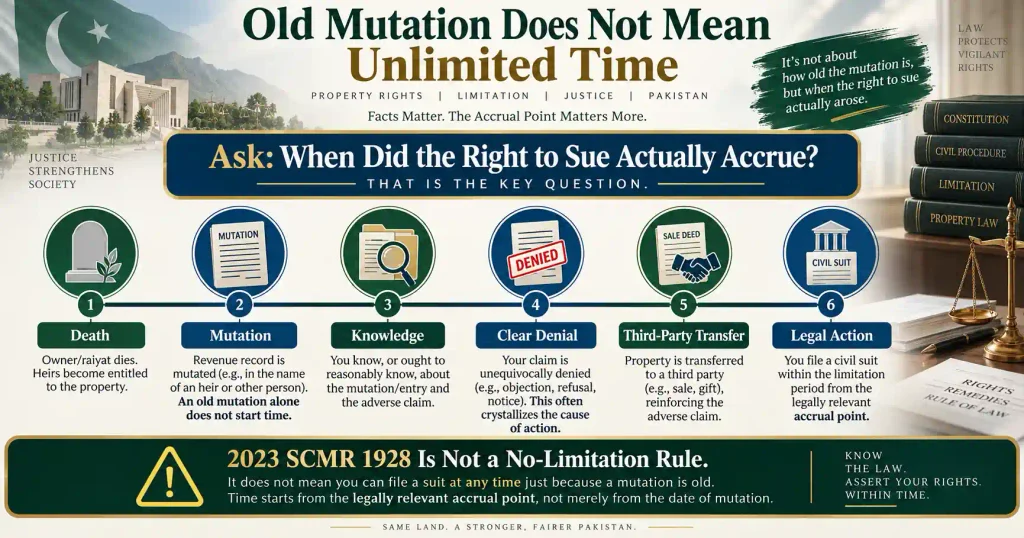
The safest rule is simple: act promptly after a clear denial.
A wrong mutation may not itself extinguish an heir’s title. But an open and known act against that heir can create a cause of action and start the limitation analysis.
This is why 2023 SCMR 1928 must not be read as permission for unlimited delay. The Supreme Court relied on the absence of proven relinquishment, absence of proved lifetime transfer, constructive possession, and the pleaded discovery in December 2004 followed by the suit in June 2005.
A different case may produce a different result if the excluded heir knew for years that another person had sold the property, taken compensation as sole owner, expressly refused the share, or created third-party rights.
For that contrasting situation, see Inheritance Dispute in Pakistan, which discusses actual denial and delayed claims. (Inheritance Dispute)
Women and Inheritance Mutation in Pakistan
A daughter does not lose inheritance merely because her name was omitted from the mutation or because brothers remained in possession.
Punjab’s official rules specifically require inheritance to be sanctioned first in favour of all legal heirs, including females. (Punjab Land Records Authority)
The Supreme Court in 2023 SCMR 1928 also stressed that relinquishment or transfer requires a positive and affirmative act. Silence, absence from cultivation, or a vague family claim should not be treated as proof that a woman voluntarily surrendered her share.
This is a central safeguard in Inheritance Mutation in Pakistan. “She never asked for her share” is not the same thing as proving a lawful gift, sale, release, or relinquishment.
For a focused guide on female inheritance, read Daughter Share in Father Property in Pakistan.
Inheritance Mutation in Pakistan vs Succession Documents
A succession certificate, Letter of Administration, and inheritance mutation are not identical documents.
NADRA explains that succession certificates concern movable assets, while Letters of Administration concern immovable property under the applicable succession laws.
A mutation, by contrast, updates the relevant land or property record.
Depending on the property and authority, a Letter of Administration, family record, court order, authority-specific legal-heir process, or other supporting document may be needed before the property record can be changed.
It is therefore unsafe to say that one certificate is mandatory for every Inheritance Mutation in Pakistan case.
Practical Effect of 2023 SCMR 1928
The judgment gives heirs several practical protections.
Inheritance opens on death. A wrong mutation does not itself create title. One co-heir’s possession may operate for other co-heirs until there is a clear repudiation. A person alleging a lifetime transfer or relinquishment must prove that underlying act.
At the same time, limitation remains relevant after a known denial, acquiescence, or creation of third-party interests.
For Inheritance Mutation in Pakistan, the judgment is therefore both protective and cautionary. A wrong revenue entry cannot simply erase a lawful heir, but delay after a real and known denial can still damage an otherwise genuine claim.
7 Checks Before You Sign or File Anything
- Confirm who legally owned the property on the date of death.
- Obtain the complete mutation and ownership history.
- Prepare a full family tree and identify every possible heir.
- Separate inherited property from property bought independently.
- Record the first date of knowledge, denial, sale, gift, or transfer.
- Match the remedy to the dispute: correction, declaration, cancellation, possession, partition, or injunction.
- Verify the correct authority, court, territorial jurisdiction, and limitation period.
These checks reduce the risk of turning Inheritance Mutation in Pakistan into a case built on the wrong property, wrong forum, or wrong relief.
Conclusion: Fix the Record Before the Dispute Grows
Inheritance Mutation in Pakistan should reflect the legal devolution that follows death; it should not rewrite the family tree.
In 2023 SCMR 1928, the Supreme Court refused to let an old revenue entry, unsupported by proof of transfer or relinquishment, defeat the position of an admitted daughter.
But the judgment is not a “no limitation” rule. A known denial, later transfer, third-party interest, property type, province, record authority, and requested relief can all change the legal route.
The safest approach is early verification: obtain the mutation, inspect the complete record, include every lawful heir, preserve certified evidence, and act promptly when a right is denied.
FAQs About 2023 SCMR 1928
Can an old inheritance mutation be challenged in Pakistan?
Yes, but age alone does not decide the case. Courts examine when the heir knew of the adverse claim, whether there was an actual denial, whether the heir acquiesced, whether a transfer or relinquishment was proved, and whether third-party rights arose. Limitation should always be checked before filing.
Does inheritance mutation create ownership?
No. Inheritance Mutation in Pakistan records a change in the revenue or property record; it does not itself create the inheritance right. In Muslim inheritance, succession opens on death. A wrong mutation may be corrected or challenged, but the proper forum and relief depend on the nature of the dispute.
Is there always six years to challenge a mutation?
No. Article 120 may apply to a declaratory suit where no other period is prescribed, with time running from accrual of the right to sue. The correct analysis depends on the relief, facts, knowledge, actual denial, fraud allegations, possession, and applicable law. Do not calculate limitation from the mutation date alone.
What if a daughter was left out of the mutation?
She should obtain certified copies of the mutation and complete record, verify the family tree, and identify whether her right has been expressly denied or allegedly transferred. In 2023 SCMR 1928, omission from the mutation did not prove that Mir Jan had surrendered her inheritance share.
Can brothers keep the land because they are in possession?
Not automatically. The Supreme Court recognized that possession of one co-heir may be constructive possession for all heirs. However, a clear repudiation, exclusive transfer, sale, receipt of compensation as sole owner, or another known denial can change both the possession and limitation analysis.
What documents are usually needed for inheritance mutation?
Common records include a death certificate, identity documents of heirs, family relationship proof, ownership record, latest fard, prior mutations, and authority-specific forms. Punjab rules also emphasize verification of legal heirs through witnesses and identity documents. Always verify the current local checklist before filing.
Is a succession certificate the same as inheritance mutation?
No. NADRA describes succession certificates as relating to movable assets and Letters of Administration as relating to immovable property. Mutation updates the relevant land or property record. Depending on the authority and property, more than one document or process may be required.
What did 2023 SCMR 1928 finally decide?
The Supreme Court declined to interfere with the appellate and revisional conclusions favouring the excluded daughter’s heirs on the issues before it. It also confined the inheritance claim to Qaim Din’s estate and excluded properties independently purchased by the defendants.
Disclaimer
This article is for general legal awareness and does not replace case-specific legal advice. Inheritance shares, mutation procedure, limitation, jurisdiction, evidence, and remedies depend on the deceased’s personal law, property type, province, title record, dates, possession, and the exact relief required.