

A workplace harassment complaint can involve fear, pressure, reputation and even a person’s livelihood. But one legal mistake can change the entire case: asking the wrong forum for a remedy it cannot lawfully give. That is the central lesson behind Harassment Ombudsperson Pakistan litigation and the Lahore High Court judgment reported as PLD 2021 Lahore 24.
The case did not finally decide whether the petitioner had actually been harassed. Instead, the Court examined who could enforce an Ombudsperson’s order, when Article 199 should be used, and whether a workplace-harassment forum could direct withdrawal of a suspension made under the Punjab Employees Efficiency, Discipline and Accountability Act, 2006 (PEEDA).
For anyone dealing with Harassment Ombudsperson Pakistan, the practical message is important: identify the correct law, forum, relief and appeal route before filing. A strong grievance can still lose time if procedure and jurisdiction are ignored.
Table of Contents
Judgment at a Glance of PLD 2021 Lahore 24
| Point | Detail |
|---|---|
| Case | Iram Shahzadi v. Government of Punjab through Chief Secretary and others |
| Citation | PLD 2021 Lahore 24 |
| Court | Lahore High Court |
| Judge | Jawad Hassan, J. |
| Decision date | 27 November 2020 |
| Petitioner | Iram Shahzadi, Assistant Director, Punjab Land Records Authority |
| Main laws | Workplace Harassment Act 2010, PEEDA Act 2006, Article 199 |
| Main question | Could the High Court enforce the Ombudsperson’s direction? |
| Key holding | The Act gave the Ombudsperson enforcement/contempt powers, so an alternate remedy existed |
| PEEDA point | The Ombudsperson could not require withdrawal of a PEEDA suspension through a power outside her jurisdiction |
| Final result | Constitutional petition dismissed as not maintainable |
| What was not decided | Whether the harassment allegations were ultimately proved |
The reported judgment identifies the petition as Writ Petition No. 38872 of 2020 and records its decision on 27 November 2020.
IRAC: Why the High Court Dismissed the Writ
| IRAC | Simple explanation |
|---|---|
| Issue | Could the petitioner use Article 199 to make the High Court implement the Ombudsperson’s direction requiring withdrawal of her suspension? |
| Rule | Sections 8(5) and 10(vi) gave the Ombudsperson powers connected with implementation and contempt. Article 199 is ordinarily not used where an adequate statutory remedy is available. PEEDA also has its own disciplinary mechanism. |
| Analysis | The harassment complaint was still pending. The petitioner had already moved the Ombudsperson over alleged retaliation. The Court found that enforcement could first be pursued before that forum. It also held that the Ombudsperson’s direction to withdraw a suspension made under PEEDA was outside the Ombudsperson’s jurisdiction. |
| Conclusion | The High Court dismissed the petition as not maintainable because an alternate remedy existed and the writ could not be used as an execution mechanism for the Ombudsperson’s order. |
The Court ultimately held that an alternate remedy remained available before the Ombudsperson and dismissed the constitutional petition.
Why This Case Started
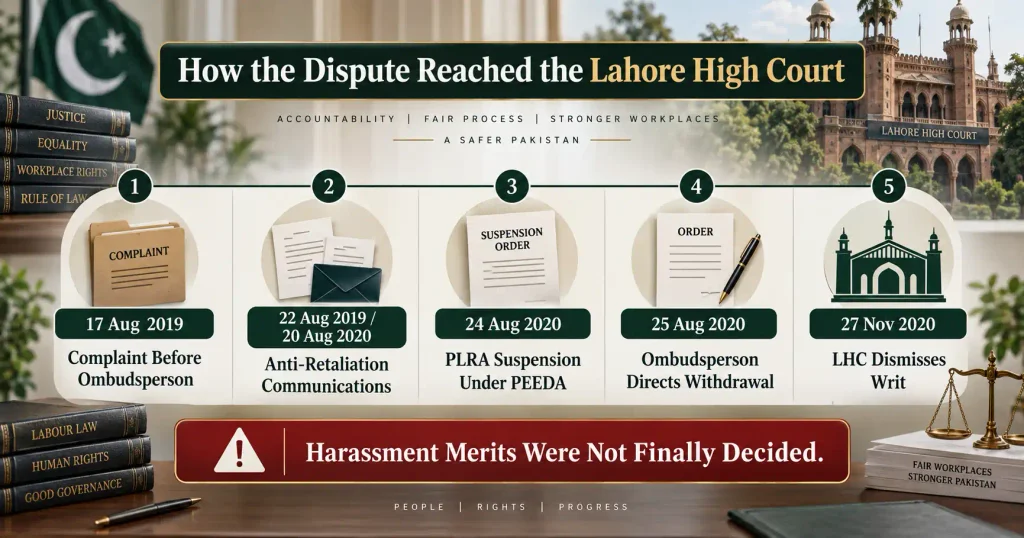
Iram Shahzadi was an Assistant Director in the Punjab Land Records Authority. Her counsel alleged repeated suspensions, transfers and harassment linked with a personal grudge. A complaint was already pending before the Provincial Ombudsperson Punjab.
PLRA suspended her on 24 August 2020 under PEEDA. On 25 August 2020, the Ombudsperson directed PLRA to withdraw that suspension and advised against further action during the pending complaint. The order described the suspension as alleged retaliation during the harassment proceedings.
The petitioner then asked the Lahore High Court to implement that direction, challenge the suspension and grant related relief. For Harassment Ombudsperson Pakistan readers, the key fact is that harassment, service law and constitutional remedies were running together.
Allegations, Arguments and the Court Record
The petitioner said the transfers, suspensions and inquiries were retaliatory. She also relied on constitutional protections concerning life, dignity and equality. These were the petitioner’s allegations and legal submissions—not final factual findings by the High Court.
The respondents denied her case, relied on pending disciplinary matters, challenged maintainability and argued that the harassment statute already supplied an enforcement route. They further maintained that PEEDA had its own procedure.
The High Court did not treat either side’s allegations as proved merely because they appeared in pleadings. It focused on the relief sought, alternate remedy, statutory power and the relationship between harassment law and PEEDA. That distinction is essential in Harassment Ombudsperson Pakistan analysis.
Evidence Before the Court: What Mattered
This was not a trial on whether harassment occurred. The important record included the pending Ombudsperson complaint, anti-retaliation communications, the 24 August suspension, the 25 August Ombudsperson direction and the petitioner’s request that the High Court compel compliance.
The judgment recorded that proceedings remained pending before the Ombudsperson and that the petitioner had already complained about alleged retaliation and non-compliance.
For Harassment Ombudsperson Pakistan disputes, preserve the complaint, notices, interim directions, service orders, hearing sheets, messages, disciplinary notices and proof of delivery. A dated chronology often matters more than a broad claim that an order was ignored.
Which Law Applied to the Dispute?
The dispute involved Punjab’s adapted workplace-harassment law, the Punjab Employees Efficiency, Discipline and Accountability Act, 2006, and Article 199.
Harassment Ombudsperson Pakistan is therefore not governed by one identical statutory text nationwide. The federal Act was materially amended in 2022, while Punjab’s official compilation continues to show its own provincial adaptations.
Do not copy a federal definition or deadline into a provincial case without checking the governing statute, employer and forum.
For primary law, readers should verify the federal Act on Pakistan Code and the official Punjab workplace harassment law rather than relying on an outdated private summary.
Why the Ombudsperson Had Enforcement Power
Section 8(5) of the Punjab law requires the Ombudsperson to record a decision and inform the parties and management for implementation. Section 10 gives the Ombudsperson specified civil-court-like powers, including compelling production of evidence, receiving affidavits and summoning persons.
Most importantly for PLD 2021 Lahore 24, section 10(vi) states that the Ombudsperson has the same powers as the High Court to punish a person for contempt.
That enforcement structure was central to the judgment. The Court reasoned that the petitioner was not without a remedy if an Ombudsperson order was being ignored. She could pursue the statutory route before the Ombudsperson instead of asking the High Court to become an execution forum.
This is one of the strongest practical points in Harassment Ombudsperson Pakistan litigation: before filing a writ for non-compliance, read the statute to see whether the forum that issued the order already has implementation or contempt powers.
Where the Ombudsperson’s Power Stopped
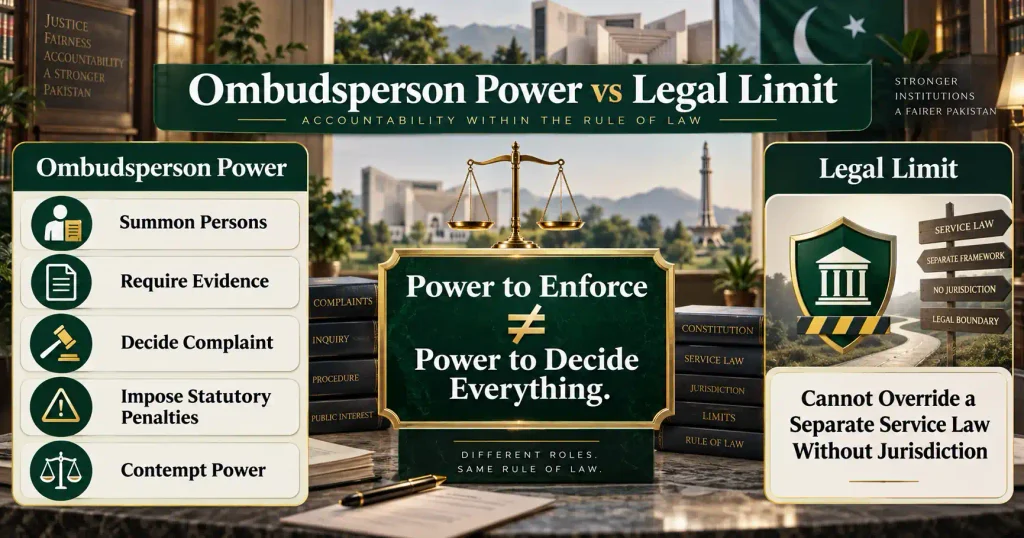
The judgment contains an equally important limitation.
The Court held that the direction requiring PLRA to withdraw the petitioner’s suspension was not within the Ombudsperson’s jurisdiction because the suspension had been made under PEEDA, which has its own mechanism and procedure.
That means PLD 2021 Lahore 24 should not be reduced to “every Ombudsperson order can be enforced by contempt.” The Court recognized enforcement powers, but it also examined the legal source of the underlying direction. A statutory forum cannot lawfully exercise a power that its governing law does not give it.
For Harassment Ombudsperson Pakistan matters involving suspension, transfer, promotion, disciplinary inquiry or termination, identify the legal source of the employment action. Harassment law may address harassment and retaliation, while a separate service statute may control how a disciplinary order is made, challenged or set aside.
What the Lahore High Court Actually Decided
The Court dismissed the constitutional petition because an alternate remedy was available before the Ombudsperson.
It relied on Supreme Court authorities concerning the use of Article 199 where an alternate efficacious statutory remedy exists. In this particular case, the Court concluded that the petitioner should pursue the statutory remedy instead of asking the High Court to act as the Ombudsperson’s executing forum.
The Court also noted that the PEEDA suspension had its own statutory route and that the Ombudsperson’s direction to withdraw that suspension was outside her jurisdiction.
The result was procedural, but not trivial. In Harassment Ombudsperson Pakistan cases, the legal strength of a complaint and the legal competence of the chosen forum are separate questions. Winning an interim direction does not automatically answer how that direction can lawfully be enforced.
What the Court Did Not Decide
The Lahore High Court did not finally hold that the petitioner’s harassment allegations were true or false. Indeed, the judgment stated that it was proceeding without touching the merits of the underlying harassment matter.
It did not conduct a full trial on the alleged conduct of her colleagues. It did not finally determine the anti-corruption allegations mentioned by the respondents. It also did not declare that every suspension during a pending harassment complaint is automatically lawful—or automatically retaliatory.
Most importantly, the Court did not treat the Ombudsperson’s PEEDA direction as a valid service-law order that the High Court simply refused to enforce. It expressly identified a jurisdictional defect with that direction.
This distinction prevents a common error in Harassment Ombudsperson Pakistan commentary: a dismissed writ is not the same as a final merits judgment against the complainant.
Harassment Ombudsperson Pakistan: Current Legal Map
A nationwide search can mislead because “the Ombudsperson” is not one office for every dispute. Federal and provincial frameworks operate side by side. FOSPAH works under the federal framework, while provinces also maintain their own laws or Ombudsperson structures.
| Starting point | What to check before filing |
|---|---|
| Federal framework / FOSPAH | Whether the federal Act and FOSPAH jurisdiction apply to the organization and dispute |
| Punjab | Punjab’s adapted 2010 Act, provincial Ombudsperson and any separate service law |
| Sindh | Provincial framework and Provincial Ombudsman for workplace harassment |
| Khyber Pakhtunkhwa | KP statutory text and the competent provincial forum |
| Balochistan | Balochistan’s workplace harassment law and provincial Ombudsperson structure |
Sindh currently maintains an official Provincial Ombudsman for protection against workplace harassment. KP has its provincial statutory text published through KP Code, while Balochistan has its own 2016 workplace-harassment legislation.
Use this table only as a starting point. Harassment Ombudsperson Pakistan jurisdiction should be checked from the statute and employment relationship, not only the city of work.
Useful official starting points include the Sindh Provincial Ombudsman website and the official provincial legislation relevant to the workplace.
Federal and Punjab Law Are Not Identical
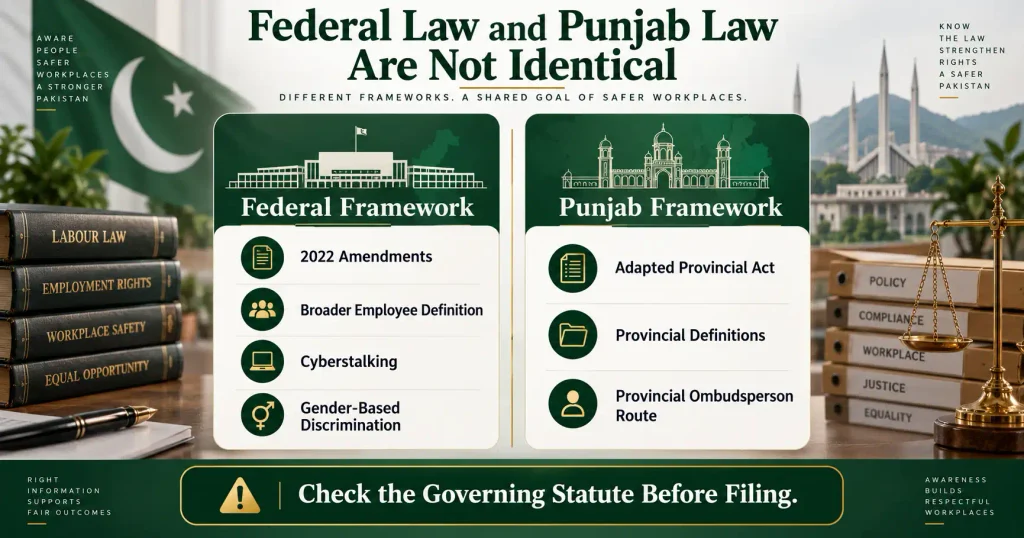
The 2022 federal amendment broadened key definitions, including employee, harassment and workplace.
The current federal definition expressly includes stalking and cyberstalking, as well as gender-based discrimination that may or may not be sexual in nature. The federal employee definition also covers a much broader range of workers, including specified freelancers, gig workers, students, interns, trainees, domestic workers and home-based workers.
Punjab’s official law page reflects a separately adapted provincial regime with its own wording and amendments. For example, its published definition of complainant covers a woman or man, while its employee definition is narrower than the current federal definition.
That difference is critical for Harassment Ombudsperson Pakistan. A national guide should not imply that the 2022 federal wording automatically replaced every provincial definition.
For deeper background, see Qanooni Dastak’s Protection Against Harassment of Women at Workplace Act 2010 guide and the broader Women Harassment Law in Pakistan judgment guide.
Can You Go Directly to the Ombudsperson?
For Harassment Ombudsperson Pakistan procedure in Punjab, section 8(1) says an employee has the option to prefer a complaint either to the Ombudsperson or the Inquiry Committee. Punjab’s statutory Code also says that a complainant does not necessarily have to use the informal channel before making a formal complaint.
Under the current federal text, the complainant likewise has the option to approach the Ombudsperson or Inquiry Committee. The federal Ombudsperson currently maintains an online complaint system.
Readers using the federal route can access the official FOSPAH complaint portal.
So a Harassment Ombudsperson Pakistan complainant should not assume that “HR first” is always a legal precondition. The better questions are: which law applies, what forum does that law authorize, and what remedy is actually needed?
For a fuller complaint-filing guide, see Harassment Complaint Pakistan: practical filing steps.
Complaint Timelines You Should Not Miss
Deadlines differ by stage and jurisdiction.
Under the Punjab statute, an Ombudsperson is to issue a written show-cause notice within three days of receiving the complaint, while the accused has five days after receiving notice to submit a written defence.
If the internal Inquiry Committee route is used under Punjab law, the Act provides:
| Stage | Punjab statutory timeline |
|---|---|
| Communicate charges | Within 3 days of written complaint |
| Written defence | Within 7 days after charges |
| Committee findings | Within 30 days of initiation |
| Competent Authority action | Within 1 week of recommendations |
| Appeal to Ombudsperson | Within 30 days |
| Representation from Ombudsperson decision | Within 30 days |
Punjab section 9 provides the 30-day representation to the Governor from communication of an Ombudsperson decision under section 8(5).
The current federal framework also contains statutory timelines. The 2022 amendment added a 90-day period for the Ombudsperson to decide a case or appeal and retains a thirty-day representation period to the President or Governor, as applicable.
Anyone dealing with Harassment Ombudsperson Pakistan should calculate the deadline from the correct law and the actual communication date—not from memory, another province’s statute or an old online article.
Evidence to Preserve Before Filing
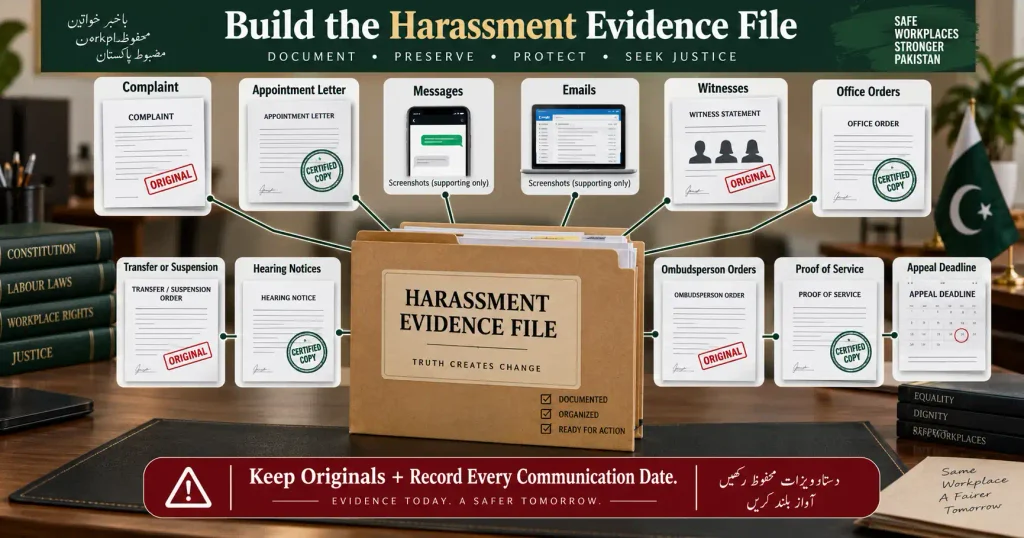
A harassment case often turns on context and chronology.
Preserve the original complaint, appointment or contract documents, office orders, complete email chains, WhatsApp chats, relevant call records, original audio or video where lawfully obtained, witness names, attendance records, performance reports, previous complaints, inquiry notices, transfer orders, suspension orders and any material said to show retaliation.
Do not crop a message so tightly that its date, sender or surrounding context disappears. Keep original devices and backups where electronic evidence may become important.
If an Ombudsperson order is allegedly ignored, preserve proof of service, compliance reminders and the employer’s written response—or evidence that no response was received.
For a Harassment Ombudsperson Pakistan matter, arrange documents by date. A one-page chronology linked to numbered documents can make the record easier to understand without altering the evidence.
For disputes involving electronic communications, Qanooni Dastak’s Cyber Bullying in Pakistan guide explains why workplace and cybercrime routes can sometimes address different legal wrongs.
How to Choose the Correct Forum
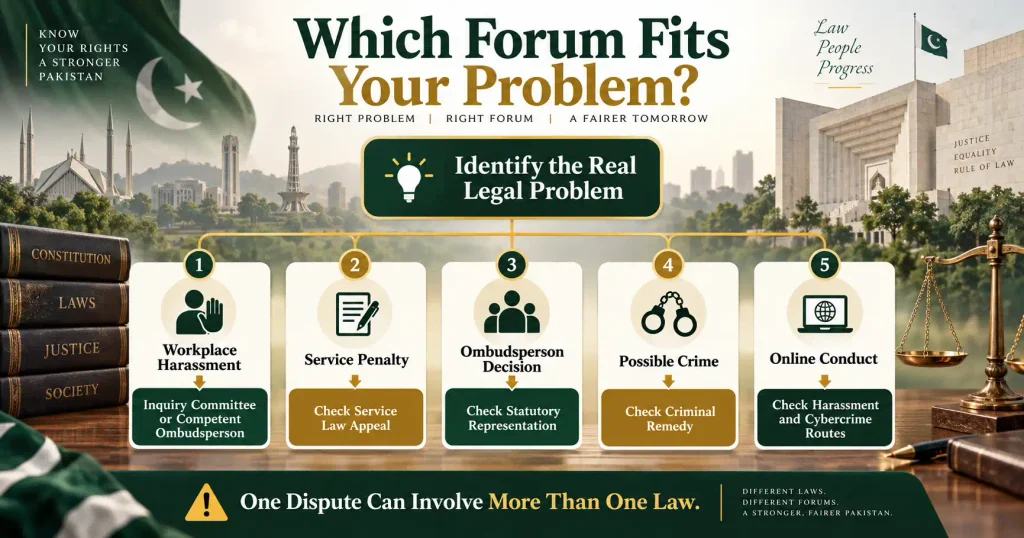
Start with the legal problem.
Harassment may belong before an Inquiry Committee or Ombudsperson. A service penalty may have its own statutory appeal. An Ombudsperson decision may carry a representation route. Alleged criminal conduct can involve a completely different forum.
Harassment, service misconduct, criminal conduct, defamation and cybercrime can arise from the same facts without becoming the same legal cause.
PLD 2021 Lahore 24 therefore adds one clear rule to Harassment Ombudsperson Pakistan law: the chosen forum must have jurisdiction over the relief requested.
A related Supreme Court perspective on the scope of workplace-harassment proceedings is discussed in Qanooni Dastak’s Workplace Harassment judgment guide.
What If an Ombudsperson Order Is Ignored?
In Harassment Ombudsperson Pakistan enforcement, first read the order carefully.
Identify exactly what the Ombudsperson directed, whether that direction falls within statutory power, who was required to comply, and whether the order has later been stayed, modified or challenged.
Under Punjab section 10(vi), the Ombudsperson has contempt power. PLD 2021 Lahore 24 treated that statutory remedy as important when the petitioner asked the High Court to enforce the Ombudsperson’s order.
But the same judgment shows why jurisdiction cannot be ignored: the specific direction to withdraw a PEEDA suspension was found outside the Ombudsperson’s authority.
In a Harassment Ombudsperson Pakistan enforcement dispute, “the order was ignored” is therefore only the first question. The next questions are whether the order itself was within jurisdiction and which statutory mechanism governs compliance or challenge.
Employers: Compliance Is Not Optional
Punjab law requires employers to form an Inquiry Committee, designate a Competent Authority and display the Code of Conduct.
Under Punjab section 11(3), failure to comply can lead to a complaint before the Ombudsperson and, if liability is established, a statutory fine ranging from Rs.25,000 to Rs.100,000.
At the federal level, FOSPAH currently emphasizes a three-member Internal Inquiry Committee with at least one female member, a designated Competent Authority and display of the Code of Conduct.
Employers handling Harassment Ombudsperson Pakistan matters should document lawful reasons for service actions during a pending complaint. Legitimate discipline and unlawful retaliation are legally different, but poor records can blur that line.
Practical Checklist Before You File
Before filing or challenging a Harassment Ombudsperson Pakistan matter, check these points:
- Identify the exact federal or provincial law that applies.
- Confirm whether the accused and organization fall within that law.
- Separate harassment allegations from service, criminal or civil disputes.
- Choose the Inquiry Committee, Ombudsperson, statutory appeal or other forum that can grant the requested relief.
- Prepare a dated chronology and preserve original evidence.
- Attach relevant appointment, transfer, suspension, inquiry and compliance documents.
- Record the date each notice or decision was received.
- Calculate every 30-day or other statutory deadline from the correct provision.
- If an order is ignored, check the issuing forum’s enforcement powers before filing elsewhere.
- If a service statute such as PEEDA applies, follow its separate mechanism where required.
The strongest Harassment Ombudsperson Pakistan file is not the one with the most pages. It is the one that connects facts, evidence, jurisdiction, statutory power and the exact relief requested.
8 FAQs About Harassment Ombudsperson Pakistan
What did PLD 2021 Lahore 24 actually decide?
The Lahore High Court dismissed Iram Shahzadi’s constitutional petition because she had an alternate statutory remedy before the Ombudsperson for enforcement or non-compliance. The Court also held that the Ombudsperson’s direction requiring withdrawal of a suspension made under PEEDA was outside the Ombudsperson’s jurisdiction. The judgment therefore concerns maintainability, enforcement and jurisdiction rather than a final finding on harassment.
Did the High Court decide whether harassment occurred?
No. The High Court focused on implementation of the Ombudsperson’s order and did not decide the merits of the underlying harassment complaint. The complaint remained pending before the Ombudsperson. Allegations of retaliation, harassment, disciplinary wrongdoing and anti-corruption matters appeared in the record, but the writ decision should not be presented as a final factual verdict on those allegations.
What powers does a harassment Ombudsperson have?
The answer depends on the applicable federal or provincial law. Under Punjab’s Act, the Ombudsperson has specified civil-court-like powers, may require information and documents, may impose statutory penalties when deciding a complaint, and possesses contempt power under section 10(vi). The current federal framework has its own provisions, so the applicable statute should be checked before relying on a general summary.
Can I file directly with the Ombudsperson in Punjab?
Yes. Punjab section 8(1) permits an employee to choose between the Ombudsperson and the Inquiry Committee. The Code also makes clear that the informal route is not compulsory before a formal complaint. However, this does not mean every employment dispute belongs before the Ombudsperson. The alleged conduct and requested relief must fall within the jurisdiction created by the governing law.
Which Ombudsperson should hear my complaint?
Do not decide this only by your city. Pakistan has federal and provincial workplace-harassment frameworks. Check the governing statute, employer, type of organization, territorial connection and legal competence of the forum. FOSPAH having regional offices does not remove the need to distinguish federal jurisdiction from provincial regimes. When uncertain, verify jurisdiction before filing.
Can the Ombudsperson cancel a suspension order?
Not automatically. PLD 2021 Lahore 24 warns against assuming harassment jurisdiction overrides every service law. The Lahore High Court held that the direction to withdraw the petitioner’s PEEDA suspension was outside the Ombudsperson’s jurisdiction because PEEDA had its own procedure. A complainant may still allege retaliation, but the disciplinary order must be challenged through a legally competent route.
What evidence should I preserve for a complaint?
Keep the original complaint, employment documents, complete messages and emails, office orders, witness details, attendance or performance records, inquiry notices, transfer or suspension orders and proof of alleged retaliation. Preserve full digital context rather than only cropped screenshots. If an Ombudsperson order is later ignored, retain proof that it was served and any written requests seeking compliance.
How long do I have to challenge an Ombudsperson decision?
Under the Punjab Act, a person aggrieved by an Ombudsperson decision under section 8(5) may make a representation to the Governor within 30 days of communication. Other stages and jurisdictions have different timelines. The current federal framework also contains a thirty-day representation period and additional decision timelines. Always calculate limitation from the statute that actually governs your case.
Conclusion: The Right Forum Can Decide the Outcome
PLD 2021 Lahore 24 does not weaken workplace-harassment protection. It explains its legal boundaries.
The Ombudsperson has meaningful inquiry and enforcement powers, but those powers remain statutory. The High Court will not ordinarily become an execution forum where an adequate alternate remedy exists, and harassment jurisdiction cannot automatically displace a separate disciplinary law such as PEEDA.
For anyone searching Harassment Ombudsperson Pakistan, the safest lesson is simple: identify the right law, preserve the right evidence, ask the right forum for the right relief, and watch every deadline.
Procedure is not a technical decoration around justice. In cases like this, procedure can determine whether the court ever reaches the merits at all.
Disclaimer
This article is for legal awareness and educational purposes only. It is not legal advice and does not create a lawyer-client relationship. Workplace harassment, service-law and constitutional remedies depend on the applicable federal or provincial statute, facts, documents, jurisdiction and current law. Obtain advice from a qualified lawyer before filing or allowing a statutory deadline to expire.