

Property transfer through power of attorney is common in Pakistan, especially when an owner lives abroad or cannot personally handle a property transaction. But a broad GPA does not mean an attorney may secretly benefit himself or connected persons. The real questions are what authority was given, whether the principal knew the material facts, whether consent existed, and what the evidence proves.
The Lahore High Court, Rawalpindi Bench, examined these questions in Mohsin Lal Chaudhary v. Shoukat Ali and 15 others, reported as 2025 MLD 1268. The Court held, on the evidence before it, that section 215 of the Contract Act, 1872 does not require the principal’s consent to be in writing. Oral consent can matter—but it still has to be proved.
Table of Contents
Judgment at a Glance: What 2025 MLD 1268 Decided
| Point | What the judgment shows |
|---|---|
| Citation | 2025 MLD 1268 |
| Court | Lahore High Court, Rawalpindi Bench |
| Judge | Mirza Viqas Rauf, J. |
| Cases | Civil Revisions Nos. 423-D and 424-D of 2024 |
| Hearing | 18 March 2025 |
| Main dispute | Alleged misuse of a registered GPA and challenge to property mutations |
| Key provision | Section 215, Contract Act, 1872 |
| Important finding | Section 215 does not require written consent; consent may be oral |
| Evidence that mattered | Principal’s own statement showed consultation and knowledge |
| Final result | Both civil revisions dismissed; no order as to costs |
The trial court had dismissed the consolidated suits on 13 January 2024. The Additional District Judge, Rawalpindi, dismissed the appeals on 9 July 2024. The High Court later found no illegality or material irregularity requiring interference in revision.
IRAC: When Can an Attorney Transfer Property?
| IRAC | Explanation |
|---|---|
| Issue | Could the principal challenge a property transfer through power of attorney by alleging misuse of the GPA and lack of permission? |
| Rule | Section 215 allows repudiation in specified self-dealing situations where the agent acts without the principal’s consent and the statutory conditions are met. |
| Analysis | The GPA expressly authorized sale and transfer. The petitioner’s own evidence also showed that the attorney consulted him and that he knew of the transaction. |
| Conclusion | On these facts, the principal could not repudiate the challenged transfer, and the revisions were dismissed. |
This judgment does not make every property transfer through power of attorney valid merely because a GPA exists. The result depended on the wording of the GPA, evidence of consent, timing of revocation, the petitioner’s earlier conduct, and the limited scope of revision.
Why This Property Transfer Through Power of Attorney Matters
A power of attorney creates an agency relationship; it does not make the attorney the owner. Where a transaction benefits the attorney, a close relative, or a connected entity, authority, consent and disclosure become especially important.
Here, the petitioner and his brothers appointed their real brother as attorney. The GPA authorized him to supervise, manage, sell, gift, mortgage, enter into sale agreements, receive consideration, and execute sale deeds or mutations.
The Court still looked beyond the broad wording. For this property transfer through power of attorney, the decisive question was whether the petitioner knew about and consented to the transaction.
Facts: How the Dispute Reached the High Court
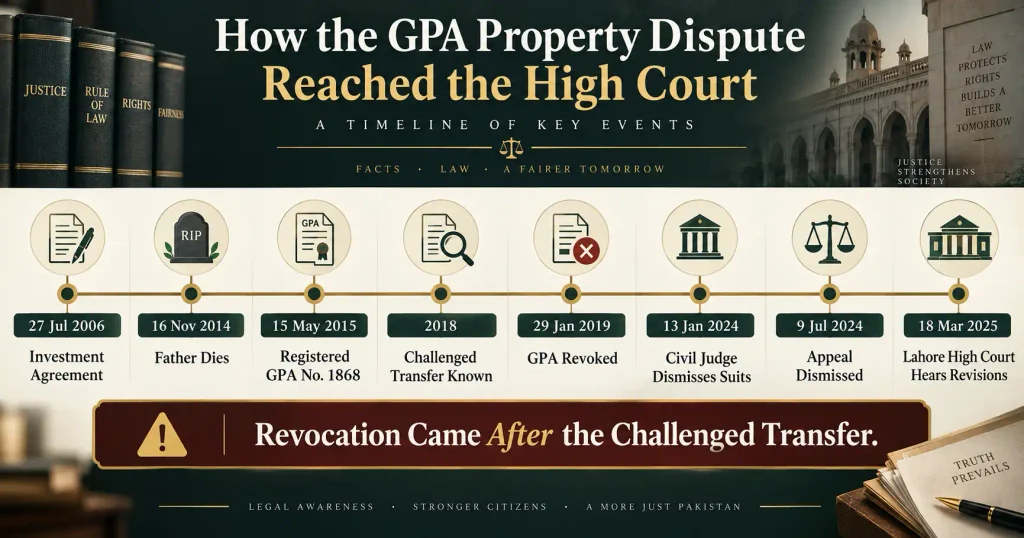
The petitioner said his parents jointly owned about 1,800 kanals in the revenue estates of Jattal, Pind Dadu and Ghariba in Tehsil and District Rawalpindi.
He also relied on an investment agreement dated 27 July 2006 under which, according to his case, he had invested £165,000 for 165 kanals of land.
His father died on 16 November 2014.
On 15 May 2015, the petitioner and two brothers executed registered GPA deed No. 1868 in favour of respondent No. 6, another brother.
The petitioner first filed a suit for separate possession through partition. He later filed a second suit seeking declaration, cancellation of Mutations Nos. 3420, 3421, 994 and 995, and injunctive relief.
He alleged that the attorney had misused the GPA and transferred property through a company in which the attorney was a director. The GPA was later revoked through deed No. 300 dated 29 January 2019. These were the petitioner’s allegations; they were not automatically treated as proved facts.
The suits were consolidated. After evidence, the Civil Judge dismissed them, and the first appeal also failed. That brought the property transfer through power of attorney dispute before the Lahore High Court.
What Each Side Argued
The petitioner argued that the attorney had misused his authority and alienated the property for his own benefit.
His counsel relied on the principle that an attorney cannot use the principal’s property for a self-benefiting or connected transaction without the legally required permission and consent. He also argued that the courts below had misread or failed to read important evidence.
The respondents took the opposite position. They argued that permission had been obtained and relied heavily on the petitioner’s own statement. They also emphasized that the trial and appellate courts had already recorded concurrent factual findings.
These were competing arguments. The High Court had to decide what the evidence actually established.
Evidence That Changed the Case
The GPA itself and the petitioner’s statement as PW-1 were central.
Exh. P-4 authorized the attorney to manage, sell, gift, mortgage and otherwise deal with the property, including receiving consideration and executing sale deeds or mutations.
Although four mutations were challenged, the parties agreed that Mutations Nos. 3421 and 994 were the ones through which the petitioner’s land had been transferred.
The High Court then examined the petitioner’s own testimony.
It concluded that his statement showed that he had authorized the attorney to sell, that the attorney had consulted and informed him about the transaction, and that he knew of the transaction in 2018. The Court also recorded that he had received his share in return.
This is why a property transfer through power of attorney case can turn on admissions, payment evidence, correspondence and previous conduct—not only on the title of the GPA document.
Section 215: Consent Does Not Have to Be Written
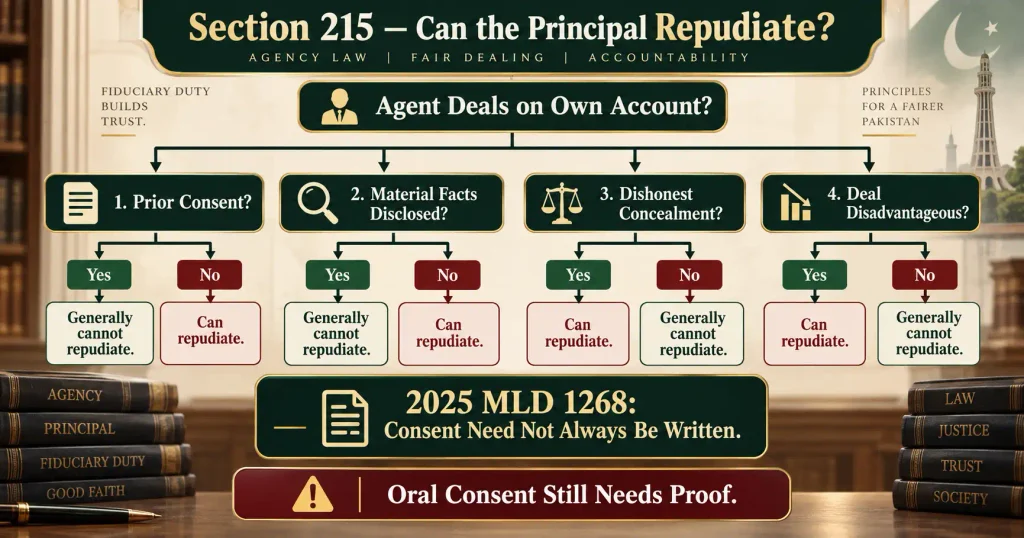
Section 215 of the Contract Act, 1872 deals with circumstances where an agent deals on his own account in the business of the agency without first obtaining the principal’s consent and without properly acquainting the principal with material circumstances.
The High Court identified important elements from the provision:
- the agent deals on his own account;
- prior consent of the principal is absent;
- material circumstances are not properly disclosed; and
- the case shows dishonest concealment of a material fact or dealings disadvantageous to the principal.
The key holding was that section 215 does not say that consent must be in writing.
The Court therefore held that consent may also be oral.
However, this does not mean oral consent is presumed. In this property transfer through power of attorney dispute, the Court found evidence of consultation, knowledge and consent in the petitioner’s own statement.
From a practical point of view, written consent is still much safer. A signed instruction, email, recorded payment trail or other reliable proof can prevent a later factual dispute about what the principal actually approved.
Why the 2019 Revocation Did Not Undo the Earlier Transfer
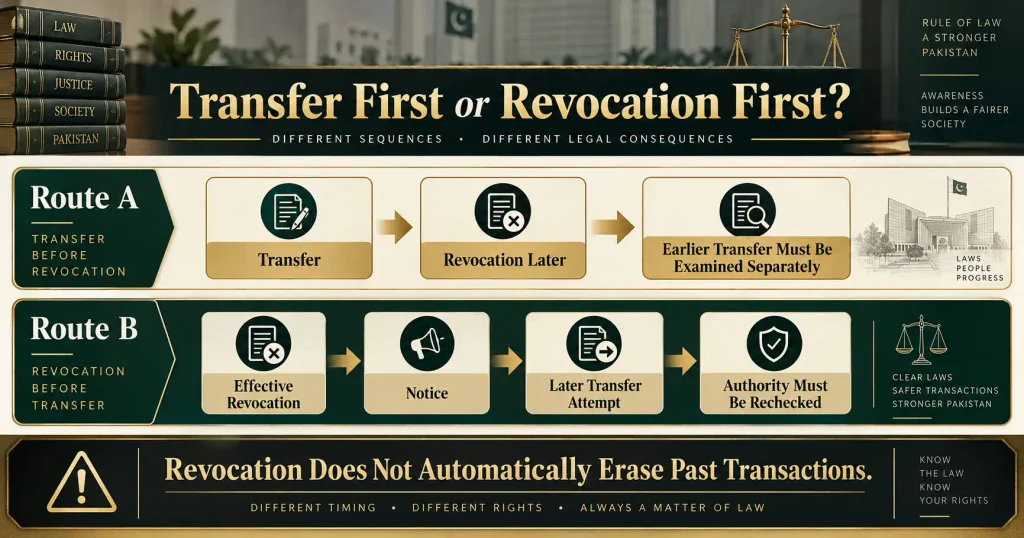
The petitioner revoked the GPA on 29 January 2019, but the challenged transactions had already taken place.
The Court therefore considered the timing important. The later revocation did not, by itself, prove that transactions already completed under the GPA were unauthorized.
For any disputed property transfer through power of attorney, prepare a precise chronology:
GPA execution → authentication or registration → transfer → payment → mutation → revocation → notice → possession → onward transfer.
A later cancellation of authority does not automatically erase an earlier transaction. The earlier transaction must be tested on its own authority, consent, disclosure, documents and evidence.
Why the First Partition Suit Hurt the Challenge
The petitioner first filed a partition suit despite having knowledge of the transactions.
In that suit, he did not challenge Mutations Nos. 3421 and 994 and did not allege that respondent No. 6 had misused his authority as attorney.
The High Court considered that conduct significant.
A later case can become harder to sustain when earlier litigation, filed with knowledge of the same facts, omits the complaint later said to be central.
That does not mean every omission automatically destroys a later suit. Cause of action, knowledge, relief claimed and procedural law must still be examined.
Order II Rule 2 Was Not the Main Reason
The respondents also raised Order II Rule 2 CPC, a rule intended to discourage splitting claims and repeated litigation arising from the same cause of action.
However, both suits had ultimately been consolidated. The High Court said that consolidation was sufficient to diminish the effect of that objection.
It also reasoned that, on the findings already reached regarding the challenged transactions, the petitioner could not maintain the partition suit on the footing that he remained a co-owner.
So this property transfer through power of attorney case was not dismissed simply because of Order II Rule 2. Consent, evidence and the concurrent findings remained central.
Section 115 CPC Limited the High Court’s Role
The trial court and first appellate court had both reached the same factual conclusions.
The Lahore High Court was exercising revisional jurisdiction under section 115 CPC. It was not hearing the entire dispute again as a fresh trial.
The Court explained that a revisional court cannot replace concurrent factual findings merely because another view of the evidence may also be possible.
After reviewing the record, it found no illegality or material irregularity requiring interference.
What the Lahore High Court Actually Decided
The Lahore High Court dismissed both civil revisions and made no order as to costs.
Its central reasoning was that:
- the GPA authorized sale and transfer;
- the petitioner’s own evidence supported consultation and consent;
- section 215 did not require consent to be written;
- the revocation occurred later; and
- the High Court found no ground to disturb the concurrent findings.
For property transfer through power of attorney disputes, the judgment shows why admissions and chronology can matter as much as the wording of the GPA.
What the Court Did Not Decide
The judgment should not be stretched beyond its facts.
It did not hold that every GPA permits an attorney to transfer property to himself or a connected person.
It did not say that disclosure of material circumstances is unnecessary.
It did not say that oral consent is automatically presumed.
It did not hold that a later revocation can never affect an earlier transaction.
It also did not create a universal rule that every revenue mutation, standing alone, conclusively proves ownership.
The Court decided these revisions on the particular evidence before it and within the limited scope of section 115 CPC.
Current Law to Check Before a POA Property Transfer
A lawful property transfer through power of attorney requires more than one reported judgment.
Section 54 of the official Transfer of Property Act, 1882 defines sale as a transfer of ownership in exchange for a price. The Pakistan Code text states that tangible immovable property worth Rs.100 or more is transferred by registered instrument, while a mere contract for sale does not itself create an interest in the property.
The Registration Act, 1908 also matters. Section 33 deals with powers of attorney recognized for registration purposes and contains different authentication rules depending on where the principal resides. (Pakistan Code)
Where a written instrument or title is challenged, the official Specific Relief Act, 1877 may become relevant. Section 39 deals with cancellation of instruments, while section 42 addresses declarations of property rights and warns against omitting further relief where it is available.
Injunction provisions can also become important where further transfer, construction, possession or interference is threatened.
For overseas Pakistanis, current official procedures should also be checked. The Ministry of Foreign Affairs confirms that NADRA and MoFA operate a Digital Power of Attorney process alongside manual procedures. Official MoFA Power of Attorney guidance (Ministry of Foreign Affairs)
Because property law and revenue procedure can include provincial and local requirements, always check the law applicable to the province and property involved.
Documents to Verify Before Transfer
Before a property transfer through power of attorney, check:
- original or certified GPA;
- registration or authentication record;
- principal and attorney CNIC/NICOP;
- exact khasra, khewat, plot or property details;
- root title documents;
- latest fard or record of rights;
- mutation history;
- sale deed or other transfer instrument;
- payment and banking trail;
- revocation deed, if any;
- proof that revocation was communicated;
- possession record;
- pending litigation or stay orders.
If the attorney, a close relative, or a connected company will benefit, keep separate proof of informed consent after disclosure of material facts.
Written consent is safer even though 2025 MLD 1268 held that section 215 does not itself require consent to be written.
A buyer should never rely only on a cropped WhatsApp image of a GPA.
If You Suspect POA Misuse, Preserve This Evidence
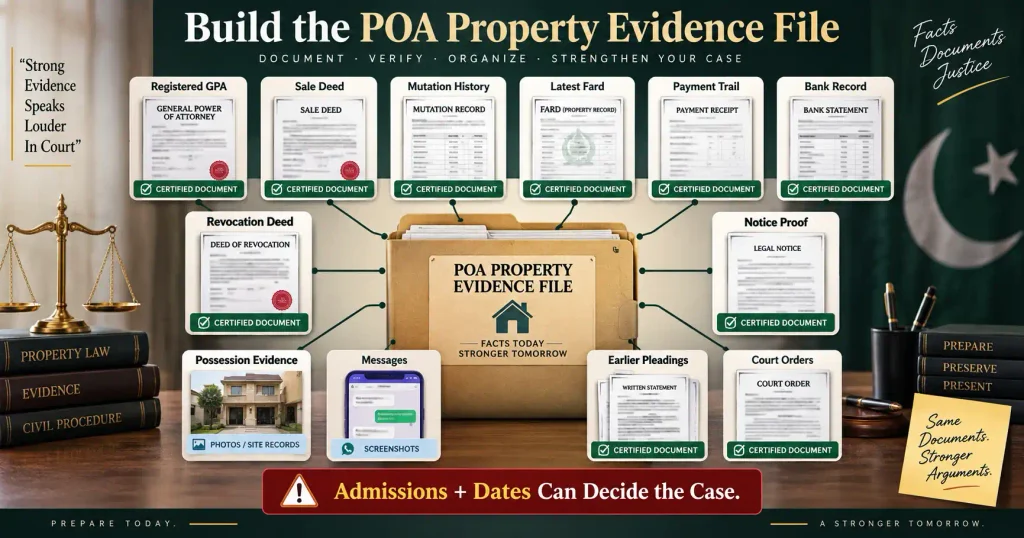
For a challenged property transfer through power of attorney, immediately preserve certified copies of the GPA, sale deed, disputed mutation, mutation history, fard, payment records, bank evidence, revocation deed, notices, possession documents and previous court pleadings.
Messages and emails may also matter where they prove instructions, consent, refusal or knowledge.
Where forgery is alleged, preserve original signatures or thumb impressions, admitted comparison documents, witnesses and the official registration file.
Do not edit or overwrite electronic evidence. Where possible, preserve the original device, source file and metadata instead of relying only on screenshots.
Earlier pleadings are also important. In 2025 MLD 1268, what the petitioner had not challenged in the first suit became part of the High Court’s reasoning.
Which Forum and Remedy May Apply?
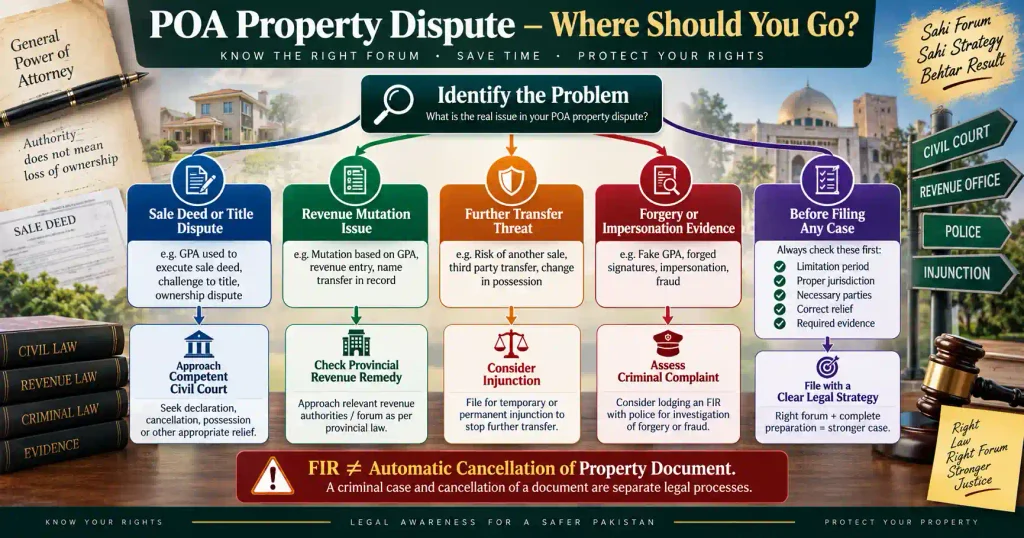
The correct forum for a property transfer through power of attorney dispute depends on the nature of the property, the document challenged and the relief required.
A dispute involving a sale deed, cancellation of an instrument, title, possession or civil rights may require proceedings before the competent civil court.
Revenue authorities may deal with mutation and revenue entries within their statutory jurisdiction, but complicated questions of title can require civil adjudication.
Possible remedies may include:
- declaration;
- cancellation of an instrument;
- possession;
- partition where legally maintainable;
- permanent injunction; and
- temporary protective relief against further transfer.
The correct combination matters. Section 42 of the Specific Relief Act states that where a plaintiff can seek further relief but omits it, a bare declaration may not be granted.
An FIR does not automatically cancel a GPA, sale deed or mutation. Criminal allegations and civil property remedies perform different legal functions.
Limitation: Why Delay Can Be Dangerous
Limitation should be checked immediately in any property transfer through power of attorney challenge.
Article 91 of the official Limitation Act, 1908 provides three years for a suit to cancel or set aside an instrument not otherwise specifically provided for. The period runs from when the facts entitling the plaintiff to cancellation or setting aside become known. (Pakistan Code)
But that rule should not be applied mechanically to every land case.
Fraud, possession, declaration, consequential relief, nature of the instrument and the actual cause of action can affect limitation analysis.
Delay should therefore never be assumed to be harmless.
7 Checks Before Property Transfer Through Power of Attorney
- Read the actual GPA powers instead of relying on the words “General Power of Attorney.”
- Verify execution, authentication and registration through the correct authority.
- Confirm that the exact property and proposed transaction fall within the authority.
- If the attorney or a connected person benefits, record informed consent and disclosure.
- Trace the consideration through reliable payment evidence.
- Check revocation, litigation, stay orders, mutation history and possession.
- Confirm limitation, jurisdiction, necessary parties and correct relief before filing a challenge.
These checks reduce the chance that a property transfer through power of attorney turns into years of litigation.
Practical Effect for Owners, Attorneys and Buyers
For property owners, authority should be drafted carefully and major approvals should preferably be kept in writing. Oral consent may be legally relevant, but written evidence is usually easier to prove.
For attorneys, broad wording is not a licence for undisclosed personal benefit. Section 215 can still protect a principal where its legal conditions are established.
For buyers, verify the principal, attorney, authority, property, consideration, revocation status, registration record and litigation history before relying on a property transfer through power of attorney.
For litigants, plead the full dispute at the correct stage. Admissions, omissions and inconsistent positions in earlier proceedings can become important later.
For related reading, see Qanooni Dastak’s guides on General Power of Attorney in Pakistan, Power of Attorney Law in Pakistan and Gift Deed Through Power of Attorney.
FAQs on Property Transfer Through Power of Attorney
Can property transfer through power of attorney be valid in Pakistan?
Yes. Property transfer through power of attorney can be valid where the attorney has lawful authority for the particular transaction and the transfer complies with applicable property, registration and agency law. The exact GPA, title record, registration, consideration, consent and surrounding facts must all be checked.
Must the principal’s consent always be in writing?
Not under the specific reasoning of 2025 MLD 1268. The Lahore High Court held that section 215 of the Contract Act does not require consent to be written and that consent may be oral. However, oral consent must still be proved through reliable evidence; it is not automatically presumed.
Can an attorney transfer property to himself or a relative?
Such transactions attract close scrutiny. Where an agent deals on his own account or a transaction benefits him or connected persons, prior consent and proper disclosure become especially important. The principal may have a right to repudiate under section 215 where its statutory conditions are established.
Does revoking the GPA cancel an earlier property transfer?
Not automatically. In 2025 MLD 1268, the GPA was revoked after the challenged transfers. The later revocation therefore did not itself undo the earlier transactions. Authority, consent, timing, notice, transfer documents and evidence must all be examined.
Can a mutation alone prove ownership after a GPA transfer?
A mutation is an important revenue entry, but a title dispute should not be reduced to a single entry. The underlying authority, ownership documents, transfer instrument, consideration, possession and surrounding evidence may all matter. The effect of the mutation depends on the transaction and applicable law.
What evidence is strongest in a POA misuse case?
Certified GPA and registration records, transfer documents, mutation history, payment trail, revocation documents, proof of notice, possession evidence and previous court pleadings can be crucial. Admissions by the principal or attorney can also be highly important, as the evidence in 2025 MLD 1268 demonstrates.
How long do I have to challenge a disputed instrument?
Article 91 of the Limitation Act generally provides three years for cancellation of an instrument not otherwise provided for, calculated from knowledge of the relevant facts. But fraud, possession, declaration and other relief can affect limitation, so a disputed transfer should be reviewed promptly.
Which court should hear a POA property dispute?
It depends on the relief and property involved. Civil courts commonly decide declaration, cancellation, title, possession and injunction disputes, while revenue authorities deal with matters within their statutory revenue jurisdiction. Territorial jurisdiction, necessary parties and the exact relief should be checked before filing.
Conclusion: Consent, Scope and Evidence Decide the Case
Property transfer through power of attorney can be lawful, but the GPA alone does not answer every dispute. Courts can examine authority, the principal’s knowledge, consent, disclosure, consideration, chronology, conduct and evidence.
In 2025 MLD 1268, the Lahore High Court dismissed the revisions because the petitioner’s own evidence supported knowledge and consent, section 215 did not require written consent, the revocation came later, and the Court found no basis to disturb the concurrent findings.
The practical lesson is to define the attorney’s powers precisely, keep important approvals in writing where possible, verify the complete transaction record, and act quickly if misuse is suspected. That is the safest way to approach property transfer through power of attorney in practice.
Disclaimer
This article is for legal awareness and educational purposes only. It is not legal advice, a legal opinion or a guarantee of any result. Property disputes depend on the governing law, documents, evidence, limitation, jurisdiction and facts of each case. Consult a qualified lawyer before taking legal action.