

A marriage may have ended emotionally long before a court is asked to decide its legal status. For Christian spouses, however, separation, unhappiness, or even a completely broken relationship does not by itself mean that a marriage has legally ended.
Christian Divorce in Pakistan is governed principally by the Divorce Act, 1869, read with constitutional protections and important court judgments. The law distinguishes between dissolution of marriage, judicial separation, and nullity. It also demands proper pleadings, admissible evidence, and a reasoned judicial decision.
PLD 2026 Lahore 206 has made this area especially important. The Lahore High Court found that the lower courts had focused too narrowly on adultery while failing to properly examine cruelty, the admitted separation of the spouses, and possible desertion. But the High Court did not grant divorce. It set aside the earlier judgments and sent the case back for fresh adjudication.
That distinction is critical for understanding Christian Divorce in Pakistan.
Table of Contents
Judgment at a Glance of PLD 2026 Lahore 206
| Point | Details |
|---|---|
| Case | Shahroz v. Additional District Judge and others |
| Citation | PLD 2026 Lahore 206 |
| Court | Lahore High Court |
| Judge | Justice Jawad Hassan |
| Petition | Writ Petition No. 2092 of 2024 |
| Decision | 23 February 2026 |
| Parties | Christian husband and wife |
| Main law | Divorce Act, 1869 |
| Key grounds | Adultery, cruelty and desertion |
| Constitutional rights | Articles 4, 10-A, 14 and 20 |
| Final result | Earlier judgments set aside; case remanded |
| What LHC did not do | It did not itself grant dissolution |
The petitioner had challenged judgments dated 8 December 2023 and 20 April 2024 dismissing his matrimonial claim.
IRAC: Why the Lahore High Court Sent It Back
| IRAC | Explanation |
|---|---|
| Issue | Did the lower courts properly examine adultery, cruelty and possible desertion under the Divorce Act, 1869? |
| Rule | Christian matrimonial relief requires proof of legally available grounds, proper evidence, fair procedure and reasoned findings. |
| Analysis | The lower courts concentrated heavily on the failed adultery allegation but did not properly examine cruelty or the admitted continuing separation. |
| Conclusion | The judgments were set aside and the case was remanded for fresh issues, evidence and a reasoned decision. |
The High Court expressly said the real question was not whether adultery or cruelty was ultimately true or false, but whether the dispute had been adjudicated according to the statutory and procedural discipline required by law.
Why Christian Divorce Law Needs Careful Reading
The principal statute is the Divorce Act, 1869. Its current consolidated federal text still contains provisions dealing with dissolution, judicial separation, nullity, alimony, custody, evidence, appeals, and remarriage.
But there is an unusual legal complication.
The official consolidated text continues to display Section 7 as “omitted.” However, in Ameen Masih v. Federation of Pakistan, PLD 2017 Lahore 610, the Lahore High Court declared the 1981 omission unconstitutional and treated Section 7 as restored.
PLD 2026 Lahore 206 itself refers to a harmonized reading of the restored Section 7, while acknowledging that it had been omitted from the statutory text.
Readers may also consult the official Ameen Masih judgment.
For Christian Divorce in Pakistan, this means one should not read Section 10 in isolation. In Punjab particularly, current Lahore High Court jurisprudence must also be considered.
Three Different Remedies People Often Confuse
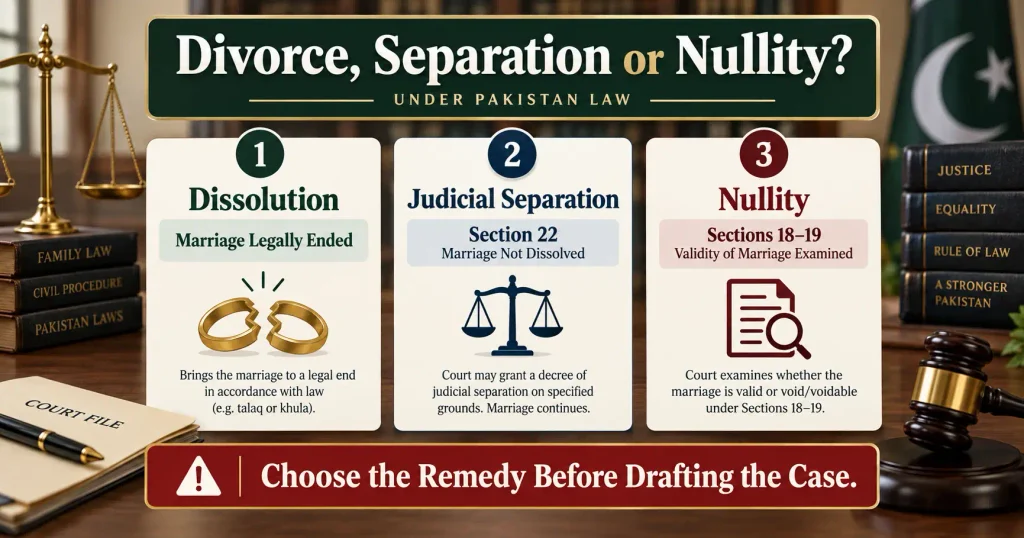
Christian matrimonial law does not treat every marital dispute as the same remedy.
Dissolution of marriage legally ends the marital bond when the applicable requirements are established.
Judicial separation allows spouses to live separately through a judicial decree without treating the marriage as dissolved. Section 22 expressly recognizes adultery, cruelty, and desertion without reasonable excuse for two years or more as grounds for judicial separation.
Nullity is different again. It concerns whether the marriage should be declared null under the grounds provided by Sections 18 and 19.
This distinction matters because Christian Divorce in Pakistan cannot safely be approached by simply asking, “How do I get a divorce?” The correct relief must first be identified.
What Section 10 Says About Dissolution
The wording of Section 10 is historically restrictive and is not symmetrical for husband and wife.
The official text states that a Christian husband may seek dissolution on the ground that his wife has committed adultery after marriage.
For a wife, Section 10 identifies a wider list of circumstances, including specified situations involving change of religion and another marriage, incestuous adultery, bigamy with adultery, rape, sodomy or bestiality, and adultery coupled with cruelty or qualifying desertion.
This old wording is one reason later constitutional interpretation became so important.
Why Restored Section 7 Still Matters
Ameen Masih challenged the deletion of Section 7 because he did not want to falsely accuse his wife of adultery merely to escape a dead marriage.
The Lahore High Court restored Section 7 and held that it should operate harmoniously with Section 10, opening the way to relevant principles of English divorce law, including irretrievable breakdown.
PLD 2026 Lahore 206 continued to recognize the legal importance of that restored provision.
This is important for Christian Divorce in Pakistan because courts should not encourage a spouse to make a false or humiliating adultery allegation merely to obtain matrimonial relief.
At the same time, restored Section 7 should not be treated as permission for automatic divorce on demand. The pleaded ground must still be legally sustainable and properly proved.
Cruelty Cannot Be Buried Under an Adultery Claim
In the 2026 case, the petitioner’s fresh proceedings relied principally on cruelty.
He claimed that his wife’s behaviour caused mental distress and that he could not reasonably be expected to live with her. The lower courts nevertheless continued to focus heavily on the failure to prove adultery.
The Lahore High Court found that this was inadequate.
Cruelty required independent examination rather than being rejected merely because a separate adultery allegation had failed.
Section 22 expressly recognizes cruelty as a ground for judicial separation. The availability of dissolution on broader grounds must also be examined in light of restored Section 7 and the applicable precedent.
For Christian Divorce in Pakistan, pleadings should therefore identify each legal ground separately.
Desertion Means More Than Living Apart
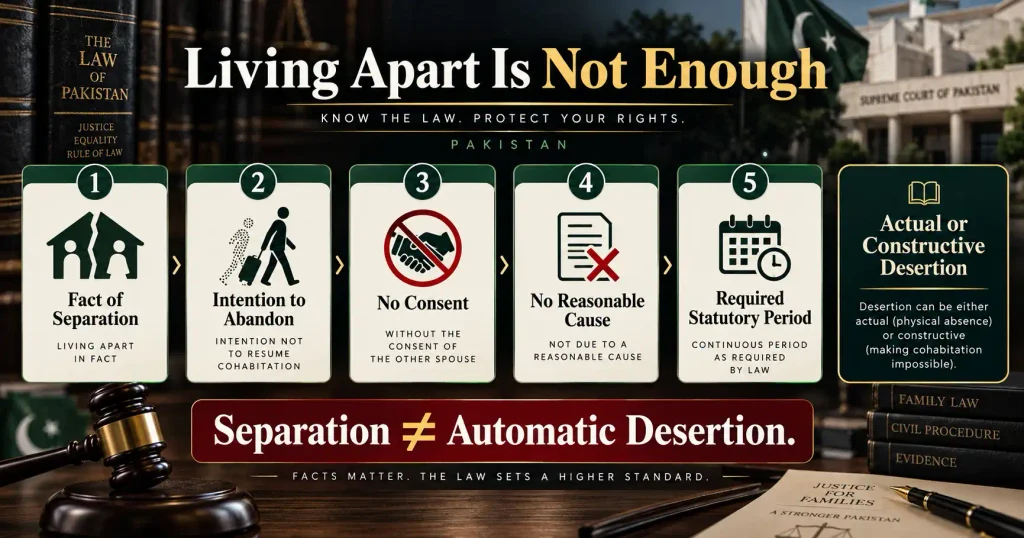
One of the strongest parts of PLD 2026 Lahore 206 concerns desertion.
The Court identified five important elements:
- actual separation;
- intention to permanently abandon the marital union;
- absence of consent by the other spouse;
- absence of reasonable cause for withdrawal; and
- completion of the statutory period.
The judgment also recognized actual and constructive desertion. Constructive desertion may arise where one spouse’s conduct makes continued cohabitation impossible even though the factual pattern differs from simply walking away.
Section 22 requires desertion without reasonable excuse for two years or upwards for judicial separation.
Living in different houses therefore does not automatically prove desertion.
Why Separation Became Important in This Case
The spouses married on 6 June 2022.
The wife later acknowledged that the parties had continued living separately, although some telephone contact remained. The husband also confirmed the continuing separation.
The High Court considered that factual development legally significant.
But it still did not pronounce desertion finally proved. Instead, it held that the lower courts should have framed and examined the proper issues and allowed evidence on legally sustainable grounds, including actual or constructive desertion.
That is a major difference.
Why Adultery Needs Serious Proof
An accusation of adultery can seriously damage dignity and reputation.
PLD 2026 Lahore 206 stressed that courts should not elaborate upon such an accusation without cogent and legally admissible evidence. The Court connected this evidentiary caution with Article 14 protection of human dignity.
Where a husband proceeds on adultery, Section 11 ordinarily requires the alleged adulterer to be joined as a co-respondent.
There are statutory exceptions, including where the person is unknown despite due efforts, is dead, or in the other specified circumstance stated by Section 11.
A serious allegation should never be added merely because someone thinks it will make Christian Divorce in Pakistan easier.
Where a Christian Divorce Case Is Filed
This is an area where ordinary online guides often create confusion.
The current Divorce Act defines the relevant Court of Civil Judge by reference to the local jurisdiction where the husband and wife reside or last resided together. Section 10 likewise refers to a petition before the Court of Civil Judge.
In PLD 2026 Lahore 206, the proceedings began before the Civil Judge 1st Class, Mianwali, and the appeal was heard by the Additional District Judge.
Territorial and subject-matter jurisdiction should still be checked before filing because the facts and applicable local legal framework matter.
Christian Divorce in Pakistan should not be confused with the Muslim talaq procedure involving notice to a Union Council and the familiar 90-day mechanism.
What Evidence Should Go Into the Court File
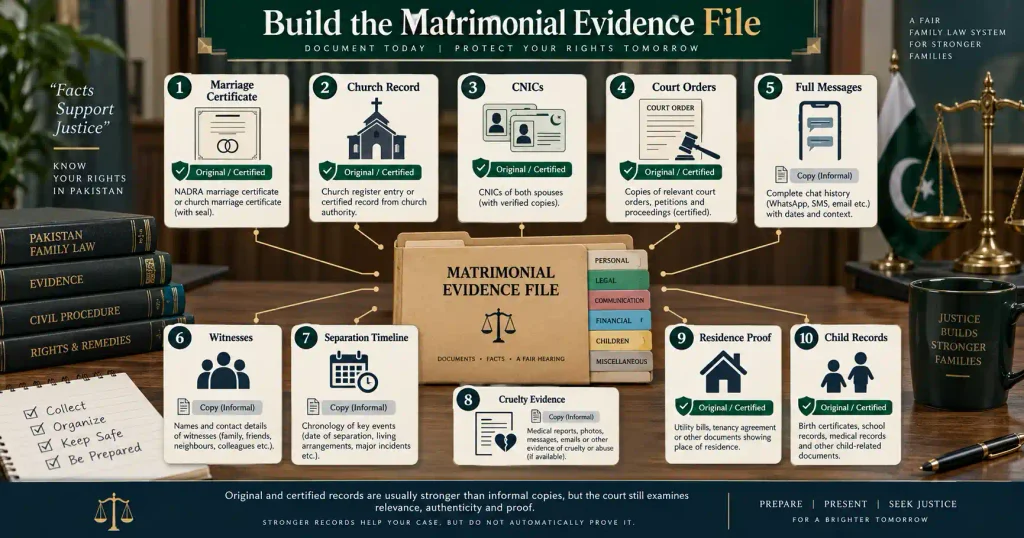
The 2026 judgment gives a practical warning about evidence.
Both spouses entered the witness box, but the High Court noted that the parties had closed their evidence without formally producing important documentary material, including the marriage certificate.
Depending on the pleaded ground, a useful file may include:
- marriage certificate and church record;
- CNIC or identity documents;
- proof of residence and territorial jurisdiction;
- earlier petitions, appeals and certified orders;
- complete messages and correspondence;
- medical or other reliable records where relevant to cruelty;
- witnesses with personal knowledge;
- evidence showing when separation began;
- proof relating to the reason for separation;
- material relevant to consent or lack of consent;
- evidence of attempts at reconciliation where relevant; and
- documents relating to children or financial relief.
Digital material should be preserved in original form where possible.
For evidence principles generally, readers may also see Qanooni Dastak’s Qanun-e-Shahadat Order guide.
How the 2026 Case Reached the High Court
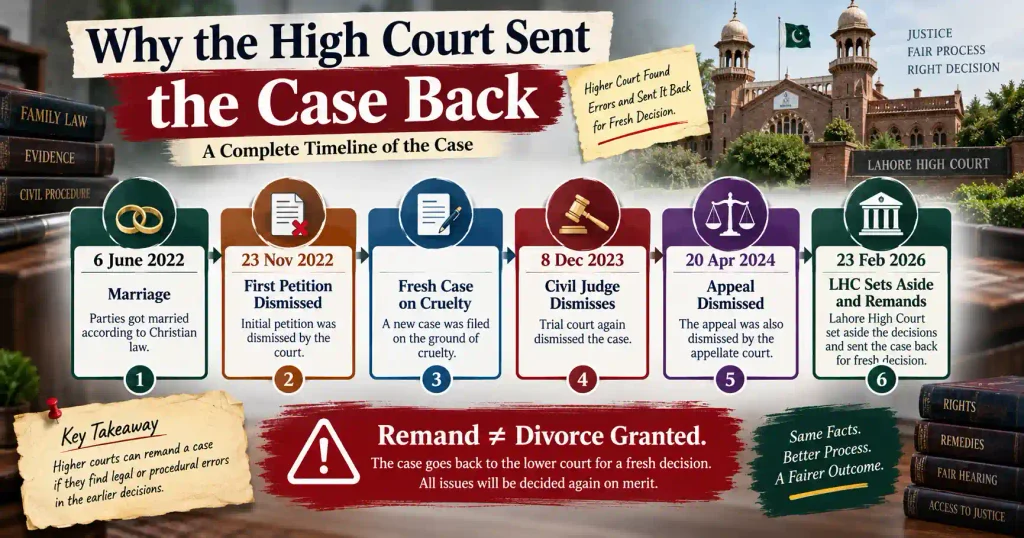
The spouses contracted a Christian marriage under the Catholic school of thought on 6 June 2022.
The husband first pursued proceedings based on adultery. Those proceedings were dismissed on 23 November 2022. During appeal, he obtained permission to withdraw and file fresh proceedings.
He then filed a fresh petition relying mainly on cruelty.
The Civil Judge dismissed it on 8 December 2023. The Additional District Judge dismissed the appeal on 20 April 2024. The husband then invoked Article 199 before the Lahore High Court.
What the Husband Argued
The husband argued that the lower courts had misread the dispute by continuing to centre the case on adultery.
He relied on cruelty, restored Section 7, earlier Lahore High Court precedent, and the continuing separation between the spouses.
He also argued that the wife had admitted prolonged separation and that desertion should therefore be properly considered.
These were arguments—not established facts merely because they were pleaded.
What the Wife Argued
The respondent opposed the petition.
Her counsel maintained that the courts below had correctly evaluated the evidence and that neither adultery nor cruelty had been proved.
It was also submitted that she remained willing to reconcile with her husband.
That defence also had to be considered through proper fact-finding rather than assumption.
What the Lower Courts Missed
The Lahore High Court did not simply replace the lower courts’ factual conclusions with its own.
Instead, it identified defects in the adjudication itself.
The courts had not fully evaluated the evidence, had not separately dealt with cruelty in the required way, and had not properly framed or considered the legally relevant question of desertion arising from the admitted separation.
The appellate judgment was also criticized as sketchy and stereotypical in its treatment of the evidence.
Christian Divorce in Pakistan requires a speaking judgment that connects evidence with each legal issue.
What the High Court Actually Decided
This point must not be overstated.
The Lahore High Court did not decree dissolution.
It allowed the writ petition without entering into the factual controversy, set aside both lower-court judgments and remanded the matter to the trial court.
The trial court was directed to decide the case afresh through a reasoned and speaking judgment within two months from receipt of the certified copy. Both sides were also permitted to seek appropriate framing of issues and production of additional evidence, subject to law.
So PLD 2026 Lahore 206 is a remand judgment, not a final divorce victory.
Why Articles 10-A, 14 and 20 Matter
The judgment places Christian matrimonial litigation within the Constitution.
Article 10-A protects fair trial and due process. Article 14 protects dignity. Article 20 protects religious freedom, subject to law, public order and morality.
The current constitutional text confirms that every citizen has the right to profess, practice and propagate religion, while religious denominations have rights concerning their institutions. (National Assembly of Pakistan)
Readers can consult the current Constitution of Pakistan for the official constitutional framework.
The High Court held that access by Christian citizens to dissolution or judicial separation through civil courts engages their religious freedom and fair-process rights.
What the High Court Did Not Decide
PLD 2026 Lahore 206 did not hold that:
- the wife had committed adultery;
- cruelty had finally been proved;
- desertion had finally been proved;
- prolonged separation automatically dissolves marriage;
- the husband had already obtained divorce; or
- every unhappy Christian marriage must be dissolved.
Instead, the Court required proper issues, proper evidence and a lawful fresh determination.
This limitation is essential when reporting Christian Divorce in Pakistan accurately.
Alimony, Children and Privacy During the Case
The Divorce Act contains rights beyond dissolution itself.
Section 36 allows a wife to seek alimony pending the suit, subject to the statutory framework. The current text sets a ceiling linked to one-fifth of the husband’s average net income for the preceding three years. Sections 37 and 38 deal with further maintenance-related orders.
Sections 41 to 44 allow orders concerning custody, maintenance and education of minor children in relevant matrimonial proceedings.
Section 53 also permits all or part of proceedings to be heard behind closed doors where the Court considers it appropriate.
These matters should be pleaded separately where relief is required.
When Can Either Party Remarry?
A decree should not be followed by an immediate new marriage without checking Section 57.
The current statute states that remarriage becomes lawful after six months from the decree of dissolution. If an appeal has been filed, the statute links remarriage to dismissal of the appeal or the relevant appellate declaration, and says the parties may not remarry sooner.
This is a crucial practical check in Christian Divorce in Pakistan.
A judicial separation is also not the same thing as dissolution, so parties should not assume that a separation decree itself frees them to remarry.
Practical Steps Before Filing
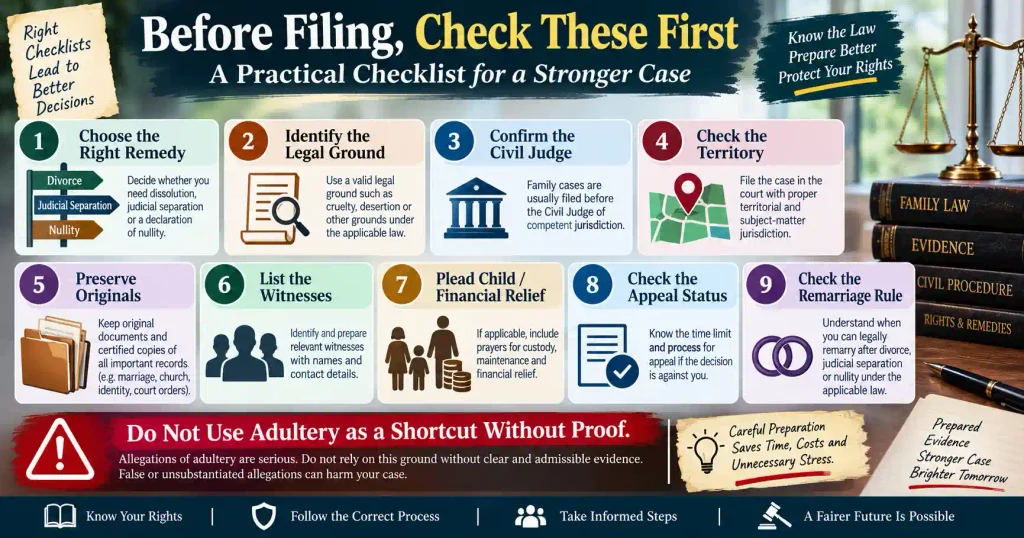
Before filing a Christian matrimonial case:
Christian Divorce in Pakistan requires the right legal ground, proper evidence and the correct court before proceedings begin.
- Confirm that the Divorce Act applies.
- Identify whether you need dissolution, separation or nullity.
- Identify each legal ground separately.
- Confirm the correct Civil Judge and territorial jurisdiction.
- Collect the marriage record and identity documents.
- Preserve original digital and documentary evidence.
- Identify witnesses with direct knowledge.
- Do not make an adultery allegation without evidence.
- Plead relevant financial or child-related relief separately.
- Verify appeal and remarriage timelines before acting.
There is no safe basis for inventing one universal limitation period for every original petition. Some grounds themselves contain time requirements—desertion under Section 22 is the obvious example. Appeal periods and procedural deadlines should be checked under the applicable civil-law framework for the specific order.
Mistakes That Can Damage a Christian Divorce Case
A case can become weaker when a party:
- uses adultery as a shortcut without proof;
- fails to distinguish cruelty from adultery;
- treats separation alone as desertion;
- files in the wrong court;
- omits the statutory co-respondent where Section 11 requires one;
- relies on screenshots without preserving originals;
- fails to formally produce important documents;
- mixes judicial separation with dissolution;
- ignores the possibility of appeal; or
- remarries before the law permits it.
Christian Divorce in Pakistan depends as much on correct procedure and evidence as on the emotional breakdown of the relationship.
What PLD 2026 Lahore 206 Changes in Practice
The judgment does not rewrite the Divorce Act.
Its importance lies in how courts should apply the law.
Christian Divorce in Pakistan requires courts to examine each pleaded ground separately, fairly and on proper evidence.
First, Christian matrimonial cases should not be decided through narrow or stereotypical reasoning.
Second, separate legal grounds require separate examination.
Third, accusations affecting dignity—especially adultery—require evidentiary discipline.
Fourth, prolonged separation may require a proper desertion inquiry rather than being ignored.
Fifth, Article 20 religious freedom and Article 10-A fair trial are not decorative constitutional references. They shape how minority matrimonial rights must be adjudicated.
Finally, the High Court directed circulation of the judgment across Punjab’s district judiciary and also directed judicial training on the Christian Divorce Act and constitutional principles.
For Christian Divorce in Pakistan, that is a significant institutional message.
Conclusion: Proof and Fair Process Matter
Christian Divorce in Pakistan is not governed by the Muslim talaq procedure and cannot be reduced to a simple declaration that the marriage has ended.
The Divorce Act, 1869 requires court proceedings, legally sustainable grounds, evidence and procedural fairness. Section 10 remains important, Section 22 separately governs judicial separation, and Lahore High Court jurisprudence on restored Section 7 has broadened the legal discussion beyond forcing spouses into false allegations of adultery.
PLD 2026 Lahore 206 does not grant automatic divorce for cruelty or separation. It does something more careful: it requires courts to identify the right issues, examine the evidence, respect dignity and religious freedom, and give a reasoned decision.
Anyone considering Christian Divorce in Pakistan should therefore build the evidence first, choose the correct remedy and forum, and avoid treating a remand judgment as a final decree.
FAQs on Christian Divorce in Pakistan
Can a Christian husband divorce without proving adultery?
Section 10 expressly states adultery as the husband’s statutory ground, but the legal position cannot now be read from Section 10 alone. Lahore High Court jurisprudence restored Section 7 in Ameen Masih and recognized broader divorce principles. The exact ground should still be properly pleaded and proved rather than treating divorce as automatic.
Did PLD 2026 Lahore 206 grant the husband a divorce?
No. The Lahore High Court set aside the judgments of the Civil Judge and Additional District Judge and remanded the case for fresh adjudication. It expressly avoided deciding the factual controversy itself. The trial court still had to frame appropriate issues, receive evidence where permitted and decide the merits.
Can cruelty support Christian matrimonial relief?
Yes, but the exact relief matters. Section 22 expressly lists cruelty as a ground for judicial separation. Questions of dissolution must also be examined in light of Section 10 and the Lahore High Court jurisprudence concerning restored Section 7. Cruelty must be proved through relevant facts and evidence.
Does living separately automatically prove desertion?
No. PLD 2026 Lahore 206 explains that desertion requires more than physical separation. The court identified separation, intention to abandon the marriage, lack of the other spouse’s consent, absence of reasonable cause and completion of the statutory period. Each element requires examination.
Where is a Christian divorce petition filed in Pakistan?
The current Divorce Act refers to the Court of Civil Judge and defines territorial jurisdiction by where the spouses reside or last resided together. The correct forum should still be checked from the applicable law and facts before filing, especially where residence or territorial jurisdiction is disputed.
What documents and evidence should be preserved?
Preserve the marriage certificate, church record where available, identity documents, previous court orders, messages, relevant medical or financial records, witness details and proof of separation. Keep digital evidence in its original form. The 2026 case itself illustrates the risk of failing to formally produce important documentary evidence.
Can the parties remarry as soon as divorce is decreed?
No. Section 57 provides a waiting framework. Under the current text, remarriage is permitted after six months from the dissolution decree, subject to the statutory position where an appeal has been filed. A judicial separation should never be confused with a decree dissolving the marriage.
Does the Muslim 90-day Union Council rule apply?
Not as the ordinary procedure for Christian dissolution under the Divorce Act, 1869. Christian matrimonial dissolution is court-based. Readers should not copy the Muslim talaq process under the Muslim Family Laws Ordinance into a Christian matrimonial case merely because both matters involve ending a marriage.
Legal Awareness Disclaimer
This article is for general legal awareness and education only. It is not case-specific legal advice. Christian matrimonial relief depends on the pleaded grounds, evidence, jurisdiction, applicable precedent and procedural history. Anyone considering dissolution, judicial separation, nullity, appeal or remarriage should obtain advice on the complete record.