

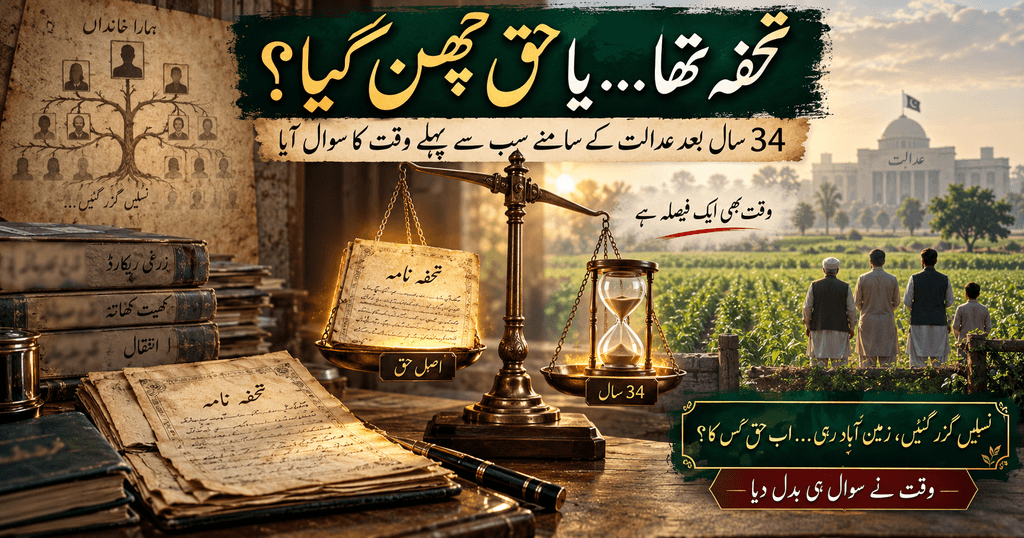
A family may discover an old gift deed only after land has changed hands, mutations have been entered, and original parties have died. The first question is usually, “Was this gift genuine?” But Gift Deed Law in Pakistan asks more: Was there a valid gift and acceptance? Was possession delivered? Did registration apply? When did the right to sue arise? Was fraud properly pleaded? Have third-party rights already been created?
These questions came together in Muhammad Hafeez v. Muhammad Ramzan and 17 others, PLD 2025 Lahore 581. The Lahore High Court did not conduct a full trial on the alleged illness, fraud, or connivance behind the 1981 gift deed. It upheld rejection of the plaint because the challenge, on the face of the pleadings, was barred by limitation.
That distinction matters. Gift Deed Law in Pakistan is not only about making a gift. It is also about proving it, registering it where required, preserving possession evidence, and challenging a disputed transaction through the correct forum in time.
Table of Contents
Judgment at a Glance: The 1981 Gift That Reached Court in 2015
| Point | What the record shows |
|---|---|
| Case | Muhammad Hafeez v. Muhammad Ramzan and 17 others |
| Citation | PLD 2025 Lahore 581 |
| Court | Lahore High Court |
| Judge | Khalid Ishaq, J. |
| Decision date | 23 April 2025 |
| Disputed instrument | Registered Gift Deed No. 6231 dated 3 September 1981 |
| Later transactions | Mutation in 1982; registered sales to third parties in 1984; later mutations |
| Suit filed | 24 November 2015 |
| Main procedural issue | Whether the plaint could be rejected under Order VII Rule 11 CPC as time-barred |
| Final order | Constitutional petition dismissed; revisional decree rejecting the plaint remained intact |
The case identity, registered gift, later sales and procedural history are recorded in the reported judgment. It is mainly a limitation and maintainability decision involving an old registered gift, inheritance allegations, and later third-party transfers.
IRAC: Why the Late Challenge Failed Before Trial
| IRAC | Analysis |
|---|---|
| Issue | Could successors challenge a registered 1981 gift deed in 2015 as an inheritance claim when the affected predecessor had not challenged it during her lifetime and third-party rights had arisen? |
| Rule | Limitation does not disappear merely because inheritance is pleaded. A plaint appearing from its own contents to be barred by law may be rejected under Order VII Rule 11 CPC. |
| Analysis | Safia Bibi remained alive for about 28 years after the gift deed and did not challenge it. Later registered sales occurred, purchasers were in cultivating possession, and the suit came 34 years after the gift deed. |
| Conclusion | The Lahore High Court found no ground under Article 199 to interfere with the revisional decree and dismissed the petition. |
The judgment expressly records Safia Bibi’s death on 1 December 2009, her lifetime non-challenge, the purchasers’ cultivating possession and the 24 November 2015 suit.
What Gift Deed Law in Pakistan Actually Covers

Section 122 of the Transfer of Property Act, 1882 describes a gift as a voluntary transfer of existing movable or immovable property without consideration, from a donor to a donee, accepted during the donor’s lifetime while the donor is capable of giving.
For Muslim property transfers, the deed is not the whole law. Section 129 preserves Muslim law. Pakistani courts have repeatedly treated declaration by the donor, acceptance by the donee, and delivery of possession as the core ingredients of Hiba. A written paper may support those facts, but paper alone does not automatically prove a complete Hiba. Section 129 itself states that the statutory gift chapter does not affect rules of Muslim law.
Gift Deed Law in Pakistan should therefore distinguish the gift transaction, the instrument recording or effecting it, and the later revenue or authority record. For a focused Supreme Court discussion, see our Valid Gift in Pakistan guide.
Official statutory text: Transfer of Property Act, 1882 — Pakistan Code.
Written Gift Deed and Muslim Oral Hiba Are Not the Same
Section 123 of the Transfer of Property Act states that, within its field of operation, a gift of immovable property is effected by a registered instrument signed by or on behalf of the donor and attested by at least two witnesses. Section 17(1)(a) of the Registration Act, 1908 likewise makes instruments of gift of immovable property compulsorily registrable.
Section 129, however, saves Muslim law. A Muslim Hiba may therefore be proved without a registered deed where its legal ingredients are established through reliable evidence. That does not make every oral claim valid; many fail because declaration, acceptance, possession, timing, or witnesses are not proved.
Under Gift Deed Law in Pakistan, a careful approach is to document a genuine gift clearly, register the instrument where applicable, update the relevant record, and preserve acceptance and possession evidence. Stamp duties, registration charges, land-record procedure, and authority requirements can vary by province and location.
Readers dealing with an unwritten family transfer can also consult our Oral Gift in Pakistan guide.
Official registration law: Registration Act, 1908 — Pakistan Code.
The Legal Checks Before a Property Is Gifted
A basic Gift Deed Law in Pakistan checklist starts before signing: verify the donor’s ownership and legal capacity. Identify the donee clearly and record acceptance. Address possession through evidence suited to the property, such as physical control, cultivation, rent collection, keys, or authority records. Then complete the documentary, stamp, registration, mutation, or authority steps that apply.
Gift Deed Law in Pakistan should never be reduced to “sign a stamp paper.” The property description, title, identities, witnesses, possession, and official record should all match the real transaction.
Case Background: What the Plaintiffs Alleged
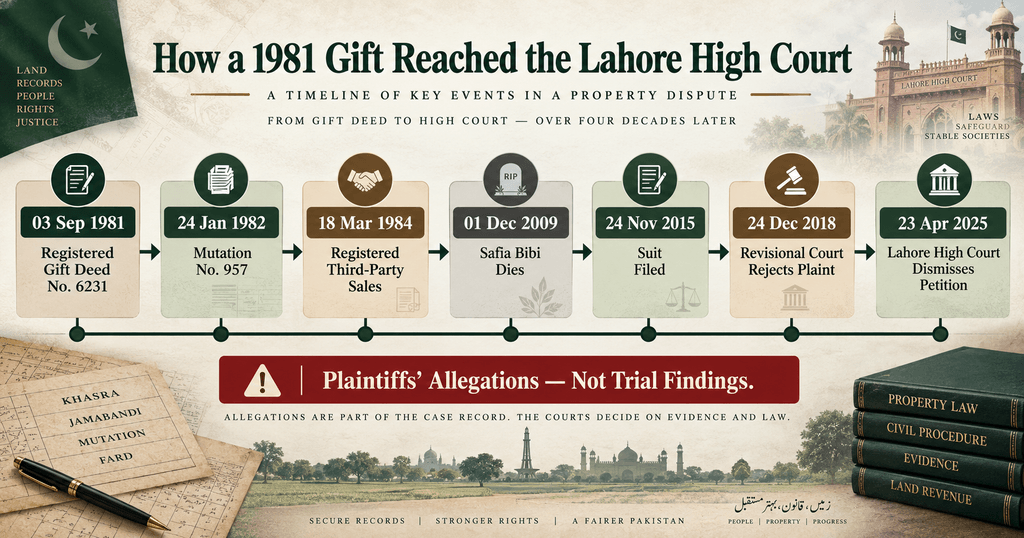
The case shows how Gift Deed Law in Pakistan can become an inheritance and limitation dispute. It concerned agricultural land in Tehsil Shahkot, District Nankana Sahib. Elahi Bakhsh executed Registered Gift Deed No. 6231 dated 3 September 1981 in favour of respondents Nos. 7 to 10, brothers of Mst. Safia Bibi.
The plaintiffs alleged that Elahi Bakhsh was old, bedridden, seriously ill, and had lost normal prudence. They also alleged connivance with revenue staff and deprivation of Safia Bibi’s share. These were allegations in the plaint; the Lahore High Court did not conduct a trial and declare them proved.
Mutation No. 957 followed on 24 January 1982. The donees later sold the land to respondents Nos. 1 to 6 through registered sale deeds dated 18 March 1984. This separation between allegation and finding is essential to accurate reporting of Gift Deed Law in Pakistan.
From the Trial Court to the Lahore High Court
The petitioner and Mst. Ishrat Bibi filed a suit for declaration and permanent injunction. The defendants sought rejection of the plaint under Order VII Rule 11 CPC. The Civil Judge did not reject it, but the contesting respondents succeeded in civil revision under section 115 CPC. On 24 December 2018, the Additional District Judge, Shahkot rejected the plaint as barred by limitation.
The petitioner then invoked the Lahore High Court’s constitutional jurisdiction. This procedural path shows why Gift Deed Law in Pakistan can involve title, registration, revenue entries, limitation, and civil procedure at the same time.
What Each Side Argued About Limitation
The petitioner’s position
The petitioner argued that limitation should not defeat an inheritance claim and that later transactions denying an heir’s right could be cancelled. Counsel also said limitation was a mixed question of law and fact requiring evidence.
The respondents’ position
The respondents said the plaint itself showed a hopelessly late challenge. Safia Bibi remained alive until 1 December 2009 without challenging the 1981 gift, while registered sales and possession in favour of third parties had followed.
The High Court accepted the core limitation objection. Gift Deed Law in Pakistan cannot be applied on the assumption that every case labelled “inheritance” is automatically outside limitation.
What the Lahore High Court Actually Decided — and What It Did Not
Safia Bibi lived for about 28 years after the gift deed without challenging it. The suit was filed on 24 November 2015, about 34 years after the gift and almost six years after her death. The Court also noted that purchasers were in cultivating possession after later registered transfers.
The Court held that a predecessor’s lifetime silence, creation of third-party rights, and an unexplained long delay could not be avoided merely by describing the suit as inheritance.
But the Court did not hold a trial on whether Elahi Bakhsh was actually incapable or whether revenue officials actually connived. That limit is vital. Gift Deed Law in Pakistan should not turn a limitation-based rejection into a merits judgment validating every historical fact surrounding the gift.
The final order was narrower: the High Court found no ground to interfere with the revisional decree and dismissed the constitutional petition.
Five Circumstances That Can Change the Limitation Analysis
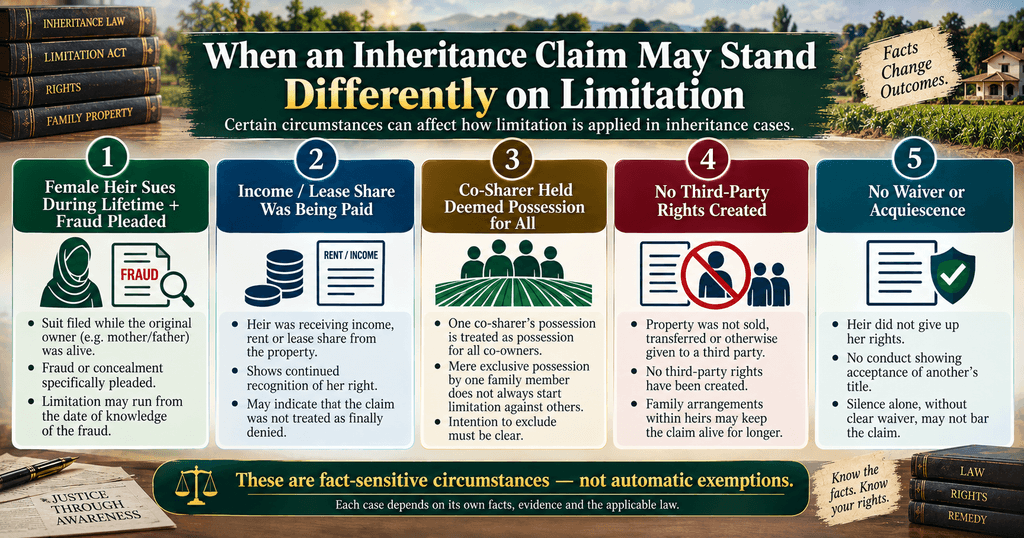
Drawing on Supreme Court precedent, the Lahore High Court identified circumstances that can make inheritance cases different:
| Circumstance | Why it can matter |
|---|---|
| Female heir sues during her lifetime alleging fraud or misrepresentation | The affected heir directly pleads the alleged deprivation. |
| Income or lease share was being paid | It may affect whether an actual denial had occurred. |
| One co-sharer held deemed possession for all | Constructive possession may affect accrual of the right to sue. |
| No third-party rights were created | The dispute remains among heirs or co-sharers. |
| Waiver and acquiescence are absent | Conduct may not show acceptance of the adverse transaction. |
These five situations are drawn directly from the judgment. They are not automatic exemptions; facts must still be pleaded and proved. Gift Deed Law in Pakistan requires a dated legal timeline, not a slogan that inheritance never faces limitation.
Fraud, Knowledge and Third-Party Purchasers
Section 18 of the Limitation Act, 1908 can postpone commencement where fraud kept a person from knowledge of the right to sue or a necessary document was fraudulently concealed. The statutory protection is also qualified where a person claims through the wrongdoer in good faith and for valuable consideration.
The judgment, relying on Supreme Court authority, stressed that fraud must be pleaded with particulars, including the relevant date of knowledge, and proved through positive evidence.
In Gift Deed Law in Pakistan, “I found out recently” is not enough by itself. Registered instruments, possession, revenue entries, family conduct, income received, notices, and later sales can all matter.
The judgment also discussed the difference between a wrong inheritance mutation and actual denial through sale and transfer of possession to a third party. When property is sold beyond a co-sharer’s right and possession passes, the right to sue may accrue more clearly.
For a wider limitation guide, see our Limitation Act in Pakistan guide.
Official source: Limitation Act, 1908 — Pakistan Code.
Why Order VII Rule 11 Ended the Case Early
Order VII Rule 11 CPC permits rejection where a plaint appears to be barred by law. The High Court explained that limitation is not always a mixed question requiring evidence. If the plaint itself shows fatal delay and does not plead facts requiring proof before limitation can be decided, a full trial is unnecessary.
The Court also relied on section 3 of the Limitation Act, under which courts must examine limitation even if the defendant does not raise it. The judgment found the 34-year delay unexplained on the face of the plaint.
For Gift Deed Law in Pakistan, dates of execution, knowledge, denial, possession, and later transfers should therefore be pleaded carefully.
Official source: Code of Civil Procedure, 1908 — Pakistan Code.
What Article 100 Really Means for a 30-Year-Old Deed
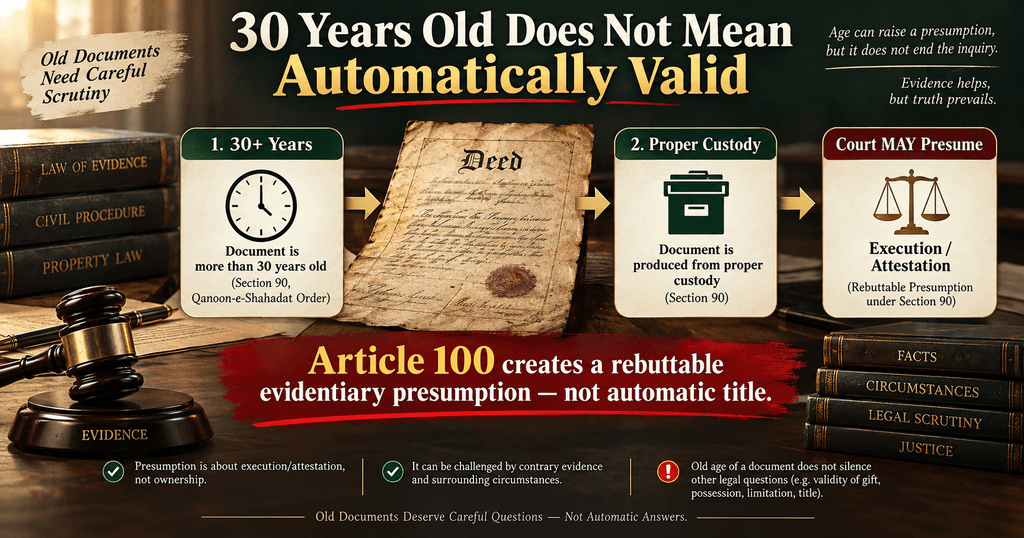
The High Court noted that the disputed deed was 34 years old and referred to Article 100 of the Qanun-e-Shahadat Order, 1984.
Article 100 does not make every old document automatically genuine. Where a document purporting or proved to be 30 years old comes from custody the court considers proper, the court may presume the relevant signature, handwriting, execution, and attestation. “May presume” and “proper custody” are important qualifications.
Under Gift Deed Law in Pakistan, age can strengthen an evidentiary position, but it is not an irrebuttable rule.
Readers can also see our Qanun-e-Shahadat Order 1984 evidence guide.
Official source: Qanun-e-Shahadat Order, 1984 — Pakistan Code.
How to Create and Preserve a Gift Safely
Obtain the title document and current land or authority record. Confirm the donor’s identity, ownership, and capacity. Describe the property and share accurately. Record the voluntary gift and the donee’s acceptance. Preserve evidence showing possession or control.
Where a registrable instrument is used, complete the applicable stamp and registration process before the competent authority. Identity, witness, biometric, fee, and supporting-document requirements can differ by province, so check the current official process where the property is situated.
After transfer, complete mutation or the relevant authority or society update where required, and keep certified copies. This practical side of Gift Deed Law in Pakistan can prevent a genuine family transfer from becoming an avoidable proof dispute.
A signed paper alone is not enough. In PLD 2025 Supreme Court 502, the grandfather kept possession of the property and the deed was not properly proved, so the grandsons’ claim failed. Read why a 1988 gift deed in Pakistan was rejected.
How to Challenge a Suspect Gift Deed Without Losing Time
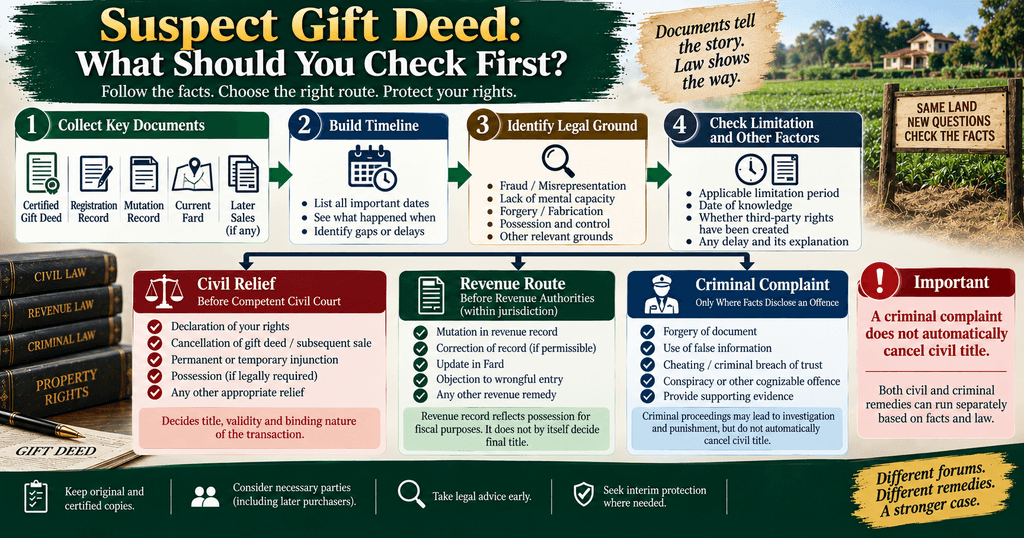
For a challenge under Gift Deed Law in Pakistan, start with certified records: the gift deed, registration endorsements, mutation, current Fard or record of rights, earlier title documents, later sale deeds, and any authority or society transfer record. Build a date-by-date title chain.
Preserve evidence matching the allegation. For incapacity, seek contemporaneous medical and witness evidence. For fraud or impersonation, preserve lawful identity, registry, thumb impression, biometric, witness, handwriting, and official record evidence. For possession, collect cultivation, rent, tenancy, utility, tax, or other control material.
A civil case may seek declaration, cancellation, injunction, possession, or consequential relief where available. Revenue authorities may deal with mutation matters, but a serious title dispute can require the competent civil court. Facts disclosing forgery or impersonation may also justify a criminal complaint; criminal proceedings do not automatically replace civil title relief.
Avoid three common mistakes: relying only on uncertified photocopies, pleading “fraud” without dates or particulars, and filing only a criminal complaint while leaving the civil title issue unresolved.
Gift Deed Law in Pakistan has no single limitation answer for every challenge. Article 91 provides three years for a suit to cancel or set aside an instrument not otherwise provided for, running from knowledge of the facts entitling cancellation; but whether Article 91 governs the particular relief must be assessed from the pleadings and nature of the instrument. An official Sindh High Court decision reproduces that rule.
Article 120 is the residuary six-year provision where the First Schedule provides no other limitation period, running from accrual of the right to sue. In PLD 2025 Lahore 581, the High Court discussed Supreme Court authority applying Article 120 in declaratory inheritance litigation and stressed that accrual depends on the facts.
Section 18 may matter in genuine fraud or concealment cases. The correct starting date depends on the relief and facts.
Practical Effect for Heirs, Donees and Buyers
Heirs should confront limitation, knowledge, possession, conduct, and later transfers instead of relying only on the word “inheritance.” Donees should preserve declaration, acceptance, possession, and registration evidence. Buyers should examine the chain of title, registered documents, possession, pending litigation, inheritance risk, and the seller’s authority.
Gift Deed Law in Pakistan works best when parties act before evidence grows old and property passes through more hands.
Conclusion: A Gift Paper Is Only Part of the Story
PLD 2025 Lahore 581 does not say every old gift deed is valid or that a deprived heir can never sue. It says an inheritance label does not automatically erase limitation, waiver, acquiescence, or third-party rights. The judgment itself summarized that inheritance claims must still cross those barriers and emphasized the importance of later third-party rights.
The best use of Gift Deed Law in Pakistan is preventive: complete a genuine gift properly, preserve acceptance and possession evidence, keep certified records, and check applicable registration rules. If a suspicious deed appears, obtain the record quickly and take the correct legal step before delay becomes a separate barrier.
FAQs About Gift Deed Law in Pakistan
1. What did PLD 2025 Lahore 581 decide about the old gift deed?
The Lahore High Court dismissed the constitutional petition and left intact the revisional decree rejecting the plaint as time-barred. The Court focused on the 34-year delay, Safia Bibi’s lifetime silence, later registered sales, purchasers’ possession, and the pleadings. It did not conduct a full merits trial on the allegations of fraud or incapacity.
2. Did the Lahore High Court prove that the 1981 gift deed was genuine?
No. The Court did not make a trial finding that every allegation against the gift deed was false. The plaintiffs alleged illness, lack of prudence, and connivance, but the case ended at the maintainability stage. The decisive holding was that the plaint itself disclosed a time-barred challenge and did not require an evidentiary trial on limitation.
3. What makes a Muslim Hiba valid in Pakistan?
Courts generally look for a clear declaration by the donor, acceptance by the donee, and delivery of possession, along with the donor’s capacity and authority over the property. Gift Deed Law in Pakistan therefore looks beyond the paper itself. A deed can be strong evidence, but possession, conduct, witnesses, and Muslim-law requirements may still decide a dispute.
4. Is registration compulsory for every gift of immovable property?
Not every gift question has one answer. Section 123 of the Transfer of Property Act and section 17 of the Registration Act govern registered instruments of gift, while section 129 preserves Muslim law. A Muslim oral Hiba may be recognised if its essentials are proved. Where a written instrument itself effects the transfer, applicable registration requirements must be checked.
5. Can an heir challenge a gift deed many years later by alleging fraud?
Possibly, but fraud is not a magic phrase that removes limitation. Gift Deed Law in Pakistan requires material particulars, a credible explanation of when and how the fraud became known, and supporting evidence. Section 18 may affect computation where fraud genuinely concealed the right to sue, but third-party rights and the claimant’s own conduct can remain important.
6. Is mutation enough to prove that a gift is valid?
No. Mutation is an important revenue entry, but it does not automatically cure a defective underlying transaction or replace proof required by law. Courts may examine the deed, declaration, acceptance, possession, witnesses, title, and conduct. At the same time, a long-standing mutation acted upon for years can become relevant to possession, limitation, waiver, and later transfers.
7. What documents should be collected before challenging a gift deed?
Under Gift Deed Law in Pakistan, collect certified copies of the gift deed, registration endorsements, mutation, current Fard or record of rights, earlier title documents, later sale deeds, and relevant authority records. Add death and relationship records, possession or income evidence, notices, medical evidence where incapacity is alleged, and material supporting the claimed date of knowledge. Prepare a dated timeline before drafting the plaint.
8. Which court or authority should be approached in a gift deed dispute?
It depends on the relief and property. Disputed title, cancellation, declaration, injunction, or possession commonly require the competent civil court, while revenue authorities deal with matters within their statutory jurisdiction. Criminal proceedings may arise from genuine forgery or impersonation. Gift Deed Law in Pakistan should be applied after checking territorial jurisdiction, valuation, limitation, necessary parties, and provincial law.
Disclaimer: This article provides general legal awareness and explains PLD 2025 Lahore 581. Property, registration, revenue, limitation, and procedural rules can depend on the province, relief, and facts. It is not a substitute for advice from a qualified lawyer who has reviewed the original documents.