

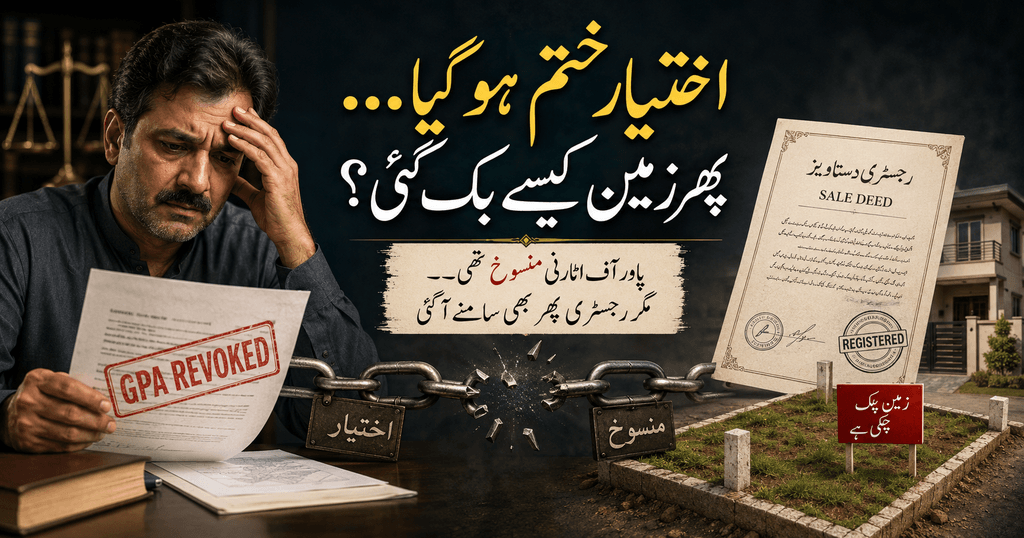
Property Law disputes can begin with one document that looked harmless when it was signed. A General Power of Attorney may be given to a relative or trusted person for convenience, but if that authority is later revoked and the attorney still deals with the land, the dispute can become a fight over ownership, fraud, evidence and limitation.
In this guide, Property Law refers to the rules governing ownership, authority to transfer land, agency, registered instruments, evidence, limitation and civil remedies. Because property law is a broad subject, this article uses one Lahore High Court judgment as a practical lens rather than suggesting that a single case explains every property dispute in Pakistan.
The Lahore High Court judgment reported as 2026 CLC 283 is an important Property Law example. The Court examined a 25-marla Lahore property, a revoked General Power of Attorney, a transfer to the attorney’s real brother, an unrelated agreement to sell, missing proof of sale consideration and incomplete possession. Registration alone did not end the inquiry.
This guide explains what the Court decided, which documents mattered, what remedies were used, and what owners, buyers and heirs should check before a Property Law dispute reaches court.
Table of Contents
Judgment at a Glance: 2026 CLC 283
| Point | Detail |
|---|---|
| Citation | 2026 CLC 283 (Lahore) |
| Case | Ali Haider and another v. Muhammad Boota and another |
| Court | Lahore High Court |
| Judge | Justice Shujaat Ali Khan |
| Case Number | Civil Revision No. 77789 of 2023 |
| Hearing Date | 23 January 2025 |
| Property | 25 marlas in Macca Colony, Guru Mangat, Lahore Cantt. |
| Main Dispute | Sale through a General Power of Attorney after revocation, with the buyer being the attorney’s real brother |
| Main Laws Noted | Specific Relief Act, 1877, ss. 39, 42 & 54; Qanun-e-Shahadat Order, 1984, Arts. 30 & 113; CPC, 1908, s. 115 |
| Trial Court | Suit dismissed on 18 March 2023 |
| First Appeal | Dismissed on 1 September 2023 |
| High Court Result | Revision allowed; both lower-court judgments set aside; plaintiffs’ suit decreed; no order as to costs |
The reported judgment records that the defendants knew about the revocation, the attorney did not justify the transfer to his real brother, proof of sale consideration was missing, and the circumstances supported the finding of a sham transaction. The High Court therefore interfered with the concurrent findings and decreed the suit.
IRAC: Why the GPA Sale Failed in Ali Haider
| IRAC | Property Law Answer |
|---|---|
| Issue | Could the sale survive where the attorney’s authority had been revoked, the buyer was his real brother, and consideration and possession were not convincingly proved? |
| Rule | An agent must act within authority and in the principal’s interest. A self-interested or close-relative transaction requires clear consent and disclosure. A party relying on a sale must prove a valid transaction. Admissions in pleadings can remove the need for proof of an admitted fact. |
| Analysis | The written statement admitted cancellation of the GPA. The agreement-to-sell story did not connect with the later sale deed. A materially different purchase story appeared in evidence but had not been pleaded, and the crucial agreement said to support it was not produced. Payment and full possession were also not proved. |
| Conclusion | The High Court held that the respondents failed to prove a valid transaction, set aside both lower-court judgments, allowed the revision and decreed the plaintiffs’ suit. |
The 2001 Paper Trail That Triggered the Dispute
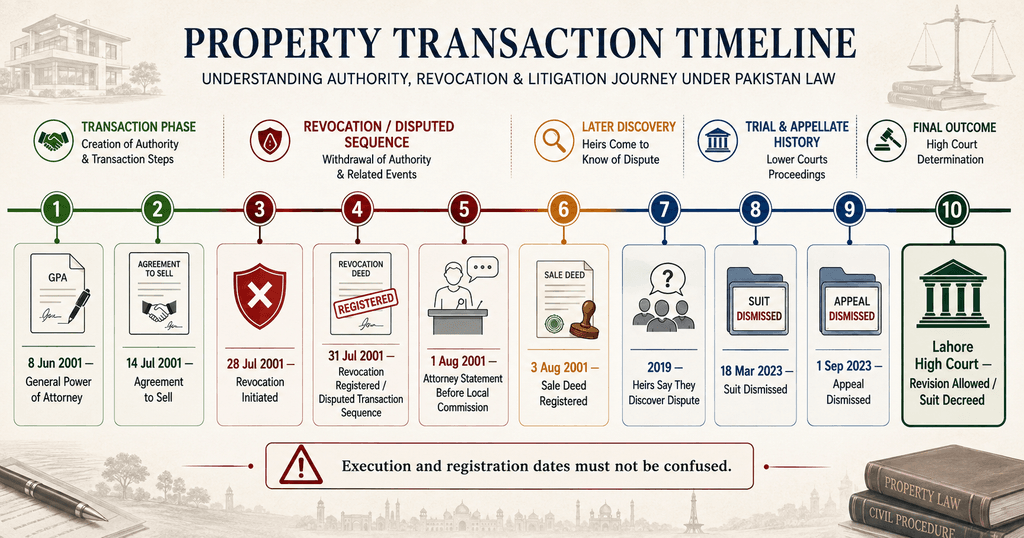
Raza Muhammad appointed respondent No. 1 as his General Power of Attorney on 8 June 2001 regarding the suit property. An agreement to sell dated 14 July 2001 later became part of the defence. The principal moved for revocation on 28 July 2001, and the revocation instrument was registered with the Sub-Registrar, Model Town, Lahore on 31 July 2001.
The detailed reasoning refers to execution of the challenged transaction on 31 July 2001 and registration of the sale deed on 3 August 2001. The opening narration identifies the impugned deed as dated 3 August. The legally safer way to explain the judgment is therefore to distinguish the transaction or execution sequence from formal registration rather than treating both as one event.
Raza Muhammad died on 1 February 2014. His heirs said they discovered the disputed transaction after approaching the Patwari Halqa in 2019. Their civil suit was dismissed by the Trial Court on 18 March 2023 and their appeal was dismissed on 1 September 2023 before the Lahore High Court reversed the outcome.
For Property Law readers, authority, revocation, knowledge, execution, registration, payment and possession are separate questions.
What Each Side Actually Argued
The Petitioners Said the Authority Had Already Ended
The petitioners argued that the transaction could not legally stand because the General Power of Attorney had been revoked, the property went to the attorney’s real brother without the principal’s written permission, and the agreement said to support the defence was not produced.
They also argued that the lower courts concentrated too heavily on delay while overlooking the alleged fraud and weaknesses in the underlying transaction.
The Respondents Relied on Delay and an Earlier Agreement
The respondents argued that the transaction had effectively been set in motion before revocation. They relied on the agreement to sell dated 14 July 2001, pleaded limitation, referred to earlier civil and criminal proceedings, and argued that the later cancellation suit should not proceed.
They also invoked the doctrine of election and disputed the petitioners’ version concerning discovery of the transaction.
The High Court tested those positions against the pleadings, admissions and documents. That distinction between allegation, argument and proof is essential in Property Law writing.
The Evidence That Changed the Property Law Result
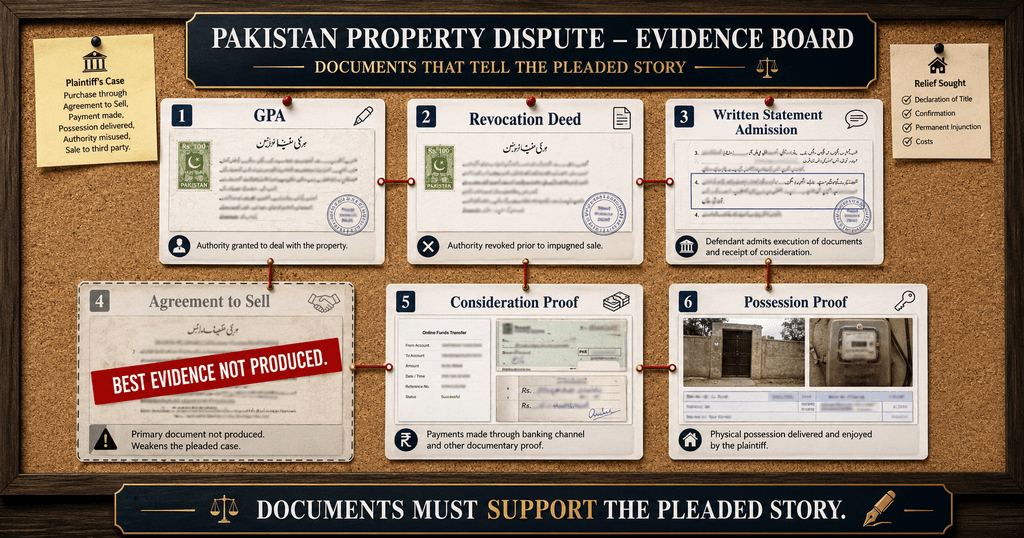
The plaintiffs produced the sale deed, the 8 June 2001 General Power of Attorney, the revocation deed, death certificates and other supporting material. The defendants produced material from earlier litigation, an FIR, the GPA, sale documents and an agreement to sell.
Respondent No. 1 later claimed in evidence that he had himself purchased the property from the principal through an agreement to sell. The High Court found that this materially different case had not been pleaded in the written statement and could not simply be introduced later through testimony.
More importantly, the agreement said to establish that purchase was not produced. The Court treated withholding such important evidence as a serious defect.
In a Property Law dispute, a document that supposedly creates the right being asserted is not a minor omission.
Rule 1: Revocation Was an Admitted Fact
One of the strongest pieces of evidence came from the defendants’ own written statement. It acknowledged that the predecessor of the plaintiffs had cancelled the General Power of Attorney through the registered instrument dated 31 July 2001.
The High Court treated that statement as an admission falling within Article 30 of the Qanun-e-Shahadat Order, 1984 and applied the principle that admitted facts need not ordinarily be proved again.
Readers may consult the current official text of the Qanun-e-Shahadat Order, 1984 on Pakistan Code.
This does not mean that every private revocation automatically binds every person. Under the law of agency, termination operates against the agent when it becomes known to him and against third persons when it becomes known to them. Courts have expressly referred to this rule under section 208 of the Contract Act.
For owners, the Property Law lesson is practical: execute revocation properly, communicate it, preserve proof of notice, and inform offices or institutions that may continue relying on the GPA.
Rule 2: A Close-Relative Sale Demanded Specific Consent
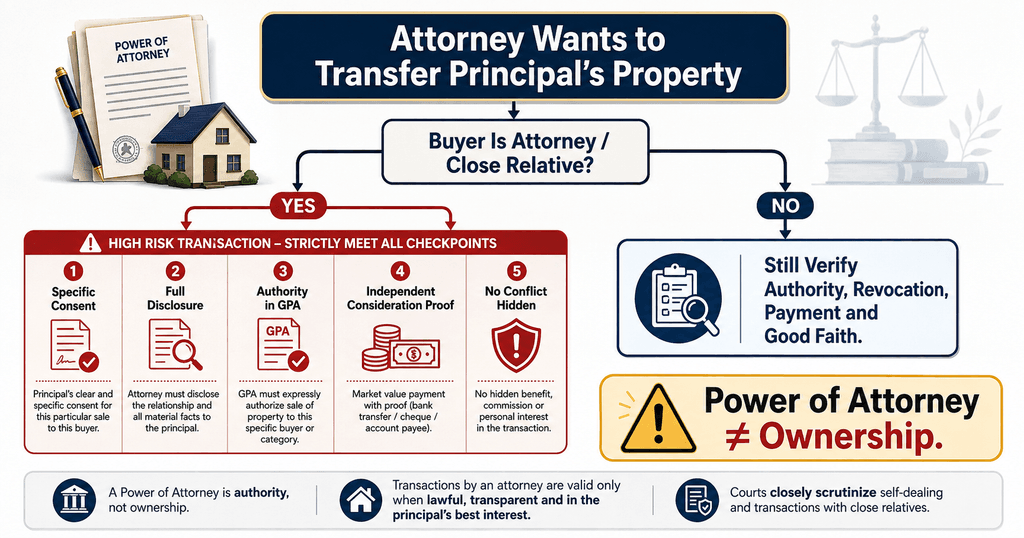
The buyer in this case was the attorney’s real brother.
The Lahore High Court relied on earlier Supreme Court authority explaining that an attorney cannot use the principal’s property for himself or his kith and kin without special and specific consent. The judgment traced that principle to earlier case law and the fiduciary obligations associated with agency.
The attorney remains an agent, not the beneficial owner. A transfer for personal benefit or to a close relative can therefore be examined for informed consent and full disclosure.
The Contract Act, 1872 is central to this part of Property Law because its agency provisions govern termination, duties and self-interested dealings. Section 201 recognises revocation as a mode of termination, while the statutory framework also deals with dealings by an agent for his own benefit.
The official Act can be consulted through the Lahore High Court copy of the Contract Act, 1872.
For a separate judgment dealing with GPA proof and inheritance rights, see Qanooni Dastak’s Power of Attorney Law in Pakistan guide.
Rule 3: An Unpleaded Agreement Could Not Repair the Case
The defence relied on an agreement to sell dated 14 July 2001 and argued that the attorney had validly acted before revocation.
The High Court found the documentary connection defective. Akhtar Ali did not seek enforcement of that agreement and was not a party or witness to the later sale deed. More importantly, the sale deed did not state that it was being executed as a continuation of the 14 July agreement.
The later sale was therefore treated as an independent transaction for the Court’s analysis.
A useful Property Law rule follows: a title chain must be legally and factually connected. One earlier document cannot automatically validate a later transfer to a different beneficiary.
Rule 4: Withholding the Best Document Had Consequences
Respondent No. 1 claimed that he was not merely an attorney but also a purchaser under a written agreement with the principal.
Yet the crucial agreement said to establish that status was not produced.
The High Court referred to the established principle that a party withholding the best available evidence must face the consequences. The omission mattered because the missing document was being used as the explanation for the attorney’s claimed power to deal with the land.
Preserve originals and certified copies early. In Property Law litigation, oral testimony may not repair a missing foundational document.
Rule 5: Consideration and Possession Still Had to Be Proved
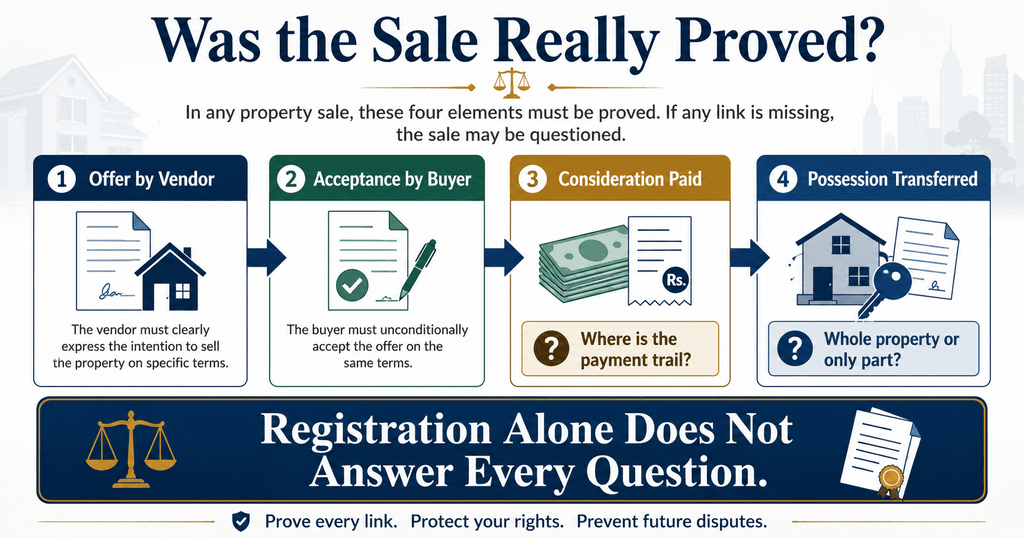
The judgment states that valid alienation required proof of:
- an offer for sale by the vendor;
- acceptance by the vendee;
- payment of consideration; and
- transfer of possession.
The respondents did not prove that sale consideration actually passed to the principal.
Possession was also problematic. Respondent No. 2 stated that possession of only three marlas had been handed over, which the Court treated as failure to establish transfer of possession of the entire suit property.
This does not create a universal mechanical test for every Property Law dispute irrespective of the governing law and facts. It shows that where a party relies on a sale, the real transaction must be proved rather than registration being treated as sufficient by itself.
Rule 6: Fraud Could Not Hide Behind Registration
The High Court held that the circumstances prima facie showed inter se connivance between the two brothers to deprive the principal of his property through a sham transaction.
It repeated the established principle that fraud vitiates even solemn proceedings.
Registration is important evidence, but it is not a shield for an unauthorised or collusive transaction. Property Law due diligence should ask who had authority, whether the principal consented, whether consideration moved, whether possession changed, and whether the documents form a coherent chain.
A registered deed therefore deserves respect as a formal document, but registration cannot be used to prevent a court from examining proven fraud, lack of authority or defects in the transaction itself.
Rule 7: Concurrent Findings Were Not Untouchable
Both the Trial Court and the first appellate court had ruled against the plaintiffs.
Ordinarily, a High Court exercising revisional jurisdiction is cautious about disturbing concurrent findings of fact. The Lahore High Court nevertheless held that concurrent findings are not sacrosanct where they are arbitrary or perverse.
It found important inconsistencies in the Trial Court’s approach and held that the appellate court had failed to apply its independent mind properly to the issues.
Section 115 of the Code of Civil Procedure was the revisional provision involved in the case. Readers can consult the official Pakistan Code text of the CPC, 1908.
The Property Law lesson is narrow: concurrence below is important, but it does not cure a material misreading, non-reading or legally defective approach to evidence.
Limitation After Fraud: What This Judgment Does—and Does Not—Say
The challenged sale dated back to 2001 while the petitioners brought their suit in 2019. The respondents therefore relied heavily on limitation.
The Lahore High Court acknowledged that proceedings barred by limitation ordinarily fail. But in the particular circumstances before it, the Court said the limitation question became secondary because the respondents had failed to prove a valid transaction and the record pointed toward a sham transfer involving the revoked GPA.
This holding should not be rewritten as a general rule that “fraud has no limitation.”
The Limitation Act, 1908 prescribes different periods depending on the relief claimed. Section 18 also addresses situations where fraud kept a person from knowledge of the right to sue or where a necessary document was fraudulently concealed.
Readers may consult the official Limitation Act, 1908 on Pakistan Code.
For Property Law litigation, delay is dangerous. Record when and how the disputed transaction was discovered, obtain certified documents immediately and seek legal advice rather than assuming that an allegation of fraud automatically solves limitation.
Civil Remedy vs Criminal Proceedings: Choosing the Right Route
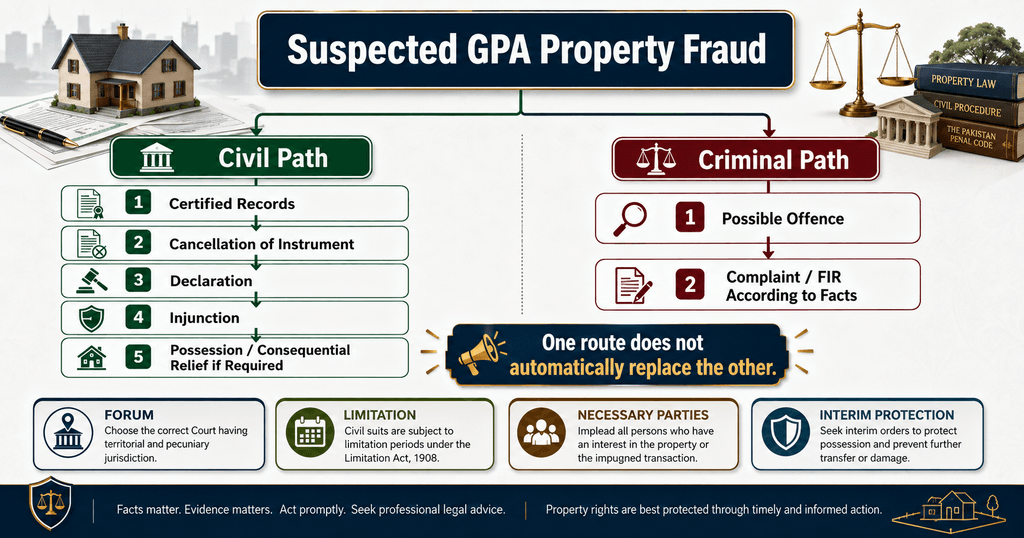
The respondents argued that an earlier injunction suit, a cancelled criminal case and proceedings under section 476 Cr.P.C. prevented the petitioners from bringing the later civil suit.
The High Court rejected that argument on the facts.
It noted that the father’s earlier civil proceedings were not a suit seeking cancellation of the impugned sale deed. It also held that cancellation of the criminal case did not by itself prevent the petitioners from pursuing the civil challenge. The section 476 proceedings likewise did not operate as estoppel or res judicata against the later cancellation claim.
This Property Law distinction matters. Criminal proceedings address alleged offences; cancellation, declaration and injunction are civil remedies.
The reported judgment specifically refers to sections 39, 42 and 54 of the Specific Relief Act, 1877. Section 39 deals with cancellation of instruments that are void or voidable and may cause serious injury if left outstanding.
The official statute is available through the Specific Relief Act, 1877 on Pakistan Code.
The correct forum, necessary parties, valuation, limitation, possession and consequential relief should be checked before filing. A person should not assume that registering an FIR automatically cancels a sale deed.
Property Law Checklist Before Signing, Buying or Challenging
Before Granting a General Power of Attorney
- Identify the property precisely.
- Give only the powers genuinely required.
- State whether sale, gift, mortgage, possession and receipt of price are allowed.
- Consider a time limit instead of unnecessary open-ended authority.
- Keep originals and certified copies.
- State how revocation notices will be served.
- Review land or society records periodically.
For a broader explanation, read Qanooni Dastak’s General Power of Attorney in Pakistan guide.
Before Buying Property from an Attorney
Verify the GPA itself, its exact sale authority, the identity of the principal and attorney, the property description, title chain, mutation, any later revocation, consideration trail and possession.
If the proposed buyer is the attorney himself or a close relative, obtain especially clear evidence of the principal’s informed consent.
Do not assume that registration removes the need for Property Law due diligence.
After Discovering Suspected GPA Misuse
Obtain certified copies of the GPA, revocation instrument, sale deed, mutation and revenue record. Preserve notices, payment evidence and possession material. Record the date and source of discovery and check whether the property has been transferred again.
Identify every necessary party and ask counsel whether cancellation, declaration, injunction, possession or another consequential remedy is required. Where another transfer appears imminent, urgent interim protection may also need consideration.
If unlawful possession in Punjab is involved, Qanooni Dastak’s separate Punjab Protection of Ownership of Immovable Property guide may also help. That special statutory route should not be treated as a substitute for every sale-deed cancellation dispute.
Documents to Preserve Before Going to Court
A useful Property Law file may include the original or certified GPA, revocation instrument, proof of communication, registered sale deed, registration endorsements, mutation, Fard, Jamabandi, agreement to sell, bank or receipt evidence, possession documents, correspondence and notices.
Where heirs bring proceedings after the owner’s death, death certificates and inheritance documents may also matter.
Previous plaints, written statements, judgments, orders, FIRs, cancellation reports or related criminal proceedings should be preserved where either side intends to rely on them.
The record should answer seven practical questions: authority, consent, payment, possession, knowledge, limitation and chain of title.
Practical Effect of 2026 CLC 283
This judgment does not declare every GPA sale to a relative void.
It does not say that every registered deed is worthless.
It does not abolish limitation.
And it does not guarantee success to every owner or heir who alleges fraud.
What it demonstrates is that Property Law courts can look behind formal paperwork where authority, close-relative dealing, consideration, possession and the parties’ own pleadings raise serious concerns.
It also confirms that a High Court may interfere with concurrent factual findings in revision when those findings are arbitrary or perverse. The final order in this case was not a remand: the Lahore High Court allowed the revision, set aside the two judgments below and decreed the plaintiffs’ suit.
The strongest practical lesson is evidentiary: define authority, communicate revocation, preserve the documentary chain, and prove the transaction you rely on.
Frequently Asked Questions
1. What did the Lahore High Court decide in 2026 CLC 283?
The Lahore High Court allowed the civil revision, set aside the Trial Court and appellate court judgments, and decreed the plaintiffs’ suit. The Court held that the respondents failed to prove a valid transaction. The admitted revocation, close relationship between attorney and buyer, lack of consideration evidence, incomplete possession and documentary defects were important to the result.
2. Does 2026 CLC 283 cancel every sale made after a GPA is revoked?
No. The case turned on its own evidence. The defendants’ admission of revocation, the attorney’s relationship with the buyer, missing consideration, incomplete possession and weak documentary chain all mattered. A third party acting in good faith without notice may raise different questions under agency law, so this judgment should not be applied mechanically.
3. What does Property Law require when an attorney sells to a close relative?
The transaction attracts careful scrutiny because an attorney acts in a fiduciary capacity rather than as the owner. The judgment relied on authority requiring special and specific consent for transfers to the attorney or his kith and kin. The wording of the GPA, disclosure, consent, consideration and surrounding evidence should therefore all be examined.
4. Is a registered sale deed automatically valid in a Property Law dispute?
No. Registration is important, but a court can still examine the transferor’s authority, consent of the principal, consideration, possession, fraud and the documentary chain. In 2026 CLC 283, formal documentation did not save the transaction because the respondents failed to prove a valid alienation on the evidence.
5. Does revocation of a power of attorney immediately bind everyone?
Not necessarily. Agency law provides that termination takes effect against the agent when it becomes known to him and against third persons when it becomes known to them. Owners should therefore communicate revocation and retain proof. In this case, the defendants’ own written statement admitted cancellation, making that admission particularly important.
6. Does fraud mean there is no limitation period in Property Law cases?
No. Fraud does not create a universal exemption from limitation. The applicable period depends on the relief and facts. Section 18 of the Limitation Act can affect computation where fraud concealed the right or a necessary document. A person discovering a suspicious transfer should act promptly and plead the discovery and limitation facts carefully.
7. What evidence should be preserved after suspected power-of-attorney misuse?
Preserve the GPA, revocation instrument, proof of notice, sale deed, mutation, Fard, Jamabandi, agreement to sell, payment records, possession evidence, correspondence and earlier civil or criminal records. Also document when and how the disputed transaction was discovered. Certified copies from the relevant public office can be crucial where originals are unavailable or disputed.
8. Which remedy is normally used to challenge a fraudulent or unauthorised sale deed?
The correct remedy depends on the claimant and document. A competent civil court may be asked for cancellation, declaration and injunction under the Specific Relief Act, together with possession or other consequential relief where legally required. Forum, valuation, necessary parties and limitation should be checked before filing; criminal proceedings do not automatically replace the required civil remedy.
Conclusion: A GPA Is Authority, Not Ownership
2026 CLC 283 is a clear Property Law warning. A General Power of Attorney does not make the attorney the owner, registration does not cure a transaction that is not legally proved, and a close-relative transfer can demand especially careful scrutiny.
Owners should define authority narrowly, communicate revocation and preserve proof. Buyers should verify the authority behind a deed as carefully as the deed itself. Anyone discovering a suspicious transfer should secure the documentary record and obtain advice quickly because limitation, evidence and the exact civil relief can decide the case.
The safest Property Law strategy is to build a clean paper trail before the transaction, monitor the record afterward, and act promptly if authority, payment, possession or ownership stops making sense.
Disclaimer
This article is for legal awareness and educational purposes only. It is not legal advice and does not predict the outcome of any individual dispute. Property rights, limitation, evidence, jurisdiction and available remedies depend on the facts, documents and applicable law. A qualified lawyer should review the complete record before legal action is filed or a disputed document is signed.