

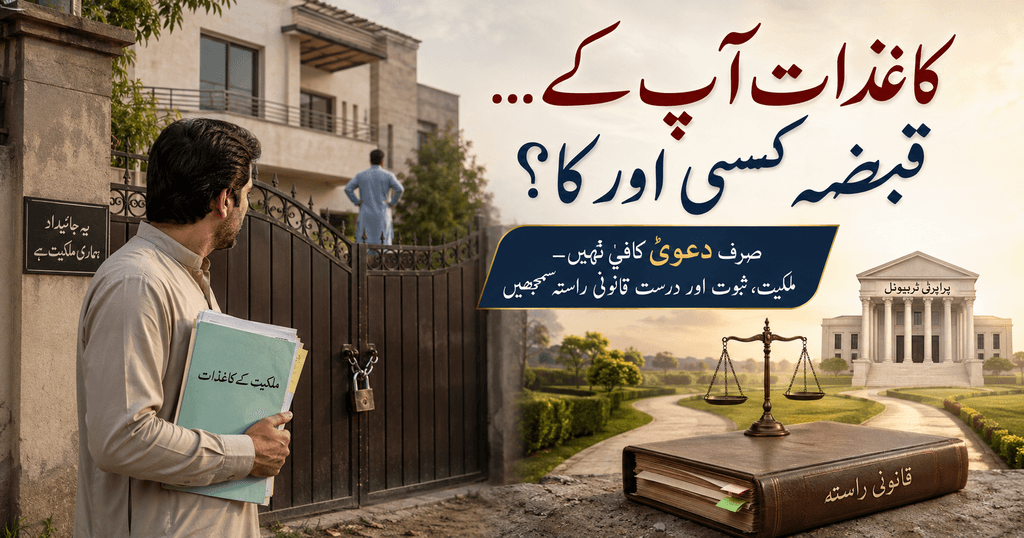
Imagine holding a registered property document, inheritance record or allotment paper while another person controls your land, house, shop or plot. The papers may say one thing, but the position on the ground may be completely different. This is where Punjab Protection of Ownership of Immovable Property can become important—but only when the facts actually fall within the law.
The legal framework changed substantially in 2026. A complaint is no longer decided through the old Deputy Commissioner-led Dispute Resolution Committee model. Under the amended law, a lawful owner approaches the Punjab Property Tribunal, while a district-level Scrutiny Committee checks records, gathers material and facilitates settlement before reporting back to the Tribunal.
That distinction matters. Punjab Protection of Ownership of Immovable Property is not a universal shortcut for every inheritance, partition, boundary, co-sharer or contractual dispute. It is a special Punjab remedy carrying criminal, possession, title, compensation and procedural consequences. A person should therefore check the offence, evidence, forum and relief before filing.
Table of Contents
Law at a Glance: What the Current Punjab Framework Does
| Point | Current Legal Position |
|---|---|
| Principal law | Punjab Protection of Ownership of Immovable Property Act 2025 |
| Act number | Act CI of 2025 |
| Gazette publication | 18 December 2025 |
| Main amendment | Punjab Protection of Ownership of Immovable Property (Amendment) Act 2026 |
| Amendment number | Act XXXVII of 2026 |
| Amendment Gazette date | 14 May 2026 |
| Territorial scope | Whole of Punjab |
| Who may complain | Lawful owner |
| Complaint forum | Punjab Property Tribunal having territorial jurisdiction |
| Initial referral | Tribunal refers complaint to Scrutiny Committee within 3 days |
| Scrutiny report | Within 30 days of referral |
| Tribunal proceedings | Day-to-day; statutory 30-day decision framework after receipt of Committee report |
| Illegal possession punishment | 5–10 years, or fine up to Rs. 10 million, or both |
| Appeal | Specified final judgment/decree may be appealed to Lahore High Court within 30 days |
The 2025 Act expressly extends to the whole of Punjab and came into force at once. It was designed to protect lawful ownership and provide remedies against unlawful dispossession.
The 2026 Amendment also came into force at once and substantially altered the complaint, scrutiny, Tribunal, appeal and procedural provisions.
IRAC: Punjab Protection of Ownership of Immovable Property in Simple Terms
| IRAC | Legal Position |
|---|---|
| Issue | Has an accused obtained or retained possession of immovable property without lawful authority or lawful means, or through conduct such as fraud, deceit, cheating, dishonesty, forgery, misrepresentation, intimidation, force, coercion or another illegal means? |
| Rule | Sections 4, 7, 8, 9, 10, 11, 13, 15, 16, 18, 19 and 20 govern the offence, complaint, scrutiny, preventive and interim orders, Tribunal powers, trial, restoration, appeal and alienation. |
| Analysis | The lawful owner must identify the property, establish a legally supportable ownership claim and connect the accused’s possession with the statutory offence. The Committee scrutinises the material; the Tribunal adjudicates the case and may determine title where it becomes an issue in a case under the Act. |
| Conclusion | Punjab Protection of Ownership of Immovable Property may provide strong relief where the statutory ingredients are genuinely present, but a normal civil property dispute does not automatically become an offence under this law. |
What Counts as Immovable Property Under the Act?
The definition is broader than simply a house or residential plot.
The 2025 Act includes land, buildings, benefits arising out of land and things attached to the earth or permanently fastened to something attached to the earth.
However, the statutory definition excludes certain matters, including standing trees, crops or grass, fruit and juice in trees, and machinery attached to the earth when that machinery is dealt with separately from the land.
In everyday cases, Punjab Protection of Ownership of Immovable Property may therefore concern agricultural land, residential houses, commercial buildings, shops, plots and other qualifying immovable property interests.
The exact property must still be identifiable. Vague statements such as “our family land” are not a substitute for plot numbers, khasra details, boundaries, title documents or other reliable identifiers.
The 2026 Reset: Why the Old DRC Model Is No Longer the Main Route
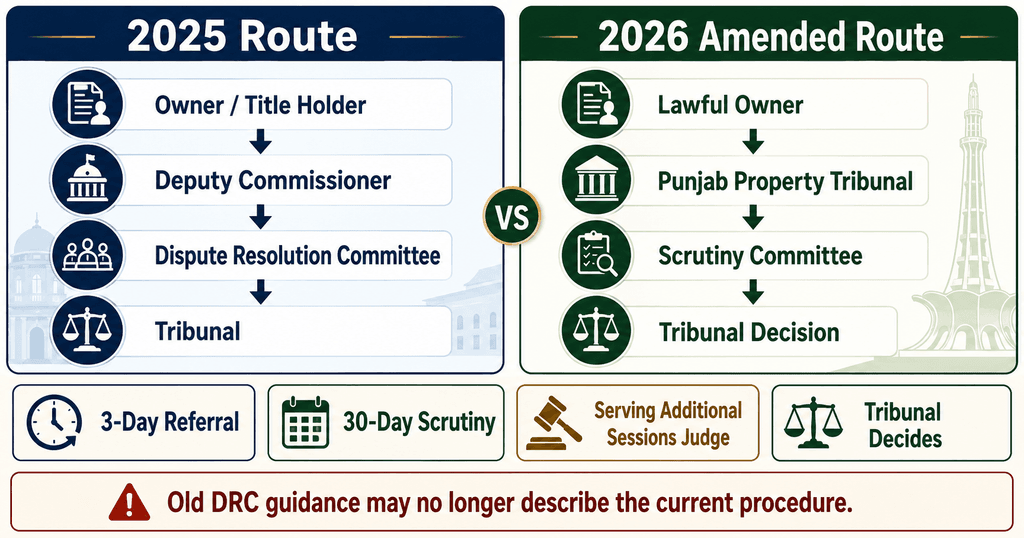
The difference between the original and amended systems is significant.
Under the 2025 Act, an owner or title holder filed a complaint before the Deputy Commissioner or prescribed officer. A Dispute Resolution Committee then had broad functions, including record examination, hearings and dispute resolution. The original statutory period was 90 days, with a possible further extension of up to 90 days.
The 2026 Amendment replaced that structure with a Tribunal-centred process.
| Issue | Original 2025 Position | 2026 Amended Position |
|---|---|---|
| Filing | Deputy Commissioner / prescribed officer | Punjab Property Tribunal |
| Committee | Dispute Resolution Committee | Scrutiny Committee |
| Tribunal head | Government-appointed Member | Serving Additional Sessions Judge designated as Judge |
| Committee role | Wider dispute-resolution function | Probe, scrutiny, record gathering and settlement facilitation |
| Committee timeline | 90 days, potentially extendable | Report within 30 days |
| Tribunal decision | Earlier 90-day framework | 30-day statutory framework after Committee report |
| Section 6 | Separate company/entity liability | Omitted |
| Definition of accused | Earlier structure | Expanded to include entities and persons controlling them |
| Burden of proof | Section 14 shifted onus in illegal-possession cases | Section 14 omitted |
| Old section 17 | Interim eviction/recovery | Omitted |
| Current interim relief | — | Substituted section 10 |
| Voluntary return section | Separate section 21 | Sections 21 and 22 omitted |
The amendment substituted sections 4 and 5 and omitted the old section 6. It also replaced the complaint provision in section 7.
For readers, the practical message is simple: old explanations saying that the Deputy Commissioner or DRC finally decides the case should not be used as a guide to the amended procedure.
Before You File: Does the Dispute Fit Section 4?
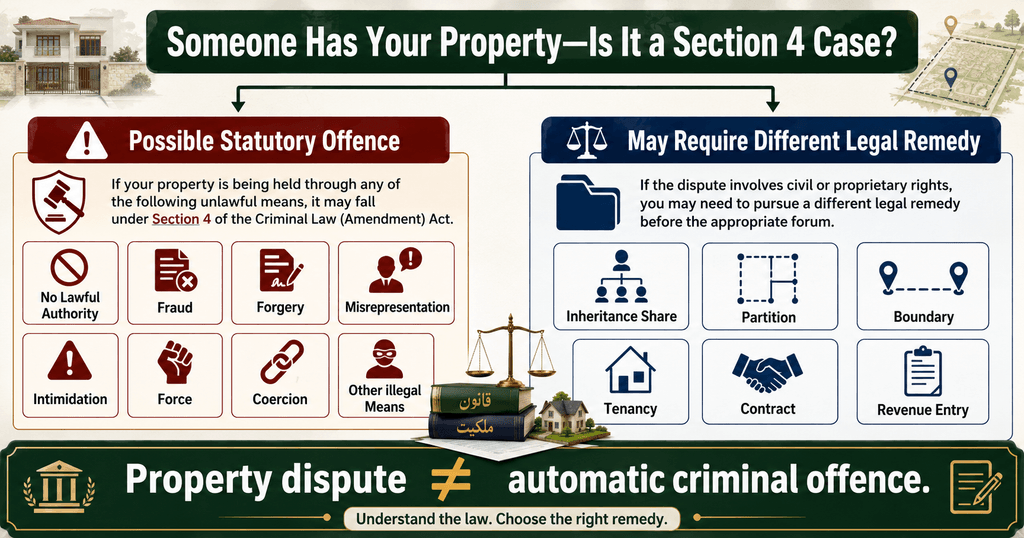
This is the most important screening question.
Amended section 4 applies where an accused obtains or retains possession of immovable property:
- without lawful authority;
- without lawful means;
- through fraud;
- deceit;
- cheating;
- dishonesty;
- forgery;
- misrepresentation;
- intimidation;
- force;
- coercion; or
- another illegal means.
A conviction may carry imprisonment from five to ten years, or fine up to Rs. 10 million, or both.
Section 5 separately covers a person who attempts, aids, abets, facilitates or conspires in relation to an offence under the Act. The punishment may extend from one to three years, or fine up to Rs. 1 million, or both.
But the existence of a property disagreement is not enough.
A dispute may instead concern inheritance shares, partition, boundaries, tenancy, specific performance, cancellation of a document, revenue entries or the extent of a co-sharer’s rights. Such disputes require analysis of their own facts and applicable remedies.
For a useful comparison between civil possession disputes and criminal allegations, see Property Possession in Pakistan and Illegal Dispossession Act 2005.
Who Can Use Punjab Protection of Ownership of Immovable Property?
Amended section 7 uses an important expression: lawful owner.
The lawful owner files the complaint before the Punjab Property Tribunal having territorial jurisdiction over the area where the property is situated.
The complaint is required to contain:
- sufficient particulars to identify the immovable property;
- material facts alleged to constitute the offence;
- evidence of lawful title or ownership; and
- particulars of the alleged accused, so far as known to the complainant.
These are not optional drafting details. They are part of the substituted section 7 itself.
A complaint under Punjab Protection of Ownership of Immovable Property should therefore connect three things clearly: the property, the ownership claim and the alleged unlawful possession.
From Complaint to Scrutiny: The 3-Day and 30-Day Route
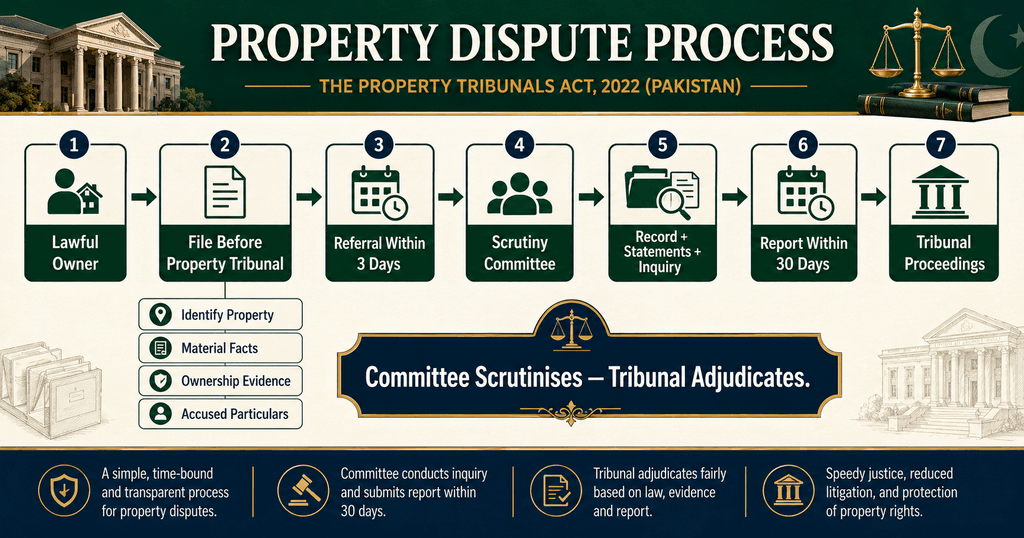
After receiving the complaint, the Tribunal must refer it to the Scrutiny Committee within three days for probe, scrutiny, encouraging and facilitating amicable resolution, and submission of its report.
The amended Scrutiny Committee includes:
- Deputy Commissioner as Convener;
- District Police Officer;
- Additional Deputy Commissioner (Revenue);
- Assistant Commissioner concerned;
- Sub-Divisional Police Officer concerned;
- Circle Revenue Officer concerned;
- officer-in-charge of the concerned police station; and
- an officer of a government agency who may be co-opted.
The Committee may scrutinise records, hear persons concerned, require attendance and information, call for public records and arrange recording of statements.
The police-station officer-in-charge has a specific operational role in attendance, statements, seizure memos and record collection. The Circle Revenue Officer acts as the focal person for liaison with the Tribunal.
The report and relevant record are to be submitted within 30 days of referral.
Parties ordinarily appear personally before the Committee. If a party is unable to do so, electronic appearance may be allowed on a written request, subject to biometric verification.
That process makes Punjab Protection of Ownership of Immovable Property evidence-driven from the beginning. Weak property identification or inconsistent documents can create difficulty before the matter reaches final adjudication.
The Tribunal Decides; the Scrutiny Committee Does Not
This distinction should be clear throughout the article.
The Scrutiny Committee probes, checks and reports. It is not a replacement civil court and it is not the final adjudicator of ownership.
Under amended section 11, the Government may constitute a Punjab Property Tribunal for each district and designate a serving Additional Sessions Judge as its Judge. More than one Tribunal may be constituted for a district with defined territorial limits.
Section 13 gives the Tribunal exclusive jurisdiction to try offences under the Act. Where title to the disputed property becomes an issue in a case under the Act, amended section 16 also gives the Tribunal jurisdiction to determine that question.
This does not mean every title dispute can be converted into a Tribunal case merely by using the words “illegal possession.”
The statutory offence must first genuinely arise.
Section 15, which was not omitted, also gives the Tribunal powers of a civil court and a court of sessions, subject to the Act and the applicable provisions of the Codes.
Urgent Protection Before and During Proceedings
The amended law provides two different types of protection. They should not be confused.
Preventive Measures Under Section 9
If a lawful owner apprehends commission of an offence under the Act, an application may be filed before the territorial Tribunal.
After examining the record and hearing the parties, the Tribunal may pass an appropriate order. The section expressly indicates measures such as obtaining reasonable and adequate surety or guarantee or sealing the property.
Interim Relief Under Section 10
Once a case is pending, the Tribunal may pass an interim order regulating possession of the immovable property and may make other orders it considers fit and appropriate.
It may also issue directions to the concerned police officer or authorise a government functionary, officer, official or authority to secure compliance.
Therefore, Punjab Protection of Ownership of Immovable Property distinguishes between preventing a threatened offence and protecting the position during an already pending case.
A Pending Case Can Move—but Only After a Prima Facie Test
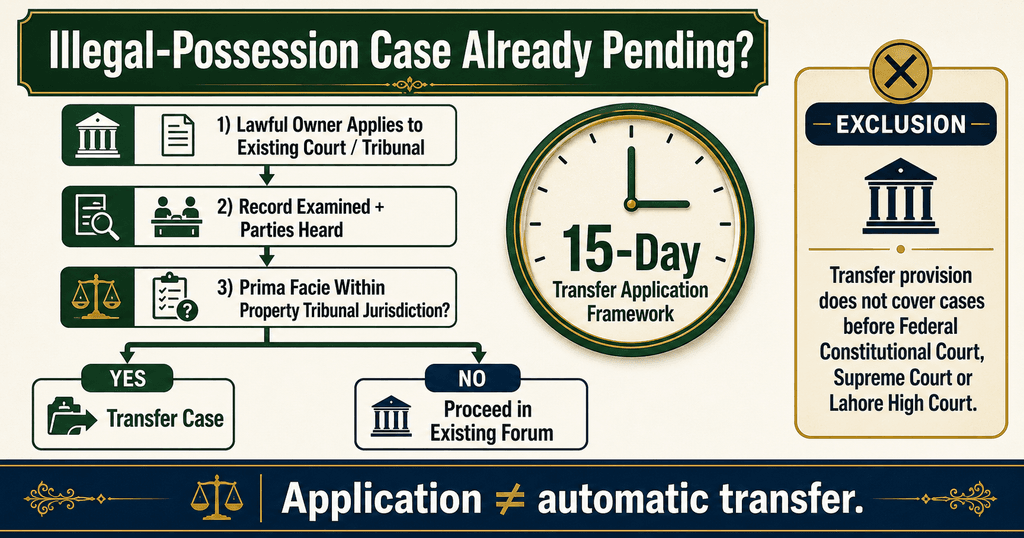
One of the most important 2026 changes concerns existing litigation.
Where a case involving illegal possession is pending before another court or tribunal, a lawful owner may apply to that existing forum for transfer to the Punjab Property Tribunal.
However, the amended section expressly excludes cases before the:
- Federal Constitutional Court of Pakistan;
- Supreme Court of Pakistan; and
- Lahore High Court.
The existing court or tribunal must examine the record and hear all concerned persons. Transfer follows only if it is satisfied that the case prima facie falls within the exclusive jurisdiction of the Punjab Property Tribunal.
The transfer application is to be decided within 15 days.
After transfer, proceedings may normally continue from the stage already reached. Witnesses and evidence already recorded do not automatically have to be repeated, although the Tribunal may refer the matter to the Scrutiny Committee where the statutory conditions permit.
A person using Punjab Protection of Ownership of Immovable Property should therefore never assume that a pending civil case disappears simply because a transfer application has been filed.
Arrest, Bail and the Day-to-Day Trial Clock
The amended procedure is serious.
Section 16 allows the Tribunal, at any stage of a case, to order arrest of an accused for an offence under the Act through the police or another government agency or authority.
Subject to the Code of Criminal Procedure, the amended Act states that no court other than the Lahore High Court has power to grant bail or order release of an accused arrested under section 16(9).
The Tribunal must proceed on a day-to-day basis.
The statutory framework requires the case to be decided within 30 days from receipt of the Scrutiny Committee report. An adjournment should be granted only where necessary in the interests of justice, and no single adjournment may exceed seven days.
A statutory timeline, however, should not be read as a guarantee that every real-world dispute will produce a final enforceable result on the exact thirtieth day. Evidence, superior-court proceedings and case-specific legal issues may affect what happens in practice.
What a Successful Claim Can Actually Produce
The Act goes beyond punishment.
Under section 16, the Tribunal may award monetary compensation for wrongful and illegal possession. The statutory wording provides that compensation shall not be less than the value of the immovable property so possessed, determined according to the valuation table notified under the Stamp Act, 1899 as on the date of final judgment.
The Tribunal may additionally order payment of profit or gain accrued from the property or a superstructure constructed there by the accused.
Compensation, profit and restoration costs may be recovered as arrears of land revenue.
Section 18 separately allows delivery or restoration of possession to the lawful owner after conclusion of the proceedings where the owner is not already in possession. Police or another government authority may be directed to provide assistance.
These are powerful remedies, but Punjab Protection of Ownership of Immovable Property does not guarantee compensation, conviction or restoration merely because a complaint has been lodged. The Tribunal must decide the matter according to the record and applicable law.
Filing a Complaint Can Freeze Later Property Transfers
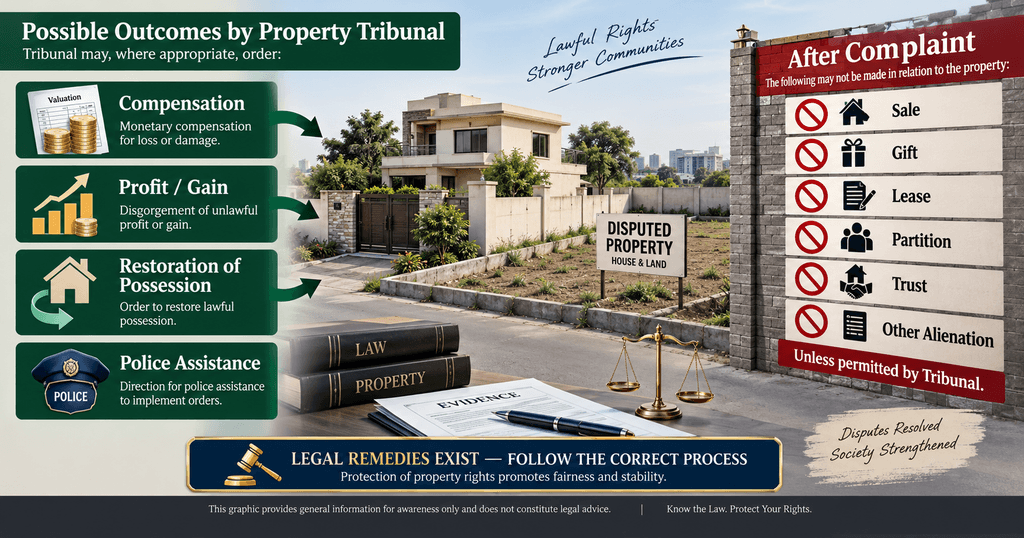
Section 20 carries a major transaction risk.
After filing of the complaint, alienation of the disputed immovable property is prohibited. The section covers transactions including:
- sale;
- lease;
- gift;
- exchange;
- settlement;
- surrender;
- usufructuary mortgage;
- partition;
- creation of a trust; and
- other forms of alienation.
Such alienation is deemed null and void except to the extent permitted by an order of the Tribunal.
That means a buyer, seller, donee, lessee or other person dealing with disputed land should verify pending proceedings before signing or paying money.
Under Punjab Protection of Ownership of Immovable Property, filing a complaint may therefore affect not only the litigants but also proposed third-party transactions.
A Compromise Can Become a Tribunal Decree
The Scrutiny Committee may encourage an amicable settlement.
If the parties resolve the matter or arrive at a compromise, the terms are reduced to writing and sent to the Tribunal for approval, judgment and decree, restoration of possession and such compensation or other terms as may be appropriate.
The consequence is important: amended section 19 states that no appeal or revision lies against a judgment or decree passed under section 8(5).
Before signing a compromise, check:
- exact property description;
- possession date;
- payment amount and schedule;
- responsibility for costs;
- withdrawal or disposal of connected proceedings;
- third-party rights;
- execution obligations; and
- every waiver written into the settlement.
A rushed compromise under Punjab Protection of Ownership of Immovable Property may create consequences that cannot later be challenged through an ordinary appeal or revision under this statutory route.
Evidence for Punjab Protection of Ownership of Immovable Property
Section 7 expressly requires evidence of lawful title or ownership. The documents needed beyond that depend on the source of title and the nature of the alleged offence.
Useful material may include:
- registered sale deed or conveyance;
- registered gift deed where relevant;
- allotment or transfer documents;
- court decree affecting title;
- mutation, fard and record of rights;
- inheritance record and death-related documents;
- complete title chain where ownership is disputed;
- plot, khasra, khewat or khata particulars;
- site plan, map or demarcation material;
- previous possession evidence;
- tax, utility, rent or cultivation records where relevant;
- photographs and videos;
- notices and correspondence;
- police complaints;
- evidence supporting allegations of fraud, forgery, force, coercion or misrepresentation; and
- certified copies of previous court, revenue or Tribunal orders.
Originals and certified public records should be preserved wherever possible.
A mutation entry should also not automatically be treated as conclusive proof of ownership. The underlying transaction and title may still matter. For that distinction, see Inheritance Mutation in Pakistan.
Where fraud or a disputed document may require declaratory civil relief, the related discussion in Civil Suit for Declaration may also help readers understand the difference between remedies.
Filing Mistakes That Can Turn a Strong Case Into a Weak One
A person considering Punjab Protection of Ownership of Immovable Property should avoid common mistakes:
- Treating every family dispute as illegal possession. A co-sharer or inheritance dispute may require a different legal analysis.
- Using inconsistent property particulars. Area, plot number, khasra and boundary descriptions should match the supporting record.
- Hiding existing litigation. A pending suit, appeal, stay or status quo order can materially affect the case.
- Relying on one revenue entry alone. The source of ownership may need to be proved.
- Alleging fraud or forgery without supporting material. Serious allegations should be tied to facts and documents.
- Creating third-party rights after filing. Section 20 may make the transaction legally ineffective unless permitted by the Tribunal.
- Signing a settlement without checking section 8(5). The appeal/revision restriction makes careful drafting essential.
There is also a direct statutory warning against misuse.
If the Tribunal finds a complaint false, frivolous or vexatious, amended section 16 provides imprisonment from one to five years and a fine that may extend to Rs. 500,000.
The safest approach is to file on provable facts rather than using criminal allegations as leverage in an ordinary private dispute.
Appeal Rules That Should Be Calendared Immediately
Amended section 19 allows an appeal to the Lahore High Court within 30 days against the relevant final judgment or decree.
The provision covers an aggrieved person convicted under the Act, the complainant and the Public Prosecutor where directed in writing by the Prosecutor General, Punjab.
Appeals are to be heard by benches constituted by the Chief Justice of the Lahore High Court, with a statutory 30-day disposal framework.
Two restrictions are particularly important:
- no appeal or revision lies against an interim or interlocutory order of the Tribunal; and
- no appeal or revision lies against a compromise judgment or decree under section 8(5).
These restrictions appear expressly in the substituted section 19.
Anyone affected by a final decision under Punjab Protection of Ownership of Immovable Property should identify the nature and date of the order immediately rather than waiting until the appeal period is close to expiry.
Current Law and Official Sources
This article reflects the Punjab Protection of Ownership of Immovable Property Act 2025, Act CI of 2025, together with the Punjab Protection of Ownership of Immovable Property (Amendment) Act 2026, Act XXXVII of 2026, as published in the official Gazette.
The 2026 Amendment also repealed the Punjab Protection of Ownership of Immovable Property (Amendment) Ordinance 2026 while preserving actions taken under it. Section 27 of the principal law was also amended to add a saving for actions taken under the earlier repealed 2025 Ordinance.
For official statutory access, readers may use Punjab Code — 2025 Act and Punjab Code — 2026 Amendment.
Because rules, notifications and superior-court orders can affect procedure, the latest official position should still be checked before filing, transferring a pending matter or acting on a Tribunal order.
Practical Checklist Before Taking the Next Legal Step
Before relying on Punjab Protection of Ownership of Immovable Property, check the following:
- Is the property situated in Punjab?
- Are you claiming as the lawful owner?
- Can the property be identified precisely?
- What document or legal event created your ownership?
- How exactly did the accused obtain or retain possession?
- Which words of section 4 match the alleged conduct?
- Is there already a civil, criminal, revenue or constitutional case?
- Is there any stay or status quo order?
- Are original and certified documents available?
- Do you need preventive relief, interim relief, transfer of a pending case or final restoration?
- Has any sale, gift, lease or other alienation been attempted after filing?
- Is any compromise being proposed?
- Has the 30-day appeal period started to run?
Punjab Protection of Ownership of Immovable Property can provide a powerful statutory route, but the correct forum is only half of the case. The ownership record, possession history and alleged unlawful conduct must all fit together.
Frequently Asked Questions
1. What changed under Punjab Protection of Ownership of Immovable Property in 2026?
The biggest change was procedural. A lawful owner now files before the Punjab Property Tribunal rather than starting before the Deputy Commissioner. The Tribunal refers the complaint to a Scrutiny Committee within three days, the Committee has a 30-day report framework, and a serving Additional Sessions Judge acts as the Tribunal Judge. Several old provisions were also substituted or omitted.
2. Does every property dispute fall under this law?
No. Punjab Protection of Ownership of Immovable Property applies where the statutory ingredients of illegal possession are present. A dispute about inheritance shares, partition, boundaries, tenancy, an agreement, revenue entries or a co-sharer’s rights does not automatically become an offence merely because possession or ownership is disputed. The factual and legal basis of the possession must be examined first.
3. Who can file a complaint before the Punjab Property Tribunal?
Amended section 7 permits the lawful owner to file before the Tribunal having territorial jurisdiction where the immovable property is situated. The complaint must sufficiently identify the property, state material facts alleged to constitute the offence, provide evidence of lawful title or ownership and identify the alleged accused as far as known.
4. What punishment can follow illegal possession?
After conviction under amended section 4, imprisonment may range from five to ten years, or a fine may extend to Rs. 10 million, or both may be imposed. Attempt, aid, abetment, facilitation or conspiracy under section 5 carries a separate punishment of one to three years, or fine up to Rs. 1 million, or both.
5. Can the Punjab Property Tribunal decide ownership or title?
Yes, where title becomes an issue in a case properly arising under the Act. Amended section 16 gives the Tribunal exclusive jurisdiction to determine the question of title, if any, concerning the immovable property that is the subject matter of the case. This does not mean a purely civil title dispute automatically falls under Punjab Protection of Ownership of Immovable Property.
6. Can an old pending property case be transferred to the Tribunal?
It may be possible where the pending case involves illegal possession and the existing court or tribunal finds that it prima facie falls within the Property Tribunal’s exclusive jurisdiction. The Federal Constitutional Court of Pakistan, Supreme Court and Lahore High Court are excluded from this transfer mechanism. The transfer application carries a statutory 15-day decision period.
7. What evidence should a lawful owner preserve before filing?
Preserve the document creating or proving ownership, complete title chain where relevant, registered deeds, revenue record, inheritance papers, exact property identifiers, previous orders, possession material, photographs, correspondence and evidence supporting any allegation of fraud, forgery, force or coercion. For Punjab Protection of Ownership of Immovable Property, originals and certified public records are generally safer than incomplete screenshots or unexplained photocopies.
8. What remedy is available after a final Tribunal judgment?
A qualifying final judgment or decree may be appealed to the Lahore High Court within 30 days under amended section 19. However, no appeal or revision lies against interim or interlocutory Tribunal orders, and a judgment or decree based on a compromise under section 8(5) also carries an express appeal/revision bar. The exact order should therefore be reviewed immediately.
Conclusion: Strong Property Protection Still Depends on Strong Proof
The 2026 amendments changed Punjab Protection of Ownership of Immovable Property from an administration-heavy model into a much more Tribunal-centred mechanism. A lawful owner now approaches the Punjab Property Tribunal, the Scrutiny Committee investigates and checks the record, and the Tribunal decides the legal case.
The Tribunal may deal with title where it arises in a case under the Act, regulate possession, grant preventive or interim protection, order arrest in accordance with the statute, award compensation, restore possession and restrict later alienation of disputed property.
But the law should not be used as a label for every family or civil property conflict. Punjab Protection of Ownership of Immovable Property works best when three things are clear: lawful ownership, identifiable property and facts that genuinely disclose the statutory offence.
Before filing, preserve the record, disclose pending litigation, choose the correct territorial Tribunal, check the remedy being requested and calculate every statutory deadline. Strong allegations cannot replace strong evidence.
Disclaimer
This article provides general legal awareness and educational information only. It is not a legal opinion or case-specific advice. Property disputes may involve civil law, criminal law, revenue law, limitation, inheritance, registered instruments, superior-court orders and facts unique to each case. The latest statute, rules, notifications and binding court orders should be checked before any complaint, transfer application, compromise, appeal or property transaction.
The brief fact is given here.
My wife’s possession for long 27 years. Girdawari in her name. Her construction and electric meter. The other party went into taqseem case in march 2026.
On 11-4-2026 patwari made wanda in their favor and they took possession forcefully the same day. Demolished her construction and erected their walls.
On 13-5-2026 tehsildar ordered wanda in their favour. On 19-5-2026 sanad taqseem allotted to them. Warrant dakhal on 21-5-2026. Application for execution of possession submitted by them on 25-5-2026.
We took stay by ADCR on the same day and execution of dakhal stopped.
Can we move to Illegal dispossession y2005 or the PPT Punjab property ownership 2026. And your favour is required for filing of our case. The courts at first hand don’t take cases of co sharers.
But at the same time no one is allowed to take law in his hands and dispossess the rightful owner or occupier.
Assalam-o-Alaikum,
We apologise for the delayed reply. What happened to your wife is truly unfortunate.
In short:
Illegal Dispossession Act 2005: Courts generally do not entertain cases between co-sharers under this Act, especially when partition proceedings are already pending before the revenue court. So this route is difficult.
Punjab’s new property law: Here too, if a case is already pending before another forum, going straight to the tribunal is not easy. Please have your lawyer check this first.
Your strongest route is the appeal before the ADCR. Stress there that possession was taken by force on 11-4-2026 on the basis of the patwari’s wanda alone, while the Tehsildar’s order, the sanad and the warrant of dakhal all came later. Also attach proof of 27 years’ possession, the girdawari, the construction and the electricity meter.
For the demolition of her construction, a separate complaint under Section 427 PPC may be possible, even though the land is jointly owned.
Important: A civil suit under Section 9 of the Specific Relief Act must be filed within 6 months of dispossession. That period ended around 11 October, so please speak to your lawyer immediately.
This is general legal information. Every case depends on its own documents.
Which city are you from, and when is your next hearing before the ADCR? Let us know so we can guide you better.