
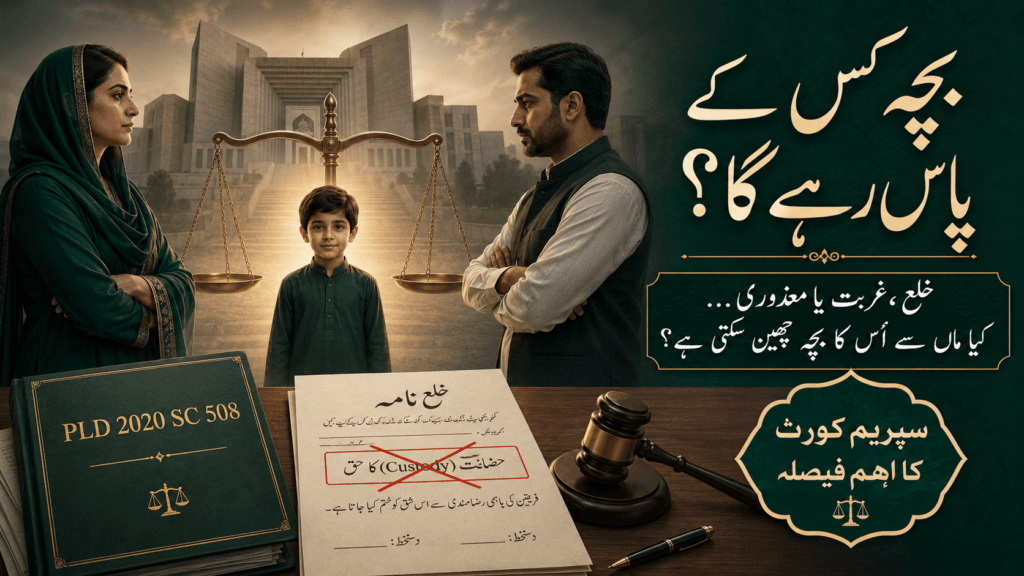
When parents separate, the hardest question is often not who “wins” the case. It is where the child will live, who will provide day-to-day care, and whether conflict between the adults will damage the child’s future. Custody of Minor in Pakistan is therefore not decided as a reward for one parent or a punishment for the other. The controlling concern is the welfare of the child.
That principle becomes especially important when people repeat shortcuts such as “a boy automatically goes to the father at seven,” “a mother loses custody after khula,” or “the richer parent gets the child.” The Supreme Court’s decision in Mst. Beena v. Raja Muhammad and others, PLD 2020 Supreme Court 508, shows why these assumptions can be dangerously wrong. In that case, a mother had signed a khula agreement containing a clause that she would not claim custody of her son. The Supreme Court held that a mother could not be compelled to surrender her right of hizanat as consideration for khula and that the child’s welfare could not be sacrificed to a parent’s private bargain.
This guide explains Custody of Minor in Pakistan through the Supreme Court judgment itself, the Guardians and Wards Act, 1890, the Family Courts Act, constitutional protections, and the practical evidence that can matter in real custody litigation.
Table of Contents
IRAC Analysis — PLD 2020 Supreme Court 508
| IRAC | Analysis |
|---|---|
| Issue | Could a mother be denied physical custody because she had signed a khula agreement saying she would not claim the child, because she had a physical disability, or because she had limited income? |
| Rule | Welfare of the minor is the controlling consideration. A mother in whom hizanat vests cannot be forced to surrender custody as the price of khula. A custody-waiver clause that conflicts with the child’s welfare, Islamic principles and public policy cannot control the court’s decision. The father remains responsible for the child’s maintenance even where physical custody is with the mother. |
| Analysis | The Family Judge heard evidence and found that the child’s welfare lay with the mother. The Supreme Court agreed that the mother’s physical condition was not, by itself, a legal reason to deprive her of custody and that her limited income did not shift the father’s maintenance obligation to her. The Court further held that the khula clause surrendering custody was unlawful: the child’s welfare could not be subordinated to the father’s personal interest, and the clause was void under sections 23 and 25 of the Contract Act, 1872. |
| Conclusion | The Supreme Court set aside the Peshawar High Court judgment and directed the father to hand over physical custody of the child to the mother within seven days, with police and social-welfare assistance if required for compliance. |
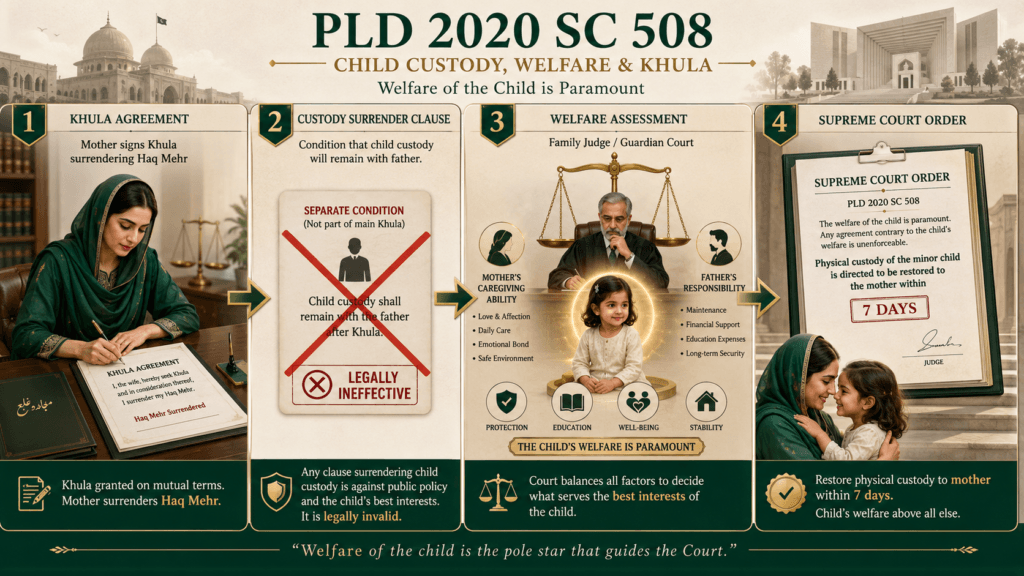
The Family Judge’s three central conclusions—welfare with the mother, disability not being a disqualifying factor, and maintenance remaining the father’s responsibility—were expressly approved by the Supreme Court. The custody-surrender clause was then examined under Islamic principles, public policy and sections 23 and 25 of the Contract Act.
Judgment at a Glance: Custody of Minor Case Snapshot
| Point | Detail |
|---|---|
| Case | Mst. Beena v. Raja Muhammad and others |
| Citation | PLD 2020 Supreme Court 508 |
| Court | Supreme Court of Pakistan |
| Bench | Mushir Alam and Qazi Faez Isa, JJ. |
| Decision Date | 13 July 2020 |
| Child | Muhammad Rayyan, born October 2012 |
| Core Dispute | Physical custody after khula where the mother had signed a deed saying she would not claim custody |
| Key Questions | Welfare of minor, hizanat, custody surrender in khula, disability, financial capacity and public policy |
| Important Laws | Guardians and Wards Act, 1890; Contract Act, 1872, sections 23 and 25; constitutional dignity/equality; Muslim personal law |
| Result | High Court judgment set aside; physical custody restored to mother |
| Compliance Order | Father directed to hand over custody within seven days |
The case was Civil Petition No. 4129 of 2019 with C.M.A. No. 10406 of 2019 and was decided on 13 July 2020. The final order directed transfer of physical custody within seven days and authorized police and social-welfare assistance if necessary to ensure compliance.
Why PLD 2020 SC 508 Matters for Custody of Minor in Pakistan
For parents trying to understand Custody of Minor in Pakistan, the case began with an ordinary but painful family dispute. The mother and father had one son. The mother obtained khula through an agreement dated 16 March 2018. According to the record before the Supreme Court, she gave up her dower—described as a house constructed on five marlas of land and four tolas of gold—and the agreement also stated that she would not claim custody of her son.
She later sought physical custody. The Family Judge granted custody to her, and the appellate court upheld that decision. The Peshawar High Court reversed both courts, relying on the agreement, the mother’s physical condition and her lack of financial independence.
The Supreme Court rejected those reasons. It held that the mother could not be forced to surrender hizanat, that custody could not lawfully become consideration for obtaining khula, and that a husband could not demand the surrender of a child’s custody as the price of ending a marriage.
This makes PLD 2020 SC 508 one of the most useful judgments for understanding Custody of Minor in Pakistan. Divorce, khula, dower and custody may arise from the same broken marriage, but a child is not consideration in a marital bargain.
Custody and Guardianship Are Not the Same Thing
A common source of confusion in Custody of Minor in Pakistan is the use of “custody” and “guardianship” as though both always mean exactly the same thing.
Physical custody or hizanat generally concerns everyday care: where the child lives, who supervises routine life, education, health, emotional care and upbringing.
Guardianship or wilayat concerns legal authority and responsibility regarding the minor and, where applicable, the minor’s property. Academic analysis of Pakistan’s custody law also notes that the Guardians and Wards Act does not always draw this distinction as clearly as modern family disputes require.
In Custody of Minor in Pakistan, the distinction matters because a father’s status or responsibilities as guardian do not automatically answer the separate question of who should have physical custody. That question remains connected to the minor’s welfare.

The Legal Framework for Custody of Minor in Pakistan
1. Guardians and Wards Act, 1890
The Guardians and Wards Act, 1890 on Pakistan Code remains a central statutory framework for guardianship and custody matters. Pakistan Code lists it as Act VIII of 1890 under family laws.
Section 17 directs the court toward the welfare of the minor. Relevant considerations can include age, sex, religion, the character and capacity of the proposed guardian, nearness of kin and, where the child is capable of forming an intelligent preference, that preference. A recent official Sindh High Court judgment has also restated these statutory considerations.
For Custody of Minor in Pakistan, section 25 is also important where a ward leaves or is removed from a guardian’s custody. Even there, return is linked to the court’s assessment of the ward’s welfare.
2. Family Courts Act, 1964
For Custody of Minor in Pakistan, the Family Courts framework expressly covers custody of children and visitation rights of parents to meet them. The official Ministry of Law text also provides that a Family Court is deemed to be a District Court for purposes of the Guardians and Wards Act.
Readers can consult the official Family Courts Act, 1964 PDF from the Ministry of Law and Justice.
Because provincial amendments and local procedural arrangements can matter, a litigant should still verify the version and procedure applicable in the relevant province or territory.
3. Muslim Personal Law and Hizanat
In Custody of Minor in Pakistan, hizanat should not be treated as a bargaining token belonging to either spouse. The Supreme Court in Beena held that a mother in whom hizanat vests cannot be compelled to surrender it to obtain khula, nor can the husband demand such surrender.
The Court further held that the specific custody-waiver clause before it was contrary to Islamic principles governing hizanat and to the law determining custody of minors.
4. Contract Act, 1872 — Why the Khula Custody Clause Failed
The Supreme Court did not stop at family-law principles. It examined the disputed term through contract law as well.
The Court held that the child’s welfare could not be subordinated to the father’s personal interest. It treated the custody term as opposed to public policy under section 23 of the Contract Act and also held the stipulation void under section 25 because it was without lawful consideration in the manner claimed.
The statute itself is available through the official Contract Act, 1872 page on Pakistan Code.
5. Constitutional Dignity and Equality
The judgment also connects custody adjudication with constitutional dignity and non-discrimination. The Supreme Court objected to stigmatizing terminology used for the mother and endorsed the view that pejorative labels concerning persons with disabilities can offend constitutional guarantees under Articles 9, 14 and 25.
For Custody of Minor in Pakistan, this means a parent should be evaluated on actual caregiving capacity and the child’s welfare—not reduced to a label.
The latest official Constitution resources can be accessed through the National Assembly of Pakistan downloads page, which lists the Constitution as amended up to 21 November 2025.
2026 Court Update: Welfare Still Requires Evidence
A March 2026 judgment of the Sindh High Court, Mir Adil v. Mst. Sugra and another, C.P. No. S-653 of 2025, restated the statutory structure in practical terms. The Court explained that section 17 directs the court toward the minor’s welfare and identified factors including age, sex, religion, character and capacity of the proposed guardian, nearness of kin and an intelligent preference where appropriate.
It also explained that section 25 makes return of a ward dependent upon welfare rather than a bare technical claim. The judgment emphasized that disputed questions involving parentage, welfare and circumstances of custody may require evidence rather than premature disposal on a technical objection.
For Custody of Minor in Pakistan, this 2026 official judgment reinforces the same child-centred theme: evidence and welfare remain at the heart of the inquiry.
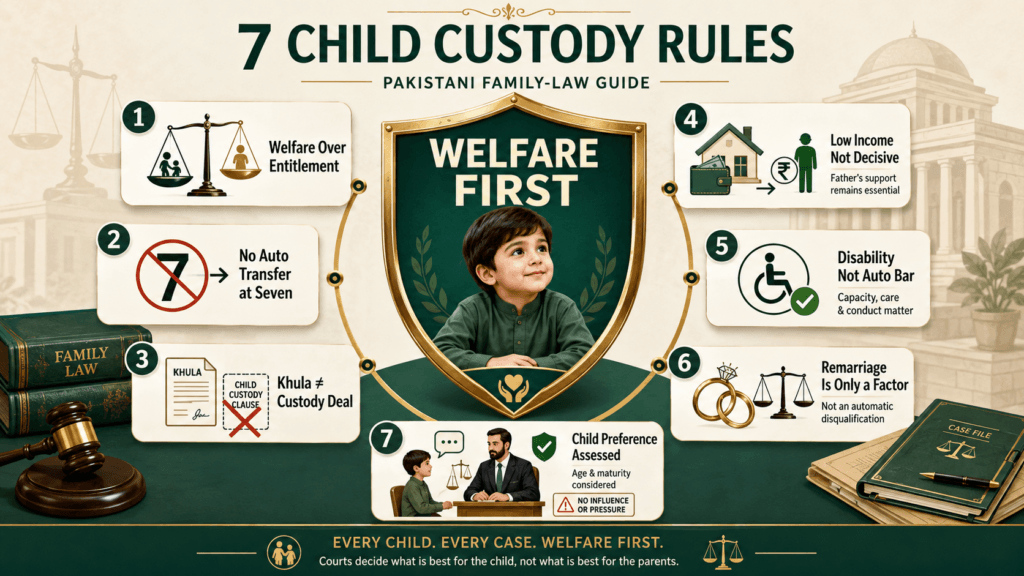
7 Supreme Court Rules Every Parent Should Understand
Rule 1: Welfare of the Child Comes Before Parental Claims
The first and most important principle of Custody of Minor in Pakistan is welfare.
A court does not merely ask which parent has a traditional preference, more money, a larger house or a stronger emotional demand. It asks what arrangement, on the evidence, best protects the child’s overall wellbeing.
Welfare is wider than money. Academic analysis of Pakistani custody jurisprudence identifies health, education, physical, mental and psychological development among the factors informing the welfare inquiry.
It can therefore include emotional security, continuity of care, safety, stable routine, education and the quality of the relationship with caregivers.
The Supreme Court’s own reasoning in Beena confirms that neither the mother’s physical condition nor her income was determinative of the child’s welfare in that case.
Rule 2: A Boy Does Not Automatically “Transfer” to the Father at Seven
The statement “a boy turns seven, so the father automatically gets custody” is not a safe description of Pakistani custody law.
For Custody of Minor in Pakistan, personal-law age principles may be relevant, but they do not operate like an automatic transfer switch. Academic analysis notes that courts have historically referred to the mother’s preferential period for a boy up to seven and a girl until puberty, yet also explains that welfare remains the paramount consideration under domestic jurisprudence.
A father seeking a change in physical custody should therefore not assume that the child legally changes hands on a birthday. A competent court still has to examine welfare and the relevant circumstances.
This corrects an important weakness found in some online explanations: an age guideline should never be presented more strongly than the welfare rule that controls its application.
Rule 3: Khula Does Not Let a Husband Buy the Child’s Custody
This is the strongest lesson from PLD 2020 SC 508.
The mother in Beena had already surrendered her haq mehr and also signed a clause agreeing not to claim her son. The Supreme Court held that custody could not be surrendered as consideration for khula and that the husband could not lawfully demand such surrender.
The Court then held that the disputed term was contrary to the principles governing hizanat and the law concerning minors. The welfare of a minor could not be subsumed by the father’s personal interest, and the clause was treated as void under sections 23 and 25 of the Contract Act.
So, where Custody of Minor in Pakistan is disputed after khula, an old custody-waiver clause should not simply be treated as the final answer without examining the law and the child’s welfare.
For connected family-law issues, readers can also see:
Rule 4: A Mother’s Limited Income Is Not, by Itself, a Reason to Remove the Child
The High Court had relied partly on the mother’s lack of financial independence. The Supreme Court expressly approved the Family Judge’s view that even if the mother was financially incapable of providing for the child, maintaining the child was not her responsibility in those circumstances but the father’s.
In Custody of Minor in Pakistan, the court can still examine whether the child’s actual needs are being met. But:
“The father earns more” is not the same legal proposition as “the child’s welfare requires physical custody with the father.”
Maintenance and physical custody are distinct issues.
Rule 5: Physical Disability Is Not an Automatic Disqualification
Beena is particularly important for parents with disabilities.
The Supreme Court held that the mother’s physical condition was not a determinative factor in deciding custody and strongly criticized insensitive, pejorative terminology.
The practical inquiry should therefore focus on real capacity rather than stereotypes: Can the parent provide safe, loving and effective day-to-day care? What support is available? What does the evidence show about the child’s actual welfare?
In Custody of Minor in Pakistan, evidence of caregiving capacity matters more than a prejudicial label.
Rule 6: Remarriage Is a Factor, Not an Automatic Forfeiture
Another common myth in Custody of Minor in Pakistan is that a mother automatically loses custody the moment she remarries.
That is too absolute. Pakistani custody analysis treats personal-law considerations within the overriding welfare inquiry. Academic review of the case law likewise explains that remarriage can affect a preferential claim but is not necessarily decisive where the child’s welfare points the other way.
The correct questions are factual: What is the new household like? Is the child safe? What is the child’s relationship with the relevant people? Has the child’s education, health or emotional stability been affected?
Likewise, bare allegations about a parent’s “character” should not replace evidence connecting alleged conduct to the child’s welfare.
Rule 7: A Child’s Preference Can Matter, but It Is Not a Veto
Section 17 permits consideration of the preference of a child capable of forming an intelligent preference. A 2026 Sindh High Court judgment also identifies an intelligent preference as one of the factors within the statutory welfare assessment.
But the court must still examine why the child expresses that preference.
The Beena judgment is particularly instructive. The father argued that the child clung to him and did not want even to look at the mother. The Supreme Court was not persuaded that this decided the matter. From the circumstances before it, the Court concluded that the father had filled the child’s innocent mind with fear or dread.
That means a court dealing with Custody of Minor in Pakistan can look behind the words. Age, maturity, consistency, fear, coaching, emotional pressure and the history of the child’s relationship with both parents may affect the weight given to a stated preference.
Can Parents Sign a Private Custody Agreement?
In Custody of Minor in Pakistan, parents may make practical arrangements about residence and contact, but a private agreement cannot remove the court’s duty to protect the minor’s welfare.
The Supreme Court in Beena referred to its earlier judgment in Razia Rehman v. Station House Officer. The passage reproduced by the Court stated that a parental agreement regarding custody could not make a claimed waiver of hizanat binding in law.
The safest way to understand this principle is not that parents can never cooperate or agree on everyday arrangements. Rather, a parent cannot treat a private document as an absolute contractual right that prevents a competent court from examining the child’s welfare.
For Custody of Minor in Pakistan, a clause that attempts to make permanent surrender of the child the price of khula is particularly vulnerable after Beena.
What Evidence Actually Matters in a Custody Case?
A case about Custody of Minor in Pakistan should be built around the child, not around insults between former spouses.
Useful evidence can include:
- school attendance, progress reports and educational records;
- medical and treatment records;
- proof of who has historically provided daily care;
- the child’s present residence and routine;
- safe and suitable living arrangements;
- evidence concerning the child’s emotional relationship with each parent;
- maintenance payments or proof of expenses;
- visitation history and compliance with orders;
- credible evidence of neglect, abuse, violence or substance misuse;
- evidence of interference with the child’s relationship with the other parent, where relevant;
- copies of earlier custody, maintenance, divorce or khula orders.
The significance of evidence is not merely theoretical. The 2026 Sindh High Court judgment stressed that disputed questions involving welfare and custody are matters that may require evidence.
For Custody of Minor in Pakistan, neutral records often speak more clearly than accusations. School reports, medical documents, payment records and previous court orders can show what has actually been happening in the child’s life.
Where domestic violence or immediate safety concerns form part of the dispute, evidence should be preserved carefully and urgent case-specific advice should be obtained. Readers may also consult Qanooni Dastak’s guide on Domestic Violence in Pakistan.
How to File a Custody Case in Pakistan
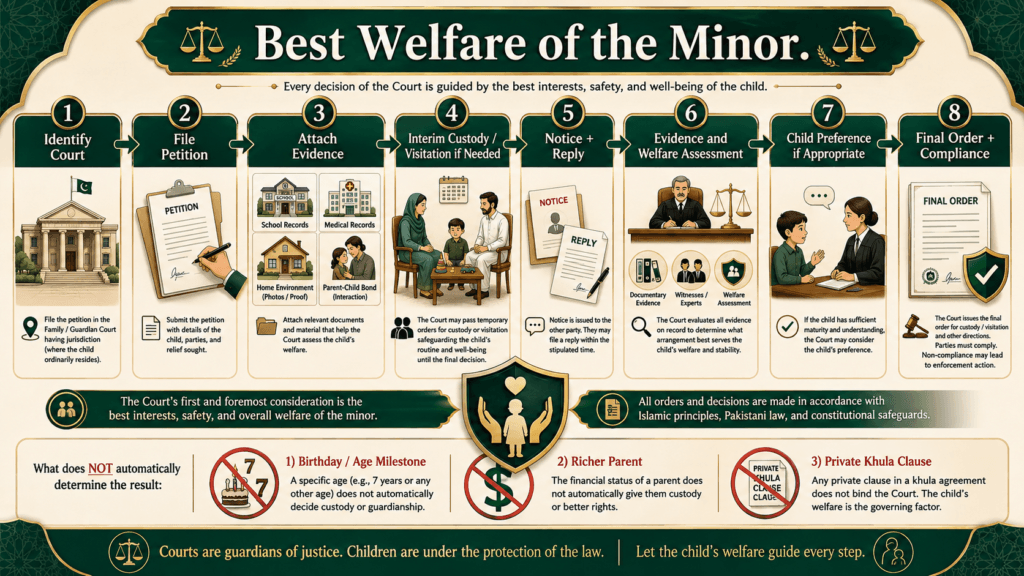
The precise pleading, territorial jurisdiction and procedure can depend on the relevant province or territory and the facts of the family. However, a typical Custody of Minor in Pakistan dispute follows this general path:
- Identify the competent Family/Guardian Court. Confirm the proper territorial and statutory forum before filing.
- Prepare the custody or guardianship petition. State the relationship of the parties, the child’s age, present custody, previous proceedings, relevant agreements and the facts showing why the requested arrangement serves welfare.
- Attach and identify material documents. Relevant school records, medical documents, previous judgments, maintenance evidence and other supporting documents should be properly organized.
- Seek interim relief if required. Depending on the circumstances, an application may seek interim custody, production of the child or temporary visitation while the main proceedings continue.
- Notice and written response. The other parent is given an opportunity to contest the claim.
- Evidence and welfare inquiry. The court assesses oral and documentary evidence concerning the child.
- Child preference where legally appropriate. A sufficiently mature child’s intelligent preference can be considered, but it does not automatically determine the result.
- Final order and compliance. The court decides physical custody and may regulate visitation according to welfare.
The official Family Courts Act includes custody and visitation within Family Court jurisdiction and also links Family Courts with proceedings under the Guardians and Wards Act.
The Beena judgment adds another practical warning: a parent should not disregard an operative order and later seek advantage from the delay created by that disobedience. The Supreme Court stated that every judgment must be obeyed unless it has been suspended or set aside by a higher court.
Visitation Rights: There Is No Universal “Two Meetings a Month” Rule
In Custody of Minor in Pakistan, visitation is one area where online advice can become misleadingly rigid.
Some guides describe “typical” arrangements such as one or two meetings each month or a fixed number of hours. Those examples may resemble arrangements made in particular cases, but they are not a universal statutory formula.
The Family Courts Act expressly recognizes visitation rights. However, the LUMS SAHSOL review explains that the Guardians and Wards Act itself is silent on detailed visitation scheduling and that the legal framework does not provide fixed guidelines for the duration or frequency of visits.
Visitation connected with Custody of Minor in Pakistan should therefore be tailored to factors such as:
- the child’s age;
- school and examination schedule;
- distance between the parents;
- holidays and religious occasions;
- health;
- the child’s bond with each parent;
- travel requirements;
- safety concerns;
- the practical ability of parents to exchange the child peacefully.
Where genuine safety concerns exist, appropriate safeguards may be necessary. There is no responsible one-size-fits-all schedule for every family.
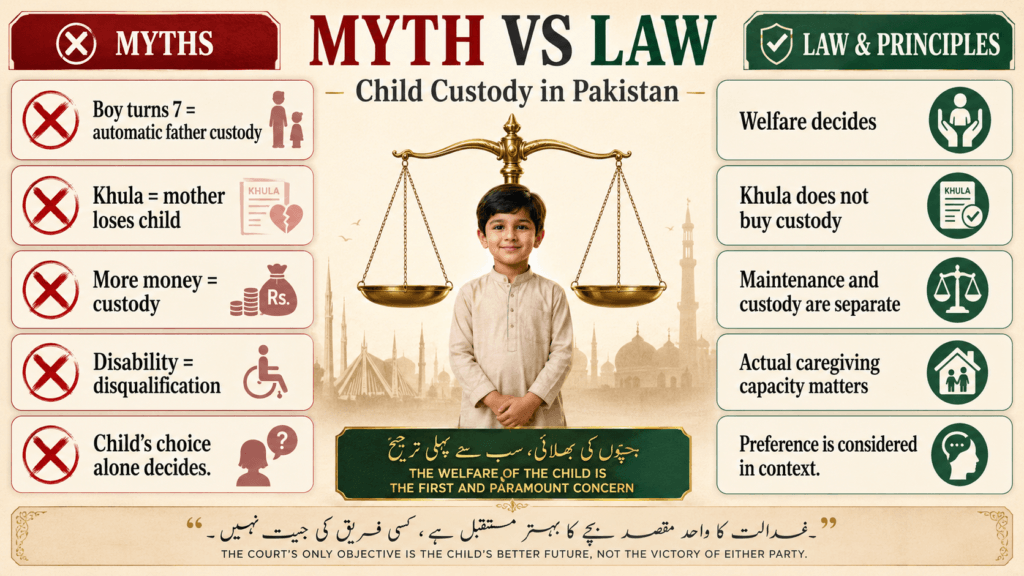
Five Myths That Can Damage a Parent’s Case
| Myth | Better Legal Understanding |
|---|---|
| “A boy automatically goes to the father at seven.” | Age may be relevant, but welfare controls and custody does not mechanically transfer on a birthday. |
| “A woman who takes khula loses her children.” | Khula itself does not extinguish custody. Beena rejects making surrender of custody the price of khula. |
| “The parent with more money wins.” | Financial circumstances may be relevant, but superior income alone does not determine physical custody. |
| “A parent with a disability cannot care for a child.” | Disability itself is not an automatic disqualification. Actual capacity and welfare require evidence. |
| “If the child chooses one parent, the case is finished.” | An intelligent preference may be considered, but maturity, influence and overall welfare still matter. |
These corrections are central to Custody of Minor in Pakistan because a parent who builds a case around a myth may overlook the evidence a court actually needs. A careful Custody of Minor in Pakistan petition should therefore connect every important allegation to the child’s welfare.
Practical Checklist Before Going to Court
Before commencing litigation, a parent should focus on evidence and conduct that protect the child:
- Keep the child’s welfare, rather than revenge against the other parent, at the centre of the case.
- Collect school, medical, residence and caregiving records.
- Preserve evidence of maintenance paid or received.
- Keep an accurate record of completed or denied visitation.
- Retain copies of all existing court orders.
- Follow operative court orders unless lawfully suspended or changed.
- Do not coach the child or force the child to choose sides.
- Avoid social-media attacks that expose the child or increase conflict.
- Preserve credible evidence if abuse, addiction, violence or neglect is alleged.
- Do not assume that an old khula or settlement document permanently decides custody.
- Ask counsel to distinguish physical custody, guardianship, maintenance and visitation.
Official and Reliable Sources for Custody of Minor in Pakistan
Readers researching Custody of Minor in Pakistan should prefer statutes, judgments and authoritative academic material over generic summaries.
Official legislation: Guardians and Wards Act, 1890 — Pakistan Code.
Official Family Court law: Family Courts Act, 1964 — Ministry of Law and Justice.
Official Contract Act: Contract Act, 1872 — Pakistan Code.
Current Constitution resources: National Assembly of Pakistan — Constitution Downloads.
Children’s-rights institution: National Commission on the Rights of Child. Its 2026 child-friendly material emphasizes best interests and non-discrimination as core child-rights principles.
Academic analysis: LUMS SAHSOL — Law on the Custody of Children in Pakistan: Past, Present and Future. The paper identifies gaps in the statutory framework and explains why custody litigation relies heavily on judicial interpretation.
Frequently Asked Questions About Custody of Minor in Pakistan
Who normally gets custody of a minor child after divorce in Pakistan?
There is no rule under which one parent automatically wins every custody dispute. Personal-law principles may be relevant, but the court must examine the welfare of the individual child. Section 17’s welfare-based considerations have also recently been restated by the Sindh High Court.
Does a mother lose custody after khula?
No. Custody of Minor in Pakistan does not disappear merely because a mother obtains khula. PLD 2020 SC 508 is particularly important because the Supreme Court held that a mother could not be compelled to surrender custody as consideration for obtaining khula.
Can a mother sign away child custody in a khula agreement?
A clause attempting to make surrender of the child the consideration for khula cannot simply override welfare. In Beena, the Supreme Court held the custody-surrender stipulation unlawful and treated it as void under sections 23 and 25 of the Contract Act in the circumstances of that case.
Does a father automatically get a son when he turns seven?
No automatic transfer occurs simply because a boy reaches seven. Age-based personal-law guidance may be relevant, but Custody of Minor in Pakistan continues to depend upon the welfare inquiry and the court’s determination. Academic analysis also confirms the centrality of welfare over a mechanical age formula.
Does a mother lose custody if she is poor or unemployed?
Limited income alone does not automatically deprive a mother of physical custody. In Beena, the Supreme Court approved the Family Judge’s finding that even if the mother lacked the financial ability to maintain the child, the maintenance obligation rested with the father.
Can a parent with a physical disability obtain custody?
Yes. Disability alone is not an automatic legal disqualification. The court should examine actual caregiving circumstances and the child’s welfare. PLD 2020 SC 508 expressly rejected the mother’s physical condition as a determinative reason to deny her custody.
Does remarriage automatically end a mother’s custody?
No automatic answer should be assumed. Remarriage may be considered alongside the new household and other circumstances, but the decisive inquiry remains the child’s welfare rather than remarriage in isolation.
Can the child choose which parent to live with?
A child who can form an intelligent preference may have that view considered. But Custody of Minor in Pakistan is not determined by a simple vote. The court can evaluate maturity, reasons for the preference, pressure or influence and the wider welfare evidence.
Can the non-custodial parent meet the child?
Visitation rights fall within the Family Court framework. There is no universal statutory rule prescribing the same number of meetings or hours for every family; academic analysis specifically identifies the absence of fixed duration and frequency guidelines.
What if one parent refuses to obey a custody order?
An operative judgment should be obeyed unless it is suspended or set aside by a competent higher court. In Beena, the Supreme Court criticized the failure to comply with earlier judgments and ultimately directed physical custody to be delivered within seven days.
Is the richer parent more likely to get custody?
More financial resources may form part of the factual circumstances, but wealth is not a legal trump card. Custody of Minor in Pakistan examines total welfare, and the responsibility to maintain a child can remain with the father even where physical custody is with the mother.
Which court handles child custody and visitation cases?
Custody, guardianship and visitation are dealt with through the Family/Guardian Court framework under the applicable Family Courts legislation and Guardians and Wards Act. The official Family Courts Act schedule expressly includes custody, visitation and guardianship.
Conclusion
PLD 2020 Supreme Court 508 gives parents a powerful but simple message: a child is not property to be exchanged in a divorce bargain.
Custody of Minor in Pakistan turns on welfare, not simply on superior income, a stigmatizing view of disability, an automatic birthday rule, or a clause attempting to make a child the price of khula.
The strongest custody case is therefore not the loudest attack on the other parent. It is the clearest evidence showing where the child will be safe, cared for, educated, emotionally secure and able to develop with dignity.
When a court keeps that question at the centre, custody law serves the person it was designed to protect—the minor.
Disclaimer
This article provides general legal information and educational analysis and is not legal advice for an individual family. Custody outcomes depend on the particular child, evidence, applicable provincial or territorial law and existing court orders. Urgent removal, safety concerns, international disputes or existing custody orders require case-specific advice from a qualified Pakistani family-law practitioner.