
A police character certificate may look like a routine paper until a visa deadline is close, a foreign employer asks for urgent clearance, or an old FIR suddenly appears during verification. Then one wrong address, missing document or incorrect application route can become a serious delay.
The problem is that Pakistan does not use one identical process for every applicant. Punjab, Islamabad, Sindh, Khyber Pakhtunkhwa and Balochistan have different police systems. Overseas Pakistanis may also need an embassy, authority letter or Police Khidmat Markaz Global route.
This guide explains where to apply, whether you can apply online, required documents, current official fees and processing times where published, overseas procedure, tracking, attestation and what to do if an old criminal case affects your certificate.
Table of Contents
Start Here: Choose the Right Police Route First
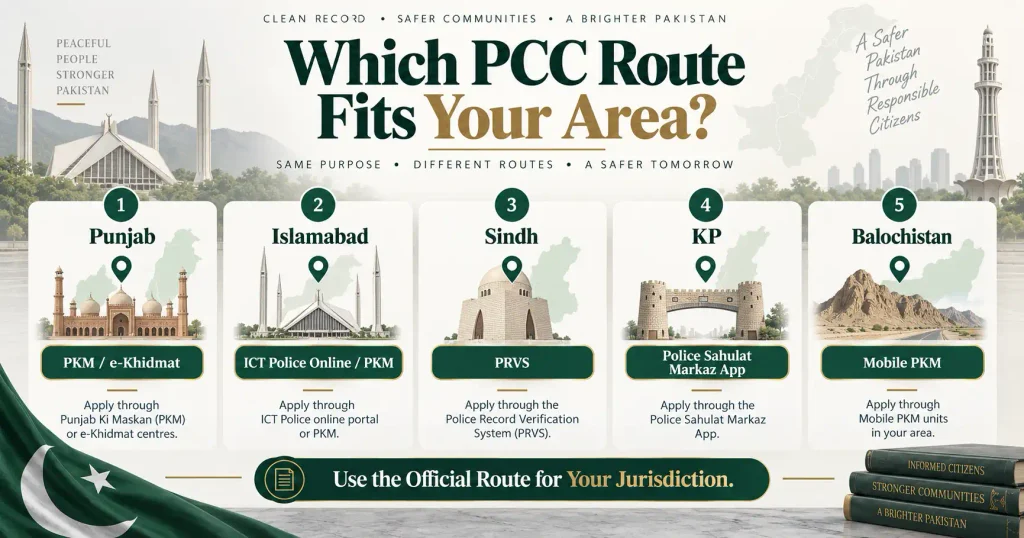
Before collecting documents, answer one question:
Which police authority is responsible for the residence period you need to prove?
That matters because a person applying from Lahore should not automatically follow Islamabad procedure, and someone who lived at several addresses may need verification covering more than one location.
Here is the practical starting point:
| Area | Main Route | Important Point |
|---|---|---|
| Punjab | Police Khidmat Markaz / e-Khidmat | Channel affects time and charges |
| Islamabad | ICT Police / Police Khidmat Markaz | Online form and tracking available |
| Sindh | Police Record Verification System | PRVS supports computerized verification |
| Khyber Pakhtunkhwa | Police Sahulat Markaz App | Online PCC services now available |
| Balochistan | Police Mobile Khidmat Markaz | Published fee and turnaround available |
| AJK / Gilgit-Baltistan | Relevant police / available PKM route | Confirm current local procedure |
| Overseas | Mission, PKM Global or authority letter | Route depends on jurisdiction and country |
The safest approach is to begin from an official police or government source. Avoid sending your CNIC, passport or fingerprints to a private website simply because it promises an “urgent certificate.”
What Does a Police Character Certificate Actually Prove?
A police character certificate is commonly required for immigration, foreign employment, study abroad, residence permits, professional licensing and other official purposes.
You may also see the term police clearance certificate, or PCC. Different authorities use different wording, but both commonly refer to police background verification.
However, a certificate should not be misunderstood as a guarantee about every event that may ever have occurred anywhere in Pakistan.
Its scope can depend on the issuing authority, declared addresses, verification period, police records and the purpose for which the certificate is required.
NADRA does not replace the police issuing authority. Your CNIC or NICOP may be an important supporting identity document, but the police character certificate itself is processed through the relevant police system.
Documents That Can Save You a Second Visit
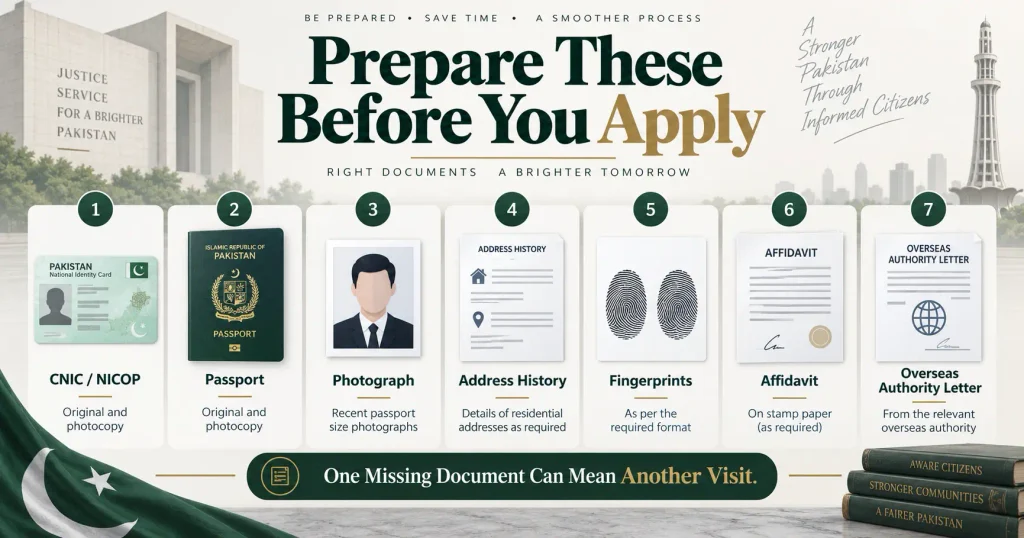
Document requirements differ between jurisdictions, but most applicants should prepare their file before opening an online form or visiting a Police Khidmat Markaz.
Keep your original CNIC or NICOP, passport, clear copies, recent passport-size photograph and complete Pakistani address history ready.
Depending on the police authority and application type, you may also need an affidavit, fingerprints, proof of residence, visa or immigration purpose, previous address details, an authority letter or evidence of your relationship with a representative.
Punjab e-Khidmat currently lists documents including an application form, attested CNIC and passport copies, photograph and original documents for processing. For an applicant abroad, its published requirements also provide for an authority letter subject to the stated conditions.
Before submitting anything, compare your name on the passport, CNIC/NICOP and application. Small spelling differences can create unnecessary verification questions.
How to Apply Without Creating Your Own Delay
The fastest application is not always the one submitted first. It is the one submitted correctly.
First, check why the certificate is required. A visa authority may ask for a particular residence period or a recent certificate. An employer may have different requirements.
Next, identify the correct police jurisdiction and official service channel.
Enter your name, CNIC, passport number and date of birth exactly as shown on your documents. Do not shorten an address or hide an earlier residence simply because another district may require additional verification.
Upload clear files. A blurred passport page, cropped CNIC, unreadable fingerprint image or incomplete court order may stop an otherwise straightforward application.
Finally, save the application ID, receipt, tracking number and submission date.
A police character certificate online application can reduce visits, but online submission does not necessarily remove police verification from the process.
Punjab: PKM or e-Khidmat—Know the Difference
Punjab applicants have more than one public-service channel, and this is where online guides often create confusion.
Punjab Police officially publishes a three-working-day timeframe after the application date for the Police Character Certificate service at Police Khidmat Markaz.
Punjab Police PKM official timeframe
Punjab e-Khidmat, however, currently publishes a PKR 500 service fee and delivery within 18 working days for its character-certificate service. It states that the relevant DPO/CPO is the issuing authority.
These figures should not simply be treated as a contradiction. They relate to different service channels.
That is why anyone searching for a police character certificate Punjab should check the exact route being used before relying on a fee or delivery time quoted on another website.
Islamabad: Online Apply, Track and Pay Rs1,000
Islamabad applicants now have a much clearer official route.
Islamabad Capital Territory Police provides an online character-certificate application form. It asks for identity details, passport information, Islamabad address, relevant police station, period of stay, purpose and destination country or organization.
The online form also allows supporting documents including CNIC or passport images, a fingerprint image and a recent photograph. Applicants can track application status using CNIC information.
More importantly, Islamabad Police currently publishes:
Application Fee: PKR 1,000
Standard Processing Time: 3 working days
Payment: Payable at the counter.
Islamabad Police official character certificate service
If your CNIC does not show an Islamabad address, the official requirements allow an affidavit and specified Islamabad residence proof in the relevant situation.
Do not confuse this certificate with Islamabad’s general police verification service. The purpose of the service matters.
Sindh: PRVS Makes Verification More Digital
Sindh Police operates the Police Record Verification System, or PRVS.
Sindh Police describes PRVS as a computerized system designed to make character verification faster and more transparent while maintaining a centralized digital database through an online service.
Sindh Police official PRVS information
For a police character certificate Sindh application, keep your complete Pakistani address, duration of stay, CNIC/NICOP, passport information and purpose ready.
The official Sindh Police character-certificate form itself asks for information including the address of stay, duration, CNIC, passport and immigration-country purpose.
Do not rely on an old private tutorial for the current Sindh process. Use the live Sindh Police system and instructions available when you apply.
KP: You Can Now Apply Through the Official App

This is an important update for anyone searching for a police character certificate KPK or KP police clearance online.
Khyber Pakhtunkhwa Police now operates the official Police Sahulat Markaz App, which provides paperless access to several police services from a smartphone.
The official service specifically lists three relevant options:
Police Character Certificate for local verification within Pakistan;
Police Clearance Certificate for Visa for travel outside Pakistan; and
Police Clearance Certificate From Abroad for applicants living overseas.
The app allows account registration, profile information, address periods and document uploads including CNIC and passport material.
KP Police official Sahulat Markaz guidance
This is a significant improvement over treating KP as a purely physical district-office process.
However, address accuracy still matters because police clearance depends on the applicant’s relevant residence and verification record.
Balochistan: Published Fee and Time Are Clear
Balochistan Police provides the character-certificate service through Police Mobile Khidmat Markaz.
Its current official information lists documents including original CNIC or B-Form, passport, affidavit and an authority letter where the applicant is abroad.
For overseas applicants, the published procedure also allows a blood relative to submit the form with the required authority letter.
Balochistan Police currently publishes:
Processing Fee: PKR 350
Turnaround Time: 3 working days after application
Delivery: Courier. Balochistan Police
Applicants should still confirm that the relevant Police Mobile Khidmat Markaz covers their district before relying on the stated process.
AJK and Gilgit-Baltistan: Check the Live Route
Applicants from Azad Jammu and Kashmir or Gilgit-Baltistan should confirm the current police service available for their residence before sending documents.
This is especially important for overseas applicants.
An official Pakistan mission currently states that its PKM Global arrangement can process Police Character Certificates for people connected with Islamabad Capital Territory, Punjab, Balochistan, Gilgit-Baltistan and AJK, while applicants from Sindh and KP use another route under that mission’s procedure. Ministry of Foreign Affairs Pakistan
The practical lesson is simple: overseas arrangements can differ by mission. Do not assume that a process available in one country is automatically available at every Pakistan embassy.
Is There One Nationwide Online PCC Portal?
This is one of the most confusing search results online.
As of 23 September 2026, the publicly accessible National Police Bureau CPCC page states that its Computerized Police Clearance Certificate service is for Pakistani nationals living in Spain only, based on character verification received from the concerned District Police Officer.
Therefore, applicants should not abandon a working provincial or territorial police route because a headline suggests that one national public portal has replaced everything.
Use the system that is actually operating for your jurisdiction and purpose.
The National Police Bureau also warns applicants in its Spain process against handing documents or certificates to irrelevant persons or unauthorized agents.
How Much Does a Character Certificate Cost?
There is no safe single answer for all Pakistan.
Current official examples show the difference clearly.
Punjab e-Khidmat publishes PKR 500 and up to 18 working days. Islamabad Police publishes PKR 1,000 with a standard three-working-day process. Balochistan PKM publishes PKR 350 and three working days. Punjab Police separately publishes a three-working-day PKM timeframe. Ekhidmat Punjab
So if a private page tells you that every police character certificate Pakistan application costs one fixed amount, check the official jurisdiction first.
Fees and processes can also change. Verify them again immediately before payment.
How Long Does the Certificate Take?
Processing depends on the service channel, residence history and verification required.
A person with one clearly documented address may have a simpler process than someone who lived in several districts.
An overseas authority letter, incomplete documents, identity mismatch, missing residence evidence or an old police record may create additional steps.
Published times should therefore be treated as service timelines rather than guaranteed completion dates.
If your visa deadline is approaching, apply early instead of assuming the fastest published time will apply to every case.
How Long Is a Police Character Certificate Valid?
Do not assume that every certificate is universally valid for exactly six months.
An official Pakistan mission states that a PCC issued by Punjab Police is valid for 180 days.
Islamabad Police, meanwhile, states that its certificate is generally valid for six months to one year depending on the receiving country or organization.
This difference matters.
Check three things: the issue date on your certificate, any validity shown by the issuing authority, and the age requirement imposed by the embassy, immigration authority, employer or university receiving it.
A genuine certificate can still be rejected because it is too old for a particular application.
Overseas Pakistanis: Do You Need to Return Home?
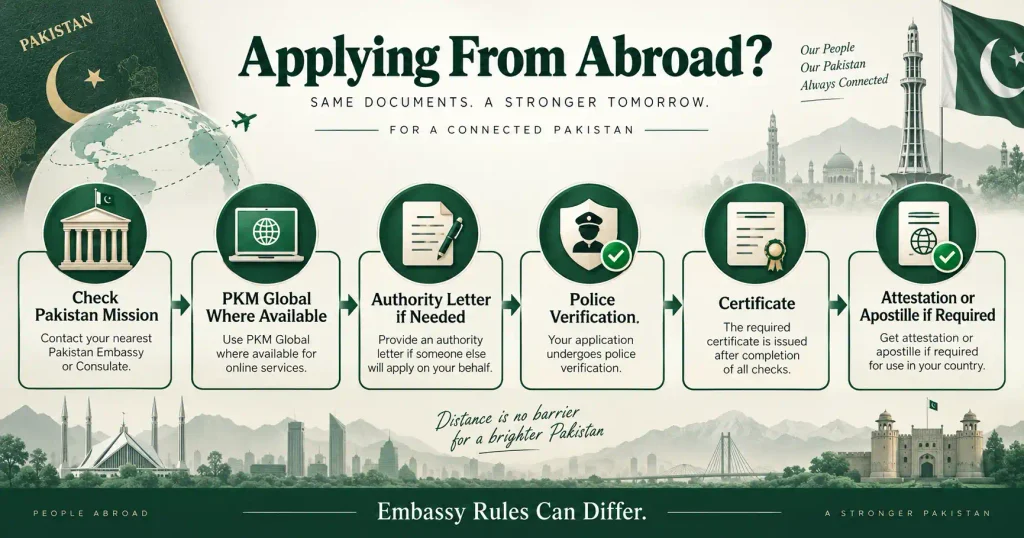
Not necessarily.
Punjab Police operates PKM Global, an online facility intended to help overseas Pakistanis obtain police-related documents through participating Pakistani embassies in more than 40 countries. Character certificate is one of the listed services. Punjab Police
Where a direct overseas facility is unavailable, an applicant may need an authority letter enabling an eligible relative or representative in Pakistan to process the application.
Depending on the police authority and Pakistan mission, the documents may include CNIC/NICOP, passport, recent photograph, overseas residence information, last-exit page, authority letter and representative’s identity details.
Do not copy another country’s embassy checklist without checking your own Pakistan mission. Requirements and processing times can differ.
Do You Need MOFA Attestation or Apostille?
Getting the police character certificate and preparing it for use abroad are two separate steps.
The Ministry of Foreign Affairs’ official attestation checklist identifies Police Character Certificates as documents required to be issued by the local District Police Officer, subject to the relevant competent authority for the area.
MOFA official attestation and apostille checklist
Whether you then need an apostille, MOFA attestation, translation or embassy legalization depends on the destination country’s requirements.
Before paying for any further legalization, inspect the certificate carefully.
Check the spelling of your name, passport details, residence period, purpose, issue date and any criminal-case wording.
Correcting an error before legalization is usually far easier than discovering it after the document has already moved through several authorities.
Can You Check a Character Certificate by CNIC?
People often mean three different things when they search for a police character certificate check online.
One is tracking their own application. Islamabad Police, for example, provides online tracking using CNIC information.
Another is verifying whether an issued certificate is genuine.
The third is trying to search another person’s complete criminal record simply by entering a CNIC.
These are not the same services.
As of September 2026, you should not trust an unknown website claiming that anyone can enter another person’s CNIC and instantly obtain a complete Pakistan-wide criminal history.
For the difference between an FIR copy, FIR status and record verification, see FIR Check Online in Pakistan.
If you have already shared identity documents with a suspicious website, also read Cyber Crime in Pakistan and Cyber Crime Online Complaint Pakistan.
Old FIR After Acquittal: Does It Still Matter?
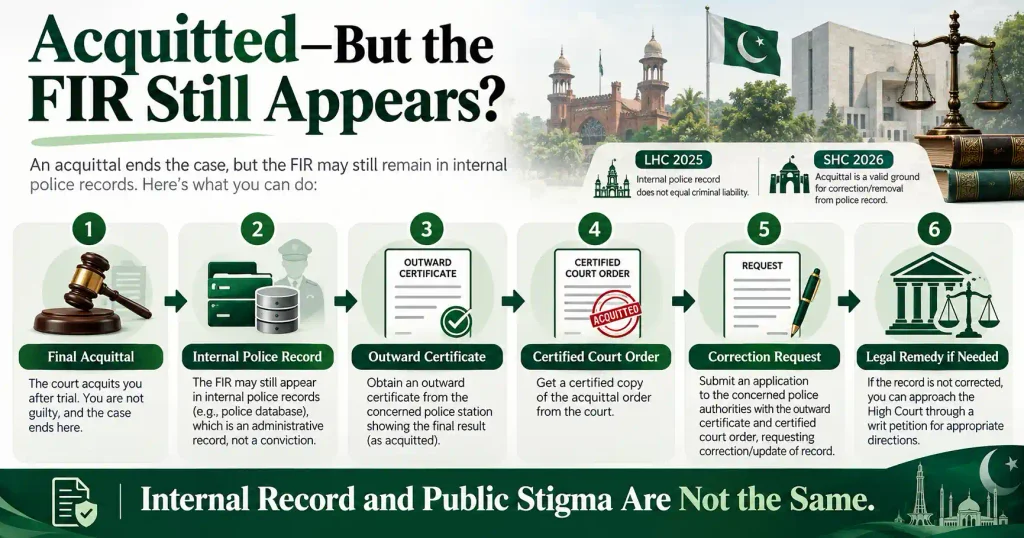
An FIR records an allegation and starts a criminal process. It is not itself a conviction.
That distinction becomes important when a person has been acquitted but the old FIR continues to appear on an outward-facing police character certificate.
Pakistani High Courts have considered the difference between retaining police information internally and continuing to attach adverse stigma to a person after a final acquittal.
Judgment at a Glance: police character certificate
| Case | Court | Practical Meaning |
|---|---|---|
| Abdul Rehman Faryad v. Government of Punjab | Lahore High Court, W.P. 40844/2025, 2025 LHC 5162 | Final acquittal cannot simply be ignored when issuing a character certificate |
| Syed Sajjad Hussain Shah Naqvi v. Province of Sindh | Sindh High Court, C.P. 421/2026, 2026 SHC HYD 1519 | Prior acquittal on a clearance certificate may create unlawful stigma |
In Abdul Rehman Faryad v. Government of Punjab, the Lahore High Court considered a petitioner who had been implicated in a criminal case and later acquitted. The Court’s official research bulletin explains that the acquittal had attained finality and that continuing to draw an adverse inference merely from registration of the FIR was legally unjustified. It also distinguished lawful preservation of FIR records from their adverse use after acquittal.
The decision does not mean that every internal police record must be erased. The Court’s reasoning recognized that digital FIR records may be preserved, but their later use must remain lawful and respect the effect of a final acquittal.
Sindh High Court: The 2026 PCC Ruling
The Sindh High Court’s decision in Syed Sajjad Hussain Shah Naqvi v. Province of Sindh, C.P. No. 421 of 2026, is especially relevant to police-clearance certificates.
The official Sindh High Court database records the decision date as 23 June 2026, with citation 2026 SHC HYD 1519. Its official headnote states that the purpose of a Police Clearance Certificate differs from a criminal record and that mentioning a prior acquittal in the clearance certificate can stigmatize the citizen. Case Law
That corrects an important point: 21 May 2026 was not the final decision date of this case.
IRAC: What the Sindh Case Means
| IRAC | Explanation |
|---|---|
| Issue | Whether an acquitted case should continue appearing adversely on a police clearance document |
| Rule | Official police records and outward clearance certificates serve different purposes |
| Analysis | A past acquittal can create unfair stigma when repeated on a document meant to communicate present clearance status |
| Conclusion | The Court treated continued mention of prior acquittal on the clearance certificate as legally significant and granted relief in the case |
The judgment should not be stretched beyond its facts.
It does not create a license to hide a pending criminal case, alter a police record yourself or demand that every historical police entry be physically deleted.
It supports the distinction between internal police record retention and the consequences of repeatedly displaying an acquitted matter on an outward-facing clearance document.
What If Your Certificate Contains a Wrong FIR?
Do not edit the document yourself and do not submit a false declaration.
First establish exactly what the criminal case record says.
Was the FIR cancelled? Was the accused discharged? Was there an acquittal? Was that acquittal challenged? Has the final order attained legal finality?
Collect the issued police character certificate, CNIC/NICOP, passport, FIR information, certified court order and proof of any earlier correction request.
Then submit a written correction request to the competent police authority and keep proof of filing, such as a diary number, portal reference, receipt or email acknowledgement.
Where an incorrect adverse entry continues despite a final judicial outcome, the proper next remedy depends on the province, police authority, status of proceedings and facts.
Constitutional jurisdiction under Article 199 may become relevant in an appropriate case, but court proceedings should not be treated as an automatic or first remedy in every certificate dispute.
Seven Mistakes That Can Cost You Time
1. Using an Agent Before Checking Police
A private website appearing on Google is not automatically an official government service.
2. Hiding an Old Address
If the required verification period includes another district, leaving it out can create a bigger problem later.
3. Mixing Passport and CNIC Spellings
Even small name differences can slow identity verification.
4. Uploading Blurred Documents
Passport pages, CNIC images, fingerprints and court orders should be clear and complete.
5. Believing Online Means Instant
Digital submission may still require police-record or address verification.
6. Copying Another Province’s Fee
Punjab, Islamabad and Balochistan already show why one Pakistan-wide fee claim can be misleading.
7. Attesting Before Checking the Certificate
Verify every detail first. An error becomes more expensive after translation, attestation or apostille.
Final Check Before You Press Submit
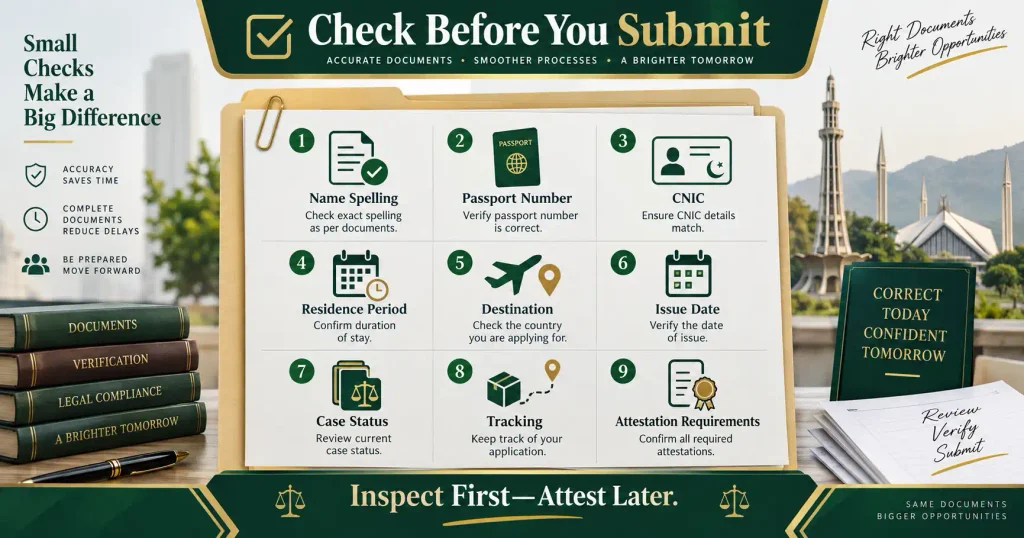
Before applying for your police character certificate, check your jurisdiction, required residence period, passport and CNIC spelling, complete address history and current official fee.
Also confirm whether photographs, fingerprints, affidavit, residence evidence or an authority letter are required.
If you had an earlier criminal case, keep the certified final order ready instead of waiting for the issue to appear during police verification.
For overseas use, check whether the receiving authority wants MOFA attestation, apostille, embassy legalization or translation.
Five minutes spent checking the application can save days of correction.
FAQs About Police Character Certificate
1. How can I get a police character certificate in Pakistan?
Apply through the police system responsible for the relevant residence area. Punjab uses PKM and e-Khidmat channels, Islamabad Police offers an online form and PKM service, Sindh uses PRVS, KP now provides Police Sahulat Markaz App services, and Balochistan uses Police Mobile Khidmat Markaz. Requirements vary by jurisdiction.
2. Can I apply for a police character certificate online?
Yes, several jurisdictions now provide online or digital services. Islamabad has an online application and tracking facility, Sindh operates PRVS, and KP’s official Police Sahulat Markaz App includes local, visa and overseas clearance services. Do not assume one national portal replaces all provincial systems.
3. What documents are required for a PCC?
Common requirements include CNIC/NICOP, passport, photographs and complete address information. Depending on the jurisdiction, you may also need fingerprints, an affidavit, proof of residence or an authority letter. Overseas applicants should check the requirements of both the relevant police authority and Pakistan mission.
4. How much does a character certificate cost?
There is no single Pakistan-wide fee. Islamabad Police currently publishes PKR 1,000. Punjab e-Khidmat publishes PKR 500 for its service, while Balochistan Police Mobile Khidmat Markaz publishes PKR 350. Always confirm the current fee from the official service before making payment.
5. How long does a police character certificate take?
Processing varies. Islamabad Police currently publishes three working days. Punjab Police PKM also publishes three working days, while Punjab e-Khidmat lists delivery within 18 working days. Balochistan PKM publishes three working days. Additional verification or incomplete documents can extend the actual time.
6. How long is a police character certificate valid?
Validity can depend on both the issuing authority and the organization receiving it. An official Pakistan mission states that Punjab Police PCCs are valid for 180 days, while Islamabad Police says certificates are generally valid for six months to one year depending on the receiving authority’s requirements.
7. Can a relative apply if I live outside Pakistan?
In many cases, yes. Some police authorities permit an eligible relative to apply through a properly prepared authority letter. Overseas Pakistanis may also have access to PKM Global through participating Pakistan missions. The exact process depends on province, territory and country of residence.
8. What if an FIR appears after I was acquitted?
Do not alter the certificate. Obtain a certified copy of the final court order and ask the competent police authority to correct the outward certificate. Lahore and Sindh High Court decisions have distinguished legitimate police-record retention from continuing adverse stigma after a final acquittal. The remedy still depends on the facts and jurisdiction.
Conclusion: One Check Can Protect Your Application
A police character certificate can affect a visa, overseas job, immigration file, university admission or professional opportunity.
The safest method is not to rush.
Choose the right jurisdiction, use an official police system, disclose the required residence history, upload clear documents and inspect the issued certificate before sending it to another authority.
Do not rely on one nationwide fee, one universal validity period or an unknown website promising instant criminal-record access.
And if an old FIR appears after a final acquittal, deal with it through certified court records and the competent police authority rather than hiding, altering or ignoring the entry.
A correct application today can prevent a much more expensive problem tomorrow.
Disclaimer
This article provides general legal and procedural information and is not a substitute for advice based on your individual case.
Police forms, online systems, fees, processing times, embassy arrangements and foreign-document requirements can change. Recheck the relevant official police, government, court or Ministry of Foreign Affairs source immediately before applying.
No particular certificate, visa, employment clearance, correction request or court result is guaranteed.