

Domestic violence law in Pakistan changed significantly on 26 January 2026—but not in the way many online articles suggest. Pakistan still does not have one uniform domestic violence statute for every province and territory. The new federal law applies only to the Islamabad Capital Territory, while Punjab, Sindh, Khyber Pakhtunkhwa, Balochistan and Azad Jammu and Kashmir continue to follow their own legislation.
Behind a closed door, fear may remain invisible to outsiders. In law, however, violence does not automatically become a private family matter merely because it happens inside a home.
Understanding Domestic Violence Law in Pakistan helps readers recognise that safety, residence, financial support and criminal accountability may require different legal routes.
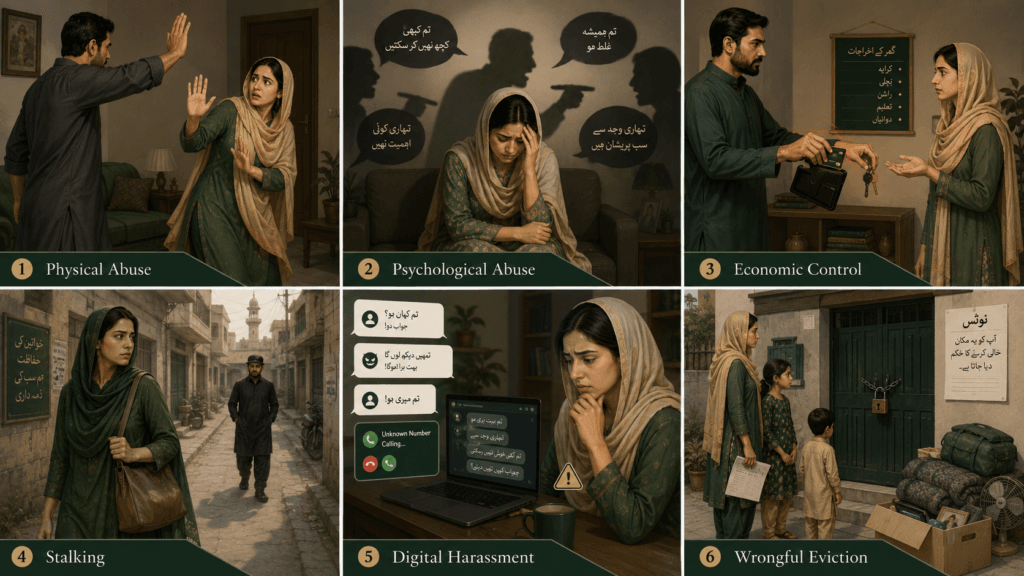
Physical assault is only one form of abuse. Repeated humiliation, stalking, threats, economic control, wrongful eviction, destruction of property, harassment and certain forms of sexual or psychological abuse can also trigger legal protection. The exact definition, court, procedure and available remedy depend on where the victim lives and where the incident occurred.
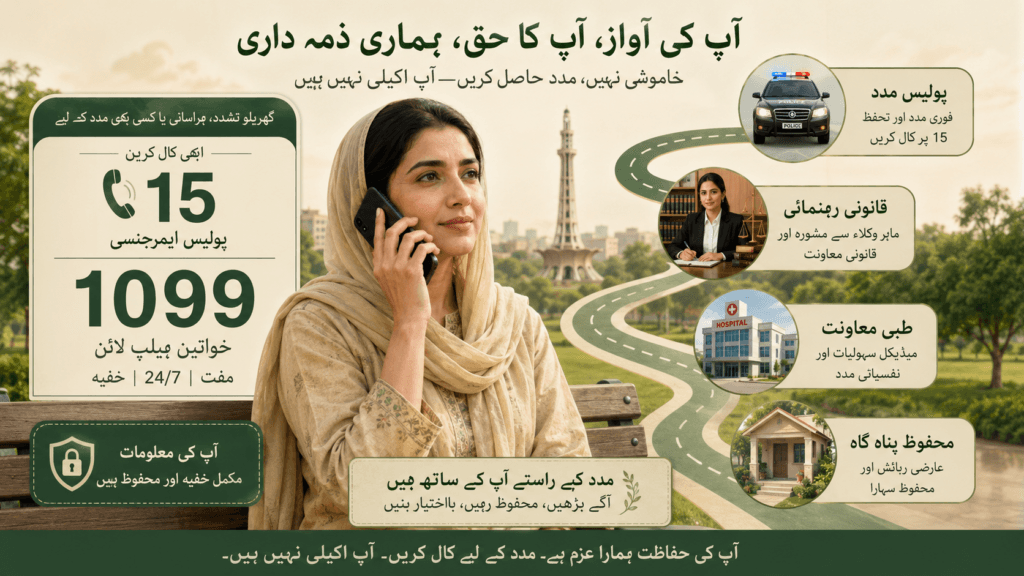
Emergency warning: If anyone faces immediate danger, move to a safer place if possible and call Police Emergency 15. In Islamabad, the official police contact page also lists 1815 as the Online Women Police helpline. For nationwide legal advice and referrals, contact the Ministry of Human Rights at 1099. Do not delay emergency help merely to collect evidence.
Table of Contents
Domestic Violence Law in Pakistan: The Biggest 2026 Update
The most important update to domestic violence law in Pakistan is the enactment of the Domestic Violence (Prevention and Protection) Act, 2026.
The President gave assent on 26 January 2026, and the law was published in the Gazette of Pakistan on 27 January as Act No. X of 2026. The official Gazette text issued by the National Assembly confirms that the Act came into force immediately.
This law:
- Extends only to the Islamabad Capital Territory.
- Protects women, men, transgender persons, children, older people, persons with disabilities and other vulnerable individuals.
- Recognises present and former domestic relationships.
- Covers physical, psychological, verbal and sexual abuse within its statutory definition.
- Permits protection, residence, monetary and temporary custody orders.
- Creates criminal punishment for domestic violence not already punishable under the Pakistan Penal Code.
- Treats breach of certain court orders as a separate offence.
The 2026 Act also requires a Protection Committee and Protection Officers. Their appointments, addresses and working procedures may depend on government notifications and rules, so current operational details should be confirmed through the Ministry of Human Rights or the relevant Family Court.
Domestic Violence Law in Pakistan at a Glance
| Area | Current principal law | Persons expressly protected | Main court or forum | Important statutory timeline |
|---|---|---|---|---|
| Islamabad Capital Territory | Domestic Violence (Prevention and Protection) Act, 2026 | Women, men, transgender persons, children and vulnerable individuals | Family Court with powers of a Judicial Magistrate First Class | First hearing within 7 days; petition to be decided within 90 days |
| Punjab | Punjab Protection of Women against Violence Act, 2016, as amended by the 2022 Amendment Act | Women, including qualifying women in domestic-employment relationships | Family Court | First hearing within 7 days; complaint ordinarily decided within 90 days |
| Sindh | Domestic Violence (Prevention and Protection) Act, 2013 and Rules, 2016 | Women, children and vulnerable persons | Judicial Magistrate First Class | First hearing within 7 days; application to be decided within 90 days |
| Khyber Pakhtunkhwa | Khyber Pakhtunkhwa Domestic Violence against Women Act, 2021 | Women | Notified District and Sessions Judge or Additional Sessions Judge | Court application must generally be filed within 15 days of occurrence; case targeted for decision within 60 days |
| Balochistan | Balochistan Domestic Violence Act, 2014, with the 2023 Amendment | Women, men, children and vulnerable persons; some employment and domestic-help relationships are recognised | Sub-Divisional Magistrate exercising First Class Magistrate powers | First hearing within 3 days; application targeted for decision within 30 days |
| Azad Jammu and Kashmir | Domestic Violence (Prevention and Protection) Act, 2014 | Women, men, children and vulnerable persons | Judicial Magistrate First Class | First hearing within 7 days; application to be decided within 90 days |
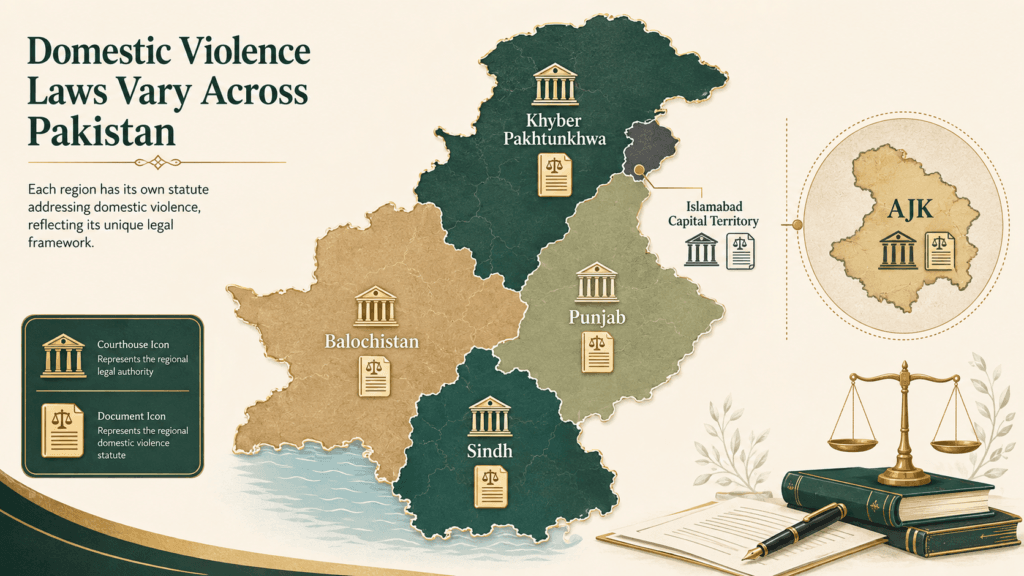
Because Domestic Violence Law in Pakistan changes by territory, readers should identify the correct province or region before filing a complaint or petition.
These are statutory targets, not guaranteed completion dates. Service of notice, evidence, adjournments and court workload may affect the actual schedule.
I could not confirm a current, dedicated domestic violence law for Gilgit-Baltistan from the official material available on 1 August 2026. This does not mean that no legal remedy exists. Victims should check the latest local law and may still have remedies under criminal law, family law, child-protection law or other applicable legislation.
What Counts Under Domestic Violence Law in Pakistan?
Domestic violence law in Pakistan is broader than a visible bodily injury. Nevertheless, every harsh argument or unhappy marriage does not automatically become a criminal offence. Courts consider the statutory definition, surrounding circumstances, pattern of conduct, harm, evidence and territorial law.
1. Physical Abuse
Physical abuse may include hitting, kicking, choking, burning, unlawful confinement, use of criminal force, causing hurt or threatening bodily injury.
Conduct amounting to an offence under the Pakistan Penal Code is usually investigated and punished under that Code, even when it occurs within a domestic relationship. The special domestic violence laws can provide additional protective remedies.
2. Psychological, Emotional and Verbal Abuse
Depending on the applicable statute, this category may cover:
- Repeated humiliation or ridicule.
- Obsessive jealousy that invades privacy or liberty.
- Threats of physical pain.
- False allegations about a person’s character.
- Threats based on unfounded claims of infertility or mental illness.
- Stalking and harassment.
- Deliberate or negligent abandonment.
- Oppressive restrictions on movement.
The legal test is not the same everywhere. Punjab and Khyber Pakhtunkhwa use more specific requirements for some forms of psychological abuse. This means that a hurtful or insulting statement alone may not always meet the legal test. The facts, pattern of conduct and available evidence still matter
For a wider explanation of dignity, equality and legal safeguards, read Women Rights in Pakistan: 7 Protections No Jirga Can Deny.
3. Sexual Abuse
Several territorial statutes recognise degrading, humiliating or dignity-violating sexual conduct as sexual abuse. The 2026 ICT Act expressly includes conduct of a sexual nature that abuses, humiliates, degrades or violates dignity.
The legal position must be checked under the law that applies in the relevant area. The domestic violence statute and the Pakistan Penal Code may both matter. Khyber Pakhtunkhwa also uses its own statutory wording. For this reason, one general internet answer should not be applied to every province or territory. The facts, the relationship between the parties, the type of conduct involved, and the law in force in that jurisdiction must all be checked before reaching a legal conclusion.
A person alleging sexual violence should seek urgent medical, legal and police assistance without being pressured to describe sensitive facts publicly.
4. Economic Abuse
Economic violence can occur without physical contact. Examples may include:
- Denial of food, clothing or shelter by a person legally responsible for providing them.
- Taking a woman’s earnings without consent where the local statute covers that conduct.
- Blocking access to money or financial resources.
- Destroying or removing personal property.
- Preventing access to identification, educational or employment documents.
- Refusing necessary medical expenses.
- Using money to force dependency or prevent safe movement.
The available monetary remedy may include lost earnings, medical costs, damaged property, rent, maintenance and compensation for qualifying economic abuse.
5. Stalking, Harassment and Digital Control
Repeated unwanted following, watching a residence or workplace, threatening calls, invasive messages and certain forms of electronic monitoring may fall within stalking, harassment, psychological abuse, cybercrime or criminal intimidation provisions.
If the behaviour occurs in an employment setting, the correct route may also involve workplace legislation. See Harassment at Workplace in Pakistan: 7 Powerful Lessons for that separate procedure.
6. Wrongful Eviction and Property Interference
Throwing a victim out of a shared household, disturbing possession, withholding belongings or destroying property may support a residence order, return-of-property direction or monetary relief.
A residence right under domestic violence legislation is a protective remedy. It does not automatically transfer ownership of the property.
7. Violence Affecting Children or Vulnerable Persons
Children may be direct victims, witnesses or dependants affected by abuse. Older persons and people with disabilities may also fall within the protected category under the ICT, Sindh, Balochistan and AJK statutes.
Courts can consider temporary custody, safe placement and restrictions on unsafe contact. Final guardianship questions may still be governed by the Guardians and Wards Act and applicable family law.
Who Can File Under Domestic Violence Law in Pakistan?
The answer changes across Pakistan.
The category of protected persons under Domestic Violence Law in Pakistan is not identical in every jurisdiction.
- Islamabad: Any protected individual may act personally, or an authorised person may proceed through the statutory Protection Officer route.
- Punjab: The principal Act protects an aggrieved woman. An authorised person or Women Protection Officer may also initiate the complaint in the circumstances allowed by law.
- Sindh: An aggrieved woman, child or vulnerable person may apply. An authorised person or qualifying informer may also approach the court.
- KP: The statute is designed for women. The complainant, her guardian or the District Protection Committee route may be relevant.
- Balochistan: Women, men, children and vulnerable persons are included. An authorised person may submit the application.
- AJK: Women, men, children and vulnerable individuals in qualifying domestic relationships are covered.
A male victim in a women-specific provincial regime is not necessarily without any legal remedy. Depending on the conduct, the Pakistan Penal Code, family law, guardianship law or another civil or criminal route may still apply.
IRAC Analysis: Can Non-Physical Abuse Create a Legal Case?
| IRAC element | Legal assessment |
|---|---|
| Issue | A spouse repeatedly humiliates the victim, takes control of earnings, threatens expulsion from the home and sends intimidating messages. There is no recent visible injury. Can relief still be sought? |
| Rule | The court must apply the domestic violence statute governing the relevant territory, together with the Pakistan Penal Code, family law and evidence law where applicable. Psychological, verbal, economic and stalking-related conduct is recognised differently across the territorial Acts. |
| Analysis | The absence of a fresh physical injury does not end the inquiry. The lawyer or court must identify the domestic relationship, location, pattern of conduct, financial control, threats, possession of the household, digital evidence and risk of future harm. In ICT, repeated degrading behaviour, certain threats, abandonment, stalking and harassment are expressly addressed. Punjab and KP apply more particular requirements to parts of psychological abuse. Sindh, Balochistan and AJK use their own definitions. Locking the victim out may separately support a residence remedy, while taking earnings or destroying property may strengthen monetary claims. |
| Conclusion | The facts may justify interim protection, a residence order, monetary relief or another territorial remedy even without a new visible injury. If the conduct also discloses a Penal Code offence, a criminal complaint can proceed alongside protective or family proceedings. The final result will depend on evidence and the wording of the applicable law. |
This analysis shows why Domestic Violence Law in Pakistan must be applied according to the facts and relevant territorial statute rather than through one nationwide assumption.
Seven Lifesaving Rights Under Domestic Violence Law in Pakistan
Right 1: Protection Before the Final Case Ends
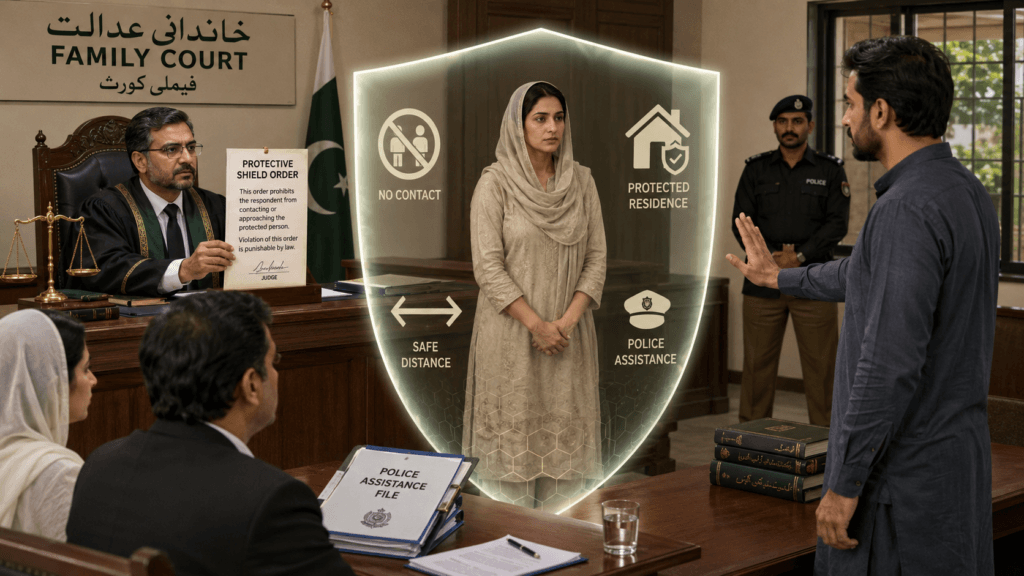
Waiting for a final judgment can expose a victim to further danger. Territorial laws therefore allow interim or protective directions when the initial material shows violence or a credible likelihood of harm.
Depending on the area and facts, the respondent may be ordered to:
- Stop further violence.
- Avoid communication with the victim.
- Remain away from the victim, workplace or educational institution.
- Maintain a court-fixed distance.
- Stop relatives from interfering.
- Execute a bond for good conduct.
- Surrender or avoid using a weapon where the statute permits.
- Move out in circumstances recognised by the applicable law.
- Comply with police-assisted implementation.
An interim order is not a final finding of guilt. It is a temporary legal response intended to reduce risk while the case is considered.
Domestic Violence Law in Pakistan uses interim protection to reduce danger before the complete evidence is finally assessed.
Right 2: Protection Against Unlawful Eviction
Domestic violence law in Pakistan commonly separates the right to safety from property ownership.
Under the 2026 ICT Act, an aggrieved person may reside in the shared household regardless of title or beneficial interest. The person may instead choose a shelter arranged through a service provider.
Punjab, Sindh, Balochistan and AJK also contain residence protections, although their wording and exceptions vary. In Balochistan, some residence provisions do not apply where the domestic relationship is based solely on employment or domestic help.
A court may restrain dispossession, restrict the respondent’s entry, direct alternative accommodation, order payment of rent or require the return of documents and valuables.
Right 3: Monetary Relief and Maintenance
Leaving violence can create immediate financial hardship. A victim may need medicine, transport, rent, food, childcare and replacement of damaged belongings.
Depending on local law, monetary relief can cover:
- Medical expenses.
- Loss of earnings.
- Damage, destruction or removal of property.
- Rent or alternative accommodation.
- Maintenance for the victim and children.
- Compensation for qualifying economic abuse.
Under the ICT Act, failure to pay may lead the court to direct an employer or debtor of the respondent to pay part of wages or debt toward the ordered amount.
Domestic violence relief does not necessarily replace a separate family maintenance claim. For the broader family-law framework, see Muslim Family Laws Ordinance: 7 Powerful Protections.
Right 4: Temporary Custody and Child Safety
A court may make temporary custody or safe-placement directions while protection proceedings continue. The child’s safety and the governing guardianship law remain central.
A protection order can also restrain the respondent from approaching a child’s school, threatening a dependent or harming someone who assists the victim.
Temporary custody is different from a final guardianship decision. Parents should not assume that filing a domestic violence complaint automatically settles permanent custody.
Right 5: Medical, Shelter and Legal Assistance
Protection Committees, Protection Officers and registered service providers have different functions under each statute. Their roles may include arranging medical examination, shelter, counselling, legal aid, incident reports and court applications.
Sindh’s 2016 Rules are particularly important: a shelter or medical facility should not refuse assistance merely because a prior Domestic Incident Report has not been completed.
For free legal advice, counselling and referrals across Pakistan, contact the Ministry of Human Rights helpline 1099. Punjab residents can also contact the Punjab Commission on the Status of Women helpline 1043 or the Punjab Women Protection Authority, which lists 0800-01737 and 042-99333817.
Right 6: Criminal and Protective Proceedings Can Coexist
A protection petition and an FIR do not perform the same function.
| Legal route | Primary purpose | Possible outcome |
|---|---|---|
| Police complaint or FIR | Investigation of a disclosed cognizable offence | Investigation, arrest where lawful, prosecution and criminal trial |
| Domestic violence petition | Immediate safety and restorative relief | Protection, residence, monetary, custody and related orders |
| Family case | Matrimonial and family rights | Maintenance, dower, khula, dissolution, custody or visitation |
| Cybercrime or harassment route | Conduct falling within specialised legislation | Investigation or proceedings before the competent authority |
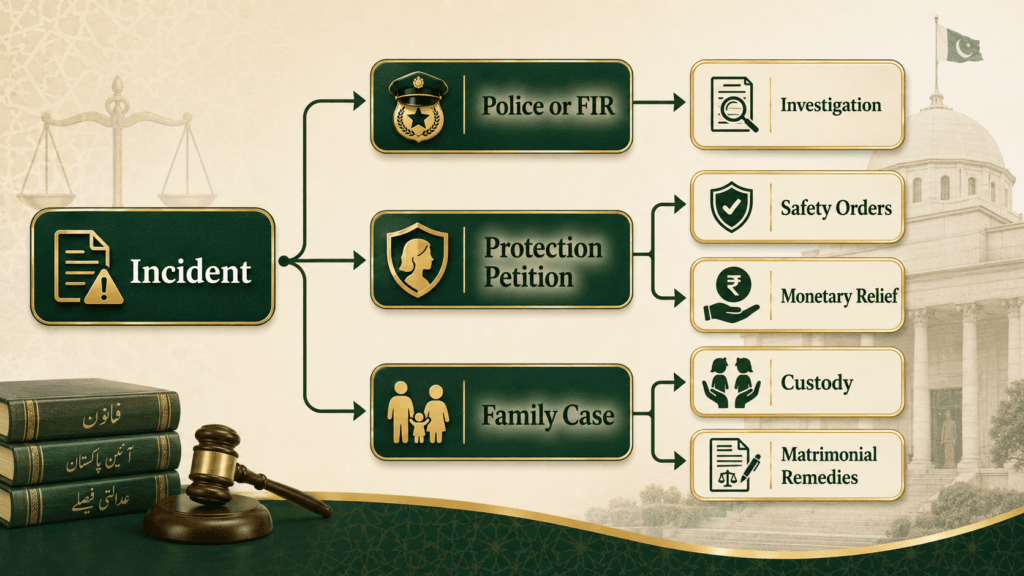
Special domestic violence legislation generally supplements other laws. A victim may therefore need more than one proceeding.
Cruelty, non-maintenance and an irretrievably intolerable relationship may also become relevant to dissolution. Read Grounds for Khula in Pakistan: 3 Shocking Haq Mehr Outcomes before confusing khula with an emergency protection order.
Right 7: Enforcement, Breach Proceedings and Appeal
A paper order is useful only when violations are documented and enforced.
In ICT, breach of an interim, protection, residence or custody order is punishable with one year’s imprisonment and a fine of Rs100,000 payable to the victim. The offence is cognizable, bailable and compoundable. A final decision may be appealed to the Sessions Court within the shorter period specified in the Act, while an appeal concerning a breach sentence follows its separate timeline.
Other territorial laws impose different sanctions:
- Punjab provides fines and imprisonment for breach, with stronger punishment for repeat violations.
- Sindh treats breach of an interim or protection order as an offence.
- KP permits imprisonment, a fine of up to Rs300,000, or both for breach.
- Balochistan prescribes imprisonment and substantial minimum fines, with enhanced punishment for repetition.
- AJK allows imprisonment, fine or both for breach of a protection order.
Report every breach promptly, keep the court-order copy accessible and record the date, time, place and manner of violation.
Province-by-Province Legal Position in 2026
Islamabad Capital Territory
The 2026 ICT Act is the newest development in domestic violence law in Pakistan.
A petition can be filed through a Protection Officer in the Family Court where the victim resides or works, or where the parties last lived together. The first hearing must be fixed within seven days, and the legislation directs disposal within 90 days.
The law recognises:
- Physical, psychological, verbal and sexual abuse.
- Current and former domestic relationships.
- Protection and no-contact orders.
- Removal of the respondent in cases of grave violence endangering life, dignity or reputation.
- Residence protection and alternative shelter.
- Medical expenses, lost earnings, maintenance and property loss.
- Temporary custody.
- Police assistance with implementation.
Where the conduct does not already fall under the Pakistan Penal Code, punishment ranges from six months to three years, accompanied by compensation between Rs20,000 and Rs100,000. Conduct amounting to a Penal Code offence remains punishable under the relevant criminal provision.
Punjab
Punjab’s 2016 law, updated in 2022, is a women-protection statute. It covers domestic violence, sexual violence, psychological and economic abuse, stalking and cybercrime within its defined scope.
The 2022 changes expanded parts of the domestic-relationship definition and strengthened coverage relevant to women in certain employment or domestic-work settings.
A Family Court may grant interim, protection, residence and monetary orders. In serious situations, the respondent can be directed to leave, stay away or comply with electronic monitoring where the statutory conditions are satisfied.
Punjab’s definition of psychological violence contains specific medical and evidentiary elements. A clinical assessment or psychologist’s certification may become important instead of relying only on a general claim of stress.
In its judgment dated 29 November 2022 in Shariat Petition No. 03/I of 2016 and connected petitions, the Federal Shariat Court rejected the challenges to the Punjab Protection of Women against Violence Act, 2016. The Court held that no provision of the Act was against the injunctions of Islam laid down in the Holy Quran and Sunnah, dismissed the petitions and directed the Punjab Government to implement the law throughout the province. This ruling is important for Domestic Violence Law in Pakistan because it confirms the Islamic validity of Punjab’s statutory protection system. Readers can access the complete Federal Shariat Court judgment here.
Sindh
Sindh’s 2013 Act protects women, children and vulnerable people and operates with detailed Rules issued in 2016.
The statute recognises physical, emotional, psychological, verbal, sexual and economic abuse, along with stalking, harassment, trespass, confinement and property-related conduct.
An application may be presented to a Judicial Magistrate First Class. Interim orders, residence protection, monetary relief and temporary custody are available.
Sindh also provides direct punishment for several specified forms of abuse and treats breach of protective orders as a distinct offence. The Rules explain how oral or written complaints, incident reports, emergency medical assistance and shelter referrals should be handled.
Khyber Pakhtunkhwa
KP’s 2021 statute specifically protects women and creates District Protection Committees.
One of its most important procedural points is the 15-day filing period for a court complaint following the occurrence. Anyone considering proceedings should seek local legal advice immediately instead of assuming the 90-day periods found in other laws also apply in KP.
The competent court is a District and Sessions Judge or Additional Sessions Judge notified by the Peshawar High Court. The Act provides protection orders, monetary relief, shelter, medical assistance and legal aid.
Domestic violence under the KP Act is punishable with imprisonment from one to five years, in addition to the fine applicable under the Pakistan Penal Code provision linked to the conduct.
Mediation may be considered through the Committee, but the legislation states that mediation does not prevent protective steps. Safety should not be postponed merely because reconciliation is being discussed.
Balochistan
The Balochistan Act applies throughout the province except the Tribal Areas stated in its extent clause. Its definition of an aggrieved person includes women, men, children and vulnerable individuals.
The law recognises domestic relationships based on marriage, kinship, adoption, joint family living and, for some purposes, employment or domestic help.
Applications go to the relevant Sub-Divisional Magistrate. The first hearing should be fixed within three days, and the application is targeted for disposal within 30 days.
Protection, residence, monetary and custody orders are available. The court can prohibit contact, restrain dispossession, require alternative accommodation and direct police assistance.
The 2023 amendment reorganised the protection mechanism around District Protection Committees and revised their official composition.
Azad Jammu and Kashmir
AJK’s 2014 Act protects women, men, children and vulnerable people in qualifying domestic relationships.
The Judicial Magistrate First Class may grant interim, protection, residence, monetary and temporary custody orders. The Act also permits police assistance and directions for the return of belongings or documents.
Breach of an interim or protection order can lead to imprisonment of up to one year, a fine of up to Rs20,000, or both. The statutory text classifies that breach as cognizable, non-bailable and compoundable.
FIR or Domestic Violence Petition: Which One Is Needed?
The correct answer may be both.
An FIR becomes relevant when the facts disclose a cognizable criminal offence, such as qualifying hurt, assault, criminal intimidation, wrongful confinement, sexual violence or another Penal Code offence. Police investigate; the trial court determines guilt.
A domestic violence petition focuses on protection and practical relief. It may request no-contact directions, safe residence, rent, medical costs, maintenance, temporary custody or return of belongings.
An FIR is not always a legal prerequisite for a protection petition. Conversely, a protection order does not erase criminal liability for an independently punishable act.
If police decline to act despite information disclosing a cognizable offence:
- Submit a clear written complaint to the SHO.
- Keep a stamped receiving, diary number or electronic acknowledgement.
- Approach the relevant senior police officer.
- Ask a lawyer whether an application before an ex-officio Justice of the Peace under section 22-A(6) of the Code of Criminal Procedure is appropriate.
- Continue pursuing urgent protection or medical assistance through any independently available route.
Evidence That Can Strengthen a Domestic Violence Case
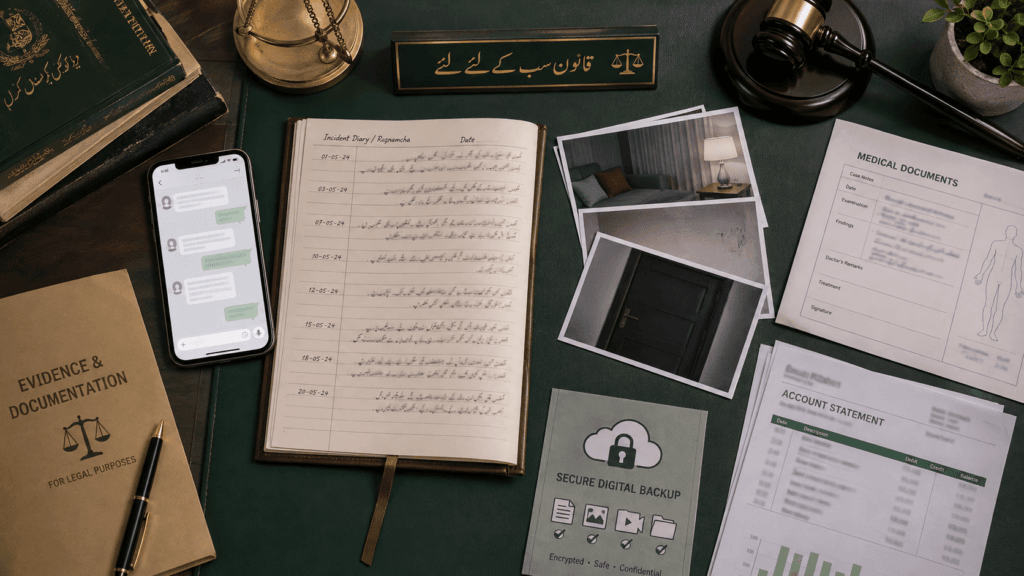
A victim’s safety is more important than obtaining the perfect screenshot. Evidence should be preserved only when doing so does not increase danger.
Useful material may include:
- Medical examination and treatment records.
- Photographs of injuries or damaged property.
- Police complaints and receiving numbers.
- WhatsApp messages, SMS, emails and call logs.
- Voice notes or recordings lawfully available to the victim.
- Bank statements showing removal or control of funds.
- Salary records and proof of lost earnings.
- Rent receipts and medical bills.
- Witness names and contact details.
- School records showing harm to children.
- A private incident diary with dates, locations and brief facts.
- Copies of CNIC, nikahnama, birth certificates and relevant court orders.
Keep original files and make a secure backup. Do not crop away dates, sender details or metadata unnecessarily.
Electronic material is not automatically conclusive. Its relevance, authenticity and evidentiary value are assessed by the court under the Qanun-e-Shahadat Order, 1984 and other applicable law.
Domestic Violence Law in Pakistan: Awareness and a Safe Action Plan
Step 1: Deal With Immediate Risk
Leave for a police station, hospital, shelter or trusted safe location if remaining in the home creates an immediate threat. Avoid announcing the plan to the alleged abuser where that could escalate danger.
Step 2: Obtain Medical Assistance
Request treatment and an appropriate medico-legal examination where an offence may have caused injury. Explain the incident honestly and identify the reported assailant’s relationship.
Step 3: Preserve Essential Documents
Secure identity documents, children’s papers, medication, court orders, emergency cash and important telephone numbers if this can be done safely.
Step 4: Make a Factual Written Complaint
State what happened, when it occurred, where it happened, who was present and what immediate protection is needed. Avoid exaggeration or conclusions that cannot be supported.
Step 5: Identify the Correct Territory and Forum
The place of occurrence, present residence, workplace and last shared household can affect jurisdiction. Never copy a Punjab petition for an ICT or KP matter without checking the relevant statute.
Step 6: Ask for Interim Relief
Where danger is continuing, the petition should explain why waiting for the final hearing would create further risk.
Step 7: Report Every Violation
A breach should be reported with the court-order copy and any supporting material. Delay can make enforcement more difficult.
Step 8: Improve Digital Safety
Change passwords from a safe device, turn off unwanted location sharing, review connected accounts and avoid storing the only evidence copy on a device controlled by the respondent.
Sample Police Complaint for Domestic Violence
To:
The Station House Officer
Police Station: _
District: _
Subject: Complaint concerning domestic violence, threats and request for legal protection
I, _, holding CNIC No. _, presently residing at _, submit that the person complained against, _, is my __ and has been in a domestic relationship with me.
On _ at approximately _, the following incident occurred:
[Describe the conduct in chronological order. Mention the exact words, acts, injuries, witnesses, damaged property, threats and relevant messages without exaggeration.]
Earlier related incidents occurred on _. I fear further harm because _.
The available supporting material includes __. I request the police to record my complaint, arrange necessary protection and medical assistance, investigate the disclosed facts, register an FIR if a cognizable offence is made out, and provide me with a receiving or diary number.
Name: _
Safe contact number: _
Date: _
Signature or thumb impression: _
Attachments: CNIC copy, medical papers, screenshots, photographs, witness list and previous complaint copies.
Do not disclose a shelter or confidential address in a document that may reach the respondent unless a lawyer or protection professional confirms it is safe.
Domestic Violence Law in Pakistan: 12 Costly Mistakes to Avoid
- Waiting for a serious injury before seeking help.
- Filing in the wrong court or under the wrong territorial law.
- Deleting original messages after taking cropped screenshots.
- Handing the only evidence device to another person without backup.
- Confronting the respondent to obtain a confession.
- Treating khula as a substitute for immediate protection.
- Assuming reconciliation is compulsory.
- Relying entirely on an oral complaint without keeping a reference number.
- Posting detailed accusations publicly before receiving legal advice.
- Missing KP’s short filing period.
- Ignoring violations of an interim order.
- Signing a compromise that has not been read or voluntarily understood.
Following Domestic Violence Law in Pakistan carefully means protecting personal safety, meeting legal deadlines, preserving original evidence and approaching the correct forum.
Frequently Asked Questions
1. Is domestic violence a crime in Pakistan?
It can be. Physical assault and other conduct may constitute offences under the Pakistan Penal Code, while territorial domestic violence statutes create additional offences, penalties or protective remedies. The correct classification depends on the conduct and location.
2. Does the 2026 federal Act apply across Pakistan?
No. The Domestic Violence (Prevention and Protection) Act, 2026 extends only to the Islamabad Capital Territory. Provincial and regional laws continue to govern other areas.
3. Can a man file a domestic violence case?
Men are expressly included in the ICT, Balochistan and AJK statutes. Punjab and KP have women-specific laws, while Sindh protects women, children and vulnerable persons. A man outside an inclusive statute may still have remedies under criminal, civil or family law.
4. Is physical injury necessary?
Not always. Qualifying psychological, verbal, economic, sexual, stalking or harassment-related conduct can fall within domestic violence law in Pakistan. The required proof varies between jurisdictions.
5. Can a victim remain in the shared home without owning it?
Several territorial statutes provide residence protection regardless of legal title, subject to their exact wording and exceptions. This protection does not make the victim the owner.
6. Is an FIR required before obtaining a protection order?
Generally, the criminal and protective routes are separate. A petition may be available without an earlier FIR, although the facts could justify using both procedures.
7. Can the court order the respondent to leave?
Yes, certain laws permit removal or exclusion orders in specified circumstances. The ICT Act expressly allows a move-out direction in cases of grave violence endangering life, dignity or reputation.
8. Are WhatsApp messages accepted as evidence?
They can be relevant electronic evidence, but the court examines authenticity, context and reliability. Original files, backups and sender details are more useful than isolated or edited screenshots.
9. Does filing a complaint automatically end the marriage?
No. A protection proceeding does not itself dissolve a marriage. Talaq, khula and dissolution follow separate family-law procedures; see Divorce Procedure in Pakistan: 7 Critical Legal Steps for an overview.
10. Can the victim receive maintenance and medical expenses?
Territorial laws permit different forms of monetary relief, including maintenance, medical costs, lost earnings, property loss and rent. A separate maintenance case may also remain available.
11. What happens if someone knowingly files a false complaint?
Certain statutes, including Punjab, Balochistan and AJK, provide punishment for information knowingly or deliberately made false. A complaint that cannot ultimately be proved is not automatically the same as an intentionally fabricated allegation.
12. Where can free legal help be obtained?
The Ministry of Human Rights helpline 1099 provides free legal advice, counselling and referrals. Punjab residents may also use 1043 or contact the Punjab Women Protection Authority.
Readers who want to explore related court protections may also read Court Marriage in Pakistan: 7 Rights Families Cannot Deny, which explains an adult woman’s right to marry through free consent without unlawful family interference; Khula Law in Pakistan: 5 Important Dower Rights, where the Supreme Court protected a wife against recovery beyond the statutory dower limit in a Punjab khula case; and Women Harassment Law in Pakistan: 5 Powerful Lessons, which explains how dignity and protection against a hostile environment remain enforceable legal rights. Together, these judgments show that consent, dignity, financial rights and access to lawful courts cannot be defeated by family pressure or informal control.
Final Word: Silence Is Not a Legal Obligation
Domestic violence law in Pakistan offers more than punishment after harm has occurred. It can provide no-contact protection, safe residence, financial relief, temporary custody, medical support and enforcement against repeated violations.
The first legal question is not merely, “Was there a physical injury?” A careful assessment asks what conduct occurred, whether it forms a pattern, where the incident happened, who is protected by that territory’s statute and which immediate remedy can reduce danger.
If there is an urgent threat, contact Police Emergency 15 or move to a safe location. For legal advice and referral, call 1099. A victim should not risk further harm while waiting to create perfect evidence.
Legal disclaimer: This guide provides general legal information verified against official sources available on 1 August 2026. It is not a substitute for advice from a lawyer who has reviewed the facts, evidence, jurisdiction and latest notifications in a particular case.