

Proof of Legal Heirs in Pakistan becomes difficult when an old mutation, pedigree table or family record leaves out the very person claiming inheritance. A missing name can look fatal, especially when the record is decades old. But 2023 SCMR 730 shows why one document should not decide the whole case.
In Rustam and others v. Jehangir (deceased) through LRs., the Supreme Court examined whether two women were really the sisters of a deceased man and whether they had been unlawfully excluded from his inheritance. The dispute turned on witnesses, a birth certificate, revenue records, a pedigree table and the legal manner in which documents were proved.
For anyone dealing with Proof of Legal Heirs in Pakistan, the judgment gives a clear warning: collect the family record, but do not stop there. If relationship is disputed, the court may ask who knows the family history, how that witness knows it, what independent record supports the story, and whether the documents were properly proved.
Table of Contents
Judgment at a Glance: 2023 SCMR 730
| Point | Verified Detail |
|---|---|
| Case | Rustam and others v. Jehangir (deceased) through LRs. |
| Citation | 2023 SCMR 730 |
| Court | Supreme Court of Pakistan |
| Appeal | Civil Appeal No. 106-L of 2010 |
| Decision | 19 December 2022 |
| Bench | Amin-ud-Din Khan and Shahid Waheed, JJ. |
| Author Judge | Shahid Waheed, J. |
| Core Dispute | Whether Nooran Bibi and Fateh Khatoon were sisters of Muhammad |
| Disputed Mutation | Mutation No. 675 dated 29 September 1992 |
| Main Evidence Issue | Whether pedigree and mutation records proved relationship |
| Final Result | Appeal dismissed |
IRAC: How the Supreme Court Tested the Relationship
| IRAC | Court’s Approach |
|---|---|
| Issue | Were Nooran Bibi and Fateh Khatoon the real sisters of Muhammad, and were they wrongly excluded from his inheritance? |
| Rule | A pedigree table in a mutation is not, by itself, proof of a disputed family relationship. It needs support from witnesses or other independent evidence. Documents relied on in court must also be legally proved. |
| Analysis | The plaintiffs produced witnesses and documentary material supporting the relationship. The defence witness did not explain his special means of knowledge, while two old mutations relied upon by the defence had not been properly proved. |
| Conclusion | The Supreme Court agreed that the women were Muhammad’s sisters and had been unlawfully excluded. The appeal was dismissed. |
The Supreme Court stated the governing principle directly: a pedigree table alone is not proof of relationship unless corroborated through witnesses or other independent evidence.
How a Family Relationship Became a Property Case
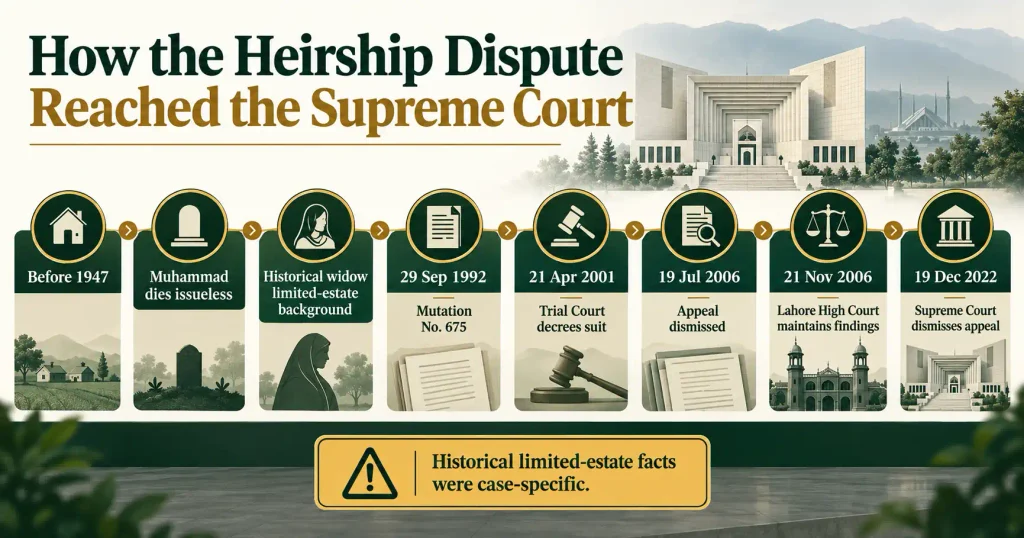
Muhammad son of Khanoo died before the partition of 1947. According to the plaintiffs’ case, he had no children. Nooran Bibi and Fateh Khatoon claimed that they were his real sisters and were entitled to succeed to his estate.
The plaintiffs said Muhammad’s property initially went to his widow, Mst. Zohra, as a limited owner under the custom then relied upon. After her remarriage, they maintained that the property was to pass to Muhammad’s heirs. Mutation No. 675 dated 29 September 1992 later became central to the dispute.
That historical limited-estate background should not be converted into a present-day general rule about a Muslim widow’s inheritance. This was an old pre-Partition succession history. Current Muslim succession questions must be checked under the law applicable today.
The plaintiffs brought a civil suit seeking a declaration that Nooran Bibi and Fateh Khatoon were Muhammad’s real sisters, were entitled to inherit from him, and that Mutation No. 675 was void.
Proof of Legal Heirs in Pakistan therefore became the decisive factual issue.
What Evidence Supported Proof of Legal Heirs in Pakistan?
The plaintiffs produced Sultan as PW-1, Manzoor Hussain as PW-2 and Khan Muhammad alias Khanoo as PW-3.
Manzoor Hussain stated that he knew the parties and Muhammad. Khan Muhammad gave direct family evidence: Muhammad was his maternal uncle, Fateh Khatoon was his mother, and Khanoo had one son, Muhammad, and two daughters, Nooran Bibi and Fateh Mai.
Their documents included jamabandis for 1984-85 and 1993-94, Mutation No. 675, other mutation and court records, and Nooran Bibi’s birth certificate.
For Proof of Legal Heirs in Pakistan, this combination mattered because oral and documentary evidence pointed in the same direction instead of leaving the claim dependent on one entry.
What Evidence Did the Defendants Rely On?
The defendants denied that Muhammad had sisters. They relied mainly on a pedigree table and Mutation Nos. 1836 and 1837.
Before the Supreme Court, they argued that the lower courts had not properly appreciated those records. Their witness, Ghulam Muhammad, however, did not explain what special means of knowledge he possessed about the disputed relationship.
No other independent witness appeared for the defendants to establish the pedigree table’s contents.
This was a serious weakness because Proof of Legal Heirs in Pakistan is not decided merely by producing an older-looking record.
Why a Pedigree Table Was Not Enough
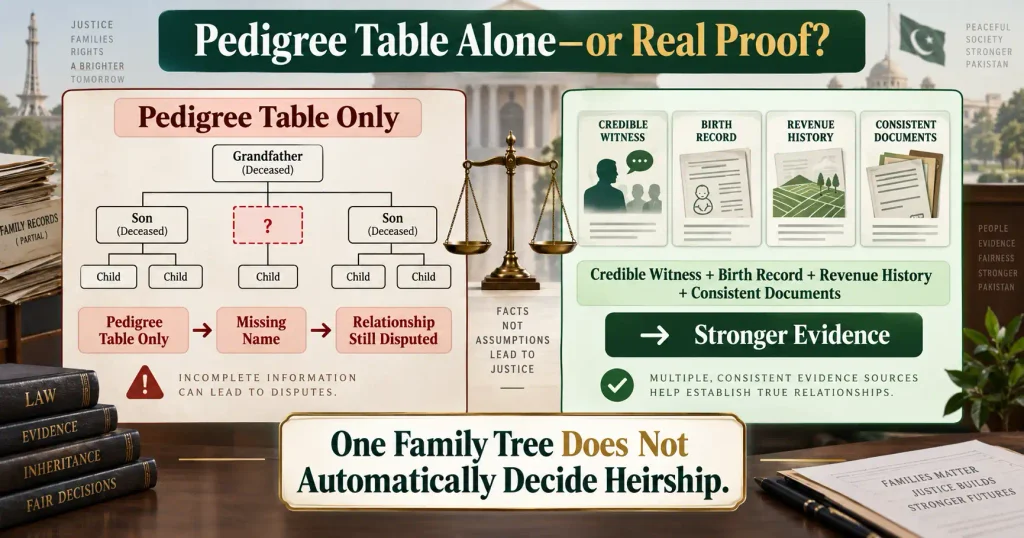
The central rule from 2023 SCMR 730 is precise: a pedigree table appearing in a mutation is not, by itself, proof of a disputed family relationship.
A shajra nasab can still be relevant. It may show how family members were recorded at a particular time. But when one party says, “These women were the deceased’s sisters,” and the other denies it, the pedigree cannot automatically end the inquiry.
The Supreme Court referred to Bashir Ahmad through LRs. v. Muhammad Hussain and another, 2010 SCMR 822, and reaffirmed that a pedigree table must be supported through witnesses or other independent evidence.
For Proof of Legal Heirs in Pakistan, ask four questions: Who proves the relationship? How does that person know it? Which independent records support the testimony? Are there contradictions that need explanation?
A Witness Must Explain the Source of Knowledge
Not every witness who claims to know a family relationship carries the same evidentiary weight.
The Supreme Court noted that the defence witness did not explain his special means of knowledge. A witness should therefore be able to explain why he or she knows the family history and how that knowledge can be tested.
The judgment does not say that a relative, Lambardar or village elder automatically proves heirship. Credibility remains fact-specific.
In Proof of Legal Heirs in Pakistan, the source and reliability of knowledge matter more than the witness’s title.
Why Old Mutations Still Had to Be Proved
The defendants also relied on Mutation Nos. 1836 and 1837.
The Supreme Court noted that those documents had been tendered through counsel’s statement and had not been produced in evidence in the manner required for the Court to rely upon them for the defence case. The Court also emphasized the opposite party’s fair opportunity to cross-examine the person proving evidence.
This point should not be exaggerated. 2023 SCMR 730 does not say that a lawyer can never tender a document, nor does it establish that every official document always requires the same witness. The Court dealt with the evidentiary manner in which these particular disputed records had been produced.
The official Qanun-e-Shahadat, 1984 is Pakistan’s principal evidence law for judicial proceedings.
In Proof of Legal Heirs in Pakistan, authenticity, admissibility, mode of proof and cross-examination can matter as much as the document itself.
What the Lower Courts Had Already Found
The Trial Court held that Nooran Bibi and Fateh Khatoon were Muhammad’s real sisters and decreed the suit on 21 April 2001.
The Additional District Judge reconsidered the oral and documentary evidence and dismissed the defendants’ appeal on 19 July 2006. The Lahore High Court maintained those findings on 21 November 2006.
Three courts had therefore accepted the relationship before the matter reached the Supreme Court.
Why the Supreme Court Agreed
The Supreme Court found no reason to disturb the concurrent findings.
The plaintiffs’ case rested on oral and documentary evidence accepted below. The defence pedigree lacked reliable corroboration, while the two old mutations had not been proved in the manner required for the defendants’ argument.
The Court agreed that Nooran Bibi and Fateh Khatoon were Muhammad’s sisters and had been illegally excluded from his inheritance. It further held that Mutation No. 675 dated 29 September 1992 was not valid in the circumstances.
The appeal was dismissed without costs.
For Proof of Legal Heirs in Pakistan, the practical message is simple: a record is evidence, not a substitute for the entire evidentiary picture.
What the Court Did Not Decide
The Supreme Court did not hold that everyone missing from a pedigree table automatically becomes an heir. A disputed relationship must still be proved.
It did not declare every pedigree table unreliable. Its rule was that a pedigree table alone is insufficient proof of disputed relationship without supporting evidence.
The Court also did not decide that an FRC, CNIC, birth certificate or mutation is universally conclusive proof of heirship. Those were not the blanket questions before the Court.
Finally, the historical limited-estate facts concerning Muhammad’s widow were part of this old succession setting. They should not be repeated as the present general rule for Muslim widows.
These limits matter when applying Proof of Legal Heirs in Pakistan beyond this case.
FRC, Succession Papers and Court Proof Differ
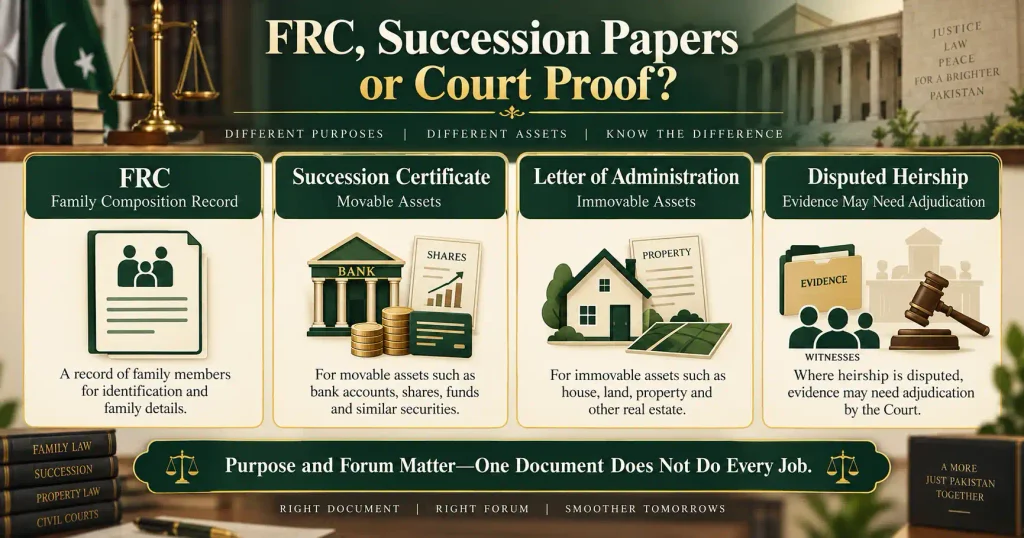
An FRC, succession certificate, letter of administration and court finding on disputed heirship do not perform exactly the same legal function.
NADRA describes the Family Registration Certificate as a record of family composition. Its current succession service states that succession certificates concern movable property, while letters of administration concern immovable property, under the relevant federal and provincial succession frameworks.
NADRA’s current listed requirements include the deceased’s death certificate, CNIC cancellation certificate, FRC, copies of heirs’ CNICs, asset details and authorization/affidavit. Its official page also states that the deceased and legal heirs must be Pakistani citizens and the assets must be in Pakistan.
These records can support Proof of Legal Heirs in Pakistan, but an administrative family record is not the same thing as a judicial finding where one alleged heir disputes another person’s relationship.
For the asset-access process itself, see our Succession Certificate guide.
Which Law Decides the Actual Share?
Proof of relationship answers who is connected to the deceased. It does not automatically calculate that person’s precise inheritance share.
For Muslims, the West Pakistan Muslim Personal Law (Shariat) Application Act, 1962 makes Muslim Personal Law the rule of decision in specified matters including succession, subject to applicable law.
So Proof of Legal Heirs in Pakistan should be separated from distribution. First establish the relevant family relationships and complete heir list. Then determine the applicable succession rules, debts, valid testamentary issues and actual shares.
If a woman has been omitted from the record, see our Women Inheritance Rights guide.
Once the relationship is proved, the next question is the size of each share. Our complete guide explains how sons, daughters, widows and parents inherit under legal heirs in Pakistan law.
Which Forum Fits Proof of Legal Heirs in Pakistan?
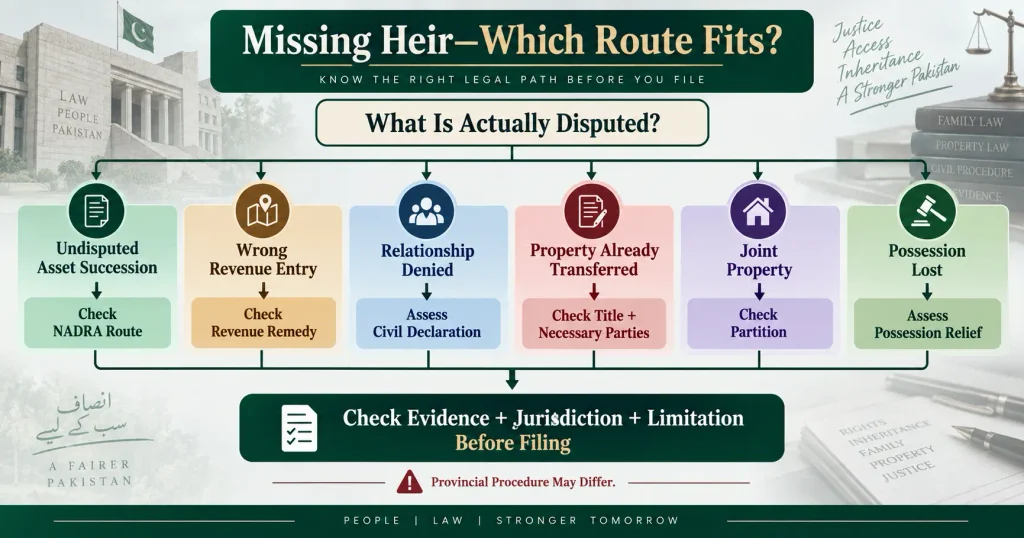
There is no single forum for every inheritance problem.
An undisputed succession application may use the administrative route available under the applicable succession law and NADRA process. A revenue-entry problem may involve the relevant revenue mechanism. But where the relationship itself is denied and evidence must be recorded, judicial adjudication may become necessary depending on the governing law and relief sought.
2023 SCMR 730 itself arose from a civil declaratory suit because the core controversy was whether the women were Muhammad’s sisters and whether the mutation excluding them was valid.
Before filing a case about Proof of Legal Heirs in Pakistan, identify the real injury: missing heir, wrong mutation, disputed transfer, possession, partition or access to movable assets.
For a wrong revenue entry, see Inheritance Mutation in Pakistan. Where title or exclusion has become a broader property dispute, see Inheritance Dispute in Pakistan.
Build Proof of Legal Heirs in Pakistan Before Filing
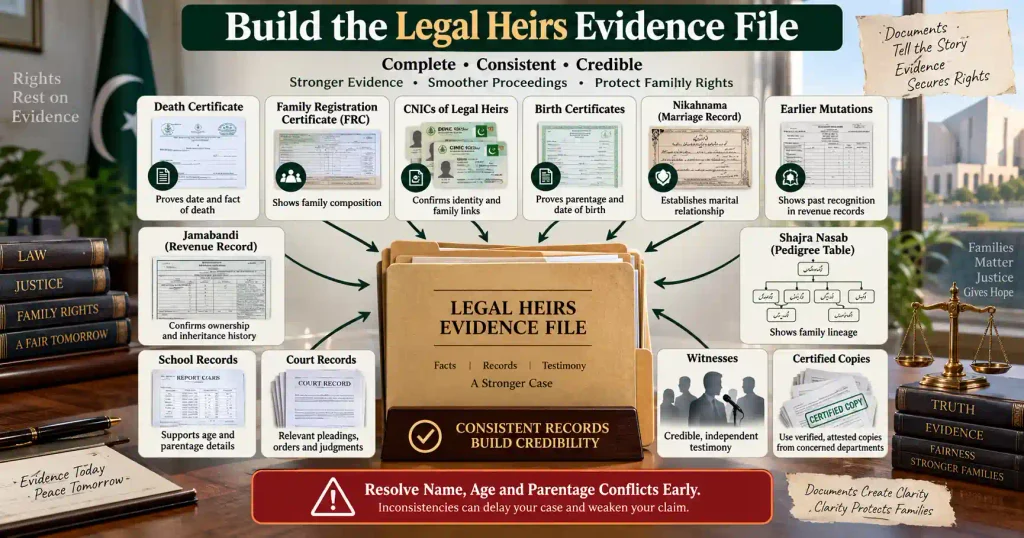
Useful evidence for Proof of Legal Heirs in Pakistan may include:
- Death certificate of the deceased.
- CNIC cancellation certificate where relevant.
- NADRA Family Registration Certificate.
- CNICs, NICOPs or child registration records.
- Birth certificates showing parentage.
- Nikahnama or marriage registration record.
- Earlier inheritance mutations and jamabandis.
- Pedigree tables or shajra nasab.
- School, service or pension records showing parentage.
- Previous court records naming the relationship.
- Witnesses with genuine personal knowledge.
- Certified copies of disputed mutations and orders.
Consistency matters. If one document gives a different father’s name, age or family relationship, investigate it before litigation. An unexplained contradiction can become more damaging than a missing document.
Seven Court Checks That Can Make or Break the Claim
Before relying on Proof of Legal Heirs in Pakistan, check seven things carefully:
- Do not treat one record as final. An FRC, mutation or pedigree may be important, but the dispute may require corroboration.
- Check the witness’s source of knowledge. The witness should explain how they know the deceased and family.
- Use properly provable records. Certified or original documents are safer than unexplained photocopies.
- Resolve contradictions early. Different names, ages or parentage entries can become serious cross-examination points.
- Separate relationship from share. Proving someone is a sibling or child does not automatically calculate the final share.
- Trace later transactions. A sale, gift, mutation or possession change may create additional issues and parties.
- Check forum, relief and limitation. Proof of Legal Heirs in Pakistan may be only one part of a larger inheritance dispute.
If Your Name Is Missing, Check These Steps
Start with the deceased’s death record and draw a simple family tree. Identify the precise relationship you must establish.
Compare NADRA data, birth and marriage records, older revenue entries and family documents. Obtain certified copies of the mutation or document that excludes the claimant.
Next, identify witnesses who genuinely know the family history and can explain their source of knowledge. Preserve supporting evidence before it becomes difficult to obtain.
Finally, check what happened after the exclusion. If property has been transferred, occupied or divided, Proof of Legal Heirs in Pakistan may need to be combined with title, possession, partition, limitation and necessary-party analysis.
Where the heirs are accepted but joint property cannot be divided, see our Partition of Inherited Land in Pakistan guide.
What 2023 SCMR 730 Means for Proof of Legal Heirs in Pakistan
The case prevents an old pedigree table from becoming a shortcut to erase a disputed heir. But it does not remove the claimant’s need to prove the relationship.
The Supreme Court accepted the relationship because the evidence upheld by the lower courts supported it, while the defence pedigree lacked adequate corroboration and the two mutations were not properly proved for the purpose relied upon.
Proof of Legal Heirs in Pakistan is therefore an evidence-building exercise. Credible witnesses, consistent records, lawful proof and fair testing of evidence can matter more than the age of a single document.
Conclusion: One Missing Name Is Not the Whole Story
Proof of Legal Heirs in Pakistan is rarely strongest when it depends on one paper. When relationship is contested, the court may examine the whole family chain: who the deceased was, how the claimant is related, which records support that connection, who can explain the family history and whether the documents are legally proved.
2023 SCMR 730 shows that a missing name in a pedigree table does not automatically destroy an inheritance claim. It also shows that merely claiming to be an heir is not enough.
Build the record early, resolve contradictions, obtain certified documents and choose the correct forum and relief. In Proof of Legal Heirs in Pakistan, a consistent evidentiary chain can be much stronger than an old entry standing alone.
Frequently Asked Questions about 2023 SCMR 730
Is a pedigree table final proof of legal heirs?
No. In 2023 SCMR 730, the Supreme Court held that a pedigree table appearing in a mutation is not, by itself, proof of a disputed family relationship. It should be assessed with witnesses or other independent evidence. Its value depends on the facts, corroboration and the manner in which the record is proved.
What if my name is missing from the inheritance mutation?
A missing name does not automatically mean you are not an heir. Obtain the certified mutation and earlier family records, identify the precise relationship with the deceased and preserve supporting identity and birth documents. Then check the correct revenue or civil remedy. If property has already been transferred, additional parties and relief may be necessary.
Is an NADRA FRC enough to prove inheritance rights?
An FRC is an important official family-composition record and is used in NADRA’s succession process. However, 2023 SCMR 730 did not decide that an FRC is conclusive proof in a contested heirship case. If another person disputes the relationship, additional evidence and adjudication may be required. Relationship and exact inheritance share are separate questions.
Can witnesses prove a disputed family relationship?
Yes. Witness evidence can be important when the witness genuinely knows the family history. The Supreme Court criticized a defence witness who failed to explain his special means of knowledge. A useful witness should explain how they know the deceased and alleged heirs, and that statement can then be tested through cross-examination.
Can a lawyer prove an old mutation just by filing it?
Not automatically. In 2023 SCMR 730, two mutations tendered through counsel were not accepted for the purpose relied upon because they had not been properly proved in evidence with an opportunity for the opposing side to test that evidence. The required mode of proof depends on the document, dispute and applicable evidence law.
What documents help prove legal heirs in Pakistan?
For Proof of Legal Heirs in Pakistan, useful material may include a death certificate, FRC, CNIC records, birth and marriage certificates, earlier mutations, jamabandis, pedigree records, school or service records, previous court material and witnesses with genuine family knowledge. The best evidence depends on the disputed family link and consistency across the record.
Where should I go if someone denies I am an heir?
The route depends on the controversy. An undisputed succession matter may use the applicable NADRA process, while a revenue-entry issue may involve revenue authorities. If the relationship itself is contested and evidence must be adjudicated, civil proceedings may be required. Check jurisdiction, limitation, necessary parties and complete relief before filing.
What did the Supreme Court decide in 2023 SCMR 730?
The Supreme Court dismissed the defendants’ appeal and agreed that Nooran Bibi and Fateh Khatoon were Muhammad’s sisters and had been unlawfully excluded from his inheritance. The unsupported pedigree table did not establish the defence case, and the two old mutations could not be relied upon in the manner they had been produced.
Disclaimer: This article is for general legal awareness and is not case-specific legal advice. Proof of relationship, inheritance shares, forum, limitation and procedure depend on the facts, applicable personal law, provincial or territorial law and relief sought. Professional legal advice should be obtained before filing or defending an inheritance claim.