


Imagine buying a full set of Part I books, then finding out your college follows a different syllabus. It happens to many students every year. Most lists of LLB subjects in Pakistan online still show the old five-year papers, while new students now study a four-year, eight-semester LLB. One wrong list can waste your money, your notes and months of preparation.
This guide clears the confusion about LLB subjects in Pakistan in one place. You will see the current HEC four-year subjects semester by semester, Punjab University’s four-year scheme, the five-year papers for students already enrolled, the old three-year LLB, BA-LLB, Karachi, eligibility after 12th and the official syllabus (nisab) PDFs.
Table of Contents
LLB Subjects in Pakistan: The Quick Answer
- New admissions: HEC’s four-year LLB, notified on 10 July 2025 and effective from Fall 2025. It has 8 semesters, 146 to 148 credit hours, a compulsory internship and a capstone project.
- Already in a five-year LLB: you continue your registered five-year scheme until you finish.
- Three-year LLB: closed to new students since around the end of 2018.
- First-year subjects (four-year LLB): Quantitative Reasoning, Functional English, ICT, Introduction to Law and Legal Systems, Pakistan Studies, Law of Torts and Criminal Law.
- Core law subjects in every version: constitution, contract, torts, criminal law, property, Islamic personal law, jurisprudence, CPC, CrPC, evidence and legal drafting.
Which LLB Syllabus Applies to Your Batch?
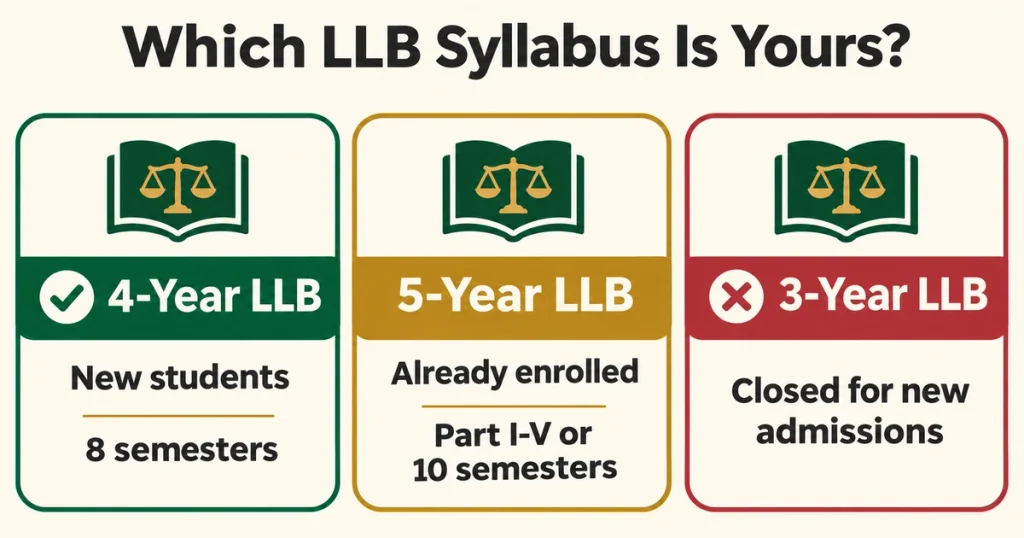
Your admission session decides your syllabus, not the year in which you search Google. Find your row below before you trust any list of LLB subjects in Pakistan.
| Your situation | Programme | Syllabus to follow |
|---|---|---|
| Admitted in Fall 2025 or later | LLB 4 years (8 semesters) | HEC 2025 curriculum as adopted by your university |
| Admitted earlier to a five-year LLB | LLB 5 years (Parts I-V or 10 semesters) | Your university’s registered five-year scheme |
| Admitted to a three-year LLB before it closed | LLB 3 years | Your university’s old three-year outline |
| Studying BA-LLB | Integrated BA-LLB | Your university’s own BA-LLB scheme |
HEC directed all universities and affiliated colleges to implement the four-year scheme from Fall 2025, to comply with the Supreme Court’s directions. A new curriculum does not cut a year from students who joined earlier. Punjab University, for example, still issued a date sheet for its five-year LLB annual examination in 2026.
LLB 4 Years Subjects: HEC Semester-Wise List
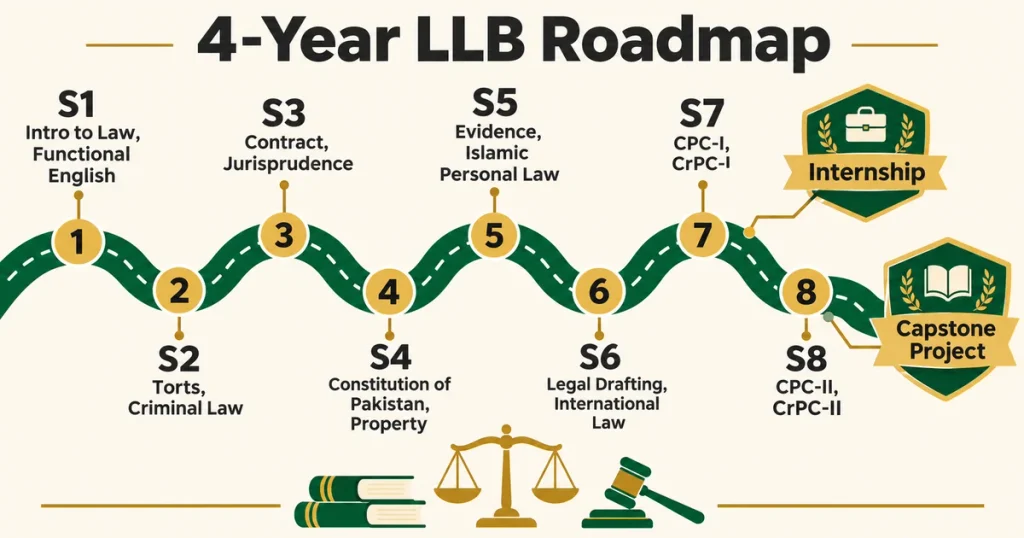
HEC’s four-year LLB is the national model that every university now builds on. It runs for at least 4 years and at most 6 years. These are the LLB subjects in Pakistan for every new batch, as HEC has laid them out:
| Semester | Credits | Subjects |
|---|---|---|
| I | 17 | Quantitative Reasoning-I, Functional English, Applications of ICT, Introduction to Law and Legal Systems, Pakistan Studies, Interdisciplinary course (IDS)-I |
| II | 18 | Quantitative Reasoning-II, Social Science, Expository Writing, Natural Science (Environmental Sciences and Law), Law of Torts, Fehm-e-Quran-I, Criminal Law |
| III | 17 | Arts and Humanities, Islamic Studies (Ethics for non-Muslims), Fehm-e-Quran-II, Law of Contract, Jurisprudence, Principles of Constitutional Law, IDS-II |
| IV | 19 | Civics and Community Engagement, Constitutional Law of Pakistan, Entrepreneurship, Equity, Trusts and Specific Relief, Law of Property, Alternative Dispute Resolution, Islamic Jurisprudence |
| V | 18 | Islamic Personal Law-I, Law of Business Organizations-I, Law of Evidence, Administrative and Services Law, Land Law, Cyber Law |
| VI | 18 | Islamic Personal Law-II, Law of Business Organizations-II, Legal Drafting and Pleadings, International Law, Electives I-II |
| VII | 18 | Legal Ethics and Moot Cases, Criminal Procedure Code-I, Civil Procedure Code-I, Research Methodology, Electives III-IV |
| VIII | 18 | Criminal Procedure Code-II, Civil Procedure Code-II, Environmental Law, Electives V-VI, Capstone Project |
On top of these, every student completes a 3-credit internship of about 6 to 8 weeks. HEC says it cannot be replaced by extra classes or project work. The capstone project in the last semester is also compulsory.
Electives are where LLB subjects in Pakistan now give students real choice. They come from clusters such as technology and law, business and commercial law, human rights, environment and climate justice, and constitutional governance. Non-Muslim students take Ethics instead of Islamic Studies, plus a two-credit interdisciplinary course in place of Fehm-e-Quran.
LLB 4 Years Syllabus Punjab University
Punjab University’s University Law College has published its own four-year scheme: 52 courses and 147 credit hours, aligned with HEC’s 2025 curriculum. The subjects match HEC’s list, but the order and a few electives differ.
| Semester | PU four-year LLB subjects |
|---|---|
| I | Quantitative Reasoning-I, Functional English, ICT, Pakistan Studies, Political Science, Introduction to Law and Legal Systems |
| II | Quantitative Reasoning-II, Sociology-I, Expository Writing, Everyday Science, Law of Torts, Criminal Law |
| III | World History, Islamic Studies/Ethics, Fehm-e-Quran-I, Ideology and Constitution of Pakistan, Public Policy, Law of Contract, Jurisprudence |
| IV | Civics and Community Engagement, Fehm-e-Quran-II, Principles of Constitutional Law, Equity, Trusts and Specific Relief, Law of Property, Environmental Law, Islamic Jurisprudence |
| V | Entrepreneurship, ADR, Media Law (elective), International Law, Islamic Personal Law-I, CPC-I, CrPC-I |
| VI | International Human Rights Law (elective), Land Law, Law of Evidence, Islamic Personal Law-II, CPC-II, CrPC-II |
| VII | Research Methodology, Medical and Forensic Law (elective), AI and Law (elective), Business Organizations-I, Administrative and Services Law, Legal Ethics and Moot Cases, Internship |
| VIII | Taxation Law (elective), International Trade Law (elective), Legal Drafting and Pleadings, Business Organizations-II, Cyber Law, Capstone Project |
Notice one big difference, and it shows why one university’s LLB subjects list in Pakistan can look different from another’s. PU teaches the Civil and Criminal Procedure Codes from Semester V, while HEC’s model places them in Semesters VII and VIII. This scheme is for PU’s University Law College, so an affiliated college student should confirm which scheme the college follows.
LLB 5 Years Subjects in Pakistan for Enrolled Students
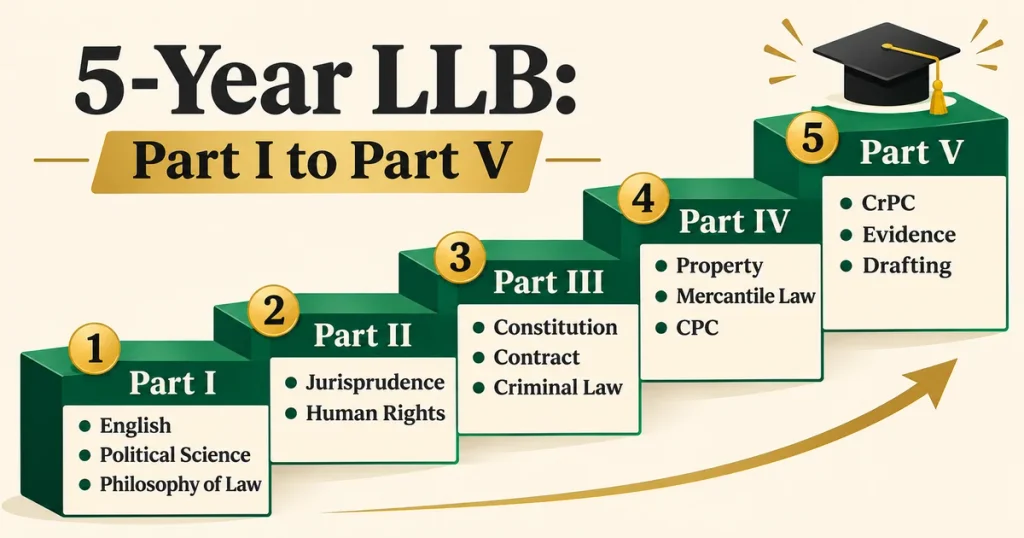
If you joined a five-year LLB before the four-year change, these are still your LLB subjects in Pakistan. The tables below follow Punjab University’s annual syllabus for session 2022-2023, worth 3,200 marks in total. PU’s University Law College moved its five-year LLB to a 10-semester system from session 2023-24, keeping mostly the same subjects split into two semesters each.
Part I: LLB First Year Subjects
If you searched for LLB subjects in Pakistan 1st year under the five-year scheme, this is your list. These are the LLB part 1 subjects in Pakistan under PU’s annual scheme, with six papers of 100 marks each:
| Paper | What you study |
|---|---|
| English-I | Reading, grammar and clear writing |
| Political Science | The state, government and political ideas |
| Sociology | Society, groups and social institutions |
| Introduction to Philosophy of Law | Basic ideas of law, justice and legal reasoning |
| Islamic Studies/Ethics and Pakistan Studies | One paper: 50 marks each part |
| Introduction to World Legal Systems | Major legal traditions of the world |
Part II: Jurisprudence and Rights
| Paper | What you study |
|---|---|
| English-II | Advanced reading and writing |
| Alternate Dispute Resolutions | Settling disputes outside a full trial |
| English Jurisprudence | Rights, duties, ownership and sources of law |
| Islamic Jurisprudence | Sources and methods of Islamic law |
| Human Rights Law | Rights and how they are protected |
| Constitutional Law-I | British and US constitutions (50 marks each) |
Part III: Core Substantive Law
| Paper | What you study |
|---|---|
| Constitutional Law-II | Constitutional history, the 1973 Constitution and leading cases |
| Muslim Personal Law | Marriage, divorce, maintenance and inheritance |
| Law of Contract and Sale of Goods | Contract Act 1872 and Sale of Goods Act 1930 |
| Law of Torts and Easements | Civil wrongs and the Easements Act 1882 |
| Criminal Law | General principles and the Pakistan Penal Code with Hudood laws |
| Public International Law | Law between states and international bodies |
Part IV: Property, Business and Civil Law
| Paper | What you study |
|---|---|
| Equity | Maxims of equity, Specific Relief Act 1877, Trusts Act 1882 |
| Law of Transfer of Property | Transfer of Property, Registration, Succession and Land Acquisition Acts |
| Mercantile Law | Company law, Partnership Act 1932, Negotiable Instruments Act 1881 |
| Special and Local Laws | Land Revenue Act 1967, Pre-emption Act 1991, Tenancy Act 1887 |
| Environmental Laws | National and international environmental law |
| Cyber Laws | Legal issues of digital activity |
| Civil Law-I | Code of Civil Procedure 1908 and Limitation Act 1908 |
Part V: Procedure and Practice
| Paper | What you study |
|---|---|
| Civil Law-II | Advanced civil law material |
| Criminal Procedure and Medical Jurisprudence | CrPC and medical evidence |
| Law of Evidence and Legal Ethics | Qanun-e-Shahadat Order 1984 and advocates’ duties |
| Legal Drafting and Interpretation of Statutes | Conveyancing, pleadings and reading laws |
| Administrative Law and Service Laws | Government powers and service matters |
| Minor Acts | Shorter laws named in the syllabus |
| Labour and Taxation Laws | Employment law and tax laws |
When you compare LLB subjects in Pakistan across annual and semester systems, remember that one annual Part equals two semesters, so Part I matches Semesters I-II and Part V matches Semesters IX-X. The mapping shows time only. It does not mean every subject sits in the same place, so check your own registered scheme.
LLB 5 Years Syllabus HEC: The 2015 Model
Many universities built their five-year LLB on HEC’s revised 2015 curriculum. It has 10 semesters, 166 credit hours and an internship after Semester VIII.
| Year | Main subjects in HEC’s 2015 model |
|---|---|
| 1 | English-I and II, Pakistan Studies, Sociology, Economics, Introduction to Law, Skills Development, Islamic Studies/Ethics, Political Science, Legal System of Pakistan, History (South Asia), Torts-I |
| 2 | English-III, Logic and Reasoning, Islamic Jurisprudence, Torts-II, Contract, UK and US Constitutional Law, Human Rights Law, Psychology |
| 3 | Jurisprudence, Constitution of Pakistan, Islamic Personal Law, Criminal Law, Law of Property, Business Organizations, Land Laws |
| 4 | Public International Law, Constitutional Developments, CPC, CrPC, Law of Evidence, Legal Drafting, Equity and Specific Relief |
| 5 | Research Methods, Minor Acts, Moot Cases and Professional Ethics, Administrative Law, Interpretation of Statutes, Research Project, four electives |
This model explains why many older lists of LLB subjects in Pakistan include Economics and Psychology. The University of Karachi’s published law syllabus uses this same first-year pattern and course codes (LLB 111 to LLB 126).
Is the 3-Year LLB Still Available in Pakistan?
No. The Pakistan Bar Council Legal Education Rules 2015 required colleges to close the three-year LLB within three years of 19 December 2015. The University of Karachi’s syllabus also records the three-year degree as discontinued from Fall 2018. An old exam notice or past paper does not reopen it.
The old LLB 3 years subjects in Pakistan were mainly the core law papers, studied by graduates over three annual parts. These included jurisprudence, constitutional law, contract, torts, criminal law, Muslim law, property, procedure, evidence and drafting. PU still lists its three-year course outline on its LLB course page. Students still finishing should get their remaining papers and deadline in writing from the examination branch.
BA-LLB Subjects in Pakistan: How They Differ
BA-LLB mixes liberal arts with law. Alongside the usual law courses, students take subjects such as economics, political science, psychology, sociology and science. LUMS lists its BA-LL.B (Honours) as a four-year programme of 146 to 148 credits. The University of Karachi’s School of Law lists BA-LLB (Hons) as a five-year programme.
So BA LLB subjects in Pakistan depend on the university. Compare the scheme of studies and the duration, not just the degree name.
LLB Subjects in Karachi and Sindh
LLB subjects in Karachi depend on the university that awards your degree, not on a Punjab list. The University of Karachi’s first semester covers English-I, Pakistan Studies, Introduction to Sociology, Fundamentals of Economics, Introduction to Law and Skills Development.
Things are changing in Sindh too. The University of Sindh offered a four-year semester LLB at its affiliated public and private law colleges for session 2026. Before you pay a fee, ask your college three things: the awarding university, the programme length and the scheme your batch will follow.
LLB Subjects in Pakistan After 12th: Eligibility and LAT
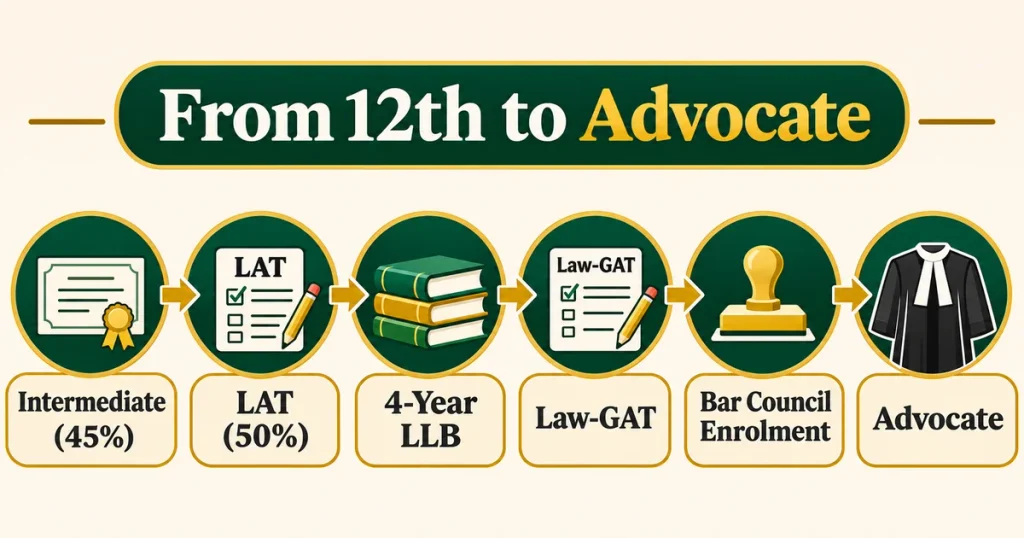
Most students start studying LLB subjects in Pakistan straight after Intermediate. HEC’s four-year curriculum requires HSSC or A-levels (or an IBCC equivalent) with at least 45% marks, plus at least 50% in the Law Admission Test (LAT). Universities may set higher merit, so 50% in LAT does not guarantee a seat.
HEC’s LAT has two parts:
- Part I (75 MCQs, 100 minutes): English 20, General Knowledge 20, Pakistan Studies 10, Islamiat 10, Urdu 10 and Mathematics 5.
- Part II (40 minutes): an essay worth 15 marks and a personal statement worth 10 marks, in English or Urdu.
Start early with our LAT test preparation guide, solve LAT past papers and practise LAT MCQs. Check the LAT test date before registration closes.
After LLB: Law-GAT and Becoming a Wakeel
An LLB degree alone does not make you an advocate (wakeel). HEC’s Education Testing Council conducts the Law Graduate Assessment Test (Law-GAT) for law graduates who want enrolment as advocates. In September 2023, HEC raised the number of attempts from five to seven.
After Law-GAT, you complete your provincial bar council’s training and enrolment steps. This is why the final-year LLB subjects in Pakistan focus so heavily on procedure, evidence and drafting.
LLB Subjects in Pakistan: Books and Official PDFs
For LLB subjects in Pakistan, your syllabus PDF is your real book list. Each paper names its prescribed books. For laws, use the free official text on Pakistan Code, which shows the current version of federal laws. Avoid undated notes that do not name the university, programme and session.
Download only from official sources:
| Official PDF | Who it is for |
|---|---|
| HEC four-year LLB curriculum | New admissions from Fall 2025 |
| PU four-year LLB scheme | PU University Law College, four-year LLB |
| PU five-year LLB annual syllabus 2022-23 | PU five-year annual students |
| HEC five-year LLB curriculum 2015 | Five-year programmes built on HEC’s model |
| University of Karachi law syllabus | University of Karachi five-year students |
Which LLB Subjects Matter for Your Future Practice?
You must pass every paper, but some LLB subjects in Pakistan shape your career more than others. Use this table to choose electives and internships wisely.
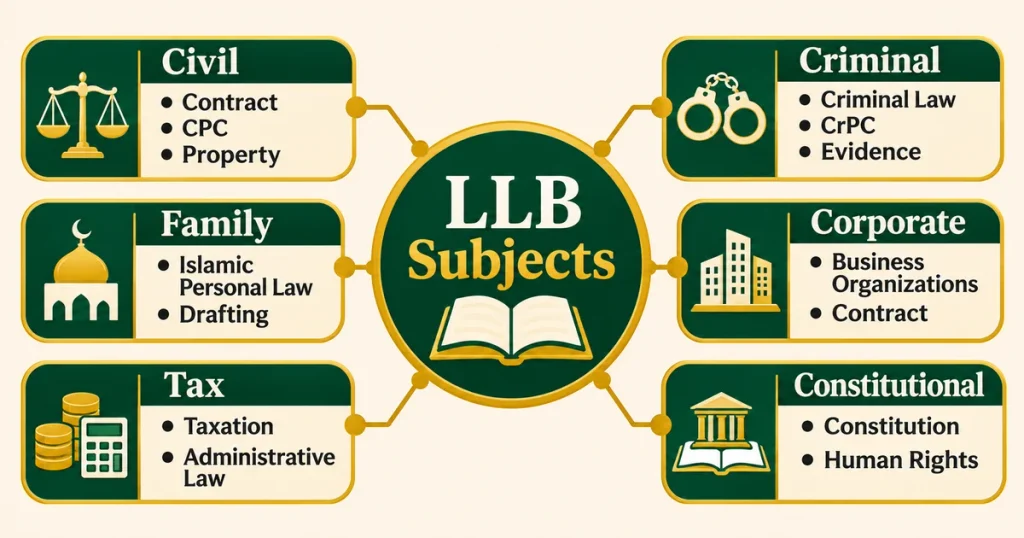
| If you want to practise | Focus on |
|---|---|
| Civil and property law | Contract, property, land law, CPC, evidence, drafting |
| Criminal law | Criminal law, CrPC, evidence, medical jurisprudence |
| Family law | Islamic personal law, evidence, drafting |
| Corporate law | Business organizations, contract, commercial electives |
| Tax law | Taxation, administrative law |
| Constitutional law | Constitutional law, administrative law, human rights |
5 Costly Mistakes Students Make Before Admission
- Following an old list. A five-year list of LLB subjects in Pakistan is wrong for a four-year batch, and the reverse.
- Joining an unrecognised college. Check the college name, city and university on the Pakistan Bar Council’s affiliated colleges list.
- Assuming every university is the same. The subjects in LLB in Pakistan share one core, but PU, Karachi and HEC’s model place them in different semesters.
- Ignoring PBC registration. Under PBC rules, your college must send the list of admitted LLB students to the Bar Council within one month, with a Rs. 3,000 fee per student. Keep proof of your registration.
- Buying outdated books. Laws change. For example, company law is now in the Companies Act 2017, so check every Act’s current version.
Frequently Asked Questions
Is LLB 4 years or 5 years in Pakistan?
LLB is now four years for new students. HEC notified the four-year curriculum on 10 July 2025 and directed universities to implement it from Fall 2025. Students admitted earlier to a five-year LLB continue under their registered scheme until they finish. Always check your admission letter and your university’s notification to confirm your programme length.
What are the LLB subjects in Pakistan in the 1st year?
Under HEC’s four-year scheme, the first-year subjects of LLB in Pakistan include Quantitative Reasoning, Functional English, ICT, Introduction to Law and Legal Systems, Pakistan Studies, Law of Torts and Criminal Law. Five-year annual students at PU study English-I, Political Science, Sociology, Philosophy of Law, World Legal Systems, and Islamic and Pakistan Studies in Part I.
Is there math in LLB?
Yes, but only basic reasoning, not FSc-level maths. Among current LLB subjects in Pakistan, HEC’s four-year scheme includes Quantitative Reasoning-I and II in the first two semesters. The LAT entry test also has 5 mathematics MCQs out of 75. You do not need an FSc pre-engineering background for LLB, but basic numbers and logic will help you.
Which type of LLB is best?
The best LLB is a recognised one that matches your admission session. A four-year LLB from a university or college on the Pakistan Bar Council list is the standard route for new students. BA-LLB adds liberal arts subjects, which suits students who also want depth in economics or politics. Recognition matters more than the degree name.
Can I still get admission in a 3-year LLB?
No. Under the Pakistan Bar Council Legal Education Rules 2015, colleges had to close the three-year LLB within three years of 19 December 2015. New admissions therefore ended around the end of 2018. Old supplementary exams are only for students who were already enrolled, not for new applicants.
Are LLB subjects the same in every university?
The core LLB subjects in Pakistan are the same everywhere, but the order and some general subjects differ. For example, PU teaches CPC and CrPC from Semester V, while HEC’s model places them in Semesters VII and VIII. Karachi’s five-year scheme also starts with Economics and Skills Development. Always study from your own university’s official scheme.
Do I need Law-GAT after LLB?
Yes, if you want to practise as an advocate. HEC’s Education Testing Council conducts Law-GAT for law graduates seeking enrolment with the bar. HEC raised the allowed attempts from five to seven in September 2023. After passing, you still complete your provincial bar council’s training and enrolment requirements.
Where can I download the LLB syllabus PDF?
-Download it only from official sources: the HEC curriculum page, your university’s website or your college’s notice. Punjab University keeps its LLB course outlines on its official website. Save the PDF with its session or notification date, then match it with your exam paper codes before buying books.
Final Word: Match Your Batch Before Your Books
The right list of LLB subjects in Pakistan depends on four things: your university, programme, admission session and exam system. New students follow the four-year HEC-based scheme, while enrolled five-year students keep their registered papers. Confirm with your examination branch before you spend money, and prepare for the exam you will actually sit.
This article is for legal awareness only and is not legal advice. Every case depends on its own facts, documents and evidence. For your specific matter, consult a qualified lawyer or your university.