


A single revenue entry can affect a family for generations. In this Supreme Court case, a deceased landowner’s widow and daughters were first recorded as legal heirs. On the same day, another mutation stated that they had orally gifted their inherited shares to the deceased’s two sons. Their successors later challenged the transaction and maintained that no genuine gift had ever taken place.
The judgment gives a strong explanation of Hiba Law in Pakistan. A gift mutation is not the gift itself. Once challenged, the beneficiary must prove declaration, acceptance and delivery of possession through reliable evidence. Old entries, long possession and silence cannot replace that proof. Women’s inheritance remains a vested Shari and legal right.
Table of Contents
IRAC Analysis: How the Court Tested the Hiba Claim
| Element | Explanation |
|---|---|
| Issue | Whether Roshan’s widow and daughters validly gifted their inherited shares to his two sons, and whether limitation and long possession defeated the challenge. |
| Rule | Under Hiba Law in Pakistan, a valid gift requires declaration by the donor, acceptance by the donee and delivery of possession. The beneficiary must prove all three elements. Mutation alone does not create title. |
| Analysis | The respondents relied on Gift Mutation No. 75, possession, cultivation and later transactions. No direct witness proved the oral declaration, acceptance or transfer of possession. The female heirs also continued receiving a share in the produce. |
| Conclusion | The Supreme Court allowed the appeal, set aside the three earlier judgments, declared Mutation No. 75 and the transactions based on it ineffective, and restored the petitioners’ inheritance shares. |
Judgment at a Glance: Hiba Dispute and Burden of Proof
| Detail | Information |
|---|---|
| Case | Noor Muhammad etc. v. Ghulam Haider etc. |
| Case number | C.P.L.A. No. 1103-L of 2016 |
| Court and bench | Supreme Court; Justice Shahid Bilal Hassan and Justice Shakeel Ahmad |
| Hearing | 4 June 2026 |
| Judgment announced | 30 June 2026 |
| Original owner | Roshan son of Bora |
| Disputed entry | Gift Mutation No. 75, sanctioned on 17 April 1955 |
| Earlier result | Suit, appeal and civil revision dismissed |
| Final result | Appeal allowed; mutation set aside and inheritance shares restored |
The case arose from a Lahore High Court, Bahawalpur Bench judgment dated 26 January 2016.
How the Property Dispute Began
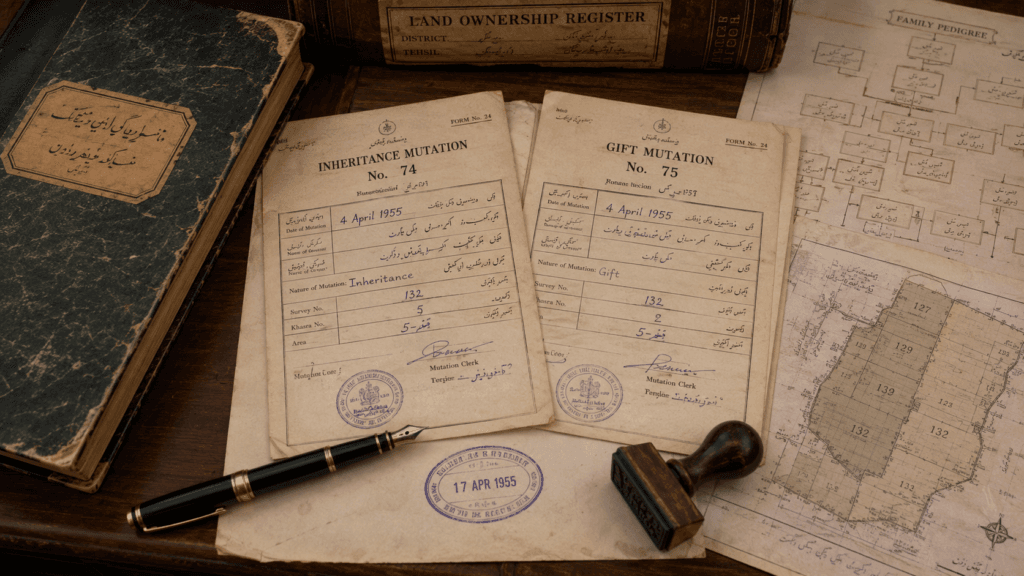
Roshan son of Bora owned the suit property and died in 1955. Inheritance Mutation No. 74 was entered on 4 April 1955 in favour of his legal heirs. On the same day, Mutation No. 75 was entered on the basis of an alleged oral gift by Roshan’s widow and daughters in favour of his two sons. Both mutations were sanctioned on 17 April 1955.
The petitioners claimed that no gift had occurred and that Mutation No. 75 was used to remove the female heirs from property already inherited by them. Roshan’s sons and their successors remained in possession and later dealt with the land through exchange mutations and additional gifts in favour of descendants. The petitioners challenged the original mutation and all later transactions founded upon it.
This sequence is important for Hiba Law in Pakistan because the alleged donees were the male heirs who directly benefited from excluding the widow and daughters.
Court History and Questions Before the Supreme Court
The Trial Court dismissed the plaintiffs’ suit for declaration. Their appeal and Lahore High Court civil revision were also dismissed, after which they approached the Supreme Court.
The Supreme Court asked whether the respondents had proved a valid oral gift through which Roshan’s widow and daughters surrendered their inheritance rights, and whether delay and possession could defeat the challenge.
The dispute raised five practical legal issues:
- Who had to prove the alleged gift?
- Could a mutation independently establish ownership?
- Were declaration, acceptance and delivery of possession proved?
- Did the brothers’ possession extinguish the sisters’ rights?
- Could limitation be applied before examining the validity of the gift?
Petitioners’ Arguments
The petitioners argued that Mutation No. 75 had wrongly been treated as proof of a valid gift. The beneficiaries, they said, had to prove declaration, acceptance and delivery of possession. Mutation did not create title, long possession could not cure an unproved gift, and later transactions were fresh claims of exclusive ownership. They also said the courts had attached excessive value to old revenue entries and failed to protect female heirs.
Under Hiba Law in Pakistan, the transaction itself must be proved; pointing to a revenue document is insufficient.
Respondents’ Arguments

The respondents relied on the mutation’s age, continuous cultivation and long possession. They claimed that the plaintiffs knew about the entry but remained silent, making the suit barred by limitation. They also asked the Supreme Court not to disturb the concurrent findings of three courts.
The Supreme Court rejected the idea that delay, possession and the age of a mutation could automatically satisfy Hiba Law in Pakistan.
Three Essentials Under Hiba Law in Pakistan

Declaration by the Donor
The donor must clearly express an intention to make an immediate gift. No reliable witness proved that Roshan’s widow and daughters personally declared that they were gifting their shares.
Acceptance by the Donee
The donee must accept the gift during the donor’s lifetime. The respondents did not establish when, where or before whom the two sons accepted it.
Delivery of Possession
The donor must transfer possession in a legally recognizable manner. Delivery is an indispensable requirement under Hiba Law in Pakistan.
No witness identified when or how possession was transferred or how the women surrendered control. Sardar and Laal were already legal heirs and cultivators, so their continued possession did not prove delivery under a gift.
Why Mutation No. 75 Failed Under Hiba Law in Pakistan
The Supreme Court explained that a mutation is maintained primarily for fiscal purposes and neither creates nor extinguishes ownership. Where title is claimed through an oral gift, title must flow from the gift itself.
A mutation may support a transaction already proved through reliable evidence, but it cannot replace proof of declaration, acceptance and delivery of possession.
This is a central rule of Hiba Law in Pakistan. Even a sanctioned mutation that remains in the revenue record for decades does not become a title document simply because it was not immediately challenged.
Readers dealing with disputed revenue entries may also read our detailed guide on Gift Mutation in Pakistan.
You can also read: Oral Gift in Pakistan: When Mutation Cannot Defeat Sisters’ Inheritance Rights
Noor Muhammad Was Not a Direct Witness
Noor Muhammad, D.W.1, was not present when Mutation No. 75 was attested, did not participate in the proceedings and could not identify the persons who appeared. His statement was second-hand information, not direct proof of declaration, acceptance or possession.
Hiba Law in Pakistan requires witnesses who can speak directly about the acts completing the gift.
Hissa Batai Weakened the Respondents’ Story
The record indicated that the female heirs continued receiving hissa batai, or a share in the produce, for several years after Roshan’s death.
The Supreme Court held that this fact created doubt about the alleged complete surrender of ownership. If the widow and daughters had absolutely gifted away their rights in 1955, there would ordinarily have been no reason to continue recognizing their entitlement in the produce.
Possession of Brothers Could Benefit Sisters

The respondents relied heavily on the sons’ long possession. The Supreme Court explained that possession of one heir is ordinarily treated as possession on behalf of all heirs unless the rights of the others are clearly and unequivocally repudiated.
Therefore, possession of brothers may also amount to constructive possession for their sisters. Waiver, relinquishment and adverse possession generally do not operate easily among co-heirs.
This principle is vital under Hiba Law in Pakistan when the alleged donee was already a co-heir. Existing possession cannot automatically become evidence of delivery under a gift.
Limitation Under Hiba Law in Pakistan
The lower courts focused on the period between 1955 and the suit. The Supreme Court held that delay may be relevant, but limitation could not hide the earlier question of whether the gift was proved. The courts had presumed the gift from possession, revenue entries and time without first requiring the beneficiaries to discharge their burden. That was a manifest error of law.
Later exchange and gift transactions were also independent assertions of exclusive ownership. They provided fresh occasions for judicial scrutiny, so the dispute could not be dismissed only by counting time from Mutation No. 75.
This ruling gives Hiba Law in Pakistan a balanced approach: limitation remains relevant, but it cannot turn an unproved gift into a valid one.
Female Heirs Must Understand the Consequences
The alleged gift permanently removed the widow and daughters from vested property rights. The beneficiaries therefore had to prove not only the technical ingredients of Hiba but also that the women understood the nature, extent and consequences of what they were allegedly surrendering.
There was no evidence that they had been informed they would permanently lose ownership or that they knowingly and voluntarily abandoned their shares.
Where a gift benefits male relatives by excluding women, Hiba Law in Pakistan requires the closest judicial scrutiny.
Why the Supreme Court Set Aside Three Judgments
Concurrent findings are normally respected, but the Supreme Court may interfere where they result from a misunderstanding of law, misreading of evidence or failure to consider important material.
The courts below failed to appreciate that the gift, not merely the mutation, had to be proved. They also overlooked co-heir possession, continued hissa batai and the special caution required where women are excluded.
Final Decision and Relief

The Supreme Court converted the petition into an appeal and allowed it. The judgments of the Trial Court, Appellate Court and Lahore High Court were set aside.
Mutation No. 75 dated 17 April 1955 and every later transaction founded upon it were declared illegal, void and ineffective against the petitioners’ inheritance rights. The petitioners were held entitled to their respective shares in Roshan’s estate. Revenue authorities were directed to correct the record and determine and separate the shares.
The result confirms that Hiba Law in Pakistan does not permit an unsupported oral claim, doubtful mutation or long possession to erase vested inheritance rights.
Islamic and Constitutional Protection of Inheritance
The Supreme Court called inheritance a vested Shari and legal right, not a bounty controlled by male relatives. It cannot be defeated through fabricated gifts, manipulated entries, pressure or prolonged litigation.
These protections can also be examined under Articles 23, 24 and 25 of the Constitution of Pakistan, which safeguard property rights and equality before law.
The Court connected women’s inheritance with constitutional equality and property rights, placing a positive duty on courts and revenue authorities to make those rights effective.
The judgment strengthens Hiba Law in Pakistan and warns against doubtful family transactions that exclude women.
Practical Checklist for Proving a Hiba
A beneficiary relying on a gift should preserve evidence of:
- a clear declaration by the donor;
- date, time and place of the transaction;
- names and details of witnesses;
- clear acceptance by the donee;
- actual or legally recognized delivery of possession;
- the donor’s ownership, capacity and free consent;
- complete identification of the property;
- and circumstances showing that the donor understood the consequences.
Under Hiba Law in Pakistan, mutation is supporting evidence, not a substitute for the original gift.
Conclusion
This judgment separates a revenue entry from a genuine gift. Mutation cannot prove declaration, acceptance or delivery of possession; the beneficiary must establish each requirement.
The ruling also addresses a painful pattern in which women are first recognized as heirs and then removed through an alleged oral gift. Hiba Law in Pakistan requires close scrutiny of such claims.
Time, possession and paperwork cannot make an unproved gift genuine. A doubtful mutation cannot erase a woman’s legal and Shari inheritance.
Disclaimer: This article is for general legal awareness only and does not constitute legal advice. Consult a qualified lawyer for guidance based on the facts and documents of a particular case.
Frequently Asked Questions
Is an oral Hiba valid in Pakistan?
Yes. An oral Hiba can be valid, but declaration, acceptance and delivery of possession must be proved through credible evidence.
Does a gift mutation create ownership?
No. A mutation is mainly a revenue entry. It may support a proved gift but cannot independently create title.
Who must prove a disputed Hiba?
The person relying on and benefiting from the gift must prove it, particularly where female heirs are excluded.
Can long possession make an invalid gift valid?
No. Long possession cannot replace the essential proof required by Hiba Law in Pakistan.
Is a brother’s possession automatically adverse to his sister?
No. Possession of one co-heir is generally treated as possession for all co-heirs unless there is a clear denial of the others’ rights.
Can an old gift mutation be challenged?
Yes, depending on knowledge, denial of title, later transactions and limitation. The court must still examine whether the alleged gift was proved.
What happens when a gift mutation is declared void?
The revenue record may be corrected, later transactions may become ineffective against lawful heirs, and inheritance shares may be determined and separated.