
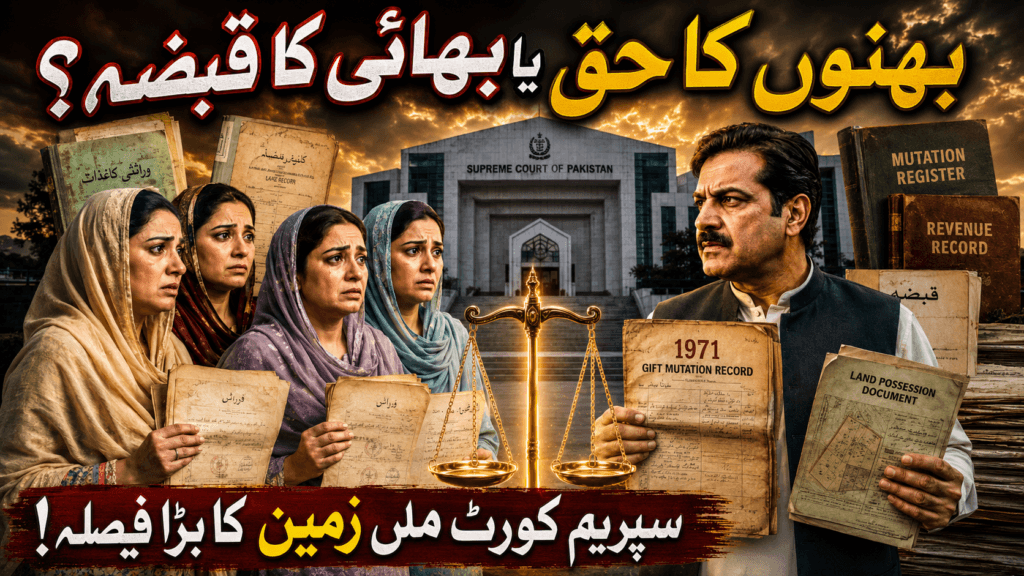
A family gift may appear simple when relations are peaceful. A sister gives her land to her brother, the revenue record is changed, possession is delivered and everyone moves forward. But decades later, the same transaction may become the centre of an emotional legal battle.
This is what happened in the Supreme Court case reported as 2026 SCMR 855. Four sisters were shown in the revenue record as having gifted their shares in agricultural land to their brother, Jumo alias Juman, in 1971. He remained in possession, cultivated the land and paid land revenue for almost 30 years.
Later, one sister, Mst. Addan, denied the gift. She alleged that the entries had been created through fraud and collusion with revenue officials. The dispute eventually reached the Supreme Court, which had to decide whether an old Gift Mutation in Pakistan could be cancelled merely because one donor later denied it.
The Court held that allegations alone were not enough. A person alleging fraud must provide specific details and convincing evidence. Because Mst. Addan’s side failed to do so, the gift and revenue entries remained valid.
Table of Contents
IRAC
| Element | Explanation |
|---|---|
| Issue | Whether the 1971 gift and revenue mutation in favour of Jumo alias Juman were fraudulent, invalid and liable to be cancelled after approximately 27 years. |
| Rule | A valid Muslim gift requires declaration, acceptance and delivery of possession. Fraud must be specifically pleaded and proved. Long-standing revenue entries carry a presumption of truth unless rebutted through convincing evidence. |
| Analysis | Jumo produced revenue entries, statements of the donors, witnesses and evidence of continued possession. Mst. Addan’s side failed to identify the specific fraud or produce independent documentary evidence. |
| Conclusion | The Supreme Court upheld the High Court judgment, accepted the gift transaction and dismissed the appeals filed by Mst. Addan’s legal heirs. |
Judgment at a Glance
| Point | Details |
|---|---|
| Case title | Mst. Addan (deceased) through L.Rs. v. Province of Sindh and others |
| Citation | 2026 SCMR 855 |
| Court | Supreme Court of Pakistan |
| Bench | Justice Irfan Saadat Khan and Justice Aqeel Ahmed Abbasi |
| Decision date | 1 October 2025 |
| Property | Agricultural land in Deh Deparja, Taluka Mirwah, District Khairpur |
| Disputed record | Revenue Entry Nos. 33 and 34 dated 6 May 1971 |
| Main allegation | Gift mutation was created through fraud and collusion |
| Delay in challenge | Approximately 27 years |
| Final result | Appeals dismissed and High Court judgment maintained |
| Winning party | Jumo alias Juman |
| Key principle | Fraud must be supported by specific particulars and reliable evidence |
Four Sisters, One Brother and a Disputed Gift

Sher Muhammad had one son, Jumo alias Juman, and four daughters:
- Mst. Addan
- Mst. Koral
- Mst. Makhan
- Mst. Subhan Khatoon
According to the official revenue record, all four sisters gifted their shares in the disputed agricultural land to their brother. The transaction was reflected through Entry No. 34 dated 6 May 1971, recorded before the Mukhtiarkar in the presence of witnesses.
The record also showed that Mst. Addan received another piece of land from Jumo through an exchange gift. This transaction was reflected in a Quboliat Nama dated 13 April 1970.
After the gift, Jumo remained in peaceful possession of the land. He cultivated it and continued paying land revenue for almost 30 years. These facts later became important in determining the validity of the Gift Mutation in Pakistan.
How Did the Property Dispute Begin?
The dispute began when Mst. Addan’s side tried to interfere with Jumo’s possession and approached the Assistant Commissioner for cancellation of the revenue entries.
Jumo then filed Suit No. 22 of 1998. He requested the court to declare him the lawful owner of the property and to declare Revenue Entry Nos. 33 and 34 valid. He also sought a permanent injunction restraining the defendants from dispossessing him.
Mst. Addan denied that any gift had taken place. She claimed that the property had originally belonged to her father, Sher Muhammad, and had passed to all his legal heirs after his death.
According to her version, Jumo had only been managing the property on behalf of the family. She claimed that he distributed the agricultural income among the co-sharers until the end of 1995 but later stopped giving them their shares.
Mst. Addan alleged that she learned about the disputed revenue entries only after receiving notice of Jumo’s suit.
Mst. Addan’s Suit Against the Gift Mutation
About six months after filing her written statement in Jumo’s case, Mst. Addan filed Suit No. 48 of 1998.
She claimed that Jumo had acted in collusion with revenue officials and had fraudulently entered the land in his name. She requested the court to:
- Declare Revenue Entry Nos. 33 and 34 illegal and fraudulent.
- Restore her joint possession in the land.
- Award mesne profits for the income allegedly withheld from her.
- Restrain Jumo from interfering with her claimed ownership rights.
Her case depended upon proving that the Gift Mutation in Pakistan was not based on a genuine transaction.

Issues Framed by the Trial Court
The Trial Court consolidated both suits and framed the following issues:
- Whether either of the two suits was maintainable under the law.
- Whether Mst. Addan had executed a gift in favour of Jumo alias Juman.
- Whether the alleged gift was legal, valid and binding.
- Whether Mst. Addan executed the Quboliat Nama dated 13 April 1970 and what its legal effect was.
- Whether either party was entitled to the relief claimed.
- What decree should be passed.
These issues covered the gift, mutation, limitation, maintainability, possession and the exchange of land between the parties.
Arguments of Mst. Addan and Her Legal Heirs

Mst. Addan’s legal heirs argued that once the mutation was challenged, Jumo was required to prove the original transaction that caused the mutation to be entered in the revenue record.
They maintained that Jumo had failed to produce the legally required evidence to establish the oral gift. According to them, a revenue entry alone could not transfer ownership or deprive a female heir of her inheritance.
Their main arguments were:
- Mst. Addan never gifted her share to Jumo.
- The revenue entries were bogus and fraudulent.
- Jumo failed to properly prove the original gift.
- A woman’s inheritance could not be taken away merely by claiming that she surrendered it to a male family member.
- There was no limitation against a co-sharer seeking her inheritance from another co-sharer.
- The Trial Court and First Appellate Court had already decided in Mst. Addan’s favour.
- The High Court should not have disturbed concurrent findings of two courts.
The appellants requested the Supreme Court to cancel the disputed Gift Mutation in Pakistan and restore Mst. Addan’s claimed share.
Arguments of Jumo Alias Juman

Jumo’s lawyers argued that the gift was supported by official documents, statements of the donors and decades of possession.
They submitted that the revenue record contained the statements, signatures or thumb impressions of all four sisters. The entries were not recently prepared documents. They had existed since 1971.
The respondent raised the following arguments:
- The gift was voluntarily made by all four sisters.
- Mst. Addan received another property through an exchange gift.
- Jumo took possession after the gift.
- He openly cultivated the land and paid land revenue.
- Mst. Addan challenged the transaction after approximately 27 years.
- No specific particulars of fraud were mentioned in the plaint.
- No reliable independent witness was produced to prove fraud.
- The other three sisters did not come forward to allege fraud.
- The lower courts failed to decide the framed issue of limitation and maintainability.
Jumo’s side maintained that long-standing possession and official record provided strong support for the Gift Mutation in Pakistan.
Evidence Produced Before the Courts
Jumo appeared as a witness and also produced Ali Bakhsh as a supporting witness. He placed several documents on record, including revenue entries and documents connected with the gift and possession.
On the other side, Muhammad Soomar, the son and legal heir of Mst. Addan, appeared as the only witness. He produced a power of attorney but did not provide independent documentary evidence proving that the mutation was fraudulent.
The courts also noted that Muhammad Soomar was approximately eight years old when the 1971 transaction allegedly took place. Therefore, he did not have direct and reliable personal knowledge of the gift.
This weakness in evidence became important. A party challenging an official Gift Mutation in Pakistan must produce evidence strong enough to rebut the legal presumption attached to long-standing revenue entries.
What Did the Trial Court Decide?
The Senior Civil Judge dismissed Jumo’s suit and decided Mst. Addan’s suit in her favour to the extent of her claimed 17-paisa share.
The Trial Court directed Jumo to place Mst. Addan in joint possession of that share within 30 days.
Jumo challenged the decision before the Additional District Judge. However, the appellate court dismissed his appeals in 2006. At this stage, both the Trial Court and First Appellate Court had decided against him.
Why Did the Sindh High Court Reverse the Decisions?
Jumo filed revision petitions before the Sindh High Court, Sukkur Bench, under section 115 of the Civil Procedure Code.
The High Court found that the lower courts had failed to properly decide the issue of limitation and maintainability, even though a specific issue had been framed.
The High Court held that Mst. Addan had challenged the gift and revenue entries after approximately 27 years. Her suit was therefore barred by limitation.
It also found that the allegations of fraud were unsupported. As a result, the High Court:
- Set aside the judgments of the two lower courts.
- Decreed Jumo’s suit.
- Dismissed Mst. Addan’s suit.
- Maintained the gift and revenue entries in Jumo’s favour.
Mst. Addan’s legal heirs then approached the Supreme Court.
Supreme Court Analysis of Gift Mutation in Pakistan
A 27-Year Delay Could Not Be Ignored
The Supreme Court observed that Mst. Addan had challenged specific gift and mutation entries almost 27 years after they were recorded.
The appellants tried to present the dispute as a simple inheritance claim between co-sharers. However, they were directly seeking a declaration that particular revenue entries and the underlying gift were illegal.
The Court explained that every court has a duty to examine limitation, even when a party does not properly raise it. The lower courts had framed an issue about maintainability but failed to decide it through clear reasons.
The High Court was therefore justified in correcting this material irregularity.
Fraud Must Be Specifically Pleaded
The most important principle in the judgment was that fraud cannot be proved through vague statements.
A person alleging fraud must clearly explain:
- Who committed the fraud.
- When the fraud took place.
- What false act or document was used.
- Which official or witness participated.
- How the claimant’s signature or thumb impression was fabricated.
- When the claimant discovered the alleged fraud.
Mst. Addan’s side used words such as “bogus,” “illegal,” “fraudulent” and “collusive,” but did not provide supporting particulars.
The Supreme Court held that general allegations, regardless of how strongly they are worded, are insufficient to establish fraud.
This principle is crucial in any dispute involving Gift Mutation in Pakistan. A later oral denial cannot automatically defeat an old official entry.
The Brother Discharged His Initial Burden
Jumo produced official revenue entries, donor statements, documentary evidence and his own sworn testimony.
His evidence was not successfully demolished during cross-examination. Once he produced evidence supporting the transaction, the burden shifted to Mst. Addan’s side to prove fraud or forgery.
The appellants failed to discharge that burden. They produced neither a handwriting or thumb-impression expert nor an independent witness who could explain how the entries had been fabricated.
Possession Proved Acceptance of the Gift

Under Muslim law, a valid gift generally requires three elements:
- A clear declaration of gift by the donor.
- Acceptance by or on behalf of the donee.
- Delivery of possession of the gifted property.
The Supreme Court explained that acceptance may be express or implied. It can be inferred from the conduct of the donor and donee.
In this case, Jumo took possession after the gift. He remained in possession, cultivated the land and paid land revenue for several decades.
His continuous possession showed acceptance and supported completion of the gift. Therefore, the Gift Mutation in Pakistan was not standing alone; it was supported by the conduct of the parties.
Is Registration Compulsory for a Muslim Gift?
The Supreme Court referred to the established rule that a Muslim gift may be valid even without a registered instrument.
Where declaration, acceptance and delivery of possession are proved, an oral gift can be complete under Muslim law.
A written instrument may provide evidence of the transaction, but registration cannot cure the absence of any essential requirement. Similarly, lack of registration does not automatically invalidate a genuine Muslim gift where all essential conditions are proved.
However, families should still document property gifts properly. Written evidence can prevent future disputes and make it easier to prove the transaction.
Article 49 of the Qanun-e-Shahadat Order, 1984 gives legal relevance to entries made in official records while performing an official duty. Readers can review the complete Qanun-e-Shahadat Order, 1984 on the official Pakistan Code website for a better understanding of this evidentiary principle.
The legal requirements of declaration, acceptance and delivery of possession are also important in oral property transfers. Read our detailed guide on Oral Gift in Pakistan to understand how courts examine witnesses, possession and supporting documents.
Long-Standing Revenue Entries Carry Legal Weight
The Supreme Court relied upon Article 49 of the Qanun-e-Shahadat Order, 1984.
Long-standing entries in the record of rights carry a presumption of truth. This presumption is not absolute, but it cannot be displaced through weak oral evidence or a simple denial.
In this case:
- The entries existed since 1971.
- Statements of the donors were available in the record.
- Jumo had remained in possession.
- He cultivated the land.
- He paid land revenue.
- No convincing evidence of fraud was produced.
Taken together, these facts strongly supported the disputed Gift Mutation in Pakistan.
Is a Mutation Alone Proof of Ownership?
No. The judgment does not mean that every mutation automatically proves ownership.
A mutation is mainly maintained for fiscal and revenue purposes. Courts can examine the original transaction behind it. A mutation may be cancelled where fraud, forgery, coercion, lack of consent or absence of a valid transaction is proved.
Jumo succeeded because he did not rely upon the mutation alone. He also relied upon:
- Statements of the donors.
- Witnesses.
- Possession.
- Cultivation.
- Revenue payments.
- The exchange transaction involving Mst. Addan.
Therefore, courts do not blindly accept every Gift Mutation in Pakistan, but they also do not cancel an old official entry merely because a family member later denies it.
Final Decision of the Supreme Court

The Supreme Court upheld the judgment of the Sindh High Court.
It held that Mst. Addan’s legal heirs had failed to prove that the gift and revenue entries were fraudulent. They also failed to overcome the effect of the long delay, official record and Jumo’s continuous possession.
Both civil appeals were dismissed, with no order as to costs.
As a result:
- Jumo alias Juman won the case.
- The gift remained valid.
- Revenue Entry Nos. 33 and 34 remained effective.
- Mst. Addan’s claim for restoration of her share failed.
- The High Court judgment remained intact.
Practical Lessons for Property Owners
A person making or receiving a property gift should preserve clear evidence of every essential step.
For a safer Gift Mutation in Pakistan, the parties should:
- Record the donor’s declaration.
- Record the donee’s acceptance.
- Deliver actual possession.
- Obtain a certified copy of the mutation.
- Preserve statements recorded before revenue officials.
- Keep land-revenue and cultivation records.
- Identify independent witnesses.
- Prepare a properly drafted gift deed where possible.
- Avoid leaving possession unclear.
- Inform other family members about the transaction.
A person who believes that a mutation is fraudulent should act quickly. Delay may make witnesses unavailable and documents harder to challenge.
Documents to Check Before Filing a Case
Obtain and examine:
- Certified copy of the gift mutation.
- Previous and current record of rights.
- Donor’s statement before the revenue authority.
- CNIC copies of donor and donee.
- Original gift deed, if any.
- Quboliat Nama or exchange document.
- Possession and cultivation record.
- Land-revenue receipts.
- Statements of attesting witnesses.
- Thumb-impression or handwriting evidence.
- Complete record showing when the fraud was discovered.
Conclusion
The judgment shows that family property disputes cannot be decided through emotions or allegations alone. A person challenging an old transaction must produce specific facts, reliable documents and convincing witnesses.
At the same time, the case does not make every revenue entry unquestionable. A Gift Mutation in Pakistan can be cancelled where fraud, forgery, lack of consent or absence of a valid gift is properly proved.
In this case, however, the official record, donor statements, exchange transaction and decades of possession were stronger than the unsupported allegations of fraud.
Disclaimer
This article is for general legal awareness only. It is not a substitute for professional legal advice. A qualified lawyer should examine the complete revenue and property record before legal proceedings are initiated.
Frequently Asked Questions
Is Gift Mutation in Pakistan enough to prove ownership?
A gift mutation is relevant evidence but is not always conclusive by itself. Courts may examine the original gift, donor’s statement, acceptance, possession and supporting documents.
Can a sister gift her inherited share to her brother?
Yes. An adult sister may voluntarily gift her lawful share to her brother. The transaction must be free from fraud, coercion and undue influence.
Can a 27-year-old gift mutation be challenged?
It may be challenged, but the claimant must explain the delay and comply with limitation law. Strong evidence is required to cancel a transaction that remained unchallenged for decades.
What evidence is required to prove fraud?
The claimant must provide specific particulars, relevant dates, names of persons involved, disputed documents, independent witnesses and expert evidence where necessary.
Is registration necessary for every Muslim gift?
Not always. An oral Muslim gift may be valid if declaration, acceptance and delivery of possession are proved. Written documentation is still strongly recommended.
Does possession matter in a gift case?
Yes. Delivery of possession is an essential requirement of a completed gift. Long and continuous possession may also prove implied acceptance.
Who won the case reported as 2026 SCMR 855?
Jumo alias Juman won the case. The Supreme Court dismissed the appeals filed by Mst. Addan’s legal heirs and maintained the gift and mutation in his favour.