

A civil case can involve property worth millions and strong evidence, yet a small filing defect can still create a serious problem. One of the most common is court fee. The amount is not decided by the case title alone. It can depend on the relief claimed, valuation, forum, province or territory, and the document being filed.
That is why Court Fee Act Pakistan should never be treated as a one-number rule. The legal foundation is the Court-fees Act, 1870, but provincial amendments, finance laws, special statutes and court rules may change the payable amount. The official federal text is available through the Pakistan Code. Court-fees Act, 1870 on Pakistan Code.
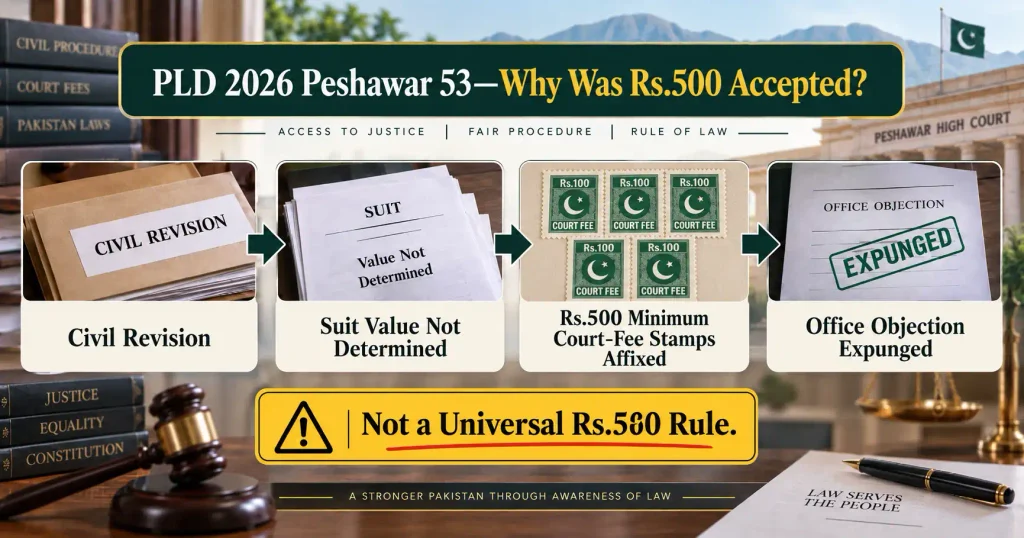
The uploaded judgment, PLD 2026 Peshawar 53, gives a useful but narrow example. The Peshawar High Court found that the value of the suit had not been determined and treated court-fee stamps worth Rs.500 affixed on the revision petition as sufficient. That does not mean every civil revision in Pakistan requires only Rs.500.
Table of Contents
Judgment at a Glance of PLD 2026 Peshawar 53
| Point | What the judgment shows |
|---|---|
| Citation | PLD 2026 Peshawar 53 |
| Court | Peshawar High Court |
| Case | Rustam Khan v. Mst. Pathani through Legal Heirs and others |
| Decision date | 12 June 2023 |
| Main dispute | Cancellation of an alleged fraudulent gift mutation |
| Court-fee issue | Office objected to the fee on the civil revision |
| Key fee fact | The value of the suit had not been determined |
| Fee affixed | Minimum court-fee stamps worth Rs.500 |
| Court’s response | The fee was sufficient for that petition and the objection was expunged |
| Final result | Civil revision dismissed; concurrent findings maintained |
The case title, court and decision date appear in the reported judgment. The case was mainly about a disputed gift mutation, not a complete interpretation of Court Fee Act Pakistan. The court-fee point appeared near the end as an office objection. That distinction matters because a short procedural finding should not be turned into a nationwide fee schedule.
IRAC: What PLD 2026 Peshawar 53 Decided
| IRAC | Court-fee point |
|---|---|
| Issue | Whether the revision petition was insufficiently stamped when the suit value had not been determined. |
| Rule | Court fee depends on the applicable law, document and valuation. The judgment did not announce a general Rs.500 rule for all revisions. |
| Analysis | The record showed no determined suit value, while the petitioner had affixed minimum court-fee stamps worth Rs.500. |
| Conclusion | The High Court treated the fee as sufficient in that case and expunged the office objection. |
For readers researching Court Fee Act Pakistan, the safest use of this judgment is as a case-specific illustration. It tells us what happened on those facts; it does not replace the Act, provincial amendments or the applicable schedule.
What Is the Court Fee Act Pakistan?
The phrase Court Fee Act Pakistan is commonly searched online, but the formal title is the Court-fees Act, 1870. It regulates fees payable on specified documents presented to courts and certain public offices. It also contains rules on valuation, refunds, insufficiently stamped documents, probate matters and fee schedules.
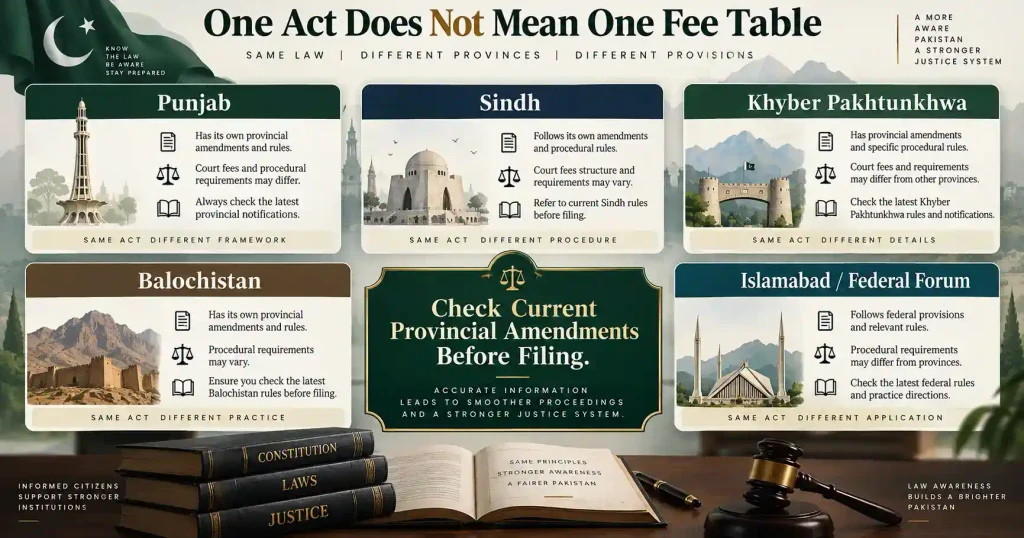
Jurisdiction is critical. Pakistan does not safely operate on one frozen fee table for every civil filing. The 1870 law is the historical base, but provinces have amended schedules, exemptions and related provisions. Punjab, Khyber Pakhtunkhwa, Sindh and Balochistan all have provincial legal material affecting the operation of court-fee law. (Punjab Laws)
Before calculating Court Fee Act Pakistan, ask four questions: Where are you filing? What document are you filing? What relief are you asking for? How does the applicable law value that relief?
Why Court Fee Depends on More Than Case Type
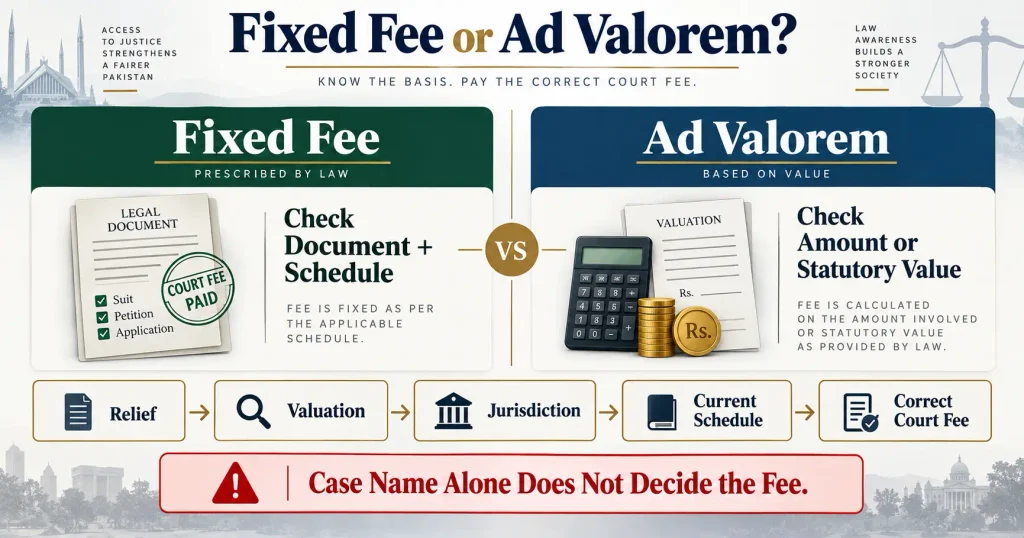
Two cases may both be called “property cases” but attract different fees. One may seek recovery of money. Another may seek declaration only. A third may ask for cancellation, possession and injunction together. The valuation clause in the plaint can therefore be as important as the case title.
Under Court Fee Act Pakistan, a fee may be ad valorem, linked to an amount or value, or fixed for a document or category specified by the applicable schedule. Special valuation rules may also apply. Market value, sale price, mutation value and jurisdictional value are not automatically the same figure for court-fee purposes.
Ad Valorem Fee
An ad valorem fee rises with the amount or value used under the governing rule. Money claims are the clearest example, while property and compensation cases can require more careful statutory valuation.
Fixed Fee
Some petitions, applications or memoranda attract a fixed amount. But fixed fees can also be amended by provincial finance legislation, so old figures should be rechecked.
When Valuation Is Uncertain
PLD 2026 Peshawar 53 is useful here. The High Court recorded that the value of the suit had not been determined. On that record, Rs.500 in minimum court-fee stamps was treated as sufficient for the revision petition. The point is narrow, but it shows why the valuation record matters.
What Happened in PLD 2026 Peshawar 53?
The case concerned gift mutation No. 1723 dated 23 February 2000. The plaintiff challenged it as fake, forged and fraudulent and denied making the alleged gift. The trial court decreed her suit, the Additional District Judge dismissed the appeal, and the matter reached the Peshawar High Court in civil revision.
The High Court found that the alleged gift was not proved through the required particulars and evidence. It noted the absence of proper proof regarding declaration, acceptance and possession. The Court also discussed the protection required where an old, illiterate parda nasheen woman is said to have divested herself of valuable property.
The Court Fee Act Pakistan point was separate. In paragraph 9, the High Court dealt with an office objection. Because the suit value was not determined and Rs.500 in minimum stamps had been affixed with the revision, the court treated the fee as sufficient and expunged the objection.
The revision was still dismissed on the merits. The court-fee finding therefore did not turn the property dispute into a win for the petitioner.
The Rs.500 Point: What the High Court Really Said
A reader may see “Rs.500” and assume that this is the current revision fee everywhere. That would be unsafe. Court Fee Act Pakistan does not allow one figure from one judgment to be applied to every court and every province.
PLD 2026 Peshawar 53 supports only this limited proposition: on the record before that court, the suit value had not been determined; Rs.500 in minimum stamps had been affixed; and the High Court considered them sufficient for that revision petition.
The judgment did not identify Rs.500 as a universal statutory rate, compare every provincial schedule, or say valuation was irrelevant.
What the Court Did Not Decide
The safest reading of Court Fee Act Pakistan requires knowing a precedent’s limits. PLD 2026 Peshawar 53 did not decide that:
- every civil revision in Pakistan carries Rs.500 court fee;
- Punjab, Sindh, KP, Balochistan and Islamabad use the same schedule;
- a party may choose any valuation simply to reduce the fee;
- deficient court fee can never lead to rejection or consequences;
- the Rs.500 finding resolved the gift dispute for the petitioner.
Instead, the High Court dismissed the revision and maintained the concurrent findings below. The fee objection was only a procedural point within a larger property case.
Can Deficient Court Fee Be Cured Later?
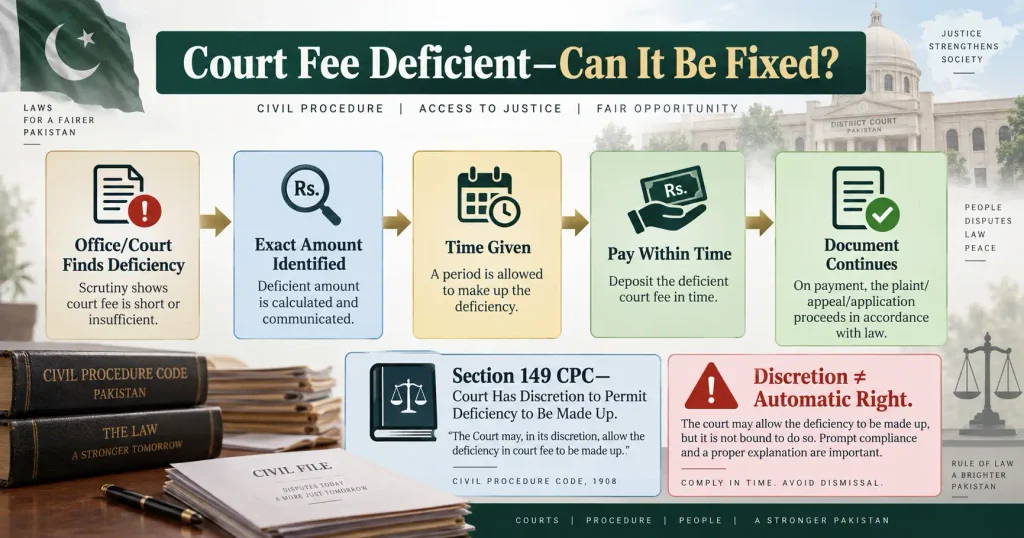
Yes, in appropriate cases the Code of Civil Procedure provides a mechanism to make up a deficiency, but it is discretionary and should not be treated as permission to file carelessly.
Section 149 CPC allows the court, at any stage, to permit payment of all or part of a missing prescribed court fee. After payment, the document can have the same force and effect as if the fee had been paid in the first instance. Section 148 CPC separately allows enlargement of time fixed for an act under the Code. Code of Civil Procedure, 1908 on Pakistan Code.
This is a major practical part of Court Fee Act Pakistan. Order VII Rule 11(c) CPC also matters where a plaint is insufficiently stamped: rejection may follow if the plaintiff fails to supply the required stamp paper within the time fixed by the court.
A recent Supreme Court authority, Province of Punjab through District Collector, Bhakkar v. Muhammad Chiragh, Civil Petition No. 385-L of 2021, dealt with deficient court fee in a first appeal. The official Lahore High Court Research Centre bulletin identifies the central issue as whether an appeal could be rejected without first determining the exact deficiency and granting reasonable time to rectify it. (Research Center)
The principle does not abolish court fee. It requires proper procedure. A genuine curable deficiency may be corrected with permission, but deliberate non-compliance or failure to obey a clear order can still create serious risk.
Court Fee in Plaints, Appeals and Revisions
| Filing | What to check first |
|---|---|
| Plaint | Relief, valuation clause, applicable schedule, province and special law |
| First appeal | Subject matter in appeal, decree challenged and appellate fee rule |
| Civil revision | Forum rule, provincial schedule, valuation and order challenged |
| Review | Relevant schedule and rule governing review fee |
| Probate | Special Court-fees Act provisions and estate valuation |
| Application | Fixed fee, special statute or court rule |
This table is a starting point, not a calculator. Under Court Fee Act Pakistan, the same label can hide different reliefs and valuation rules.
How to Calculate Court Fee Before Filing
A safe filing begins before stamps are purchased:
- Identify the exact court and territorial jurisdiction.
- List every relief separately: recovery, declaration, cancellation, possession, injunction, partition, compensation or another remedy.
- Compare the valuation paragraph with the legal rule governing that relief.
- Check the current provincial or federal version of the Court-fees Act and latest amendments.
- Check whether a special law creates a different fee, exemption or forum rule.
- Calculate the amount and keep the working sheet with the file.
- Preserve proof of stamps, e-stamps, challans or payment receipts.
- If the office objects, identify the exact deficiency and comply with the court’s order within time.
This approach makes Court Fee Act Pakistan practical and reduces the risk of a limitation-sensitive plaint or appeal becoming trapped in a preventable fee dispute.
Provincial Differences You Must Check
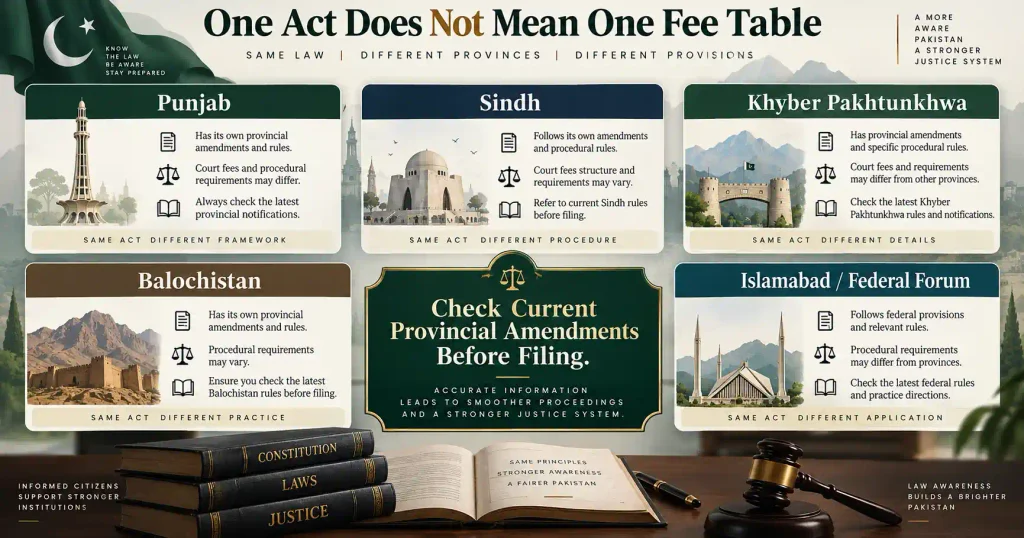
The biggest weakness in many explanations is the idea that one historical schedule gives the current answer everywhere. It does not.
| Jurisdiction | What to verify |
|---|---|
| Punjab | Check Punjab’s version of the Act and later finance amendments. The Punjab Finance Act 2024 amended multiple court-fee entries. Punjab Finance Act 2024 |
| Khyber Pakhtunkhwa | Check the KP Code version and provincial amendments or exemption provisions. KP Court Fees Act, 1870 |
| Sindh | Sindh legislation and notifications can affect court-fee liability and exemptions. Sindh court-fee legislation |
| Balochistan | Check the law as extended or adapted to Balochistan together with later provincial changes. (Balochistan Government) |
| Islamabad / federal forum | Check the federal text, applicable court rules and any special statute governing the filing. |
For Court Fee Act Pakistan, “current fee” means current for the correct jurisdiction and document. A Lahore filing should not be priced from a Peshawar precedent only because both refer to the 1870 Act. That is the practical way to read Court Fee Act Pakistan in 2026.
Court Fee Is Not Every Legal Cost
Court fee is different from an advocate’s professional fee, process fee, copying charges, commissioner expenses, stamp duty on transactions and registration fee.
This matters in property litigation. Stamp duty on a sale deed is not the same thing as court fee on a cancellation suit. Court Fee Act Pakistan concerns fees on documents and proceedings covered by court-fee law; it does not replace the Stamp Act or registration law.
If a dispute concerns a fraudulent document, the relief claimed can change both valuation and fee analysis. Readers may also see Qanooni Dastak’s guide on a civil suit for declaration and the separate guide on a fake sale deed in Pakistan.
Property Cases: Relief Controls the Fee Question
A plaintiff may ask only for declaration in one case, while another may need declaration plus cancellation, possession or injunction. The correct aim is not the “cheapest” plaint. It is a legally complete plaint with a defensible valuation.
Under Court Fee Act Pakistan, the statutory category and valuation rule control the fee question. For related procedure, Qanooni Dastak’s guides on power of attorney misuse and partition of inherited land explain why the forum and relief should be identified before filing.
What Evidence Should You Preserve?
Preserve the filed plaint, appeal or revision; valuation paragraph; fee calculation; stamp or e-payment proof; filing receipt; office objection; order sheet fixing any deficiency; application under sections 148 or 149 CPC; and proof of later payment.
These records matter if a party later says the exact amount was never identified or payment was made within time. Good recordkeeping turns a vague Court Fee Act Pakistan dispute into a provable procedural history.
What If You Cannot Afford the Court Fee?
Order XXXIII CPC provides a formal procedure for a qualifying person who lacks sufficient means to pay the prescribed plaint fee. The applicant must disclose assets and satisfy the legal conditions; it is not an automatic exemption.
So Court Fee Act Pakistan should not be read as requiring every person to pay first regardless of financial capacity. The CPC contains a separate route, but the current text and local procedure should be checked before relying on it.
What to Do When the Office Raises an Objection
Do not ignore a court-fee objection. Identify whether it concerns valuation, rate, document type, missing stamps or an exemption. If the amount is disputed, obtain the exact deficiency through the record or court order and check the latest law rather than relying on an old precedent or a verbal figure.
If the court fixes a date to cure the deficiency, comply within that period. Section 149 CPC gives discretion to permit later payment, but the safer Court Fee Act Pakistan strategy is accurate filing, documented payment and a prompt response.
What PLD 2026 Peshawar 53 Means in Practice
The uploaded judgment shows that an office objection is not necessarily the end of the case. The High Court looked at the record, noted that the suit value was not determined, saw Rs.500 in minimum stamps, and expunged the objection.
But it gives no licence to use Rs.500 blindly in every revision. It gives no national tariff and does not override provincial amendments. Used correctly, the case is a narrow illustration within the wider Court Fee Act Pakistan framework.
Practical Filing Checklist
For Court Fee Act Pakistan compliance, check the jurisdiction, precise relief, valuation method, current schedule, provincial amendments, special-law exemptions, limitation and proof of payment before filing. After filing, review any office objection and order sheet instead of assuming acceptance means the fee question can never arise again.
Where the case concerns a disputed property document, also confirm whether consequential relief such as possession or injunction is legally necessary. Qanooni Dastak’s civil suit for declaration guide is useful for that distinction.
Conclusion
Court Fee Act Pakistan is not a single rupee figure. It is a framework working through the Court-fees Act, 1870, the CPC, provincial amendments, schedules, special laws and the valuation of the relief claimed.
PLD 2026 Peshawar 53 should be read narrowly. The High Court accepted Rs.500 in minimum court-fee stamps because the suit value had not been determined in that case and expunged the office objection. It did not declare Rs.500 to be the universal fee for civil revisions.
The safer rule is simple: identify the forum, relief, valuation and current local law first. If a deficiency is raised, respond quickly and use sections 148 and 149 CPC where legally available. A small fee mistake may be curable, but it should never be planned.
FAQs on Court Fee Act Pakistan
1. What is Court Fee Act Pakistan?
Court Fee Act Pakistan usually refers to the Court-fees Act, 1870 and the rules governing fees on court documents. The federal text is only a starting point because provincial amendments, finance laws, special statutes and court rules may change the amount payable in a particular forum.
2. Is court fee the same across Pakistan?
No. Provincial amendments and exemptions matter. Punjab, KP, Sindh and Balochistan should be checked separately, while Islamabad or a federal forum may require the federal text and its own rules. Never copy a fee figure from another province without verification.
3. Did PLD 2026 Peshawar 53 fix court fee at Rs.500?
No. The High Court held that Rs.500 in minimum stamps was sufficient in that revision, where the record showed that the suit value had not been determined. The judgment did not create a universal Rs.500 rate for all civil revisions or provinces.
4. Can a case be rejected for deficient court fee?
Yes, deficiency can have serious consequences, but correction may be possible. Under Order VII Rule 11(c), an insufficiently stamped plaint can be rejected if the plaintiff fails to supply the required stamp within the time fixed. Section 149 CPC may allow the deficiency to be made good later.
5. What does Section 149 CPC do?
Section 149 gives the court discretion to allow payment of all or part of a missing prescribed court fee at any stage. Once allowed and paid, the document can have the same force as if the proper fee had been paid at first. It is not a licence for deliberate default.
6. How is court fee calculated in a property suit?
It depends on the relief and applicable valuation rule. Recovery, declaration, cancellation, possession and injunction can be treated differently. Property market value is not automatically the correct court-fee value in every case. Check the statute, provincial amendments and the relief pleaded.
7. What should I do if the court raises a fee objection?
Check the written objection or order sheet, identify the exact deficiency, verify the current legal provision and comply within the time fixed. Keep proof of payment. If there is a genuine problem, seek appropriate relief under the CPC rather than ignoring the objection.
8. Can a person who cannot afford court fee still file a suit?
Order XXXIII CPC provides a formal route for qualifying persons who lack sufficient means to pay the prescribed fee. The applicant must disclose assets and satisfy the legal conditions. It is not an automatic waiver, so the current CPC and local procedure should be checked before filing.
Disclaimer: This article is for legal awareness and general information. Court fee depends on the forum, province, relief, valuation, amendments and facts. Verify the current law, latest official gazette or court rules and obtain case-specific advice before filing.