

Property fraud is not always done with force. Sometimes it happens quietly, through papers, signatures, mutation entries and old revenue files. A person may be living with the belief that his land is safe, but years later someone appears with a registered sale deed and claims, “This property was sold to us long ago.”
This is where the law becomes a shield. The Supreme Court of Pakistan, in 2024 SCMR 1271, explained an important principle: a registered sale deed has legal value, but it cannot protect fraud. If a document is surrounded by suspicious facts, false age, doubtful signatures, missing witnesses, no proof of payment, or manipulated revenue record, the court can look beyond registration and examine the truth.
This judgment is extremely useful for understanding Fake Sale Deed in Pakistan cases. It teaches landowners, buyers, heirs and lawyers that property documents are powerful only when the transaction behind them is real, lawful and provable.
Table of Contents
IRAC: Fake Sale Deed in Pakistan
| Element | Explanation |
|---|---|
| Issue | Whether the disputed registered sale deeds and mutations were genuine or were the result of fraud, forgery and manipulation. |
| Rule | A registered document carries presumption of correctness, but fraud vitiates all actions. Mere denial is not enough; reliable evidence is required. |
| Analysis | The Court examined the minor age of one alleged executant, school certificate, mortgage record, suspicious signatures, non-production of attesting witnesses and lack of payment proof. |
| Conclusion | The Supreme Court dismissed the appeal and maintained the cancellation of the disputed sale deeds and mutations. |
Judgment at a Glance: Fake Sale Deed and Property Ownership Dispute
| Point | Details |
|---|---|
| Case Title | Mst. Nazeeran and others v. Ali Bux and others |
| Citation | 2024 SCMR 1271 |
| Court | Supreme Court of Pakistan |
| Bench | Ijaz ul Ahsan, Syed Hasan Azhar Rizvi and Irfan Saadat Khan JJ |
| Date of Decision | 5 December 2023 |
| Main Topic | Fake sale deed, registered document, fraud, burden of proof, minor’s property |
| Origin | High Court of Sindh, Bench at Sukkur |
| Final Result | Appeal dismissed; respondents succeeded |
Case Background: How the Disputed Sale Deeds Came to Light

The dispute was about agricultural land. The respondents claimed that they were the owners of the suit land. According to them, the land was given on lease to one of the appellants for a period starting from 1988 till December 1994, and possession remained with that side up to 2005.
The respondents also stated that the land was mortgaged with the Agricultural Development Bank Pakistan. Later, when the appellants refused to return possession, the respondents came to know that the land had been shown as sold through registered sale deeds and mutations.
This was not a simple ownership dispute. It became a serious case of Fake Sale Deed in Pakistan because the respondents alleged that the sale deeds were fabricated and the revenue record had been manipulated.
The disputed documents included sale deeds dated 14 September 1985, 27 February 1989 and 25 July 1991. Mutations were also sanctioned on the basis of these documents. The respondents challenged the sale deeds and mutations as void, illegal and nullities in the eyes of law.
What the Appellants Claimed
The appellants denied the lease story. Their position was that they had purchased different portions of the land through registered sale deeds. They claimed that possession was delivered to them, mutations were entered and land revenue was paid after the purchase.
They also argued that registered sale deeds carry a strong presumption of correctness. According to them, the respondents could not defeat registered documents by relying on oral evidence or unregistered lease deeds.
This argument was important because in Pakistan, a registered sale deed is not treated lightly. A person challenging a registered document must bring real evidence. That is why every allegation of Fake Sale Deed in Pakistan must be prepared with care, documents and proper pleadings.
What the Respondents Claimed

The respondents argued that the sale deeds were not genuine. They said the land was leased, not sold. Their strongest point was that one alleged executant, Hamza Ali, was shown as an adult in the sale deed, but according to the school leaving certificate, he was only four years old at the time.
This fact changed the direction of the case. A four-year-old child cannot execute a valid sale deed. If a minor is falsely shown as an adult in property papers, the document becomes deeply suspicious.
The respondents also relied on mortgage record, revenue entries, doubtful signatures and absence of proof regarding payment of sale consideration. These facts made the case stronger than a bare denial.
In many Fake Sale Deed in Pakistan disputes, people only say, “I never sold this property.” But courts need more than that. This case shows that documentary support can turn suspicion into a legally provable case.
Supreme Court on Burden of Proof
The Supreme Court discussed the law of burden of proof under the Qanun-e-Shahadat Order, 1984. The Court explained that the person who asserts a fact must prove it. In civil cases, the matter is decided on the preponderance of evidence, meaning the court examines which version appears more probable.
The Court also explained the difference between legal burden and evidential burden. Legal burden normally remains on the plaintiff, but evidential burden can shift during trial when one party produces enough material to raise a presumption in its favour.
This principle is very important in Fake Sale Deed in Pakistan cases. At first, the person alleging fraud must produce evidence. Once credible material is brought before the court, the beneficiary of the disputed sale deed may be required to prove execution, transaction and payment.
For readers who want to verify the legal background, the Supreme Court of Pakistan judgments section, the Qanun-e-Shahadat Order, 1984, and the Contract Act, 1872 are important official resources. These laws help explain why burden of proof, attesting witnesses, minor’s capacity, documentary evidence, and valid execution matter in Fake Sale Deed in Pakistan cases.
Registered Sale Deed Has Presumption, But Not Absolute Protection
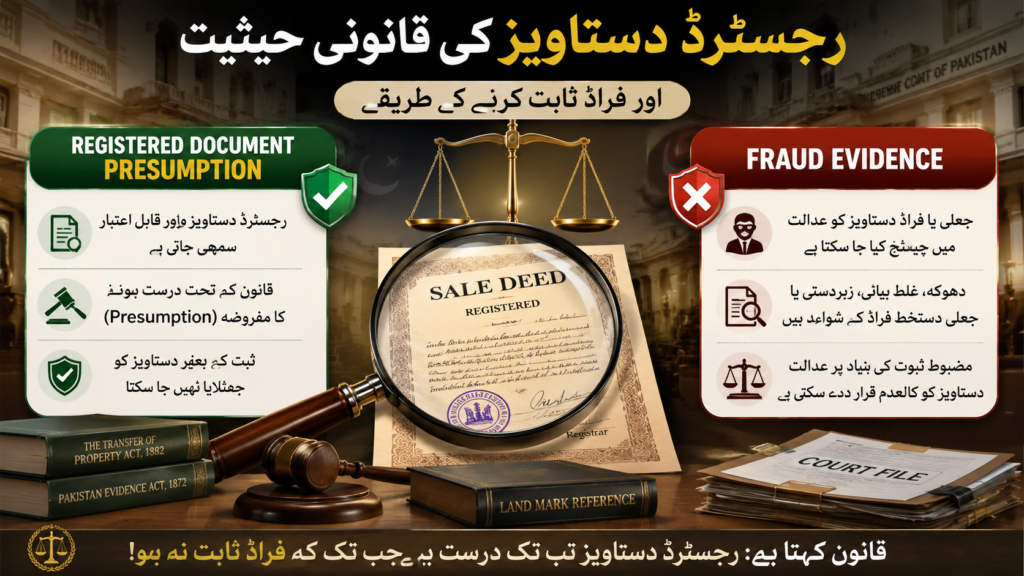
The Supreme Court made it clear that registration is not a useless formality. A registered document becomes part of public record and carries presumption of genuineness and correctness.
However, the Court also clarified that this presumption is not absolute. If the person challenging the document brings reliable evidence of fraud, forgery or suspicious circumstances, the presumption can be rebutted.
This is the heart of this judgment on Fake Sale Deed in Pakistan. Registration gives strength to a document, but it does not give a licence to fraud. A registered document must still be connected with a real transaction, real parties, valid execution and actual consideration.
Mere Denial Is Not Enough
One of the most practical lessons from this judgment is that mere denial cannot cancel a registered sale deed. If a person simply says, “I did not sign it,” the court may not accept that statement unless it is supported by evidence.
The Supreme Court observed that fraud is easy to allege but difficult to prove. General allegations and bald assertions do not shift the burden. A person alleging fraud must bring reliable evidence.
This protects genuine buyers from false claims. At the same time, it protects real owners when they bring strong evidence against a false document.
Therefore, anyone filing a Fake Sale Deed in Pakistan case should collect certified copies, age record, possession proof, bank record, revenue entries, witness details and any contradiction in the disputed document.
Minor’s Property and Void Transaction
The most powerful fact in this case was the age of Hamza Ali. He was allegedly shown as an adult in the sale deed, but the school leaving certificate showed that he was only four years old.
The Supreme Court relied on section 11 of the Contract Act, 1872 and the principles of Muslim Law. A minor cannot enter into a valid contract. A de facto guardian also has no power to transfer any right or interest in the immovable property of a minor.
This means such a transaction is not merely weak; it is void. The law does not allow a child’s property rights to be destroyed through a paper transaction.
In Fake Sale Deed in Pakistan cases involving minors, birth certificates, school leaving certificates, B-form, family record and old educational documents can become decisive evidence.
Mortgage Record Raised Serious Doubt

The land was shown to have been mortgaged with the Agricultural Development Bank Pakistan. The bank manager supported the respondents’ position, and revenue entries also reflected the mortgage.
The Supreme Court accepted that a mortgaged property can be sold. The existence of mortgage does not automatically invalidate a sale. But the non-mentioning of the previous mortgage in the disputed sale deeds created serious doubts about the credibility and validity of those documents.
This is a very practical point. A genuine buyer normally checks whether the land is mortgaged, under charge, leased or disputed. If a major fact like mortgage is missing from the sale documents, the court may treat it as a suspicious circumstance.
This is why every Fake Sale Deed in Pakistan case should be tested against the complete history of the property, not just one registered document.
Why Attesting Witnesses Were Important

A sale deed is a financial document. It is not enough to wave a paper in court. The party relying on the sale deed should prove how the document was executed, who attested it, who wrote it, where the stamp paper came from and how payment was made.
In this case, the appellants did not produce attesting witnesses, scribe or stamp vendor. They also failed to produce documentary evidence showing payment of sale consideration.
This failure was serious. When a person claims that land was purchased through a registered sale deed, the court expects proof of real payment and real execution.
For anyone defending a sale deed in a Fake Sale Deed in Pakistan dispute, this judgment is a warning: keep witnesses, payment trail, stamp paper record, registration record and possession proof safe.
Court Can Compare Signatures
The trial court compared signatures on the disputed sale deeds and found suspicious differences. The appellants argued that the court should not have acted like a handwriting expert.
The Supreme Court rejected this objection. It held that in certain circumstances, a court can compare signatures along with other relevant material to decide the controversy.
This does not mean expert evidence is useless. Expert opinion may still be important in many cases. But the judgment confirms that courts are not powerless when the record itself shows suspicious signatures.
In a Fake Sale Deed in Pakistan matter, signature comparison, thumb impression analysis, biometric record, registration office record and witness evidence can all play a major role.
Why the First Appellate Court Was Wrong
The trial court had decreed the suit in favour of the respondents. The first appellate court reversed that decision. Later, the High Court restored the trial court judgment, and the Supreme Court upheld the High Court’s view.
The Supreme Court found that the first appellate court had ignored important circumstances. It wrongly treated the respondents’ case as if it was based only on oral evidence. In reality, there was documentary and circumstantial evidence supporting the challenge.
The Court noted that once the respondents produced enough material to rebut the presumption attached to the sale deeds, the burden shifted to the appellants. They were required to prove execution, original transaction and payment of sale consideration. They failed to do so.
This is why the appeal was dismissed.
7 Powerful Lessons from This Judgment
1. A registered sale deed is strong, but not untouchable
Registration gives legal value to a document, but it cannot save a document infected by fraud. Courts can cancel even registered documents if fraud is proved.
2. Fraud must be proved with evidence
A person alleging Fake Sale Deed in Pakistan must bring documents, witnesses and circumstances. Bare allegations are not enough.
3. Minor’s property cannot be transferred casually
If a minor is shown as an adult in a sale deed, age proof can destroy the entire transaction.
4. Mortgage record can expose the truth
Bank documents and revenue entries can show the real history of land. A hidden mortgage may create doubt about the alleged sale.
5. Payment proof is essential
A genuine sale normally involves proof of consideration. If payment is not proved, the sale transaction becomes suspicious.
6. Witnesses cannot be ignored
Attesting witnesses, scribe and stamp vendor are important. Their non-production can weaken the beneficiary’s case.
7. Revenue record must match the real transaction
Mutation entries alone do not cure fraud. If the foundation document is false, mutation based on it can also fall.
Practical Checklist for Fake Sale Deed in Pakistan Cases
Also read: Civil Suit for Declaration in Pakistan
Property Mutation Fraud in Pakistan
Cancellation of Sale Deed in Pakistan.
| Document / Proof | Why It Matters |
|---|---|
| Certified copy of sale deed | To check signatures, witnesses, date, consideration and registration details |
| Mutation copy | To see how revenue record was changed |
| Fard Malkiat | To verify ownership chain |
| CNIC and family record | To confirm identity and relationship |
| Birth certificate / school certificate | Important where minority is involved |
| Bank mortgage record | To prove charge, loan or prior encumbrance |
| Possession proof | To show who actually controlled the land |
| Payment record | To test whether sale consideration was really paid |
| Stamp paper record | To verify document preparation |
| Witness details | To prove or disprove execution |
| Expert report | Useful for signature or thumb impression disputes |
What Should a Landowner Do?
If you suspect a Fake Sale Deed in Pakistan, do not waste time only arguing with the opposite party. Start collecting documents immediately.
First, obtain certified copies of the sale deed, mutation and Fard from the relevant office. Second, check the complete revenue history of the land. Third, collect proof of possession, lease, mortgage, bank record or family ownership. Fourth, identify whether any alleged executant was minor, absent, dead or incapable at the time of execution. Fifth, consult a property lawyer and file the proper civil action for declaration, cancellation, possession and injunction where required.
A weak case can become strong with documents. A strong case can become weak because of delay, missing record or careless pleadings.
What Should a Buyer Learn?
This judgment is not only for victims. It is equally important for buyers.
Before buying land, never rely only on one sale deed. Check title history, mutation record, Fard, possession, mortgage status, litigation record and identity of sellers. Make payment through traceable means. Keep witnesses available. Make sure the seller is adult, competent and legally entitled to sell.
Many people face litigation for years because they buy land without proper due diligence. A property deal should not be completed only on trust. It must be completed through verification.
A buyer who wants to avoid a Fake Sale Deed in Pakistan allegation must keep the transaction clean from day one.
Final Decision of the Supreme Court
The Supreme Court dismissed the appeal. It held that the respondents had produced enough material to rebut the presumption attached to the disputed registered sale deeds.
The minor’s age, school certificate, mortgage record, doubtful signatures, missing attesting witnesses, absence of payment proof and failure to prove the original transaction all supported the respondents’ case.
The result was that the cancellation of the disputed sale deeds and mutations remained intact. This judgment is now an important precedent for Fake Sale Deed in Pakistan disputes, especially where registered documents are challenged through strong documentary and circumstantial evidence.

Conclusion
A sale deed can transfer property, but only when it is genuine. Registration gives strength to a document, but it does not turn fraud into truth. The Supreme Court’s message is clear: courts will protect genuine transactions, but they will not protect fabricated documents.
For landowners, this judgment is a shield. For buyers, it is a caution. For lawyers, it is a useful authority on burden of proof, registered documents, minors’ property and fraud. And for anyone facing a Fake Sale Deed in Pakistan, it shows that justice is possible when the case is supported by credible evidence.
Disclaimer
This article is for legal awareness and educational purposes only. It is based on a reported judgment of the Supreme Court of Pakistan. It is not legal advice. For any actual property dispute, consult a qualified lawyer with complete documents.
FAQs About Fake Sale Deed in Pakistan
What is a fake sale deed?
A fake sale deed is a property document prepared through fraud, forgery, impersonation, false signatures, false thumb impressions or without a real sale transaction.
Can a registered sale deed be cancelled?
Yes. A registered sale deed can be cancelled if fraud, forgery, minority, lack of payment or defective execution is proved.
Is mere denial enough to cancel a registered sale deed?
No. Mere denial is not enough. The person challenging the document must produce reliable evidence.
Who has the burden of proof?
Initially, the person alleging fraud must bring evidence. Once credible evidence is produced, the burden may shift to the beneficiary of the sale deed.
Can a minor execute a sale deed?
No. A minor cannot enter into a valid contract. A sale deed allegedly executed by a minor can be treated as void.
Can a guardian sell minor’s immovable property?
A de facto guardian has no power to transfer a minor’s immovable property under Muslim Law.
Does mutation prove ownership?
Mutation is a revenue entry. It does not create ownership if the basic transaction is illegal or fraudulent.
Why is payment proof important?
Payment proof helps show that a real sale transaction took place. Absence of payment proof can make the sale suspicious.
Are attesting witnesses necessary?
Yes, attesting witnesses are very important for proving execution of a sale deed.
Can court compare signatures?
Yes, in appropriate circumstances, the court can compare signatures along with other material on record.
What documents are needed to challenge a fake sale deed?
Certified sale deed copy, mutation, Fard, CNIC, family record, possession proof, payment record, age proof, mortgage record and witness details are useful.
What is the main lesson of this judgment?
The main lesson is that a registered sale deed has legal value, but if strong evidence proves fraud, the court can cancel it.