

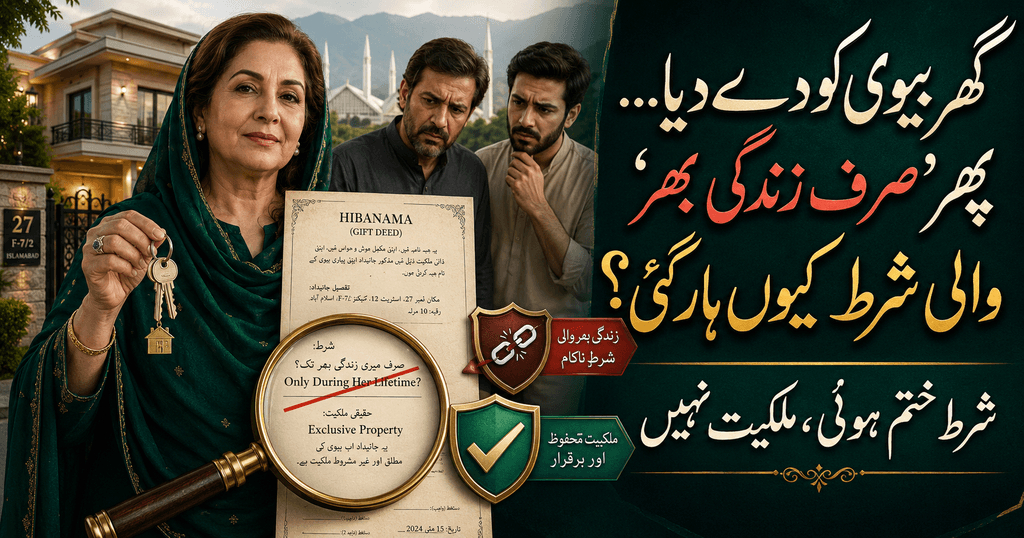
Sometimes a family believes that one sentence in a gift deed will protect property for the next generation.
A husband gives a house to his wife but writes that she may keep it only during her lifetime. After her death, the house will go back to his sons. Years later, the wife treats the house as her own property and agrees to sell it.
Who owns the house then?
The wife? The husband’s children? Or the person who agreed to buy it?
This difficult question reached the Islamabad High Court in PLD 2026 Islamabad 57, Mst. Samina Naz and others v. Tariq Usman and others. The judgment gives an important lesson on Conditional Gift in Muslim Law: when ownership of the property itself is validly gifted, a condition that cuts down that complete ownership may be void while the gift itself remains valid.
The case is especially useful because the Court did not decide the dispute from one document alone. It examined the gift deed, possession, written admissions, rent, CDA record, transfer applications, Nikahnama objections and the civil-law standard of proof.
The result changed the entire inheritance claim.
Table of Contents
Judgment at a Glance: Conditional Gift Dispute
| Point | Details |
|---|---|
| Reported Citation | PLD 2026 Islamabad 57 |
| Case | Mst. Samina Naz and others v. Tariq Usman and others |
| Court | Islamabad High Court |
| Judge | Sardar Ejaz Ishaq Khan, J. |
| Appeals | R.F.As. Nos. 101 and 102 of 2016 |
| Date of Hearing | 24 February 2025 |
| Decision Date | 28 October 2025 |
| Reported Law | Specific Relief Act, 1877, sections 42 and 54; Islamic law of gift; Qanun-e-Shahadat Order, 1984 |
| Property | House No. 225, Street No. 74, G-9/3, Islamabad |
| Main Question | Did the wife receive only a lifetime interest or full ownership? |
| Key Rule | A condition restricting a completed gift of property to the donee’s lifetime may be void while the gift remains absolute |
| Final Result | Both appeals dismissed |
The judgment was decided in October 2025 but reported in PLD 2026.
IRAC: Conditional Gift in Muslim Law Explained Simply
| IRAC | Court’s Approach |
|---|---|
| Issue | Whether Durr-e-Shahwaar received the house only for her lifetime or became its absolute owner. |
| Rule | Where a gift is subject to a condition that takes away from the completeness of the grant, the condition may be void while the gift takes effect without that condition. |
| Analysis | The gift deed recorded the gift and delivery of possession. Samina’s own pleadings admitted Durr-e-Shahwaar’s right to live in and receive rent from the property. The gift was also supported by Iftikhar’s CDA transfer application and Durr-e-Shahwaar’s long possession. |
| Conclusion | Durr-e-Shahwaar became absolute owner. The lifetime restriction failed. Samina had no reversionary interest and therefore no legal standing to challenge the sale as an heir of Iftikhar. |
The Court relied on the settled rule stated in Mulla’s Principles of Muhammadan Law and the Supreme Court judgment Mst. Kaneez Bibi v. Sher Muhammad, PLD 1991 SC 466.
The Family Story Behind the Case
Raja Iftikhar Abbasi married Durr-e-Shahwaar as his second wife in 1978.
Iftikhar already had three children from his first marriage:
- Nisar Abbasi;
- Obaid Ahad, later also referred to as Ubaid in the judgment; and
- Sajida Naseem.
Durr-e-Shahwaar and Iftikhar lived in House No. 225, Street No. 74, G-9/3, Islamabad.
Iftikhar died in 1985. He had no children with Durr-e-Shahwaar.
Durr-e-Shahwaar did not leave the property after his death. She continued living there for about another 25 years and died on 19 April 2010.
This long possession later became an important part of the Court’s reasoning on Conditional Gift in Muslim Law.
The Rs. 9 Million Agreement That Triggered the Litigation
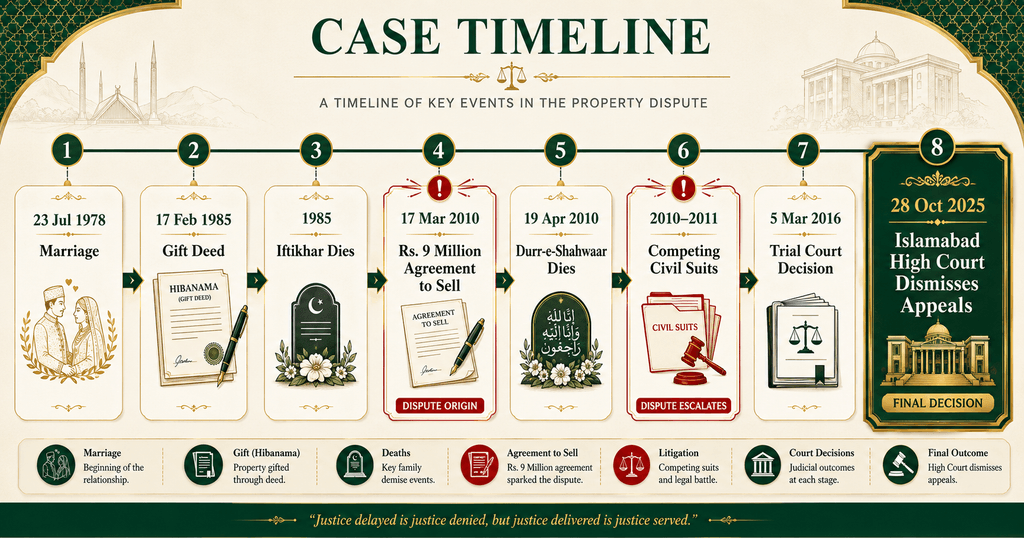
About one month before her death, Durr-e-Shahwaar entered into an Agreement to Sell dated 17 March 2010 with Tariq Usman.
The agreed price was Rs. 9 million.
The agreement recorded that Durr-e-Shahwaar had already received Rs. 8 million from the buyer.
Because Durr-e-Shahwaar died without children, the judgment records her three brothers — Colonel Asif, Muhammad Azam and Muhammad Sheryar — as the natural heirs of her estate.
Tariq Usman then filed Suit No. 723/2010 on 19 September 2010 seeking specific performance of the agreement.
Initially, Durr-e-Shahwaar’s three brothers and CDA were parties.
The sons of Iftikhar later asked to be included as heirs from his first marriage.
During the litigation, both sons, Nisar and Ubaid, also died. Nisar’s widow, Samina Naz, and her four children became parties and remained the main contestants against Tariq.
What Samina Claimed
Samina did not accept Durr-e-Shahwaar as the absolute owner.
She separately filed Civil Suit No. 605/2011 seeking:
- declaration;
- partition;
- possession; and
- injunction.
Her primary case was that Durr-e-Shahwaar had no title in the house.
Alternatively, she argued that Durr-e-Shahwaar could have been entitled only to 1/8 share, while the remaining property belonged to the lawful heirs of Iftikhar.
The two suits were consolidated.
On 5 March 2016, the trial court allowed Tariq’s suit for specific performance and dismissed Samina’s suit.
Those findings later came before the Islamabad High Court in the two Regular First Appeals.
Four Documents Tariq Relied Upon
Tariq’s original claim was mainly based on four documents:
- Exhibit P1: Agreement to Sell;
- Exhibit P2: Nikahnama;
- Exhibit P3: Iqrarnama declaring the house as a dower gift; and
- Exhibit P4: Iftikhar’s application dated 24 February 1985 asking CDA to transfer the house to Durr-e-Shahwaar.
Samina alleged that all four documents were fabricated and forged.
The trial court held that the burden to prove that allegation lay on Samina and that she had failed to discharge it.
But then another document appeared.
That document became the real turning point.
The 1985 Gift Deed That Changed the Case
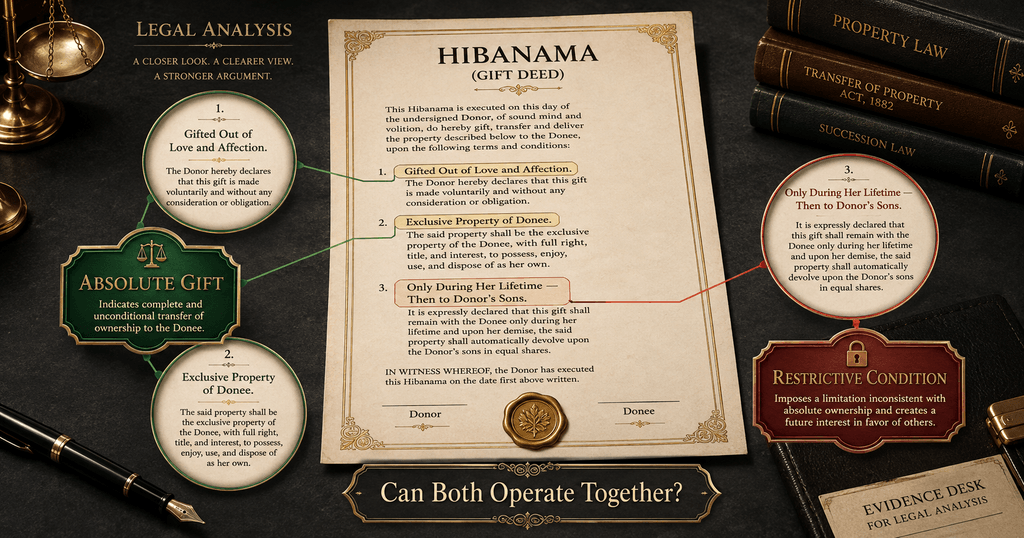
During the testimony of a CDA record keeper, DW-3, a copy of a gift deed came from the CDA record.
It was dated 17 February 1985 and was exhibited as Exhibit DW-3/16.
The deed stated that Iftikhar had gifted the house to Durr-e-Shahwaar out of love and affection.
It also recorded that possession had been handed over to her.
More importantly, the deed described the house as the exclusive property of the donee.
But then came the disputed condition.
The same document tried to limit the gift to Durr-e-Shahwaar’s lifetime. It stated that after her death, Nisar Ahmed Abbasi and Ubaid Ahad, sons of the donor, would become owners.
The High Court described this document as having prime importance in deciding the appeals.
That contradiction created the central question in Conditional Gift in Muslim Law:
Can a donor give the property itself to someone as exclusive owner and at the same time say that the ownership will end at her death?
Conditional Gift in Muslim Law: The Core Rule
The Court answered this by applying the rule concerning a condition that is inconsistent with the completeness of a gift.
In simple words:
If the property itself has been absolutely gifted, the donor normally cannot keep back a condition that destroys the absolute nature of that ownership.
The Islamabad High Court referred to section 164 of Mulla’s Principles of Muhammadan Law and explained that where a gift is made subject to a condition that derogates from the completeness of the grant, the condition is void and the gift takes effect without that condition.
Pakistani case law has also explained the same corpus-versus-usufruct distinction. The Sindh High Court has stated that the first question is whether the donor gave ownership of the property itself — the corpus — or only a limited right to use and enjoy it — the usufruct. Where the corpus is absolutely gifted, a condition cutting down that ownership can be rejected as repugnant.
Read the Sindh High Court discussion on conditional gifts
Corpus and Usufruct in Very Simple English
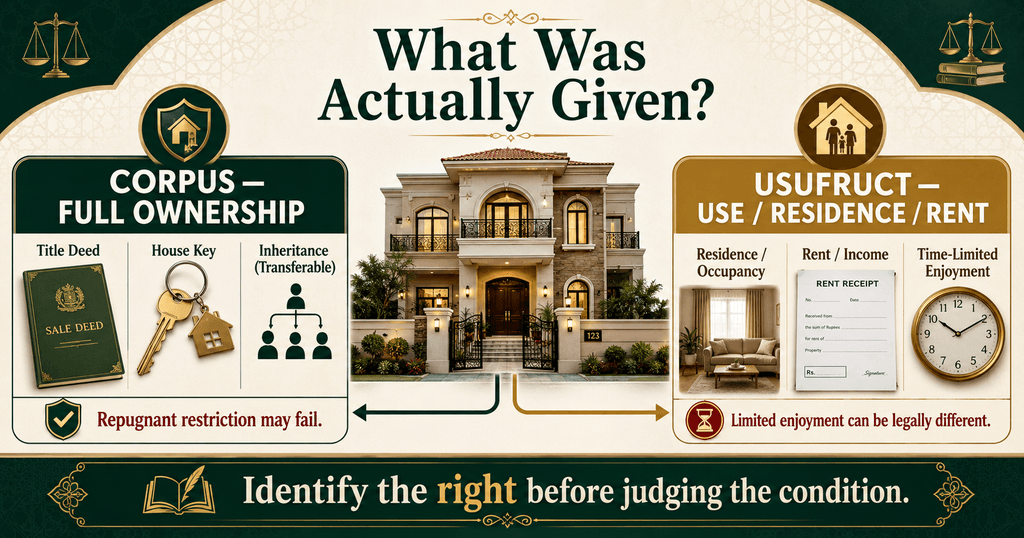
This distinction sounds technical but is easy to understand.
Corpus
Corpus means ownership of the property itself.
For example:
“I give this house to my wife. It is now her property.”
If a completed gift transfers the corpus, the donee receives ownership.
Usufruct
Usufruct means only the right to use or enjoy property.
For example:
“You may live in my house for ten years.”
or:
“You may receive rent from this property during your lifetime.”
The person may have the benefit of the property without necessarily becoming absolute owner of the property itself.
This distinction is extremely important in Conditional Gift in Muslim Law because a court must first understand what the donor actually transferred before deciding the effect of a condition. Pakistani judicial authority expressly recognises this distinction.
What PLD 1991 SC 466 Added
The Islamabad High Court relied particularly on Mst. Kaneez Bibi and another v. Sher Muhammad and 2 others, PLD 1991 SC 466.
The judgment explained that the Supreme Court had held that where land was gifted but the gift was restricted only to the donee’s lifetime, the lifetime condition was void.
The gift of the corpus operated in favour of the donee with the legal effects of ownership.
The Islamabad High Court also recorded the Supreme Court’s observation that if a life estate had to be created through a gift in that context, it had to take the form of waqf.
This is the authority that made the lifetime clause in the present Conditional Gift in Muslim Law dispute so difficult for Samina to rely upon.
But the Gift Deed Was Only a Photocopy — Why Did the Court Consider It?
This is one of the most important parts of the judgment.
Samina’s lawyer argued that Exhibit DW-3/16 was only a photocopy.
The original had not been produced.
An objection to its admissibility had also been raised when the CDA witness testified.
The trial court had said that it would decide the objection in the final judgment but apparently did not finally resolve that point.
The Islamabad High Court therefore directly examined whether the photocopy could legally be considered as secondary evidence.
The Court applied Article 76(b) of the Qanun-e-Shahadat Order, 1984.
The important point was not simply that a photocopy existed in the CDA record.
The Court found written admissions in Samina’s own pleadings that matched essential parts of the gift deed.
Article 76 allows secondary evidence in specified circumstances, including where the existence, condition or contents of the original have been admitted in writing by the person against whom the document is being proved or by that person’s representative in interest.
The official Qanun-e-Shahadat Order can be checked on Pakistan Code.
Official Qanun-e-Shahadat Order, 1984 — Pakistan Code
The Admission in Samina’s Own Written Statement
Samina had pleaded that Durr-e-Shahwaar had only a right to stay in the property during her lifetime.
That statement was important.
Why?
Because a person could hardly make that particular allegation without accepting that some right had in fact been given to Durr-e-Shahwaar.
Samina’s separate suit also pleaded that after Iftikhar’s death, Durr-e-Shahwaar lived with Nisar for some time and received Rs. 1,500 per month from Nisar.
She further claimed that Durr-e-Shahwaar was bound eventually to hand over peaceful possession.
The High Court found that these pleadings corresponded with the important contents of the gift deed.
According to the Court, they amounted to a candid admission that Durr-e-Shahwaar was a donee, although Samina disputed the duration and extent of the gift.
This is one of the strongest practical lessons from Conditional Gift in Muslim Law:
Never treat pleadings as casual storytelling. A sentence written in a plaint or written statement may later prove a fact against the person who filed it.
Article 113 QSO: Admitted Facts May Not Need Further Proof
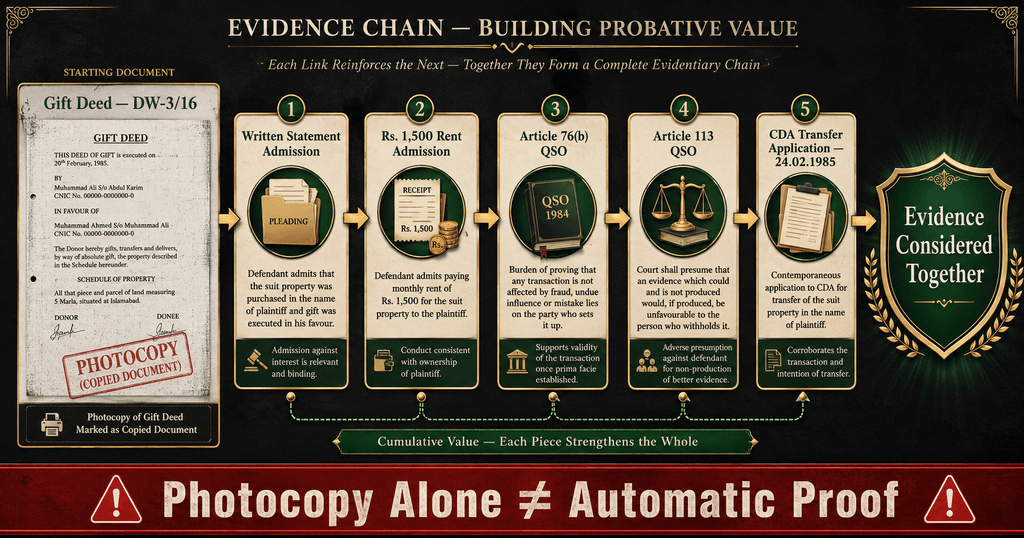
The Court further referred to Article 113 of the Qanun-e-Shahadat Order, 1984.
It distinguished admissions in pleadings from an ordinary evidentiary admission under Article 45.
For that principle, the Court referred to:
- Mst. Niaz Begum v. Waris Khan, 1995 MLD 690; and
- Akbar Waheed v. Karachi Development Authority, 1993 MLD 87.
The Court also noted that the gift was independently supported by Iftikhar’s own CDA transfer application No. 2071 dated 24 February 1985.
Article 113 itself states the general rule that facts admitted by parties, including facts treated as admitted through pleadings, need not ordinarily be proved again.
How the Court Decided Whether the Gift Was Actually Proved
A civil court does not normally require proof beyond every possible doubt.
The High Court referred to Article 2(4) QSO and the Supreme Court judgment Salamat Ali and others v. Muhammad Din and others, PLD 2022 SC 353.
The test in a civil case is commonly described as preponderance of probability.
In ordinary language, the Court asks whether, after considering the full record, a fact is more likely to be true than not.
The High Court considered several facts together:
- Durr-e-Shahwaar was admittedly Iftikhar’s lawful wife;
- she lived in the house while Iftikhar was alive;
- she remained there for about another 25 years after his death;
- Samina’s own case admitted that Nisar paid Durr-e-Shahwaar Rs. 1,500 per month;
- the gift deed recorded the gift and possession;
- Samina’s pleadings corresponded with that deed; and
- Iftikhar’s CDA transfer application supported the transaction.
On the balance of probabilities, the Court concluded that the house had been duly gifted to Durr-e-Shahwaar.
It then reached the second conclusion: the gift was absolute and the condition limiting it to her lifetime was void.
Conditional Gift Is Different From a Contingent Gift
This distinction is useful because the two terms are often mixed together online.
A conditional gift may transfer ownership now but attach a restriction to it.
Example:
“I give this house to you now, but you can never sell it.”
A contingent gift depends upon an uncertain future event.
Example:
“This house will become yours if a particular uncertain event happens.”
Muslim-law educational material commonly distinguishes the two and explains that a condition restricting the completeness of an otherwise valid gift is treated differently from a gift that itself depends on a future contingency.
The Islamabad judgment, however, was not primarily a contingent-gift case.
It dealt with a completed property gift carrying a purported lifetime restriction.
That distinction should remain clear when explaining Conditional Gift in Muslim Law.
What Are the Basic Elements of a Valid Hiba?
Before worrying about a condition, there must first be a valid gift.
Pakistani judicial discussion identifies three familiar essentials:
- Declaration by the donor
- Acceptance by the donee
- Delivery of possession
The Sindh High Court has explained these requirements while discussing gifts under Islamic law.
For another Pakistani Supreme Court judgment dealing specifically with declaration, acceptance and possession, read:
Valid Gift in Pakistan: Supreme Court Lessons
In PLD 2026 Islamabad 57, the 1985 gift deed itself stated that Iftikhar had gifted the house and had handed over possession to Durr-e-Shahwaar. The Court then tested that document against the surrounding evidence and admissions.
Why the Nikahnama Objection Failed
After deciding the central ownership question, the Court still dealt with Samina’s objections for completeness.
One objection was that the Nikahnama, Exhibit P2, was forged because the form carried CNIC-related columns associated with a later period.
The argument was that Iftikhar and Durr-e-Shahwaar had married in 1978, so a later-format Nikahnama appeared suspicious.
The Court examined the document carefully.
It found that 1 January 2010, appearing in row 24, was the date of registration of the Nikahnama, not the date on which the marriage was solemnised.
The actual Nikah date appearing in row 20 was 23 July 1978.
More importantly, the marriage itself had already been admitted by Samina in her written statement.
The objection therefore did not assist her case.
What About Tariq Never Meeting Durr-e-Shahwaar?
Another objection was that Tariq Usman had never personally met Durr-e-Shahwaar.
He had not personally seen her sign the Agreement to Sell or receive the sale consideration.
Tariq explained in cross-examination that he had been communicating with Durr-e-Shahwaar’s brothers.
The judgment records his explanation that her brothers told him that she was a Pathan, was advanced in age and would not come before other men.
The High Court regarded that explanation as reasonable in the circumstances from the perspective of a purchaser who had been shown the relevant documents and had checked the CDA record.
This factual finding was specific to the evidence in this case and should not be converted into a general rule for every property transaction.
If She Owned the House, Why Was CDA Transfer Never Completed?
This was another strong-looking objection.
Samina argued that if the gift was genuine, Durr-e-Shahwaar should have transferred the CDA property into her name during the 25 years after her husband’s death.
But the CDA witness gave the answer.
The record showed no fewer than six applications by Durr-e-Shahwaar asking CDA to transfer the house into her name.
She had also initiated proceedings before the Ombudsman seeking transfer.
At the same time, Nisar Abbasi had submitted competing applications requesting transfer of the house in the names of Iftikhar’s children as heirs.
Faced with competing ownership claims, CDA did not transfer the property without a civil-court determination.
Therefore, the lack of final CDA transfer was not treated as proof that no gift existed.
Why the Forgery Allegations Ultimately Could Not Save Samina
This part of the judgment is easy to misunderstand.
The High Court did not say that allegations of forged documents are never important.
Instead, after finding that the 1985 gift made Durr-e-Shahwaar absolute owner, the Court explained that even if the other challenged documents, Exhibits P1 to P4, were assumed to be fabricated, it still would not give Samina an inheritance share in the house.
Why?
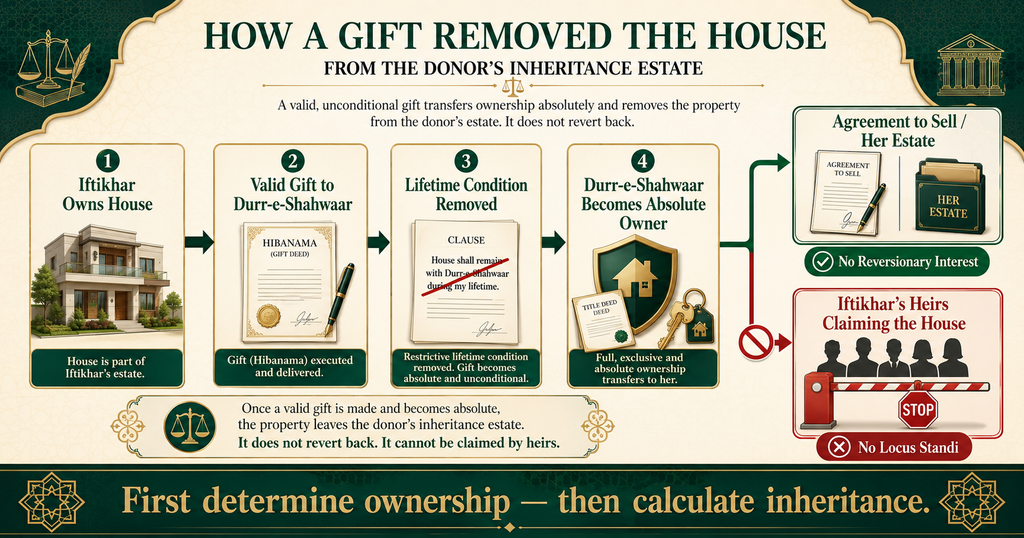
Because once the house was Durr-e-Shahwaar’s exclusive property, it was no longer part of Iftikhar’s estate.
If Tariq’s transaction failed, the property would still belong to Durr-e-Shahwaar’s estate and, according to the judgment, would devolve upon her brothers.
It would not return to Iftikhar’s descendants merely because Tariq’s documents were challenged.
That is a crucial point in Conditional Gift in Muslim Law.
A party must first establish a legal interest in the property before attacking someone else’s transaction.
Why Samina Lost Her Locus Standi
Locus standi simply means a person’s legal right or standing to bring a particular challenge.
After finding that Durr-e-Shahwaar had received the house through a valid absolute gift, the High Court held that Samina became a stranger to the property.
She had no reversionary interest.
In other words, there was no legal right under which ownership would automatically return from Durr-e-Shahwaar to Iftikhar’s heirs after her death.
Without that interest, Samina had no standing to challenge the sale transaction between Durr-e-Shahwaar and Tariq as an heir of Iftikhar.
For the same reason, her own suit seeking an inheritance share in the property failed.
Both appeals were dismissed.
Why This Was Not Really an Inheritance Property Anymore
This is perhaps the easiest way for an ordinary reader to understand the case.
Imagine that A owns a house.
A validly gives the whole house to B during A’s lifetime.
If B becomes the absolute owner, the house is no longer part of A’s estate when A dies.
Therefore, A’s heirs cannot later divide that house as though A still owned it at death.
That is what happened here after the Court recognised the absolute gift.
The lifetime condition could not restore the house to Iftikhar’s heirs.
So the property belonged to Durr-e-Shahwaar, not to Iftikhar’s estate.
For a related explanation of how a valid lifetime gift can affect later family claims, see:
Gift for Wife Pakistan — Supreme Court Rules on Hiba and Possession
Conditional Gift in Muslim Law vs Inheritance Expectation
A child may expect to inherit a parent’s house one day.
That expectation is not the same as present ownership.
If the parent validly transfers the property during life, the property may no longer remain in the estate for those expected heirs.
That is why every Conditional Gift in Muslim Law dispute should begin with a basic title question:
Who owned the property immediately before death?
Do not start by calculating inheritance shares.
First determine whether the property still formed part of the deceased person’s estate.
For readers dealing with the difference between ownership and revenue records, see:
Inheritance Mutation in Pakistan — Supreme Court Ruling
7 Powerful Lessons from PLD 2026 Islamabad 57
1. A Gift Can Survive Even When Its Restrictive Condition Fails
The most important lesson is that an invalid lifetime restriction does not automatically destroy the underlying gift.
Where the gift of the corpus is complete, the condition may fail while ownership remains with the donee.
2. Pleadings Can Prove More Than a Witness
Samina’s own written case became evidence against the position she later wanted to establish.
Before filing a plaint or written statement in a property dispute, every admission should be checked carefully.
3. A Photocopy Is Not Automatically Worthless
The Court did not accept the photocopy merely because it existed.
Its admissibility was connected to Article 76(b) QSO and written admissions confirming essential contents.
Every photocopy case therefore depends on its own evidentiary foundation.
4. Long Possession Can Support the Overall Evidence
Durr-e-Shahwaar remained in the house for about 25 years after Iftikhar’s death.
That fact, together with rent, admissions and documentary record, contributed to the balance-of-probabilities finding.
5. Missing Administrative Transfer Does Not Always Decide Title
Six CDA transfer applications and Ombudsman proceedings explained why Durr-e-Shahwaar had not simply ignored the transfer process.
The competing claims before CDA were important.
6. Challenging Another Person’s Documents Requires Legal Standing
Even a serious allegation such as forgery may not help a person who has no legal interest in the property.
The first question is always: What right will the claimant receive even if the challenge succeeds?
7. One Badly Drafted Clause Can Create Decades of Litigation
The deed simultaneously described the house as Durr-e-Shahwaar’s exclusive property and attempted to limit the gift to her lifetime.
That conflict eventually became the central legal battle.
A carefully drafted property instrument should clearly state whether the donor intends:
- complete ownership;
- only a right to occupy;
- only a right to receive income;
- a waqf-type arrangement;
- a gift with return consideration; or
- some other legally recognised structure.
Do not try to create all of them through one contradictory sentence.
Practical Checklist Before Making a Conditional Gift
Before signing a Hibanama involving conditions, ask:
- Does the donor actually own the property?
- Is the donor giving full ownership or only a right to use it?
- Is the gift effective immediately?
- Has the donee accepted it?
- Has possession or control been transferred in the manner required by law?
- Does the deed call the donee “absolute owner” but later restrict ownership?
- Is there a ban on sale, transfer or inheritance?
- What happens after the donee dies?
- Is the intended arrangement really a gift, usufruct, waqf or another transaction?
- Are title and authority records being updated?
- Are all original documents safely preserved?
- Could any clause contradict another clause?
These questions can prevent a future Conditional Gift in Muslim Law dispute.
Practical Checklist If a Gift Is Already Disputed
Collect the full record before going to court:
- original gift deed or Hibanama;
- certified copies where available;
- title documents;
- mutation or authority record;
- CDA or housing-society correspondence;
- transfer applications;
- possession evidence;
- rent receipts;
- utility or property records where relevant;
- previous plaints and written statements;
- earlier admissions;
- Nikahnama where the marital relationship is relevant;
- agreements to sell;
- payment evidence;
- death certificates;
- family record;
- correspondence between donor and donee; and
- previous court or Ombudsman proceedings.
A Conditional Gift in Muslim Law case is rarely decided by one sentence alone.
Courts examine the complete legal and evidentiary picture.
What Competitor Articles Explain — and What Pakistani Readers Must Add
General Muslim-law resources correctly explain the common requirements of Hiba, including declaration, acceptance and delivery of possession. They also discuss conditional and contingent gifts.
iPleaders — Hiba under Muslim Law
Drishti Judiciary — Gift under Muslim Law
The supplied academic notes also discuss conditional gifts and the distinction between corpus and usufruct.
Gifts and Wills under Muslim Law — Academic Material
But Pakistani readers should not stop at general textbook explanations.
For Pakistani litigation, the stronger approach is to connect those principles with Pakistani judgments, the Qanun-e-Shahadat Order, pleadings, possession and the actual property record.
That is what makes PLD 2026 Islamabad 57 especially valuable.
Relevant Pakistani Legal Sources
The judgment itself arose under the Specific Relief Act, 1877 and referred to sections 42 and 54 in its reported headnote. The official statute can be checked through Pakistan Code.
Official Specific Relief Act, 1877 — Pakistan Code
For gift disputes generally, readers can also explore:
Gift / Hiba Disputes — Qanooni Dastak
Final Decision of the Islamabad High Court
The High Court ultimately held that the suit house was the sole and exclusive property of Durr-e-Shahwaar by virtue of a valid gift under Islamic law.
The lifetime condition did not survive.
Because no reversionary right remained in Samina or the other heirs of Iftikhar, Samina had no locus standi to challenge the sale transaction between Durr-e-Shahwaar and Tariq on the basis asserted.
Her inheritance suit also failed.
The Islamabad High Court therefore dismissed both appeals.
Conclusion: The Gift Survived — The Condition Did Not
PLD 2026 Islamabad 57 is a powerful illustration of Conditional Gift in Muslim Law because the entire dispute turned on the difference between giving property and merely allowing someone to enjoy it temporarily.
The 1985 document called the house Durr-e-Shahwaar’s exclusive property and recorded delivery of possession, but it also tried to limit her right to her lifetime.
The Court did not allow that restrictive clause to cut down the completed gift.
But the judgment is equally important for another reason.
The result was not based on the gift deed alone.
Samina’s written admissions, Iftikhar’s CDA transfer application, Durr-e-Shahwaar’s possession for decades, the Rs. 1,500 monthly payment, her repeated CDA applications and the civil standard of proof all helped complete the evidentiary picture.
The biggest lesson from Conditional Gift in Muslim Law is therefore simple:
Do not ask only, “What condition is written?”
Ask first:
“What property right was actually given, was the gift completed, and what does the complete evidence prove?”
One unclear clause may look harmless when a family is united.
After death, the same clause can decide who owns the house.
FAQs About Conditional Gift in Muslim Law
What is a Conditional Gift in Muslim Law?
A Conditional Gift in Muslim Law is a gift carrying a condition or restriction. Where the property itself is absolutely and validly gifted, a condition that cuts down the completeness of that ownership may be treated as void while the gift remains effective.
What did PLD 2026 Islamabad 57 decide?
The Islamabad High Court held that Durr-e-Shahwaar received the suit house through a valid absolute gift. The condition limiting the gift to her lifetime was void, and both appeals filed against the result were dismissed.
Who originally owned the disputed house?
The judgment identifies Raja Iftikhar Abbasi as the owner who gifted the Islamabad house to his second wife, Durr-e-Shahwaar.
When was the gift deed executed?
The gift deed that became central to the appeals was dated 17 February 1985 and was exhibited as DW-3/16.
What condition was written in the gift deed?
Although the deed described the house as Durr-e-Shahwaar’s exclusive property, it attempted to limit her interest to her lifetime and stated that after her death the property would belong to Nisar Ahmed Abbasi and Ubaid Ahad.
Why was the photocopy of the gift deed considered?
The High Court relied on Article 76(b) of the Qanun-e-Shahadat Order because Samina’s written pleadings admitted essential facts corresponding with the contents of the deed.
What was the importance of Article 113 QSO?
The Court referred to Article 113 when dealing with admissions made in pleadings. Such admissions can remove the need to separately prove an admitted fact, although the Court retains the power provided by law to require proof where appropriate.
Why did the CDA not transfer the house to Durr-e-Shahwaar?
The judgment records at least six transfer applications by Durr-e-Shahwaar and Ombudsman proceedings. At the same time, Nisar had made competing applications for transfer in the names of Iftikhar’s heirs. CDA therefore faced competing claims requiring civil-court determination.
Why did Samina lose her inheritance claim?
Once Durr-e-Shahwaar was held to be the sole owner through the absolute gift, the house was no longer part of Iftikhar’s estate. Samina therefore had no reversionary interest in it through Iftikhar.
Does every lifetime arrangement automatically become an absolute gift?
No. The first question is what was actually transferred. A transfer of the corpus is different from a limited right of use or usufruct. The document, possession, intention and applicable law must all be examined.
Can heirs challenge a gift just because they expected to inherit the property?
An expected future inheritance does not by itself establish present ownership. A claimant must show a valid legal basis for challenging the lifetime transfer.
Is registration alone enough to prove every Hiba?
No single document should automatically be treated as the whole case. A valid Hiba generally requires declaration, acceptance and delivery of possession, and courts examine the entire evidence relating to the transaction.
Legal Disclaimer
This article is for general legal awareness and educational purposes only.
It is based primarily on PLD 2026 Islamabad 57 and the legal principles discussed in the judgment. Every property dispute depends on its own documents, pleadings, dates, possession, evidence, applicable Muslim personal law and procedural history.
Nothing in this article should be treated as legal advice for an individual case.
Anyone involved in an actual Hiba, inheritance, gift deed, sale agreement, property-transfer or possession dispute should have the complete record examined by a qualified Pakistani lawyer.