


In the Law Admission Test, you get 100 minutes for 75 MCQs, then 40 more minutes for the essay and personal statement. Yet several popular pages on the LAT syllabus still print a different time, and a student who plans for the wrong clock can walk out with a half-written essay. With the next LAT scheduled for Sunday, 15 November 2026, a small mistake like this can cost real marks.
This guide sets out the LAT syllabus exactly as HEC’s Education Testing Council (ETC) publishes it: the six MCQ subjects, the marks for each, the essay and the personal statement, and how the time is split. Then we explain what each subject usually covers, what HEC has not officially said, and five costly mistakes that quietly cut marks.
Table of Contents
LAT syllabus in 30 seconds
| Point | Official position |
|---|---|
| Total marks | 100 (75 MCQs + 25 written marks) |
| Part I | 75 MCQs in 100 minutes |
| Part II | Essay (15 marks) + personal statement (10 marks) in 40 minutes |
| Total time | 140 minutes in all: 100 for the 75 MCQs + 40 for writing |
| Writing language | English or Urdu, your choice |
| Eligibility to sit | 12 years of education in any discipline |
| Result validity | 2 years from the result date |
LAT Syllabus at a Glance: The Official HEC Pattern
HEC’s own document, Approved Content Weightage for HEC Law Admission Test (LAT), is the only official LAT syllabus. It lists the subjects and marks, not chapters. Here is the full pattern from that document.
| Part | Subject or task | Questions | Marks | Time |
|---|---|---|---|---|
| Part I | English | 20 MCQs | 20 | 100 minutes for all 75 MCQs |
| Part I | General Knowledge | 20 MCQs | 20 | – |
| Part I | Pakistan Studies | 10 MCQs | 10 | – |
| Part I | Islamiat | 10 MCQs | 10 | – |
| Part I | Urdu | 10 MCQs | 10 | – |
| Part I | Mathematics | 5 MCQs | 5 | – |
| Part II | Essay writing | 1 topic out of 3, English or Urdu | 15 | 40 minutes for both tasks |
| Part II | Personal statement | English or Urdu | 10 | – |
| Total | – | 75 MCQs + 2 written tasks | 100 | 140 minutes |
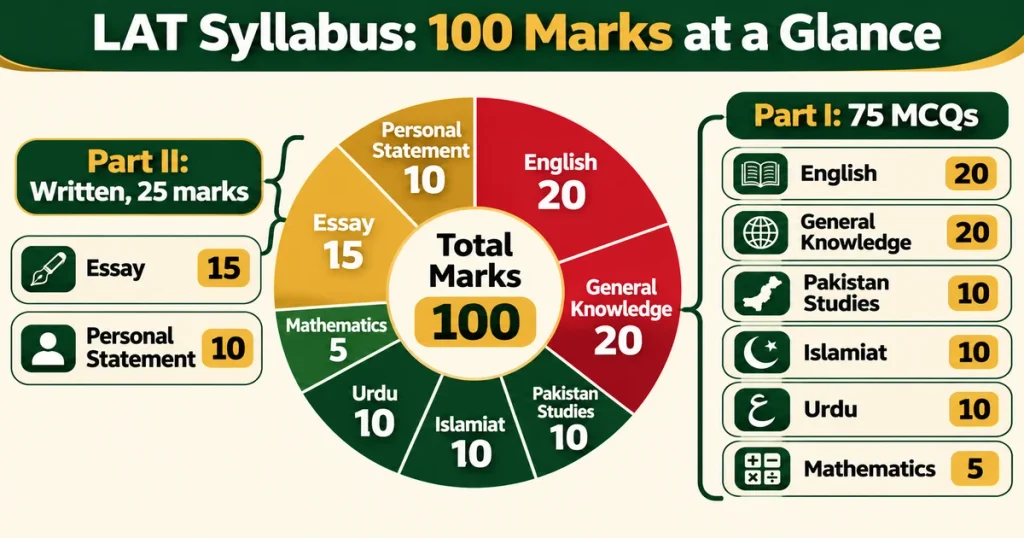
Two things stand out. English and General Knowledge together carry 40 of the 100 marks. And the written part, which many students leave to the last week, carries 25 marks, more than Islamiat and Pakistan Studies combined.
How the Time Is Split: 100 + 40 Minutes
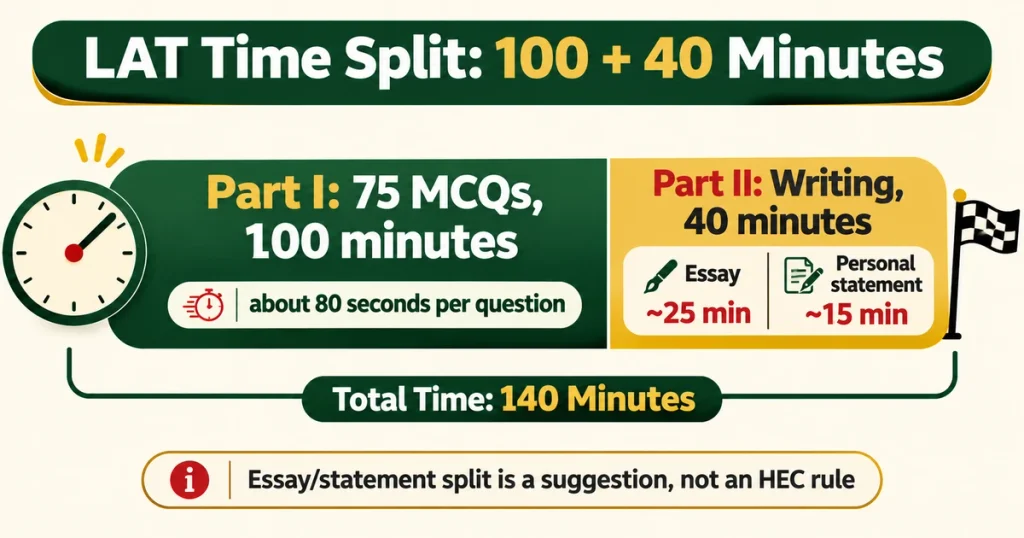
Part I gives you 100 minutes for 75 MCQs. That is 80 seconds per question. HEC does not set a separate time for each subject, so you control the pace inside Part I.
Part II gives you 40 minutes for both writing tasks together. A sensible split is about 25 minutes for the essay and 15 minutes for the personal statement, including a minute or two to read your work again. This split is our suggestion, not an HEC rule.
Download the Official LAT Syllabus PDF
You can download the official HEC LAT content weightage PDF directly from the HEC website. Keep it on your phone. If any website, academy or WhatsApp group shows you a different number of MCQs or a different time, this PDF is the one that counts.
Note one thing the PDF does not do: it does not give a chapter-by-chapter topic list. Any detailed topic list you see online, including the one below, is built from past papers and preparation experience, not prescribed by HEC.
Subject-Wise LAT Syllabus: What Each Section Usually Covers
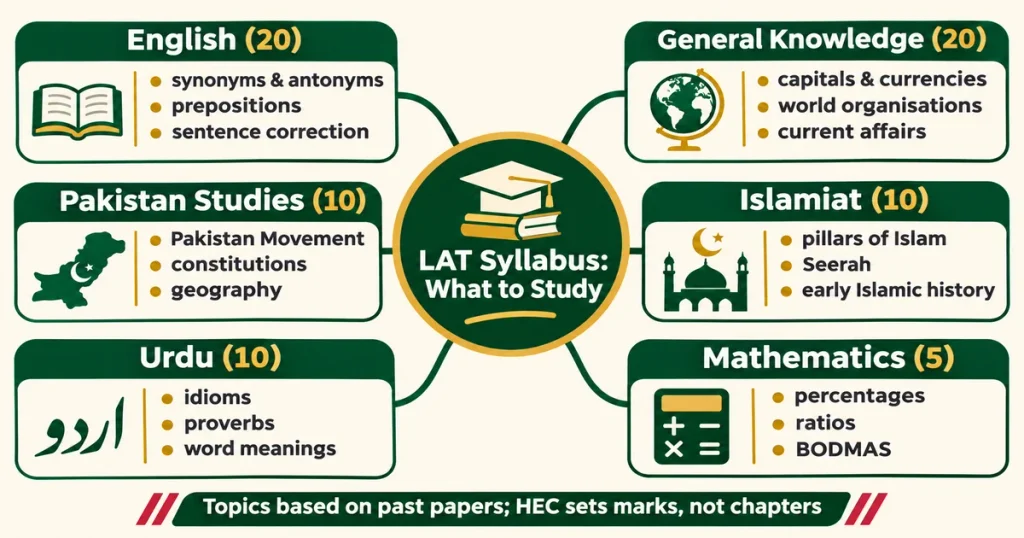
HEC fixes the marks for each subject in the LAT syllabus. The topics below come from past papers and the experience of students who sat the test. Treat them as a smart study map, not an official HEC list.
English (20 Marks): Vocabulary and Grammar Carry the Load
English is one of the two biggest sections. Most questions test whether you know word meanings and basic grammar rules, not long reading.
- Synonyms and antonyms
- Prepositions and articles
- Tenses and subject-verb agreement
- Sentence correction and sentence completion
- Short comprehension or meaning-in-context questions
Tip: learn words in small daily batches of 15 to 20, with one example sentence each. Cramming 500 words in the last week rarely sticks.
General Knowledge (20 Marks): Static Facts Plus Current Affairs
General Knowledge is the widest section of the LAT syllabus, which is why students fear it. Most questions are short factual recall.
- Countries, capitals and currencies
- International organisations such as the UN, OIC and SAARC
- World and Pakistani geography
- Everyday science, inventions and inventors
- Famous personalities and sports
- Recent national and international events
HEC has not fixed how many questions come from current affairs or from which period. Read a newspaper summary daily for a few months before the test, but give most of your time to static facts, which do not change.
Pakistan Studies (10 Marks)
This section rewards students who revise their school Pakistan Studies properly.
- The Pakistan Movement and the events before 1947
- Founding leaders and their roles
- Constitutional history, including the 1956, 1962 and 1973 constitutions
- Geography, rivers, provinces and neighbouring countries
- National symbols and important dates
Islamiat (10 Marks)
Islamiat questions are usually at school level and test basic, well-known facts.
- Articles of faith and the five pillars of Islam
- Basic Quranic knowledge, including surahs and revelation
- Seerah of the Holy Prophet (PBUH)
- The four rightly guided caliphs
- Major battles and events of early Islamic history
HEC’s weightage document lists Islamiat for all candidates and does not mention any alternative paper. If you are a non-Muslim candidate and this concerns you, ask ETC through its official help channels well before test day.
Urdu (10 Marks): Idioms, Proverbs and Word Meanings
The Urdu section mainly tests vocabulary, not literature.
- Synonyms and antonyms
- Idioms (muhavray) and proverbs (zarb-ul-amsal)
- Singular and plural forms, masculine and feminine forms
- Correct spelling and sentence structure
Students from English-medium schools often lose easy marks here. Twenty minutes a day with an idioms list is usually enough.
Mathematics (5 Marks): Basic Arithmetic Only
With only 5 MCQs, Mathematics is the smallest section of the LAT syllabus. Questions are usually simple arithmetic.
- Percentages, ratios and averages
- Fractions and the BODMAS rule
- Profit and loss
- Simple word problems and very basic algebra
Calculators are not allowed, so practise quick mental working. Do not spend 10 minutes on a 1-mark question; mark your best answer and move on.
You can practise every MCQ subject on our LAT MCQs page, where the answer shows instantly after each question.
The Writing Section: 25 Marks Most Students Underrate
Part II of the LAT syllabus decides more results than students expect. Two candidates with the same MCQ score can end up far apart because one wrote a clear essay and the other did not.
Essay: 15 Marks, One Topic Out of Three
You choose one topic out of three and write the essay (mazmoon) in English or Urdu. Topics usually come from education, social issues, technology, the environment, governance and human rights.
A simple structure works best: a short introduction with your main point, two or three body paragraphs with one idea each, and a short conclusion. HEC’s weightage document does not set a word limit, so follow the instruction printed on your question paper.
See our guide to LAT essay topics for practice topics and a ready structure.
Personal Statement: 10 Marks in Your Own Voice
The personal statement is a short piece about you, written in English or Urdu. Many students memorise one answer on “Why I want to study law”. That is risky, because the question on the paper decides what you must write about.
Prepare two or three real experiences from your own life: a problem you solved, a person who influenced you, a goal and why it matters. You can then fit them to whatever prompt appears. Our detailed guide on the personal statement for LAT walks through examples.
LAT Passing Marks, Validity and Retakes
To pass the LAT you need at least 50 out of 100. University of the Punjab, for example, asks for LAT passed “with 50% passing marks” in its four-year LLB eligibility criteria.
Under HEC’s ETC registration SOP, a LAT result stays valid for two years, counted from the result date, not the test date. The same SOP allows candidates to sit the next test again to improve their score.
For the 15 November 2026 sitting, HEC’s 2026 test calendar schedules roll number slips for 6 November and the result for 24 December 2026. Our guide to the LAT test date covers the full schedule.
Passing LAT Is Not the Same as Getting Admission
This is where many families get confused. Passing the LAT only makes you eligible. Each university then builds its own merit list, and the LAT may or may not count in it.
| University | LAT requirement | How merit is calculated |
|---|---|---|
| University of the Punjab (LLB 4 years) | LAT passed with 50% marks, plus FA/F.Sc. with at least 55% | PU’s own admission test carries 25% of merit; the LAT is an eligibility condition |
| Quaid-i-Azam University | Valid LAT result | LAT 30%, HSSC Part-I 50%, SSC 20% |
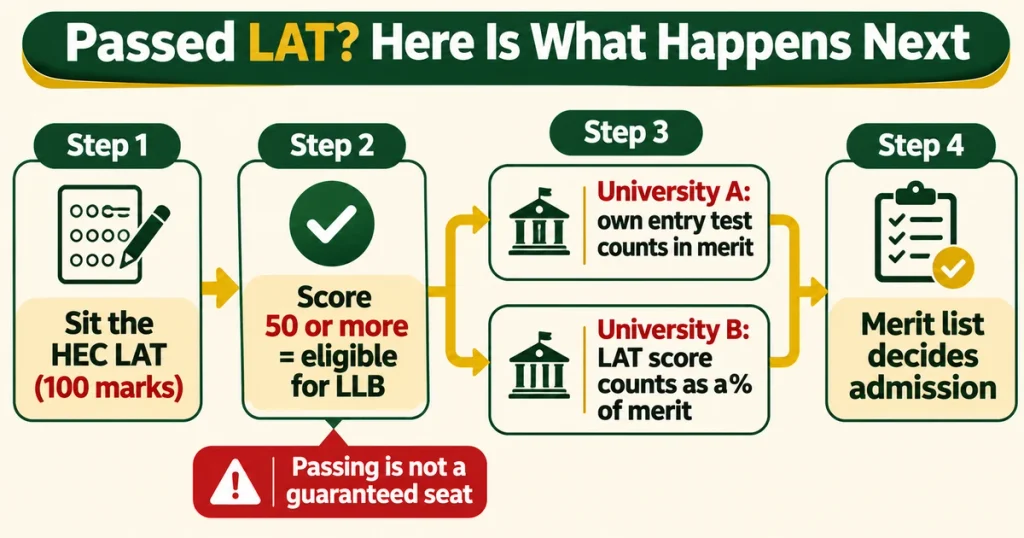
So a score of 52 may get you through the door at one university and leave you far down the list at another. Always read the latest admission notice of each university you apply to. Merit rules change between sessions.
Is LLB Now Four Years?
HEC has given in-principle approval to a four-year LLB curriculum, and University of the Punjab now lists its programme as “LLB 04-Yrs”. Some older pages and notices still mention a five-year LLB. For you, the LAT requirement is the same either way: no valid LAT, no LLB admission.
Test-Day Rules That Can Stop You at the Gate
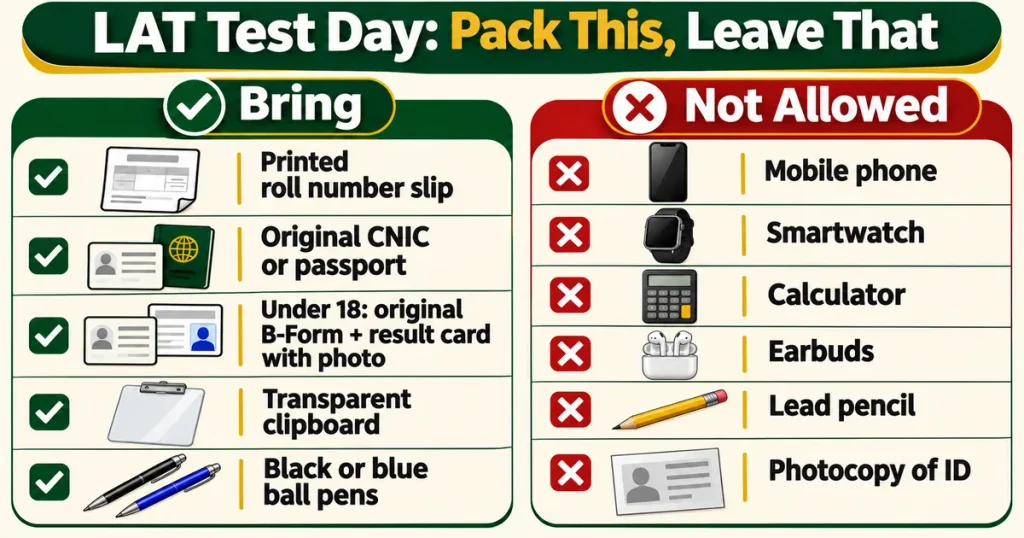
Knowing the LAT syllabus is useless if you are turned away at the gate. HEC’s ETC FAQ sets these rules:
- Bring a printed roll number slip and your original valid CNIC or passport.
- Under 18? Bring your original B-Form and your original Matric or Intermediate result card with your photo. The result card is mandatory.
- Expired CNIC or passport? Bring the original along with the NADRA slip.
- Lost CNIC? Bring the police report, the NADRA receipt for the new card, and your original Matric or Intermediate certificate or result card with photo.
- Photocopies and phone pictures of ID are not accepted.
- Bring a transparent clipboard and black or blue ball pens. Lead pencils, fountain pens and markers are not allowed on the OMR (bubble) sheet.
- Mobile phones, smartwatches, calculators, earbuds and vapes are banned. If found, they are confiscated and an unfair-means case is registered.
- If you registered with a CNIC that differs by even one digit, or with a parent’s or sibling’s CNIC, you will not be allowed to sit the test.
Our post on the LAT roll number slip explains how to download and check your slip.
5 Costly Mistakes That Cut LAT Marks
- Planning for the wrong time. The official LAT syllabus gives 100 minutes for the 75 MCQs and 40 minutes for the essay and personal statement. Some websites print a different total time. Practise with exactly 100 + 40 minutes.
- Leaving the writing section to the last week. The essay and personal statement carry 25 marks. Write at least two timed essays and two personal statements before test day.
- Thinking you must write in English. HEC allows English or Urdu for both writing tasks. Pick the language you write best in. Roman Urdu is neither, so do not risk it.
- Memorising one personal statement. If the question asks about a challenge you faced and you write “why I want to study law”, you lose easy marks. Prepare stories, not one script.
- Wrong stationery or a photocopied ID. A pencil on the OMR sheet or a photocopy of your CNIC can ruin months of preparation. Pack the night before.
A 14-Day LAT Study Plan Built on the Syllabus
If the test is two weeks away, follow the marks in the LAT syllabus. Spend the most time where the most marks are.
| Days | Focus |
|---|---|
| 1 to 3 | English vocabulary and grammar, plus 20 minutes of Urdu idioms daily |
| 4 to 6 | General Knowledge (static facts first) and Pakistan Studies |
| 7 to 8 | Islamiat revision and Mathematics practice without a calculator |
| 9 to 10 | Two timed essays and two personal statements, 40 minutes each set |
| 11 to 12 | Full timed mock tests: 100 minutes MCQs, then 40 minutes writing |
| 13 | Revise only your mistakes and weak topics |
| 14 | Light revision, print the roll number slip, pack your documents and pens |
For days 11 and 12, use our free LAT Mock Test, which follows the official LAT syllabus pattern. For a fuller preparation guide, see our LAT test preparation page.
LAT Syllabus FAQs
1. How many subjects are in the LAT syllabus?
The LAT syllabus has six MCQ subjects and two writing tasks. The MCQ subjects are English (20), General Knowledge (20), Pakistan Studies (10), Islamiat (10), Urdu (10) and Mathematics (5). The writing tasks are an essay worth 15 marks and a personal statement worth 10 marks, for a total of 100 marks.
2. What are the passing marks for LAT?
You need at least 50 marks out of 100, which is 50%. Passing makes you eligible for LLB admission, but it does not guarantee a seat. Each university then makes its own merit list, often with higher cut-offs, its own entry test or a fixed weightage for your LAT score.
3. Is the LAT test easy or difficult?
Questions across the LAT syllabus are mostly at intermediate school level, so the content is not hard. What makes the LAT difficult is breadth and speed: 75 MCQs from six subjects in 100 minutes, then two pieces of writing in 40 minutes. Students who practise under real timings usually find it manageable.
4. How can I pass the LAT on my first attempt?
Follow the marks. Give the most time to English and General Knowledge, which carry 40 marks together. Practise the essay and personal statement under a 40-minute clock. Take at least two full mock tests with the official timings. Then revise only the questions you got wrong, not the ones you already know.
5. Is there negative marking in the LAT?
HEC’s official content weightage document and its ETC FAQ do not mention negative marking either way. Many preparation guides say there is none. Read the instructions printed on your question paper and OMR sheet on test day, and follow them exactly.
6. Can I write the LAT essay and personal statement in Urdu?
Yes. HEC’s official weightage document says both the essay and the personal statement can be written in either English or Urdu. Choose the language you can write clearly and correctly in. Write Urdu in Urdu script; Roman Urdu is not one of the two allowed languages.
7. Where can I download the official LAT syllabus PDF?
HEC publishes the official LAT syllabus as a PDF titled “Approved Content Weightage for HEC Law Admission Test (LAT)” on the Education Testing Council section of hec.gov.pk. The link is given earlier in this article. It lists subjects, marks and time, but not chapter-wise topics.
8. How long is a LAT result valid, and can I retake it?
Under HEC’s ETC SOP, a LAT result is valid for two years from the result date. You can also sit the test again to improve your score. HEC held five LAT sittings in its 2026 calendar, so another chance is never far away.
Final Word on the LAT Syllabus
The LAT syllabus is short on paper: 75 MCQs in 100 minutes, then one essay and one personal statement in 40 minutes. Students lose marks not because the content is hard, but because they trust wrong timings, skip the writing practice or forget a document at the gate. Keep the official HEC PDF, practise under real timings, and plan your days by marks, not by fear.
Start today with our LAT MCQs and finish with a full LAT Mock Test before test day.
Disclaimer: This article is for awareness and guidance only and is not official HEC advice. Test rules, dates and university merit criteria can change, so always confirm the latest instructions on the official HEC and ETC websites and in your university’s admission notice.