


The paper is in front of you. The essay is done, the clock is running, and now one question asks about you. Not about history, not about grammar. About you. Many students freeze right here, because nobody ever taught them how to write about themselves.
The personal statement for LAT test carries 10 marks. That is one-fifth of the 50 marks you need to pass the whole test. The good news is that you do not need big achievements to score well. You need one honest story, told clearly in under 200 words. This guide shows you how, with five free samples in English and Urdu, a simple 4-part formula and a practice timer you can use right here.
Table of Contents
Personal Statement for LAT Test at a Glance
| Point | What you need to know |
|---|---|
| Marks | 10 out of 100 |
| Word limit | 200 words maximum |
| Language | English or Urdu |
| Time | 40 minutes for the essay and personal statement together |
| Question | One personal question |
| Marking criteria | HEC has published criteria for the essay, not for the personal statement |
What Is a Personal Statement for LAT Test?
A personal statement is a short answer about you: your experiences, your values and your goals. In the Law Admission Test (LAT), it comes in the written part, right after the essay. HEC gives you one question, and you answer it from your own life.
Many students write it like a second essay. That is the most common mistake. The essay is about a topic in the world. The personal statement is about the person holding the pen.
| Point | Essay | Personal statement |
|---|---|---|
| Marks | 15 | 10 |
| Choice | 1 of 3 topics | One question |
| It is about | A topic, such as justice or technology | You: your life, values and goals |
| Voice | Mostly “we” and “society” | “I”, naturally |
| Strength | Arguments and examples | One true story and its lesson |
A strong personal statement does three things. It answers the question directly. It proves the answer with one real moment from your life. And it shows what that moment taught you. For the other written answer, see our guide to LAT essay topics, with 30 practice topics and 200-word samples.
What HEC Says: Marks, Words, Language and Time
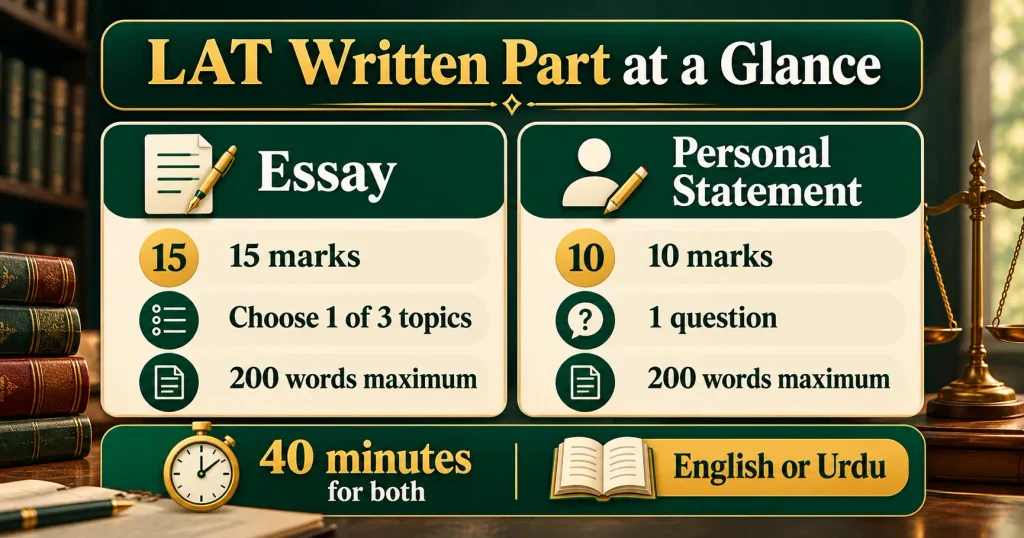
HEC’s content weightages for the LAT list two written tasks in Part II: an essay (one of three topics, 15 marks) and a personal statement. The personal statement for LAT test is worth 10 of the 100 marks. Each answer can be written in English or Urdu, and both together get 40 minutes.
The HEC/ETC advertisement for LAT 2026, published on 4 October 2026, sets a limit of 200 words maximum for each of these two answers. Rules can change from one test to the next, so always follow the instructions printed on your paper and check the latest notice on the HEC ETC portal.
Remember, 200 words is a ceiling, not a target. A clear answer of 150 to 190 words is safer than a rushed answer that crosses the line.
HEC has published criteria for marking the essay, but no separate criteria for the personal statement. So the safest approach is to write it with the same care: a direct opening, a logical flow, relevant ideas, a clear ending and clean language.
Here is a practice plan for the 40 minutes. It is our suggestion, not an HEC rule.
| Task | Suggested time |
|---|---|
| Read the three essay topics and choose one | 3 minutes |
| Plan and write the essay | 21 minutes |
| Plan and write the personal statement | 12 minutes |
| Check both answers | 4 minutes |
| Total | 40 minutes |
For a full study plan for every section of the test, read our LAT test preparation guide.
What HEC’s Own Sample Teaches You
HEC’s official sample personal statement for LAT test answers this question, written exactly like this: “What role you can play in solving problem in your life?”
The sample is titled “The Builder & Problem Solver”. It tells one person’s story of building and fixing things, from childhood projects to a computer program that tests eyesight, and ends with how they want to use these skills to improve the world.
Three lessons stand out:
- It tells a story, not a list. It shows problem-solving instead of claiming it.
- It shows growth, from a curious child to someone with a purpose.
- It ends with the future and what the writer wants to do next.
But be careful. The sample runs to about 450 words, more than double the 200-word limit in the latest advertisement. Its examples also come from a life very different from that of most Pakistani intermediate students. So learn its style, but do not copy its length or its story. Sample 1 below answers the same HEC question in under 200 words, from a Pakistani student’s life.
7 Types of Questions You May Face
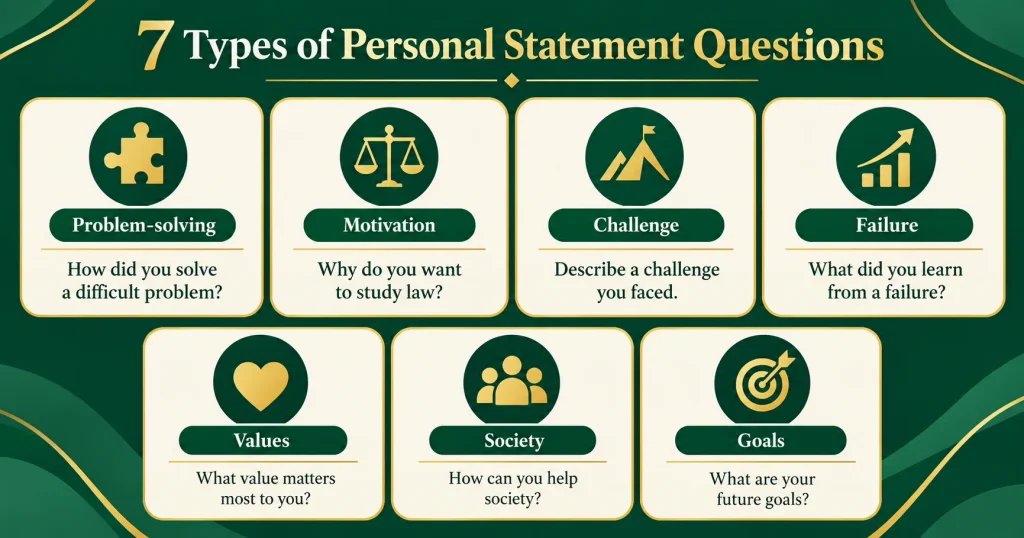
HEC does not publish past personal statement questions, so nobody can promise you the exact question. But questions in the personal statement for LAT test usually come from a few families. Prepare for the families, and no question will feel completely new.
| Type | Practice question | What it really asks |
|---|---|---|
| Problem-solving | What role can you play in solving problems in your life? | Can you act, not just complain? |
| Motivation | Why do you want to study law? | Is your reason real and personal? |
| Challenge | Describe a challenge you faced and how you handled it. | How do you behave under pressure? |
| Failure | What did you learn from a failure? | Can you admit a mistake and grow? |
| Values | What does honesty mean to you? | What do you stand for? |
| Society | How can you contribute to society? | Do you think beyond yourself? |
| Goals | Where do you see yourself in ten years? | Do you have a direction? |
The first question is based on HEC’s sample. The rest are practice questions written by Qanooni Dastak, not past-paper questions. Practise at least one answer from each family.
How to Structure a Personal Statement for LAT Test
You have 200 words, so every line must work. Do not start writing the moment you read the question. Spend two minutes on your rough sheet and answer four small questions:
- What is my direct answer, in one sentence?
- Which one real moment from my life proves it?
- What did that moment teach me?
- How does that lesson shape my future?
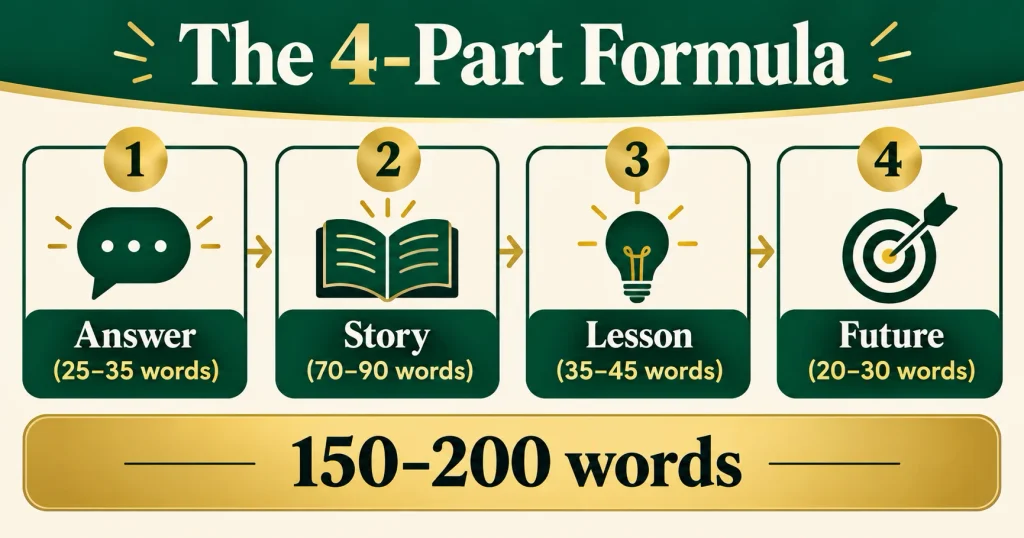
Those four answers become your four parts. We call it the Answer, Story, Lesson, Future formula.
| Part | What to write | Words |
|---|---|---|
| 1. Answer | Answer the question directly in one or two sentences | 25–35 |
| 2. Story | One real moment: where it happened, what went wrong, what you did | 70–90 |
| 3. Lesson | What changed in you because of it | 35–45 |
| 4. Future | Link the lesson to your goals or to law, without big promises | 20–30 |
| Total | 150–200 |
Write in three or four short paragraphs. Use “I” naturally and choose simple, exact words over difficult ones. A small story is fine. A family matter, a problem at college or a promise you kept can be stronger than any award, as long as it is true.
Personal Statement for LAT Test Samples in English
These samples are original and written for practice. Learn the method from them, then write your own story. A memorized answer rarely fits the exact question on your paper. If you want to sharpen your grammar too, practise our LAT English MCQs.
Sample 1: Your Role in Solving Problems (HEC Question)
Question: What role can you play in solving problems in your life?
I believe I can solve problems by listening first and then building a fair plan.
In our street, six families share one water motor. Every summer, the same question started fights: whose turn is it? Last year, two neighbours stopped speaking to each other over a few buckets of water.
I was seventeen, but I could see that the real problem was not the water. It was the lack of a fair system. With my father’s permission, I visited every house, noted when each family needed water most and made a simple timetable. I pasted it near the motor and shared it in our street’s WhatsApp group. One family felt their time was too early, so we changed it together. Within two weeks, the arguments stopped.
This taught me that most problems are not solved by shouting. They are solved by finding the real cause and giving everyone a fair hearing. That is the role I want to play, at home and later as a lawyer.
(166 words)
Why this works:
- The first line answers the question directly.
- The story is small, real and easy to believe.
- The lesson connects naturally to law, without big promises.
Sample 2: Why Do You Want to Study Law?
Question: Why do you want to study law?
I want to study law because I have seen what happens when people do not know their rights.
When my grandfather passed away, my aunt was told that daughters do not take a share in land. She believed it for three years. She did not want to fight her own brothers, and she did not know whom to ask. Finally, a lawyer explained to her, in simple words, that the law gives her a fixed share. He did not shout or threaten anyone. He just explained. Within months, the family sat together and settled the matter peacefully.
I was in class ten then, but I still remember her face that evening. It was not only relief. It was dignity.
That day I learned that legal knowledge can protect a family without breaking it. I want to become that kind of lawyer: one who explains the law clearly, especially to women who are told to stay silent.
(156 words)
Why this works:
- It avoids the overused “since my childhood” opening.
- One moment, the aunt’s face, carries real emotion.
- The goal is specific and realistic.
Sample 3: A Challenge You Faced
Question: Describe a challenge you faced and what you learned from it.
The biggest challenge I faced was my fear of speaking in front of people.
In my first year of college, our English teacher asked each student to give a three-minute presentation. When my turn came, my hands shook, I forgot my points and I sat down after one minute. Some classmates laughed.
That evening, I decided fear would not make my choices for me. For two months, I practised every night in front of a mirror and recorded myself on my phone. I also volunteered to read the morning assembly announcements, even though my voice still shook at first.
At the end of the year, I gave a five-minute talk on road safety without notes. It was not perfect, but I finished it with confidence.
This challenge taught me that courage is not the absence of fear. It is preparation. As a law student, I will need to speak clearly for others, and I am ready to keep practising.
(159 words)
Why this works:
- It admits a real weakness honestly.
- It shows exactly what the writer did to improve.
- The ending turns the lesson into a reason for studying law.
Personal Statement Samples in Urdu (اردو)
HEC allows the personal statement in Urdu. If you write faster in Urdu, use it, but do not mix English and Urdu inside one answer. These two samples follow the same formula.
سوال: آپ اپنی زندگی کے مسائل حل کرنے میں کیا کردار ادا کر سکتے ہیں؟
میں سمجھتا ہوں کہ مسئلہ حل کرنے کا پہلا قدم شکایت نہیں، ذمہ داری قبول کرنا ہے۔
ہماری گلی میں کئی مہینوں سے کوڑا جمع ہو رہا تھا۔ ہر گھر دوسرے کو قصوروار ٹھہراتا تھا، اور بارش کے بعد بدبو اور مچھر بڑھ گئے۔ جب میری چھوٹی بہن بیمار ہوئی تو میں نے فیصلہ کیا کہ اب صرف باتیں کافی نہیں۔
میں نے والد صاحب کی اجازت سے ہر گھر کا دروازہ کھٹکھٹایا اور ایک سادہ تجویز دی: ہر گھر ہر مہینے تھوڑی سی رقم دے اور ہم مل کر ایک صفائی والا رکھ لیں۔ کچھ لوگ پہلے ہچکچائے، مگر جب سارا حساب سب کے سامنے رکھا گیا تو اکثر گھر راضی ہو گئے۔ آج ہماری گلی صاف ہے۔
اس تجربے نے مجھے سکھایا کہ لوگ تب ساتھ دیتے ہیں جب فیصلہ شفاف اور منصفانہ ہو۔ یہی سوچ لے کر میں قانون پڑھنا چاہتا ہوں، تاکہ آگے چل کر بڑے مسائل بھی انصاف اور صبر سے حل کر سکوں۔
سوال: آپ قانون کیوں پڑھنا چاہتے ہیں؟
میں قانون اس لیے پڑھنا چاہتا ہوں کہ میں نے دیکھا ہے کہ ایک لکھا ہوا کاغذ کسی خاندان کی روزی بچا سکتا ہے۔
میرے والد کی ایک چھوٹی سی دکان ہے۔ ایک دن مالکِ دکان نے اچانک کہا کہ ایک ہفتے میں دکان خالی کر دو۔ گھر میں سب پریشان تھے، کیونکہ یہی دکان ہماری آمدنی تھی۔ والد صاحب ایک وکیل کے پاس گئے۔ وکیل نے کرایہ نامہ غور سے پڑھا اور سکون سے سمجھایا کہ معاہدے کی مدت ابھی باقی ہے اور یوں اچانک کسی کو نکالا نہیں جا سکتا۔ بات چیت سے معاملہ ٹھنڈا ہو گیا اور دکان بچ گئی۔
اس دن مجھے سمجھ آئی کہ قانون صرف عدالتوں کی بات نہیں، یہ عام آدمی کی حفاظت بھی ہے۔
میں ایسا وکیل بننا چاہتا ہوں جو چھوٹے دکانداروں اور عام لوگوں کو ان کے حقوق آسان زبان میں سمجھا سکے، تاکہ کوئی ڈر کر اپنا حق نہ چھوڑے۔
طالبات “چاہتا ہوں” کی جگہ “چاہتی ہوں” اور “سمجھتا ہوں” کی جگہ “سمجھتی ہوں” لکھیں۔ یہ نمونے صرف مشق کے لیے ہیں، امتحان میں اپنی کہانی لکھیں۔
Writing in Urdu? Polish your spelling and grammar with our LAT Urdu MCQs.
From Weak to Strong: One Answer, Fixed Line by Line
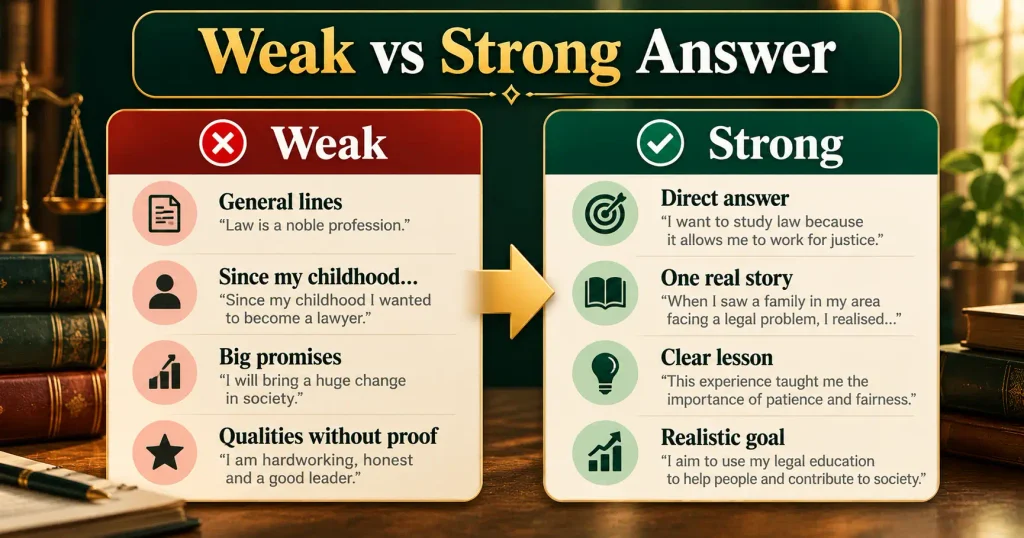
Here is the kind of personal statement for LAT test answer that many students write for “Why do you want to study law?”:
“Law is a very noble profession. Since my childhood, I have dreamed of becoming a lawyer. Lawyers get respect in society and they help poor people. There is a lot of injustice in Pakistan and I want to remove all injustice from the country. I am very hardworking, honest and intelligent, so I will become a great lawyer. That is why I want to study law.”
Nothing in it is wrong. But nothing in it is personal either. Any student could have written it.
| Weak line | The problem | Better approach |
|---|---|---|
| “Law is a very noble profession.” | General; could be anyone’s answer | Give your own reason in the first line |
| “Since my childhood, I have dreamed…” | Overused, with no proof | Name one real moment that started your interest |
| “I want to remove all injustice from the country.” | Too big to believe | Set a real goal you can work towards |
| “I am very hardworking, honest and intelligent.” | Claims without proof | Show one quality through something you did |
| “That is why I want to study law.” | Repeats and adds nothing | End with your lesson and the lawyer you want to be |
Now read Sample 2 again. Same question, but one story, one lesson and one realistic goal. That is the difference between a forgettable answer and one that stays with the examiner.
What If the Question Surprises You?
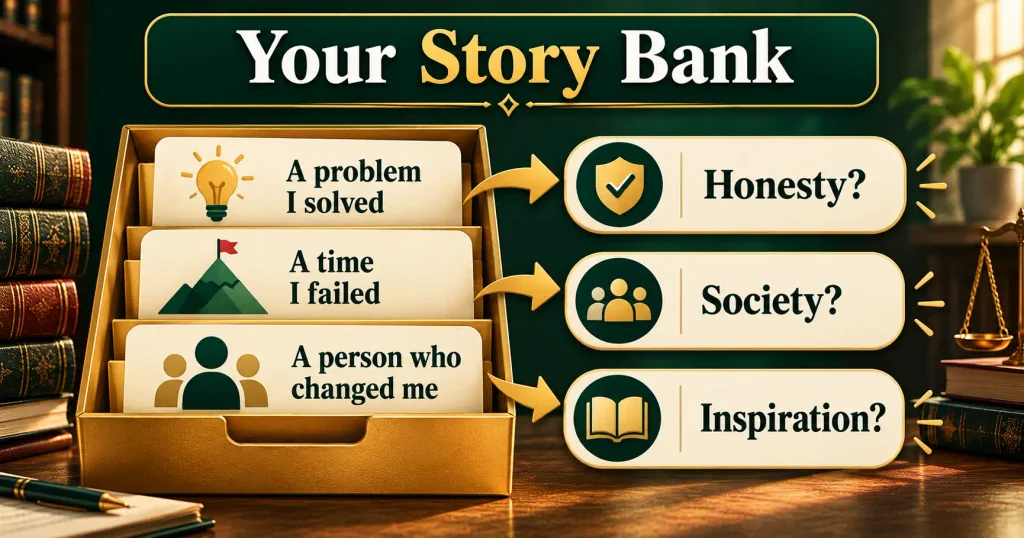
This is the skill that matters most. You open the paper and the question is one you never practised. Do not panic. You need a bridge, not a new story.
Before the test, build a story bank of three true stories:
- A problem you solved, at home, in your street or at college
- A time you failed or struggled, and what you did next
- A person or moment that changed how you think
In the exam hall, read the question twice and ask: which value does it want to see? Fairness, courage, honesty or responsibility? Pick the story that shows that value best, and write a first line that uses the question’s own words.
| Surprise question | Story from your bank | Your first line |
|---|---|---|
| What does honesty mean to you? | The failed presentation | “To me, honesty means admitting I am not ready, and then doing the work.” |
| How can you contribute to society? | The water motor timetable | “I can contribute by solving shared problems fairly, starting in my own street.” |
| Who has inspired you the most? | The lawyer who helped your aunt | “The person who inspired me most was a lawyer who explained my aunt’s rights in simple words.” |
The same three stories, three different answers. Prepare your bank once, and you can face almost any personal statement for LAT test question with confidence.
8 Mistakes That Quietly Cost You Marks
Avoid these eight mistakes in your personal statement for LAT test:
- Copying a memorized answer that does not match your question.
- Hiding the answer. Answer the question before you start the story.
- Crossing 200 words. Count words while practising until you can feel the limit.
- Inventing achievements. Fake internships or awards can backfire. A small true story is stronger.
- Listing qualities without proof. “Hardworking” means nothing until a story shows it.
- Starting with clichés, such as “Since my childhood”.
- Writing an essay instead. Statistics and “In today’s world” do not belong here.
- One long block of text. Use short paragraphs, clean spelling and one language.
Practise Now: 40-Minute Timer and Word Counter
Reading samples is not enough; you need practice under time pressure. Practise your personal statement for LAT test with the tool below: pick a question, start the timer and write. The counter turns red if you cross 200 words, and your draft stays saved on your own device.
Personal Statement Practice: Timer + Word Counter
Pick a question, start the timer and write. Works in English and Urdu.
The tool ends with a 60-second check. Tick every box before you call an answer finished.
For the MCQ part of the test, practise subject by subject with our free LAT Test MCQs.
Frequently Asked Questions
What is a personal statement for LAT test?
It is the short personal answer in the written part of the LAT. HEC asks one question about you, such as how you solve problems, and you answer it from your own life. It carries 10 marks. The best answers tell one true story and explain what it taught you.
How many marks and words is the LAT personal statement?
It carries 10 of the LAT’s 100 marks. The HEC/ETC advertisement for LAT 2026 sets a maximum of 200 words, the same as the essay. Aim for about 150 to 190 words, and always follow the instructions printed on your paper.
Can I write my personal statement in Urdu?
Yes. HEC allows both the essay and the personal statement in English or Urdu. Choose the language in which you write clearly and quickly, and do not switch languages halfway through an answer. If you choose Urdu, keep the same Answer, Story, Lesson, Future formula.
Is the personal statement question the same every year?
There is no official list of past questions. HEC’s published sample asks what role you can play in solving problems in your life, but your paper may ask something else. Prepare for question types and keep three true stories ready.
Can I memorize a sample and write it in the exam?
Use samples to learn the method, not to copy. A memorized answer rarely fits the exact question in the personal statement for LAT test. Learn the Answer, Story, Lesson, Future formula and practise your own stories until you can shape them to any question in 12 minutes.
Do I have to explain why I want to become a lawyer?
Only if the question asks for it. Always answer the question that is actually printed. A short, natural link to law in your last lines can help, because you are applying for an LLB. But forcing “why law” into every answer can make you miss the real question.
Can I write about a failure or a weakness?
Yes. A failure often makes the strongest answer, because it shows honesty and growth. Keep the failure part short, spend more words on what you did next and what you learned, and avoid topics that are too private to share.
How much time should I give the personal statement?
HEC gives 40 minutes for the essay and personal statement together. A practical split is about 24 minutes for the essay, 12 for the personal statement and 4 for checking both. Never leave the personal statement without enough time to finish it.
Conclusion: Your Story Deserves Those 10 Marks
Ten marks can feel small. But when you need 50 marks to pass, those 10 can be the difference. The personal statement for LAT test is the one part of the paper where nobody else’s answer can beat yours, because nobody else has lived your story.
So build your story bank, learn the Answer, Story, Lesson, Future formula and practise with the timer until 200 words feel comfortable. On test day, read the question twice, answer it directly and tell one honest story well.
Your story has value. Write it with confidence, and let it earn its 10 marks.
Disclaimer: This article is for awareness and test preparation only. It is not an official HEC document and does not promise any score. Test rules can change, so always follow the latest HEC/ETC notice and the instructions printed on your paper.