
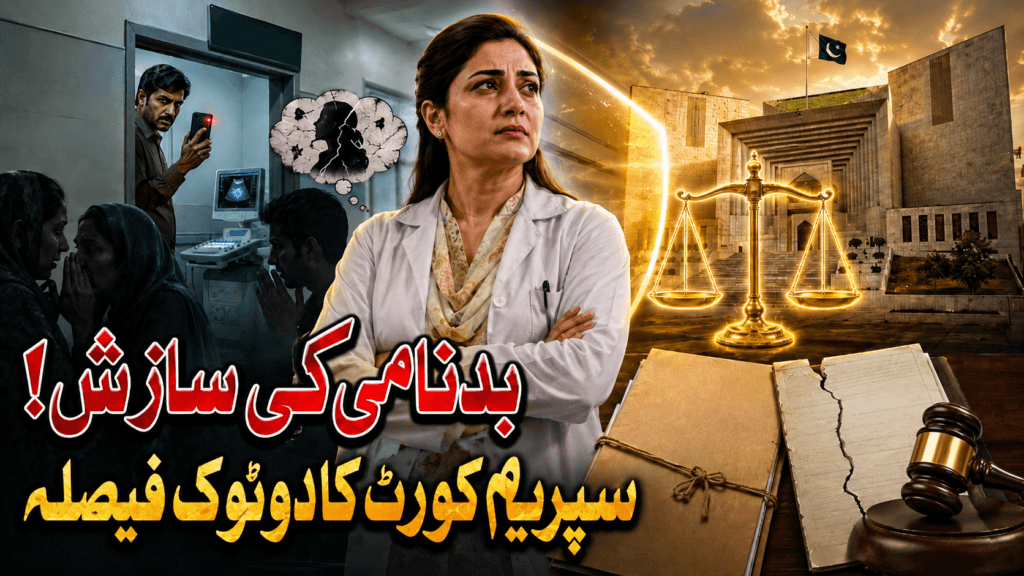
A workplace should be a place where a person can earn a living with dignity. It should not become a space of fear, humiliation, rumours or character assassination. Yet this case shows how repeated verbal abuse, false allegations and an unauthorised video can damage not only a woman’s reputation but also her confidence and professional standing.
The Supreme Court’s judgment in Muhammad Din v. Province of Punjab and others, reported as PLD 2025 Supreme Court 354, gives an important explanation of Harassment at Workplace in Pakistan. The Court made it clear that harassment is not always about sexual desire. In many cases, it is about power, control and an attempt to weaken a woman’s authority.
This decision is especially important because the complainant was a senior lady doctor, while the accused employee was her driver. The case proves that formal rank alone does not decide who can exercise power. A junior employee can also create a hostile environment through rumours, disrespect, gender prejudice and social pressure.
The case was decided by a two-member bench comprising Justice Syed Mansoor Ali Shah and Justice Aqeel Ahmed Abbasi on 12 February 2025. Justice Syed Mansoor Ali Shah authored the judgment.
Table of Contents
IRAC Analysis: Why Compulsory Retirement Was Upheld
| Element | Simple Explanation |
|---|---|
| Issue | Whether the driver’s verbal abuse, character assassination, unauthorised recording, false rumours and defiance amounted to workplace harassment, and whether compulsory retirement was lawful. |
| Rule | Sections 2(h) and 4(4)(ii) of the Protection against Harassment of Women at the Workplace Act, 2010 allow action against harassment and permit a major penalty where misconduct is proved. |
| Analysis | The Ombudsperson examined the evidence and found the allegations proved. The Governor and Lahore High Court upheld that finding. The Supreme Court found no jurisdictional error, illegality or procedural irregularity. |
| Conclusion | Leave to appeal was refused, the petition was dismissed and the penalty of compulsory retirement remained effective. |
Judgment at a Glance: Supreme Court Workplace Harassment Case
| Detail | Information |
|---|---|
| Case Title | Muhammad Din v. Province of Punjab through Secretary, Population Welfare, Lahore and others |
| Citation | PLD 2025 Supreme Court 354 |
| Court | Supreme Court of Pakistan |
| Bench | Justice Syed Mansoor Ali Shah and Justice Aqeel Ahmed Abbasi |
| Author Judge | Justice Syed Mansoor Ali Shah |
| Case Number | C.P.L.A. No. 2541 of 2023 |
| Decision Date | 12 February 2025 |
| Earlier Judgment | Lahore High Court judgment dated 30 March 2023 in W.P. No. 39095 of 2020 |
| Complainant | Dr. Sidra Zafar, a lady doctor |
| Petitioner | Muhammad Din, her driver |
| Relevant Law | Protection against Harassment of Women at the Workplace Act, 2010 |
| Relevant Provisions | Sections 2(h) and 4(4)(ii) |
| Major Penalty | Compulsory retirement from service |
| Final Result | Petition dismissed and leave to appeal refused |
The Supreme Court declined to interfere because no jurisdictional error, illegality or procedural irregularity was established in the Lahore High Court judgment.
How Harassment at Workplace in Pakistan Began
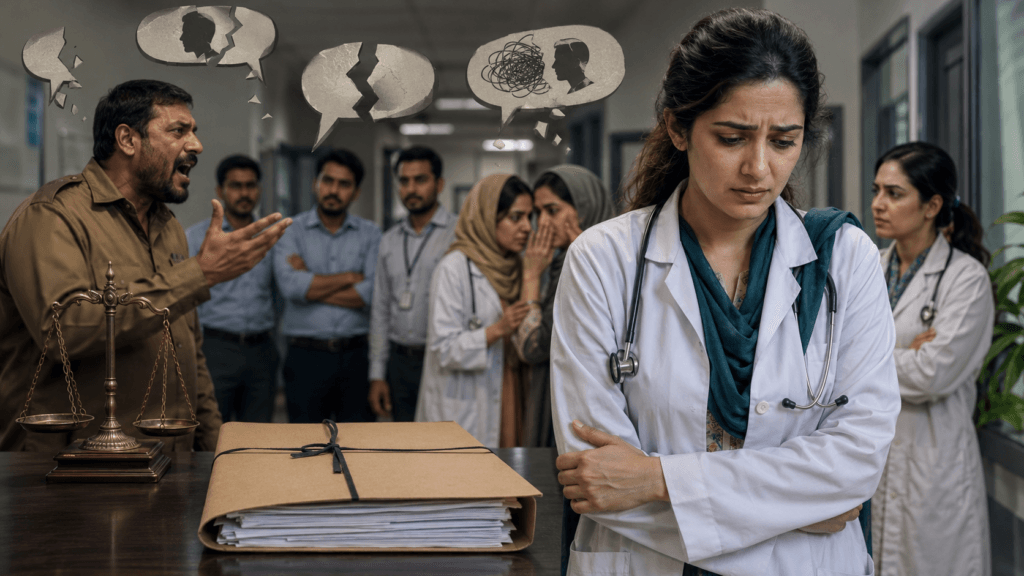
Dr. Sidra Zafar filed a complaint before the Ombudsperson, Punjab, on 30 December 2019. She alleged that Muhammad Din had repeatedly subjected her to abuse, verbal assaults and character assassination.
According to the complaint, he used indecent language, behaved unethically with female patients and spread malicious rumours that the doctor had affairs with male colleagues. He also made derogatory remarks about her in front of other staff members.
These were not described as one careless comment or an isolated disagreement. The complaint presented a continuing pattern that allegedly damaged her dignity and created an unsafe professional environment.
This factual background is central to understanding Harassment at Workplace in Pakistan. Harmful conduct does not become acceptable merely because it does not involve physical touching. Words, rumours, gestures, recordings and gender-based humiliation can also interfere with work and create an intimidating or offensive workplace.
The Ultrasound Room Incident
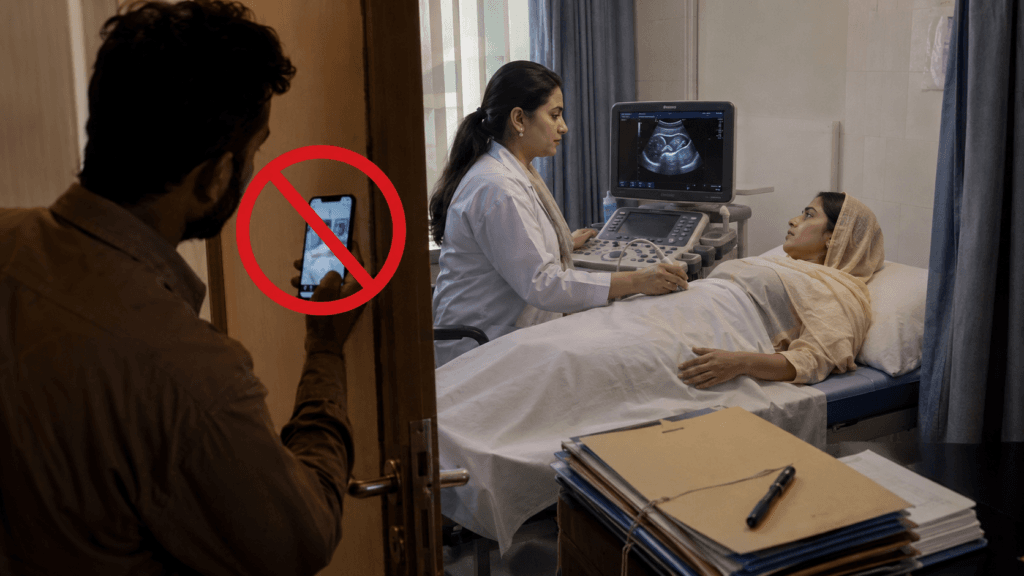
The most serious incident occurred on 26 October 2019. Dr. Sidra was performing an ultrasound examination on a patient when Muhammad Din entered the ultrasound room without lawful authority.
He recorded the medical procedure without the consent of the doctor. According to the judgment, he later circulated the video and used it to make false and defamatory allegations against her.
He suggested that Dr. Sidra had improper relationships with different men. The apparent purpose and effect of this conduct was to damage her dignity, reputation and professional standing.
This part of the case shows why Harassment at Workplace in Pakistan can involve privacy, reputation and professional safety at the same time. Secretly recording a medical procedure may affect the doctor, the patient and the institution.
When such a recording is combined with false and sexualised rumours, it may create a deeply hostile workplace.
Warnings, Transfer and Open Defiance
The misconduct allegedly continued despite several warnings. Dr. Sidra did not have direct authority to remove Muhammad Din from service. She therefore asked the department to transfer him.
Even after a transfer order was issued, Muhammad Din refused to comply with it. He also withheld the official vehicle’s keys and logbook from the newly appointed driver.
This behaviour was relevant because it showed continued defiance of institutional authority. It was not only a personal dispute between two employees.
The Supreme Court used this situation to explain a wider point. Although Dr. Sidra was senior in the official hierarchy, the driver could still exercise informal power through gender prejudice, social support and rumours.
Therefore, Harassment at Workplace in Pakistan is not limited to situations where a senior officer harasses a junior employee. A subordinate may also create a hostile work environment for a senior officer.
Proceedings Before the Punjab Ombudsperson
After receiving the complaint, the Punjab Ombudsperson issued a show-cause notice to Muhammad Din. He denied the allegations against him.
The Ombudsperson then examined the evidence placed before the forum. After considering the material, the allegations were found to have been proved.
Muhammad Din’s conduct was held to fall within the definition of harassment under section 2(h) of the Protection against Harassment of Women at the Workplace Act, 2010.
On 18 March 2020, the Ombudsperson imposed the major penalty of compulsory retirement from service under section 4(4)(ii) of the Act.
The legal process is important for anyone trying to understand Harassment at Workplace in Pakistan. It also shows that Harassment at Workplace in Pakistan complaints require notice, evidence and a reasoned finding.
A complaint does not automatically result in punishment. The accused person must receive notice and an opportunity to answer. The competent authority must examine the evidence and decide whether the allegations have been proved.
In this case, the finding against Muhammad Din survived every later legal challenge.
From the Governor to the Supreme Court
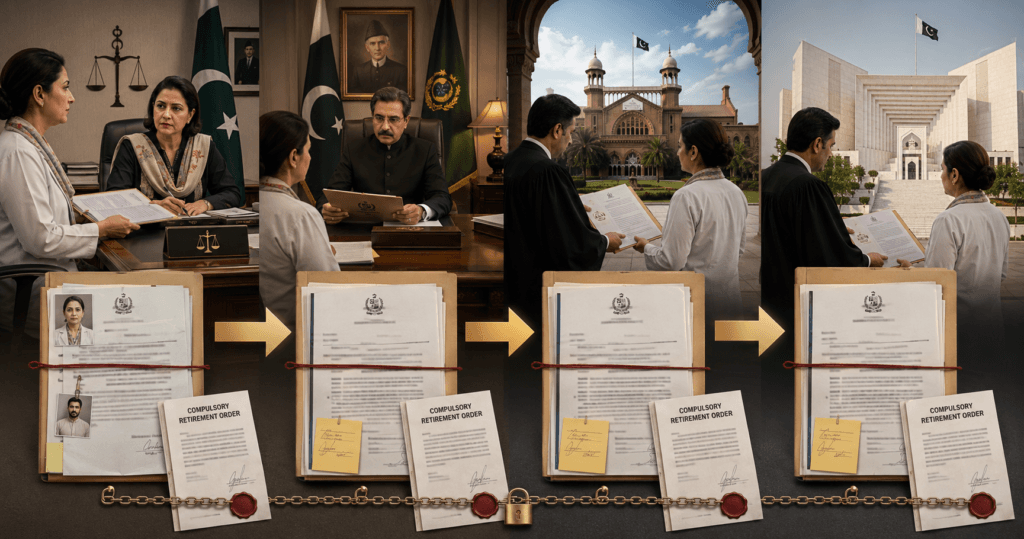
Muhammad Din challenged the Ombudsperson’s order by filing a representation before the Governor of Punjab.
The Governor dismissed his representation on 6 August 2020.
He then filed a constitutional petition before the Lahore High Court, Lahore. The High Court dismissed his writ petition on 30 March 2023.
After losing before the Lahore High Court, Muhammad Din approached the Supreme Court through a petition for leave to appeal.
The Supreme Court heard his counsel and examined the Lahore High Court judgment and the available record. The Court found that the petitioner’s objections had already been convincingly answered by the High Court.
His counsel could not point out any jurisdictional error, illegality or procedural irregularity in the judgment.
The Court therefore refused leave to appeal and dismissed the petition.
The result was that the finding of harassment and the penalty of compulsory retirement remained intact. This final outcome strengthens the enforcement of Harassment at Workplace in Pakistan by showing that courts will not interfere merely because a punished employee disagrees with the factual findings.
Why the Court Treated Harassment as a Systemic Problem
The Supreme Court noted that more than one in five workers worldwide—22.8%, or approximately 743 million people—had experienced workplace violence or harassment.
Women were slightly more likely than men to face harassment during their careers.
The judgment also referred to Pakistan’s 2024 Global Gender Gap ranking of 145 out of 146 countries. Pakistan was placed at number 142 regarding economic participation.
These figures helped the Court explain that Harassment at Workplace in Pakistan is not merely a personal quarrel between two employees. It can restrict women’s professional and economic participation.
When women fear humiliation, rumours, retaliation or character assassination, they may be discouraged from joining or remaining in the workforce.
Legal Meaning of Harassment at Workplace in Pakistan
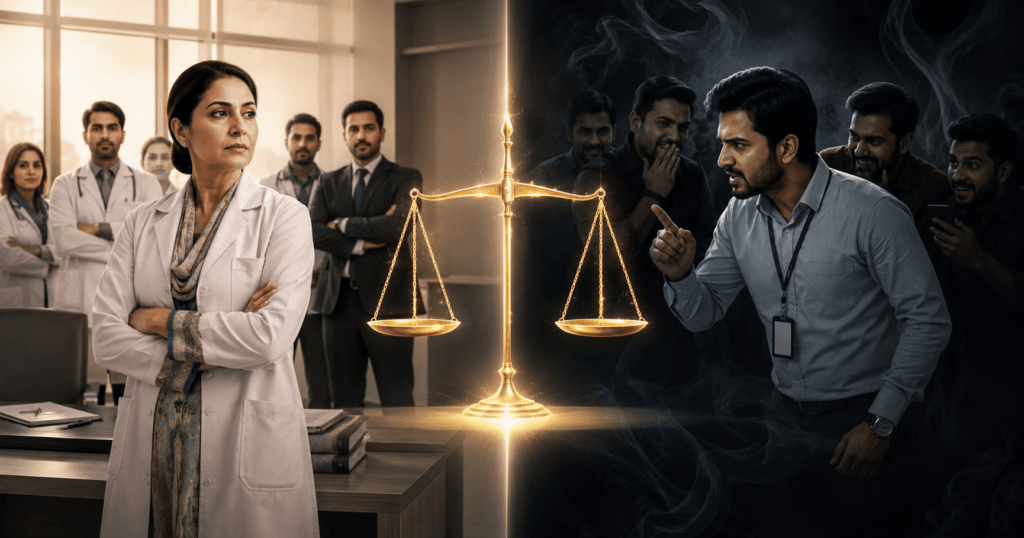
The most memorable principle in the judgment is that sexual harassment is about power.
The Court explained that workplace harassment often grows from control, dominance, discrimination and deeply rooted gender hierarchies. It is not necessary that every case should involve sexual desire or a direct demand for sexual favours.
The Court discussed two recognised forms of workplace harassment.
Quid Pro Quo Harassment
“Quid pro quo” means “this for that.”
It occurs where employment benefits, promotions or protection from negative consequences are linked with a demand for sexual favours.
For example, a senior officer may offer a promotion in exchange for an improper relationship or threaten an employee with dismissal for refusing an unwanted demand.
Hostile Work Environment
A hostile work environment is created when unwanted sexual or gender-based conduct makes the workplace intimidating, humiliating, offensive or difficult to work in.
This form of harassment may include:
- abusive remarks;
- sexualised rumours;
- gender-based insults;
- offensive messages;
- humiliating gestures;
- stalking or cyberstalking;
- repeated character assassination;
- unauthorised recordings;
- conduct intended to destroy professional confidence.
The present case was important because the alleged harasser was lower in the formal workplace hierarchy.
The Supreme Court explained that informal power may come from patriarchal attitudes, gender privilege and cultural norms that treat a woman’s authority as less legitimate.
A subordinate may use insults, rumours or public humiliation to challenge a woman holding a senior position.
This interpretation gives Harassment at Workplace in Pakistan a realistic meaning. The law does not examine only job titles. It also considers how the conduct affects dignity, authority, work performance and the overall workplace environment.
The Court observed that even a junior employee may become a harasser where gender privilege, social reinforcement and cultural attitudes enable him to undermine a senior woman.
Protection Under the 2010 Act and 2022 Amendment
The Protection against Harassment of Women at the Workplace Act, 2010 aims to provide workplaces free from harassment, abuse and intimidation.
It creates complaint mechanisms through workplace inquiry committees and the office of the Ombudsperson.
The Protection against Harassment of Women at the Workplace (Amendment) Act, 2022 widened the scope of the law.
The definition of “employee” now includes broader groups, such as:
- informal workers;
- freelancers;
- domestic workers;
- interns;
- trainees;
- persons working without formal written contracts.
The definition of “workplace” was also widened. It may cover various places where professional services are performed, including educational institutions, courts, highways, studios, sporting facilities and gymnasiums.
Harassment may now include:
- stalking;
- cyberstalking;
- verbal communication;
- written communication;
- visual communication;
- physical conduct;
- sexually demeaning attitudes;
- gender-based discrimination that may not be sexual.
The wider framework of Harassment at Workplace in Pakistan protects any person, including men, women and transgender persons.
The law recognises that women and transgender persons may remain particularly vulnerable to harassment and discriminatory workplace behaviour.
Constitutional Rights Behind Workplace Protection
The Supreme Court connected workplace safety with fundamental and constitutional principles.
Article 14 protects human dignity.
Article 18 supports the right to lawful work and professional activity.
Article 25 guarantees equality before the law and equal protection of the law.
The Court also referred to Article 34, which requires the State to take steps for the full participation of women in all spheres of national life.
A safe workplace is not an employer’s favour. Effective protection against Harassment at Workplace in Pakistan supports the right to earn a livelihood without fear.
It also prevents harassment from forcing women out of professional and economic life.
A workplace free from abuse, intimidation and gender discrimination is connected with dignity, equality, liberty and social justice.
International Principles Considered by the Court
The Supreme Court referred to several international legal instruments, including:
- ILO Violence and Harassment Convention No. 190;
- Convention on the Elimination of All Forms of Discrimination Against Women;
- Universal Declaration of Human Rights;
- International Covenant on Civil and Political Rights;
- International Covenant on Economic, Social and Cultural Rights.
The judgment also mentioned leading decisions from the United States, India, Canada and South Africa.
These international decisions recognise harassment as a question of discrimination, dignity, control, power and workplace safety.
They also recognise that a hostile working environment may amount to unlawful workplace harassment even where an employee does not suffer direct financial loss.
Recommendation to Ratify ILO Convention No. 190
Pakistan had not ratified the ILO Violence and Harassment Convention No. 190 when this judgment was issued.
The Supreme Court observed that ratification could strengthen Pakistan’s legal protections against workplace violence and harassment. It could also reinforce constitutional guarantees of dignity, equality and non-discrimination.
The Court recommended that the ratification of the Convention should be considered.
It also directed that a copy of the judgment be sent to the Attorney-General for Pakistan so that the recommendation could be considered by the relevant authorities.
This gave Harassment at Workplace in Pakistan a wider policy dimension beyond the dispute between Dr. Sidra Zafar and Muhammad Din.
Why the Supreme Court Refused to Interfere
The Supreme Court was not conducting a fresh workplace inquiry.
The Ombudsperson had already examined the evidence and found the allegations proved. The Governor of Punjab had rejected the representation, and the Lahore High Court had upheld the decision.
To obtain interference from the Supreme Court, Muhammad Din needed to identify a serious legal defect, such as:
- lack of jurisdiction;
- violation of a mandatory procedure;
- denial of a fair hearing;
- material illegality;
- serious procedural irregularity.
The Supreme Court found no such defect.
The petitioner’s arguments had already been properly answered by the Lahore High Court. Therefore, there was no legal basis for reopening the entire matter.
The petition was dismissed, and leave to appeal was refused. The judgment confirms that findings under the law governing Harassment at Workplace in Pakistan will not be disturbed without a valid legal reason.
Practical Lessons for Employees and Employers
A person facing workplace harassment should preserve all available evidence, including:
- messages and emails;
- screenshots;
- audio or video recordings;
- witness names;
- complaint copies;
- transfer requests;
- official correspondence;
- dates and locations of incidents;
- medical or psychological records where relevant.
The complaint should clearly explain what happened, when it happened, who witnessed it and how the conduct affected the complainant’s dignity, work performance or workplace environment.
Employers should maintain an active inquiry committee, display the required code of conduct, protect complainants from retaliation and respond without unnecessary delay.
An accused employee must receive notice and a fair opportunity to answer the allegations.
However, a simple denial may not be sufficient where the evidence proves a repeated course of abuse, intimidation or humiliation.
For institutions dealing with Harassment at Workplace in Pakistan, prompt and fair action is essential.
The wider lesson from Harassment at Workplace in Pakistan is that rumours, secret recordings, gender-based insults and public humiliation cannot be used to destroy another person’s dignity or professional authority.
Final Supreme Court Ruling on Harassment at Workplace in Pakistan

The Supreme Court found no jurisdictional error, illegality or procedural irregularity in the Lahore High Court judgment.
It refused leave to appeal and dismissed Muhammad Din’s petition.
As a result, the Ombudsperson’s finding of harassment and the major penalty of compulsory retirement remained in force.
The decision is now an important authority on Harassment at Workplace in Pakistan, particularly where a junior employee uses informal gender power, rumours and humiliation to create a hostile workplace for a senior female officer.
The judgment sends a clear message: workplace harassment is not limited to physical acts or direct sexual demands. It may also arise from character assassination, defamatory rumours, unauthorised recordings, verbal abuse and gender-based attempts to weaken a woman’s professional authority.
Frequently Asked Questions
1. What conduct was treated as harassment in this case?
The complaint included verbal abuse, indecent language, character assassination, malicious rumours about alleged affairs, derogatory remarks, unauthorised entry into an ultrasound room, non-consensual video recording and circulation of the video with defamatory allegations.
2. Can a junior employee harass a senior officer?
Yes. The Supreme Court explained that harassment is not controlled only by official rank. A junior employee may exercise informal power through gender privilege, social pressure, rumours and cultural attitudes.
3. Does workplace harassment always involve a sexual demand?
No. Harassment at Workplace in Pakistan may include gender-based discrimination, sexually demeaning conduct, hostile remarks, stalking, cyberstalking or other behaviour that creates an intimidating, hostile or offensive environment.
4. What punishment was imposed in this case?
The Punjab Ombudsperson imposed compulsory retirement from service as a major penalty under section 4(4)(ii) of the Protection against Harassment of Women at the Workplace Act, 2010.
5. Which forums examined the matter?
The matter was examined by the Punjab Ombudsperson, the Governor of Punjab, the Lahore High Court and finally the Supreme Court of Pakistan.
6. Why did the Supreme Court dismiss the petition?
The petitioner could not identify any jurisdictional error, illegality or procedural irregularity in the Lahore High Court judgment. The Supreme Court therefore found no lawful ground to interfere.
7. Who is protected by the amended workplace harassment law?
The amended framework uses broader language and protects any person, including men, women and transgender persons. It also extends protection to wider categories of employees and workplaces.
Disclaimer
This article explains a reported Supreme Court judgment for public legal awareness. It is not legal advice and does not replace advice from a qualified lawyer.
Every workplace harassment complaint depends on its own facts, evidence, applicable service rules and procedural history.