
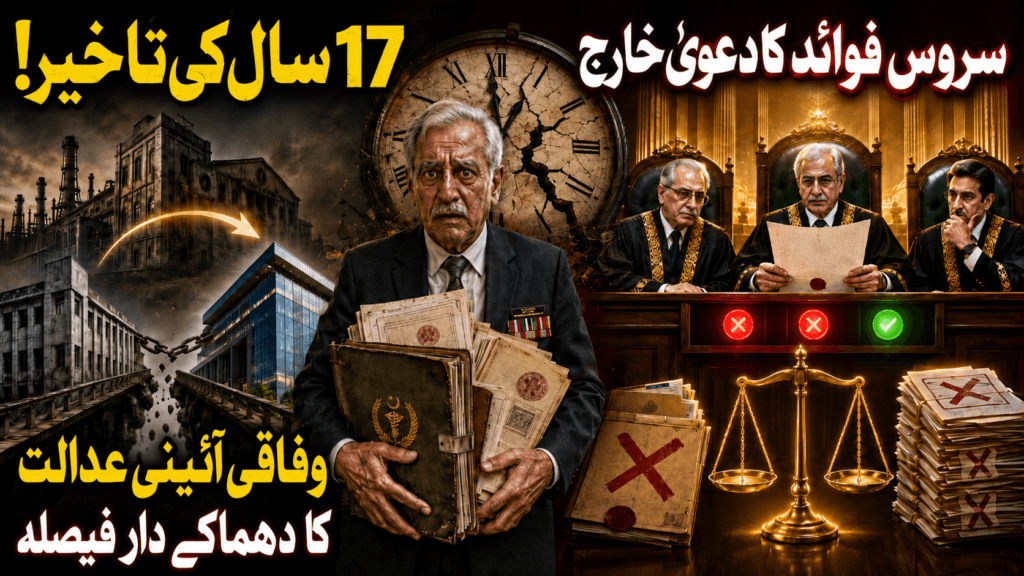
A government officer may believe that a lawful service claim can be raised at any time, especially when it concerns seniority, pay fixation or previous service. This important judgment shows why that belief can be dangerous. A claim may appear fair, but delay, silence and repeated applications can still destroy the legal remedy.
The case concerns a qualified doctor who completed more than nine years of compulsory service in the Pakistan Army and later joined the Oil and Gas Development Corporation. He asked that his military service be counted towards seniority, pay and other employee benefits. The Federal Constitutional Court examined Section 9A of the Compulsory Service in the Armed Forces Ordinance, 1971, OGDCL’s conversion from a statutory corporation into a public limited company, and the legal effect of a seventeen-year delay.
Table of Contents
IRAC: Why the 17-Year Delay Defeated the Employee Benefits Claim
| Element | Explanation |
|---|---|
| Issue | Whether the respondent’s compulsory Army service could be counted towards seniority, pay fixation and employee benefits in OGDCL, and whether his constitutional petition was maintainable after about seventeen years. |
| Rule | Section 9A gives credit for compulsory Armed Forces service when the person later enters employment of the Federal Government, a Provincial Government, a government-controlled organisation, a statutory body or a local body. Constitutional relief may also be refused because of delay and laches. |
| Analysis | OGDCL in its present form was a public limited company and did not automatically fall within the entities listed in Section 9A. The respondent’s claim had already been rejected in 1994 and was not a vested right preserved at the time of corporatisation. His later applications did not create a fresh cause of action. |
| Conclusion | The appeal was allowed. The Sindh High Court order was set aside, and the respondent’s constitutional petition was dismissed by a majority of two to one. |
Judgment at a Glance: OGDCL Employee Benefits and Delay Dispute
| Point | Details |
|---|---|
| Case title | Managing Director, OGDCL and others v. Dr. Capt. (R) Nusrat Hussain through legal representatives |
| Court | Federal Constitutional Court of Pakistan, Appellate Jurisdiction |
| Case numbers | C.P.L.A. No. 4245/2022 and C.M.A. No. 10808/2022 |
| Bench | Justice Syed Hasan Azhar Rizvi, Justice Rozi Khan Barrech and Justice Syed Arshad Hussain Shah |
| Author judge | Justice Syed Hasan Azhar Rizvi |
| Date of hearing and short order | 10 June 2026 |
| Impugned order | Sindh High Court, Circuit Court, Hyderabad, dated 26 October 2022 |
| Main law | Section 9A, Compulsory Service in the Armed Forces Ordinance, 1971 |
| Related law | Section 5, Oil and Gas Development Corporation (Re-organization) Ordinance, 2001 |
| Main dispute | Credit of compulsory military service towards seniority, pay fixation and employee benefits |
| Final relief | Appeal allowed, High Court order set aside and writ petition dismissed |
| Majority | Two to one; Justice Syed Arshad Hussain Shah dissented |
The case was heard by a three-member Bench of the Federal Constitutional Court. Justice Syed Hasan Azhar Rizvi wrote the majority reasons.
Background of the Employee Benefits Dispute

Dr. Capt. (R) Nusrat Hussain was a qualified medical practitioner. Through a Call-Up Notice dated 4 March 1981, he was required to serve in the Pakistan Army under the Compulsory Service in the Armed Forces Ordinance, 1971.
He reported to the Commanding Officer on 22 March 1981. After completing nine years and twenty-nine days of service, he was released from the Pakistan Army through a Release Order dated 21 October 1989.
After his release, he applied for the post of Medical Officer in the Oil and Gas Development Corporation. The post had been advertised in 1990. He received an offer letter on 15 February 1992 and joined the Corporation on 18 August 1992.
He later requested that his compulsory military service be counted towards:
- his seniority in the Corporation;
- fixation of his pay;
- previous-service credit; and
- connected employee benefits.
He submitted applications on 7 August 1994, 5 July 2000, 1 December 2002 and 27 January 2009. The Corporation granted him two advance increments, but rejected his larger claim through office memorandums issued in 1994, 2000, 2002 and 2009.
The Corporation’s position was that he had been appointed through a competitive process after accepting the offered salary, allowances and service conditions. A further application, described as an appeal, was rejected on 29 April 2011.
The respondent then filed a constitutional petition before the Sindh High Court. The High Court accepted the petition and directed OGDCL to grant his lawful service entitlements to his family under Section 9A.
OGDCL challenged that decision.
What Section 9A Actually Provides

Section 9A is a beneficial and compensatory provision. It was introduced to protect medical practitioners and other essential persons who were compelled by law to serve in the Armed Forces.
Its purpose is simple: compulsory national service should not unfairly damage a person’s later civil career.
Under Section 9A, the qualifying period of military service may be counted towards seniority and pay when, after release, the person enters employment with:
- the Federal Government;
- a Provincial Government;
- an organisation controlled by the Federal or Provincial Government;
- a statutory body; or
- a local body.
The provision also contains a non-obstante clause. This means it may operate despite anything inconsistent contained in another law dealing with the same subject.
Section 9A therefore recognises that compulsory military service may support a later claim for employee benefits. The section specifically mentions credit towards seniority and fixation of pay.
However, the Court made an equally important point: the benefit is neither automatic nor absolute.
A claimant must strictly satisfy every statutory condition. A court cannot extend the section merely because it is beneficial. The claim must fall within its actual wording and legal framework.
Employee benefits involving retrospective seniority may affect other serving officers. Granting an earlier seniority date can disturb:
- settled seniority lists;
- promotions already granted;
- expectations of other employees;
- departmental service structures; and
- financial liabilities of the employer.
For this reason, the Court held that the rights of the claimant must be balanced against the stability of the service structure.
Readers may review the complete Compulsory Service in the Armed Forces Ordinance, 1971 on the official Pakistan Code website.
Arguments Presented by OGDCL
OGDCL argued that the Sindh High Court had incorrectly interpreted Section 9A.
Its counsel submitted that:
- OGDCL was a public limited company and not one of the bodies expressly listed in Section 9A.
- A court could not insert the words “employment of a corporation” into the provision when the legislature had not used those words.
- The earlier Supreme Court precedent relied upon by the High Court concerned a Punjab Government department, not a public-sector company.
- Two advance increments had already been granted.
- The respondent repeatedly accepted the rejection of his claim and approached the High Court after an unexplained delay.
- The High Court should not have awarded employee benefits without examining OGDCL’s legal status and service structure.
OGDCL therefore requested that the High Court order be set aside.
Arguments Presented by the Respondent
The respondent’s counsel argued that the High Court had correctly applied Section 9A.
He submitted that Dr. Nusrat Hussain had not voluntarily joined the Army. He had been compelled by law to complete national service and had served for more than nine years.
According to the respondent:
- Section 9A was meant to prevent compulsory military service from harming a later civil career;
- the statutory benefit could not be denied merely because he entered OGDCL through regular recruitment;
- his military service should have been counted for seniority and pay;
- the original Corporation had wrongly rejected the claim; and
- his entitlement arose before OGDCL became a public limited company.
The respondent also relied on Section 5 of the 2001 Re-organization Ordinance and argued that his previous rights had passed from the Corporation to OGDCL.
OGDCL’s Change from a Statutory Corporation to a Company
The original Oil and Gas Development Corporation was established under the Oil and Gas Development Corporation Ordinance, 1961. It was a statutory corporation created through legislation.
On 23 October 1997, the Corporation was incorporated as a public limited company under the Companies Ordinance, 1984.
The Oil and Gas Development Corporation (Re-organization) Ordinance, 2001 later gave legal recognition to this conversion with retrospective effect from 23 October 1997.
This change in legal status became central to the employee benefits dispute.
OGDCL argued that after becoming a public limited company, it was no longer a statutory body within the meaning of Section 9A. The Court accepted that OGDCL in its present corporate form did not automatically remain a statutory body merely because its predecessor had been created through legislation.
The Court referred to the principle that when a statutory body is incorporated as a public limited company, it loses its earlier legal character.
Therefore, the respondent could not establish his claim merely by pointing to OGDCL’s historical connection with the old statutory Corporation.
Did Section 5 Preserve the Employee Benefits Claim?

Section 5 of the 2001 Ordinance protected employees who were transferred from the old Corporation to the new company.
It provided continuity regarding:
- remuneration;
- existing service conditions;
- pension;
- provident fund;
- gratuity;
- existing rights; and
- existing privileges.
The Court described Section 5 as a saving and continuity provision. The conversion into a company did not terminate employment and did not create a completely new employment contract.
However, Section 5 preserved only those rights and privileges that actually existed immediately before the conversion.
It did not:
- create new rights;
- enlarge existing rights;
- convert a disputed claim into an accepted right; or
- revive a rejected and stale claim.
The respondent joined the original Corporation in 1992. His Section 9A claim was expressly rejected through an office memorandum dated 19 October 1994.
When the Corporation became OGDCL in 1997, no recognised, vested or crystallised right concerning those employee benefits existed in his favour.
The right he claimed had not been accepted as part of his service conditions. It remained disputed and rejected. Therefore, it could not be carried forward through Section 5.
The Court held that OGDCL did not inherit liability for a claim that had never matured into an enforceable right.
This is one of the judgment’s most valuable principles: a successor organisation may inherit existing legal rights, but it does not necessarily inherit every disputed demand previously raised against its predecessor.
Why the Earlier Supreme Court Judgment Did Not Apply
The Sindh High Court relied on Capt. (Retd.) Abdul Qayyum v. Government of Punjab, reported as 2003 PLC (C.S.) 1008.
In that case, the former Army officer was appointed as an Assistant Engineer in the Communication and Works Department of the Government of Punjab after his release from military service.
His later employer was clearly a Provincial Government department covered by Section 9A. There was also little break between his Army service and civil appointment.
The Federal Constitutional Court held that Dr. Nusrat Hussain’s case was materially different.
First, OGDCL in its present corporate form was not in the same legal category as a Provincial Government department.
Second, there was a gap of almost three years between his release from the Army and joining the Corporation.
Third, during the intervening period, he had joined Cadet College Petaro.
There was therefore no immediate transition or substantial continuity between the two services.
The Court explained that a precedent must be understood in the background of its own facts. A small difference in facts may create a major difference in the legal result. Officers should not rely on a reported judgment merely because its general subject appears similar.
Delay and Laches: The Decisive Blow
The original claim was rejected on 19 October 1994. The respondent did not challenge that decision through an appropriate legal remedy at the time.
Instead, he continued sending applications to the employer over many years. He finally invoked constitutional jurisdiction in 2011, approximately seventeen years after the first rejection.
The Court explained that Article 199 does not prescribe one fixed limitation period for every constitutional petition. However, this does not mean that a person may approach the High Court whenever it becomes convenient.
Constitutional jurisdiction is:
- discretionary;
- equitable; and
- dependent on the conduct of the claimant.
A person who remains inactive, accepts the situation for years or shows gross negligence may be refused relief because of delay and laches.
The Court explained that delay must be considered according to the circumstances of each case. A delay of several years may sometimes be excused where justice clearly requires it. In another case, even a delay of a few months may be fatal.
The important considerations include:
- the length of the delay;
- the explanation offered;
- the claimant’s conduct;
- actions taken during the intervening period;
- prejudice caused to the other party; and
- the balance of justice.
In employee benefits litigation, delay is particularly serious because seniority and pay decisions may affect many other employees. A late challenge can disturb promotions, financial arrangements and settled service structures.
The Court held that the Sindh High Court had failed to properly decide this important objection.
Delay can affect property, employment, and constitutional claims in different ways. Readers may also study our detailed guide on the Limitation Act in Pakistan to understand why courts expect litigants to pursue legal remedies without unreasonable delay.
Repeated Applications Did Not Create a Fresh Cause of Action

The respondent argued that every rejection of a later application created a fresh cause of action.
The Federal Constitutional Court rejected this argument.
The first final rejection took place in 1994. Later applications were not submitted under any law or rule that gave the respondent a fresh legal right of reconsideration.
Replies to those applications did not:
- extend the legal period;
- restart time;
- create a new cause of action; or
- revive the old claim.
The Court warned that accepting such an argument would allow an inactive employee to resurrect a dead claim whenever convenient simply by submitting another representation.
Employee benefits claims cannot safely be kept alive through reminders alone. Once a final adverse decision has been communicated, the employee must obtain legal advice and use the appropriate remedy without unnecessary delay.
The cause of action arose in 1994, but the constitutional petition was filed near the end of 2011. The Court found no reasonable explanation for this seventeen-year delay.
Federal Constitutional Court’s Jurisdiction
The judgment also records an important constitutional development.
The Federal Constitutional Court was established through the Constitution (Twenty-Seventh Amendment) Act, 2025. It received exclusive jurisdiction, subject to the grant of leave, over appeals arising from High Court judgments and final orders passed under Article 199.
As a result, the Supreme Court ceased to exercise jurisdiction over this category of cases, and the pending OGDCL matter stood transferred to the Federal Constitutional Court under Article 175F.
For service officers and lawyers, this procedural point is important because the appellate forum for this category of constitutional litigation has changed.
Final Decision on Employee Benefits

The Federal Constitutional Court converted the petition into an appeal and allowed it.
The Court:
- set aside the Sindh High Court order dated 26 October 2022;
- dismissed the respondent’s constitutional petition;
- made no order regarding costs; and
- decided the matter by a majority of two to one.
Justice Syed Arshad Hussain Shah dissented and stated that he would issue a separate note. The uploaded PDF contains the majority reasons but does not contain the separate dissenting opinion.
The final outcome rested on both the merits and the delay. The Court found that:
- OGDCL in its present corporate form did not automatically fall within Section 9A.
- No vested right had been preserved at the time of corporatisation.
- The earlier Supreme Court judgment arose from materially different facts.
- Repeated applications did not create a fresh cause of action.
- The unexplained seventeen-year delay was independently sufficient to dismiss the constitutional petition.
The High Court order was therefore set aside by a two-to-one majority.
Practical Checklist for Officers and Employees
An officer pursuing employee benefits should take the following steps:
- Obtain the appointment letter, service rules and relevant statutory provisions.
- Identify the exact date on which the claim was first rejected.
- Obtain a copy of every departmental order and office memorandum.
- Check whether the employer falls within the category named in the relevant law.
- Determine whether the claimed right is vested, recognised or merely disputed.
- Review whether restructuring or corporatisation preserved that specific right.
- Do not rely only on repeated applications or reminders.
- Seek legal advice immediately after a final adverse decision.
- Explain every period of delay through documents.
- Consider whether retrospective seniority may affect other employees.
- Compare the facts of every cited precedent carefully.
- Approach the correct departmental and judicial forum.
Employee benefits should be pursued through the remedy provided by law, not through endless informal representations.
Lessons for Departments and HR Officers
Public bodies and companies should issue clear and reasoned orders on service claims.
A proper order should identify:
- the relevant statutory provision;
- the employee’s full service history;
- the date on which the claim arose;
- the employer’s current legal status;
- previous decisions on the same issue;
- the effect on other employees; and
- the available appeal or review remedy.
Departments should maintain complete records of applications and office memorandums. In this case, the dates of earlier applications and rejection orders became central to determining whether the claim had become stale.
Where an organisation is converted from a statutory body into a company, HR officers must distinguish between existing rights and disputed claims. A continuity clause may preserve existing rights, but it does not necessarily create new employee benefits.
Frequently Asked Questions
1. Can previous Army service always be counted towards seniority?
No. The claimant must satisfy the conditions of the applicable law. Section 9A applies only where the later employment falls within one of the categories stated in the provision.
2. Are employee benefits under Section 9A automatic?
No. The Federal Constitutional Court held that the benefit is neither automatic nor absolute. Every statutory condition must be proved.
3. Does a beneficial law receive unlimited interpretation?
No. A beneficial law should advance its purpose, but a court cannot add categories that the legislature did not include, particularly where the seniority of other employees may be affected.
4. Is OGDCL still a statutory body because it was originally created by law?
Not necessarily. The original Corporation was a statutory body, but its legal character changed when it became a public limited company.
5. Does corporatisation preserve every previous service claim?
No. A continuity provision normally protects existing and subsisting rights. It does not automatically revive disputed, rejected or stale claims.
6. Does every new representation create a fresh cause of action?
No. Repeated applications on the same issue do not normally restart time unless a law or rule gives a genuine right of reconsideration.
7. Is there a fixed limitation period for an Article 199 petition?
There is no single statutory limitation period for every constitutional petition. However, unreasonable and unexplained delay may still defeat the case under the doctrine of laches.
8. Can a court refuse relief even where a right appears to exist?
Yes. Constitutional relief is discretionary and equitable. A court may refuse enforcement where the claimant remained inactive for an unreasonable period.
9. Was the decision unanimous?
No. The short order was passed by a majority of two to one. Justice Syed Arshad Hussain Shah dissented.
10. What should an employee do after receiving a final rejection?
The employee should preserve the order, obtain legal advice promptly and use the correct departmental or judicial remedy without unnecessary delay.
Conclusion
This judgment is a serious warning for every officer dealing with seniority, pay fixation or employee benefits. A claimant must prove not only that the demand appears fair, but also that the statute applies to the employer, the right legally existed and the court was approached without unreasonable delay.
Dr. Nusrat Hussain had completed more than nine years of compulsory service in the Pakistan Army. However, that fact alone was not enough. His claim was rejected in 1994, no vested right was preserved at corporatisation, the precedent relied upon arose from different facts, and the constitutional petition was filed approximately seventeen years late.
The clearest lesson is simple: service rights must be asserted through the correct legal remedy at the correct time. Repeated applications cannot safely replace timely legal action.
Disclaimer
This article is intended only for general legal awareness. It is not legal advice and does not create a lawyer-client relationship. Service matters depend on the applicable statute, service rules, appointment terms, employer’s legal status and the facts of each case. Affected officers and employees should consult a qualified service-law practitioner.