


A daughter may remain away from family land for decades, but silence, family pressure, or an old revenue entry does not erase her lawful inheritance. The Supreme Court of Pakistan addressed this reality in Mst. Raj Begum through LRs v. Mst. Ajaib Jan through LRs, reported as 2022 SCMR 1394.
Allah Ditta left behind a widow, two sons, and three daughters. His agricultural land measured 53 kanals and 13 marlas, yet Mutation No. 2207 recorded only the two sons as heirs. The daughters challenged their exclusion and ultimately succeeded.
This judgment is crucial for Daughters Inheritance Rights in Pakistan because it explains that an old custom cannot protect male heirs unless the land was actually acquired under that custom before the legal cut-off date. Since the mutation was attested in 1956, after the 1948 law came into force, the daughters could not be denied their Islamic shares.
To understand how suspicious property transfers can affect a daughter’s lawful share, read our detailed guide on Daughter Share in Father Property in Pakistan.
Table of Contents
IRAC Analysis: How the Court Protected Daughters’ Inheritance Rights
| Element | Explanation |
|---|---|
| Issue | Could the sons exclude their sisters by relying on custom when the inheritance mutation was attested after 15 March 1948? |
| Rule | Section 2-A of the West Pakistan Muslim Personal Law (Shariat) Application Act, 1962 protects only an acquisition completed under custom before 15 March 1948. |
| Analysis | The sons relied on Mutation No. 2207 dated 6 April 1956. Their claimed acquisition occurred after the cut-off date, when Islamic inheritance law applied. |
| Conclusion | The mutation was cancelled, the appeal was dismissed, and all legal heirs were held entitled to their Islamic shares. |
Judgment at a Glance: Daughters’ Inheritance Rights Dispute
| Detail | Information |
|---|---|
| Case Title | Mst. Raj Begum through LRs v. Mst. Ajaib Jan through LRs |
| Citation | 2022 SCMR 1394 |
| Court | Supreme Court of Pakistan |
| Bench | Justice Qazi Faez Isa and Justice Yahya Afridi |
| Author Judge | Justice Qazi Faez Isa |
| Appeal | Civil Appeal No. 230 of 2016 |
| Decision Date | 19 April 2022 |
| Property | 53 kanals and 13 marlas of agricultural land |
| Disputed Entry | Inheritance Mutation No. 2207 dated 6 April 1956 |
| Final Relief | Appeal dismissed, mutation cancelled, and all heirs ordered to be recorded according to Islamic shares |
The case reached the Supreme Court after the trial court, appellate court, and Islamabad High Court had already ruled in favour of the daughters.
Three Daughters Removed from the Revenue Record
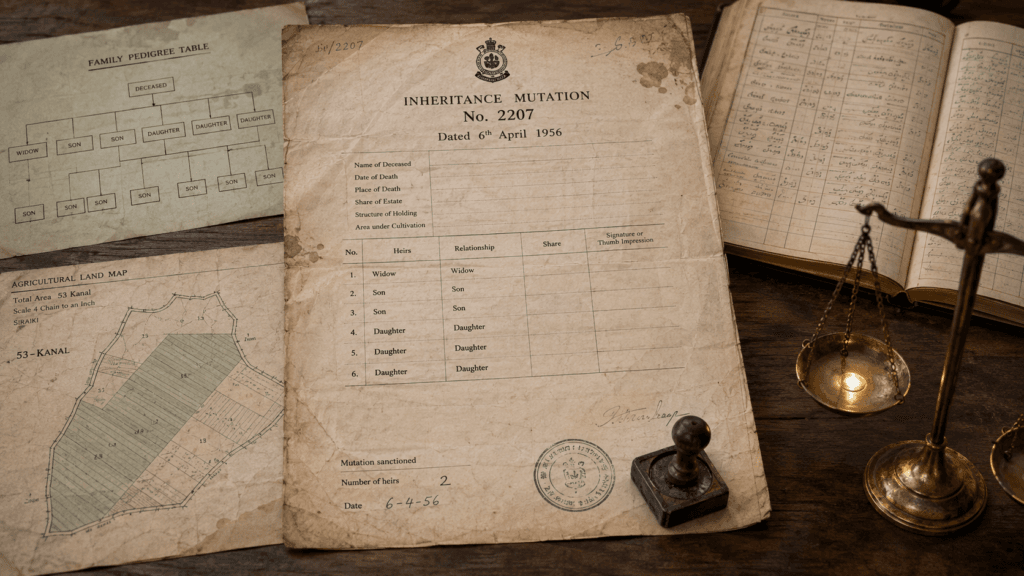
Allah Ditta died in 1947 or 1948. When the inheritance mutation was attested on 6 April 1956, only his two sons were shown as owners of the complete estate. The names of his widow and three daughters were absent from the revenue record.
The daughters filed a civil suit claiming their inheritance and seeking cancellation of Mutation No. 2207. The trial court decreed the suit. The first appeal was dismissed, and the civil revision filed before the Islamabad High Court also failed.
This history shows why Daughters Inheritance Rights in Pakistan cannot be decided by reading a mutation alone. A mutation is a revenue entry. It must reflect the lawful devolution of property and cannot validate the exclusion of genuine legal heirs.
A document may remain in the revenue record for many years, but its age does not automatically make it lawful. Courts can examine whether the entry was made according to the inheritance law applicable at the relevant time.
Arguments of the Sons’ Legal Heirs
The appellants argued that Allah Ditta had died before 15 March 1948, when the Punjab Muslim Personal Law (Shariat) Application Act, 1948 came into force.
According to them, the prevailing custom at the time gave agricultural land only to male heirs. They claimed that the two sons therefore became exclusive owners of their father’s estate and that the daughters had no share in the agricultural property.
They relied on Section 2-A of the West Pakistan Muslim Personal Law (Shariat) Application Act, 1962. The provision protects certain acquisitions of agricultural land made by male heirs under custom before the commencement of the 1948 Act.
The appellants also relied on Ghulam Haider v. Murad, reported as PLD 2012 Supreme Court 501.
Their argument treated the father’s date of death as the decisive factor. The Supreme Court, however, focused on a different and more precise question: When did the sons legally acquire the land?
Readers may consult the official text of the West Pakistan Muslim Personal Law (Shariat) Application Act, 1962, on the Pakistan Code website for a detailed understanding of the applicable statutory provisions.
Arguments of the Daughters
The daughters’ legal heirs argued that there was no evidence showing that the sons had acquired the agricultural land before 15 March 1948.
The appellants themselves relied on Mutation No. 2207, which was attested on 6 April 1956. This meant that the alleged acquisition took place more than eight years after the legal cut-off date.
The daughters’ side submitted that Section 2-A required an actual acquisition under custom before 15 March 1948. The fact that the father may have died earlier was not sufficient.
They also explained that the judgment in Ghulam Haider v. Murad supported their position because that case treated formal acquisition before the cut-off date as an essential requirement.
This distinction is central to Daughters Inheritance Rights in Pakistan. Anyone relying on an old custom must prove that every legal requirement of the exception was fulfilled. A general statement about family practice cannot replace legal evidence.
The Main Question Before the Supreme Court
The central legal question was:
Could the sons rely on customary inheritance merely because their father died before 15 March 1948, even though the mutation through which they claimed ownership was entered in 1956?
The Supreme Court answered this question in the negative.
Even if Allah Ditta had died before the cut-off date, his sons had not formally acquired the agricultural land before that date. Their alleged acquisition arose only through Mutation No. 2207, attested on 6 April 1956.
By that time, a custom excluding female heirs could not control the distribution of the estate.
The Court therefore separated two different events:
- The death of the property owner in 1947 or 1948.
- The alleged acquisition by the sons through the 1956 mutation.
The appellants could not obtain protection merely by relying on the first event while ignoring the second.
Why the Mutation Date Changed the Result

Section 2-A protected only agricultural land that a male heir had already acquired under custom before 15 March 1948.
The sons could not prove any such acquisition. Their entire claim depended on a mutation entered nearly eight years after the cut-off date.
This reasoning protects Daughters Inheritance Rights in Pakistan from vague claims based on family tradition. A person seeking the benefit of a statutory exception must bring the case strictly within the conditions of that exception.
The Supreme Court also held that Ghulam Haider v. Murad did not assist the appellants. That precedent confirmed that where formal acquisition occurred after the cut-off date, the property had to devolve under Islamic inheritance law rather than customary inheritance law.
The judgment therefore did not reject the law cited by the appellants. Instead, the Court carefully applied that law and found that the appellants’ own facts did not satisfy it.
Why a Mutation Cannot Defeat Daughters Inheritance Rights in Pakistan
Mutation proceedings are maintained mainly for revenue administration. A mutation may record inheritance, but it cannot create a title that substantive law does not allow.
It cannot lawfully remove a daughter, widow, or other genuine legal heir from an estate merely because male relatives are in possession of the property.
Mutation No. 2207 showed only the two sons as heirs. The Supreme Court held that this entry conflicted with the inheritance law applicable at the relevant time. It was therefore correctly cancelled.
For Daughters Inheritance Rights in Pakistan, the practical lesson is clear: an old mutation is not automatically valid simply because it remained in the revenue record for many years.
Its legality depends on:
- the identity of all legal heirs;
- the law applicable on the relevant date;
- the date and nature of the alleged acquisition;
- the evidence supporting the mutation; and
- whether the entry unlawfully excluded any heir.
Final Decision on Daughters Inheritance Rights in Pakistan
The Supreme Court dismissed the appeal and affirmed that every legal heir of Allah Ditta was entitled to a respective share under Islamic Shariat.
The cancellation of Mutation No. 2207 was therefore maintained.
The Court also issued an important implementation direction. If the judgments of the subordinate courts and the High Court had not yet been acted upon, the concerned authority was required to record the ownership of all legal heirs immediately.
The Supreme Court noted that decades had already passed while some legal heirs remained deprived of their inheritance.
This direction gives practical force to Daughters Inheritance Rights in Pakistan. A favourable court decree should not remain only on paper. The revenue record must also be corrected so that the successful heirs can exercise their ownership rights.
Practical Steps for Daughters Inheritance Rights in Pakistan
An excluded daughter should first obtain certified copies of the inheritance mutation, fard, jamabandi, pedigree table, and earlier ownership record.
She should also preserve:
- the deceased owner’s death certificate;
- NADRA Family Registration Certificate;
- CNIC copies of relevant legal heirs;
- previous revenue entries;
- mutation attestation record;
- court judgments or decrees;
- possession and cultivation records; and
- documents proving her relationship with the deceased.
Every widow, son, and daughter should appear in the inheritance record according to the applicable law. The date on which the exclusion occurred should also be carefully identified.
A statement such as “this is our family custom” should not be accepted without legal proof.
Cases concerning Daughters Inheritance Rights in Pakistan frequently turn on dates, mutation numbers, names of heirs, and the statute operating at the relevant time. Long possession by male heirs does not automatically convert an unlawful exclusion into a lawful inheritance.
Conclusion
The judgment in 2022 SCMR 1394 confirms that inheritance is a legal right, not a favour given by male relatives. The Supreme Court refused to allow a 1956 mutation to erase the lawful shares of three daughters and a widow.
For Daughters Inheritance Rights in Pakistan, the message is direct: examine the dates, verify every legal heir, and challenge any revenue entry that conflicts with the applicable law.
A daughter’s inheritance may be delayed, but a defective mutation or an unsupported custom should not be allowed to defeat it.
Disclaimer: This article is for legal awareness only and does not constitute legal advice. Consult a qualified lawyer regarding the facts and documents of a specific inheritance dispute.
Frequently Asked Questions
Can a daughter claim inheritance if her name is missing from the mutation?
Yes. A missing name does not automatically destroy her lawful share. She may seek a declaration of ownership, correction of the revenue record, and cancellation of an unlawful mutation.
Does an old family custom override Islamic inheritance law?
Not automatically. The person relying on custom must prove that the land was acquired under that custom within the period legally protected by the relevant statute.
Why was the 1956 mutation decisive?
The sons claimed ownership through Mutation No. 2207 dated 6 April 1956. Since this was after the cut-off date of 15 March 1948, their acquisition was not protected under the old custom.
What did the Supreme Court finally order?
The Supreme Court dismissed the appeal, upheld the cancellation of the mutation, and recognized the respective Islamic shares of all legal heirs.
Can revenue authorities correct the ownership record after a court judgment?
Yes. In this case, the Supreme Court directed the concerned authority to record all legal heirs immediately if the earlier judgments had not already been implemented.
Why does this case matter for Daughters Inheritance Rights in Pakistan?
It confirms that daughters cannot be excluded through a later mutation merely because male heirs invoke an old custom. The male heirs must prove that their acquisition was legally protected before the relevant cut-off date.