


You spent five years earning your LLB. The degree is framed, relatives have started calling you “wakeel sahib”, and then someone asks: “Have you cleared the HEC Law GAT test yet?” Suddenly the black coat feels a little further away.
That worry is real. In Pakistan, a law degree on its own does not give you a licence to practise (wakalat ka license). Before a Bar Council will even process your enrolment, you must pass the Law Graduate Assessment Test, commonly written Law-GAT, conducted by the Higher Education Commission (HEC) through its Education Testing Council (ETC).
The problem is that much of what you find online about the HEC Law GAT is outdated, contradicts itself, or stops at a test date. This guide was checked against HEC announcements and the Pakistan Bar Council rules on 17 October 2026. It covers the current schedule, the real marks split, the registration traps, seven mistakes that quietly cost candidates an attempt, and what actually happens after you pass.
Table of Contents
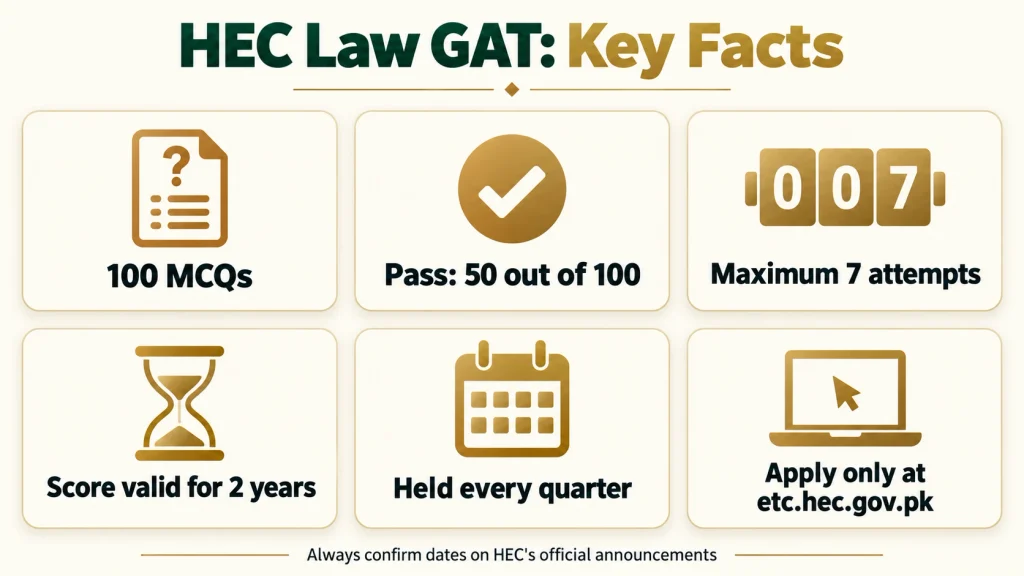
HEC Law GAT at a Glance (Status on 17 October 2026)
| Item | Current position |
|---|---|
| Conducting body | HEC Education Testing Council (ETC) |
| Who must take it | LLB (or equivalent) graduates who want to enrol as advocates |
| Current sitting | Sunday 18 October 2026 (registration closed on 27 September) |
| Tentative result for that sitting | 6 November 2026 |
| Next sitting | Sunday 20 December 2026 (tentative) |
| Expected registration window | Opens around 15 November, last date around 29 November 2026 |
| Paper | 100 multiple-choice questions (MCQs) |
| Pass mark | 50 out of 100 |
| Attempts allowed | 7 in total |
| Score validity | 2 years |
| Official portal | etc.hec.gov.pk |
Tentative HEC Law GAT dates come from HEC’s published 2026 ETC test calendar. HEC can and does move dates, so confirm the latest notice on the HEC ETC announcements page before you act on any of them.
What Is the HEC Law GAT Test, and Why Does It Exist?
The HEC Law GAT is a screening test for law graduates who want to enter legal practice. Its purpose is simple: only graduates with a basic working knowledge of the core statutes should reach the courts as advocates.
The test has a clear legal footing. On 6 March 2018, the Supreme Court ordered the restoration of the Law-GAT by the Pakistan Bar Council (PBC) through HEC. In August 2018, the Court directed HEC to conduct assessment tests both for LLB admissions and for the enrolment of law graduates with the Bar.
The Pakistan Bar Council’s own rules build the test into enrolment. Under the Pakistan Legal Practitioners and Bar Councils Rules, 1976, Rule 108-B requires your enrolment application to carry the assessment test result card, and the proviso to Rule 108-C requires you to pass that test before you begin pupillage (chamber training) and file its intimation with the Bar Council. The rule still names the National Testing Service, the earlier test body; HEC now conducts the test.
In practical terms, the HEC Law GAT comes first and your six months of chamber training come after it. Many graduates join a senior’s chamber straight after their final exams and discover this order too late.
Do not confuse this test with the Law Admission Test. LAT is the entry test you take before an LLB programme; Law-GAT is taken after you graduate. If you are still at the admission stage, our LAT test date guide is the right place to start.
Who Can Sit the Law GAT Test (and Who Cannot)
You are eligible if you hold a bachelor’s degree in law, or an equivalent qualification, from a local or foreign university recognised by HEC or the Pakistan Bar Council.
HEC’s 2026 announcements also list three groups who cannot apply:
- Candidates who have already qualified the Law-GAT
- Candidates who have used all seven attempts
- Students who are still enrolled in a bachelor’s degree in law
If you studied law abroad, there may be an extra step: since the Supreme Court’s 2018 rulings, HEC has conducted a Special Equivalence Examination (SEE-Law) for foreign law graduates before the Law-GAT. Check the current ETC notice for your category before you register.
Passing the HEC Law GAT also does not, on its own, make you an advocate. HEC states clearly that you must still meet the Pakistan Bar Council’s other enrolment requirements. We explain those steps later in this guide.
HEC Law GAT 2026 Dates: October Sitting Now, December Next
HEC conducts the Law-GAT every quarter in major cities. Its 2026 ETC test calendar sets the sittings below. The October and December dates are tentative until the official advertisement confirms them.
| Sitting | Last date to apply | Test date | Result date (calendar) | Status on 17 Oct 2026 |
|---|---|---|---|---|
| 1st | 3 March 2026 | 5 April 2026 | 23 April 2026 | Held |
| 2nd | 19 July 2026 | 9 August 2026 | 28 August 2026 | Held, result announced |
| 3rd | 27 September 2026 | 18 October 2026 | 6 November 2026 | Registration closed |
| 4th | 29 November 2026 | 20 December 2026 | 31 December 2026 | Registration expected from about 15 November |
Notice how short the registration window is. For the October sitting, HEC opened registration on 13 September and closed it on 27 September: two weeks. If you plan to sit in December, keep your CNIC, degree details, email and mobile number ready now, so you can apply the day the portal opens.
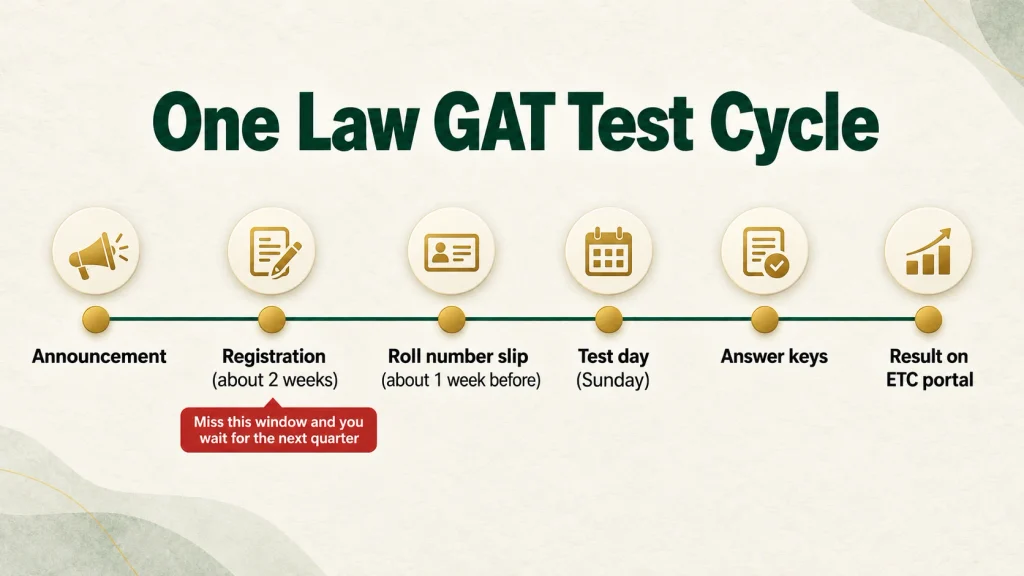
Dates can also move. In May 2025, HEC postponed a Law-GAT at short notice and cancelled the roll number slips already issued. Treat any HEC Law GAT date as final only once it appears on HEC’s own pages.
How to Register for HEC Law GAT Without Rejection
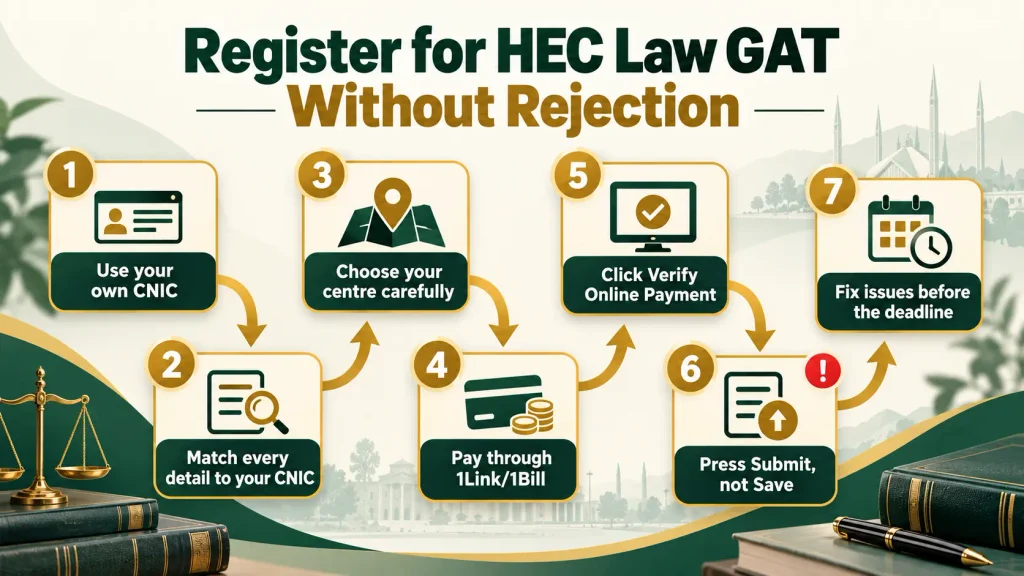
HEC Law GAT registration happens only online, on the official ETC portal. Most rejections have nothing to do with knowledge; they come from small form mistakes. Follow these steps in order:
- Create your ETC profile with your own CNIC. HEC warns that a candidate who registers on a parent’s, sibling’s or relative’s CNIC will not be allowed to sit the test.
- Open the Law-GAT application from your dashboard while the portal is open, and enter your name, CNIC number, mobile number and email exactly as they appear on your CNIC. Any mismatch between your CNIC and the application can stop you at the test centre.
- Choose your test centre with care. The centre cannot be changed after registration, and ETC may move you to another centre if fewer than 250 candidates select yours.
- Generate the 1Link/1Bill consumer number and pay the fee through your banking app, an ATM or any 1Bill-enabled channel.
- Click “Verify Online Payment” on the ETC dashboard after paying.
- Press Submit. ETC considers only submitted applications; forms left in “saved” or “incomplete” status are not accepted.
- Fix any problem before the deadline through HEC Online Help. HEC says queries are not handled once the portal closes.
If the steps feel familiar, it is because ETC runs every test through the same portal. Our LAT online apply guide shows the same dashboard from the admission side.
Fee, Payment and the Official Portal
The exact fee appears on the invoice the ETC portal generates for you. HEC’s recent Law-GAT advertisements do not print the amount, so be careful with figures quoted on unofficial websites. The fee is non-refundable and non-transferable, which means a missed test is a lost fee as well as a lost sitting.
Keep these ready before you open the form:
- Your original, valid CNIC
- Your LLB degree or final result details
- An email address and mobile number you actually check
- A screenshot or record of the paid invoice
ETC sends alerts by SMS and email, but SMS may not reach a mobile number ported to another network. If you have switched networks, watch your email closely.
Law GAT Test Syllabus: Where the 100 Marks Sit
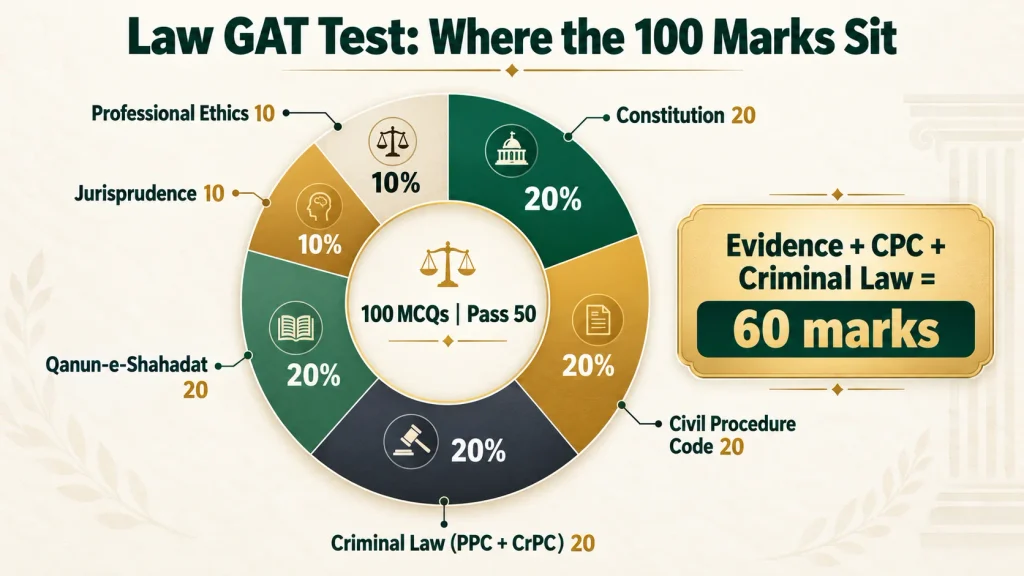
HEC’s revised curriculum divides the 100 MCQs of the HEC Law GAT across six subject areas. Knowing this split tells you where your study time will earn the most marks.
| Subject | What is tested | Marks |
|---|---|---|
| Constitution | Constitutional history through eight leading cases | 5 |
| Constitution | Constitution of Pakistan, 1973 | 10 |
| Constitution | International law (UN Charter and the International Court of Justice) | 5 |
| Jurisprudence | English jurisprudence | 5 |
| Jurisprudence | Islamic jurisprudence | 5 |
| Civil procedure | Code of Civil Procedure, 1908 (selected sections and Orders) | 20 |
| Criminal law | Pakistan Penal Code, 1860 | 10 |
| Criminal law | Code of Criminal Procedure, 1898 | 10 |
| Evidence | Qanun-e-Shahadat Order, 1984 | 20 |
| Professional ethics | Canons of Professional Conduct and Etiquette | 10 |
| Total | 100 |
The eight constitutional cases named in the curriculum are:
- Maulvi Tamiz-ud-Din Khan case (PLD 1955 FC 240)
- The State v. Dosso (PLD 1958 SC 533)
- Miss Asma Jilani v. Government of the Punjab (PLD 1972 SC 139)
- Begum Nusrat Bhutto v. Chief of Army Staff (PLD 1977 SC 657)
- Muhammad Nawaz Sharif v. President of Pakistan (PLD 1993 SC 473)
- Al-Jehad Trust v. Federation of Pakistan (PLD 1996 SC 324)
- Zafar Ali Shah v. General Pervez Musharraf (PLD 2000 SC 869)
- Khan Asfandyar Wali v. Federation of Pakistan (PLD 2001 SC 607)
Learn each holding in one or two lines; five marks ride on them. For context on how such rulings shape the law today, browse our landmark judgments.
The ethics portion is narrower than it looks. The Canons of Professional Conduct and Etiquette sit in Chapter XII of the 1976 Bar Council Rules, Rules 134 to 175-B: conduct towards other advocates, towards clients, towards the court and towards the public. That is a short, fixed text worth ten marks.
Download the latest curriculum from HEC before you start; it is the only version that counts on test day.
Passing Marks, 7 Attempts and Two-Year Validity
To pass the HEC Law GAT, you need at least 50 marks out of 100. HEC adds a reminder that matters: a pass is required for enrolment, but it does not by itself give you the right to practise.
You get seven attempts in total. Older websites, and even the original wording of Rule 108-C, still mention three chances; HEC’s current announcements set the limit at seven, and anyone who has used all seven cannot apply again. Every sitting counts, so never sit “just to see the paper”.
A passing score stays valid for two years. Use that window well: finish your six months of chamber training and file your enrolment application well before the score expires. If your validity is close to running out, speak to your Provincial Bar Council and ETC before you assume anything.
Your result card lives on the ETC portal. In a 2025 order, the Pakistan Information Commission recorded HEC’s position that result cards are issued only to the candidate through the portal, and that results published there are treated as authentic and certified for licensing with the Pakistan Bar Council. Download your card as a PDF the day it appears and keep a printed copy with your enrolment papers.
Roll Number Slip and Test-Day Rules
ETC issues roll number slips about a week before the test, on the portal and by email, followed by an alert. Check your name, CNIC number, test centre and reporting time against your CNIC the moment you download it.
On test day:
- Bring a printed roll number slip and your original CNIC or passport.
- An expired card, a photocopy or a photo of your CNIC on a phone screen will not be accepted.
- Mobile phones, calculators and any recording or imaging device are banned inside the centre.
- Taking or sharing pictures of the question booklet is an offence under ETC policy.
Reach your HEC Law GAT centre early; a long queue at the gate is the last thing you need before a 100-question paper.
7 Costly Mistakes That Can Waste Your HEC Law GAT Attempt
Most HEC Law GAT candidates who lose a sitting do not lose it in the exam hall. They lose it on the form, at the gate, or in the months after the result. Avoid these seven:
- Registering on someone else’s CNIC. A parent’s or sibling’s CNIC means you will not be allowed to sit, whatever you paid.
- Letting your form and CNIC disagree. One wrong digit or a different spelling of your name can stop you at the centre.
- Leaving the form “saved” instead of submitted. ETC ignores saved and incomplete applications, and an unverified payment leaves your application hanging.
- Choosing a centre casually. You cannot change it later, and ETC may shift you if fewer than 250 candidates pick it.
- Trusting unofficial dates, fees and answer keys. Several popular pages still show old dates, three attempts or a fixed fee. Only HEC’s own pages decide.
- Arriving with the wrong ID or a phone. An expired CNIC, a photocopy or a phone photo will not get you in, and a mobile phone in the hall is a serious violation.
- Starting chamber training before passing, or letting the score expire. Under the Bar Council rules, training follows the test. A two-year validity also means a pass is not forever.
A Smart Law GAT Test Preparation Plan Built on the Marks
The marks table already tells you how to plan for the HEC Law GAT. The Qanun-e-Shahadat Order (20), the Civil Procedure Code (20) and criminal law (20) carry 60 of the 100 marks. Build your preparation around those three, and treat the rest as the marks that separate a near miss from a comfortable pass.
Read the bare text first. MCQs in a statute-based paper reward people who know where a rule sits and what it says, not people who have read about it in a guide. Summary notes help only once you know the sections themselves.
If you are aiming for the December sitting, this six-week plan fits the time left after the October result:
| Week | Focus | Marks covered |
|---|---|---|
| 1 | Qanun-e-Shahadat Order, 1984 | 20 |
| 2 | Code of Civil Procedure, 1908 | 20 |
| 3 | Pakistan Penal Code and Code of Criminal Procedure | 20 |
| 4 | Constitution of 1973, the eight cases and international law | 20 |
| 5 | English and Islamic jurisprudence, plus the ethics canons | 20 |
| 6 | Timed full-length practice papers and revision of weak areas | All |
Practise under time pressure at least three times before the test. Be wary of anyone promising that a fixed share of questions “always repeats”; past papers show you the style, not a guaranteed answer sheet.
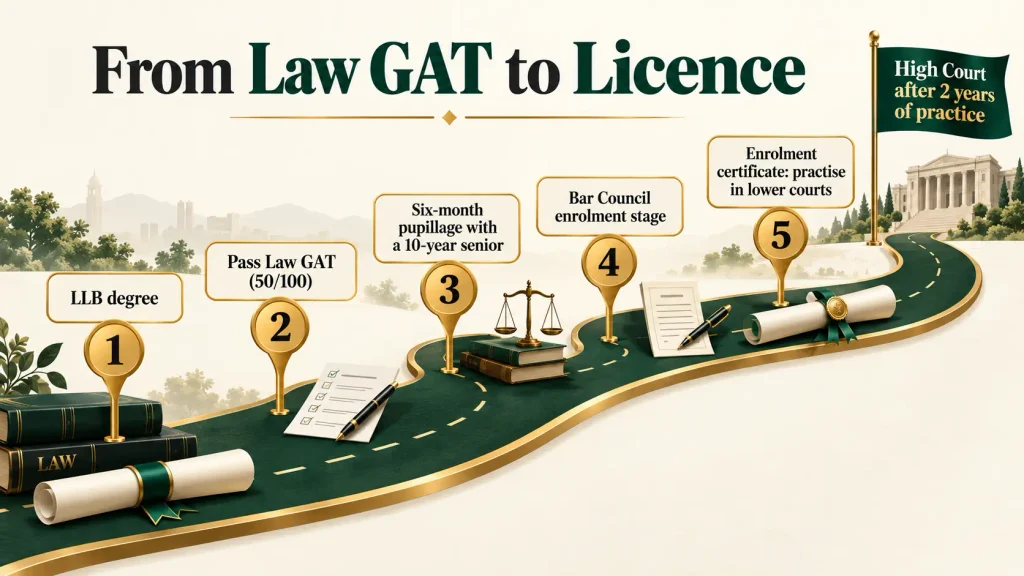
After You Pass: Law GAT Is Step One of Four
Passing the HEC Law GAT opens the door; it does not walk you through it. The Legal Practitioners and Bar Councils Act, 1973 and the Bar Council Rules of 1976 set out the rest of the journey.
- Keep your result card safe. It goes with your enrolment application under Rule 108-B.
- Complete six months of pupillage. Under Rule 108-C, you must train regularly for a continuous period of six months in the chamber of an advocate with at least ten years of practice. You and your senior must send a signed intimation to the Secretary of your Provincial Bar Council within one month of starting. A senior can count no more than three pupils at a time, and must certify at least ten cases in which you assisted.
- Clear the Bar Council stage. Rule 108-C(5) also provides for a written and a viva voce examination conducted by the Enrolment Committee of your Provincial Bar Council. Ask your Bar Council how and when it currently holds this stage.
- Apply for enrolment. Under Section 30 of the Legal Practitioners and Bar Councils Act, 1973, you apply to the Bar Council of the province where you intend to practise (the Islamabad Bar Council if you will practise in Islamabad). Section 26 also requires you to be at least 21 years old.
Rule 108-B lists what your enrolment application should carry:
- Proof of your date of birth and your law qualification
- Two character testimonials from advocates of ten years’ standing
- An affidavit disclosing any criminal or misconduct proceedings against you
- Receipts for the enrolment fees paid to the Pakistan and Provincial Bar Councils
- An undertaking to join a Bar Association within six months of enrolment
- A list of at least ten cases you assisted in, signed by your senior
- Your training certificate from your senior and your Law-GAT result card
- An affidavit explaining any long gap since your studies, and a character certificate from any past employer
Section 28A bars enrolment of anyone dismissed from government service for misconduct, convicted of an offence involving moral turpitude, or declared a tout. If your application is refused, Rule 108-G gives you 30 days to appeal to the Enrolment Committee of the Pakistan Bar Council.
Once enrolled, you can practise in the courts below the High Court in your province. Under Section 27, the right to appear in the High Court generally comes after two years of practice in the subordinate courts.
Law GAT Result and Answer Keys
After each sitting, HEC publishes answer keys on its “Result and Keys” page, sorted by question-booklet colour. They help you estimate your score, but only the final result on the ETC portal counts.
Log in to the ETC portal with your registered account, open the results section and download your card. For the 18 October 2026 sitting, HEC’s calendar gives 6 November 2026 as the tentative result date.
Never enter your CNIC, password or OTP on a “result by CNIC” site that HEC does not run. Our step-by-step result guide will appear in the Law GAT Test section; the LAT result guide already shows how ETC result cards work.
Frequently Asked Questions About HEC Law GAT
1. What is the HEC Law GAT test?
The HEC Law GAT test is the Law Graduate Assessment Test that the Higher Education Commission conducts through its Education Testing Council. It is a 100-question MCQ paper for law graduates. Under the Pakistan Bar Council rules, you must pass it before you start chamber training and before a Provincial Bar Council can enrol you as an advocate.
2. When is the next HEC Law GAT in 2026?
The third 2026 sitting of the HEC Law GAT is scheduled for Sunday 18 October 2026, and registration for it has closed. HEC’s 2026 calendar places the next sitting on Sunday 20 December 2026, with the last date to apply around 29 November. Both dates are tentative until HEC’s advertisement confirms them.
3. What are the passing marks for the Law GAT test?
You need at least 50 marks out of 100. The paper has 100 MCQs across the Constitution, jurisprudence, civil procedure, criminal law, evidence and professional ethics. A pass makes you eligible to move ahead with enrolment; it does not, by itself, give you the right to practise.
4. How many times can I take the HEC Law GAT?
HEC’s current announcements allow a maximum of seven attempts. Once you have used all seven, or once you have passed, you cannot sit the HEC Law GAT again. Pages that mention three or five chances are out of date, so treat every attempt as precious.
5. What is the Law GAT test syllabus?
HEC’s revised curriculum gives 20 marks to the Constitution (including eight leading cases and international law), 10 to English and Islamic jurisprudence, 20 to the Civil Procedure Code, 20 to criminal law (PPC and CrPC), 20 to the Qanun-e-Shahadat Order and 10 to professional ethics. Always download the latest curriculum from HEC before you prepare.
6. How much is the HEC Law GAT fee?
The exact amount appears on the 1Link/1Bill invoice the ETC portal generates when you apply; HEC’s recent advertisements do not print a figure. Pay through any 1Bill-enabled channel and click “Verify Online Payment”. The HEC Law GAT fee is non-refundable and non-transferable.
7. Can I start chamber training before passing the Law GAT test?
The proviso to Rule 108-C of the 1976 Bar Council Rules requires you to pass the assessment test before you begin pupillage and file its intimation. If you have already started training, ask your Provincial Bar Council how those months will be treated before counting on them.
8. Does passing the HEC Law GAT make me an advocate?
No. Passing the HEC Law GAT is the first requirement, and your score stays valid for two years. You still need six months of pupillage, the Bar Council’s own enrolment stage, and an approved application to your Provincial Bar Council. Only after the Enrolment Committee grants your application and issues a certificate are you an enrolled advocate.
One Paper Today, a Lifetime at the Bar Tomorrow
The HEC Law GAT is not designed to stop good lawyers; it is designed to make sure every new advocate knows the statutes that the courts run on. Treat it that way. Register early and carefully, prepare by the marks, protect every one of your seven attempts, and plan your pupillage to begin after you pass.
Above all, verify before you act. HEC’s announcements, the ETC portal and your Provincial Bar Council are the only sources that decide your next step. Get those right, and the Law GAT test becomes what it should be: the first, clear step towards your licence.
Disclaimer
This article is for legal awareness only and is not legal advice. Test schedules, fees, portal steps and Bar Council requirements can change, and every candidate’s situation depends on their own documents and record. Verify time-sensitive details with HEC, the ETC portal and your Provincial Bar Council, and consult a qualified lawyer about your specific matter.