


A DNA test may appear to be a simple scientific procedure, but in a family dispute, it can affect a mother’s honour, a child’s identity, and the future of an entire family. In an important Lahore High Court judgment, an ex-husband attempted to deny the paternity of a minor after the child’s mother filed a maintenance case.
The Court explained that Paternity Test in Pakistan is not an automatic right available whenever a father raises doubt. Before permitting DNA evidence, a court must examine the marriage, date of divorce, date of birth, timing of denial, Article 128 of the Qanun-e-Shahadat Order, 1984, Muslim Personal Law, and the dignity and emotional welfare of the child.
More importantly, DNA testing cannot be converted into a device for avoiding maintenance, delaying court proceedings, or harassing a mother and her innocent child.
Table of Contents
IRAC Analysis: When DNA Evidence Becomes Relevant
| Element | Court’s Finding |
|---|---|
| Issue | Could the ex-husband obtain a DNA test of the minor and use its result to deny paternity during maintenance proceedings? |
| Rule | Article 128 treats a child born during a valid marriage, or within two years after its dissolution while the mother remains unmarried, as conclusively legitimate. Muslim Personal Law also requires denial of paternity to be made immediately or within the recognised postnatal period. |
| Analysis | The marriage was admitted, the child was born about six months after divorce, and paternity was first denied almost three years after the child’s birth. The law did not permit the father to reopen the child’s legitimacy through DNA evidence. |
| Conclusion | The Trial Court and Appellate Court correctly rejected the DNA application. The Lahore High Court dismissed the constitutional petition. |
Judgment at a Glance: Paternity Test and DNA Dispute
| Detail | Information |
|---|---|
| Case title | Sakhawat Hussain v. Additional District Judge and others |
| Citation | PLD 2025 Lahore 332 |
| Court | Lahore High Court, Lahore |
| Judge | Justice Ahmad Nadeem Arshad |
| Petition | Writ Petition No. 22286 of 2023 |
| Decision date | 27 November 2024 |
| Original proceedings | Maintenance suit filed for the mother and minor child |
| Main dispute | DNA testing after denial of the minor child’s paternity |
| Key laws | Articles 2(9) and 128, Qanun-e-Shahadat Order, 1984; section 2, West Pakistan Muslim Personal Law (Shariat) Application Act, 1962 |
| Final result | Petition dismissed and refusal of DNA examination upheld |
The judgment deals directly with the legality of requesting DNA evidence after a delayed denial of paternity in child-maintenance proceedings.
How the Dispute Reached the Lahore High Court
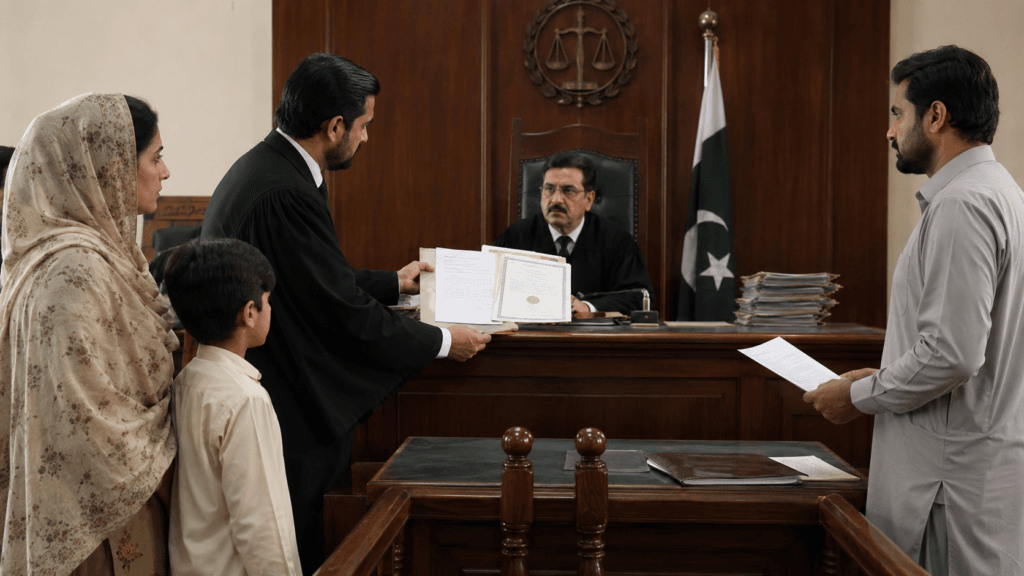
The petitioner married respondent No. 3 on 11 January 2018. Their marriage ended through divorce on 17 August 2018. The minor, Sadaqat Hussain, was born on 1 March 2019, almost six months after the divorce.
The mother subsequently filed a Family Court suit seeking maintenance for herself and the minor child.
The ex-husband did not deny that the marriage had taken place. However, in his written statement, he denied that the minor was his biological son. He also filed an application requesting the Court to order a DNA examination of the child.
The Trial Court rejected his application on 15 March 2023. He challenged that order before the Appellate Court, but his appeal was dismissed on 29 March 2023. He then approached the Lahore High Court through a constitutional petition under Article 199 of the Constitution.
This chronology was decisive because Paternity Test in Pakistan cannot be considered separately from the dates of marriage, divorce, birth, and the first denial of paternity.
Questions Considered by the Court
The Court’s treatment of Paternity Test in Pakistan centred on the following questions:
- Could a father demand DNA testing merely by denying paternity in a maintenance case?
- Did Article 128 conclusively protect the child’s legitimacy?
- Could a denial made almost three years after birth have any legal effect?
- Would the proposed DNA examination harm the dignity, privacy, and emotional welfare of the mother and child?
- Was the application a genuine request for evidence or an attempt to avoid financial responsibility?
What the Father Argued
The petitioner argued that DNA technology could scientifically determine whether he was the biological father of the minor. He wanted the child to undergo testing and the DNA report to be admitted as evidence.
At first sight, this argument may appear convincing. A Paternity Test in Pakistan can scientifically compare genetic material and indicate whether a biological relationship exists.
However, scientific possibility does not automatically override statutory law, settled principles of Muslim Personal Law, public policy, or constitutional dignity. Therefore, the Court had to decide whether DNA evidence was legally permissible—not merely whether the science was reliable.
The Mother and Child’s Legal Position
The mother and minor child relied upon the admitted marriage, the child’s date of birth, and the legal protection provided by Article 128.
The child had been born within the period protected by the Qanun-e-Shahadat Order. Moreover, the father had not denied paternity immediately after birth. The first denial appearing on the judicial record was made years later when maintenance proceedings were initiated.
For the mother and child, the proposed DNA examination was not simply a medical test. It carried the danger of humiliation, social stigma, emotional insecurity, and permanent damage to the child’s identity and sense of belonging.
Why Article 128 Was Decisive
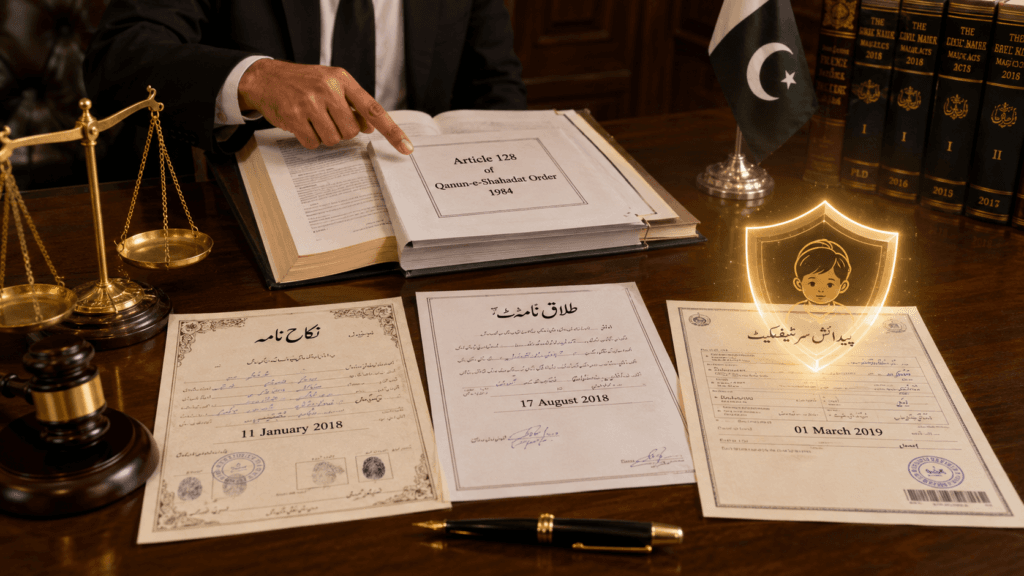
Readers may consult the official text of the Qanun-e-Shahadat Order, 1984 for the complete legal provisions governing evidence and child legitimacy.
Article 128 of the Qanun-e-Shahadat Order, 1984 protects the legitimacy of a child born during a valid marriage or within two years after its dissolution, provided the mother remains unmarried.
When the facts required by Article 128 are established, the child’s legitimacy becomes “conclusive proof.” Under Article 2(9), when one fact is declared conclusive proof of another, the court must treat the second fact as proved and cannot ordinarily allow evidence intended to disprove it.
This rule is central to Paternity Test in Pakistan because Family Courts do not order DNA examinations as a routine response to every allegation. Where the law conclusively protects a child’s legitimacy, a party cannot automatically bypass that protection by requesting scientific testing.
The minor in the present case was born approximately six months after the marriage had been dissolved. His birth therefore fell within the period addressed by Article 128.
Supreme Court Precedent on a Child’s Legitimacy
The Lahore High Court relied on the Supreme Court judgment in Ghazala Tehsin Zohra v. Mehr Ghulam Dastagir Khan, PLD 2015 SC 327.
The Supreme Court had explained that the law deliberately protects children from damaging and unnecessary disputes over paternity. The legal presumption is intended to preserve family stability, social cohesion, and the dignity of mothers and children.
The law does not grant an unrestricted licence to a father to make allegations that may cause lasting harm to the child and the mother.
Therefore, Paternity Test in Pakistan must be considered in light of the wider social purpose behind Article 128, rather than as an isolated scientific procedure.
Muslim Personal Law and Late Denial of Paternity

The Court also examined section 2 of the West Pakistan Muslim Personal Law (Shariat) Application Act, 1962. In cases involving Muslims, questions concerning legitimacy or illegitimacy must be determined according to Muslim Personal Law, subject to the applicable legislation.
According to the principles discussed in the judgment:
- Imam Abu Hanifa requires denial of paternity to be made immediately after the child’s birth.
- According to Imam Muhammad and Imam Abu Yusuf, denial must be made within the postnatal period, extending to a maximum of forty days.
- A denial made after the recognised period cannot lawfully disturb the child’s status.
In the present case, the minor was born on 1 March 2019. However, the father’s first recorded denial appeared in his written statement dated 28 May 2022.
The demand for Paternity Test in Pakistan could not revive a denial that had been raised almost three years after the child’s birth. The delay was fatal to the petitioner’s case.
DNA Science Does Not Automatically Control the Case
The High Court acknowledged that every human being has a unique DNA pattern inherited from biological parents. Samples may be obtained from blood, saliva, hair, skin tissue, and other biological material.
DNA technology can undoubtedly assist courts in appropriate cases. However, the real question was not whether DNA science was accurate. The question was whether the test was legally admissible in the particular circumstances of this case.
Evidence may be scientifically persuasive but legally excluded because of:
- a conclusive statutory presumption;
- constitutional protection of dignity and privacy;
- settled Muslim Personal Law;
- public policy;
- lack of genuine necessity; or
- potential harm to an innocent child.
Paternity Test in Pakistan must therefore be assessed through both science and law.
Dignity, Privacy and the Child’s Identity

The judgment strongly protects women and innocent children from scandalous allegations and social stigma.
Questioning the legitimacy of a child can create an atmosphere of doubt and insecurity. It may damage the child’s sense of identity, dignity, family connection, and belonging. Such allegations can also produce long-lasting psychological effects.
The Court referred to Mst. Laila Qayyum v. Fawad Qayum, PLD 2019 SC 449. In that case, the Supreme Court recognised that forcibly taking a DNA sample could violate the liberty, privacy, and dignity protected by Article 14 of the Constitution.
For this reason, Paternity Test in Pakistan cannot be ordered casually or mechanically. Courts must determine whether there is a real and unavoidable need for the test and whether the dispute can be resolved through existing law and evidence.
Although this case does not involve workplace harassment, the Court’s protection of a woman’s dignity reflects the broader safeguards explained in our guide on the Protection Against Harassment of Women at Workplace Act 2010.
DNA Testing Cannot Be Used to Avoid Maintenance
One of the most powerful parts of the judgment concerns the misuse of paternity allegations in maintenance proceedings.
The High Court observed that it was becoming common for a father to challenge the child’s legitimacy only after the mother filed a claim for maintenance. Such an allegation might be used to:
- avoid financial responsibility;
- delay maintenance proceedings;
- pressure the mother into abandoning her claim;
- attack the mother’s character; or
- stigmatise the child.
The Court stated that such conduct should be firmly discouraged. A Paternity Test in Pakistan must not become a tool for harassment or a procedural excuse to postpone child maintenance.
The child’s immediate needs, dignity, emotional security, and welfare must remain the Court’s primary concern.
Why the DNA Application Failed
The petitioner’s application failed because:
- the marriage between the parties was admitted;
- the child was born approximately six months after divorce;
- the birth fell within the period protected by Article 128;
- the father did not deny paternity immediately after birth;
- no denial was made within the recognised forty-day period;
- the first recorded denial came almost three years later;
- the request arose during maintenance proceedings; and
- the proposed test could harm the dignity and emotional welfare of the child.
These facts made the application legally unsustainable, even though DNA science itself is capable of identifying biological relationships.
Final Decision of the Lahore High Court

The Lahore High Court held that the Trial Court and Appellate Court had correctly dismissed the application for DNA examination.
The petitioner’s lawyer could not identify any jurisdictional error, legal defect, or other reason requiring constitutional interference. The constitutional petition was therefore dismissed for lacking force and substance. No order as to costs was passed.
The ruling creates an important limit on Paternity Test in Pakistan: a delayed and unsupported allegation cannot be converted into a valid DNA request merely because the mother has filed a maintenance claim.
Practical Lessons for Families and Lawyers
Before filing or opposing an application for DNA testing, the following facts should be carefully examined:
- date of marriage;
- date of divorce or dissolution;
- date of birth of the child;
- whether the mother remarried;
- date on which paternity was first denied;
- earlier admissions made by the alleged father;
- contents of the written statement;
- existence of maintenance proceedings;
- genuine necessity for scientific testing; and
- effect of the test on the child’s dignity and welfare.
Cases involving Paternity Test in Pakistan often depend upon chronology. A single date may determine whether scientific evidence is permissible or whether the child’s legitimacy is already conclusively protected by law.
Conclusion
This Lahore High Court judgment sends a clear message: family litigation is not a licence to place a mother’s character or a child’s identity on trial without lawful justification.
Scientific evidence is valuable, but it must operate within legislation, Muslim Personal Law, constitutional dignity, and the best interests of the child.
Paternity Test in Pakistan may assist courts in appropriate cases, but it cannot be used to reopen settled legitimacy, escape maintenance, delay justice, or cause emotional harm to an innocent child.
Disclaimer: This article is intended for general legal awareness only. It is not a substitute for advice from a qualified family lawyer regarding the facts of an individual case.
Frequently Asked Questions
What is a paternity test?
A paternity test is usually a DNA examination used to determine whether a particular man is the biological father of a child.
Can a father demand Paternity Test in Pakistan in every maintenance case?
No. A father cannot obtain a DNA test merely by making an allegation. The Court must examine Article 128, the timing of denial, legal necessity, privacy, dignity, and the child’s welfare.
What does Article 128 of the Qanun-e-Shahadat Order provide?
It treats a child born during a valid marriage, or within two years after dissolution while the mother remains unmarried, as conclusively legitimate, subject to the conditions and exceptions stated in the provision.
Can a father deny paternity several years after the child’s birth?
The judgment explains that denial must be made immediately or within the recognised postnatal period. A denial raised several years later will ordinarily have no lawful effect.
Can a woman or child be forced to provide a DNA sample?
Not as a routine matter. Courts must consider liberty, dignity, privacy, necessity, statutory presumptions, and the consequences of compulsory testing.
Is DNA evidence completely prohibited in family disputes?
No. DNA evidence may be valuable in an appropriate case. Its use depends upon the facts, legal admissibility, applicable presumptions, and the existence of a genuine need for testing.
Can Paternity Test in Pakistan be refused if it appears intended to avoid maintenance?
Yes. A delayed, unsupported, or harassing request may be refused, especially where the child’s legitimacy is already conclusively protected by law.