
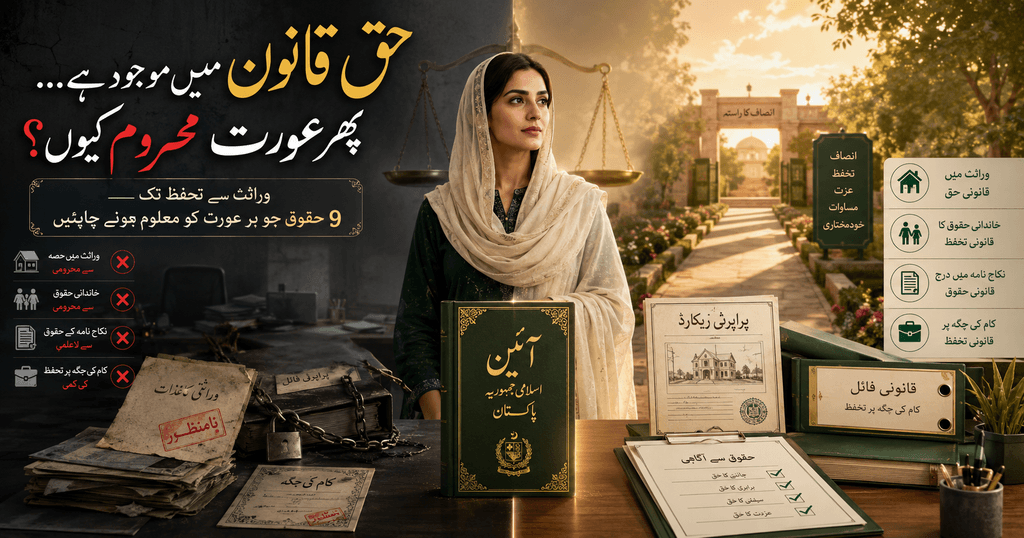
A woman may have her name written in the law, yet still find her name missing from an inheritance record. She may have a Nikahnama but never understand what was promised in it. She may work for years in an office but remain silent about harassment because she does not know where to complain.
This is the real challenge behind female rights in Pakistan. The law provides important protections, but a right becomes meaningful only when a woman knows it, has evidence to prove it and reaches the correct legal forum. From constitutional equality to inheritance, property, marriage and workplace dignity, women have legal protections that should not remain only on paper.
Table of Contents
Judgment at a Glance: Female Inheritance Rights Case
One recent Balochistan High Court case shows why legal awareness matters so much.
| Point | Details |
|---|---|
| Citation | 2026 CLC 131 |
| Case Title | Muhammad Siddique and others v. Bibi Shahzado and others |
| Court | High Court of Balochistan |
| Judge | Muhammad Aamir Nawaz Rana, J. |
| Decision Date | 11 September 2025 |
| Nature of Case | Civil revision involving inheritance and property rights |
| Female Claimants | Two daughters of late Saifuddin |
| Main Dispute | Their lawful share in ancestral property |
| Main Defence | Alleged family settlement of 1971 |
| Important Evidence | Revenue record and inheritance mutation |
| High Court Result | Civil revision dismissed |
| Costs Imposed | Rs.500,000 |
| Core Lesson | Female heirs cannot be deprived through vague, contradictory and legally defective claims |
The judgment concerned two sisters who sought recognition of their inheritance and ownership rights in property connected with their late father, Saifuddin. The High Court found no reason to disturb the judgments already passed in their favour.
IRAC Summary of 2026 CLC 131
| IRAC | Explanation |
|---|---|
| Issue | Could the daughters’ inheritance claim be defeated through the alleged 1971 family settlement and the competing ownership position taken by the petitioners? |
| Rule | Revenue entries enjoy the statutory presumption discussed by the Court under section 52 of the Balochistan Land Revenue Act, 1967. A document relied upon to create or extinguish rights in immovable property may also attract the registration requirements of sections 17 and 49 of the Registration Act, 1908. |
| Analysis | The relevant revenue record supported the daughters’ line of inheritance. The alleged settlement was unregistered, vague and not reflected in the revenue record. The petitioners also relied on inconsistent positions regarding the ownership of the property. |
| Conclusion | The High Court found no illegality or irregularity requiring interference. The civil revision was dismissed with Rs.500,000 costs. |
The case is a powerful example of how female rights become effective when legal entitlement is supported by documents and evidence.
What Do Female Rights Mean in Pakistan?
Female rights are not one single law. They come from the Constitution of Pakistan, federal and provincial statutes, personal laws, criminal laws and judicial decisions.
The official Punjab Women Development Department explains women’s rights as fundamental rights in political, economic, civil, social and cultural spheres. It also identifies a range of constitutional provisions protecting equality and women’s participation in national life. Women Development Department — Women Rights
For an ordinary reader, these protections can be understood through nine major areas.
1. Female Rights Begin With Equality Before Law
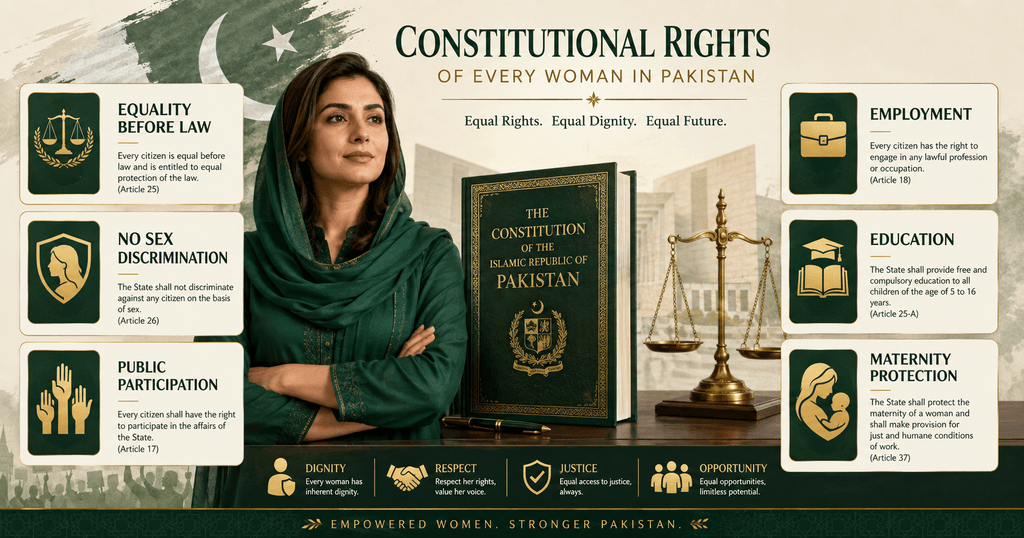
The first protection is simple but powerful: a woman is not a lesser citizen.
Article 25 of the Constitution provides that all citizens are equal before law and entitled to equal protection of law. It also prohibits discrimination on the basis of sex and permits the State to make special provisions for the protection of women and children.
Other constitutional provisions identified by the Women Development Department deal with access to public places, employment, women’s participation in national life, protection of marriage and family, humane working conditions and maternity benefits.
This constitutional foundation is important because female rights are not merely social demands. Many of them arise from enforceable law or broader constitutional commitments.
The practical question, however, is always the same:
Which right has been violated, and what legal remedy applies to that particular violation?
2. Female Rights in Inheritance Cannot Be Treated as a Family Favour
Inheritance is one of the areas where women can face the greatest difference between a legal right and family practice.
A daughter, widow, mother or other female heir may inherit according to the personal law applicable to the deceased and the actual family tree. The exact share cannot be calculated merely from the word “daughter” or “widow”; all relevant heirs must first be identified.
What the law does not permit is the automatic exclusion of a lawful female heir simply because male relatives control the property.
That is exactly why 2026 CLC 131 matters.
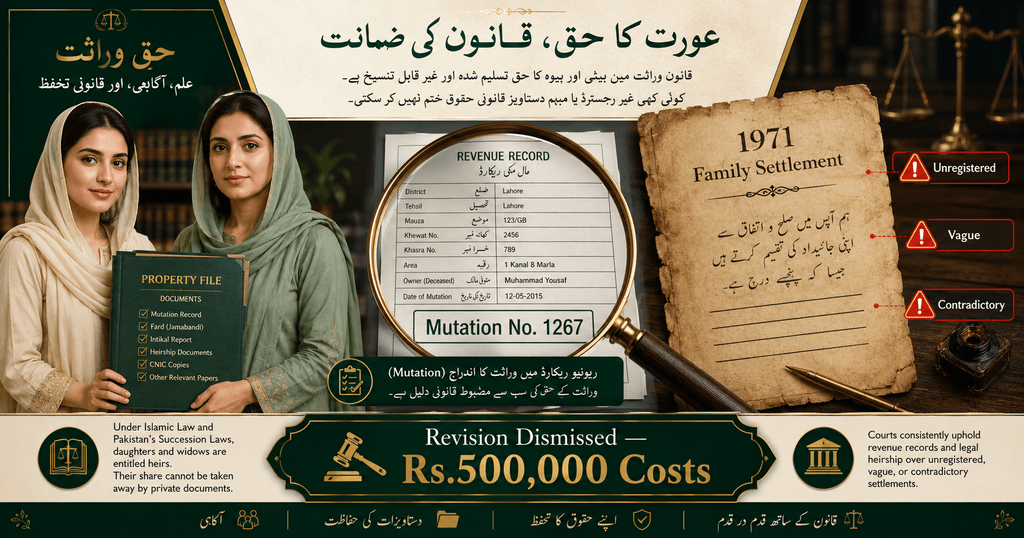
The daughters in that case claimed through their late father Saifuddin. The property was recorded in the relevant revenue record, and the High Court observed that the opposing side carried a heavy burden to displace the inheritance claim supported by that record.
The petitioners relied mainly on an alleged family settlement dated 4 August 1971.
But the Court identified serious problems.
The document was not registered even though it was being relied upon as affecting rights in immovable property. It was vague. It did not find reflection in the revenue record. The petitioners also raised an inconsistent plea that the disputed property had been exclusively purchased by their predecessor.
These contradictions weakened their case.
For another Supreme Court example explaining why daughters cannot automatically be removed through an old mutation or custom, readers can study Qanooni Dastak’s guide to Daughters Inheritance Rights in Pakistan.
Why Revenue Records Mattered
The High Court referred to section 52 of the Balochistan Land Revenue Act, 1967 and the presumption attached to relevant record-of-rights or periodical entries.
This does not mean that every revenue entry is automatically final proof of ownership in every dispute.
It means that where the law gives an entry a presumption of correctness, the party challenging that position must bring legally sufficient evidence to rebut it.
That distinction makes this judgment useful for understanding female rights without oversimplifying property law.
The Lesson From the Alleged Family Settlement
An old document should never be accepted merely because someone calls it a “family settlement.”
Ask:
- What does the document actually say?
- Who signed it?
- Was it proved?
- Does registration law apply?
- Does it identify the property clearly?
- Is it reflected in subsequent conduct or records?
- Are the parties now taking a position contrary to their earlier position?
In 2026 CLC 131, the Court found multiple problems with the document relied upon against the daughters.
The High Court ultimately dismissed the revision with Rs.500,000 costs.
3. Depriving a Woman of Inheritance May Also Become a Criminal Matter
An inheritance dispute may involve civil or revenue remedies, but Pakistan Penal Code also contains a specific criminal provision dealing with deprivation of women from inheritance.
Section 498A of the Pakistan Penal Code provides punishment where a person, through deceitful or illegal means, deprives a woman from inheriting movable or immovable property at the opening of succession.
The statutory provision prescribes imprisonment that may extend to ten years but shall not be less than five years, or a fine of one million rupees, or both.
However, this does not mean every disagreement between brothers and sisters automatically becomes an offence under section 498A.
The ingredients of the criminal offence still have to be established.
A title suit, inheritance mutation, partition proceeding and criminal allegation may involve different legal questions.
That distinction is important when discussing female rights responsibly.
4. A Woman Can Own Property in Her Own Legal Capacity
Marriage does not automatically transfer a woman’s independently owned property to her husband.
A woman may acquire property through:
- inheritance;
- purchase;
- gift;
- dower;
- allotment;
- settlement; or
- another legally recognized source of title.
If she is unlawfully deprived of ownership or possession, the remedy will depend on the nature and location of the property and the applicable law.
In Punjab, the Women Development Department states that a woman deprived of ownership or possession, including inheritance rights, may approach the Ombudsperson under the applicable women’s property-rights legislation.
This is an important practical lesson: female rights are not protected by sending every dispute to the same office.
First identify:
What property?
Where is it situated?
How was ownership acquired?
Who is denying the right?
Which forum has jurisdiction?
5. Marriage Does Not End a Woman’s Independent Legal Rights
Marriage creates a family relationship, but it does not erase a woman’s separate legal identity.
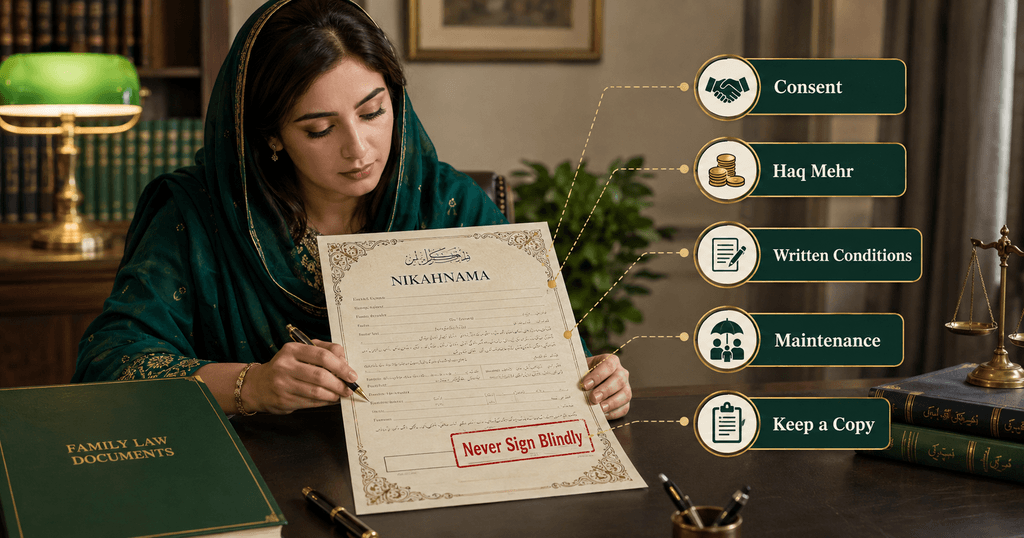
Important rights may arise from:
- free consent to marriage;
- Haq Mehr or dower;
- maintenance;
- written terms in the Nikahnama;
- property already belonging to the wife;
- custody and child-related claims;
- dissolution of marriage; and
- other enforceable family-law obligations.
Section 498B of the Pakistan Penal Code also deals with forced marriage.
One practical mistake is especially common: a woman signs the Nikahnama without carefully reading what has been written, left blank or altered.
Years later, those entries may become important evidence.
The Nikahnama should therefore be read carefully before signature, and a clear copy should be preserved.
For a detailed case-based explanation of Khula and Haq Mehr, read Qanooni Dastak’s Grounds for Khula in Pakistan.
Understanding marriage documents is an important part of female rights because a financial or property claim may depend on exactly what was agreed and proved.
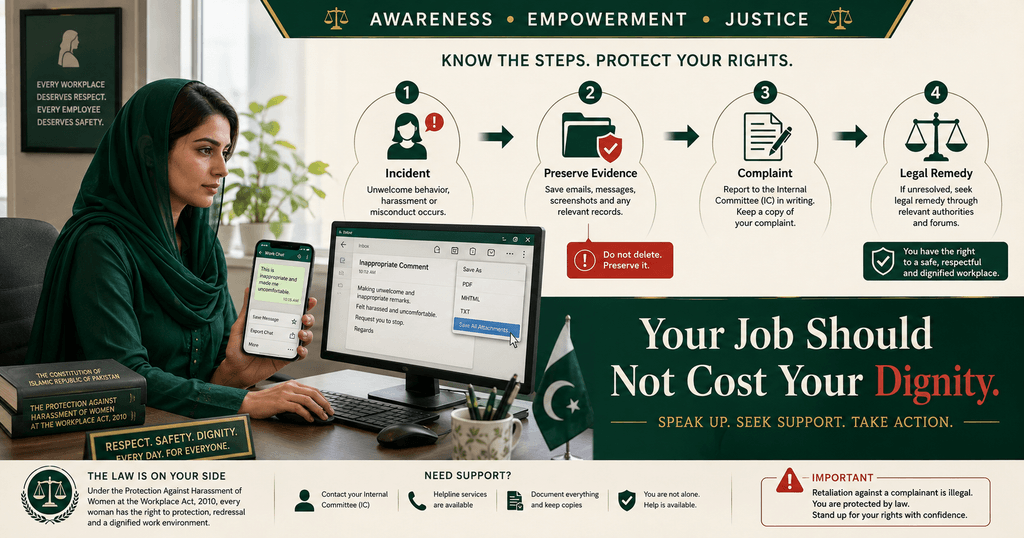
6. Female Rights at Work Include Protection From Harassment
A workplace should not become a place where a woman must choose between her dignity and her salary.
Pakistan has a statutory framework dealing with harassment at the workplace. FOSPAH’s official guidance explains that organizations are required to have an Inquiry Committee and sets out complaint mechanisms under the workplace harassment law.
The official guidance also recognizes forms of harassment including unwelcome sexual conduct, sexually demeaning attitudes and gender-based discriminatory conduct falling within the statutory definition.
A woman facing workplace harassment should preserve relevant evidence instead of relying only on memory.
Useful evidence may include:
- messages;
- emails;
- written complaints;
- dates and times;
- witness names;
- office orders;
- performance records;
- retaliatory notices; and
- other relevant correspondence.
Qanooni Dastak’s detailed analysis of the Supreme Court position can be read at Workplace Harassment: 7 Powerful Supreme Court Lessons.
This part of female rights is not limited to obvious physical misconduct. The actual statutory definition and evidence must be examined in each case.
7. Protection From Violence Is Also a Legal Right
Violence inside a home should not automatically be dismissed as a “private family matter.”
Legal protection against domestic violence exists through applicable federal or provincial frameworks, but the correct statute and procedure may depend on the territory.
For example, the Punjab Women Development Department lists the Punjab Protection of Women against Violence Act, 2016 among Punjab’s women-protection laws.
Its official FAQ explains that remedies in Punjab may include protection, residence and monetary orders through the relevant legal process.
This territorial difference must not be ignored.
A person in Lahore, Islamabad, Karachi, Quetta and Peshawar should not automatically be told to use the same statute or forum.
For female rights to be useful, legal information must identify the jurisdiction before recommending a remedy.
8. Education, Employment and Participation Are Part of Female Rights
Women’s legal protections are much wider than property and marriage disputes.
The Constitution protects equality and contains provisions relevant to education, access to public places, public employment and participation in national life.
Article 25A provides for free and compulsory education for children between five and sixteen years of age in the manner determined by law. Article 34 directs the State to take appropriate measures to enable women to participate fully in national life.
The Punjab Women Development Department also identifies constitutional provisions concerning women’s representation, employment and maternity benefits.
This broader view matters.
A discussion of female rights should not begin and end at the door of a family court.
A woman is also a student, employee, professional, entrepreneur, property owner, voter and citizen.
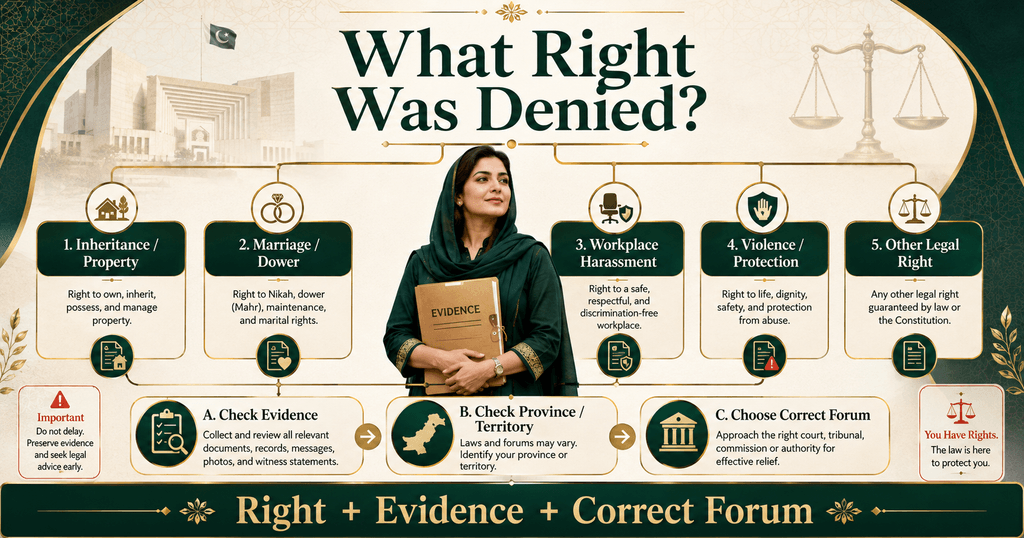
9. Female Rights Mean Little Without Access to Justice
This may be the most important lesson of all.
A right written in a statute is only the beginning.
A woman also needs to know:
- what happened;
- which right was affected;
- which law applies;
- what evidence exists;
- which forum has jurisdiction; and
- whether any limitation or urgent deadline applies.
The correct forum might be a Civil Court, Family Court, Revenue Authority, Inquiry Committee, Ombudsperson, criminal justice forum or another statutory authority.
There is no single “women’s court” that decides every dispute.
The official Punjab Women’s Helpline 1043 is listed by the Women Development Department as a 24/7 service dealing with matters including workplace harassment, gender discrimination, property and inheritance disputes and domestic violence.
Knowing where to begin can turn female rights from an abstract promise into a practical remedy.
Why 2026 CLC 131 Is Bigger Than One Inheritance Dispute
At first sight, Muhammad Siddique v. Bibi Shahzado appears to be only an inheritance case.
Its wider lesson is about proof.
The daughters did not succeed merely because the Court felt sympathy for them.
The Court examined:
- the family relationship;
- the revenue record;
- the alleged 1971 settlement;
- registration requirements;
- competing ownership claims;
- mutation proceedings;
- contradictions in the defence; and
- findings already recorded by the courts below.
That is how female rights should be discussed: emotionally enough for ordinary people to understand why the issue matters, but legally enough to show what must actually be proved.
The alleged family settlement surfaced after mutation entries had been attested in favour of the daughters. The Court considered the inconsistent defences and found no basis to interfere with the concurrent judgments.
The lesson is stronger than a slogan:
A lawful right needs a lawful record, reliable evidence and the correct remedy.
Five Dangerous Myths About Female Rights
Myth 1: “She received dowry, so she has no inheritance”
Dowry and inheritance should not automatically be treated as substitutes for each other.
Inheritance rights must be determined according to the applicable law, estate and family tree.
Myth 2: “Her brothers have possession, so they own everything”
Possession may be legally relevant, but it does not automatically answer every question of title or inheritance.
Possession and ownership are not always the same thing.
Myth 3: “The family has an old paper, so the daughter has lost her share”
Not necessarily.
The legal effect of the document depends on its nature, execution, proof, contents, applicable registration requirements and surrounding circumstances.
The 1971 document considered in 2026 CLC 131 demonstrates exactly why courts examine these matters carefully.
Myth 4: “After marriage, the husband owns the wife’s property”
Marriage itself does not automatically transfer a woman’s separate property to her husband.
Ownership must be traced through the actual legal source of title.
Myth 5: “Every woman can go to the same authority”
No.
A property dispute, workplace complaint, domestic violence case, inheritance claim and matrimonial dispute can require completely different forums.
Recognizing this distinction is essential for protecting female rights.
Evidence Every Woman Should Preserve
Legal awareness becomes much stronger when documents are preserved before a dispute becomes serious.
For Inheritance or Property
Keep copies of:
- death certificate;
- Family Registration Certificate where relevant;
- pedigree or family-tree record;
- mutation;
- jamabandi or record-of-rights;
- fard;
- title documents;
- registered deeds;
- allotment papers;
- rent records;
- possession evidence; and
- court or revenue orders.
For Marriage or Family Claims
Preserve:
- Nikahnama;
- marriage registration record;
- dower details;
- receipts;
- bank transfers;
- written promises;
- property documents;
- relevant messages; and
- previous court orders.
For Workplace Harassment
Preserve:
- messages;
- emails;
- dates;
- witness details;
- written complaints;
- responses from management;
- inquiry notices; and
- documents showing retaliation.
A simple rule helps:
Do not hand over your only original document without first keeping a clear copy and obtaining appropriate legal advice.
What Should a Woman Do When Her Right Is Denied?
Do not begin by asking:
“Which case should I file?”
Begin with five questions.
What exactly was denied?
Was it inheritance, property, dower, maintenance, workplace dignity, protection from violence or another legal right?
What proves the right?
Find the primary document or record.
Where did it happen?
Province and territory can change the applicable law and forum.
What has already happened?
Check whether any mutation, transfer, court case, complaint, agreement or other proceeding already exists.
Is there any urgent risk or legal deadline?
Some matters need urgent protective action, while other claims may involve limitation questions.
These questions make female rights practical rather than theoretical.
Female Rights Checklist: Before Signing Away Property or Inheritance
Before signing a relinquishment, settlement, gift, power of attorney or other property document, a woman should understand:
- What property is involved?
- What share does she presently own or claim?
- Is she giving up ownership permanently?
- Is any payment being made?
- Has she actually received that payment?
- Has the document been read and explained to her?
- Is the property correctly identified?
- Does the document require registration?
- Is she signing voluntarily?
- Has she obtained independent legal advice where needed?
A signature can have serious legal consequences.
It should never be obtained through pressure, confusion or incomplete information.
Frequently Asked Questions About Female Rights
What are female rights in Pakistan?
Female rights include constitutional equality and legal protections concerning inheritance, property, marriage, dower, workplace harassment, violence, education, employment, participation and access to justice.
Do daughters have inheritance rights in Pakistan?
Yes, a daughter may be a legal heir. Her exact share depends on the applicable personal law, family tree and other heirs of the deceased.
She should not be excluded merely because she is female.
Can brothers keep all inherited property because they are already in possession?
Possession alone does not automatically establish exclusive lawful ownership.
The title, inheritance record, family tree, applicable law and evidence must be examined.
Can an old family settlement remove a daughter’s inheritance?
It depends on the facts and legal validity of the particular arrangement.
In 2026 CLC 131, the settlement relied upon by the petitioners was found to have serious defects including lack of registration where the Court found registration legally necessary, vagueness and inconsistency with the record.
Is denying inheritance to a woman a criminal offence?
Section 498A of the Pakistan Penal Code criminalizes deprivation of a woman from inheritance through deceitful or illegal means at the opening of succession. Whether the provision applies to a particular dispute depends on its facts and evidence.
Can a woman own property after marriage?
Yes. Marriage itself does not automatically transfer independently owned property to the husband.
The source of title must be examined.
What rights does a woman have in her Nikahnama?
Rights can involve dower and other lawful terms recorded in the marriage contract. The exact effect depends on what has been written and the applicable family law.
Can a woman complain about workplace harassment?
Yes. Applicable workplace harassment laws provide statutory complaint mechanisms. The appropriate Inquiry Committee or Ombudsperson route should be identified from the applicable legal framework.
Where can women in Punjab seek initial guidance?
The Punjab Women Development Department lists the Punjab Women’s Helpline 1043, available 24/7 for various women-related issues.
Is every women’s protection law the same throughout Pakistan?
No.
Some laws and remedies are federal, while others are territorial or provincial. The location of the dispute must therefore be checked before selecting the legal remedy.
Conclusion: Knowing Female Rights Is the First Protection
A woman should not discover her rights only after the property has been transferred, the inheritance mutation has been completed, the workplace complaint has become unbearable or an important document has already been signed.
Knowledge should come first.
Female rights in Pakistan cover much more than inheritance. They begin with constitutional equality and extend into property, marriage, employment, dignity, safety and access to justice.
The lesson from 2026 CLC 131 makes this especially clear. The daughters’ claim was tested against the revenue record, alleged family settlement, registration law and the conduct of the parties. The High Court found no ground to interfere and dismissed the revision with substantial costs.
The strongest protection is therefore not a slogan.
It is a combination of:
Know your right.
Preserve your evidence.
Understand what you sign.
Identify the correct forum.
Act through law.
That is how female rights move from paper into real life.
Legal Disclaimer
This article is written for legal awareness and educational purposes only. It does not constitute legal advice. Every case depends on its own facts, documents, applicable personal law, territorial legislation, limitation issues and available evidence. A qualified lawyer should examine the complete record before legal proceedings are started.