


The LAT is on Sunday 15 November 2026. That gives you about four weeks. Your WhatsApp groups are full of “guaranteed” notes, coaching adverts and old papers nobody can verify, and you still do not know where to begin. Good LAT test preparation does not start with more material. It starts with knowing exactly where HEC puts the 100 marks.
This LAT test preparation guide is built on HEC’s own documents, checked on 19 October 2026: the official content weightages, the 2026 test calendar and HEC’s sample personal statement. It gives you the paper pattern, a four-week plan up to 15 November, subject-by-subject tips, essay and personal statement formulas, a test-day time plan and the mistakes that quietly cost marks.
One urgent point first: registration for the 15 November LAT closes on Tuesday 20 October 2026. If you have not applied yet, follow our LAT online apply guide today, then come back to your preparation.
Table of Contents
LAT Test Preparation in 60 Seconds
- Paper: 75 MCQs in 100 minutes, then one essay and one personal statement in 40 minutes.
- Pass mark: 50 out of 100. Aim for 60 or more if you want a comfortable merit position.
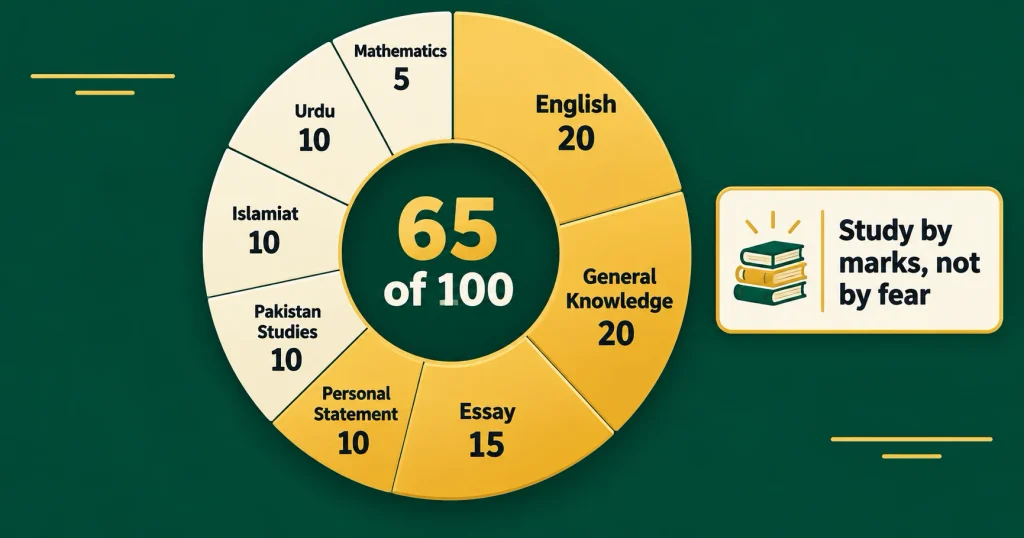
- Biggest marks: English (20), General Knowledge (20), essay (15) and personal statement (10) add up to 65 of 100.
- Smallest section: Mathematics, only 5 MCQs.
- Daily routine: two focused hours beat six distracted ones.
- Key dates: apply by 20 October, roll number slips on 6 November, test on 15 November, result tentatively on 24 December.
- Free practice paper: download our LAT Model Paper 1 (PDF) with 75 original MCQs and a full answer key.
LAT 2026 Dates You Cannot Afford to Miss
HEC’s Education Testing Council (ETC) publishes a test calendar for the whole year. For the fifth and final LAT of 2026, the dates below come from the HEC ETC test calendar. HEC treats test dates as tentative, so recheck the ETC announcements page before every step.
| Step | Date (tentative) |
|---|---|
| Last date to apply online | Tuesday 20 October 2026 |
| Roll number slips issued | Friday 6 November 2026 |
| Test day | Sunday 15 November 2026 |
| Result | Thursday 24 December 2026 |
For earlier sittings and the full-year calendar, see our LAT test date guide.
The Official LAT Paper Pattern, Straight From HEC
Many websites print slightly different numbers. The safest source is HEC’s own Content Weightages for the Law Admission Test. It sets one paper for anyone with 12 years of education in any discipline, so FSc, FA, ICS, ICom and A Level students all sit the same test.
| Part | Section | Questions or marks | Time |
|---|---|---|---|
| Part I | English | 20 MCQs | 100 minutes for all 75 MCQs |
| Part I | General Knowledge | 20 MCQs | |
| Part I | Pakistan Studies | 10 MCQs | |
| Part I | Islamiat | 10 MCQs | |
| Part I | Urdu | 10 MCQs | |
| Part I | Mathematics | 5 MCQs | |
| Part II | Essay (1 of 3 topics, English or Urdu) | 15 marks | 40 minutes for both |
| Part II | Personal statement (English or Urdu) | 10 marks | |
| Total | 100 marks | 140 minutes |
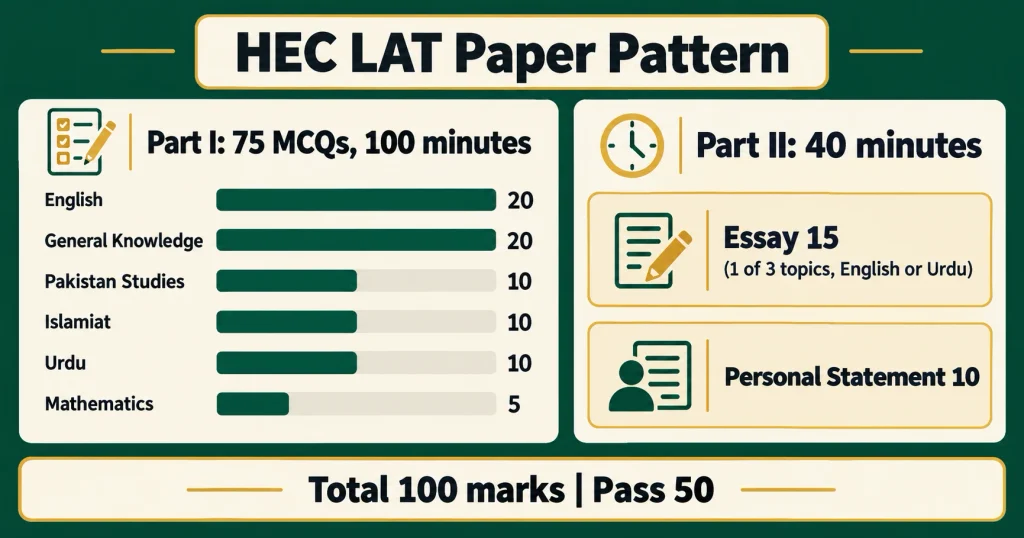
HEC’s LAT notices have also set a 200-word maximum for the essay and for the personal statement, and they describe the English part as synonyms, antonyms and prepositions, and the Urdu part as vocabulary. Every hour of LAT test preparation should start from this table. Still, read the instructions printed for your own sitting, because HEC can adjust the format.
Where 65 of Your 100 Marks Really Sit
Look at the pattern again. English (20), General Knowledge (20), the essay (15) and the personal statement (10) add up to 65 marks. Mathematics, the section many students fear most, carries only 5. Smart LAT test preparation follows the marks, not the fear.
| Priority | Section | Marks | Share of weekly study time |
|---|---|---|---|
| 1 | English | 20 | 25% |
| 2 | General Knowledge | 20 | 25% |
| 3 | Essay and personal statement | 25 | 25% |
| 4 | Pakistan Studies and Islamiat | 20 | 15% |
| 5 | Urdu and Mathematics | 15 | 10% |
The writing section deserves a full quarter of your LAT test preparation time because most candidates have never written a timed personal statement. It is also the part where a calm, prepared student can gain marks quickly, while others lose them through panic and poor structure.
Pass Mark vs Merit: Why 50 Is Only the Floor
You pass the LAT with 50 out of 100. That pass makes you eligible to apply for LLB admission; it does not give you a seat. Universities and colleges set their own merit formulas, and some count your LAT score inside that formula. So a 52 and a 68 are both passes, but they may not open the same doors.
Plan your LAT test preparation around a working target of 60 to 65. That leaves room for a bad day and a tricky essay topic. Your LAT result also stays valid for two years, which our LAT result guide explains along with the steps to check it on the ETC portal.
A 4-Week LAT Test Preparation Plan (19 Oct to 15 Nov)
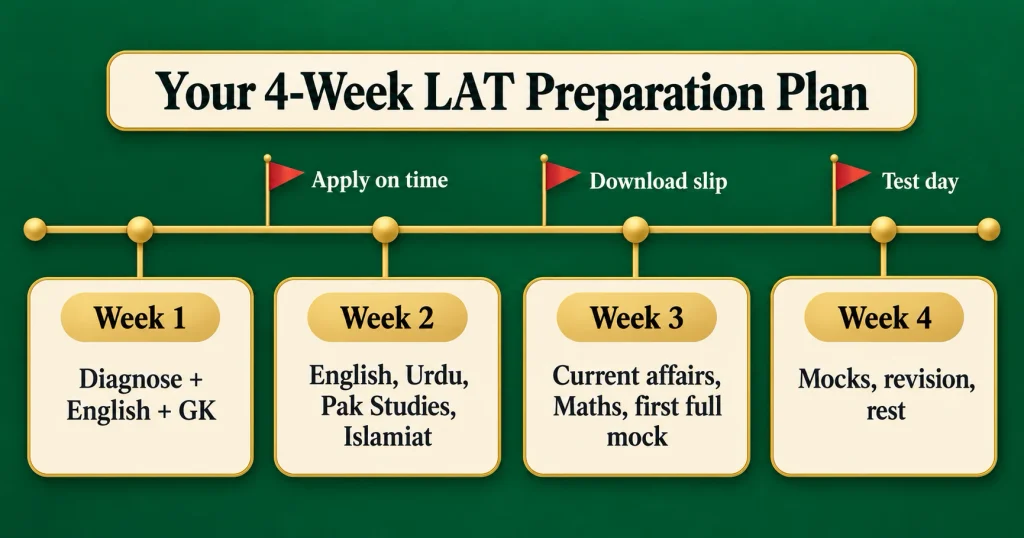
This LAT test preparation plan assumes about two hours a day on weekdays and three on weekends. If you are still in college or working, shrink each block, but keep the order: diagnose, build, test, polish.
| Week | Dates | Main focus | Writing task | Checkpoint |
|---|---|---|---|---|
| 1 | 19–25 Oct | Diagnose weak areas; English vocabulary; General Knowledge basics | 1 personal statement draft | Apply by 20 Oct; 1 untimed mixed test |
| 2 | 26 Oct–1 Nov | English, Urdu vocabulary, Pakistan Studies, Islamiat | 2 essays (1 English, 1 Urdu) | 30-MCQ timed set |
| 3 | 2–8 Nov | Current affairs, Mathematics, weak areas | 2 essays and a statement rewrite | First full timed mock; download slip on 6 Nov |
| 4 | 9–15 Nov | Full mocks, error review, light revision | 1 essay every other day | Rest on 14 Nov; test on 15 Nov |
A Two-Hour Daily Routine That Actually Works
- 30 minutes, English: 15 new words with synonyms and antonyms, plus 10 preposition sentences.
- 30 minutes, General Knowledge: one topic, plus the week’s major news.
- 20 minutes, a smaller subject: rotate Pakistan Studies, Islamiat, Urdu and Mathematics.
- 20 minutes, writing: one essay outline or 100 words of your personal statement.
- 20 minutes, review: copy every wrong answer of the day into a mistake notebook.
The mistake notebook is the heart of good LAT test preparation. Most students keep solving new MCQs and repeat the same errors. Re-reading your own mistakes every Sunday is faster, cheaper and far more effective than buying another book.
Subject-by-Subject LAT Test Preparation Tips
English (20 MCQs): Words, Opposites and Prepositions
Build vocabulary in themed groups, not alphabetical lists: words about justice, emotions, speed or honesty. Learn each word with one synonym, one antonym and one short sentence of your own. For prepositions, collect common pairs such as fond of, afraid of, interested in, depend on and agree with, and test yourself until each pair feels automatic.
General Knowledge (20 MCQs): Stable Facts First
General Knowledge is wide, so start with facts that do not change: world geography, major international organisations such as the UN and its organs, basic everyday science and Pakistan’s key institutions. Add current affairs mainly in the last two weeks of your LAT test preparation, and check any fact you rely on against an official website rather than a forwarded message.
Pakistan Studies and Islamiat (10 + 10 MCQs)
Both sections expect intermediate-level knowledge. For Pakistan Studies, make one timeline page covering 1906, 1930, 1940, 1947, 1949, 1956, 1962 and 1973, with one line on each event. For Islamiat, revise the pillars of Islam, basic facts about the Quran, key events in the life of the Holy Prophet (PBUH) and the Rightly Guided Caliphs.
Urdu (10 MCQs): Vocabulary You Can Recognise
The Urdu part tests vocabulary, so read a short Urdu column or editorial every day and note five difficult words (mushkil alfaz) with their meanings. Students from English-medium schools often lose easy marks here. Ten minutes a day for four weeks is usually enough to close that gap.
Mathematics (5 MCQs): No Calculator, No Panic
Expect basic arithmetic: percentages, ratios, averages, simple equations and short word problems. Calculators are prohibited at ETC test centres, so practise mental shortcuts, such as finding 10% and halving it for 5%. Keep Mathematics to about 10% of your LAT test preparation time, together with Urdu.
Essay Writing: How to Earn the 15 Marks
In Part II, you choose one essay topic out of three and write in English or Urdu. Choose the language you can write correctly under time pressure, not the one that sounds more impressive. With a 200-word limit, the examiner is looking for a clear position, organised paragraphs and clean language, not long quotations.
A 200-Word Essay Formula
| Part | Words | What it does |
|---|---|---|
| Introduction | 35 | Context and your clear position |
| Body point 1 | 55 | One argument with a Pakistani example |
| Body point 2 | 55 | A second argument with an example |
| Counterpoint | 25 | Admit the other side, then answer it |
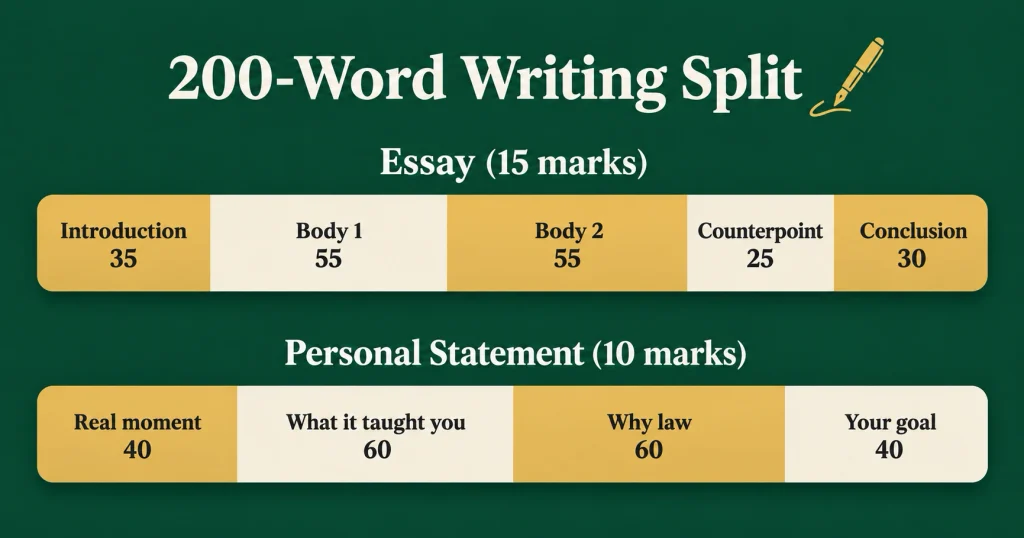
| Conclusion | 30 | Restate your position and offer one practical solution |
| Total | 200 |
Practise with topics students meet often: social media and youth, education reform, climate change in Pakistan, the role of women in development, and technology and jobs. Do not memorise full essays. Memorise this structure and a bank of five examples you can fit into almost any topic. Make essays part of your LAT test preparation from the first week, not the last.
Personal Statement: The 10 Marks Most Students Waste
The personal statement is about you, written in the first person. HEC’s own sample personal statement shows the idea: a real story about the writer’s character, not a list of slogans about justice. Many students copy a template that begins “Since childhood I wanted to become a lawyer”, and examiners read that line again and again.
A Simple Four-Part Structure
- A real moment (about 40 words): something you saw or did that connects to the prompt.
- What it taught you (about 60 words): the quality it shows, such as patience, courage or fairness.
- Why law (about 60 words): how that quality fits the study of law.
- Your goal (about 40 words): one specific thing you want to do with a law degree.
Write three versions from three different life moments in the first week of your LAT test preparation. By test day, you will be able to adapt one of them to almost any personal statement prompt instead of freezing in the hall.
Test-Day Time Plan: 100 Minutes and 40 Minutes
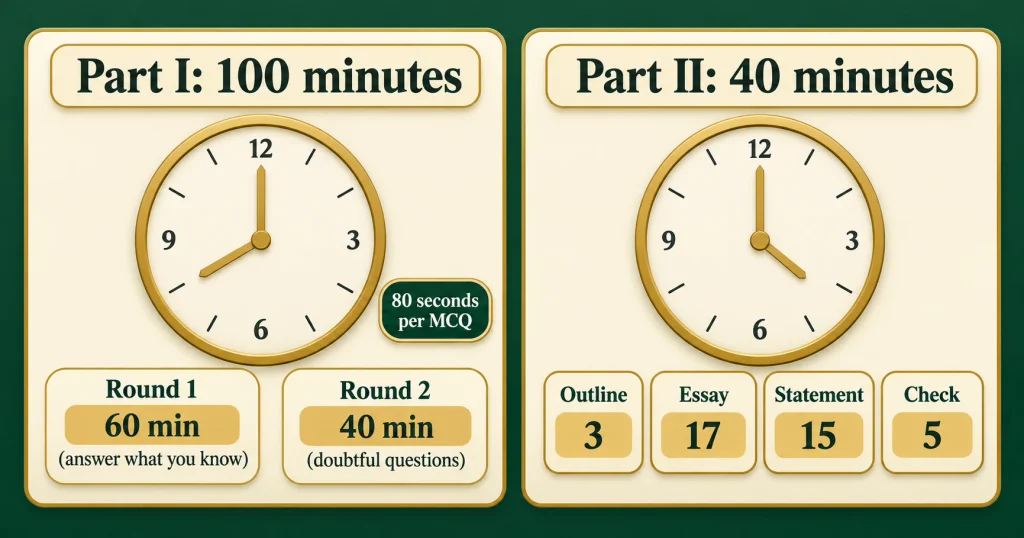
In Part I, 100 minutes for 75 MCQs gives you 80 seconds per question. Use a two-round method: answer everything you know in about 60 minutes, mark the doubtful ones, then return to them. Never let one difficult question eat three minutes of your time.
In Part II, a workable split for the 40 minutes is 3 minutes to choose and outline the essay, 17 minutes to write it, 15 minutes for the personal statement and 5 minutes to check spelling and length. Timed mocks are the final stage of LAT test preparation, so practise this split in at least two full mocks before 15 November.
Try 6 Sample LAT MCQs Before You Move On
These are original practice questions written for this guide, one from each MCQ subject. They are not taken from any HEC paper.
| No. | Subject | Question | Options |
|---|---|---|---|
| 1 | English | Choose the synonym of “candid”. | (a) frank (b) secretive (c) rude (d) tired |
| 2 | General Knowledge | The principal judicial organ of the United Nations is: | (a) ICC (b) WTO (c) UNSC (d) ICJ |
| 3 | Pakistan Studies | The Objectives Resolution was passed in: | (a) 1947 (b) 1949 (c) 1956 (d) 1973 |
| 4 | Islamiat | Surah Al-Fatiha is also called: | (a) Qalb-ul-Quran (b) Arus-ul-Quran (c) Umm-ul-Kitab (d) Al-Kahf |
| 5 | Urdu | “مستعد” کا مطلب ہے: | (a) سست (b) تیار (c) ناراض (d) خاموش |
| 6 | Mathematics | 15% of a number is 45. The number is: | (a) 200 (b) 250 (c) 450 (d) 300 |
Answers: 1-a, 2-d, 3-b, 4-c, 5-b, 6-d (15% of 300 is 45).
Want a full practice paper? Download our free LAT Model Paper 1 (PDF): 75 original MCQs on HEC’s pattern, an essay and personal statement section, an OMR-style answer sheet and a full answer key with explanations.
Past Papers: Use Them Right, Don’t Trust Them Blindly
Start searching for past papers during LAT test preparation and you will find hundreds of PDFs. Most are recalled by candidates from memory after the test. HEC’s official pages publish the content weightages, a sample personal statement and answer keys by booklet colour, not a complete question bank you can download.
Recalled papers are still useful for one job: showing the style and difficulty of questions. Treat them as one tool of LAT test preparation, not a shortcut. Do not memorise their answers as facts, and never pay anyone who claims to have a leaked paper. Such offers are usually scams, and they can put your own test at risk.
7 LAT Test Preparation Mistakes That Cost Marks
- Giving every subject equal time. Mathematics carries 5 marks; English and General Knowledge carry 40 together.
- Memorising a template personal statement. Examiners have seen it many times; a real story scores better.
- Ignoring the 200-word limit. Practise until you can stop near 200 words without counting every line.
- Solving only untimed questions. On test day, you have about 80 seconds per MCQ.
- Treating recalled past papers as official. Use them for style and verify facts elsewhere.
- Leaving registration and the slip to the last minute. The portal closes on 20 October, and slips come on 6 November.
- Aiming for exactly 50. One weak section can pull you below the pass mark, so aim for 60 to 65.
Test-Day Checklist: What to Carry and What to Leave
Your LAT test preparation is not finished until your paperwork is ready. Download and print your roll number slip from the ETC portal when HEC issues it, and check your name, test centre and reporting time the same day.
Carry:
- The printed roll number slip
- Your original CNIC, or your original Juvenile Card if you are under 18
- The stationery your slip allows
Leave at home:
- Mobile phone, smartwatch, calculator, earbuds and every other electronic device
HEC’s announcements page has advised candidates below 18 who do not have a Juvenile Card to get one from NADRA before the test date. Many LAT candidates are 17 or 18, so if this applies to you, start the process today. Bring the original document; a photocopy or a photo on your phone may not be accepted.
After the Test: Answer Keys, Result and Next Steps
After each sitting, HEC posts answer keys on its announcements and results pages, sorted by booklet colour. Use them to estimate your MCQ score, remembering that the essay and personal statement (25 marks) are marked separately and are not part of the key.
HEC’s calendar gives Thursday 24 December 2026 as the tentative result date for this sitting, and the result appears in your own ETC account. If you fall short, or want a better score, HEC’s notices allow candidates to sit the LAT again. All our LAT guides are collected in the Law Admission Test LAT section.
Frequently Asked Questions About LAT Test Preparation
1. How should I start LAT test preparation with four weeks left?
Start with one untimed mixed test to find your weak areas. Then follow the marks: English and General Knowledge first, writing practice every day, and the smaller subjects in short daily blocks. Keep a mistake notebook and take at least two full timed mocks in the last two weeks before 15 November.
2. What is the LAT syllabus and marks distribution?
HEC’s content weightages set 75 MCQs in 100 minutes: English 20, General Knowledge 20, Pakistan Studies 10, Islamiat 10, Urdu 10 and Mathematics 5. Part II gives 40 minutes for one essay (15 marks, one of three topics) and one personal statement (10 marks), each in English or Urdu.
3. How many marks do I need to pass the LAT?
You need at least 50 out of 100. A pass makes you eligible to apply for LLB admission, but universities set their own merit, and some include your LAT score in it. Aim for 60 to 65, so that one weak section does not push you below 50.
4. Can I write the LAT essay and personal statement in Urdu?
Yes. HEC’s content weightages allow both the essay and the personal statement in either English or Urdu. Choose the language you write most accurately under time pressure, and practise in that language throughout your LAT test preparation so you can finish within the 200-word limit and the 40-minute window.
5. Does HEC publish LAT past papers?
HEC publishes the content weightages, a sample personal statement and answer keys after each sitting. The past papers circulating online are mostly recalled by candidates from memory. They help you understand question style, but verify facts elsewhere and never trust anyone selling a leaked paper.
6. Is there negative marking in the LAT?
HEC’s LAT content weightages do not mention negative marking. Read the instructions on your roll number slip and question booklet on the day, because those govern your test. If they do not say otherwise, avoid leaving any MCQ blank and make your best guess before time runs out.
Can I take a calculator to the LAT?
No. ETC’s test-day rules prohibit calculators along with mobile phones, smartwatches and other electronic devices. The Mathematics section has only five basic MCQs and is meant to be solved by hand, so practise percentages, ratios and averages without a calculator.
8. Can I retake the LAT to improve my score?
Yes. HEC’s LAT notices allow candidates who have already passed to reappear to improve their score, and HEC holds several sittings a year. Your result stays valid for two years. If 15 November does not go well, check HEC’s next test calendar for the following sitting.
Four Weeks Are Enough If You Use Them Well
You do not need every book in the market. You need the official pattern, a plan that follows the marks, daily writing practice and two honest mock tests. That is what strong LAT test preparation looks like in the four weeks before 15 November.
Apply before 20 October, start your mistake notebook tonight and write your first personal statement draft this week. The LAT is the first gate to a legal career; after your LLB, the HEC Law GAT will be the next. Get this first step right, and the road ahead becomes much easier.
Disclaimer
This article is for awareness and guidance only and is not official HEC advice. Test dates, format and rules can change, and HEC’s notices, the ETC portal and your roll number slip are the final word. For admission decisions, check each university’s own admission rules.