
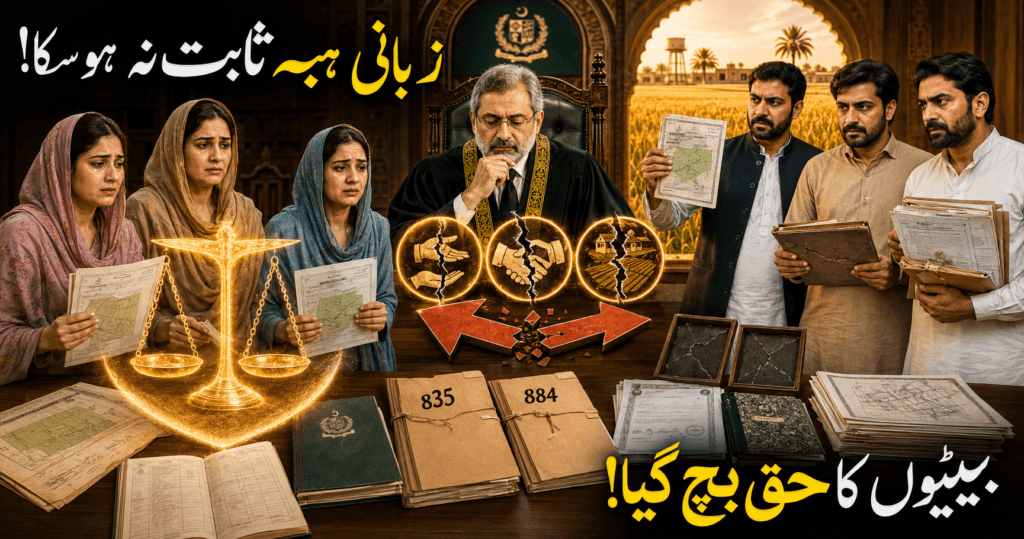
An Oral Gift in Pakistan can change the ownership of valuable family property without a formal sale. But when such a gift is used to exclude daughters from inheritance, courts require clear pleadings and reliable evidence. In this case, three daughters claimed that disputed gift transactions had taken away their lawful share in 244 Kanals of agricultural land.
The Supreme Court examined whether the alleged gift was properly pleaded and proved. It found that the supposed donees had not clearly established the offer, acceptance, delivery of possession, place of transaction, time, or witnesses. The Court therefore refused leave to appeal, leaving intact the decisions that protected the female heirs.
Table of Contents
Why This Judgment Matters for Families Claiming Oral Gifts
Property disputes often begin inside families. A brother may say that the father gifted the land during his lifetime, while sisters may discover years later that mutations or documents have removed their names from the inheritance record. Such cases are emotionally painful because they combine family trust, land ownership and legal rights.
The law does not reject an Oral Gift in Pakistan merely because it was not initially written. However, a person relying on an Oral Gift in Pakistan must prove every essential ingredient through convincing evidence. A mutation entry or registered document cannot automatically repair missing facts about the original transaction.
This decision also strengthens the broader protection of female inheritance rights in Pakistan, particularly where disputed property documents are used to exclude daughters or sisters from their lawful inheritance.
Judgment at a Glance: Oral Gift Dispute and Proof
| Particular | Details |
|---|---|
| Citation | 2026 SCMR 587 |
| Case | Abdul Majeed and others v. Mst. Khalida Bibi (deceased) through LRs and others |
| Court | Supreme Court of Pakistan |
| Bench | Shahid Bilal Hassan and Miangul Hassan Aurangzeb, JJ. |
| Case number | C.P.L.A. No. 990 of 2022 |
| Decision date | 24 June 2025 |
| Property | 244 Kanals of agricultural land |
| Location | Chak No. 26/E.B., Tehsil Arifwala, District Pakpattan Sharif |
| Main dispute | Alleged Oral Gift in Pakistan, gift deeds and revenue mutations excluding female heirs |
| Key issue | Whether offer, acceptance and delivery of possession were properly pleaded and proved |
| Final outcome | Petition dismissed and leave to appeal refused |
The case arose from a Lahore High Court order dated 25 January 2022. The Supreme Court found no illegality in the concurrent decisions of the Trial Court, Appellate Court and Lahore High Court.
IRAC Analysis: How the Court Tested the Oral Gift Claim
| Element | Explanation |
|---|---|
| Issue | Whether the alleged gift and the mutations based on it were legally proved. |
| Rule | A valid gift requires offer, acceptance and delivery of possession. Evidence must remain within the pleadings, and the mutation must be independently proved. |
| Analysis | The alleged donees did not plead or prove the date, time, place, witnesses, offer, acceptance or delivery of possession. Important witnesses and revenue officials were also withheld. |
| Conclusion | The alleged gift failed, the petition was dismissed and the female heirs’ successful decree remained intact. |
Background of the Property Dispute
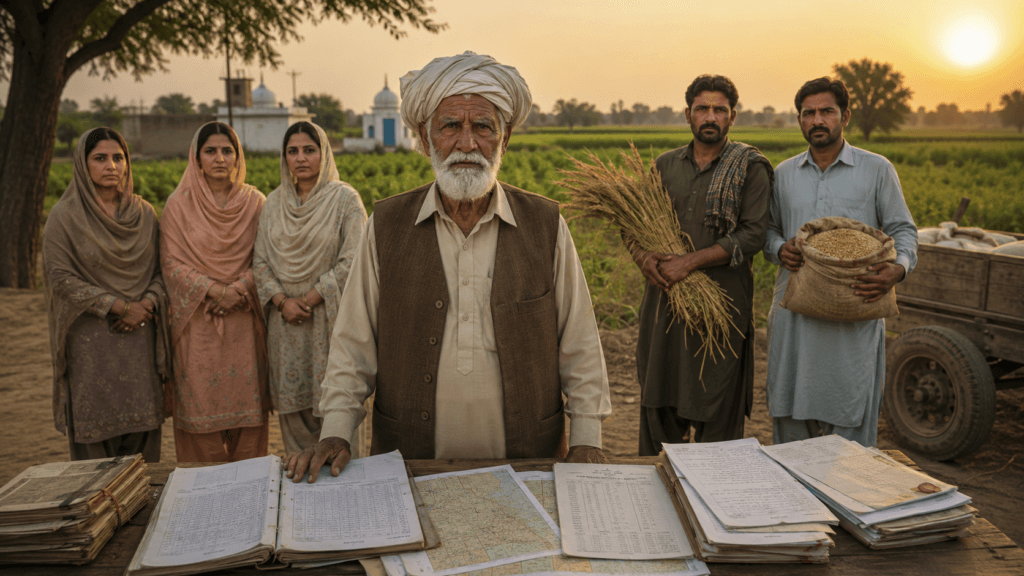
Imdad Ali was the owner of 244 Kanals of agricultural land situated in Chak No. 26/E.B., Tehsil Arifwala, District Pakpattan Sharif. The land was recorded in Khewat Nos. 97/98 and Khatuni Nos. 286 to 291.
The reported judgment states that Imdad Ali left behind three daughters and two sons. His exact date of death is not provided. The daughters claimed that, through inheritance, they became owners of 104 Kanals and 11 Marlas with constructive possession.
According to the plaintiffs, they were simple, illiterate and parda-observing women. The land remained in their brothers’ possession, and the brothers allegedly gave them a share of the agricultural produce. This arrangement meant that the women did not regularly deal with the revenue record themselves.
The dispute came to light on 2 May 2009. The female heirs said they went to the Halqa Patwari to obtain a copy of the record of rights for securing a loan from Zarai Taraqiati Bank. They then discovered that the land had already been shown as transferred through disputed gift transactions.
The Disputed Gift Documents and Mutations
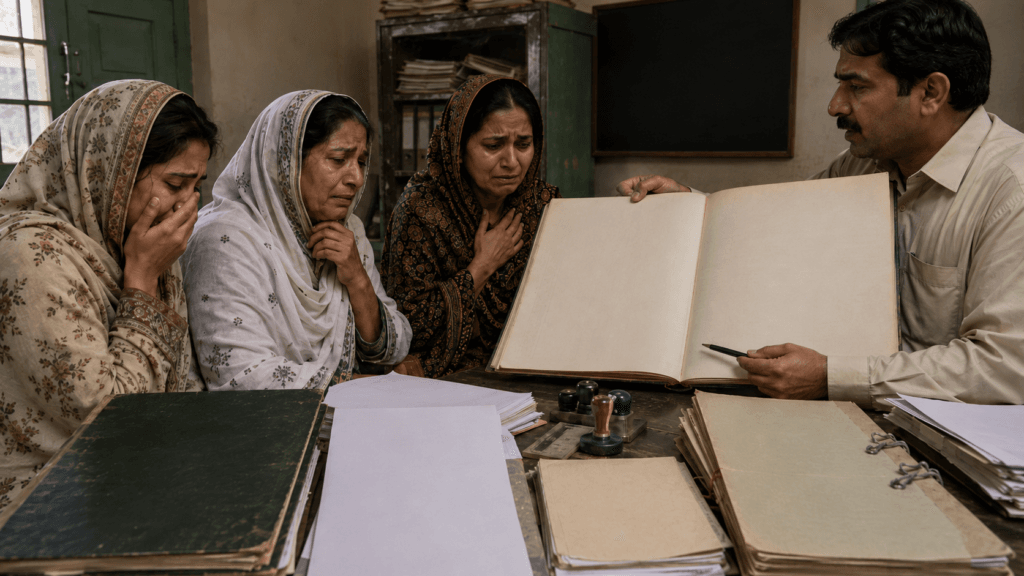
The record referred to the following transactions:
| Document | Date |
|---|---|
| Gift Deed No. 162/1 | 27 February 1992 |
| Gift Deed No. 901/1 | 21 September 1993 |
| Mutation No. 835 | 27 February 1992 |
| Mutation No. 884 | 19 January 1994 |
The property was also mortgaged to Zarai Taraqiati Bank, Arifwala:
| Mortgage mutation | Loan amount |
|---|---|
| Mutation No. 993 | Rs. 334,400 |
| Mutation No. 1650 | Rs. 332,800 |
The daughters alleged that the gift documents were based on fraud and misrepresentation and had been created to deprive them of their inherited shares. The defendants denied these allegations and defended the gift transactions and mutations as genuine.
The judgment discusses an Oral Gift in Pakistan alongside “registered gift deed” terminology while addressing different evidentiary parts of the transaction. Therefore, the safest legal reading is that the alleged original gift and the documents or mutations connected with it had to be proved separately.
Procedural History
The female heirs filed a suit for declaration with perpetual and mandatory injunction. The exact institution date of the suit is not stated in the reported judgment.
On 8 May 2021, the Trial Court decreed the suit in favour of the plaintiffs. The defendants then filed Appeal No. 32-ADJ-2021, but the Appellate Court dismissed it on 8 December 2021.
The defendants approached the Lahore High Court through Civil Revision No. 3308 of 2022. The High Court dismissed the revision on 25 January 2022. They then filed a petition for leave to appeal before the Supreme Court under Article 185(3) of the Constitution.
On 24 June 2025, the Supreme Court dismissed the petition and refused leave. Thus, the concurrent decisions favouring the female heirs remained undisturbed.
Three Essential Requirements of Oral Gift in Pakistan

The Supreme Court reaffirmed that a valid gift under Muslim law has three essential ingredients:
- An offer by the donor;
- Acceptance by the donee; and
- Delivery of possession.
A person relying on an Oral Gift in Pakistan should therefore clearly explain when and where the donor made the offer, how the donee accepted it, who witnessed the transaction, and how possession changed. Without these details, the court may find that the foundation of the gift was never established.
Defective Pleadings Cannot Be Repaired Later
The Supreme Court closely examined the written statement filed by the alleged donees. It found no proper description of how Imdad Ali offered the property as a gift, how the petitioners accepted it, where the transaction occurred, or which witnesses were present.
These details were necessary because the defendants were relying on the alleged gift to defeat the daughters’ inheritance rights. The Court also noted that the petitioners and their witnesses did not establish these matters through evidence.
A fundamental procedural rule is that evidence cannot travel beyond pleadings. A party must first state the material facts in its plaint or written statement and then prove those facts through evidence. A court cannot safely decide a case on a story that was never properly pleaded.
This principle is especially important in litigation concerning an Oral Gift in Pakistan. General statements such as “the donor gifted the land” are not enough when the transaction is disputed. The pleading should contain the material circumstances that make the alleged gift understandable and capable of verification.
Oral Gift in Pakistan and Mutation Are Separate Matters
One of the most useful principles in this judgment is that an alleged Oral Gift in Pakistan and the mutation based upon it involve two separate evidentiary stages.
First, the underlying gift must be proved through cogent and reliable evidence of offer, acceptance and delivery of possession.
Second, the mutation based on that gift must be independently proved according to the Punjab Land Revenue Act, 1967, the relevant rules and the Qanun-e-Shahadat Order, 1984.
This means that a mutation does not prove itself. It is primarily a revenue entry. When the underlying transaction is challenged, the beneficiary must prove both the original gift and the legality and authenticity of the mutation process.
For anyone claiming an Oral Gift in Pakistan, this distinction is critical. Even a sanctioned mutation cannot replace proof of the donor’s offer, the donee’s acceptance and the actual delivery of possession.
Why the Evidence Failed

The Supreme Court found that the petitioners did not produce strong, unimpeachable and confidence-inspiring evidence regarding the alleged gift. More importantly, they withheld several witnesses and officials who could have explained the preparation, execution, attestation and revenue entry of the disputed transactions.
The missing witnesses included:
- the stamp vendor;
- the scribe;
- marginal witnesses;
- the identifying witness;
- the Sub-Registrar;
- revenue officials; and
- the Patwari.
Under Article 129(g) of the Qanun-e-Shahadat Order, 1984, withholding the best available evidence can justify an adverse presumption. In simple words, the court may presume that the missing evidence would not have supported the party that withheld it.
The Court applied this principle because the petitioners were beneficiaries of the alleged transaction. They were expected to produce the people and record capable of proving it. Their failure seriously weakened the claim.
No Reason Was Shown for Excluding the Daughters
The Supreme Court also noticed that the petitioners had not pleaded or proved any reason why Imdad Ali would gift the disputed property to them while excluding his daughters, who were lawful heirs.
The Court observed that a gift is usually connected with an understandable reason, such as affection or reward for sincere service. The absence of any pleaded and proved reason did not by itself create a universal rule that every gift must have consideration. Rather, in the circumstances of this inheritance dispute, it was another important gap in the petitioners’ version.
When an Oral Gift in Pakistan is relied upon to exclude daughters or sisters from inheritable property, courts may scrutinise the evidence more carefully. The alleged donee must prove the transaction through independent, credible and complete evidence.
Heavy Burden on the Alleged Donees
The property admittedly belonged to Imdad Ali and was inheritable after his death. Ordinarily, a Muslim’s property devolves upon legal heirs at death. Therefore, anyone claiming that some heirs were excluded because of an earlier gift carries a serious burden.
The Supreme Court held that the petitioners, as alleged donees, had to stand on their own evidence. They could not succeed merely by pointing out weaknesses in the daughters’ evidence.
This is a vital lesson about the burden of proving an Oral Gift in Pakistan. The beneficiary must affirmatively establish the transaction. A weak case from the opposing side does not automatically turn an unproved gift into a valid one.
The petitioners also failed to clearly state the date, time and place of the gift or the names of the witnesses present when the donor allegedly offered the property and the donees accepted it.
Limitation Did Not Defeat the Female Heirs’ Claim
The petitioners also raised a limitation objection. However, the three courts below had already addressed it, and the Supreme Court found no reason to interfere.
The Court referred to the principle under Article 120 of the Limitation Act, 1908 that limitation in a declaratory suit begins when the right to sue accrues. Determining that date depends on the facts of each case.
The judgment further recognised that a claim seeking declaration of title concerns a subsisting right. Such a right may continue while the claimant’s ownership interest in the property remains alive.
Here, the plaintiffs stated that they discovered the disputed transfers on 2 May 2009. The Supreme Court did not treat their suit as barred by limitation. This does not mean that every delayed inheritance suit will automatically succeed. Each case still depends on its pleadings, knowledge, possession, fraud allegations and available evidence.
Supreme Court’s Final Decision

The Supreme Court found no illegality in the Lahore High Court’s order or in the judgments and decrees passed by the Trial Court and the first Appellate Court.
Accordingly:
- C.P.L.A. No. 990 of 2022 was dismissed;
- leave to appeal was refused;
- the Lahore High Court order dated 25 January 2022 remained intact;
- the Appellate Court judgment dated 8 December 2021 remained intact;
- the Trial Court decree dated 8 May 2021 in favour of the female plaintiffs remained intact; and
- the alleged donees remained non-suited.
The reported Supreme Court order does not reproduce every item of the Trial Court’s decree. It is therefore more accurate to say that the plaintiffs’ successful declaratory and injunction decree, together with their inheritance claim, remained protected rather than claiming that the Supreme Court passed a fresh detailed cancellation decree.
Practical Checklist for Proving Oral Gift in Pakistan
A person relying on an alleged gift should preserve and present:
- the exact date, time and place of the transaction;
- the donor’s clear words of offer;
- the donee’s clear acceptance;
- proof of delivery of actual or constructive possession;
- names and statements of independent witnesses;
- relevant revenue record and mutation proceedings;
- evidence showing who remained in possession;
- supporting conduct after the gift;
- the original documents and registration record, where applicable; and
- an explanation for the transfer, especially where other heirs were excluded.
Lawyers drafting such a case should place every material fact in the pleadings. Evidence should support those pleaded facts rather than introduce a new version during trial.
Practical Checklist for Legal Heirs Challenging a Gift
A legal heir who discovers a suspicious transaction should consider obtaining:
- the latest record of rights;
- certified copies of the mutation;
- copies of any alleged gift deed;
- mutation proceedings and statements recorded by revenue officials;
- registration details from the Sub-Registrar;
- possession and cultivation records;
- mortgage entries;
- proof of the date of knowledge;
- family inheritance details; and
- professional legal advice without unnecessary delay.
These steps are especially useful where an Oral Gift in Pakistan is asserted after the donor’s death and the alleged transaction has excluded daughters, sisters or other heirs.
Key Lessons from 2026 SCMR 587
This judgment provides several clear lessons:
- Offer, acceptance and delivery of possession must all be proved.
- Material facts must first appear in the pleadings.
- Evidence outside the pleadings cannot repair a defective case.
- The gift and the mutation are separate matters requiring separate proof.
- Withholding material witnesses may create an adverse presumption.
- A beneficiary excluding legal heirs carries a heavy burden.
- Mutation entries alone do not establish a valid gift.
- Concurrent factual findings are not disturbed without a valid legal reason.
An Oral Gift in Pakistan may be legally recognised, but it cannot rest on vague statements, incomplete pleadings or unsupported revenue entries.
Conclusion
The ruling in 2026 SCMR 587 shows that family property cannot lawfully change hands through an unproved story. A mutation, document or claim of possession is not enough where the alleged transaction lacks clear evidence of offer, acceptance and delivery.
For every disputed Oral Gift in Pakistan, the court will examine the complete chain: what the donor said, how the donee accepted, whether possession changed, who witnessed the event, how the mutation was entered and whether the best evidence was produced. Where that chain breaks, the beneficiary cannot defeat the lawful inheritance rights of other heirs.
Disclaimer
This article is for general legal awareness only and is based on the reported Supreme Court judgment. It does not constitute legal advice. Consult a qualified lawyer for guidance on your specific facts and documents.
Frequently Asked Questions
1. What are the essentials of Oral Gift in Pakistan?
The three essentials are an offer by the donor, acceptance by the donee and delivery of possession. All three must be proved through reliable evidence.
2. Must an Oral Gift in Pakistan always be registered?
Muslim law can recognise an Oral Gift in Pakistan, but its validity depends on proof of its essential ingredients. In this case, related documents and mutations did not replace proof of the original transaction.
3. Is a mutation enough to prove ownership?
No. A mutation is a revenue entry. When challenged, the beneficiary must prove both the underlying transaction and the mutation through legally acceptable evidence.
4. Who must prove the alleged gift?
The person who benefits from and relies upon the gift must prove it. The burden becomes particularly serious when the gift is used to exclude lawful heirs.
5. Why does delivery of possession matter?
Delivery of possession shows that the donor completed the transfer and gave control of the property to the donee. Without it, the gift may remain incomplete.
6. Can evidence cure missing pleadings?
No. Evidence must correspond with the case pleaded. A party cannot normally introduce material facts through evidence when those facts were absent from the pleadings.
7. Can daughters challenge a mutation discovered years later?
They may challenge it depending on the facts, date of knowledge, nature of the title claim, possession and applicable limitation law. The Supreme Court did not find the present suit time-barred.
8. What did the Supreme Court decide in 2026 SCMR 587?
The Court dismissed the petition and refused leave to appeal because the alleged donees failed to prove the gift and related transactions through the required pleadings and evidence.