

A company receives a super tax demand. But there is a problem: billions of rupees of its tax have already been deducted at source. Should the taxpayer still pay the demand first and then begin a separate refund struggle—or can the existing tax credit be used against the super tax liability?
That question reached the Federal Constitutional Court of Pakistan in CM Pak Limited v. Federation of Pakistan & others, F.C.P.L.A. Nos. 1276 and 1277 of 2026.
The answer matters far beyond one telecom company.
The Federal Constitutional Court held that a taxpayer is not automatically confined to the refund mechanism under section 170 where a tax credit under section 168 is legally available. Because section 4C itself applies all provisions of Chapter X, the tax-credit machinery cannot simply be ignored.
For businesses, tax advisers and finance teams, the judgment gives important clarity on Super Tax Adjustment—but it also contains an equally important warning: the Court did not calculate or automatically allow the amount claimed. The competent tax authority must still determine whether, and to what extent, the credit is actually adjustable.
For readers dealing with the wider filing process, our separate guide on FBR Tax Return explains return filing, tax payment, wealth reconciliation and post-filing checks in simple language.
Table of Contents
IRAC: Why Did the Court Allow the Adjustment Route?
| IRAC | Court’s Position |
|---|---|
| Issue | Whether income tax generally, and super tax under section 4C particularly, can be adjusted where a tax credit within section 168 of the Income Tax Ordinance, 2001 is available. |
| Rule | Section 4C(3) provides that super tax is to be paid, collected and deposited in the manner specified in section 137(1), and that all provisions of Chapter X shall apply. Section 168 forms part of that statutory tax-credit regime. |
| Analysis | The separate reference to “all provisions of Chapter X” could not be treated as meaningless or limited only to payment procedure. Section 137(1) already addresses the date and manner of payment. The wider Chapter X incorporation therefore extends to adjustment and tax credit, including section 168 where applicable. |
| Conclusion | The Court answered the legal question in the affirmative. The taxpayer may seek Super Tax Adjustment before the competent taxing authority, which must determine the claim according to the Ordinance and the Court’s observations. |
The “A” in IRAC means Analysis: this is where the Court connected the statutory language of section 4C with section 168 and explained why a narrow reading of Chapter X could not stand.
Judgment at a Glance: What Should You Remember in 60 Seconds?
| Point | Detail |
|---|---|
| Court | Federal Constitutional Court of Pakistan, Appellate Jurisdiction |
| Cases | F.C.P.L.A. Nos. 1276 & 1277 of 2026 |
| Petitioner | CM Pak Limited |
| Respondents | Federation of Pakistan through Secretary, Revenue Division & others |
| Bench | Chief Justice Amin-ud-Din Khan and Justice Aamer Farooq |
| Judgment by | Justice Aamer Farooq |
| Hearing | 30 June 2026 |
| Impugned judgment | Islamabad High Court judgment dated 25 March 2026 in W.P. Nos. 1125 and 1126 of 2026 |
| Core provisions | Sections 4C, 137, 168 and 170, Income Tax Ordinance, 2001 |
| Main question | Whether section 168 tax credit may operate against section 4C super tax |
| Answer | Yes, where the credit is legally available |
| What Court did not decide | The factual entitlement and exact amount of adjustment |
| Final result | Appeals allowed; IHC judgment set aside; taxpayer permitted to seek adjustment before competent tax authority |
The petitioner was represented by Salman Akram Raja, ASC, with Syed Rifaqat Hussain Shah, AOR, assisted by Asad Ladha, Advocate, Sabir Hussain, Assistant Manager (Litigation), while the respondents were represented by Ali Nawaz Kharral, ASC, with Zahid Sohail and Muhammad Arsalan.
Readers interested in more constitutional decisions can also explore our Federal Constitutional Court Judgments section.
Why This Super Tax Adjustment Case Was Different from the Earlier Super Tax Battle
There are two different legal questions that should not be mixed.
The first was whether section 4C super tax itself was constitutionally valid. That controversy had already travelled through the superior courts. The present judgment records that the vires of section 4C had been upheld, referring to PLD 2026 FCC 62.
FBR also publicly reported the earlier constitutional ruling on section 4C. According to the official FBR press release, the Court upheld the levy and its application to tax year 2022 in the circumstances described there.
But the present case asked something else:
Once super tax liability exists, can an available section 168 tax credit be used against it?
That distinction is the key to understanding the entire judgment.
The Court did not abolish super tax. It did not declare section 4C invalid. It decided the mechanics of discharging a valid liability where tax credit may already exist.
That is why anyone researching Super Tax Adjustment should not confuse this decision with the earlier constitutional challenge to the levy itself.
What Triggered the Dispute? A Rs. 2.212 Billion Tax-Credit Claim
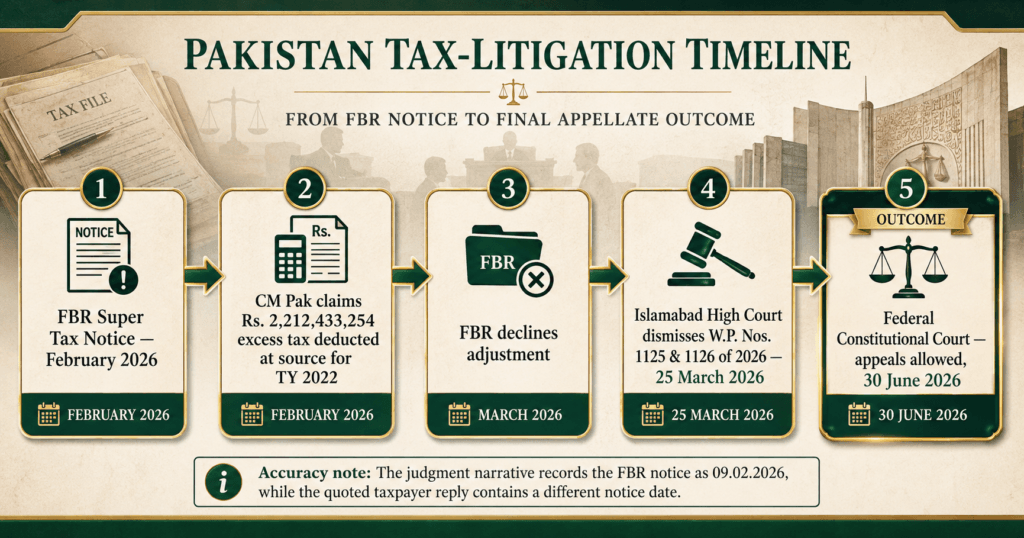
After the constitutional validity of super tax had been affirmed, FBR issued a notice requiring CM Pak Limited to discharge its section 4C liability.
The judgment records the notice date as 9 February 2026.
The company responded that it had excess tax deducted at source of:
Rs. 2,212,433,254
relating to tax year 2022, and maintained that this amount was available for adjustment against the super tax payable.
Its reply was dated 16 February 2026.
There is one small date inconsistency inside the judgment itself worth preserving accurately: paragraph 3 records the FBR notice as 09.02.2026, while the quoted portion of the taxpayer’s reply refers to the notice as dated February 19, 2026. The judgment does not reconcile that discrepancy.
FBR declined the taxpayer’s position.
CM Pak then invoked the constitutional jurisdiction of the Islamabad High Court under Article 199. The High Court dismissed Writ Petitions Nos. 1125 and 1126 of 2026 on 25 March 2026.
The taxpayer then approached the Federal Constitutional Court.
This sequence matters because Super Tax Adjustment was not being raised as an abstract academic argument. A substantial amount of tax had allegedly already been deducted and the taxpayer wanted that available credit considered against its section 4C liability.
The One Sentence in Section 4C That Changed the Result
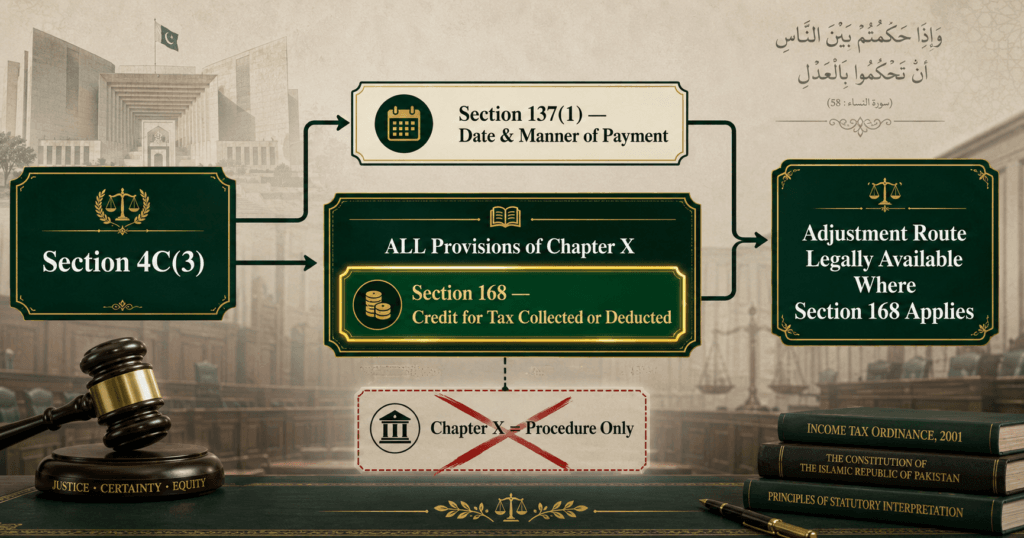
The legal turning point lies in section 4C(3).
Section 4C is the charging provision dealing with super tax on high-earning persons. The judgment reproduced the provision in detail, including the categories of income relevant for section 4C and its collection and recovery framework.
For current statutory text, readers should check FBR’s Income Tax Ordinance, 2001. FBR currently lists an Ordinance version amended up to 30 June 2026.
The critical structure of section 4C(3) does two things.
First, it links payment to section 137(1).
Second, it separately provides that:
all provisions of Chapter X shall apply.
That second part became decisive.
The Court reasoned that section 137(1) had already been specifically incorporated for the date and manner of payment. If the additional incorporation of all of Chapter X were treated as doing nothing more than repeating the same procedural point, Parliament’s additional words would become redundant.
Courts ordinarily do not interpret statutory language as meaningless where a workable interpretation gives each part a purpose.
Here, that meant Chapter X had to be given its proper statutory effect.
And Chapter X includes section 168.
That opened the legal door for Super Tax Adjustment.
Why Could FBR Not Treat Chapter X as “Procedure Only”?
The Court’s reasoning goes deeper than simply saying section 168 exists.
It focused on the legislative language.
According to the judgment, the expressions used in section 4C—payment, collection and deposit—operate within the wider statutory machinery for discharging tax liability. That machinery includes matters such as payment, collection, credit and adjustment.
The Court observed that if Parliament intended to incorporate only procedural provisions from Chapter X, it could have expressly limited the section that way.
It did not.
The Court therefore refused to insert a restriction that the legislature itself had not written.
This is a significant statutory interpretation principle. A tax authority cannot selectively use Chapter X for collection while ignoring another applicable provision within the same incorporated chapter simply because that provision benefits the taxpayer.
Where section 168 applies on the facts, it must be allowed to operate according to its terms.
That reasoning is the real legal foundation of Super Tax Adjustment under this judgment.
What Does Section 168 Actually Do?
Section 168 deals with credit for tax collected or deducted.
In simplified terms, where qualifying tax has already been collected from or deducted from a taxpayer, the Ordinance treats that amount within the statutory tax-credit mechanism.
The section also contains conditions, limitations and specific rules. Therefore, the judgment should never be read as saying that every amount described by a taxpayer as “withholding tax” automatically becomes an allowable credit.
The factual and legal nature of the amount must still be established.
That is why businesses considering Super Tax Adjustment should begin with the evidence:
- What tax was deducted or collected?
- Under which provision?
- For which tax year?
- Is the credit reflected in the taxpayer’s records?
- Is it excluded by any statutory limitation?
- Has any part already been utilized?
- Does it satisfy the requirements of section 168?
- Is it being claimed against the correct liability and tax year?
These factual checks matter because the Federal Constitutional Court decided the legal availability of the route, not the final arithmetic of CM Pak’s claim.
Section 168 Tax Credit vs Section 170 Refund: Why the Difference Could Save a Taxpayer a Separate Fight
One of the strongest parts of the judgment is the Court’s distinction between a tax credit and a refund.
They are not interchangeable expressions.
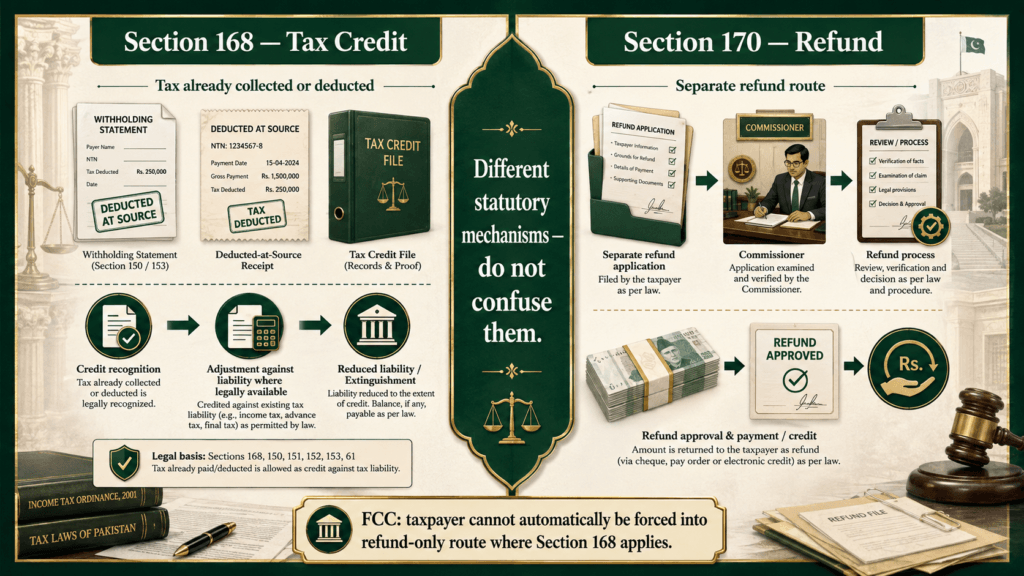
Section 168: tax credit
Section 168 concerns credit arising from qualifying tax collected or deducted.
It operates within the computation and discharge of tax liability.
Section 170: refund
Section 170 provides a separate statutory mechanism for obtaining a refund.
The Court specifically noted that a section 170 refund requires the statutory refund process, including an application before the Commissioner under section 170(1).
The Court therefore rejected the proposition that a taxpayer with an available section 168 credit must necessarily be forced to ignore that credit and pursue only a section 170 refund.
That approach would collapse two legally distinct mechanisms into one.
The judgment relied in this context on Hamid Ashraf v. Commissioner Inland Revenue, Lahore, 2020 SCMR 843.
It also referred to Messrs Rajby Industries Karachi v. Federation of Pakistan, 2023 SCMR 1407 while discussing the established approach to interpretation of fiscal statutes.
For practical tax compliance before any adjustment dispute arises, see our detailed FBR Tax Return guide.
Does This Mean Every Super Tax Demand Can Now Be Adjusted?
No.
This is the most important limitation in the entire article.
The Court deliberately did not decide whether CM Pak’s claimed tax was factually adjustable or how much of the claimed Rs. 2.212 billion should ultimately be allowed.
That determination belongs to the competent tax authority.
So Super Tax Adjustment is now supported as a legally available route where section 168 genuinely applies, but it is not an automatic waiver.
A taxpayer still needs to establish:
- the existence of the credit;
- the legal nature of the tax collected or deducted;
- the relevant tax year;
- the unutilized amount;
- compliance with section 168;
- the relationship between that credit and the outstanding liability.
The judgment creates a legal entitlement to have a valid adjustment claim considered. It does not guarantee that every claim will succeed.
That distinction makes the article more useful than a headline such as “Court allows super tax adjustment,” because the headline alone can create a dangerously broad impression.
Why Did the Federal Constitutional Court Set Aside the Islamabad High Court Judgment?
After considering section 4C and the Chapter X framework, the Federal Constitutional Court found no statutory basis for holding that super tax was inherently incapable of adjustment where section 168 credit was available.
The Court rejected a constrained interpretation under which Chapter X would apply selectively.
Its logic was straightforward:
If Chapter X applies, its applicable provisions must be allowed to operate according to their terms.
That includes section 168.
A court or tax authority cannot read an unstated limitation into section 4C simply to force the taxpayer into section 170.
On that basis, the Federal Constitutional Court converted the petitions into appeals, allowed them and set aside the Islamabad High Court judgment dated 25 March 2026.
What Exactly Did the Final Order Give CM Pak?
The final relief was carefully framed.
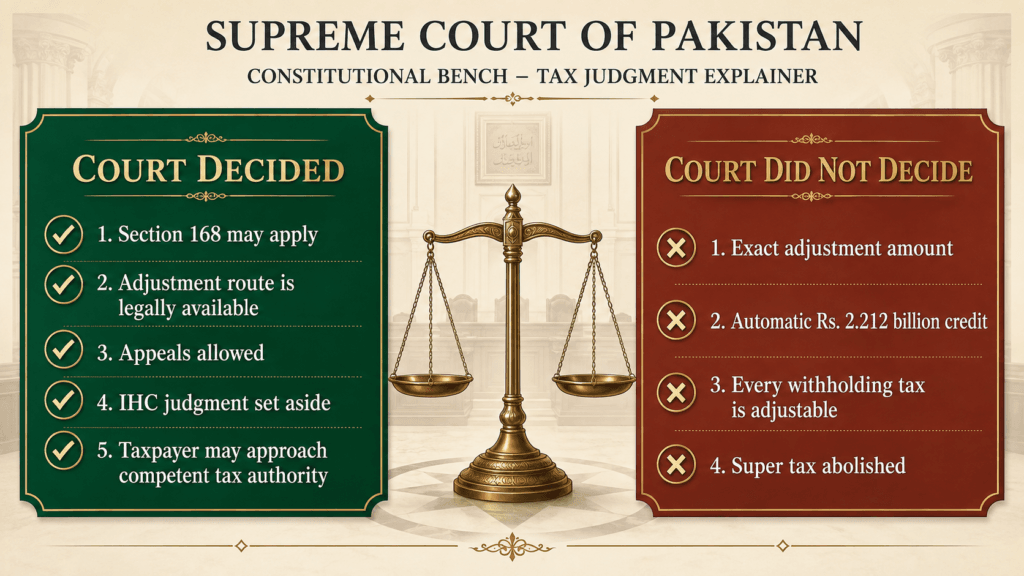
The taxpayer was declared at liberty to seek adjustment, if any, before the competent taxing authority.
That authority must determine the claim:
- under the Income Tax Ordinance, 2001; and
- in light of the Federal Constitutional Court’s observations.
All pending applications were also disposed of.
The judgment was approved for reporting.
This wording is important.
The Court did not write a cheque for Rs. 2.212 billion.
It restored the taxpayer’s lawful ability to pursue Super Tax Adjustment and required the tax authority to decide that claim under the correct legal interpretation.
Super Tax Adjustment Practical Checklist: What Should a Taxpayer Check Before Filing a Claim?

A company should not approach FBR with only a copy of this judgment.
A stronger adjustment claim should be built around records.
1. Start with the section 4C demand
Identify the exact tax year, amount, notice, order and statutory basis of the liability.
2. Build a tax-credit reconciliation
Prepare a year-wise schedule showing every amount claimed as available tax credit.
3. Match withholding evidence
The amount should be supported by tax deduction certificates, statements, CPRs, portal records and other relevant evidence.
4. Confirm section 168 eligibility
Not every deduction operates identically. Check whether the specific tax is creditable and whether any statutory exclusion applies.
5. Confirm the credit is still unutilized
A tax credit cannot realistically be used twice.
6. Keep adjustment separate from refund
Your written representation should explain why section 168 applies and why the claim is an adjustment question rather than merely a section 170 refund request.
7. Attach the judgment
Use the official Federal Constitutional Court judgment rather than relying only on a social-media summary or screenshot.
8. Preserve the paper trail
Keep notices, replies, emails, portal acknowledgements, tax workings and orders together.
9. Obtain case-specific tax advice
The judgment settles an important legal principle, but the amount and availability of Super Tax Adjustment remain fact-dependent.
A Crucial 2026 Warning: Do Not Calculate Today’s Super Tax from the Old Case Facts
CM Pak’s dispute concerned tax year 2022.
That does not mean the historical rates reproduced in old litigation should automatically be applied to a current tax year.
Tax laws change through Finance Acts.
FBR currently publishes both the Income Tax Ordinance, 2001 amended up to 30 June 2026 and the Finance Act 2026.
Accordingly, readers should separate two questions:
Question 1: Is Super Tax Adjustment legally possible where section 168 applies?
This judgment says yes.
Question 2: What is my current section 4C liability and applicable rate?
That must be checked under the law applicable to the relevant tax year.
This distinction prevents one of the most common mistakes in tax blogs: mixing a judgment’s historical facts with current tax rates.
What This Judgment Does—and Does Not—Change
It does:
- recognize that section 168 may operate against section 4C liability;
- reject the idea that a taxpayer must always pursue only section 170 refund;
- require Chapter X to be read as a complete incorporated statutory regime where applicable;
- permit CM Pak to place its adjustment claim before the competent authority;
- set aside the Islamabad High Court judgment.
It does not:
- strike down section 4C;
- abolish super tax;
- automatically allow Rs. 2.212 billion;
- declare every withholding amount adjustable;
- remove the tax authority’s role in examining factual entitlement;
- freeze the section 4C rate structure for future tax years.
This is the safest way to understand Super Tax Adjustment after the FCC ruling.
Why This Decision Matters Beyond One Telecom Company
Tax cases often look technical because they involve sections, schedules, credits and calculations.
But underneath this dispute was a simple fairness question.
If Parliament says an entire statutory chapter applies, can the revenue authority rely on the collection parts of that chapter while ignoring an applicable tax-credit provision inside it?
The Federal Constitutional Court’s answer was effectively no.
That approach promotes consistency in statutory interpretation.
It also gives taxpayers a clearer framework for arguing that tax already legally standing to their credit should be recognized when an additional liability is being discharged.
For tax advisers, the judgment is particularly important because Super Tax Adjustment is no longer merely an administrative convenience argument. It now has direct support in the Federal Constitutional Court’s interpretation of sections 4C and 168.
Five Costly Mistakes to Avoid After Reading This Judgment
Mistake 1: “The Court abolished super tax”
It did not.
Mistake 2: “Every withholding tax can be adjusted automatically”
The Court did not say that either.
Mistake 3: “Refund and adjustment are the same”
The judgment expressly distinguishes the two.
Mistake 4: “The Court approved CM Pak’s full Rs. 2.212 billion”
No. The amount remains for the competent authority to determine.
Mistake 5: “The 2022 tax rates in the case are today’s rates”
Current liability must be checked under current legislation, including the applicable Finance Act.
Avoiding these five mistakes is essential when advising a business on Super Tax Adjustment.
Frequently Asked Questions
What is Super Tax Adjustment?
Super Tax Adjustment generally refers to using an available tax credit against a section 4C super tax liability where the Income Tax Ordinance legally permits that credit to operate.
Did the Federal Constitutional Court allow Super Tax Adjustment?
Yes. The Court answered the legal question in the affirmative and held that section 4C super tax is not inherently incapable of adjustment where section 168 tax credit is available.
Was super tax itself declared illegal?
No. This case was about adjustment after the validity of section 4C had already been upheld in earlier litigation.
What is the difference between tax adjustment and refund?
A section 168 tax credit operates within the statutory credit mechanism, while section 170 provides a separate refund procedure. The Federal Constitutional Court treated them as legally distinct.
Can every company use section 168 against super tax?
Not automatically. The taxpayer must first establish that a qualifying section 168 credit actually exists and is legally available.
Did CM Pak receive Rs. 2,212,433,254 from the Court?
No. That was the excess tax deduction amount claimed by the company. The Court left factual determination and quantum to the competent tax authority.
Why was Chapter X so important?
Because section 4C expressly states that all provisions of Chapter X apply. Section 168 falls within the relevant statutory machinery, so the Court refused to restrict Chapter X merely to procedural collection provisions.
Does a taxpayer have to apply for a section 170 refund first?
The judgment rejected the proposition that the taxpayer must necessarily be confined to the section 170 route where a valid section 168 adjustment is available.
Who decides the final amount of Super Tax Adjustment?
The competent taxing authority decides the factual entitlement and amount in accordance with the Income Tax Ordinance and the FCC judgment.
What documents should support an adjustment claim?
Depending on the case, useful records may include withholding statements, tax certificates, CPRs, return workings, tax-credit reconciliations, FBR notices, correspondence and prior orders.
Where can I verify the current law?
Use FBR’s official Income Tax Ordinance page and Finance Acts page. FBR currently lists the Ordinance amended up to 30 June 2026 and the Finance Act 2026.
Where can I read the original judgment?
Readers should prefer the official Federal Constitutional Court judgment for authoritative reading.
Conclusion: The Real Relief Is the Right to Have the Credit Considered
The biggest lesson from this case is not that super tax disappeared.
It did not.
The real relief is more precise.
The Federal Constitutional Court held that when section 4C brings all provisions of Chapter X into its statutory scheme, an applicable section 168 tax credit cannot simply be treated as irrelevant. Nor can the taxpayer automatically be pushed into a refund-only route under section 170.
That gives Super Tax Adjustment a clear legal foundation.
At the same time, the judgment protects the tax authority’s proper role: factual entitlement and the exact amount still have to be examined under the Income Tax Ordinance.
For taxpayers, the practical message is therefore balanced: know your credit, reconcile your evidence, distinguish adjustment from refund, use the correct tax year, and do not assume that the judgment itself completes the calculation.
That is what makes this decision important—not a blanket exemption, but a clear judicial recognition that a lawful tax credit deserves to be considered.
Disclaimer
This article is written for legal awareness and educational purposes only. It does not constitute tax advice, legal opinion or professional representation. Super tax liability, tax credit, refund and adjustment depend on the applicable tax year, statutory amendments, taxpayer status and documentary record. Always verify the current law from FBR and obtain professional advice for a specific tax matter.