

A property owner may trust a father, brother, son, or close relative with a power of attorney only to manage land or supervise construction. But what happens when that trusted document is used to gift the entire property to someone else?
That painful question reached the Supreme Court of Pakistan in Babar Anwar v. Muhammad Ashraf, reported as 2024 SCMR 734. The case shows that a Gift Deed Through Power of Attorney is not automatically valid merely because it is registered. Registration proves that a document exists, but it does not replace the real owner’s clear intention, consent, and authority.
The Supreme Court protected the owner because the record did not prove that he had authorised the attorney to make the gift. The Court also noticed a serious contradiction: the beneficiary claimed that the property was gifted to him, yet he also claimed that he had purchased it for valuable consideration. These two stories could not stand together.
Table of Contents
IRAC: The Entire Case in One View
| Part | Simple explanation |
|---|---|
| Issue | Could an attorney validly gift the principal’s property to Babar Anwar without clearly proved permission or consent from the principal? |
| Rule | A Gift Deed Through Power of Attorney requires the principal’s express permission and proved instructions. A valid Muslim gift also requires declaration, acceptance, and delivery of possession. |
| Analysis | The record did not show that Muhammad Ashraf authorised his father to make this gift. The beneficiary also relied on conflicting pleas of gift and purchase. Possession was supported by Form P.T.I., electricity bills, and gas bills produced by Muhammad Ashraf. |
| Conclusion | The gift deed was not protected. The suit for declaration and cancellation remained decreed, the petition was dismissed, and leave was refused. |
The Supreme Court repeated that a valid gift requires declaration, acceptance, and possession. The donor must clearly give up control and ownership and place the donee in possession.
Judgment at a Glance: Gift Deed Through Power of Attorney Dispute
| Detail | Information |
|---|---|
| Case title | Babar Anwar v. Muhammad Ashraf and another |
| Citation | 2024 SCMR 734 |
| Court | Supreme Court of Pakistan |
| Bench | Qazi Faez Isa, C.J., Muhammad Ali Mazhar and Musarrat Hilali, JJ. |
| Author judge | Muhammad Ali Mazhar, J. |
| Decision date | 24 January 2024 |
| Main law | Sections 39 and 42, Specific Relief Act, 1877; section 115, C.P.C.; principles of Muslim gift law |
| Disputed document | Registered gift deed dated 24 September 2011 |
| Earlier gift | Gift Deed No. 100 dated 10 January 1978 |
| Power of attorney | Executed on 1 March 2006 |
| Forum path | Trial Court → District Judge → Lahore High Court, Rawalpindi Bench → Supreme Court |
| Final relief | Petition dismissed and leave refused |
The case was Civil Petition No. 5972 of 2021 and was decided on 24 January 2024.
How a Family Trust Turned into a Property Dispute

The disputed property originally belonged to Muhammad Ashraf’s father. On 10 January 1978, the father gifted it to Muhammad Ashraf through Gift Deed No. 100 and also delivered possession. Muhammad Ashraf later raised construction on the land.
On 1 March 2006, Muhammad Ashraf executed a power of attorney in favour of his father. According to the record, it was meant for administration and supervision of the property.
However, the father later used that authority to execute another registered gift deed, dated 24 September 2011, in favour of Babar Anwar.
Muhammad Ashraf then filed a suit for declaration and cancellation. He alleged that his father was elderly, had cardiac problems, and was not in a proper frame of mind. He further alleged that the later transaction resulted from connivance and dishonest conduct.
The dispute therefore became a major test of whether a Gift Deed Through Power of Attorney can survive when the real owner denies giving permission.
That is why every Gift Deed Through Power of Attorney must be tested against the principal’s real instructions, not merely the words printed on a registered document.
Muhammad Ashraf’s Case: “I Never Authorised This Gift”
Muhammad Ashraf asked the court to cancel the registered gift deed of 24 September 2011.
His case was that:
- he already owned the property under the 1978 gift deed;
- the power of attorney was for management and supervision;
- no valid consent to gift the property to Babar Anwar was proved;
- he remained in actual possession;
- the later gift deprived his two sons and four daughters without any explained reason; and
- Babar Anwar’s version was internally inconsistent.
The Supreme Court treated the absence of proved permission as a central defect. It also noted that no one had pleaded that the earlier gift in Muhammad Ashraf’s favour had ever been revoked.
The respondents were not represented during the Supreme Court hearing, but Muhammad Ashraf’s case, documents, and the findings of the lower courts were already part of the judicial record.
Babar Anwar’s Defence: “The Registered Deed Was Valid”

Babar Anwar’s counsel argued that the registered gift deed was valid and that the lower courts had misread the evidence.
He relied on the testimony of the Sub-Registrar, who appeared before the Trial Court and verified the registered document.
He also relied on D.W.1, a tenant who allegedly deposited rent into Babar Anwar’s bank account from 2012 until September 2015. Since Babar Anwar permanently lived in the United Kingdom, his case was that Muhammad Ashraf later took possession by force.
Most importantly, his counsel argued that the wording of the power of attorney already permitted the father to gift the property. Therefore, according to him, no fresh consent or separate permission was required.
This argument raised the heart of the case: does broad wording automatically validate a Gift Deed Through Power of Attorney, or must the owner’s actual intention still be proved?
The Two Conflicting Stories That Weakened the Petition
The Supreme Court found that Babar Anwar had taken two mutually destructive positions.
First, he claimed to be a lawful donee under a gift deed. Second, he claimed that he had purchased the property for valuable consideration.
A gift is made without consideration. A sale is made for consideration.
The Court explained that if the property was gifted, the plea of purchase was misleading. If it was purchased, there was no logical reason to execute a gift deed instead of a proper conveyance or sale deed.
This contradiction damaged the transaction. A court cannot safely accept a Gift Deed Through Power of Attorney when the beneficiary presents both gift and purchase as the source of his ownership.
A party claiming ownership must tell the court one clear and legally consistent story. A person cannot ordinarily say, “I received it free as a gift,” and at the same time say, “I paid for and purchased it.”
Gift Deed Through Power of Attorney: The Documents That Proved Possession
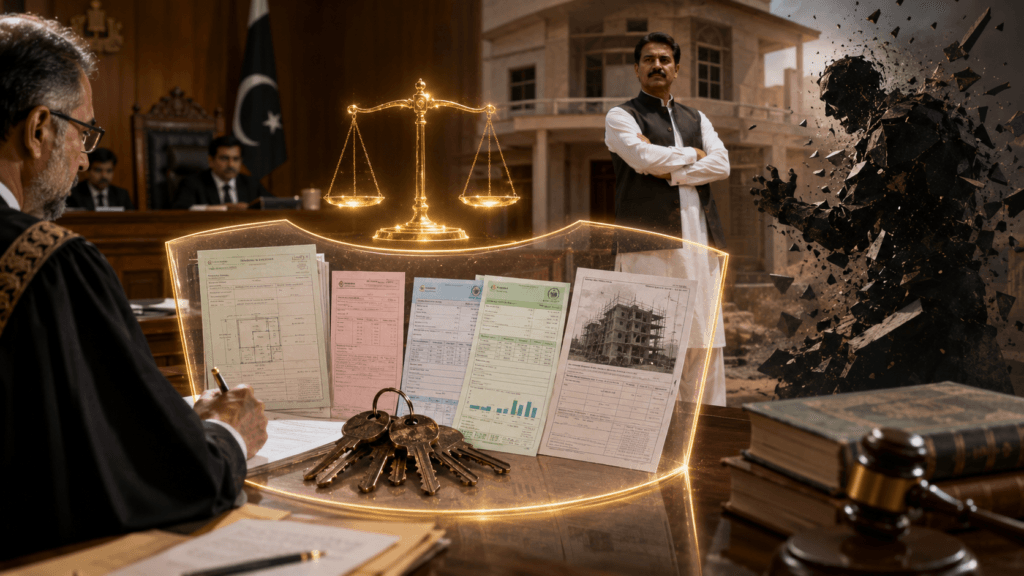
Possession was another important part of the dispute. Babar Anwar’s side claimed that possession was delivered with the gift and was later taken back by force.
Muhammad Ashraf produced documentary evidence before the Trial Court, including:
- Form P.T.I., marked as Exhibits P-7 to P-10;
- electricity bills, marked as Exhibit P-12; and
- Sui gas bills, marked as Exhibits P-13.
The Supreme Court found that these documents supported Muhammad Ashraf’s possession and contradicted the allegation that he had simply snatched possession later.
Babar Anwar had also filed a complaint under section 3 of the Illegal Dispossession Act, 2005. The Trial Court acquitted Muhammad Ashraf and his special attorney on 13 March 2019. The Lahore High Court upheld that acquittal on 9 December 2019.
This evidence shows why a Gift Deed Through Power of Attorney is not judged by registration alone. Courts also examine possession, utility bills, property documents, conduct, pleadings, and surrounding circumstances.
Why the Owner’s Six Children Became Important
Muhammad Ashraf had two sons and four daughters.
The Supreme Court observed that the record did not explain why he would deprive all six children and direct his attorney to gift the property to Babar Anwar.
The Court explained that a gift usually comes from love, affection, or personal services rendered by the donee. However, that love or affection must come from the actual owner.
An attorney cannot rely on his own feelings and treat them as the principal’s intention. The real owner must consciously decide to make the gift.
An owner may legally gift property outside the family. But where all close heirs are being excluded, the beneficiary must be able to explain and prove the transaction through strong evidence.
The absence of clear instructions and consent made this Gift Deed Through Power of Attorney appear unnatural and legally unsafe.
The Supreme Court’s Clear Rule on Attorney-Made Gifts

The Supreme Court stated that an attorney or agent may gift the principal’s property, but only on the principal’s express permission and instructions.
In this case, no convincing evidence showed that the father asked Muhammad Ashraf for permission or obtained his consent before making the gift. Therefore, the lower courts correctly refused to validate the transaction.
This is the controlling principle of 2024 SCMR 734.
A Gift Deed Through Power of Attorney requires more than:
- a signature;
- registration;
- possession of the original document; or
- a broad clause in the power of attorney.
The beneficiary must prove the real owner’s conscious and specific intention behind the gift.
Importantly, the judgment did not rest only on the allegation that the attorney was elderly or medically unwell. The stronger reasons were the absence of proved consent, the contradictory gift-and-sale claims, the possession evidence, and the concurrent findings of three courts.
Applicable Law and Precedents That Controlled the Result
Sections 39 and 42 of the Specific Relief Act, 1877
Muhammad Ashraf sought a declaration of his ownership rights and cancellation of the registered gift deed.
The case demonstrates that a registered document may be cancelled when it threatens the rights of the true owner and was executed without lawful authority.
Readers may also examine the official text of the Specific Relief Act, 1877, published on Pakistan Code by the Ministry of Law and Justice.
Three Essentials of a Valid Muslim Gift
The Supreme Court repeated that a valid Muslim gift requires:
- a clear declaration by a competent donor;
- acceptance by or on behalf of the donee; and
- delivery of possession.
The donor must own the property, understand the legal effect of the transaction, act freely, give up control, and place the donee in possession.
A Gift Deed Through Power of Attorney cannot bypass these requirements. The attorney must prove that the declaration and intention were those of the real owner.
For a broader explanation of declaration, acceptance and delivery of possession, read our complete guide on Gift Deed in Pakistan.
Jamil Akhtar v. Las Baba, PLD 2003 SC 494
The Supreme Court had held that when a general attorney transfers the principal’s property to himself or a close fiduciary relation, special permission from the principal is required.
Muhammad Ashraf v. Muhammad Malik, PLD 2008 SC 389
An attorney intending to sell or gift property to himself or close relatives must consult the principal and obtain consent after disclosing all material circumstances.
Mst. Naila Kausar v. Sardar Muhammad Bakhsh, 2016 SCMR 1781
A power of attorney cannot be used to make a gift without the principal’s proved intention and directions.
Special and specific consent is particularly important where the attorney himself or a close family member receives the benefit.
Allah Ditta v. Manak, 2017 SCMR 402
The Court had considered it unnatural for a person to deprive his children and give property to nephews where the alleged reason was not proved.
The Court also observed that mutation is only evidence of an alleged transaction. It does not carry an automatic presumption of correctness when challenged by an affected person.
Gift Deed Through Power of Attorney and Three Concurrent Decisions
The Trial Court decreed Muhammad Ashraf’s suit on 20 February 2020.
Babar Anwar filed an appeal before the District Judge, but the appeal was dismissed on 4 February 2021.
He then filed Civil Revision No. 115-D/2021 before the Lahore High Court, Rawalpindi Bench. The High Court dismissed the revision on 17 September 2021.
The matter then reached the Supreme Court.
The Supreme Court explained that the High Court has limited jurisdiction under section 115 of the Code of Civil Procedure to interfere with concurrent factual findings.
In this case, the findings were not based on misreading or non-reading of evidence. They also contained no illegality or material irregularity that could justify interference.
The Court therefore found no lawful reason to reopen the conclusions already reached by the Trial Court, Appellate Court, and Lahore High Court.
Final Decision on Gift Deed Through Power of Attorney

The Supreme Court dismissed Babar Anwar’s civil petition and refused leave to appeal.
It upheld the judgments of:
- the Trial Court;
- the District Judge; and
- the Lahore High Court, Rawalpindi Bench.
The later gift deed could not defeat Muhammad Ashraf’s ownership and possession because the attorney’s specific authority and the owner’s consent were not proved.
The beneficiary’s conflicting gift-and-sale story also remained unexplained.
The judgment confirms that a Gift Deed Through Power of Attorney may be cancelled where:
- the attorney acts beyond proved instructions;
- the principal’s intention is missing;
- express permission is not proved;
- possession remains with the owner;
- the beneficiary relies on contradictory claims; or
- the surrounding circumstances make the transaction doubtful.
Practical Checklist Before Trusting This Kind of Gift
Before accepting or challenging a Gift Deed Through Power of Attorney, check the following:
- Read the original power of attorney, not only a photocopy.
- Identify the exact powers given to the attorney.
- Confirm whether the principal approved this particular gift.
- Obtain written consent or independent confirmation from the principal.
- Verify the principal’s identity, mental capacity, and free will.
- Examine earlier gift deeds, sale deeds, mutations, and title documents.
- Confirm who has actual possession.
- Collect utility bills, tax documents, rent records, and possession forms.
- Ask why close legal heirs are being excluded.
- Never combine a gift claim with a purchase claim.
- Verify declaration, acceptance, witnesses, registration, and delivery of possession.
- Consult a property lawyer before paying money or taking possession.
Registration does not prevent a legal challenge. Early verification can avoid years of litigation.
Frequently Asked Questions
1. Can an attorney legally gift the principal’s property?
Yes, but the principal’s express permission, instructions, and intention must be proved. General authority to manage or supervise property may not be sufficient.
2. Is a registered Gift Deed Through Power of Attorney automatically valid?
No. Registration does not cure lack of authority, consent, declaration, acceptance, or possession.
3. Can the principal cancel a Gift Deed Through Power of Attorney?
The principal may seek declaration and cancellation where the attorney acted without authority, dishonestly, fraudulently, or beyond the instructions given to him.
4. What are the three essentials of a valid Muslim gift?
They are:
- declaration by the donor;
- acceptance by the donee; and
- delivery of possession.
All three elements must be proved through reliable evidence.
5. Why did the purchase claim harm Babar Anwar’s case?
Because he also claimed ownership as a donee. A sale requires valuable consideration, while a gift is made without consideration. The two versions contradicted each other.
6. What evidence may prove possession in a property gift dispute?
Utility bills, property tax documents, rent records, possession forms, construction evidence, official property records, and reliable witness testimony may help prove possession.
7. What is the main lesson of 2024 SCMR 734?
The main lesson is that a Gift Deed Through Power of Attorney must reflect the real owner’s proved intention. An attorney cannot use delegated authority as if he were the owner.
Conclusion: A Power of Attorney Creates Duty, Not Ownership
A power of attorney creates trust and responsibility. It does not make the attorney the owner.
In 2024 SCMR 734, the Supreme Court looked beyond the registered paper. It examined authority, consent, possession, family circumstances, conflicting pleadings, and the findings of three courts.
The transaction failed because the owner’s specific permission was not proved.
The fate of a Gift Deed Through Power of Attorney depends on provable authority, not personal trust alone.
Property owners should never sign broad authority without understanding its consequences. A beneficiary should not rely on a Gift Deed Through Power of Attorney unless the owner’s consent, intention, and delivery of possession can be clearly proved.
Disclaimer
This article is for general legal awareness and is based on the reported judgment in 2024 SCMR 734. It is not a substitute for professional legal advice. Property disputes depend on their own facts, documents, evidence, and applicable law. Consult a qualified lawyer before taking legal action.