

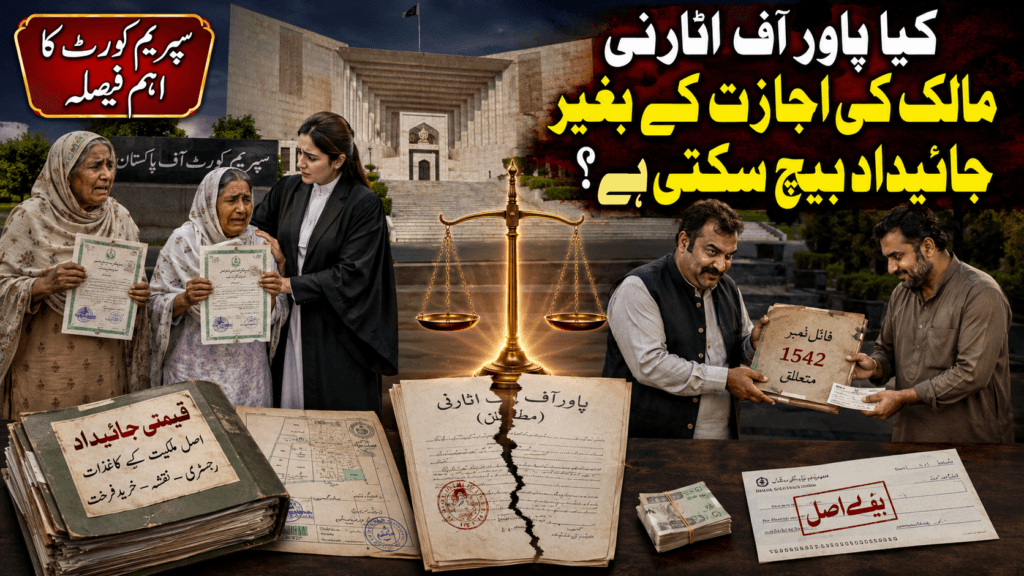
A property owner may sign a General Power of Attorney because managing land, visiting revenue offices and dealing with buyers can be difficult. But can the attorney secretly complete a property sale without properly informing the real owner? Can a buyer safely rely only on a mutation when there are no witnesses, no clear payment record and no proof of the owner’s consent?
These questions became central in Pervaiz Akhtar v. Mst. Farida Bibi and others, PLD 2023 Supreme Court 628. The dispute concerned land belonging to two illiterate housewives who had appointed their nephew as their attorney. The attorney later transferred the property to another person through an alleged oral sale and Mutation No. 1542.
The Supreme Court, by a majority of two to one, dismissed the buyer’s appeal. The majority held that merely producing a General Power of Attorney and a mutation was not enough. The buyer, as the beneficiary of the transaction, had to prove the alleged oral sale, payment of consideration and the owners’ informed consent.
This judgment provides important guidance for buyers, sellers, attorneys and families involved in Property Sales through a power of attorney.
Table of Contents
IRAC Analysis: Property Sale Through Power of Attorney
| Element | Explanation |
|---|---|
| Issue | Whether the alleged sale made by a General Power of Attorney holder in favour of the buyer was legally proved, particularly when the actual owners were illiterate/Pardanashin women who denied knowledge and consent. |
| Rule | A power of attorney does not, by itself, prove that a particular sale was completed with the owner’s informed consent. Where the property belongs to Pardanashin or illiterate women, the beneficiary must prove good faith, independent advice, knowledge, free consent, payment and the genuineness of the transaction. |
| Analysis | The buyer produced no witness to the oral sale or payment. The mutation contained limited details, the relevant revenue report was not proved, and neither the attorney nor any witness appeared to confirm the transaction. The owners had agreed to sell for Rs.1,600,000, whereas the disputed mutation mentioned Rs.148,000. |
| Conclusion | The majority upheld the Lahore High Court judgment in favour of the women. The buyer’s civil appeal was dismissed, and the challenged transaction did not survive. |
Judgment at a Glance: Supreme Court Property Sale Dispute
| Particular | Details |
|---|---|
| Case title | Pervaiz Akhtar v. Mst. Farida Bibi and others |
| Citation | PLD 2023 Supreme Court 628 |
| Court | Supreme Court of Pakistan |
| Bench | Ijaz ul Ahsan, Jamal Khan Mandokhail and Ayesha A. Malik, JJ. |
| Majority judgment | Ayesha A. Malik, J.; Ijaz ul Ahsan, J. agreeing |
| Dissenting opinion | Jamal Khan Mandokhail, J. |
| Date of decision | 8 August 2023 |
| Previous forum | Lahore High Court, Rawalpindi Bench |
| Nature of case | Civil appeal arising from a suit for declaration and permanent injunction |
| Disputed document | Mutation No. 1542 based on an alleged oral sale through a GPA |
| Owners | Two illiterate housewives/Pardanashin women |
| Alleged sale amount in mutation | Rs.148,000 |
| Amount under owners’ agreement | Rs.1,600,000 |
| Final result | Appeal dismissed by a majority of two to one |
| Core principle | A beneficiary of a transaction involving an illiterate or Pardanashin woman must prove good faith, knowledge, consent and the transaction itself through reliable evidence. |
Background of the Property Sales Dispute

Mst. Farida Bibi and another woman were recorded owners of property situated in village Sehr Bagla, Tehsil Murree, District Rawalpindi. Since they were illiterate housewives and could not personally manage complicated property affairs, they trusted their nephew, Muhammad Pervaiz, and executed a registered General Power of Attorney in his favour on 24 November 2006.
Their understanding was that the nephew would manage the property and complete its sale on agreed terms. The record referred to agreements under which the total sale consideration was fixed at Rs.1,600,000. The women reportedly received Rs.100,000 each as advance payment, while a cheque issued for the remaining amount was later dishonoured.
However, the attorney transferred the property to Pervaiz Akhtar, the appellant before the Supreme Court. The transfer was entered through Mutation No. 1542 and was described in the revenue record as an oral sale.
The owners maintained that they had never knowingly agreed to sell their land to the appellant. They alleged that their attorney had betrayed their trust and transferred the property in collusion with the appellant.
This turned the case into more than an ordinary payment dispute. It raised a deeper question affecting many Property Sales: does authority under a General Power of Attorney automatically establish the owner’s consent to every transfer made by the attorney?
This case shows how informal Property Sales can create years of litigation when authority and consent are treated as the same thing. In legally secure Property Sales, the attorney’s authority, the identity of the buyer, the agreed consideration and the owner’s approval should all be documented separately.
This dispute also demonstrates how Power of Attorney Misuse in Pakistan can threaten the rights of genuine property owners.
Journey of the Case Through the Courts
The women filed a suit for declaration and permanent injunction against the appellant and their attorney. They claimed that they remained owners in possession and that the disputed mutation had been obtained fraudulently.
The Civil Judge, Murree, dismissed their suit on 31 March 2010. Their appeal was also dismissed by the Additional District Judge, Rawalpindi, Camp at Murree, on 5 October 2013.
The women then approached the Lahore High Court, Rawalpindi Bench, through a civil revision. The High Court reversed the concurrent decisions of the lower courts and decreed the suit in their favour on 31 January 2022.
The alleged buyer filed a civil appeal before the Supreme Court. By a majority of two to one, the Supreme Court dismissed his appeal and maintained the relief granted to the women.
Issues Considered by the Court
The trial court framed several issues, but the Supreme Court focused mainly on the following questions:
- Whether the attorney had legally alienated the property in favour of the appellant.
- Whether the alleged oral sale was proved through independent and reliable evidence.
- Whether the owners knew about and freely consented to the particular sale made in favour of the appellant.
- Whether Mutation No. 1542, by itself, was sufficient proof of a completed sale.
- Whether the buyer had proved payment of the sale consideration.
- Whether special protection available to illiterate and Pardanashin women applied to the disputed transaction.
- On whom did the burden of proving the transaction and allegations of fraud fall?
These issues are especially relevant in Property Sales where an attorney, elderly owner, Pardanashin woman or illiterate person is involved.
Arguments of the Appellant-Buyer
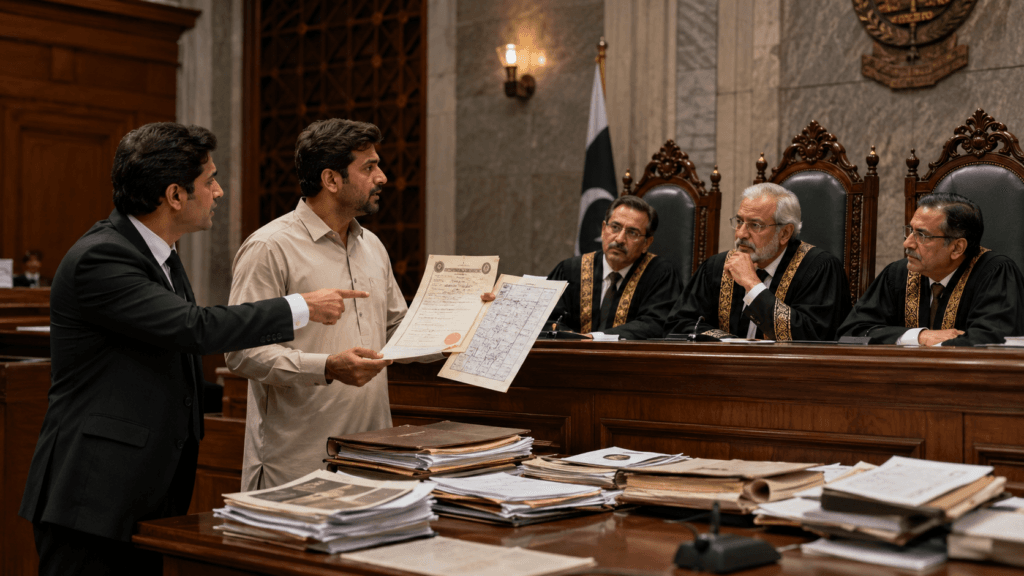
The appellant argued that he was a lawful and bona fide purchaser. His main submissions were as follows:
The General Power of Attorney Was Admitted
The appellant emphasised that the women did not deny executing the registered General Power of Attorney in favour of their nephew. That document authorised the attorney to manage and alienate the property.
According to the appellant, once the attorney had legal authority to sell, the transfer made by him could not be treated as invalid merely because the owners later developed a dispute with the attorney.
The Sale and Mutation Were Valid
The appellant relied upon Mutation No. 1542 and argued that the property had been transferred to him through the authorised attorney. He maintained that the mutation reflected a valid sale.
The Owners’ Real Dispute Was About Money
The appellant contended that the women’s actual grievance concerned the unpaid balance of the consideration promised by their nephew. Therefore, any claim for recovery should have been brought against the attorney rather than against the buyer.
He Was Not Bound by Private Agreements
The buyer was not a party to the agreements executed between the women and their nephew. He argued that their private terms could not be enforced against him.
He Had Paid the Entire Amount
In his written statement and testimony, the appellant claimed that he had paid Rs.1,600,000 to the attorney. He therefore argued that he had fulfilled his obligations as purchaser.
Arguments of the Women Property Owners

The respondent women presented a very different version of the transaction.
The Attorney Was a Trusted Relative
They explained that they were illiterate housewives who had trusted their nephew to manage the land and secure a fair price. Their reliance on him was based on family confidence rather than business experience.
They Never Consented to This Buyer
The women maintained that they had never knowingly authorised a sale specifically in favour of the appellant. According to them, execution of a broad power of attorney did not mean that the attorney could secretly dispose of their land without informing them.
The Sale Was Fraudulent and Collusive
They alleged that the appellant and the attorney knew each other and had previous property dealings. They therefore claimed that the two acted together to deprive them of their property.
The Sale Price Created Serious Doubt
The women had entered into an arrangement valuing the property at Rs.1,600,000. In contrast, the disputed mutation mentioned consideration of only Rs.148,000. This enormous difference raised serious questions about the fairness and genuineness of the alleged sale.
There Was No Independent Proof
No witness appeared to prove the oral sale, payment of consideration or the women’s consent. The attorney himself stayed away from the proceedings. The respondents argued that the disputed entry could not replace substantive evidence of a genuine transaction.
What Evidence Was Missing?
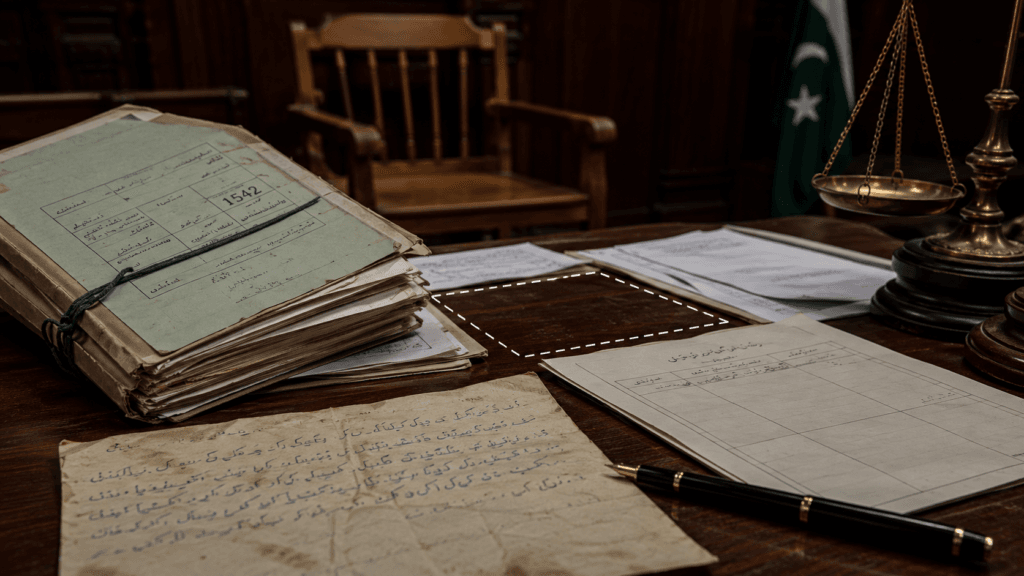
The majority judgment identified several major gaps in the appellant’s case.
No Witness to the Oral Sale
The mutation described the transaction as an oral sale. Yet no person who witnessed the agreement, payment or transfer appeared before the court.
An alleged oral transaction must be proved by credible evidence. A revenue entry alone cannot automatically establish all essential facts of Property Sales.
No Reliable Proof of Payment
The appellant did not produce witnesses to payment of the consideration. The revenue record also did not show that payment was made before a revenue officer.
A buyer claiming ownership must be able to show when, where, how and to whom the price was paid.
Incomplete Revenue Record
The appellant relied on a copy of the Register Dakhal Kharaj Mahal. However, the relevant report referred to in Column No. 14 was not produced and relied upon to establish the transaction.
There was also no report from a revenue officer verifying the alleged oral sale.
Attorney Did Not Appear
The attorney was the central person in the transaction. He allegedly received the money, represented the owners and executed the sale. Yet he did not appear to explain the circumstances.
His absence left the appellant without the most important witness.
No Proof of the Owners’ Consent
The buyer lived in the same area and knew that the owners were illiterate housewives. Nevertheless, he made no meaningful effort to confirm directly whether they wished to sell their property to him.
The majority viewed this failure as significant.
Why Pardanashin and Illiterate Women Receive Special Protection

The Supreme Court explained that the law adopts a cautious approach where valuable property rights of Pardanashin or illiterate women are involved.
Such protection is not based on an assumption that women cannot own or manage property. Its purpose is to prevent exploitation where a person has limited education, limited exposure to commercial dealings or heavy dependence on relatives.
For a transaction involving a Pardanashin woman to be safely upheld, the beneficiary should establish that:
- the transaction was fully explained to her;
- she understood its nature and consequences;
- she knew the identity of the buyer;
- she received independent and trustworthy advice;
- she freely consented to the transaction;
- witnesses were present;
- payment of the consideration was proved; and
- the transaction was completed in good faith.
These safeguards are crucial in vulnerable Property Sales, especially where an elderly, illiterate or secluded owner signs documents through a relative.
Does a General Power of Attorney Automatically Prove a Sale?
No. This is one of the strongest principles emerging from the majority decision.
A General Power of Attorney may establish that an attorney has certain powers. It does not automatically prove that:
- a specific sale actually occurred;
- the owner knew the identity of the buyer;
- the owner approved the agreed price;
- consideration was paid;
- the attorney acted honestly; or
- the buyer acted in good faith.
The buyer must still prove the underlying transaction.
In this case, the alleged sale was not supported by witnesses, a reliable payment trail or direct evidence from the attorney. Therefore, the existence of the GPA could not cure the evidentiary defects.
Readers may also review sections 42 and 54 of the Specific Relief Act, 1877 for the statutory background of declaration and injunction suits.
Burden of Proof in Property Sales
The case involved two related but distinct rules concerning burden of proof.
First, a person who alleges fraud, cheating or collusion normally has to prove those allegations. This principle was strongly emphasised in the dissenting opinion.
Second, where a transaction benefits a person and involves the property of a Pardanashin or illiterate woman, the beneficiary must prove that the transaction was genuine, fair, voluntary and made with full knowledge and consent.
The majority applied the second principle to the buyer. Since he relied on the disputed sale and mutation, he was required to prove the oral sale and the owners’ consent.
The safest legal approach is therefore not to rely on accusations alone. Every party should preserve documentary and oral evidence supporting its own case.
Majority Reasoning of the Supreme Court
The majority found that the buyer had failed to discharge the burden placed upon him.
The court noted that the women consistently challenged the transfer as having been made without their knowledge and consent. Their narration of how they discovered the transaction could not be treated as an admission of the sale.
The majority further observed that the attorney and the appellant had previous business dealings. The appellant knew the women lived nearby and were illiterate. Despite that knowledge, he did not contact them to verify whether they intended to sell the property to him.
The stark difference between Rs.1,600,000 and Rs.148,000 also weakened the buyer’s claim.
Most importantly, the buyer produced no independent evidence of the alleged oral sale. Neither the attorney nor any sale witness appeared. Payment was not proved, and the mutation record was incomplete.
The majority therefore held that the Lahore High Court had rightly decreed the women’s suit.
Dissenting Opinion of Justice Jamal Khan Mandokhail
Justice Jamal Khan Mandokhail disagreed with the majority and would have allowed the appeal.
According to the dissent, the original agreement showed that the women had sold the property to their nephew for Rs.1,600,000 and had later executed a registered power of attorney authorising him to alienate it.
The dissent placed significant weight on a later agreement dated 22 March 2007, which allegedly referred to the disputed mutation. This suggested that the women knew about the transfer but did not immediately object to it.
Justice Mandokhail considered their real grievance to be the outstanding payment owed by the nephew. Since the buyer was not a party to the agreements between the women and their nephew, the dissent found that those agreements could not support a suit against him.
The dissent also stressed that anyone alleging fraud, cheating or collusion must prove those allegations. In its view, the women failed to produce sufficient evidence against the purchaser.
However, this remained a minority view. The binding final order was the majority decision dismissing the buyer’s appeal.
Final Decision

The Supreme Court dismissed the civil appeal by a majority of two to one. The judgment of the Lahore High Court, Rawalpindi Bench, remained effective.
The result protected the property rights of the two women and rejected the buyer’s reliance on an inadequately proved oral sale and mutation.
The judgment does not mean that all Property Sales through a power of attorney are invalid. It means that such a transaction must be proved through clear, independent and trustworthy evidence, particularly where the actual owners are illiterate or Pardanashin women.
Seven Practical Lessons for Buyers and Property Owners
1. Never Depend Only on a Mutation
A mutation is a revenue entry. Buyers should also obtain and preserve the sale agreement, payment record, witnesses’ details and proof of the seller’s consent.
2. Verify the Power of Attorney
Check whether the document is registered, valid and still in force. Confirm the exact powers granted to the attorney.
3. Contact the Actual Owner
Even where an attorney is authorised, the buyer should directly verify the owner’s willingness, especially in high-value Property Sales.
4. Use Traceable Payments
Pay through banking channels and mention the property, payee and purpose in the transaction record.
5. Record Independent Witnesses
Witnesses should be present at the agreement, payment and transfer stages. Their CNIC details and signatures should be preserved.
6. Take Extra Care with Vulnerable Owners
Where the owner is illiterate, elderly or Pardanashin, the document should be read and explained in a language she understands. Independent legal advice should be arranged.
7. Investigate an Unusually Low Price
A dramatic difference between market value, agreed price and mutation value may later be treated as a warning sign.
Documents to Check Before Completing Property Sales
Before purchasing property through an attorney, examine:
- original title documents;
- latest fard or ownership record;
- registered General Power of Attorney;
- authority to sell and receive consideration;
- CNICs of the owners, attorney and buyer;
- sale agreement;
- bank payment record;
- mutation proceedings;
- revenue officer’s report;
- possession record;
- pending litigation search;
- cancellation or revocation record of the GPA;
- statements or written confirmation from the owners; and
- independent witnesses.
Conclusion
This Supreme Court judgment sends a clear warning: authority written on paper cannot replace proof of a genuine transaction.
A buyer involved in Property Sales through a General Power of Attorney must go beyond checking the attorney’s document. He should verify the actual owner’s intention, confirm the agreed price, use traceable payment methods and preserve independent evidence.
For property owners, especially women who depend on relatives to manage land, the judgment provides meaningful protection. Trusting a family member does not mean surrendering the right to know who is purchasing the property, at what price and on what terms.
The safest property transaction is one in which authority, consent, payment and possession are all transparent and independently verifiable.
Disclaimer
This article is for general legal awareness and educational purposes only. The outcome of every property case depends on its documents, pleadings and evidence. Consult a qualified lawyer before filing a case or completing a property transaction.
Frequently Asked Questions
Can property legally be sold through a General Power of Attorney?
Yes, property may be sold through a properly authorised attorney. However, the attorney must act within the authority granted, and the buyer must be able to prove the transaction, payment and the owner’s consent.
Is a mutation enough to prove ownership after a property sale?
A mutation may support a claim, but it is not always conclusive proof of the underlying transaction. Where the sale is disputed, the beneficiary may have to produce the agreement, witnesses, payment record and other independent evidence.
Can an owner challenge a sale completed by her attorney?
Yes. An owner may challenge the transaction if the attorney exceeded his authority, acted fraudulently, concealed material facts or completed the sale without informed consent.
Who must prove an oral property sale?
The person relying on the oral sale must prove it. This normally requires credible witnesses, payment evidence, possession evidence and reliable supporting documents.
What protection is available to an illiterate or Pardanashin woman?
The beneficiary of the transaction must show that the deal was explained to her, that she understood it, received independent advice and freely consented to it.
Who must prove fraud in a property dispute?
As a general rule, the person alleging fraud, cheating or collusion must prove it. However, the beneficiary of a disputed transaction involving a vulnerable owner may independently bear the burden of proving good faith and informed consent.
Are all Property Sales through an attorney risky?
Not necessarily. The risk becomes manageable when authority, consent, payment, witnesses and due diligence are properly documented. Problems usually arise when buyers rely only on an attorney’s assurance or a bare mutation entry.