

A father dies leaving agricultural land to several heirs. One brother keeps cultivating a valuable khasra, another controls the papers, while a married sister lives elsewhere. Years later, when the sister asks for her share, she is told: “This land is already in our possession.” Does possession decide who gets that parcel?
For Partition of Inherited Land in Pakistan, the answer can be very different from family practice. In Nazar Abbas and others v. The State/Nazia Ashraf alias Nazia Habib and others, reported as 2026 CLC 471, the Board of Revenue, Punjab held that an heir could not claim a specific piece of inherited land merely because he was in possession of it. The holding had to be divided according to lawful shares, value and the Naqis Kamil principle.
This guide explains the judgment, current Punjab procedure, evidence, forum, deadlines and practical remedies. Because the reported case is from Punjab, the detailed statutory procedure below mainly concerns Punjab agricultural or revenue-record land. Other provinces and Islamabad may follow different statutes and forums.
Table of Contents
Judgment at a Glance of 2026 CLC 471
| Point | Detail |
|---|---|
| Case | Nazar Abbas and 2 others v. The State/Nazia Ashraf alias Nazia Habib and others |
| Citation | 2026 CLC 471 |
| Forum | Board of Revenue, Punjab |
| Member | Babar Aman Babar, Member (Judicial-I) |
| Case No. | R.O.R. No. 2994 of 2024 |
| Decision date | 15 September 2025 |
| Main law | Punjab Land Revenue Act, 1967, section 135 |
| Main dispute | Partition of inherited joint land |
| Key principle | Mere possession did not create a right to one specific parcel |
| Result | Revision dismissed; impugned partition order maintained |
The reported judgment confirms both the procedural history and the Board’s central holding on possession, inherited land and Naqis Kamil.
The case matters for Partition of Inherited Land in Pakistan because it separates physical possession from lawful entitlement. Occupying the best khasra first does not automatically make that khasra your exclusive share.
IRAC: Why Possession Did Not Control the Partition
| IRAC | Analysis |
|---|---|
| Issue | Could the petitioners overturn the partition because certain khasra numbers were in their possession and compact blocks were allegedly ignored? |
| Rule | In inherited joint land, a co-sharer cannot claim a specific piece merely on possession. Partition should protect lawful shares and comparative value. |
| Analysis | The petitioners challenged the Wandajaat and relied on possession, location and compactness, but they failed to show a real infringement of their legal rights. |
| Conclusion | The Board dismissed the revision and maintained the partition. |
What Partition of Inherited Land Actually Means
Before partition, heirs normally hold undivided shares in the joint holding. A one-fourth share in a khewat does not automatically mean ownership of one named field or corner.
Partition of Inherited Land in Pakistan converts undivided rights into separate holdings through a lawful process. The authority verifies the co-sharers and their shares, hears objections, decides the mode of division and issues a final partition order and instrument.
Three things should not be confused:
- Inheritance share: how much a person legally owns.
- Possession: who is using a particular area.
- Partition allotment: which defined land is finally allotted against that share.
Possession can be relevant evidence, but it is not automatically exclusive title.
What 2026 CLC 471 Really Decided
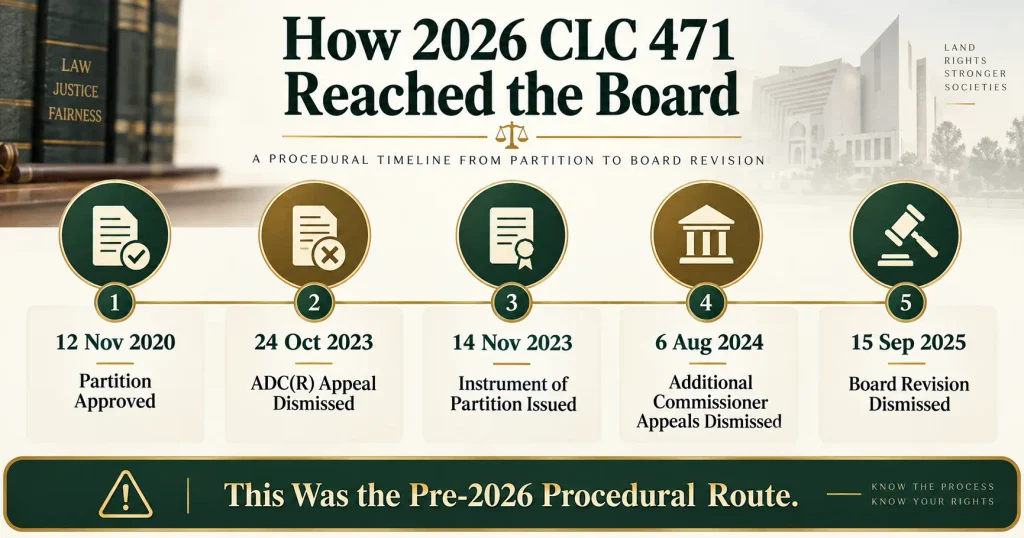
The dispute concerned joint inherited land in Mauza Jundwal, Tehsil Depalpur, District Okara. The Revenue Officer approved partition on 12 November 2020, and an instrument of partition was later issued. The matter then moved through the revenue appellate hierarchy before reaching the Board of Revenue in revision.
The petitioners argued that field staff had prepared Wandajaat after site inspection by considering possession, location and classification, but the Circle Revenue Officer altered the arrangement. They specifically objected to Khasra Nos. 5/2 and 5/8 and said possession and compact blocks had been ignored.
The Board rejected the challenge. It held that the land was inherited from the father and no heir could demand a particular piece merely because he was occupying it. The petitioners were also asked to show what legal right the partition had actually infringed, but they failed to establish sufficient prejudice.
For Partition of Inherited Land in Pakistan, the lesson is precise: dissatisfaction with an allotted parcel is not enough. A challenger should identify a real defect, such as a wrong share, exclusion of a co-sharer, denial of hearing, serious valuation imbalance or another material legal error.
Why the Possession Argument Failed
The judgment does not say possession is always irrelevant. It says possession alone does not create an automatic right to receive the same parcel in partition of inherited joint land.
If one heir cultivates land beside a road while another uses land with better irrigation, freezing existing possession may produce an unfair result. The authority must compare lawful shares and the overall value and utility of the allotments.
That is why Partition of Inherited Land in Pakistan cannot be decided only by asking who is sitting on a khasra today. A sister living after marriage in another city does not lose her recorded inheritance share merely because her brothers remained physically present on the land.
Naqis Kamil: Equal Value, Not a Favourite Khasra
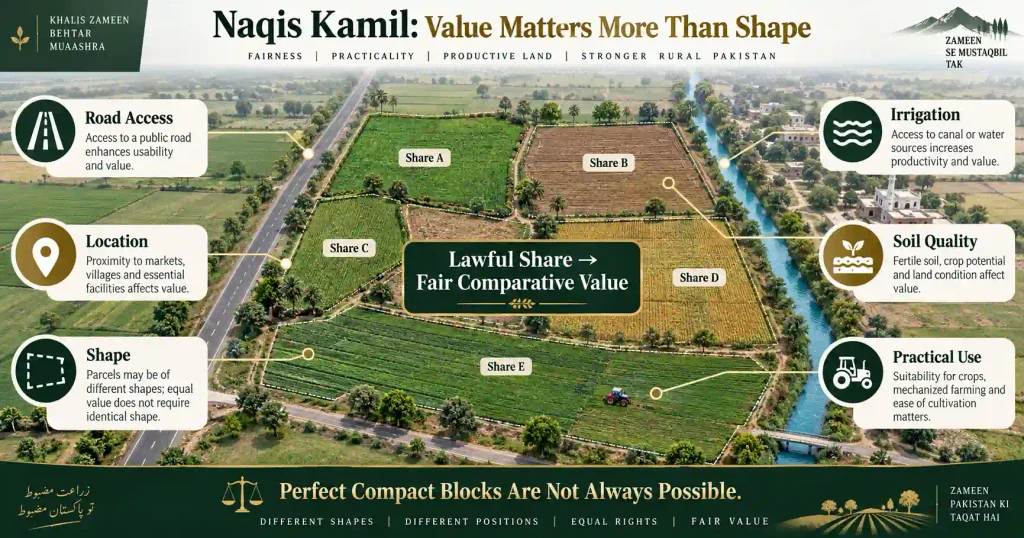
The Board applied the principle described as Naqis Kamil. In simple terms, each co-sharer should receive land whose value fairly corresponds to that person’s lawful share.
Value may depend on road access, irrigation, soil quality, location, shape and practical use. The Board therefore held that perfectly compact blocks are not necessary in every case. Different portions may be allotted where that is required to protect value, approach and irrigation.
For Partition of Inherited Land in Pakistan, this means a person cannot insist as an absolute rule that every area already under his control must remain with him. The real question is whether the final allotment fairly protects legal entitlement.
Current Punjab Law After the 2026 Amendment
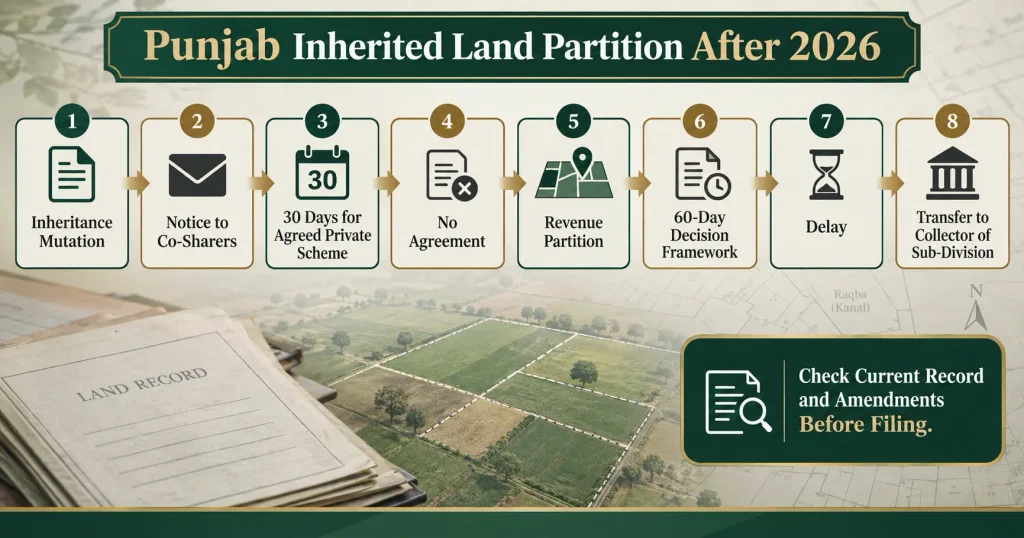
Older partition articles can now be misleading because Punjab amended the Punjab Land Revenue Act, 1967 in May 2026.
Under section 135, a joint owner may seek partition where the share is recorded in his or her name, established by a subsisting decree, or acknowledged in writing by all interested persons. Under section 135-A, after an inheritance mutation is sanctioned, the Revenue Officer must give the joint landowners an opportunity to submit an agreed private-partition scheme within 30 days. If no scheme is filed, the current law requires the partition process to move forward and the order to be passed within 60 days. (LawHub)
For the base statute, readers may consult the official Punjab Land Revenue Act, 1967 publication. Punjab Land Revenue Act, 1967
The 2026 amendment also changed other steps. Section 137 now requires a hearing date to be fixed not later than seven days after a proper application is received. Section 141 requires the Revenue Officer to inquire into a title or possession question raised in the proceedings and decide it after hearing the parties. Section 142-A now uses a 60-day decision period, limits certain adjournments, deals with common paths and addresses mesne profits where a person occupies excess land beyond title. If the Revenue Officer does not decide within time, the case is to stand transferred to the Collector of the Sub-Division for further decision under the amended scheme.
This update is critical for Partition of Inherited Land in Pakistan. The reported judgment was decided on 15 September 2025, before these amendments. Its old appeal path should therefore not be copied blindly in a new case.
The current statutory text must be checked whenever Partition of Inherited Land in Pakistan is filed or challenged after the amendment.
How Partition Proceedings Now Move in Punjab
A practical Punjab route is:
- Obtain the latest fard, inheritance mutation, khewat and relevant land record.
- Identify every co-sharer and confirm each recorded share.
- Check the section 135-A private-partition opportunity after inheritance mutation.
- File or pursue partition before the competent Revenue Officer.
- Attend the service and hearing stage; do not ignore notices.
- Put objections about title, possession, value, access or irrigation on record with documents.
- Inspect the proposed Wandajaat and compare each allotment with the lawful share.
- Obtain the final order and instrument of partition.
- Check appeal, stay and possession deadlines immediately.
Under the amended section 145, the order and instrument are to be issued together when the partition case is decided.
Punjab Land Records Authority also provides an official partition service for land-record cases. official PLRA partition service
For Partition of Inherited Land in Pakistan, the safest approach is to follow the official record from the first notice to the final instrument instead of relying on family assurances.
Which Forum Should You Use for Partition?
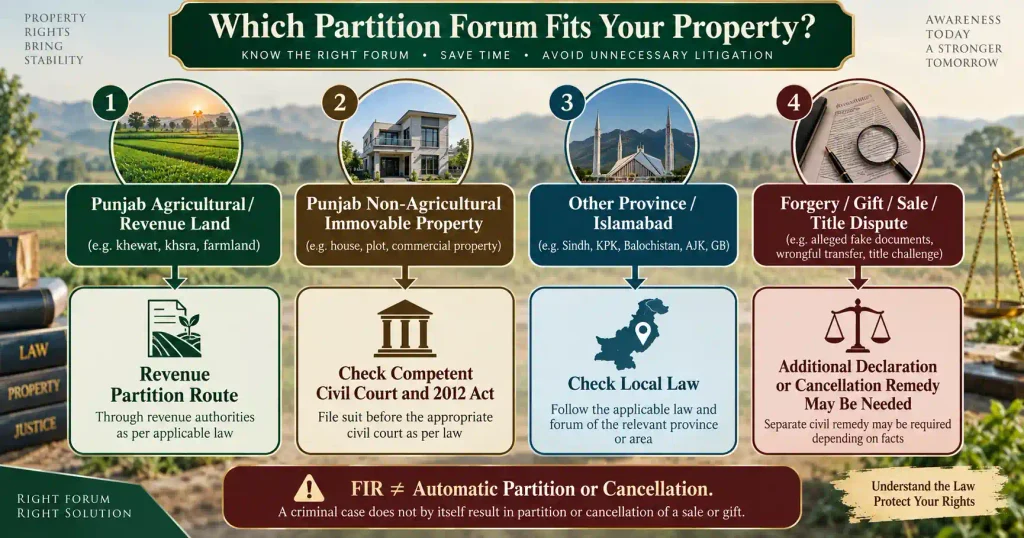
The correct forum depends on the nature and location of the property. Choosing that forum is the first serious legal check in Partition of Inherited Land in Pakistan.
For Punjab agricultural land or land governed by the revenue record, the Punjab Land Revenue Act provides the revenue partition mechanism discussed above.
The Punjab Partition of Immovable Property Act, 2012 expressly says it does not affect laws providing for partition of agricultural land or land subservient to agriculture. (WDD Punjab)
Punjab Partition of Immovable Property Act, 2012
So every Punjab property dispute should not be treated as the same civil partition suit.
For Partition of Inherited Land in Pakistan outside Punjab, do not automatically apply Punjab sections or deadlines. Provincial law and the local revenue or civil forum must be checked.
Also identify the real dispute. If the case is actually about a forged sale deed, invalid gift, fraudulent mutation or excluded heir, partition alone may not provide complete relief. Declaration, cancellation, correction of record, possession or injunction may also be needed depending on the facts.
An FIR or criminal complaint is not a substitute for partition. Criminal proceedings may be relevant where forgery or impersonation is properly alleged, but they do not automatically divide land or cancel a property document.
Documents and Evidence to Prepare Before Filing
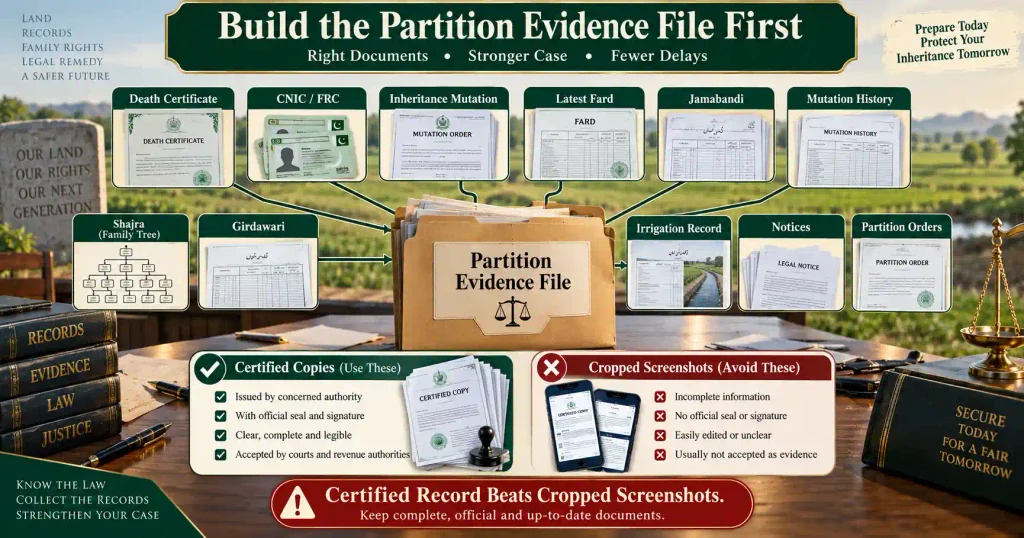
A strong file for Partition of Inherited Land in Pakistan should start with official or certified records. In practice, evidence quality can decide whether a claim in Partition of Inherited Land in Pakistan is persuasive or merely an allegation.
| Record | Purpose |
|---|---|
| Death certificate | Shows when succession opened |
| CNICs / family record | Helps identify heirs |
| Inheritance mutation | Shows recorded devolution |
| Latest fard | Confirms current ownership entries |
| Jamabandi / record-of-rights | Shows khewat and shares |
| Mutation history | Reveals later transfers |
| Shajra / map | Shows khasra boundaries and access |
| Girdawari / possession record | Supports factual possession claims |
| Irrigation record | May affect value and utility |
| Notices and orders | Helps test service, hearing and limitation |
Do not rely only on cropped screenshots. Obtain certified copies or official digital records where possible. The Punjab Land Records Authority provides official Fard services. official Punjab Fard service information
For related issues, read Qanooni Dastak’s Legal Heirs in Pakistan Law guide. Legal Heirs in Pakistan Law
Where a female heir is being excluded, the detailed Women Inheritance Rights guide is also useful. Women Inheritance Rights
How to Challenge an Unfair Partition Order
A challenge becomes stronger when it identifies the exact legal injury. “I do not like my parcel” is weaker than showing that your share, access, irrigation, value or hearing right was materially affected.
Possible grounds include wrong calculation of share, failure to include or serve a co-sharer, serious valuation imbalance, blocked access, ignored irrigation, failure to decide a material title or possession issue, or breach of mandatory procedure.
The current appeal structure is also different from the one shown in 2026 CLC 471. After the 2026 amendment, an appeal in a partition matter lies against the original order to the Collector of the District, whose decision is stated to be final for that appeal. Section 162 now gives a 30-day limitation period for an appeal under section 161. Revision under section 164 is also restricted in partition matters.
For Partition of Inherited Land in Pakistan, check limitation as soon as the order is received. A timely written objection is especially important in Partition of Inherited Land in Pakistan because later forums look for a real legal injury already supported by the record.
An appeal or revision does not automatically stay execution unless the competent authority grants stay under the law.
What the Judgment Did Not Decide
2026 CLC 471 should not be overstated.
The Board did not hold that every sister must receive the exact khasra she chooses. It did not say possession can never be considered. It did not decide every Muslim inheritance-share question, forged document dispute or title-cancellation case. It also did not create one Pakistan-wide procedure.
What it decided was narrower: in the inherited joint land before it, possession of a particular parcel did not give the petitioners a superior right to that parcel, and they failed to prove a legal infringement serious enough to disturb the concurrent partition orders.
This distinction keeps Partition of Inherited Land in Pakistan accurate rather than turning one Punjab judgment into a rule for every property dispute.
Practical Effect for Sisters and Other Heirs
For a sister whose name is recorded as an heir but who is not physically occupying the land, the judgment is useful. A brother’s cultivation does not by itself give him an absolute right to keep a particular inherited parcel.
For brothers and other co-sharers, a genuine objection is still possible. If the proposed partition gives materially lower-value land, cuts off access, ignores irrigation, misstates the share or violates procedure, preserve the evidence and object promptly.
The practical lesson for Partition of Inherited Land in Pakistan is to protect the record early: verify the mutation, inspect the map, attend hearings and file written objections before the partition becomes final.
Good preparation can prevent Partition of Inherited Land in Pakistan from becoming a years-long fight over facts that could have been documented at the start.
Common Mistakes That Weaken Partition Cases
Common mistakes include ignoring notices, treating possession as final ownership, using pre-2026 procedure, filing in the wrong forum, and making broad allegations without certified records.
In 2026 CLC 471, the Board noted that the partition process had continued for years and the petitioners had not appeared before the Revenue Officer during the process.
Their later objections could not replace proof of an actual legal injury.
For Partition of Inherited Land in Pakistan, a map, certified mutation, service record or valuation objection is usually more useful than repeating that the other side is powerful or already in possession.
Conclusion: Protect the Share With Record, Not Assumptions
Partition of Inherited Land in Pakistan is not simply about dividing acres. It converts undivided legal shares into separate rights while balancing value, access, irrigation and lawful entitlement.
In 2026 CLC 471, the Board of Revenue, Punjab maintained the partition because the petitioners could not show that their legal rights had actually been infringed. Their possession-based objections were insufficient, and the Board accepted that perfectly compact blocks are not always possible.
The law has also moved on since that decision. Punjab’s 2026 amendments shortened important partition timelines and changed the appeal structure.
Anyone dealing with Partition of Inherited Land in Pakistan should therefore check the latest record, current statute, correct forum and limitation period before filing or challenging an order.
FAQs About Partition of Inherited Land in Pakistan
1. Can possession defeat another heir’s share?
No. In 2026 CLC 471, possession of a specific part of inherited joint land did not give the petitioners an automatic right to that parcel. A lawful partition must protect the shares and value of all co-sharers. Possession can be relevant, but it is not the only test.
2. What did 2026 CLC 471 decide for sisters?
The dispute was mainly between brothers and a sister. The Board maintained the partition and rejected the brothers’ possession-based challenge because they could not show a sufficient infringement of their legal rights. The case supports the point that a female heir’s share is not defeated merely because male relatives occupy the land.
3. What is Naqis Kamil in land partition?
Naqis Kamil, as used in the judgment, means the partition should protect value corresponding to each co-sharer’s lawful entitlement. Perfectly compact blocks are not always required. Access, irrigation, quality and practical utility may affect the final allotment.
4. How does inherited land partition start in Punjab?
Section 135 allows an eligible joint owner to seek partition. In inheritance cases, section 135-A also requires action after the inheritance mutation, including notice for an agreed private-partition scheme. If no agreed scheme is filed within the statutory period, the revenue partition process proceeds.
5. Is the current Punjab partition deadline 60 days?
The 2026 amendment now uses a 60-day decision period in the relevant provisions. If the Revenue Officer does not decide within the statutory time, the amended law provides for transfer of the matter to the Collector of the Sub-Division. The actual record should still be checked for service, objections and related orders.
6. Which documents matter most in a partition case?
Keep the inheritance mutation, latest fard, jamabandi or record-of-rights, mutation history, map or shajra, possession record, notices and previous orders. If value or irrigation is disputed, preserve evidence about access, watercourses and land classification. Prefer certified or officially verifiable records.
7. Can I appeal an unfair Punjab partition order?
Yes, but the current route is narrower than the route seen in the 2025 judgment. After the 2026 amendment, the partition appeal lies against the original order to the Collector of the District, and section 162 provides a 30-day limitation period. Revision is subject to further statutory restrictions.
8. Does this judgment apply across all Pakistan?
No. Partition of Inherited Land in Pakistan is a national search topic, but 2026 CLC 471 is a Punjab Board of Revenue decision applying Punjab land-revenue law. Its reasoning can be informative, but procedure, forum, appeal rights and deadlines must be checked under the law applicable where the property is located.
Disclaimer
This article is for legal awareness and general information. It does not replace advice on a specific land record or dispute. Partition law depends on the location and nature of the property, current revenue entries, title documents, procedural history and the latest amendments. Obtain the current record and professional advice before filing, appealing or surrendering any inherited share.