
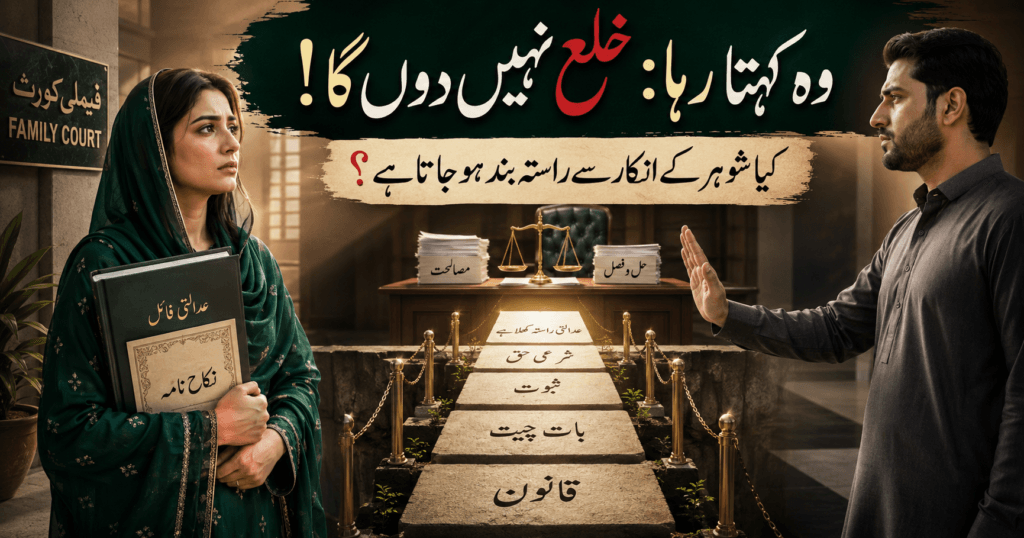
A husband says, “I will never agree to Khula.” The wife believes the marriage has broken beyond repair. Families start giving contradictory advice: some say she can never leave without his signature; others say a court can end the marriage immediately. For an ordinary Pakistani family, this confusion can turn an already painful dispute into fear, delay and financial loss.
Khula Without Husband Consent is therefore not just an internet question. It is a real issue of Pakistani family law, Islamic legal reasoning, court procedure, reconciliation, dower and personal dignity. PLD 2023 Federal Shariat Court 286 directly examined the argument that a Family Court cannot grant Khula without the husband’s agreement. The Federal Shariat Court rejected that challenge and followed its earlier Full Bench authority.
The important point, however, needs careful wording. The legal meaning of Khula Without Husband Consent must be kept precise. Khula Without Husband Consent does not mean a wife simply declares herself divorced at home. It means a judicial remedy can be granted through a competent court despite the husband’s refusal when the legal requirements are met and reconciliation fails.
Table of Contents
IRAC: What Did the Federal Shariat Court Actually Decide?
| IRAC | Analysis |
|---|---|
| Issue | Whether Section 10(4) of the Family Courts Act, 1964 was repugnant to the injunctions of Islam because it allowed a Family Court to grant Khula even when the husband did not consent. |
| Rule | The Federal Shariat Court had already considered this controversy in Saleem Ahmad and others v. Government of Pakistan and others, PLD 2014 FSC 43. The Court held that the husband’s refusal does not create an absolute bar to judicial Khula where reconciliation has failed. |
| Analysis | The Federal Shariat Court examined the husband’s argument that Khula without his consent was un-Islamic, but found no basis to depart from the earlier Full Bench judgment. The Court reasoned that the Quranic material relied upon by the petitioner did not specifically prohibit a competent court from dissolving a marriage through Khula when reconciliation had failed. It further emphasized that courts exist to resolve disputes, including matrimonial disputes, and therefore a husband cannot make the judicial remedy ineffective simply by refusing consent. |
| Conclusion | The Shariat petition was dismissed in limine. Section 10(4) was not struck down, and the Federal Shariat Court reaffirmed that the husband’s refusal alone does not prevent a competent Family Court from granting judicial Khula after reconciliation fails. |
The judgment expressly reproduced and approved the earlier FSC reasoning that the Quranic material relied upon did not create a specific bar preventing a competent court from decreeing Khula when reconciliation had failed.
This IRAC makes the core rule behind Khula Without Husband Consent easy to understand: refusal is relevant to the dispute, but it is not an unlimited veto over the Family Court. In practical terms, Khula Without Husband Consent is judicial relief, not permission created by the husband.
Judgment at a Glance: Why PLD 2023 FSC 286 Matters
| Point | Analysis |
|---|---|
| Case | Khurram Shehzad v. Federation of Pakistan through Ministry of Law and Justice Commission of Pakistan, Islamabad and another |
| Citation | PLD 2023 Federal Shariat Court 286 |
| Court | Federal Shariat Court of Pakistan |
| Bench | Dr. Syed Muhammad Anwer, A.C.J. and Khadim Hussain M. Shaikh, J. |
| Decision Date | 7 February 2023 |
| Main Provision | Section 10(4), Family Courts Act, 1964; constitutional scrutiny under Article 203-D |
| Central Controversy | Could judicial Khula be granted despite the husband’s refusal, or was his consent indispensable? |
| Court’s Analysis | The controversy had already been settled by the Full Bench in PLD 2014 FSC 43. The Quranic material relied upon did not create a specific bar preventing a competent court from decreeing Khula when reconciliation failed. |
| Result | Petition dismissed in limine |
| Public Importance | Khula Without Husband Consent remains a court-supervised legal remedy; the husband’s refusal alone does not close the door of judicial relief. |
The case was Shariat Petition No. 11-I of 2022 and was decided on 7 February 2023.
The Marriage Behind the Judgment: What Really Happened?
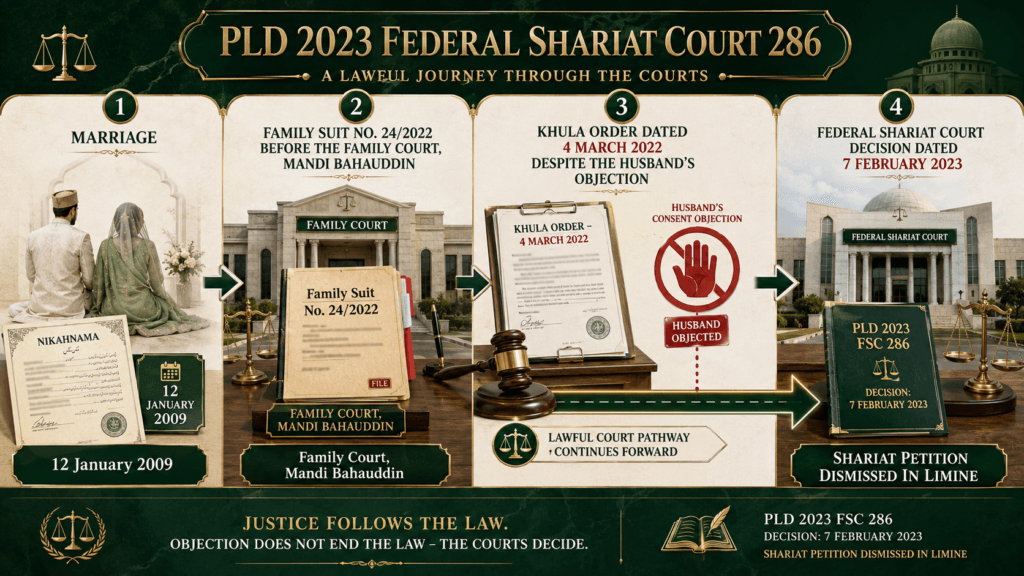
The reported judgment gives unusually clear facts. Khurram Shehzad stated that he and respondent No. 2 married on 12 January 2009. The judgment records that no child was alive from the spouses. Years later, the wife approached the Family Court at Mandi Bahauddin in Family Suit No. 24 of 2022.
On 4 March 2022, the Family Court granted her Khula. The husband objected because the order had been passed without his consent. He then approached the Federal Shariat Court and attacked Section 10(4) itself, asking that it be examined in light of the Quran and Sunnah and declared un-Islamic and void.
That factual background matters. The 2023 case was not merely an academic discussion about Khula Without Husband Consent. A Family Court decree had already affected the petitioner’s own marriage, and he wanted the Shariat Court to hold that the legal mechanism permitting such relief was contrary to Islam.
The Husband’s Argument: “My Consent Was Essential”
The petitioner’s case was direct: Khula granted by an ordinary court under Section 10(4) without the husband’s consent was, in his view, against the injunctions of Islam.
He relied on Quranic and Hadith material, including Surah Al-Baqarah 2:237 and narrations concerning divorce. The judgment also records the narration concerning Jamilah bint Salul and Thabit, where she expressed that she could not continue with her husband and agreed to return the garden.
The petitioner relied on this religious material to support the proposition that the husband retained the decisive role.
This is one reason the judgment is especially useful. It did not avoid the religious objection to Khula Without Husband Consent. It confronted that objection through the Federal Shariat Court’s earlier Full Bench reasoning.
Why the Federal Shariat Court Rejected the Challenge
The decisive answer came from Saleem Ahmad and others v. Government of Pakistan and others, PLD 2014 FSC 43.
The 2023 Bench treated the central question as already settled. The earlier Full Bench reasoning was that the Quranic verses relied upon did not specifically create a bar preventing a competent court from decreeing Khula when reconciliation fails.
Courts exist to decide disputes, including disputes concerning dissolution of marriage. If the husband refuses divorce altogether and every effort at reconciliation fails, the earlier Full Bench saw no reason why the competent court should become powerless to decide the Khula claim.
The 2023 Bench expressly agreed with that earlier view. After considering the judgments, arguments and Quranic and Sunnah points raised by the petitioner, it dismissed the petition in limine.
This is the strongest answer from this particular judgment to the question of Khula Without Husband Consent.
Readers who want to check the statute themselves can access the Family Courts Act, 1964 on Pakistan Code, the Ministry of Law and Justice’s official laws portal. The Federal Shariat Court judgment database also lists PLD 2023 FSC 286.
Why Online Religious Answers Seem to Contradict Pakistani Courts
This is where many online articles become confusing.
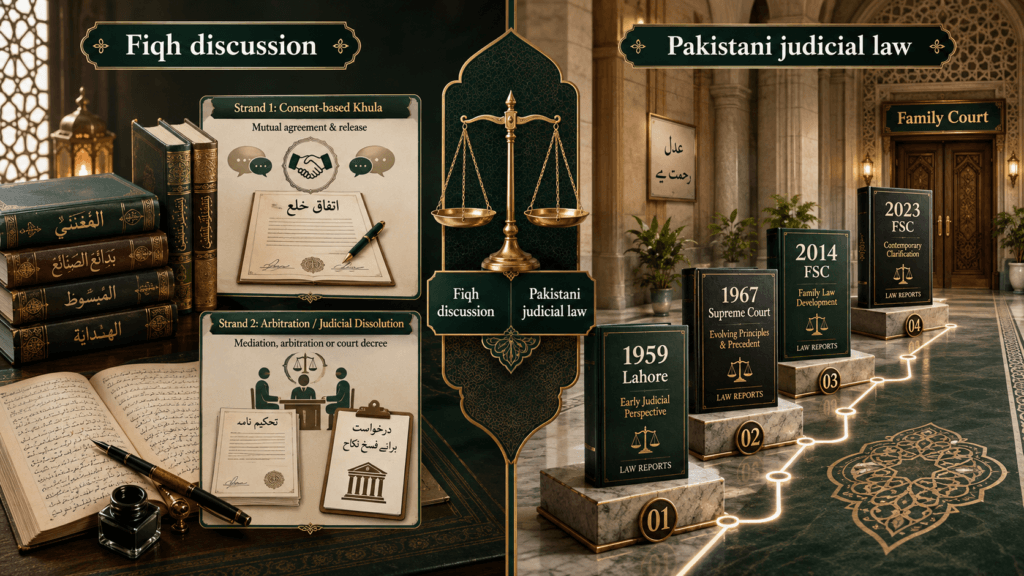
Classical juristic discussion does not speak with one voice on the judicial role in Khula. A detailed academic analysis published by LUMS explains that the majority position attributed to Hanafi, Shafi‘i, Hanbali and Shi‘a jurists regards the husband’s consent as necessary in the traditional contractual conception of Khula. It also discusses Maliki authorities giving judges or arbitrators broader power to dissolve a marriage despite lack of consent in serious marital discord.
That explains why a person searching online may find a Hanafi fatwa saying Khula requires the husband’s agreement. One of the sources reviewed for this article, for example, defines Khula as a consensual exchange and takes the position that a court decree without such consent is invalid. Another faith-based body uses Khula for husband-consented separation and Faskh for judicial dissolution when the husband refuses.
Those sources explain particular religious interpretations. They do not, however, determine what a Pakistani Family Court or superior Pakistani court is legally bound to do.
For Pakistani readers, Khula Without Husband Consent must therefore be separated from purely private or foreign religious procedures.
Pakistani judicial law developed a strong judicial-Khula line. The LUMS analysis records that the Lahore High Court recognized the wife’s judicial right to Khula without her husband’s consent in Mst. Balqis Fatima v. Najm-ul-Ikram Qureshi, PLD 1959 Lahore 566, and that the Supreme Court endorsed that approach in Mst. Khurshid Bibi v. Muhammad Amin, PLD 1967 SC 97.
The Federal Shariat Court later reinforced the judicial route in PLD 2014 FSC 43 and again in PLD 2023 FSC 286.
So every reader should distinguish two questions:
- What does a particular school, scholar or fatwa platform call consensual Khula?
- What remedy will a Pakistani Family Court recognize and apply under Pakistani law?
A foreign religious answer should not automatically be treated as the governing law of Pakistan.
That distinction is essential to understanding Khula Without Husband Consent correctly.
The Most Important Clarification: No Husband Veto Does Not Mean No Court Process
Khula Without Husband Consent is not “self-divorce.”
A wife should not assume that saying “I take Khula” in a WhatsApp message, on private stamp paper, before relatives or on social media automatically creates the same legal status as a decree passed through the lawful Family Court process.
PLD 2023 FSC 286 concerns the power of a competent court. Its reasoning repeatedly connects judicial authority with failed reconciliation.
That distinction protects both sides. It also explains why Khula Without Husband Consent still requires lawful court procedure.
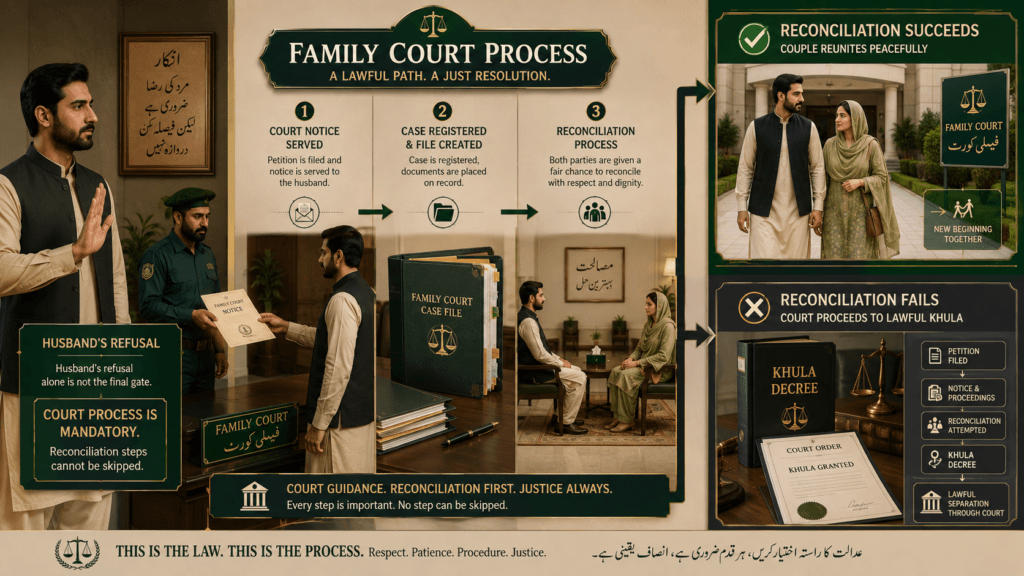
The wife has access to a judicial remedy. The husband is not simply erased from the proceedings. He may be served, appear, participate in reconciliation and raise lawful legal or financial issues.
What the judgment rejects is the idea that the husband can permanently defeat the judicial remedy merely by saying:
“I do not consent.”
For the full filing route, documents, jurisdiction, service and decree stages, read our detailed guide on Khula Process in Pakistan.
A Critical 2026 Update: A Court Cannot Force Khula on the Wife Either
This is the distinction a complete modern article must not miss.
Khula Without Husband Consent means the husband’s consent is not an absolute requirement for judicial Khula. It does not mean the Family Court may impose Khula upon a wife who never chose that remedy.
In Dr. Seema Hanif Khan v. Waqas Khan and others, reported as 2025 SCP 392 / PLD 2026 Supreme Court 91, the wife had approached the court for dissolution on statutory grounds. The Supreme Court addressed the error of granting her Khula instead of deciding the remedy she had actually invoked. The case emphasizes that Khula is a distinct cause of action connected with the woman’s own consent and autonomy.
This distinction is crucial because the legal basis used to end a marriage can affect financial rights, especially dower.
Khula Without Husband Consent protects the wife from a husband’s veto; it does not authorize a court to ignore the wife’s own pleaded remedy.
That creates an important two-way rule:
Husband’s consent: not an absolute veto over judicial Khula.
Wife’s consent to Khula: the court should not impose Khula where she instead seeks another lawful form of dissolution.
For a detailed explanation of this newer Supreme Court development, see Khula Process in Pakistan.
Khula or Dissolution Under the 1939 Act? One Wrong Choice Can Affect Haq Mehr

Not every wife who wants a marriage dissolved should automatically file only for Khula.
Pakistan also has the Dissolution of Muslim Marriages Act, 1939, which provides statutory grounds on which a Muslim woman may seek dissolution. The Act remains listed on the Ministry of Law and Justice’s Pakistan Code portal.
Depending on the facts, a wife may rely on statutory grounds such as cruelty, qualifying failure of maintenance or another ground recognized by the applicable law.
Those cases are legally different from a pure Khula claim based upon the wife’s genuine inability to continue the marital relationship.
Why does the distinction matter?
Because financial consequences can differ.
In a Khula claim, surrender or restoration of dower may become an issue. Where dissolution succeeds on a statutory ground attributable to the husband’s conduct, the financial analysis may be materially different.
This is why a wife should identify the correct remedy before filing, rather than discovering after the decree that the label used in the suit has affected her Haq Mehr or promised property.
For a fuller treatment, read Grounds for Khula in Pakistan, which discusses grounds and their interaction with dower disputes.
Khula Without Husband Consent solves the “husband refuses” question, but it should not erase a stronger statutory case that may protect other rights.
Does a Wife Have to Prove Cruelty Before She Can Get Khula?
Not necessarily in the same manner as a fault-based dissolution claim.
The Pakistani judicial approach to Khula focuses on whether the marital relationship has reached a point where the spouses cannot live together in accordance with their marital obligations and whether reconciliation is no longer possible. The judicial history discussed by LUMS traces that approach through Balqis Fatima and Khurshid Bibi.
But there is an important difference.
If a wife says:
“I genuinely cannot continue this marital relationship and seek Khula,”
the legal inquiry is not identical to a case where she says:
“My husband committed a particular statutory wrong, and I seek dissolution because that ground has been proved.”
Where specific statutory grounds are pleaded, evidence matters because the court has been asked to adjudicate those grounds.
That is why pleadings matter.
Khula Without Husband Consent should be approached as a properly framed legal remedy, not as a one-line shortcut that accidentally sacrifices another claim.
What Can the Husband Still Do If He Refuses Khula?
A husband is not legally invisible merely because his consent is not decisive.
He may, according to the applicable procedure:
- appear before the Family Court;
- respond to the suit;
- participate in reconciliation;
- raise a genuine jurisdictional issue;
- contest disputed financial claims;
- produce relevant evidence; and
- use lawful remedies available against an order where the law permits.
What he should not assume is that simply refusing consent automatically prevents the Family Court from deciding the matter.
Likewise, deliberate non-appearance is not necessarily a permanent shield. A Family Court may proceed according to law after lawful service and completion of the applicable procedural requirements. Qanooni Dastak’s detailed process guide explains the service and ex parte issue separately.
So the balanced meaning of Khula Without Husband Consent is not:
“The husband has no rights.”
It is:
“The husband has procedural rights, but his refusal is not an unlimited veto over judicial Khula.”
Does the Wife Automatically Lose Her Entire Haq Mehr?
This is one of the most important corrections to oversimplified Khula articles.
There is no universal full-Mahr rule that should be extracted from PLD 2023 FSC 286.
The 2023 judgment focused on the Shariat challenge to Section 10(4), the court’s authority to decree Khula despite the husband’s refusal, failed reconciliation, and the legal effect of Khula.
It should therefore be used carefully when explaining the financial consequences of Khula Without Husband Consent.
The reported judgment does mention the Jamilah/Thabit narration involving return of a garden. But it does not contain a detailed adjudication fixing the particular dower rights of Khurram Shehzad’s wife.
That distinction matters.
Modern Pakistani jurisprudence also requires courts to distinguish a wife’s chosen Khula claim from statutory dissolution rather than using Khula to unintentionally strip away financial rights. The later Dr. Seema Hanif Khan case makes that issue especially important.
Before filing, therefore, review:
- the Nikahnama;
- amount and nature of Haq Mehr;
- whether Mehr was prompt or deferred;
- whether it was actually paid;
- any house, plot, gold or other property promised as dower;
- the remedy the wife is actually seeking; and
- evidence of any statutory ground relied upon.
A woman should not discover only after the decree that a valuable property right was affected because the wrong cause of action was chosen.
What Happens After Khula? The FSC Explained the Legal Effect
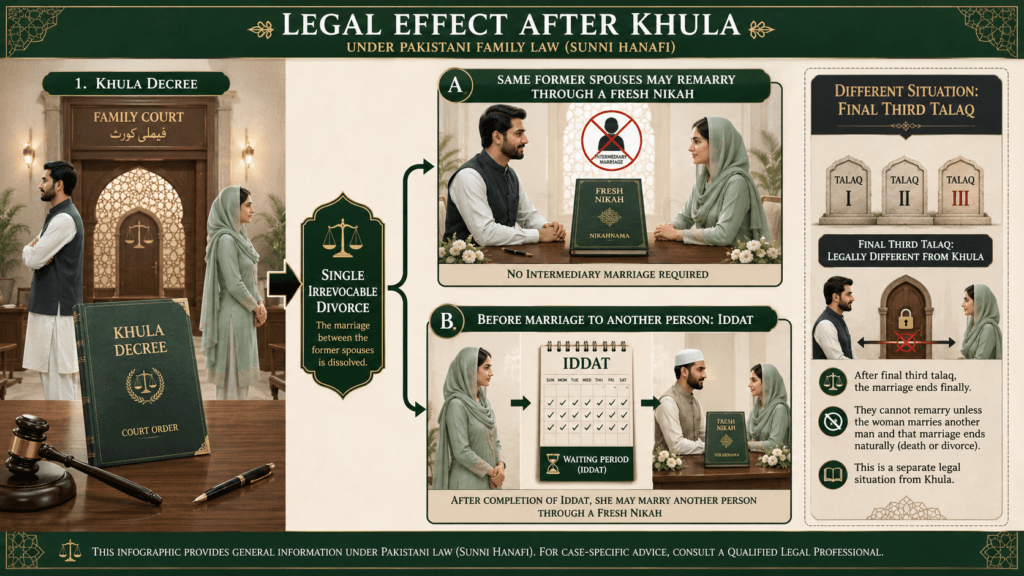
PLD 2023 FSC 286 states that, according to Shariah, Khula operates as a single irrevocable divorce.
The Court explained that after Khula the former spouses may, if they both wish, contract a fresh marriage with mutual consent. It expressly distinguished this situation from the consequences attached to a husband’s final third Talaq.
This part of the case is vital for public awareness because families often wrongly assume every form of marital separation has exactly the same legal effect.
Khula Without Husband Consent does not convert Khula into a third Talaq.
The Court again explained later in the judgment that the former spouses may contract a fresh marriage with each other, without an intermediary marriage, if both mutually choose to do so.
Is Halala Required After Khula?
According to the explanation given in PLD 2023 FSC 286, an intermediary marriage—commonly discussed under the term Halala—is not required merely because the earlier marriage ended through Khula and the same former spouses later wish to marry each other again.
They may contract a fresh Nikah with mutual consent.
The Court distinguished Khula from the situation where a husband has pronounced Talaq for the third time and that divorce has attained finality.
So a Khula decree should not automatically be treated as equivalent to a final third Talaq.
Khula Without Husband Consent does not itself create a Halala requirement before the same former spouses can marry afresh.
What About Iddat After Khula?
The Federal Shariat Court also addressed Iddat.
The judgment states that Iddat is incumbent upon the wife if she wishes to marry someone else after Khula.
Questions about the precise calculation of Iddat can depend on circumstances such as pregnancy and personal-law considerations. Anyone facing an immediate remarriage issue should therefore obtain case-specific religious and legal advice rather than relying on a generic calculation from social media.
This is another reason Khula Without Husband Consent should be understood as a complete legal transition, not merely the date on which a Family Court announces a decree.
A Practical Route: What Should a Wife Do If the Husband Says “Never”?
For anyone considering Khula Without Husband Consent, the safest sequence is simple.
Step 1: Identify the Correct Legal Remedy
Do not start with:
“I need Khula immediately.”
Start with:
“Which remedy actually fits my facts?”
Possible routes may include:
- judicial Khula;
- dissolution on statutory grounds;
- Talaq-e-Tafweez if a right of divorce was validly delegated through the Nikahnama; or
- mutual dissolution where both spouses agree.
For a side-by-side explanation, read Divorce Procedure in Pakistan.
Step 2: Read the Nikahnama Before Filing
Check:
- dower;
- delegated divorce clauses;
- special conditions;
- property promises;
- addresses;
- marriage particulars.
A Nikahnama should not be treated as a ceremonial piece of paper once litigation has begun.
Step 3: Gather the Basic Record
Keep available:
- Nikahnama or certified copy;
- CNIC details;
- current addresses;
- marriage-related documents;
- proof relevant to dower;
- documents supporting any separate statutory ground;
- maintenance evidence where relevant; and
- relevant messages, complaints or other lawful evidence if misconduct is pleaded.
Step 4: File Before the Competent Family Court
Territorial jurisdiction should be checked, particularly where:
- spouses live in different districts;
- the wife has moved from the matrimonial home;
- the husband lives abroad; or
- the marriage took place outside Pakistan.
For overseas-jurisdiction issues, readers may also study Marriage in Pakistan, which explains a Supreme Court case involving an overseas marriage and Family Court jurisdiction.
Step 5: Let Service and Reconciliation Take Their Legal Course
Khula Without Husband Consent does not mean skipping the husband.
It means that after lawful court process and failed reconciliation, his refusal by itself does not defeat the judicial remedy.
Step 6: Protect Financial Claims Before the Decree
Do not discuss only marital status.
Check:
- Haq Mehr;
- maintenance;
- dowry articles;
- promised property;
- other pleaded family claims.
A quick decree may not be a good result if important financial rights were unnecessarily surrendered.
Step 7: Preserve the Final Record
Keep certified copies of all important orders and the decree and complete any further legal or administrative formalities applicable to the case.
Do not rely only on the verbal statement:
“Khula ho gayi hai.”
Seven Mistakes That Can Turn a Khula Case Into a Bigger Dispute
1. Treating a Foreign Fatwa as Pakistani Court Law
Religious scholarship deserves respect, but different schools and institutions may use Khula and Faskh differently. Pakistani legal status must be checked under Pakistani law and binding Pakistani judgments.
2. Believing the Husband Can Permanently Block the Court
PLD 2023 FSC 286 rejects that assumption where reconciliation fails.
3. Believing the Opposite: That No Court Process Is Needed
Khula Without Husband Consent is not permission to create an uncertain marital status through a private declaration.
4. Filing Khula Without Checking Statutory Dissolution Grounds
If strong grounds exist, choosing the wrong route may affect dower and other rights.
5. Ignoring Haq Mehr Until the Last Hearing
Property and dower consequences should be examined at the beginning.
6. Treating Khula and Third Talaq as Identical
The Federal Shariat Court expressly distinguished their legal effects.
7. Remarrying on Family Advice Alone
Before remarriage, confirm the decree, legal status, Iddat and any case-specific requirements.
Avoiding these mistakes is what turns Khula Without Husband Consent from an internet slogan into responsible legal planning.
Why PLD 2023 FSC 286 Is Stronger Than a One-Line “Yes”
For public legal education, Khula Without Husband Consent should not be reduced to a dramatic yes-or-no slogan.
The value of this judgment lies in its institutional reasoning.
The Federal Shariat Court did not say marriage is unimportant.
It did not erase reconciliation.
It did not say the husband should never be heard.
Instead, it accepted the earlier Full Bench view that a competent court must remain capable of resolving a matrimonial dispute when reconciliation has failed and the husband refuses to end the marriage.
That is a much more accurate way to explain Khula Without Husband Consent to Pakistani families.
The remedy is:
judicial, lawful, supervised and linked with failed reconciliation.
It is neither a private self-declaration nor a husband-controlled veto.
FAQs About Khula Without Husband Consent
Can a wife get Khula Without Husband Consent in Pakistan?
Yes. PLD 2023 FSC 286 reaffirmed the Federal Shariat Court’s earlier position that a competent court can decide and decree Khula where reconciliation fails even if the husband does not agree.
Can a husband stop Khula just by saying “I do not consent”?
His refusal alone is not an absolute bar under the reasoning approved in PLD 2023 FSC 286. He may participate in the proceedings and raise lawful issues, but the Family Court retains judicial authority to decide the matter.
Is Khula Without Husband Consent the same as a wife divorcing herself?
No. The 2023 FSC judgment concerns judicial Khula through a competent court. A private declaration should not automatically be treated as equivalent to a Family Court decree.
What if the husband never appears before the Family Court?
Proper service and procedure still matter. If lawful service has been completed and the husband does not appear, the Family Court may deal with the case according to the applicable procedural law. His absence should not be confused with an automatic right to block the case.
Must the wife prove cruelty before obtaining Khula?
A pure Khula claim is not identical to a statutory cruelty claim. If the wife instead seeks dissolution on specific statutory grounds, those pleaded grounds and supporting evidence become important.
Can a court grant Khula when the wife asked only for statutory dissolution?
The later Supreme Court jurisprudence makes this distinction extremely important. Dr. Seema Hanif Khan v. Waqas Khan addressed the error of imposing Khula where the wife had sought statutory dissolution rather than Khula.
Does a woman always lose her full Haq Mehr after Khula?
Do not use PLD 2023 FSC 286 as a blanket authority for that proposition. The financial result depends on the actual remedy, pleadings, Nikahnama, payment status, facts, applicable law and relevant case law.
Is Halala required after Khula?
According to PLD 2023 FSC 286, the same former spouses can enter into a fresh marriage with mutual consent after Khula without an intermediary marriage.
Is Iddat required after Khula?
The Federal Shariat Court stated that Iddat is incumbent if the woman wants to marry another person after Khula.
Where can I read the official law?
You can read the Family Courts Act, 1964 on Pakistan Code and search the Federal Shariat Court’s official judgments database.
What is the biggest lesson for husbands and wives?
A wife should not believe that one word of refusal permanently locks the courtroom door. A husband should not believe that refusal alone gives him a legal veto. At the same time, both sides should respect lawful notice, reconciliation and court procedure.
Final Analysis: His Refusal Is Not the Last Word—but the Correct Route Still Matters
Khula Without Husband Consent is recognized in Pakistan as a judicial route in which the husband’s refusal does not by itself prevent the competent court from dissolving the marriage where reconciliation fails.
PLD 2023 FSC 286 confirms that the Federal Shariat Court was not prepared to declare that judicial power repugnant to the injunctions of Islam. The petition challenging Section 10(4) was dismissed in limine.
But the deeper lesson is just as important.
Do not confuse:
judicial Khula with private self-declaration;
Khula with statutory dissolution;
husband’s lack of consent with wife’s own consent to Khula;
or
Khula with the legal effect of a final third Talaq.
The wife’s chosen remedy, pleadings, evidence, Nikahnama and applicable law can materially affect the outcome.
For a family already under pressure, good legal information should reduce confusion rather than create more of it. The safest approach is to identify the correct remedy first, complete the lawful court process properly, protect financial rights before the decree and obtain case-specific advice where dower, children, service, overseas residence or remarriage creates additional questions.
Disclaimer
This article is for legal awareness and educational purposes only. It explains PLD 2023 Federal Shariat Court 286 and related Pakistani legal developments in general terms. Family-law outcomes depend on individual facts, applicable provincial law, pleadings and current case law. It is not a substitute for advice from a qualified family lawyer.