

A person may have a genuine property claim, a valid contract, proof of fraud, or an inheritance right—and still face dismissal because the court was approached too late. That is why the Limitation Act in Pakistan matters before a case is drafted, not after an objection is raised.
The most dangerous mistake is to ask only, “How many years do I have?” The better questions are: What relief am I seeking? Which Article of the First Schedule applies? And from which event does time begin to run? The Limitation Act in Pakistan contains different periods for different suits, appeals, and applications. The starting event may be breach, refusal, knowledge, dispossession, discovery of fraud, actual denial, or another event fixed by law.
The official text can be read on the Pakistan Code website of the Ministry of Law and Justice. Pakistan Code notes that its online content is under review and the relevant Gazette should be consulted where doubt remains.
Table of Contents
IRAC: Can a Strong Case Still Fail Just Because It Was Filed Late?
| IRAC | Simple Explanation |
|---|---|
| Issue | Can a person file a civil claim whenever they wish simply because the underlying right appears genuine? |
| Rule | Section 3 requires a suit, appeal, or application filed after the prescribed period to be dismissed, subject to the exceptions recognised by law. |
| Analysis | Identify the remedy, applicable Schedule Article, starting event, and any lawful exclusion or postponement such as disability, fraud, bona fide proceedings before a wrong forum, acknowledgment, payment, or a continuing wrong. |
| Conclusion | A strong right is not enough. The claimant must also cross the limitation barrier. |
The Lahore High Court in PLD 2025 Lahore 581 also stressed the mandatory importance of limitation and the court’s duty to examine it.
Judgment at a Glance: How a 34-Year Delay Changed Everything
| Point | Details |
|---|---|
| Case | Muhammad Hafeez v. Muhammad Ramzan and 17 others |
| Citation | PLD 2025 Lahore 581 |
| Court | Lahore High Court |
| Judge | Khalid Ishaq, J. |
| Decision Date | 23 April 2025 |
| Main Dispute | Challenge to a registered 1981 gift deed and later third-party sales |
| Delay | Suit filed in 2015, about 34 years after the gift deed |
| Important Laws | Limitation Act, 1908; Order VII Rule 11 CPC; Article 100 Qanun-e-Shahadat |
| Result | Petition dismissed; rejection of the plaint as time-barred maintained |
| Core Lesson | Calling an old dispute an inheritance claim does not automatically remove limitation |
The disputed registered gift deed was executed on 3 September 1981. A mutation followed in 1982. The donees later transferred the land to third parties through registered sale deeds in 1984. Safia Bibi, through whom the petitioner later claimed, remained alive until 2009 but never challenged the gift deed during her lifetime. The suit was eventually filed on 24 November 2015.
This made the case an important practical example of the Limitation Act in Pakistan. The Court rejected the idea that merely describing a stale dispute as an inheritance claim automatically removes the limitation problem, particularly where the predecessor remained silent and valuable third-party rights had already arisen.
What Is the Limitation Act in Pakistan—and Why Should Ordinary People Care?
The Limitation Act, 1908 regulates time limits for suits, appeals, and certain applications. Section 3 links those deadlines with the First Schedule. Other provisions deal with court holidays, legal disability, exclusion of time, fraud, acknowledgment, payment, continuing wrongs, and related issues.
The Limitation Act in Pakistan should therefore be understood through four basic questions:
- What legal relief are you asking for?
- Which Article of the First Schedule applies?
- From which event does time begin to run?
- Does any statutory exception, exclusion, or special law affect that period?
For example, a person seeking cancellation of an instrument may have to examine Article 91. Someone seeking specific performance of a contract may have to examine Article 113. Where the Schedule does not provide a specific period for a suit, Article 120 may become relevant.
This is why one cannot safely answer a limitation question merely by saying, “You have three years” or “You have six years.”
Limitation Act in Pakistan: There Is No Single Deadline for Every Case
One of the biggest misunderstandings about the Limitation Act in Pakistan is that every civil claim must be filed within the same period.
That is incorrect.
The First Schedule contains different limitation periods for different legal proceedings. Depending on the nature of the claim, a prescribed period may be measured in days, months, or years.
Even two claims arising from the same property dispute may have different limitation periods because the remedies requested are legally different.
Imagine that a disputed transaction took place in 2018. One person wants cancellation of a document. Another wants possession. A third seeks specific performance of an agreement. A fourth asks only for a declaration.
The same 2018 event does not automatically give all four people the same filing deadline.
The legally important date may also not be the date written on the document. Depending on the relevant Article, time may run from:
- the date of breach;
- knowledge of an important fact;
- refusal to perform;
- dispossession;
- discovery of fraud;
- actual denial of ownership; or
- accrual of the right to sue.
That starting point can decide the entire case.
Limitation Act in Pakistan: What Is the 3-Year Limitation Period?
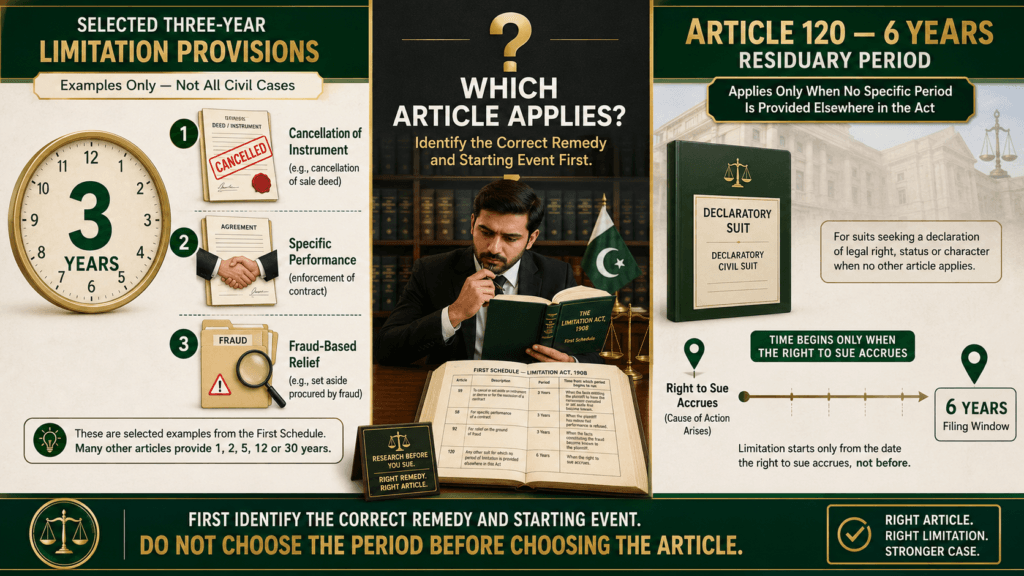
One of the most searched questions is: What is the 3-year limitation period?
There is no single three-year rule for all cases. Under the Limitation Act in Pakistan, many First Schedule Articles provide three years, but each Article has its own starting event.
Some important examples are:
- Article 91: A suit to cancel or set aside an instrument not otherwise specifically provided for carries three years from when the facts entitling the plaintiff to seek cancellation become known.
- Article 95: Relief against a decree obtained by fraud, or other relief based on fraud, carries three years from when the fraud becomes known.
- Article 113: A suit for specific performance carries three years from the date fixed for performance. If no date was fixed, the period runs from when the plaintiff has notice that performance has been refused.
- Article 115: Certain compensation claims for breach of an unregistered contract carry three years from the relevant breach.
- Various suits concerning money, goods, accounts, rent, promissory notes, movable property, and other contractual matters also fall under separate three-year Articles.
So, if someone tells you simply, “Your limitation is three years,” ask one more question:
Three years from what date?
That second question is often more important than the first.
Limitation Act in Pakistan and Article 120: When Does Six Years Apply?
Article 120 is extremely important, but it is also frequently misunderstood.
It applies to a suit for which no period of limitation is provided elsewhere in the First Schedule. The prescribed period is six years from when the right to sue accrues.
PLD 2025 Lahore 581 discussed Supreme Court authority, including Saadat Khan v. Shahid-Ur-Rehman (PLD 2023 SC 362), while examining Article 120 in declaratory inheritance litigation.
The judgment explained that a declaratory ownership claim under Section 42 of the Specific Relief Act may be governed by Article 120 where no other specific Schedule Article covers the relief.
This part of the Limitation Act in Pakistan is crucial.
Six years do not automatically begin from the oldest date appearing in the property file.
The key question is:
When did the right to sue legally accrue?
What Are the Requirements for Filing a Suit Under Article 120?
A proper Article 120 analysis should answer these questions:
- Is the proceeding actually a suit?
- Is there no other specific Article in the First Schedule governing that relief?
- What legal right is the plaintiff claiming?
- When was that right actually denied or otherwise made enforceable?
- When did the right to sue mature?
- Was the suit filed within six years of that date?
- Does fraud, disability, exclusion of time, special law, waiver, acquiescence, or the creation of third-party rights affect the calculation?
Article 120 should therefore be used as a residuary provision, not as a convenient six-year answer for every civil dispute.
A Wrong Mutation and Actual Denial Are Not Always the Same Thing

One of the most useful parts of PLD 2025 Lahore 581 concerns the difference between a wrong revenue entry and a later act that actually denies another heir’s rights.
While discussing Supreme Court authority, the judgment explained that an incorrect inheritance mutation may, in some situations, amount only to an apprehended or threatened denial.
But the legal position may change when a co-sharer:
- claims to be the exclusive owner;
- sells land beyond his own share;
- transfers it to a third party; and
- delivers possession to that purchaser.
That conduct may amount to actual denial, causing the right to sue to accrue.
Anyone applying the Limitation Act in Pakistan to a property dispute should therefore make a complete timeline containing:
mutation → knowledge → possession → sale deed → third-party transfer → refusal → actual denial → filing date.
For a deeper discussion of this issue, read Limitation in Inheritance Cases in Pakistan.
Section 5: “The Court Will Condone My Delay” Can Be a Dangerous Assumption
Section 5 is another provision people often misunderstand.
It allows delayed admission of specified appeals and applications where the applicant or appellant establishes sufficient cause. It does not create a general rule that every late ordinary civil suit can simply be filed and then saved through an application for condonation.
A person applying the Limitation Act in Pakistan should therefore never build a legal strategy on:
“We are already late, but the court will probably forgive the delay.”
First determine whether Section 5 legally applies to that proceeding.
Also check whether a special statute has its own limitation and condonation provisions.
Sections 6 to 9: Does Minority or Legal Disability Stop the Clock?
Sections 6 and 7 contain rules relating to certain legal disabilities existing at the time from which limitation is to be reckoned.
Section 8 places restrictions on the extension available through those provisions. Section 9 then provides an important general principle: once limitation has begun to run, a later disability or inability ordinarily does not stop it.
This means the timing of the disability is critical.
The Limitation Act in Pakistan therefore requires lawyers to examine:
- age;
- legal capacity;
- date the cause of action arose;
- death of the concerned person;
- legal representation; and
- whether the disability existed when limitation originally began.
A vague statement that a claimant was “young” or “unable to act” is not a substitute for the statutory analysis.
Section 14: Went to the Wrong Court—Is All That Time Lost?
Not necessarily.
Section 14 can exclude time spent prosecuting another civil proceeding where the statutory requirements are satisfied.
Broadly, the previous proceeding must have been pursued:
- with due diligence;
- in good faith;
- on the same cause of action or for the same relief, as applicable; and
- before a court unable to entertain it because of lack of jurisdiction or another similar legal defect.
This is an important protection under the Limitation Act in Pakistan.
But it is not permission for careless forum-shopping.
If someone knowingly chooses an obviously wrong forum, delays proceedings, or fails to act with due care, Section 14 cannot simply be assumed to rescue the case.
Limitation Act in Pakistan and Section 18: Can Fraud Save a Late Claim?

Fraud is often pleaded when an old transaction is challenged.
Section 18 deals with situations where fraud kept a person from knowledge of the right to sue or where a document necessary to establish the right was fraudulently concealed.
Where the legal requirements are satisfied, limitation may be computed from discovery of the fraud or from when the claimant first had the means of producing the concealed document.
But PLD 2025 Lahore 581 gives a strong warning.
A plaintiff cannot simply write:
“The transaction was fraudulent and I discovered it recently.”
The judgment explains that a claimant relying on Section 18 must plead relevant particulars of fraud, state the date of knowledge, and prove the allegation through positive evidence.
The Court also discussed the important statutory protection concerning a bona fide purchaser for valuable consideration. Fraud cannot simply be used as a slogan to disturb every later purchase by an innocent third party.
Under the Limitation Act in Pakistan, a recent-knowledge plea becomes much weaker where the surrounding record shows open possession, old registered documents, repeated transfers, or conduct inconsistent with ignorance.
Sections 19 and 20: Can an Acknowledgment Restart Limitation?
Sometimes it can.
Section 19 provides that where, before expiry of the existing limitation period, a qualifying acknowledgment concerning a property or right is:
- in writing; and
- signed by the relevant party,
a fresh limitation period may be computed from the time of acknowledgment.
Section 20 contains a related rule concerning qualifying payment on account of debt or interest on a legacy.
These provisions are especially important in money and contractual disputes.
But timing is critical.
An alleged oral promise, informal family conversation, or acknowledgment made only after the original limitation period has expired should not automatically be treated as creating a new period.
Section 23: Does a Continuing Wrong Create Fresh Limitation?
Section 23 deals with continuing breaches and continuing wrongs. Where a wrong is legally continuing, a fresh period can arise while the wrong continues.
However, there is an important distinction between:
a continuing wrong
and
the continuing effect of an old completed wrong.
A person cannot automatically escape the Limitation Act in Pakistan merely by describing a completed historical transaction as “continuing.”
The nature of the wrong must actually satisfy the legal rule.
Section 29: A Special Law Can Change the Entire Limitation Answer
Another common mistake is to open the Limitation Act, choose a Schedule Article, and stop researching.
Section 29 recognises that a special or local law may prescribe a different limitation period and regulates how the Limitation Act interacts with such special periods.
The Limitation Act in Pakistan is therefore not always the final source of the deadline.
Depending on the case, separate rules may arise under laws dealing with:
- revenue matters;
- banking;
- taxation;
- service disputes;
- elections;
- labour matters;
- special tribunals; or
- other specialised proceedings.
Always identify the special statute before calculating the final date.
Limitation Act in Pakistan: Does It Apply to Inheritance Claims?
Yes—but the answer depends heavily on the facts.
PLD 2025 Lahore 581 rejected a blanket argument that an inheritance claim can be brought whenever a later generation wishes.
Safia Bibi lived for approximately 28 years after the disputed 1981 gift deed but did not challenge it. The property was later transferred through registered transactions to third parties. Her legal heirs eventually approached the court in 2015.
The Court treated those facts as extremely important.
However, the decision does not mean every delayed female inheritance claim must automatically fail.
The Court identified important exceptional factual situations, including cases where:
- a female heir brings the claim during her lifetime and properly pleads fraud or misrepresentation;
- the deprived female heir continued receiving a proportionate share of income or lease proceeds;
- another co-sharer was in deemed possession for all heirs;
- no third-party rights had been created; or
- waiver and acquiescence were absent.
The Limitation Act in Pakistan therefore requires a balanced inquiry into:
knowledge + possession + conduct + fraud + actual denial + third-party rights + waiver + acquiescence.
If you first need to understand who inherits and how female inheritance rights work, read Inheritance Law in Pakistan.
For family gift disputes, you can also read Gift for Wife Pakistan.
Order VII Rule 11 CPC: Can a Late Suit End Before Evidence Starts?
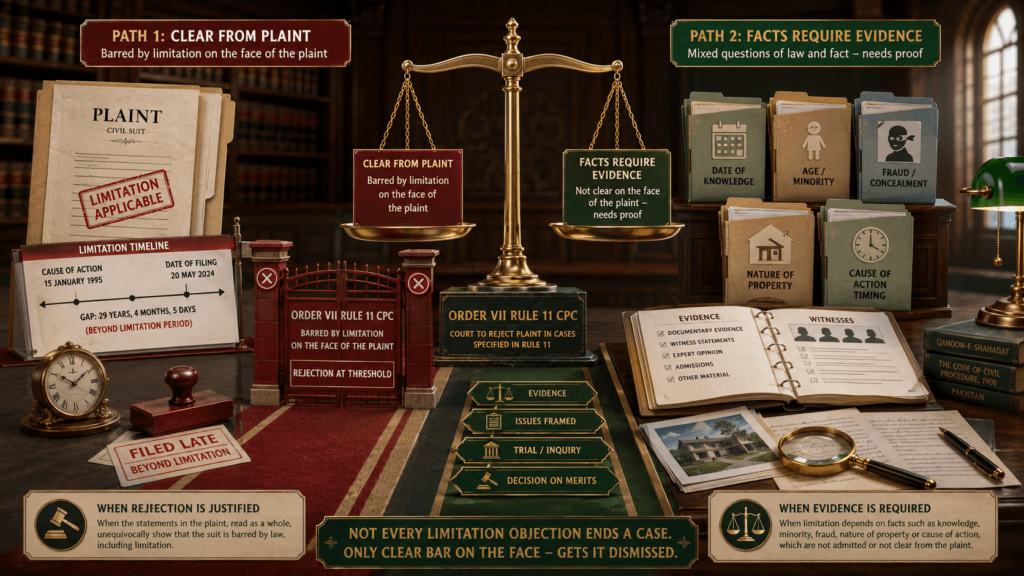
Yes—if the limitation bar is clear from the plaint itself.
PLD 2025 Lahore 581 held that where the plaint itself clearly shows that the suit is barred by limitation, recording evidence merely for formality is unnecessary.
A plaint may therefore be rejected under Order VII Rule 11 CPC where it appears from its own contents to be barred by law.
But there is another side to this rule.
Limitation is sometimes a mixed question of law and fact.
If the date on which the cause of action arose genuinely depends on disputed facts requiring evidence, a court may have to examine those facts first.
The judgment discussed examples involving:
- the age of a claimant;
- nature of land;
- disputed date of knowledge;
- dissolution of a partnership; and
- time consumed in obtaining necessary copies.
This distinction is essential when applying the Limitation Act in Pakistan.
A badly drafted plaint may appear hopelessly late. A properly pleaded case may show that an important limitation fact genuinely requires evidence.
The official Code of Civil Procedure, 1908 is also available on Pakistan Code.
Why Did the 34-Year-Old Registered Gift Deed Matter?
The Lahore High Court also noted that the registered gift deed had become approximately 34 years old by the time it was challenged.
The judgment referred to the evidentiary presumption attached to the old document under Article 100 of the Qanun-e-Shahadat Order, 1984.
That does not mean every old document is automatically lawful or impossible to challenge.
It means that age of the document, registration, later transactions, possession, conduct of the parties, and unexplained silence can become important when a court evaluates an extremely old dispute.
Readers can consult the official Qanun-e-Shahadat Order, 1984 on Pakistan Code.
Limitation Act in Pakistan: How to Calculate the Limitation Period
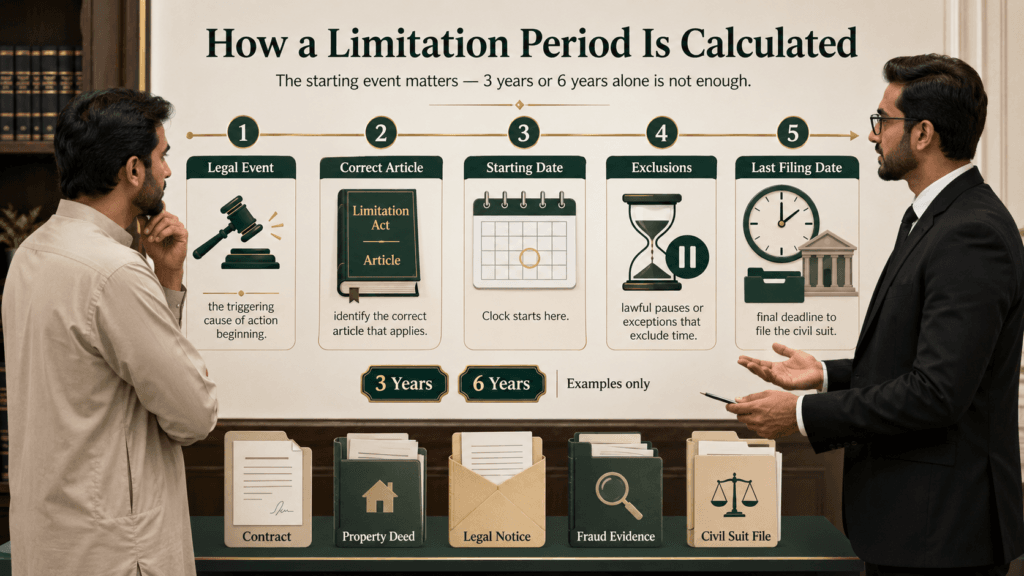
Do not calculate limitation from memory.
Create a dated legal timeline.
Step 1 — Identify the Exact Relief
Are you asking for:
- cancellation?
- declaration?
- possession?
- specific performance?
- recovery of money?
- compensation?
- appeal?
- review?
- revision?
- execution?
Different remedies may have different deadlines.
Step 2 — Check Any Special Law
Before relying on the First Schedule, check whether a special or local law prescribes its own limitation period.
Step 3 — Find the Correct Schedule Article
Do not immediately use Article 120.
First confirm that no specific Article governs the relief.
Step 4 — Identify the Starting Event
The clock may begin from:
- breach;
- refusal;
- knowledge;
- dispossession;
- discovery of fraud;
- actual denial; or
- accrual of the right to sue.
Step 5 — Check Lawful Exclusions
Sections such as 12, 14, and 15 may affect computation where their statutory requirements are satisfied.
Step 6 — Check Disability and Fraud
Sections 6 to 8 and Section 18 may materially affect the starting point or computation.
Step 7 — Check Acknowledgment or Payment
Sections 19 and 20 may affect the calculation in proper cases.
Step 8 — Check Third-Party Rights
This is especially important in land, gift, and inheritance litigation.
Step 9 — Calculate Conservatively
Do not plan to file on the very last day if earlier filing is possible.
Section 4 also deals with a situation where the limitation period expires while the court is closed, while Section 12 contains important rules concerning exclusion of time in specified legal proceedings.
A calculation under the Limitation Act in Pakistan should therefore look like a timeline, not a rough guess such as “around three years.”
Before Filing an Old Case, Collect These Documents First
Before going to court, collect:
- the document that created your right;
- the document allegedly violating that right;
- certified copies of orders and mutations;
- sale deeds and gift deeds;
- proof of possession;
- legal notices;
- written refusals;
- evidence showing the date of knowledge;
- records of rent or property income;
- written acknowledgments;
- payment records; and
- documents relating to any third-party transfer.
In PLD 2025 Lahore 581, third-party transactions were not a minor detail. They formed an important part of the limitation analysis.
If your dispute concerns physical occupation of property, read Illegal Possession of Property in Pakistan.
Most importantly, do not treat family assurances such as “We will give your share later” or “We will settle this next year” as substitutes for proper legal advice.
The Limitation Act in Pakistan is applied through legal dates and recognised events, not informal hope.
9 Rules Worth Remembering Before Time Runs Out
- There is no universal three-year limitation period.
- Article 120 is a six-year residuary provision, not a blanket rule for every suit.
- Section 5 does not automatically condone every late civil suit.
- Fraud must be specifically pleaded and proved where Section 18 is relied upon.
- A qualifying written acknowledgment made before expiry may affect limitation under Section 19.
- A special or local law may prescribe another deadline.
- Inheritance claims can also face limitation, waiver, and acquiescence objections.
- A clearly time-barred plaint may be rejected under Order VII Rule 11 CPC.
- The safest time to calculate limitation is before filing—not after the defendant objects.
The purpose of the Limitation Act in Pakistan is legal certainty. In practical terms, the Limitation Act in Pakistan forces parties to identify and protect rights before evidence becomes stale and old transactions become increasingly difficult to examine.
FAQs
What is the 3 year limitation period?
There is no single three-year limitation period for every civil case.
Many Articles of the First Schedule prescribe three years, but the starting event changes. For example, Article 91 concerning cancellation of an instrument runs from knowledge of the relevant facts; Article 95 concerning fraud-based relief runs from knowledge of the fraud; and Article 113 concerning specific performance runs from the fixed performance date or notice of refusal where no date was fixed.
Always identify the correct Article before calculating three years.
Can you provide me with notes on the Limitation Act, 1908?
Yes. These short notes on the Limitation Act in Pakistan start with Section 3, which makes limitation mandatory.
Section 4 deals with the court being closed when limitation expires. Section 5 deals with delayed admission of specified appeals and applications. Sections 6 to 8 concern legal disability. Section 9 concerns continuous running of time. Sections 12 to 15 contain important computation and exclusion rules. Section 18 deals with fraud. Sections 19 and 20 deal with acknowledgment and qualifying payments. Section 23 concerns continuing wrongs. Section 29 addresses special or local laws. The First Schedule then specifies periods for different suits, appeals, and applications.
What are the requirements for filing a suit under Article 120 of the Limitation Act 1908?
Article 120 applies where no specific limitation period for the suit is provided elsewhere in the First Schedule.
Its period is six years from when the right to sue accrues.
The claimant should therefore identify:
the exact legal right;
the act or denial that caused the right to sue to mature;
the date of that accrual; and
whether the suit was filed within six years.
Fraud, disability, exclusion of time, special legislation, waiver, acquiescence, or third-party rights may affect the final legal analysis.
How to calculate the limitation period?
Under the Limitation Act in Pakistan, identify the relief, check any special law, locate the correct Schedule Article, determine the legal starting event, and then apply any lawful exclusion or postponement.
Only after those steps should the final filing date be calculated.
Using the wrong starting date can make the entire calculation wrong.
Does limitation apply to inheritance cases in Pakistan?
Yes, depending on the facts.
PLD 2025 Lahore 581 expressly rejected the proposition that limitation automatically becomes irrelevant in every inheritance dispute.
The Court also recognised important exceptions based on facts such as fraud, concealment, continued income, co-sharer possession, absence of third-party rights, waiver, and acquiescence.
Can fraud save a late case?
Sometimes, but not automatically.
Section 18 may affect limitation where fraud prevented knowledge of the right to sue or concealed a necessary document.
However, the fraud, its particulars, and the date of discovery must be properly pleaded and proved.
Can a void order be challenged at any time?
Do not assume that it can.
PLD 2025 Lahore 581 states that limitation can run even against a void order and that a void order must also be challenged within limitation.
Can a time-barred plaint be rejected without recording evidence?
Yes, where the bar of limitation is clear from the plaint itself.
However, if determination of limitation genuinely depends on disputed facts that require evidence, limitation may become a mixed question of law and fact.
Does a written acknowledgment restart limitation?
A qualifying acknowledgment made before expiry of the existing limitation period, in writing and signed by the relevant party, may result in a fresh period being computed under Section 19.
The wording, signature, timing, and legal nature of the acknowledgment should be examined carefully.
Does Article 120 always run from the date of the disputed document?
No.
Article 120 runs for six years from when the right to sue accrues.
Depending on the facts, that event may occur later than the date appearing on an old document. PLD 2025 Lahore 581 demonstrates why actual denial, possession, knowledge, and later third-party transactions can become important.
Conclusion: A Good Case Can Still Be Too Late
The Limitation Act in Pakistan teaches a simple but serious lesson: a genuine grievance does not remove the requirement to approach the correct legal forum within the prescribed period.
PLD 2025 Lahore 581 demonstrates the danger clearly. The Court did not say that inheritance rights are unimportant. It held that decades of silence, old registered transactions, and completed third-party transfers could not simply be ignored because a later suit was described as an inheritance claim.
At the same time, the judgment preserved protection for genuine exceptional situations involving fraud, concealment, continued payment of property income, co-sharer possession, absence of third-party rights, and other relevant facts.
For an ordinary citizen, the safest question is therefore not only:
“Am I legally right?”
Ask one more question before valuable time passes:
“How much time does the law give me to act?”