
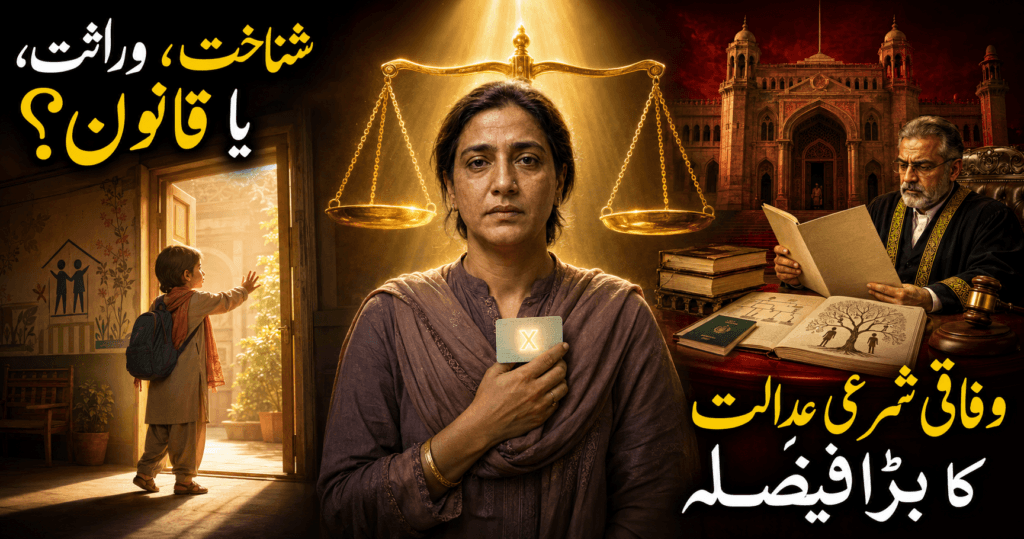
Behind every legal definition is a human life. An abandoned intersex child needs shelter. A citizen with an “X” marker on a CNIC wants to perform Hajj. A family needs certainty about inheritance. The Transgender Act 2018 in Pakistan brought these concerns into one law, but it also created a difficult debate about identity, religion and official records.
That debate reached the Federal Shariat Court in Hammad Hussain and others v. Federation of Pakistan, PLD 2023 Federal Shariat Court 301. The Court decided 12 connected Shariat petitions after hearing government departments, NADRA, scholars, experts and community representatives. This guide separates their arguments from the Court’s findings and also explains the later appeal position.
Table of Contents
IRAC: Did Gender Identity Conflict with Islamic Injunctions?
| IRAC Element | Clear Explanation |
|---|---|
| Issue | Whether definitions and rights in the Transgender Act 2018 in Pakistan, particularly self-perceived gender identity, document changes and inheritance based on CNIC gender, were repugnant to the injunctions of Islam. |
| Rule | Article 203-D authorises the Federal Shariat Court to examine whether a law is repugnant to the Holy Quran and Sunnah. |
| Analysis | The Court separated intersex and eunuch categories from self-perceived transgender identity, then examined the consequences for CNICs, Hajj, privacy and inheritance. |
| Conclusion | Sections 2(1)(f), 2(1)(n)(iii), 3 and 7 were declared repugnant. The entire Act and Section 2(1)(e) were not struck down. |
Judgment at a Glance: What Fell, Survived and Stayed Protected
| Point | Verified Detail |
|---|---|
| Citation | PLD 2023 Federal Shariat Court 301 |
| Case | Hammad Hussain and others v. Federation of Pakistan through Secretary, Ministry of Law and Justice and others |
| Court | Federal Shariat Court of Pakistan |
| Bench | Dr. Syed Muhammad Anwer, Acting Chief Justice, and Khadim Hussain M. Shaikh, J. |
| Author Judge | Dr. Syed Muhammad Anwer, A.C.J. |
| Decision Date | 19 May 2023 |
| Proceedings | 12 connected Shariat petitions heard on 45 dates from September 2020 to May 2023 |
| Main Law | Transgender Persons (Protection of Rights) Act, 2018 |
| Other Measures Examined | Transgender Persons (Protection of Rights) Rules, 2020; NADRA Regulation 13(1); NADRA registration policy |
| Provisions Declared Repugnant | Sections 2(1)(f), 2(1)(n)(iii), 3 and 7 |
| Provisions Expressly Preserved | Section 2(1)(n)(i) on intersex persons; Section 2(1)(n)(ii) was not struck down but required clarity |
| Final Result | Petitions accepted only to the stated extent; three challenges to deleted NADRA Regulation 13(1) disposed of as infructuous |
| Later Legal Position | The Islamabad High Court recorded that Civil Shariat Appeals Nos. 2 and 3 of 2023 were pending and Article 203-D prevented premature effect before disposal of the appeals |
Why Transgender Act 2018 in Pakistan Became a Test of Identity, Dignity and Faith
Parliament enacted the Transgender Act 2018 in Pakistan to address discrimination, harassment, education, employment, healthcare, voting, public office, assembly, public places, property and constitutional rights. It also placed welfare and rehabilitation duties on the Government. Readers can examine the official text on Pakistan Code.
Under Section 20, the Federal Government made the Transgender Persons (Protection of Rights) Rules, 2020 on 19 January 2021.
Several petitioners accepted protection for intersex or Khunsa persons. Their core objection was that Section 2 placed physical conditions and self-perceived identities under one broad definition. The case therefore tested whether a protective law had defined sex, gender and identity with enough legal precision.
Transgender Act 2018 in Pakistan: The Five-Part Definition That Triggered the Case

Section 2(1)(n) brought five expressions under the umbrella of “transgender person”:
- Intersex or Khusra;
- Eunuch;
- Transgender man;
- Transgender woman; and
- KhawajaSira.
It also covered a person whose gender identity or gender expression differed from social norms and cultural expectations based on the sex assigned at birth. Section 2(1)(f) defined gender identity as a person’s innermost sense of being male, female, a blend of both or neither, whether or not it corresponded with sex assigned at birth. Section 2(1)(e) dealt with how a person presented that identity and how others perceived it.
The Federal Shariat Court concluded that these terms were not synonyms. In the Court’s analysis, intersex referred to congenital physical or biological variations, while transgender man and transgender woman in the Act were linked with self-perception. Combining them created what the Court called confusion, conflation and a “circular definition fallacy”.
This drafting problem became the foundation of the Transgender Act 2018 in Pakistan judgment because different legal and religious consequences could follow from each category.
How Transgender Act 2018 in Pakistan Reached Forty-Five Hearings
The reported case combined Shariat Petition Nos. 5/I and 6/I of 2020; 5/I and 6/I of 2021; 2/I, 3/I, 6/I, 7/I, 14/I, 18/I and 20/I of 2022; and 1/I of 2023. Some challenged provisions of the Act and Rules. Others challenged NADRA Regulation 13(1) or the policy used for registering gender in identity records.
The Court allowed intersex persons, persons identifying as transgender women, psychologists, therapists, gender experts, scholars and civil-society members to participate. Because the record contains conflicting positions, a responsible summary must distinguish what a party argued from what the Court actually held.
Why the Government Changed Its Transgender Act 2018 in Pakistan Reply
The Ministry of Human Rights filed a detailed reply dated 16 February 2022. It distinguished gender identity from sexual orientation and referred to the Yogyakarta Principles while defending self-identified gender recognition, privacy and dignity. Petitioners objected that this reference supported their allegation of an outside agenda.
On 18 March 2022, the Ministry submitted amended comments removing that reference while maintaining that the Act did not legalise homosexuality or same-sex marriage. The Court later criticised the Federal Government, MoHR and Law Division for not presenting a fully correct picture about the legislative process. This was not a finding that the Transgender Act 2018 in Pakistan legalised homosexuality; that remained an allegation denied by the Government.
MoHR also relied on the Supreme Court’s Dr. Muhammad Aslam Khaki orders as a reason for the law. The FSC noted that those reported orders did not use “transgender”, “transgender person”, “transgender man” or “transgender woman”.
The CII Dispute Behind Transgender Act 2018 in Pakistan

The Law and Justice Division stated that the Bill had been sent to the Council of Islamic Ideology before enactment. Petitioner Orya Maqbool Abbasi produced a letter dated 18 November 2021 from CII Chairman Dr. Qibla Ayaz stating that the Bill had not been forwarded to the Council by the Government or Ministry of Human Rights for consultation.
After this contradiction appeared, the Ministry requested time to refer the Act to the CII. The Court allowed the request on 11 April 2022. The Council reviewed the law and submitted a detailed report dated 18-19 May 2022.
The claimed pre-enactment consultation and the later referral were therefore not the same. In the reported PDF reviewed for this article, the inserted CII letter and report appear as broken-image boxes; this summary relies only on the readable surrounding judgment text.
How Transgender Act 2018 in Pakistan Exposed NADRA’s Unnotified Policy
NADRA’s response concerned CNICs carrying the gender marker “X”. According to the judgment, NADRA did not identify notified rules or regulations that clearly prescribed the complete procedure under the Act. It said that it followed a policy.
The Court called that position questionable. A national identity system affects inheritance, passports, travel, voting, public services and security. The Court reasoned that leaving such decisions to an unnotified policy could create uncertainty and opportunities for abuse.
Before the 2018 Act, NADRA had used Regulation 13(1) of the 2002 CNIC Regulations for cards concerning eunuch persons. During the proceedings, NADRA deleted that regulation through the NADRA Amendment Regulations, 2022. As a result, three connected petitions challenging Regulation 13(1)—filed by Abdur Rehman, Hammad Hussain and Muhammad Younas Qureshi with others—were disposed of as infructuous. This means the Court did not decide those three challenges on their merits because the targeted regulation no longer existed.
For updated administrative information after the Transgender Act 2018 in Pakistan litigation, readers should use NADRA’s official identity-services website instead of relying on social-media claims.
Transgender Act 2018 in Pakistan: When an “X” CNIC Became a Hajj Barrier
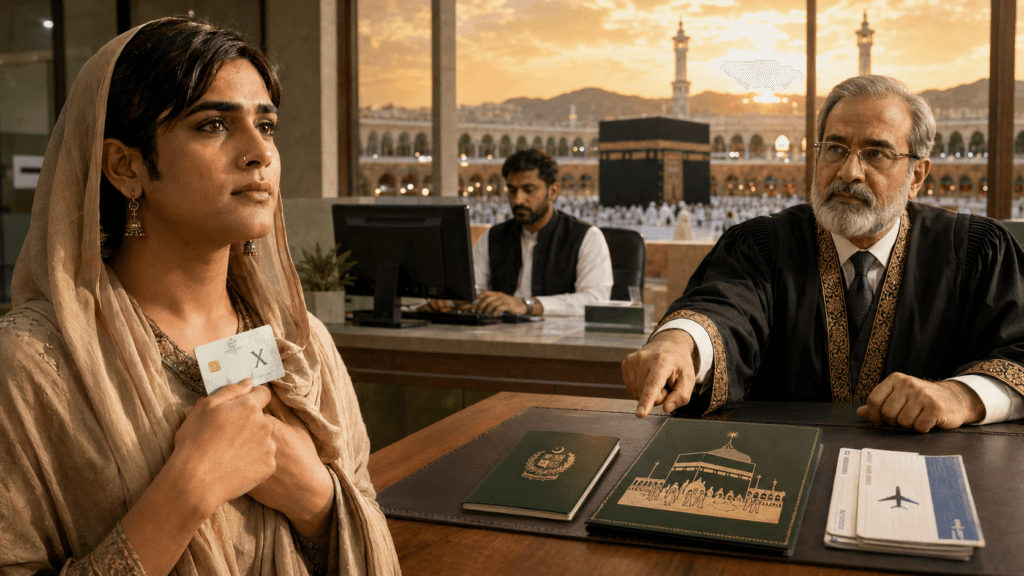
Several intersex participants told the Court that a CNIC marked “X” created difficulty in performing Hajj or Umrah. At the hearing on 18 October 2022, a person named Shahana raised the issue, and other intersex or eunuch participants confirmed it.
NADRA explained that its backend database differentiated categories but issued an “X” marker to intersex, eunuch, transgender man and transgender woman categories. The Court treated the Hajj concern as serious and directed NADRA to develop rules or criteria for issuing identity documents to Khunsa persons so that they could perform Hajj.
This part of the Transgender Act 2018 in Pakistan judgment is important because it came from the people directly affected. Their concern was not about gaining an abstract label. They wanted an official identity that would not prevent them from fulfilling a religious duty.
The Human Cost Behind Transgender Act 2018 in Pakistan
Julie Malik, who identified as an intersex person, described being abandoned by biological parents and suffering sexual, physical and psychological abuse during childhood. The Court took the account seriously. In its order dated 13 December 2022, it asked the Ministry of Human Rights whether protective facilities existed for children born with sexual-organ infirmities who were abandoned and exposed to predators.
The Court also summoned or involved the National Commission for Human Rights, Pakistan Sweet Home and Akhuwat representatives. In response, the Ministry formed a monitoring committee, consulted community representatives and established some protection centres for intersex children and older persons described in the record.
This human story prevents the Transgender Act 2018 in Pakistan case from being reduced to a debate over words. Whatever position a person takes on the disputed definitions, the judgment repeatedly recognises that abandoned and abused individuals need dignity, shelter, healthcare and protection from exploitation.
Why Petitioners Challenged Transgender Act 2018 in Pakistan
Hammad Hussain and other petitioners alleged that the law could cover conduct prohibited by Islam or be misused. Senator Mushtaq Ahmad Khan accepted protection for intersex persons and medically necessary treatment, but objected to legal identity based only on self-perception. He connected biological sex with marriage, dower, divorce, inheritance, purification, prayer, fasting and Hajj, and questioned why medical determination applied below age 18 in Section 7 but not to adults.
Ansar Javaid discussed medical care for biological ambiguities. PIMA experts discussed gender dysphoria and detransition. JUI Pakistan, through Senator Kamran Murtaza, accepted intersex rights but challenged Section 2(1)(n)(iii), weak safeguards and possible effects on female-only spaces. These were party or expert submissions, not automatically proved facts.
How the Government, Lawyers and Gender Experts Defended the Law
The Federation and ministries said the law protected a marginalised community in education, employment, healthcare and public life, and did not create same-sex marriage rights. Farhat Ullah Babar argued that ordinary criminal laws and departmental policies answered misuse concerns. Muhammad Sherkan Malik discussed psychological guidance, while Nayab Ali argued that the Act did not promote homosexuality. The defence of the Transgender Act 2018 in Pakistan rested on dignity, privacy, autonomy and equality, but the Court rejected self-perceived identity where it conflicted with biological sex for Islamic legal purposes.
Four Questions That Controlled the Entire Judgment
The Federal Shariat Court framed four points of determination:
- Were intersex, eunuch, transgender man, transgender woman and KhawajaSira identical or different categories?
- Under the Quran and Sunnah, did sex or gender provide the basis for male and female legal identity?
- Were the definitions of gender identity and gender expression consistent with Islamic injunctions?
- Did Islam permit medical treatment for physical infirmity in reproductive systems or sexual organs?
These four questions gave the Transgender Act 2018 in Pakistan judgment its structure. The Court’s seven most important findings flowed from them.
7 Court Findings That Changed the Legal Debate
1. Intersex and Transgender Were Not Interchangeable Terms
The Court treated intersex as a congenital physical or biological condition and transgender identity under the disputed provision as an inner sense differing from sex at birth. It held that combining these categories in the Transgender Act 2018 in Pakistan obscured their differences and created drafting confusion.
2. Intersex Persons Were Recognised and Their Rights Were Protected
Section 2(1)(n)(i), defining intersex or Khusra, was not held repugnant. The Court stated that Islamic law recognised Khunsa persons, that they enjoyed constitutional rights and that the State could take affirmative action against their deprivation. The Transgender Act 2018 in Pakistan judgment therefore did not erase intersex persons or deny their protection.
3. The Eunuch Definition Survived but Needed Clear Medical Limits
The judgment noted that “eunuch” may be considered outdated or derogatory. It rejected voluntary castration but allowed treatment for serious medical need. Paragraph 56(a) used contrary wording about the unrestricted definition, yet paragraphs 60 and 90 held Section 2(1)(n)(ii) not repugnant but in need of clarity, and paragraph 96 did not strike it down. The operative result controls. The Court also considered “KhawajaSira” misplaced in Section 2(1)(n)(iii); that was the Court’s stated linguistic conclusion.
4. Biological Sex Controlled Islamic Legal Identity in the Court’s View
After considering language, medical references, Quranic verses and Hadith, the Court gave biological sex precedence over gender for Islamic legal purposes. It connected sex with marriage, Mehr, Talaq, Khula, purification, prayer, fasting, Hajj and inheritance.
Readers studying related family-law principles may also read Qanooni Dastak’s explanation of khula without husband consent, another Federal Shariat Court case under Article 203-D.
5. Self-Perceived Gender Identity Failed the Shariat Test
Section 2(1)(f) allowed identity as male, female, a blend of both or neither even when it did not match sex at birth. The Court held that inner feeling alone could not determine Islamic legal identity and declared the provision repugnant. It also criticised identity based on presentation, but Section 2(1)(e) on gender expression was not included in paragraph 96. Any account of the Transgender Act 2018 in Pakistan must preserve that distinction.
6. Section 3 Could Not Make Self-Perception the Basis of CNIC Gender
Section 3 allowed an adult to register or change name and gender on the CNIC, CRC, driving licence and passport according to self-perception. The Court linked those records with Hajj, privacy and female-only spaces, applied Sadd al-Dhara’i and declared Section 3 repugnant. Section 4 was discussed but not separately struck down.
7. Inheritance Could Not Depend on Self-Declared CNIC Gender
Section 7 gave a man’s share to a transgender male, a woman’s share to a transgender female and special rules for ambiguous characteristics, including an average distribution where an adult identified as neither. The Court held that Islamic shares depended on biological sex and declared Section 7 as a whole repugnant, even though parts of the headnote focus on subsection (2).
For wider context, read Qanooni Dastak’s guide to inheritance law in Pakistan and women’s protected shares and its case analysis on nieces’ inheritance rights under Hanafi law. These articles show why the exact class and legal status of an heir matter.
Medical Treatment Was Permitted—But the Court Drew a Firm Boundary
Relying on Hifz al-Nafs and Hifz al-Nasl, the Court permitted and encouraged treatment of an intersex person’s physical or reproductive infirmity. It also referred to OIC International Islamic Fiqh Academy Resolution No. 251 (25/13) of February 2023. The Transgender Act 2018 in Pakistan judgment distinguished corrective care from an intervention that damaged sexual or reproductive ability without valid medical reason. Individual treatment still requires qualified doctors.
The Final Order Named Four Provisions—not the Whole Act
Paragraph 96 is the controlling operative part of the judgment. It declared the following provisions repugnant to the injunctions of Islam:
- Section 2(1)(f), defining gender identity;
- Section 2(1)(n)(iii), covering transgender man, transgender woman, KhawajaSira and identity or expression differing from social norms;
- Section 3, recognising self-perceived identity in official documents; and
- Section 7, governing inheritance.
The Court said these provisions and corresponding parts of the 2020 Rules would cease to have legal effect immediately. The petitions were accepted only to that extent. The Transgender Act 2018 in Pakistan was not invalidated as a whole: the intersex definition survived, the eunuch provision survived subject to clarity, and the other protective sections were not listed in paragraph 96.
Is Transgender Act 2018 in Pakistan Final? The Appeal Changed the Position

The words “cease immediately” in paragraph 96 cannot be read alone. The proviso to Article 203-D(2) of the Constitution of Pakistan says that a Federal Shariat Court decision does not take effect before the appeal period expires or, when an appeal is filed, before that appeal is disposed of.
Farhat Ullah Babar and Muhammad Sherkan Malik appealed. In Nadeem-ul-Zafar Khan v. Returning Officer NA-47, PLD 2024 Islamabad 122, the Islamabad High Court recorded that Civil Shariat Appeals Nos. 2 and 3 of 2023 were pending, that premature effect was constitutionally unwarranted, and that NADRA had resumed “X” CNIC processing after initially stopping it.
NADRA’s current Inclusive Registration page says registration is performed under the 2018 Act. The Transgender Act 2018 in Pakistan must therefore be discussed with both the FSC ruling and its appeal status. Check the latest order through the Supreme Court Public Facilitation Portal before acting.
Five Misreadings That Can Turn a Legal Article Into Misinformation
- The whole Act was not struck down; paragraph 96 named four provisions.
- Intersex rights, medical care and possible affirmative action were recognised.
- Promotion of homosexuality was a petitioners’ allegation denied by Government, not the operative finding.
- Sections 2(1)(e) and 4 were not separately struck down.
- Regulation 13(1) challenges became infructuous after deletion, not after a merits ruling.
These distinctions keep discussion of the Transgender Act 2018 in Pakistan accurate rather than sensational.
A Practical Checklist Before Acting on This Judgment
- Obtain the latest official court order, not only a social-media post.
- Check Civil Shariat Appeals Nos. 2 and 3 of 2023.
- Use NADRA’s current written CNIC requirements.
- Keep birth, medical, CNIC, CRC, passport and application records together.
- For inheritance, prepare a family tree and obtain advice on Muslim personal law.
- Record any official refusal in writing and use the proper forum.
- Treat every intersex and transgender person with dignity.
For another dignity-focused ruling, read Qanooni Dastak’s guide to workplace harassment and gender-based discrimination.
10 FAQs About Transgender Act 2018 in Pakistan
1. What is the Transgender Act 2018 in Pakistan?
It is a federal law enacted to recognise identity, prohibit discrimination and protect education, employment, healthcare, voting, public-office and property rights.
2. Which Judgment Examined the Law?
Hammad Hussain and others v. Federation of Pakistan, PLD 2023 Federal Shariat Court 301, decided on 19 May 2023.
3. Did the Federal Shariat Court Strike Down the Whole Act?
No. Only Sections 2(1)(f), 2(1)(n)(iii), 3 and 7 were named in the operative order.
4. Did the Court Deny the Rights of Intersex Persons?
No. Section 2(1)(n)(i) survived, and the Court recognised constitutional rights, healthcare and state support for intersex or Khunsa persons.
5. What Did the Court Decide About the Eunuch Category?
Section 2(1)(n)(ii) survived but needed clarity. The Court rejected voluntary castration while recognising serious medical need.
6. Why Was Section 3 Declared Repugnant?
It allowed self-perceived identity on CNIC, CRC, driving licence and passport. The Court held this could not override biological sex for the Islamic legal purposes examined.
7. Why Was Section 7 About Inheritance Affected?
The Court held that Islamic inheritance shares depended on biological sex, not merely self-perceived CNIC gender.
8. What Happened to the “X” Gender Marker?
The FSC recorded Hajj difficulties. The IHC later recorded that NADRA resumed “X” processing while appeals were pending.
9. Is the FSC Judgment Currently the Final Word?
The IHC recorded pending appeals and held that Article 203-D delayed the FSC decision’s effect. Always check the latest Supreme Court and NADRA position.
10. What Is the Most Important Lesson From the Case?
Protection requires dignity and precise definitions. Intersex status, self-perceived identity, medical care, CNIC registration and inheritance are not one identical question.
Conclusion: Protection and Legal Precision Must Stand Together
The Transgender Act 2018 in Pakistan judgment protected intersex recognition, necessary care, shelter and state support, while rejecting self-perceived gender as the basis of documents and inheritance under the Court’s interpretation.
The accurate reading is narrow: four provisions were declared repugnant, not the whole Act. Section 2(1)(e) was discussed but not struck down; Section 2(1)(n)(ii) survived with a need for clarity; Regulation 13(1) challenges became infructuous; and the pending appeals affect legal operation. The lasting lesson of the Transgender Act 2018 in Pakistan is that justice needs both human dignity and precise law.
Legal Disclaimer
This educational article is based mainly on PLD 2023 FSC 301 and later reported developments. It is not legal advice or a certified record. Verify current orders and consult a qualified lawyer before acting.