

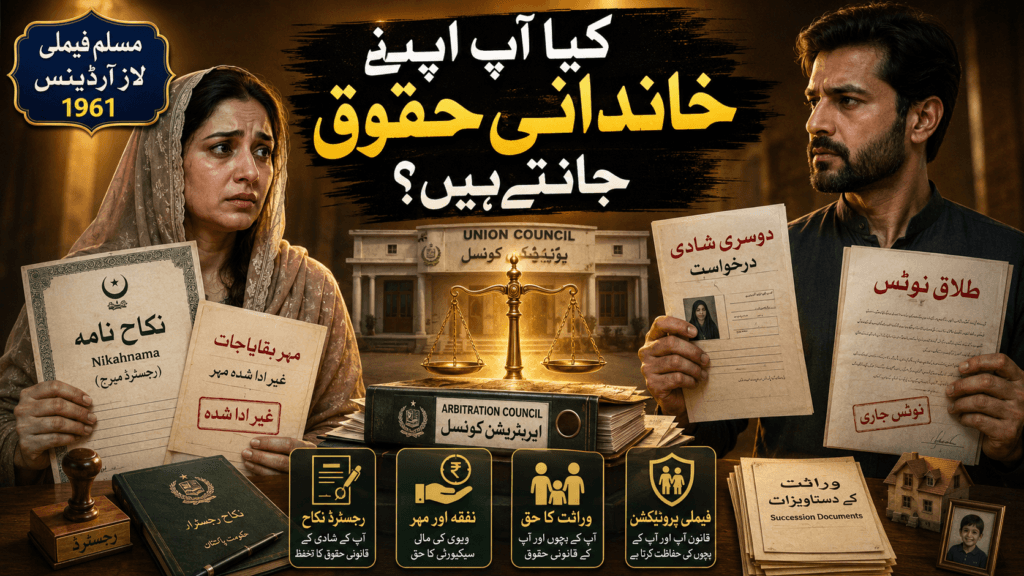
Family disputes often begin with one question: “What does the law say?” A marriage may remain unregistered, a husband may attempt a second marriage without permission, or a wife may be left without maintenance. The Muslim Family Laws Ordinance gives a legal structure for these situations.
Introduced in 1961, the Muslim Family Laws Ordinance deals with succession, marriage registration, polygamy, talaq, dissolution of marriage, maintenance, dower and rule-making. Its purpose is practical: to replace uncertainty and family pressure with records, procedures and enforceable rights.
This guide follows the official Pakistan Code text updated to 10 March 2022. Official parliamentary records also confirm that Acts XXVIII and XXIX of 2021 amended the succession and talaq provisions.
Readers may verify the complete statutory text of the Muslim Family Laws Ordinance through the official Pakistan Code website, maintained by the Ministry of Law and Justice.
Table of Contents
Why the Muslim Family Laws Ordinance Still Matters Today
The Muslim Family Laws Ordinance is not only a divorce law. It regulates important events from the registration of Nikah to the recovery of maintenance and dower. It also explains the role of the Union Council, Arbitration Council and Chairman.

Below is an easy explanation of all eleven operative sections.
Section 1: Title, Extent, Application and Commencement
Section 1 gives the law its official name. It says that it extends to the whole of Pakistan and applies to all Muslim citizens of Pakistan, wherever they may be.
The Ordinance came into force on a date appointed through a Federal Government notification. The official statutory text identifies 15 July 1961 as the commencement date in its footnote.
This wording connects the law with Muslim citizenship, not merely physical residence inside Pakistan.
Section 2: Definitions That Control the Procedure
Section 2 explains the institutions used throughout the law.
An Arbitration Council consists of the Chairman and one representative from each party. If a party does not nominate a representative within the prescribed time, the Council may still be formed without that person.
The Chairman generally means the Chairman of the Union Council or another person lawfully appointed to perform that function.
The section also defines:
- Prescribed;
- Union Council;
- Ward.
These definitions decide where notices and applications under the Muslim Family Laws Ordinance must be filed. They are especially relevant to second-marriage applications, talaq notices, reconciliation and maintenance proceedings.
Section 3: The Ordinance Overrides Conflicting Customs
Section 3 gives the Muslim Family Laws Ordinance overriding effect despite any conflicting law, custom or usage. It also requires Muslim marriages to be registered under its provisions.
The Arbitration Act, 1940, Code of Civil Procedure, 1908, and other laws regulating ordinary court procedure do not apply to an Arbitration Council.
The Council therefore follows the special procedure created by this family law instead of conducting a complete civil trial.
Section 4: Succession and Family Inheritance Rights
Section 4 is one of the most important parts of the Muslim Family Laws Ordinance.
When a son or daughter of the original deceased person dies before succession opens, the living children of that predeceased son or daughter receive, per stirpes, the share their parent would have received if alive.
In simple words, when a grandparent dies after one of their children has already died, the children of that deceased child may represent their parent.
For example, a man dies leaving two sons. One son had already died but left two children. Under Section 4, those children may jointly receive the share their father would have received if he had been alive.

Ahl-e-Tashih Widow’s Share
The updated text also contains provisions concerning Ahl-e-Tashih inheritance.
If an Ahl-e-Tashih Muslim man dies, his widow receives:
- One-fourth of the fixed price or value of immovable property where there is no child;
- One-eighth where the deceased leaves a child.
Where there are two or more widows, the relevant share is divided equally between them.
The property value is determined at the time of payment. If the legal heirs do not pay the widow, she becomes entitled to her due share in the property itself. Her right in movable property is also recognised.
Under Fiqah-e-Jafri, a husband receives one-half of his deceased wife’s property if she leaves no child and one-fourth if she leaves a child.
A dispute may be taken to a competent court or to a Mujtahid-e-Alam from the panel maintained by the Council of Islamic Ideology. Ahl-e-Tashih inheritance matters are to be decided according to their personal law interpreted through Fiqah-e-Jafria.
Section 5: Registration of Muslim Marriages
Section 5 requires every marriage solemnised under Muslim law to be registered.
Union Councils issue licences to Nikah Registrars. Where a marriage is performed by a person other than the licensed Nikah Registrar, that marriage must still be reported to the Registrar.
Failure to report the marriage may result in:
- Simple imprisonment of up to three months;
- A fine of up to one thousand rupees;
- Or both.
The prescribed rules regulate the Nikahnama form, marriage registers, record preservation, copies and fees.
A person may inspect the marriage record kept by the Union Council or obtain a copy after paying the prescribed fee.
Registration is important because the Nikahnama may later prove the marriage, dower amount, payment conditions, delegated right of divorce and other terms accepted by the parties.
Section 6: Second Marriage Requires Legal Permission
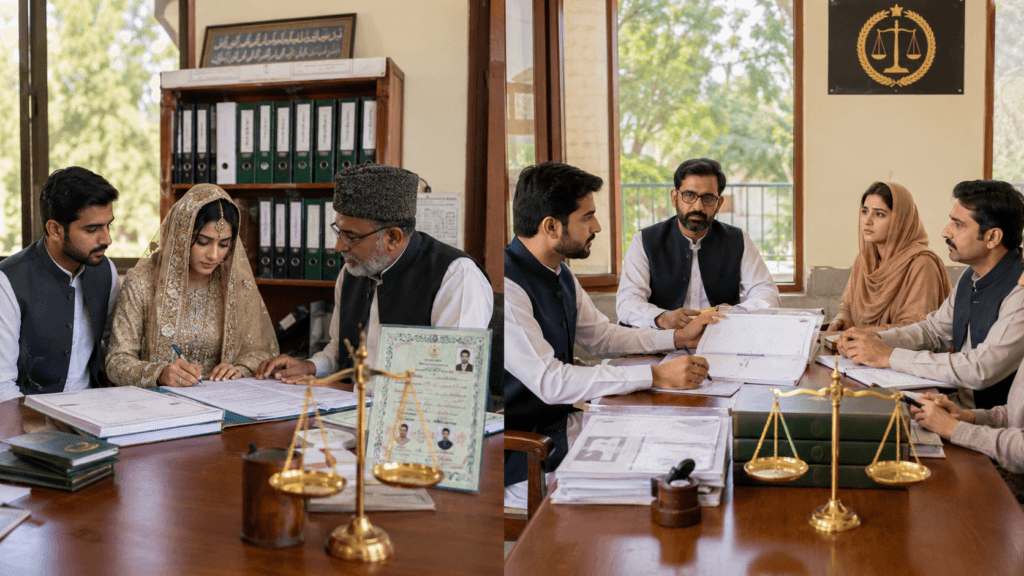
Under the Muslim Family Laws Ordinance, a man cannot contract another marriage during an existing marriage without prior written permission from the Arbitration Council.
A second marriage contracted without such permission cannot be registered under the Ordinance.
The husband must apply to the Chairman and explain:
- Why he wants to contract another marriage;
- Whether the existing wife or wives have consented;
- Why the proposed marriage should be considered necessary and just.
The Chairman asks the husband and the existing wife or wives to nominate their representatives. The Arbitration Council considers the matter and may grant permission subject to appropriate conditions.
The Council must record reasons for its decision. A dissatisfied party may file a revision before the concerned Collector in the prescribed manner.
Consequences of Marrying Without Permission
A man who contracts another marriage without the Council’s permission must immediately pay the entire prompt and deferred dower due to the existing wife or wives.
On complaint and conviction, he may also face:
- Simple imprisonment of up to one year;
- A fine of up to five thousand rupees;
- Or both.
Section 7: Talaq Notice and the Ninety-Day Rule
Section 7 of the Muslim Family Laws Ordinance creates a formal procedure for talaq.
After pronouncing talaq in any form, the husband must give written notice to the Chairman and provide a copy to the wife.
Failure to provide the required notice may result in:
- Simple imprisonment of up to one year;
- A fine of up to five thousand rupees;
- Or both.
Unless revoked earlier, talaq does not become effective until ninety days have passed from the date on which the notice was delivered to the Chairman.
Within thirty days of receiving the notice, the Chairman must form an Arbitration Council. The purpose of the Council is to attempt reconciliation between the spouses.
If the wife is pregnant, talaq becomes effective after the ninety-day period or the end of pregnancy, whichever occurs later.
The section also permits the woman to remarry the same husband without an intervening marriage unless the termination has become effective for the third time.
For a complete step-by-step explanation of the notice, reconciliation and ninety-day period, read our guide on Divorce Procedure in Pakistan

Rules for Fiqah-e-Jafria Parties
For parties belonging to Fiqah-e-Jafria, the updated text adds requirements relating to:
- Free and voluntary pronouncement;
- Pronouncement personally or through an authorised Vakil;
- Arabic seegha;
- Physical presence of at least two qualified witnesses;
- Reference of disputes to a competent court or Mujtahid-e-Alam.
The text also states that Ahl-e-Tashih divorce matters are to be decided according to their personal law.
Section 8: Dissolution Otherwise Than by Talaq
Section 8 applies where the right of divorce has been delegated to the wife. This right is commonly called talaq-e-tafweez.
It also applies where either party wants to dissolve the marriage through a method other than the husband’s talaq.
In these situations, the procedure contained in Section 7 applies with necessary changes and only to the extent that it is relevant.
A delegated right of divorce recorded in the Nikahnama therefore has real legal importance. It should not be treated as an unnecessary or meaningless entry.
Section 9: A Wife’s Right to Maintenance
If a husband fails to maintain his wife adequately, she may apply to the Chairman in addition to using any other legal remedy available to her.
Where a man has more than one wife, he is required to maintain them equitably.
The Chairman forms an Arbitration Council, which examines the matter and may issue a certificate stating the maintenance amount payable by the husband.
Either spouse may seek revision of the certificate before the concerned Collector in the prescribed manner.
If the maintenance amount is not paid on time, it may be recovered as arrears of land revenue.
The Muslim Family Laws Ordinance therefore provides an administrative route for maintenance without removing other legal remedies available to the wife.
Section 10: Dower Becomes Payable on Demand
Section 10 applies where the Nikahnama or marriage contract mentions dower but does not clearly state how or when it will be paid.
In that situation, the entire dower is treated as payable on demand.
This provision prevents vague drafting from being used against the wife. Silence about the mode of payment does not allow the husband to delay payment indefinitely.
The Nikahnama should still clearly state whether the dower is prompt, deferred, partly paid or attached to any particular property. Clear drafting can prevent future litigation.
Section 11: Power to Make Rules
Section 11 authorises the Federal Government for cantonment areas and Provincial Governments elsewhere to make rules under the Muslim Family Laws Ordinance.
These rules are made to implement the Ordinance properly.
The rules may provide punishment for their breach, including:
- Simple imprisonment of up to one month;
- A fine of up to two hundred rupees;
- Or both.
Once the rules are published in the official Gazette, they operate as if they had been enacted in the Ordinance itself.
Practical Lessons for Every Pakistani Family
The Muslim Family Laws Ordinance teaches families to register Nikah promptly, read every Nikahnama entry before signing and preserve certified copies of important documents.
A second marriage should not be treated as an entirely private decision. The legal permission process, reasons, representation of the existing wife and decision of the Arbitration Council are important.
Talaq should also not be treated as a purely verbal event. Written notice, reconciliation proceedings and the statutory period matter.
Maintenance and dower are legal rights, not family favours. Children of a predeceased son or daughter may also have a statutory succession claim.
Families should preserve:
- Certified Nikahnama;
- Union Council notices;
- Talaq notice and delivery proof;
- Arbitration Council proceedings;
- Maintenance certificate;
- Dower payment receipts;
- Marriage-registration record;
- Relevant inheritance documents.
Conclusion
The Muslim Family Laws Ordinance remains a central framework for Muslim family rights in Pakistan. It brings proof to marriage, accountability to polygamy, procedure to talaq, protection to maintenance and dower, and recognition to important succession claims.
Understanding the Muslim Family Laws Ordinance before a dispute begins can protect families from years of avoidable conflict.
Disclaimer: This article is for legal awareness only. Family and inheritance cases depend on their facts, applicable provincial or federal amendments and judicial interpretation. Consult a qualified lawyer for advice about a specific matter.
Frequently Asked Questions
What is the main purpose of the Muslim Family Laws Ordinance?
It regulates succession, Muslim marriage registration, polygamy, talaq, other forms of marital dissolution, maintenance and dower through defined legal procedures.
Is registration of a Muslim marriage compulsory?
Yes. Section 5 requires every marriage solemnised under Muslim law to be registered according to the Ordinance.
Can a husband marry again without the first wife’s consent?
Prior written permission from the Arbitration Council is legally required. The application must also disclose whether the existing wife or wives have consented. Consent and Council permission are connected but legally distinct matters.
Does oral talaq become effective immediately?
Section 7 generally requires written notice to the Chairman and the completion of a ninety-day period. Pregnancy may postpone the effective date until the pregnancy ends where that date is later.
Can grandchildren inherit through a parent who died earlier?
Yes. Section 4 allows the living children of a predeceased son or daughter to receive, per stirpes, the share their parent would have received if alive.
What happens when the Nikahnama does not state how dower will be paid?
Section 10 treats the entire dower as payable on demand.
Can a wife seek maintenance through the Union Council?
Yes. She may apply to the Chairman, who may form an Arbitration Council and issue a maintenance certificate. Other available legal remedies also remain open.