
Power of attorney law in Pakistan becomes extremely important when family land is transferred without clear proof, proper witnesses, or the real consent of the original owner. In this Lahore High Court judgment, a daughter challenged sale and gift mutations made before her father’s death through an alleged general power of attorney. The Court examined whether the attorney had lawful authority, whether witnesses were produced, whether revenue officials were brought to court, and whether property could be transferred to a real brother without specific permission. This judgment is a powerful warning: fraud, weak evidence, and family pressure cannot defeat inheritance rights.
| Judgment at a Glance: Power of Attorney Dispute in Pakistan | |||
| Citation | 2026MLD320 Lahore | General Power of Attorney Law in Pakistan | |
| Court / Forum | Lahore High Court, Punjab | ||
| Hon’ble Judges | Justice Ch. Muhammad Iqbal | ||
| Petitioner | Respondent | ||
| Muhammad Mansha and 5 others | Saleem Bibi | ||
| Judgment Author | Justice Ch. Muhammad Iqbal | ||
| Final Decision | Civil revision dismissed; appellate court decree in favour of Saleem Bibi maintained. | ||
Table of Contents
Why This Judgment Matters for Families Using a Power of Attorney
Property disputes in Pakistan often begin after the death of a father. When heirs go to the revenue office for inheritance mutation, they sometimes discover that land has already been transferred through sale, gift, or power of attorney.
This judgment matters because it explains how courts examine such transfers. A general power of attorney is not a magic paper. It must be validly executed, properly proved, and lawfully used.
The case is especially important because the alleged attorney transferred property to his real brother. The Lahore High Court clearly held that an attorney does not have absolute power to sell, exchange, or transfer the principal’s property to his own close relative without explicit and clear permission from the principal.
For ordinary citizens, this judgment gives a strong lesson about power of attorney law in Pakistan: when property and inheritance are involved, every document must stand on lawful proof.
Background of the Case
The dispute started from the estate of Ghulam Nabi, who owned land in three Mauzajat: Karak, Hardo Kalleywala, and Kotli Mango, situated in Tehsil Noshehra Virkan, District Gujranwala.
Ghulam Nabi had contracted two marriages. His first wife was Mst. Sardaran Bibi. From this marriage, Muhammad Mansha and Saleem Bibi were born. His second wife was Mst. Nazar Begum, and petitioners Nos. 2 to 5 were born from that marriage.
Ghulam Nabi died on 11 March 2006. After his death, the husband of Saleem Bibi contacted the concerned revenue official for sanctioning inheritance mutation. At that stage, it was discovered that before Ghulam Nabi’s death, some land had already been transferred through sale and gift mutations.
This discovery became the foundation of the litigation.

What Saleem Bibi Challenged
Saleem Bibi challenged the transactions through a suit for declaration and cancellation. She alleged that her father Ghulam Nabi had been seriously ill for four to five years before his death. According to her, he was not mentally stable and was not in a position to record any statement for transfer of land.
The disputed transactions included sale mutations executed by Muhammad Sharif, who claimed to be the general attorney of his father Ghulam Nabi. The sale mutations were made in favour of Saifullah, who was Muhammad Sharif’s real brother.
The judgment mentions sale mutation No. 215 dated 22 February 2006 for land measuring 14 Kanal 17 Marla in Moza Kotli Mansu, and sale mutation No. 448 dated 22 February 2006 for land measuring 83 Kanal 14 Marla in Moza Hardo Kalleywala. The judgment also discusses a gift mutation dated 24 April 2000 involving land measuring 192 Kanal.
In simple words, Saleem Bibi said these transactions were not valid and affected her inheritance rights.
What Happened Before the Trial Court and Appellate Court
The trial court framed several issues, including whether the mutations were against law and facts, whether the plaintiff was entitled to declaration, and whether power of attorney No. 210 was bogus and ineffective.
After recording evidence, the trial court dismissed Saleem Bibi’s suit on 13 March 2010.
Saleem Bibi filed an appeal. The learned Additional District Judge, Gujranwala accepted the appeal on 17 May 2014, set aside the trial court judgment, and decreed the suit in favour of Saleem Bibi.
The petitioners then filed a civil revision before the Lahore High Court. The Lahore High Court examined the whole record and dismissed the revision.
This is why the judgment is important for power of attorney law in Pakistan and inheritance litigation.
Main Legal Issues Before the Lahore High Court
The Lahore High Court had to decide several important questions.
First, whether the alleged general power of attorney was validly executed and proved.
Second, whether the sale and gift mutations were legally valid.
Third, whether the petitioners produced the best evidence, including the Sub-Registrar, Patwari, Tehsildar, and attesting witnesses.
Fourth, whether an attorney can transfer the principal’s property to his own real brother without explicit permission.
Fifth, whether fraud and misrepresentation destroyed the entire foundation of the transactions.
Sixth, whether the appellate court judgment should be preferred over the trial court judgment.
These issues make the case highly relevant for anyone studying power of attorney law in Pakistan.
Arguments of the Petitioners’ Lawyers
The petitioners were represented by Muhammad Ahsan Bhoon, Khalid Pervez Warraich, and Rana Abdul Sattar Khan.
The judgment does not record their arguments in long separate detail. However, from the available record, their position was clear. They relied on the alleged general power of attorney and the subsequent sale and gift mutations.
Their stance was that Ghulam Nabi had appointed Muhammad Sharif as his general attorney. Muhammad Sharif, as attorney, then transferred land in favour of Saifullah. They also defended the gift mutation and challenged the appellate court decree.
In simple words, the petitioners wanted the Lahore High Court to restore the trial court judgment and set aside the appellate court decree in favour of Saleem Bibi.
Arguments of the Respondent’s Lawyer
The respondent Saleem Bibi was represented by Muqtadar Akhtar Shabbir.
The respondent’s case was that her father Ghulam Nabi had not executed any valid general power of attorney. She also challenged the mutations and claimed that the transactions were bogus, fraudulent, and ineffective against her inheritance rights.
Saleem Bibi appeared as P.W.1 and stated that her father was about 100 years old at the time of death, his health condition was very bad, and he had never executed any general power of attorney, gift, or sale of land. Her witness Amanat Ali P.W.2 supported her case.
The Lahore High Court noted that the respondent produced trustworthy and reliable oral and documentary evidence. Despite lengthy cross-examination, her position was not shaken.
The Burden Shifted to the Petitioners
One important point in this judgment is the shifting of burden. At first, Saleem Bibi had to prove her case. The Court found that she produced reliable evidence.
After that, the burden shifted to the petitioners. They had to prove the valid execution of the alleged general power of attorney, the gift mutation, and sale mutations.
This is a very important rule in power of attorney law in Pakistan. The beneficiary of a power of attorney cannot simply rely on the document. When the document is challenged, the beneficiary must prove its validity according to law.
Why the General Power of Attorney Failed
The whole case depended on the alleged general power of attorney. The Court said the entire lis hinged upon the proof and validity of that document.
The petitioners were required to prove the execution of the power of attorney by producing the Sub-Registrar who registered the document. But the Sub-Registrar was not produced.
The Patwari and Tehsildar who entered and sanctioned the sale and gift mutations were also not produced. The petitioners also failed to produce any attesting witness of the gift mutation.
The Court held that non-production of these material witnesses amounted to withholding the best evidence. Under Article 129(g) of the Qanun-e-Shahadat Order, 1984, the Court could presume that if these witnesses had been produced, they would have gone against the petitioners.
This was a serious blow to their case.

Why Two Attesting Witnesses Were Important
The alleged general power of attorney showed only one marginal witness, Farooq Ahmad. But under Article 17 of the Qanun-e-Shahadat Order, 1984, such a document must be attested by at least two witnesses.
The Court also referred to Article 79, which requires attesting witnesses to testify when execution is disputed.
Because the second marginal witness was not established, the Lahore High Court held that there was blatant non-compliance with the mandatory law. The petitioners failed to prove valid execution of the document.
This is a key legal lesson. In power of attorney law in Pakistan, attestation and proof are not formalities. They can decide the entire case.
For evidence rules, readers may also study the Qanun-e-Shahadat Order, 1984.
What If One Witness Had Died?
The petitioners took the position that one witness, Haji Ilyas, had passed away. But the Court held that even then, the petitioners did not make any effort to prove the alleged power of attorney through the mode prescribed under Article 80 of the Qanun-e-Shahadat Order, 1984.
This point is important for lawyers and students. If an attesting witness is dead or unavailable, the law provides a method for proving the document. But the party relying on the document must follow that method.
The petitioners failed to do so. Therefore, their document remained legally unproved.
Fraud Destroyed the Whole Foundation
The Lahore High Court also held that the alleged general power of attorney was based on fraud and misrepresentation. Therefore, any subsequent transaction made on the basis of that document had no validity.
The Court used a strong legal principle: fraud vitiates the most solemn proceedings. It means that if the foundation is fraudulent, the entire structure built on it collapses.
This is very important for ordinary citizens. If a power of attorney is fraudulent, then sale mutation, gift mutation, or any benefit taken through it cannot become valid only because it was entered in revenue record.
A fraudulent document cannot create lawful rights.
Attorney Selling Property to His Real Brother
One of the strongest parts of this judgment is about an attorney transferring property to his close relative.
Muhammad Sharif, the alleged attorney, transferred land in favour of his real brother Saifullah. The Court held that an attorney does not enjoy absolute power to sell, exchange, or dispose of the principal’s property to his own close relative.
For such transfer, the attorney must obtain explicit and unequivocal permission from the principal.
In this case, no such specific permission from Ghulam Nabi was proved. Therefore, the alienation was held to be illegal and against settled law.
This makes the judgment very valuable for power of attorney law in Pakistan, especially in family property cases.
For further reading, citizens may study the Contract Act, 1872 to understand an attorney’s legal duty toward the principal.
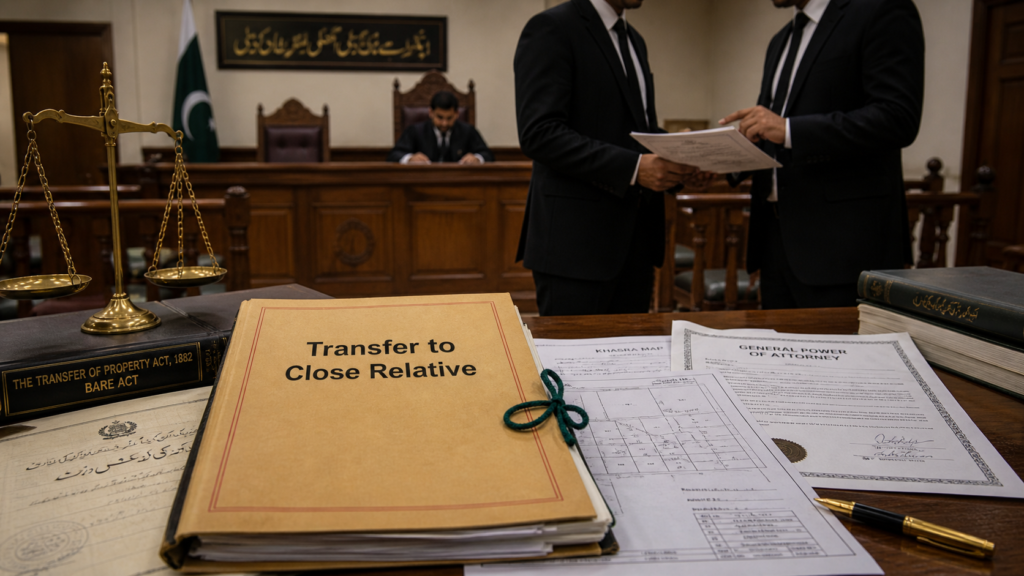
Mutation Is Not Enough Without Proof
Many people in Pakistan think that once a mutation is entered, the matter is finished. This judgment shows that a mutation can be challenged when the foundation behind it is weak, fraudulent, or unproved.
The Patwari and Tehsildar who entered and sanctioned the mutations were not produced. This damaged the petitioners’ defence.
A mutation is not stronger than the law. If the power of attorney is not proved, and the revenue officials are not produced, the mutation may fail.
For citizens, the lesson is simple: revenue entries must be backed by valid documents, proper witnesses, and lawful authority.
Why the Appellate Court Judgment Was Preferred
There was a conflict between the trial court and appellate court. The trial court had dismissed Saleem Bibi’s suit. The appellate court had accepted her appeal and decreed the suit.
The Lahore High Court held that where there is conflict between trial court and appellate court judgments, the findings of the appellate court are to be preferred and respected, unless those findings are not supported by evidence.
In this case, the appellate court had discussed the facts and evidence in a well-reasoned manner. Therefore, the Lahore High Court maintained the appellate court judgment.
Final Decision of the Lahore High Court
The Lahore High Court dismissed the civil revision because it had no merit.
The result was that the appellate court judgment and decree in favour of Saleem Bibi remained intact.
In simple words, the petitioners failed to prove the alleged general power of attorney and the transactions made on its basis. The Court protected the respondent’s inheritance rights and refused to validate weak, fraudulent, and unproved transactions.
This decision is an important guide on power of attorney law in Pakistan for families, lawyers, revenue officials, and law students.
Practical Lessons for Pakistani Citizens
Before relying on any general power of attorney, citizens should understand the requirements of power of attorney law in Pakistan.
A power of attorney must be properly executed and proved.
If a document requires two attesting witnesses, one witness is not enough.
If witnesses are not produced, the court may presume that their evidence would have gone against the party withholding them.
If a Sub-Registrar, Patwari, or Tehsildar is material to the case, their non-production can seriously damage the claim.
An attorney cannot freely transfer the principal’s property to his own real brother or close relative without clear permission.
Fraud destroys the entire transaction.
Mutation alone does not prove ownership.
Inheritance rights can be protected where suspicious transfers are made before death.
You may also read our detailed article on gift deed in Pakistan to understand how courts examine Hiba, possession, and property transfer disputes.
Key Takeaways
- Power of attorney law in Pakistan requires proper proof of execution.
- The beneficiary of a power of attorney must prove its validity.
- Two attesting witnesses are mandatory where the law requires attestation.
- Non-production of material witnesses may lead to adverse presumption.
- Fraud destroys even solemn proceedings.
- An attorney cannot transfer property to his close relative without explicit permission.
- Revenue mutation is not enough if the foundation document is not proved.
- Appellate court findings are preferred where they are supported by evidence.
- Inheritance rights cannot be defeated through weak or fraudulent documents.
- The Lahore High Court dismissed the civil revision.
Conclusion
This Lahore High Court judgment is a strong reminder that family property cannot be shifted through doubtful documents, weak mutations, or fraudulent use of authority.
The case shows that power of attorney law in Pakistan protects principals, heirs, and vulnerable family members from misuse of authority. If an attorney transfers land to his own close relative without clear permission, and if the power of attorney itself is not proved through legal evidence, courts can reject the whole transaction.
For ordinary citizens, the message is clear: before accepting any power of attorney, sale mutation, or gift mutation, check the document, witnesses, authority, and purpose. Property rights should never rest on fraud.
Disclaimer
This article is for legal awareness and educational purposes only. It is not professional legal advice. For any personal legal matter, readers should consult a qualified lawyer.
FAQs
What was the main issue in 2026 MLD 320 Lahore?
The main issue was whether the alleged general power of attorney and the sale and gift mutations based on it were valid against Saleem Bibi’s inheritance rights.
What is power of attorney law in Pakistan?
Power of attorney law in Pakistan deals with the authority given by one person to another to act on his behalf, especially in property, sale, mutation, and legal matters.
Can an attorney sell property to his real brother?
An attorney cannot sell or transfer the principal’s property to his close relative unless he has explicit and clear permission from the principal.
Why did the Lahore High Court reject the power of attorney?
The Court found that the power of attorney was not proved according to law, material witnesses were not produced, and the document was based on fraud and misrepresentation.
Are two witnesses required for power of attorney?
Where the law requires attestation, two attesting witnesses are necessary. The Court referred to Article 17 and Article 79 of the Qanun-e-Shahadat Order, 1984.
What happens if material witnesses are not produced?
The court may presume under Article 129(g) that if those witnesses had been produced, they would have gone against the party withholding them.
Is mutation proof of ownership in Pakistan?
Mutation is not enough by itself. If the underlying document or transaction is not proved, the mutation may fail.
What did the Court say about fraud?
The Court repeated that fraud vitiates the most solemn proceedings and any transaction built on fraud automatically collapses.
Why was the appellate court judgment maintained?
The appellate court had properly discussed the facts and evidence. The Lahore High Court held that appellate findings should be preferred when supported by evidence.
What was the final decision?
The Lahore High Court dismissed the civil revision and maintained the appellate court decree in favour of Saleem Bibi.