
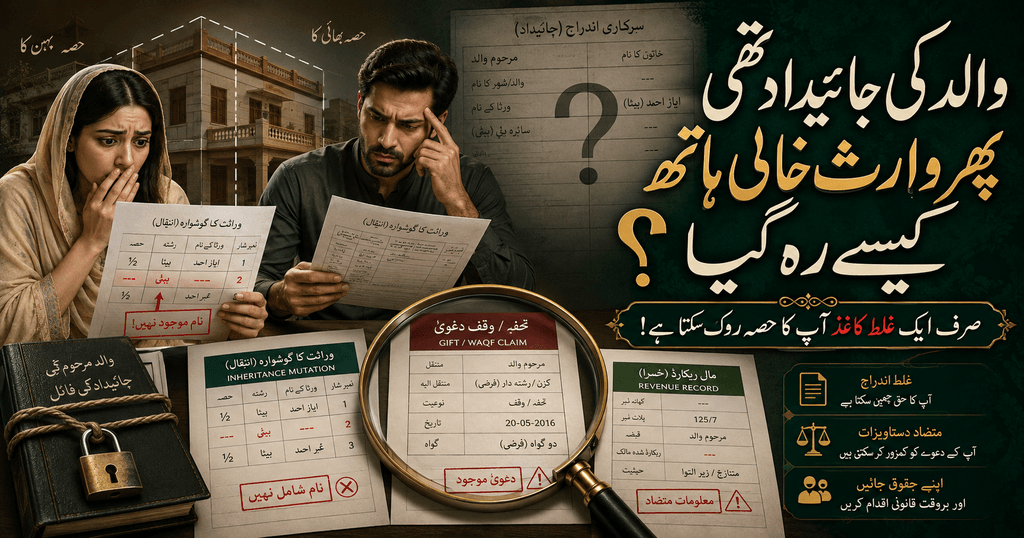
A person dies, leaving behind a house, agricultural land, a plot or other assets. Within days, questions begin. Who actually owns the property now? Which family members are legal heirs? Does the eldest son control everything? Can a daughter be left out because she is married? Is an old mutation enough to prove ownership? And what happens when someone suddenly produces a gift deed, will or waqf document?
These questions make Property Inheritance much more than a simple calculation of shares. A family may correctly identify all heirs yet still lose years in litigation because the title record, mutation, possession or lifetime transactions were never checked. This guide explains the complete journey—from death and identification of heirs to succession documents, mutation, partition, disputes and the Supreme Court’s important ruling in PLD 2026 SC 283.
Table of Contents
Property Inheritance in Pakistan — The Quick Answer
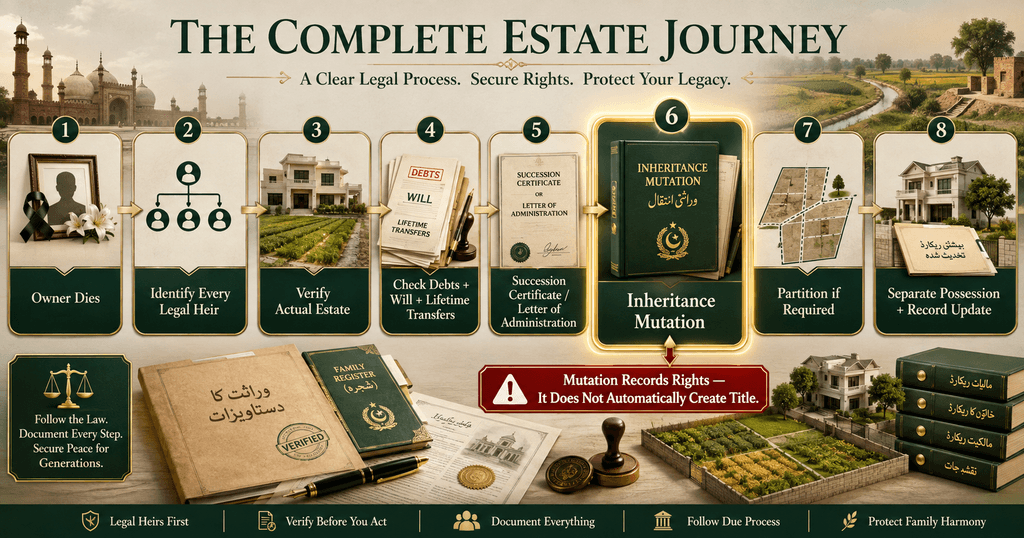
Property Inheritance ordinarily opens when the owner dies. At that point, the estate must first be identified and the persons legally entitled to inherit must be determined under the law applicable to the deceased.
But one distinction is critical:
The inheritance right and the later entry of that right in Government records are not the same thing.
A mutation may record an inheritance right, but it does not create that right from nothing. This principle is particularly important where a daughter, widow or another heir was omitted from old revenue entries. Our detailed discussion of Inheritance Mutation in Pakistan explains how the Supreme Court treated mutation as a revenue record rather than an independent source of title.
Property Inheritance also does not mean that every asset appearing in the deceased’s possession automatically becomes part of the estate. Before distribution, the family should establish what the deceased legally owned, whether the property was joint, whether any lawful lifetime transfer had already taken place, and whether the asset was subject to a mortgage or another enforceable liability.
What Does Property Inheritance Actually Mean?
Property Inheritance is the legal devolution of a deceased person’s estate upon the persons entitled to succeed to it.
The estate may contain:
- A residential house
- Agricultural land
- Commercial property
- Plots or housing-society files
- Bank balances
- Investments
- Vehicles
- Business interests
- Rent receivables
- Other movable or immovable assets
The first question should therefore not be:
“How much does each heir get?”
The first question is:
“What did the deceased actually own when succession opened?”
That single question can prevent a major mistake.
Inheritance Does Not Operate During the Owner’s Lifetime
No person inherits the property of somebody who is still alive.
A father may own a house. His children may expect to inherit it one day, but during his lifetime it remains his property unless some independent legal right exists.
If the owner validly sells, gifts or otherwise transfers an asset during his lifetime, that transaction must be examined separately. Property Inheritance generally operates upon the estate that legally remains when the owner dies.
Property Inheritance Is Not the Same as Gift, Sale, Will or Waqf
Families frequently mix these concepts.
| Legal Concept | Basic Nature | Usually Operates |
|---|---|---|
| Inheritance | Devolution of estate after death | On death |
| Gift / Hiba | Lifetime transfer without sale consideration | During donor’s life |
| Sale | Transfer for consideration | During lifetime |
| Will | Testamentary disposition | After death |
| Waqf | Dedication of property for a recognized purpose | Subject to valid creation |
If another person says that inherited property was already gifted during the deceased’s lifetime, the issue is no longer merely “who are the heirs?”
The alleged gift itself may need proof.
For that reason, anyone facing a gift claim should also understand the principles discussed in our Gift Deed in Pakistan guide, where the evidentiary requirements behind a claimed property gift are explained.
Likewise, a will can create a different dispute from inheritance. Our guide on a Will in Pakistan explains why the legal effect of testamentary conditions must be examined under the law applicable to the estate.
Which Law Governs Property Inheritance in Pakistan?
There is no legally safe “one chart fits every family” rule.
Property Inheritance can depend on:
- Religion of the deceased
- Applicable personal law
- Sect in relevant Muslim-law questions
- Complete family structure
- Whether a child predeceased the deceased
- Province or territory
- Type of property
- Nature of the dispute
- Previous transfers or litigation
For Muslim estates, inheritance is generally determined under Muslim personal law as applicable in Pakistan together with relevant statutory provisions.
One important statutory provision is section 4 of the Muslim Family Laws Ordinance, 1961.
The official Muslim Family Laws Ordinance, 1961 provides that where a son or daughter of the propositus dies before succession opens, the children of that predeceased son or daughter who are alive when succession opens receive, per stirpes, the share their parent would have received if alive.
That is one reason an inheritance calculator cannot safely work from the words “two sons and one daughter” without first obtaining the entire family tree.
Sunni and Shia Rules Should Not Be Mixed
Differences can arise between schools of Muslim inheritance law.
A share chart prepared without identifying the applicable law can therefore produce a wrong result.
Similarly, a non-Muslim estate should not simply be processed by copying Muslim inheritance shares from an online article.
Property Inheritance should always begin with the law actually applicable to the deceased.
Who Is a Legal Heir?
Common heirs in Muslim estates may include, depending on the family structure:
- Husband
- Wife
- Son
- Daughter
- Father
- Mother
- Grandchildren in legally relevant circumstances
- Brothers or sisters in some combinations
- Other relatives where nearer heirs do not exclude them
But the presence of one heir can change the entitlement of another.
That is why the statement:
“Every male receives twice every female”
is misleading when presented as a universal formula.
Is a Daughter’s Share Always Half of a Son’s?
No.
Where a son and daughter inherit together in a situation to which the familiar 2:1 rule applies, the son may receive twice the daughter’s share.
But that does not mean every woman in every Property Inheritance case receives half of every man.
A mother, wife, daughter or sister may inherit under different rules depending on the relatives surviving the deceased.
What About a Predeceased Son or Daughter?
Section 4 of the Muslim Family Laws Ordinance, 1961 is particularly important in Pakistan where a son or daughter died before the person whose estate later opens.
The provision specifically addresses the living children of that predeceased son or daughter.
Never remove a branch of the family tree merely because its parent died earlier without first checking the applicable law.
What Must Be Checked Before Property Inheritance Is Divided?
Many family disputes begin because the property is divided before the estate itself is audited.
A safer approach is:
- Identify the deceased’s assets.
- Separate personally owned assets from joint assets.
- Identify legally enforceable liabilities.
- Examine any will.
- Examine any claimed lifetime transfer.
- Determine all legal heirs.
- Calculate the net distributable estate.
For Muslim estates, lawful liabilities and valid testamentary arrangements must be dealt with before the remaining estate is distributed among heirs according to the applicable rules.
The safest practice is therefore to prepare an estate inventory before anyone starts marking rooms, fields or plots as “my share.”
Property Inheritance Process in Pakistan — Step by Step
Administrative procedure matters because a legal right eventually has to be reflected in documentary records.
Step 1: Obtain the Death Certificate
Secure the official death record of the deceased.
Check the name, identity details and date carefully. Even small differences in official records can create problems later.
Step 2: Verify the Complete Family
Obtain relevant NADRA family information and identity documents.
Do not rely only on what one relative says.
Specifically check for:
- Married daughters
- Widows
- Elderly parents
- Minor children
- Overseas heirs
- Children of a predeceased son or daughter
- Any disputed family relationship
Step 3: Make a Complete Asset List
For Property Inheritance involving land or a house, collect the title chain.
Depending on the property, this may include:
- Registered deed
- Fard
- Jamabandi
- Previous mutations
- Allotment letter
- Housing-society record
- Lease
- Transfer letter
- Possession documents
For movable assets, also check banks, securities, investments, vehicles and other assets.
Step 4: Check Whether the Property Was Previously Transferred
Do not assume that the last physical possession tells the complete story.
Look for:
- Gift deed
- Gift mutation
- Sale deed
- Waqf deed
- Relinquishment deed
- Family settlement
- Power of attorney transactions
- Court decrees
- Previous partition
Where a suspicious gift mutation appears, our Civil Suit for Declaration guide explains why courts look behind the mutation to the actual underlying transaction.
Step 5: Succession Certificate or Letter of Administration
The distinction between movable and immovable assets is important.
NADRA currently provides a succession service under the applicable federal or provincial framework. Its official information explains the procedure concerning Succession Certificates and Letters of Administration and requires relevant information about the deceased, legal heirs and assets. See the official NADRA Succession Certificate service.
This document-processing stage should not be confused with the final adjudication of a serious disputed title.
Step 6: Punjab’s Important 2025 Change
This is one of the most important current updates for readers in Punjab.
The Punjab Letters of Administration and Succession Certificates (Amendment) Act 2025, Act LXII of 2025, came into force on 31 July 2025.
The amendment inserted the words “or a civil court” after “Authority” in section 3 and provided that a civil court follows the procedure under the Succession Act, 1925. Section 10 of the 2021 Act was also omitted.
The amendment is listed in the official Punjab Code 2025 legislation record.
This means older online statements suggesting that every Punjab claimant must first obtain a NADRA decline certificate before approaching a civil court should not be repeated as a universal current rule.
Province matters.
For example, the Peshawar High Court in May 2026 dealt with the Khyber Pakhtunkhwa statutory framework and expressly noted Punjab’s different 2025 amendment.
Is Inheritance Mutation Proof of Ownership?
This is one of the most misunderstood Property Inheritance questions.
A mutation is important because it updates the revenue record. But courts have repeatedly treated mutation as a fiscal/revenue entry and not as an instrument that creates title independently of the real transaction.
That distinction matters in two opposite situations.
Situation 1: A Genuine Heir Is Missing
Suppose a father dies leaving two sons and a daughter.
The mutation is entered only in the names of the sons.
The daughter’s omission does not automatically prove that she never inherited.
This precise problem is examined in our detailed article on Inheritance Mutation in Pakistan.
Situation 2: A Suspicious Mutation Is Used to Support a Gift
Suppose the revenue record says a woman gifted her inherited land to someone.
The beneficiary cannot always end the dispute by saying:
“My name is already in the mutation.”
The underlying gift may still require proof.
The Supreme Court approach discussed in our Civil Suit for Declaration article is particularly useful here.
Property Inheritance litigation therefore requires examination of the source of title—not merely the last name appearing in a revenue column.
Mutation, Succession Certificate and Partition Are Not the Same Thing
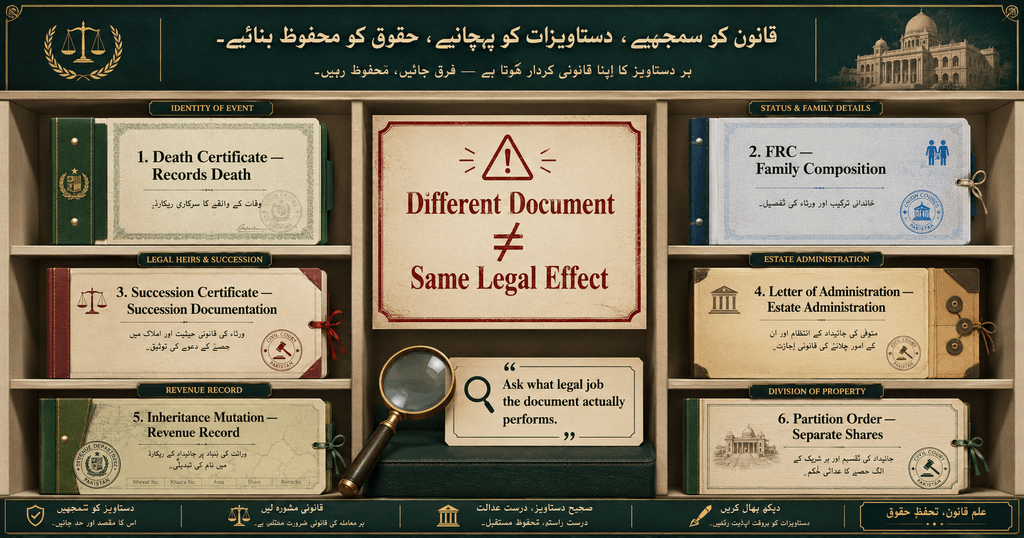
| Document / Proceeding | Primary Function | Does It Automatically Decide Every Title Dispute? |
|---|---|---|
| Death Certificate | Records death | No |
| Family Record / FRC | Helps identify recorded family composition | No |
| Succession Certificate | Succession documentation, commonly linked with movable assets | No |
| Letter of Administration | Administration/succession documentation concerning estate, commonly immovable property | No |
| Inheritance Mutation | Updates revenue record | No |
| Partition | Separates joint interests | Only within its legal scope |
| Declaration Decree | Determines asserted legal rights in a civil dispute | According to decree and issues decided |
A family can complete inheritance mutation and still remain co-owners.
If heirs want separately identifiable portions, partition may become necessary.
Our guide on Partition of Inherited Land in Pakistan explains why one co-heir’s physical occupation of a particular portion does not automatically establish exclusive ownership of that exact portion.
When Does Property Inheritance Become a Serious Title Dispute?
A normal succession matter becomes more complicated when someone says:
- “The deceased gifted this property before death.”
- “There was a waqf.”
- “I bought it years ago.”
- “She relinquished her share.”
- “The mutation proves it belongs to me.”
- “The deceased left a will.”
- “The Government owns it.”
- “The claimant waited too long.”
At that stage, Property Inheritance may overlap with evidence law, limitation, civil procedure, revenue law and property law.
Alleged Gift
Ask:
- Who was the donor?
- Did the donor own the property?
- When was the gift made?
- What exactly was gifted?
- Was acceptance proved?
- Was possession transferred where legally required?
- Who witnessed the transaction?
- Does the surrounding evidence support it?
Alleged Waqf
A waqf claim can be particularly important because a valid dedication may affect whether an asset remained part of the estate.
But a court must decide that issue on pleadings and evidence.
A piece of paper bearing the word “waqf” does not eliminate the need for legal proof.
Forged Transfer
Where forgery is alleged, obtain certified records immediately.
Possible evidence may include:
- Mutation proceedings
- Registered instrument
- Roznamcha entry
- Thumb impressions
- Signatures
- Witness statements
- Revenue-officer record
- Consideration trail
- Possession history
Third-Party Purchaser
Once inherited property has passed to a third party, the litigation can become materially more difficult.
Dates, notice, possession, nature of transfer and purchaser’s rights may become important.
Delay and Limitation
Never assume that inheritance can be challenged “at any time forever.”
Equally, never assume that an old mutation automatically defeats every inheritance claim.
The answer can depend on knowledge, denial of right, acquiescence, third-party rights and the particular cause of action.
For the risks of sleeping over an old claim, see our detailed analysis of Limitation in Inheritance Cases in Pakistan.
PLD 2026 Supreme Court 283 — Why This Property Inheritance Case Matters
PLD 2026 Supreme Court 283 involved an inheritance-based title claim, but this judgment must be described carefully.
The plaintiffs had filed a suit claiming ownership of a house through inheritance. The opposing side relied upon an alleged waqf deed.
The Trial Court dismissed the suit, and the dismissal was maintained in appeal and revision because neither side established its respective title or claim.
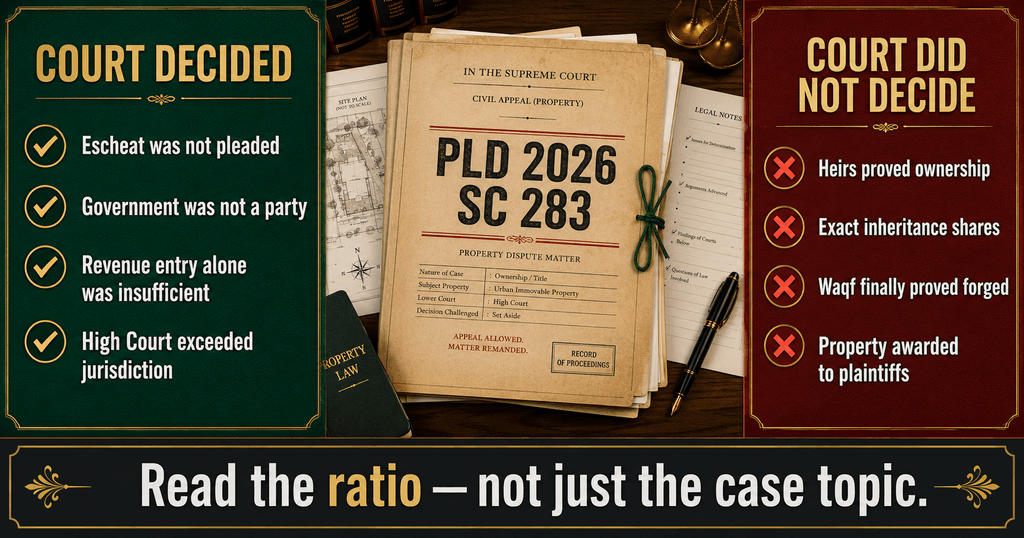
The Supreme Court did not finally decide:
- the plaintiffs’ inheritance shares;
- that the plaintiffs had established ownership;
- that the alleged waqf deed was forged; or
- that the house must be delivered to the claimed heirs.
The actual Supreme Court issue was narrower—and legally important.
Judgment at a Glance
| Point | Position |
|---|---|
| Citation | PLD 2026 Supreme Court 283 |
| Court | Supreme Court of Pakistan |
| Judges | Shahid Bilal Hassan and Shakeel Ahmad, JJ. |
| Decision Date | 15 January 2026 |
| Plaintiffs’ Claim | Ownership through inheritance |
| Defendants’ Competing Claim | Alleged waqf deed |
| High Court’s Additional Finding | Property treated as escheat; Government directed to take possession |
| Supreme Court Question | Could High Court introduce escheat without pleadings, issue, evidence or Government as party? |
| Supreme Court Answer | No |
| Final Effect | Escheat declaration removed; dismissal of suit remained intact |
The reported facts show that the plaintiffs said the house had been jointly owned by Mst. Bismillah Begum and her mother, Mst. Hakeeman. After Bismillah Begum’s death, an inheritance claim was asserted, while the defendants relied upon an alleged waqf deed.
IRAC — PLD 2026 Supreme Court 283
| IRAC | Legal Position |
|---|---|
| Issue | Could the High Court suo motu declare the disputed property escheat and order Government possession when escheat had not been pleaded, framed as an issue or supported by evidence and Government was not a party? |
| Rule | Courts decide the controversy placed before them. An escheat determination requires the necessary legal foundation and cannot simply be inserted as a new third case into a private title dispute. |
| Analysis | The litigation remained between private parties: one claimed through inheritance and the other through an alleged waqf. No party pleaded escheat. No issue was framed on it. No evidence established its foundational requirements, and Government was absent from the litigation. |
| Conclusion | The High Court exceeded its jurisdiction. The Supreme Court removed the escheat finding and Government-possession direction, while leaving the dismissal of the private title suit intact. |
The Supreme Court observed that the entire controversy had remained a title contest between the private parties. It explained that escheat was a distinct legal concept and that the foundational facts required for it had not been established through proper independent proceedings.
What the Supreme Court Decided — and What It Did Not
This table prevents one of the biggest errors in reporting Property Inheritance judgments.
| Supreme Court Decided | Supreme Court Did Not Decide |
|---|---|
| High Court travelled beyond the pleadings | Plaintiffs proved ownership |
| Escheat was never properly in issue | Plaintiffs were entitled to possession |
| Government was not a party | Exact shares of individual heirs |
| Government entry alone could not justify escheat | Alleged waqf deed was finally forged |
| Escheat direction had to be removed | One private side had proved better title |
| Suit dismissal would remain | Property had been awarded to heirs |
The Court expressly held that the Government’s name appearing in the revenue record could not by itself justify the declaration of escheat.
The appeals were partially allowed only to the extent of setting aside the escheat observations and Government-possession direction. The original dismissal because neither side proved its title or claim remained intact.
That is the correct legal takeaway.
Can Property Go to the Government When No Heir Exists?
Yes, Pakistani law recognizes the concept of ownerless property.
Article 172(1) of the Constitution provides, in substance, that property having no rightful owner vests in the Government of the Province where it is located, and otherwise in the Federal Government.
But PLD 2026 Supreme Court 283 shows why that conclusion cannot be reached casually.
The Supreme Court explained in this case that State vesting on the basis of escheat required foundational facts—such as intestate death and absence of a legal heir—to be established through proper and independent proceedings.
Therefore:
Failure of two private claimants to prove title does not automatically equal proof that the Government owns the property.
That distinction makes the judgment valuable to a broad Property Inheritance guide even though the Court did not calculate inheritance shares.
Women’s Property Inheritance Rights
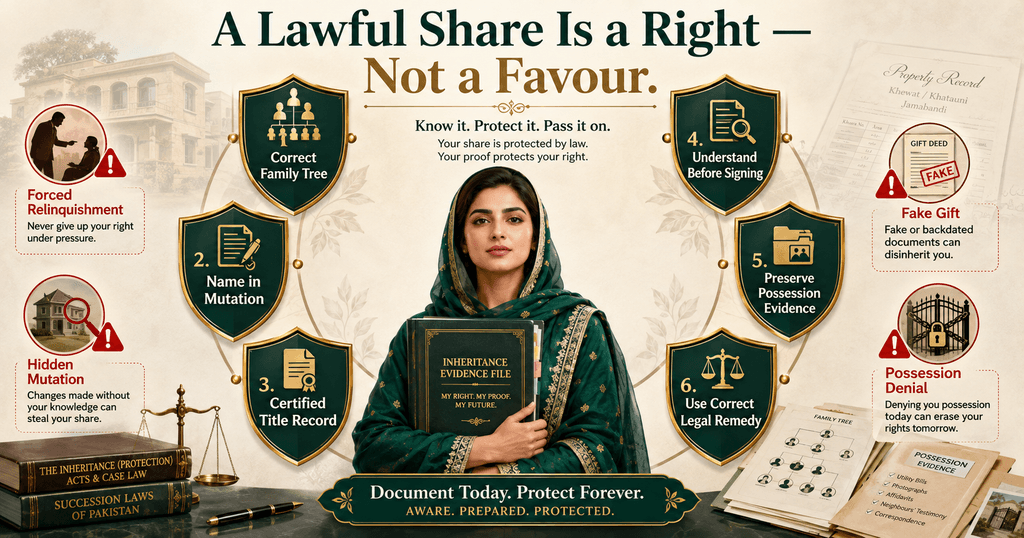
A woman does not receive an inheritance share because her brothers are generous.
If she is a lawful heir, her entitlement arises from law.
Common ways women may be deprived include:
- Omitting a daughter from inheritance mutation
- Keeping a widow out of possession
- Concealing the death or property record
- Pressuring a sister into signing a release
- Taking thumb impressions on unexplained papers
- Claiming she received “dowry instead”
- Producing a suspicious oral gift
- Keeping rental income from her
- Telling her that marriage ended her inheritance rights
Our broader collection on women’s legal and inheritance rights contains judgments examining several such patterns.
Section 498A PPC
Pakistan’s criminal law also addresses deprivation of women from inheritance.
Section 498A of the Pakistan Penal Code criminalizes deprivation of a woman from inheriting movable or immovable property through deceitful or illegal means at the opening of succession.
The current statutory text provides for imprisonment that may extend to ten years but shall not be less than five years, or a fine of one million rupees, or both. See the relevant provision through .
Criminal liability, however, depends on the legal ingredients and evidence of the particular case. A family disagreement should not automatically be labelled a criminal offence without examining those ingredients.
Punjab Enforcement of Women’s Property Rights Act 2021
Punjab also has a special statutory mechanism.
The Punjab Enforcement of Women’s Property Rights Act 2021 is listed in the official Punjab Code property laws.
The legislation provides an Ombudsperson mechanism and addresses restoration of ownership or possession where a woman has been illegally deprived, while matters requiring detailed evidence or intricate adjudication may be referred to the competent civil court.
Property Inheritance disputes involving women should therefore be assessed not only as family disagreements but also against the statutory remedies actually available.
Can a Sister Be Forced to Relinquish Her Share?
A lawful inheritance share should not be treated as something a woman must surrender simply because brothers demand it.
A genuine release, relinquishment, settlement or transfer is a separate legal transaction and may require scrutiny of:
- Identity
- Free consent
- Understanding
- Property description
- Nature of the right surrendered
- Legal formalities
- Registration where required
- Consideration where relevant
- Evidence surrounding execution
Never sign a blank page or a document whose legal effect has not been explained.
Can One Heir Sell the Whole Inherited Property?
Normally, ownership of an undivided share should not be confused with ownership of everybody else’s shares.
If several heirs become co-owners, one person’s interest is legally different from authority to transfer the interests of all other owners.
Before buying inherited property, a purchaser should verify:
- All heirs
- Their shares
- Mutation
- Partition status
- Title documents
- Seller’s authority
- Possession
- Pending litigation
- Any power of attorney
- Any earlier gift or sale
Property Inheritance purchases deserve enhanced due diligence because one excluded heir can later change the entire risk profile of the transaction.
Which Forum Should Be Used in a Property Inheritance Dispute?
The words “inheritance problem” are not enough to select a forum.
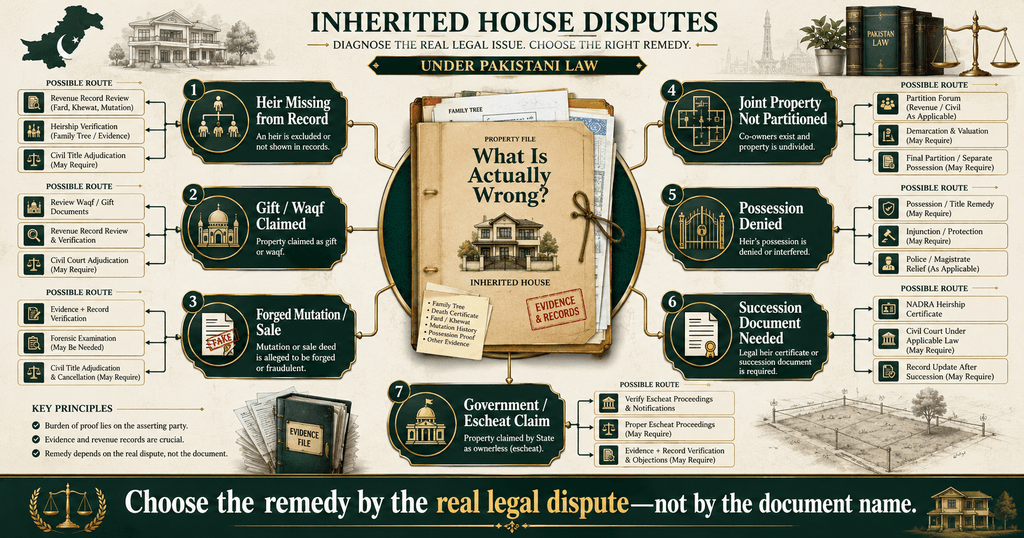
Identify the actual legal problem.
| Problem | Possible Legal Route |
|---|---|
| Routine succession documentation | NADRA / civil court as permitted by applicable law |
| Incorrect revenue entry | Appropriate revenue remedy and/or competent court |
| Serious ownership dispute | Civil court |
| Forged gift or sale | Civil proceedings; criminal route if legal ingredients exist |
| Joint property requiring separation | Partition before competent forum |
| Possession dispute | Appropriate possession/injunction proceedings |
| Woman deprived in Punjab | Ombudsperson and/or other competent legal forum |
| Alleged ownerless property | Proper proceedings concerning escheat and Government rights |
If the dispute is fundamentally over title, merely asking a revenue official to “correct the mutation” may not decide everything.
Likewise, a succession certificate proceeding should not automatically be treated as a substitute for full adjudication of an allegedly forged deed.
Property Inheritance Evidence Checklist
Before starting litigation, organize one evidence file.
Identity and Family Evidence
- Death certificate
- CNIC of deceased
- CNIC/NICOP of heirs
- FRC
- Birth records where relevant
- Marriage records where relevant
- Complete family tree
Property Evidence
- Registered title deed
- Allotment documents
- Lease
- Fard
- Jamabandi
- Mutation history
- Housing-society record
- Property tax record
- Maps where relevant
Transaction Evidence
- Gift deed
- Gift mutation
- Sale deed
- Waqf document
- Will
- Relinquishment deed
- Family settlement
- Power of attorney
Possession Evidence
- Rent receipts
- Tenancy agreements
- Utility records
- Crop record where relevant
- Photographs
- Correspondence
- Possession proceedings
Litigation Evidence
- Previous plaint
- Written statement
- Issues
- Evidence
- Trial judgment
- Appellate judgment
- Revision order
- Interim orders
Property Inheritance cases are often won or lost because someone preserved the original chain of evidence—or failed to do so.
9 Shocking Property Inheritance Mistakes That Can Cost You
1. Treating Mutation as Final Ownership
Mutation matters.
But it does not replace proof of the legal right behind the entry.
2. Leaving Out a Married Daughter
Marriage does not by itself remove a lawful inheritance entitlement.
Every legal heir should be identified under applicable law.
3. Using the 2:1 Formula Without Building the Family Tree
The familiar male/female ratio applies in particular combinations.
It is not a universal inheritance calculator.
4. Dividing the Whole Property Without Checking the Deceased’s Actual Share
If the deceased owned only 40% of a joint property, heirs do not automatically inherit the remaining 60%.
First establish the deceased’s title.
5. Believing Every Gift or Waqf Document Is Automatically Valid
A document can be challenged.
Execution, capacity, legal requirements and evidence matter.
6. Signing a Relinquishment Without Understanding It
A signature can have consequences lasting generations.
Know exactly which property and share are being affected.
7. Waiting Decades Without Preserving Evidence
Delay can create serious limitation, acquiescence and third-party-right issues.
Read our guide on limitation in inheritance litigation before assuming an old claim is automatically safe.
8. Filing Before the Wrong Forum
A title suit, mutation correction, succession proceeding and partition case serve different purposes.
Choose the remedy after identifying the real dispute.
9. Saying a Judgment Decided Something It Never Decided
PLD 2026 Supreme Court 283 is the best example.
The plaintiffs relied on inheritance.
That does not mean the Supreme Court awarded them Property Inheritance rights.
The Court decided the narrower escheat and jurisdiction issue while leaving the dismissal of their title claim intact.
Frequently Asked Questions
When Does Property Inheritance Open?
Ordinarily, inheritance opens upon the death of the owner.
The subsequent record-transfer procedure is a different stage.
Do Heirs Become Owners Only After Mutation?
Mutation is not itself the source of inheritance.
An incorrect revenue entry does not necessarily erase the underlying legal entitlement of a true heir.
Our Inheritance Mutation in Pakistan case analysis explains this distinction in detail.
Is a Succession Certificate the Same as Mutation?
No.
They perform different legal and administrative functions.
A succession document does not automatically replace land-revenue entries, and mutation does not automatically resolve every contested succession or title issue.
What Is the Difference Between Succession Certificate and Letter of Administration?
NADRA’s current succession framework distinguishes the relevant succession documents and provides a mechanism for legal heirs under applicable federal or provincial legislation.
Applicants should check the current official NADRA succession requirements and the statute applicable to their province.
Can Punjab Heirs Approach a Civil Court Directly?
The Punjab 2025 amendment added “or a civil court” to section 3 and omitted section 10 of the 2021 Act.
A civil court proceeding follows the Succession Act, 1925 as provided in the amendment.
Therefore, old material stating that a NADRA decline certificate is universally mandatory before civil-court access in Punjab is
Is a Daughter Always Entitled to Half of Her Brother’s Share?
No universal rule can be applied without knowing the complete family structure and applicable law.
In combinations where sons and daughters inherit together under the relevant Muslim-law rule, the familiar ratio may apply, but women can inherit in several different capacities.
Can a Married Daughter Claim Property Inheritance?
Marriage by itself does not erase a daughter from the category of lawful heirs where she is otherwise legally entitled to inherit.
Can a Lifetime Gift Remove Property From the Estate?
A valid lifetime transfer can affect what property remains in the estate.
But if the alleged gift is disputed, its validity has to be established according to applicable law and evidence.
Can One Brother Keep the Entire Property Because He Is in Possession?
Physical occupation does not automatically answer every ownership question among co-heirs.
Where joint inherited land requires separation, the legal partition process may be necessary. See our guide to Partition of Inherited Land in Pakistan.
Can an Old Inheritance Mutation Be Challenged?
Possibly, but there is no safe answer without the facts.
Knowledge, denial of right, limitation, acquiescence, relinquishment, possession and third-party transfers may all matter.
Does the Government Automatically Own Property if Private Claimants Lose?
No.
PLD 2026 Supreme Court 283 demonstrates precisely why that conclusion is unsafe.
The failure of private parties to prove title did not entitle the High Court to create an unpleaded escheat case and order Government possession.
Did the Plaintiffs Win the Property in PLD 2026 Supreme Court 283?
No.
This point should be stated clearly.
The Supreme Court removed the High Court’s escheat declaration and Government-possession direction.
The dismissal of the plaintiffs’ suit remained intact because neither private side had established its title or claim.
Final Takeaway
Property Inheritance should never begin and end with a share calculator.
A safe inheritance process asks five separate questions:
- What did the deceased actually own?
- Who are all the lawful heirs?
- What liabilities or valid transactions affect the estate?
- Which documents and record changes are required?
- Is there a genuine title dispute that needs adjudication?
The biggest practical mistake is confusing one stage with another.
A mutation is not automatically final title. A succession document does not automatically prove every disputed transaction. Physical possession does not necessarily eliminate co-heirs. A claimed gift needs its own legal foundation. And failure of private claimants to prove ownership does not, without more, automatically turn property into Government-owned escheat.
PLD 2026 Supreme Court 283 reinforces that final point. The Supreme Court protected the integrity of judicial proceedings by holding that an entirely new escheat case could not simply be introduced where it had never been pleaded, put in issue or proved.
For families, the safest approach to Property Inheritance is therefore simple: verify first, calculate second, document third, and transfer only after the legal position is clear.
Disclaimer: This article is for legal awareness and educational purposes only. Property Inheritance depends on the deceased’s applicable personal law, family structure, province, property record, documents, transfers, possession and litigation history. Obtain advice from a qualified lawyer before surrendering a share, purchasing disputed inherited property or starting legal proceedings.