

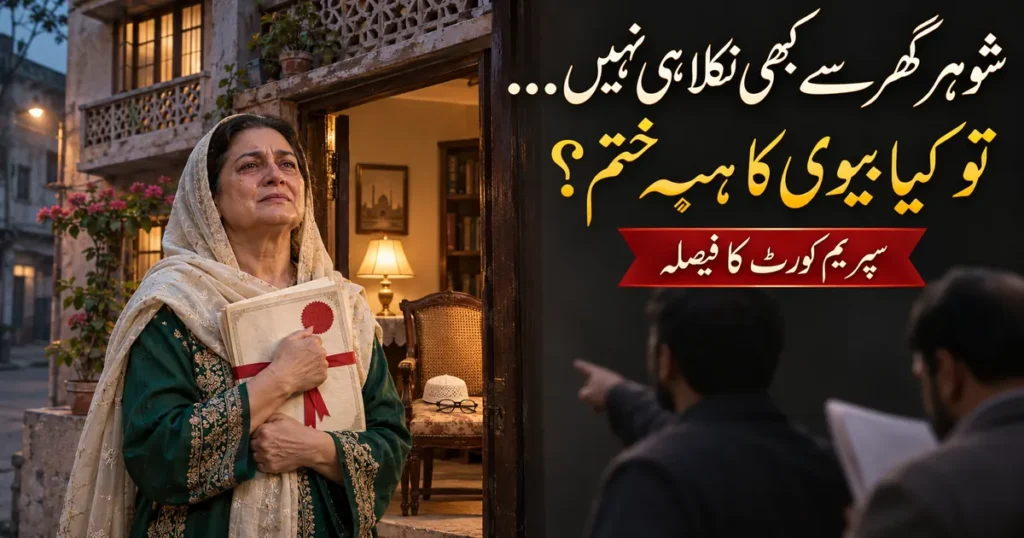
A husband gifts his house to his wife. She accepts it. Nothing changes at home: the same rooms, the same kitchen, the same family around the table. Years later he dies, and his son from his first marriage arrives with one sentence: “Father never moved out, so the gift was never complete.”
For anyone searching gift for wife Pakistan law, this is the real fear. Can a widow lose her home just because her husband kept living in it?
The Supreme Court of Pakistan answered that question in Syed Masood Ali v. Mst. Feroza Begum and another, PLD 2025 SC 339. The gift was made in 1991. The court fight began in 2004 and ended only in December 2024, after climbing through every level of the courts. In the end, the wife’s ownership stood.
Below, you will see what the Court decided, why the son’s arguments failed, and what a family should do so that a gift (hiba) to a wife survives a challenge.
Table of Contents
Judgment at a Glance: PLD 2025 SC 339
| Point | Detail |
|---|---|
| Case | Syed Masood Ali v. Mst. Feroza Begum and another |
| Citation | PLD 2025 Supreme Court 339 |
| Court | Supreme Court of Pakistan |
| Bench | Justice Muhammad Ali Mazhar and Justice Syed Hasan Azhar Rizvi (author) |
| Case numbers | Civil Petitions Nos. 552-K of 2021 and 1108-K of 2023 |
| Date of decision | 26 December 2024 |
| Challenged orders | Sindh High Court judgment of 6 April 2021 (IInd Appeal No. 22 of 2009) and order of 17 August 2023 (C.P. No. D-3343 of 2023) |
| Property | A 90-square-yard house in Liaquatabad, Karachi Central |
| Law involved | Muslim law of Hiba (Mulla’s Principles, Sections 149, 150, 152(3) and 153); Specific Relief Act, 1877, Sections 39, 42 and 54; Article 199 of the Constitution |
| Result | Both petitions dismissed and leave to appeal refused; the 1991 gift to the wife stands |
IRAC Analysis: Why the Wife’s Hiba Survived
| IRAC | Supreme Court Analysis |
|---|---|
| Issue | Was a husband’s gift of a house to his wife invalid because he kept living there, the deed’s marginal witnesses were not produced, and his son alleged forgery? |
| Rule | A valid Hiba needs a clear declaration, acceptance and delivery of possession. Where husband and wife already live together in the gifted house, he need not move out. An overt act showing he gave up ownership and control is enough. |
| Analysis | The registered deed recorded the oral gift, the wife’s acceptance, and that he had handed over possession and given up control. Nothing showed he tried to keep the house. The son proved neither illness nor forgery. |
| Conclusion | All three essentials were met. Three lower courts had reached the same view, and their findings were not perverse. Both petitions were dismissed and leave was refused. |
The Family Story Behind This Hiba Dispute
The house belonged to Syed Mahmood Ali. He had two wives: Mst. Akhtari Begum, mother of the petitioner Syed Masood Ali, and Mst. Feroza Begum, the respondent. So this was a son fighting his stepmother.
According to the record, on 9 January 1991 Mahmood Ali made an oral gift of the house to Feroza Begum in front of witnesses. One month later, a registered Deed of Declaration and Confirmation of Oral Gift, No. 577 dated 9 February 1991, confirmed it.
That one document carried the whole case. It recorded his declaration, her acceptance and the handing over of possession. Mahmood Ali died in 1999.
How the Case Moved Through Four Courts
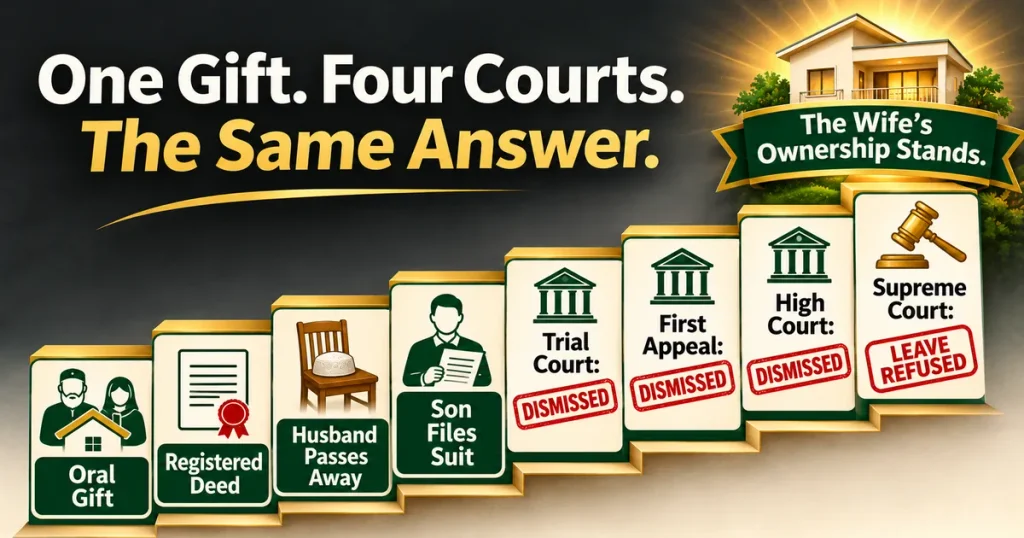
The son sued in 2004, five years after his father’s death. One of the challengers, a daughter of the donor, later admitted she had learned of the transfer in 2000.
| Date | Forum | What happened |
|---|---|---|
| 9 Jan 1991 | Before witnesses | Oral gift of the house to Feroza Begum |
| 9 Feb 1991 | Sub-Registrar | Registered Deed No. 577 confirms the oral gift |
| 1999 | — | The donor, Syed Mahmood Ali, dies |
| 2004 | 1st Senior Civil Judge, Karachi Central | Son files Civil Suit No. 581 of 2004 for declaration, cancellation and permanent injunction |
| 27 Apr 2007 | Trial Court | Suit dismissed (decree dated 18 May 2007) |
| 21 Feb 2009 | Additional District Judge-V, Karachi Central | Civil Appeal No. 95 of 2007 dismissed |
| 6 Apr 2021 | Sindh High Court | IInd Appeal No. 22 of 2009 dismissed |
| 26 Dec 2024 | Supreme Court | C.P. No. 552-K of 2021 dismissed, leave refused |
What the Son Argued Against His Stepmother
Before the Supreme Court, the son’s counsel argued that:
- the lower courts had misread or ignored the evidence;
- physical possession was never handed over to the wife;
- the deed’s marginal witnesses were never produced at trial; and
- the essentials of a valid gift were missing.
The challengers also claimed the father’s signature was forged because illness made him unable to sign. No one appeared for the wife at the Supreme Court. Even unopposed, the son could not show a legal error.
The Evidence That Decided the Case
The courts decided on documents and proof, not family memories:
- The registered deed (Exh. P.1): its wording left no doubt that the donor meant to transfer ownership (para 7).
- The wife’s acceptance: written into the deed in her own words.
- The possession recital: possession was handed over, and the donor had “divested himself completely from the domination of the subject gift” (para 14).
- The Sub-Registrar’s endorsement: it carries a presumption of truth.
Against this, the challengers had no medical record and a long, unexplained silence. Nothing showed the donor ever tried to keep possession (para 15).
Hiba Law in Pakistan: The Three Essentials
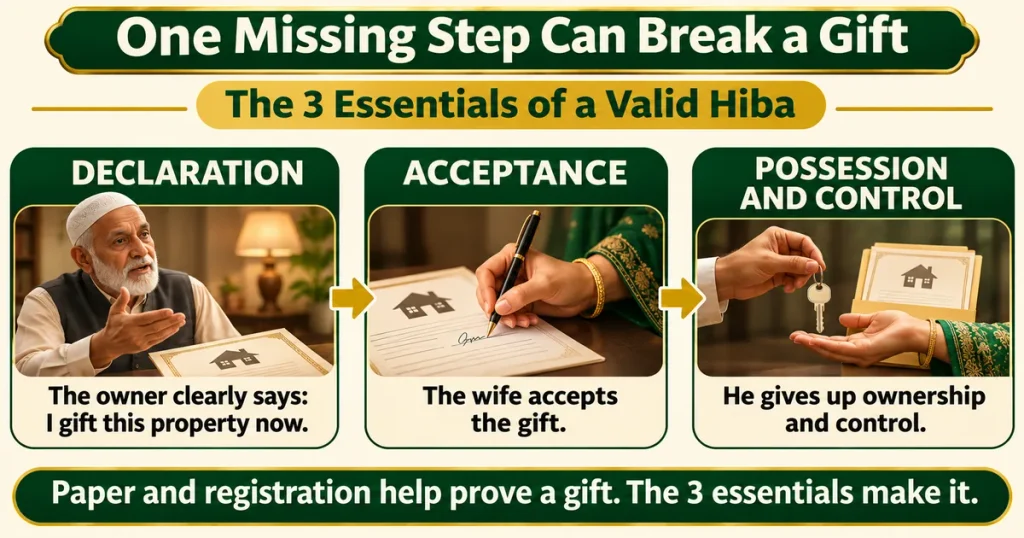
Under Muslim law, Hiba is an immediate transfer of property without any exchange, accepted by or for the person receiving it. The Court relied on Mulla’s Principles of Mohammedan Law and Babar Anwar v. Muhammad Ashraf, 2024 SCMR 734.
| Essential (Mulla, Section 149) | What the law requires | What the Court found |
|---|---|---|
| Declaration | A clear, unequivocal statement of gift by the owner | Clear wording in the deed |
| Acceptance | Express or implied, by or for the donee | Written into the deed |
| Delivery of possession | Such possession as the property allows (Section 150) | Met through the recital and the shared-home rule |
The Court also repeated a point many families miss: a Hiba can be oral. Under Muslim law, writing and registration are not essential, even for a house. The gift chapter of the Transfer of Property Act, 1882 leaves Muslim-law gifts to Muslim law (Section 129).
Must a Husband Leave the House After Gifting It?
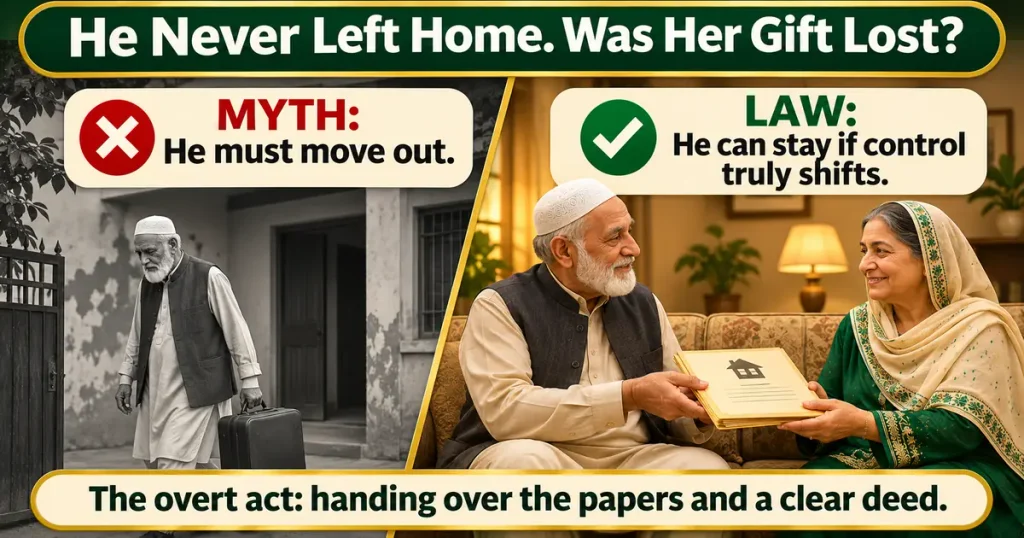
No. This is the heart of the judgment.
Section 152(3) of Mulla covers cases where donor and donee both live in the gifted property. The donor need not walk out, and the donee need not make a formal entry. The gift is complete on an overt act showing he intends to transfer possession and give up control. Handing the property papers to the donee is one example the Court noted from an Indian case.
Section 153 applies this rule to husband and wife. Read together, the Court said, formal delivery is not needed when they live together in the property at the time of the gift. Their shared possession is enough, if he has clearly given up ownership and control.
The Court also cited the Privy Council (AIR 1932 PC 13): a husband’s declaration plus handing over the deed can transfer possession to his wife, even if he never vacates.
What If the Husband Still Collects the Rent?
Many gifted properties earn rent: an upper portion, a shop, a flat. The Court was clear (para 12). A husband’s continued residence, or his collection of rent after gifting property to his wife, does not invalidate the gift. The presumption is that he collects the rent on her behalf.
This rests on two earlier Supreme Court judgments:
- Mst. Kaneez Bibi v. Sher Muhammad, PLD 1991 SC 466: strict proof of physical possession is not insisted upon when a husband gifts to a wife living with him. Once the mutation (intiqal) is proved, his later acts about the property are presumed to be for her.
- Riaz Ullah Khan v. Asghar Ali, 2004 SCMR 1701: in a gift to a wife or a ward, delivery of possession is immaterial.
Why the Deed’s Own Words Bound the Children
The deed did not just say “I gift this house.” It said possession had been delivered and control given up. The Court treated that recital as an admission binding on the donor and everyone claiming through him, including his children (para 16).
It cited Ismail v. Idrish, AIR 1974 Patna 54, where such a recital made a gift binding on the donor’s heirs, even though one heir was later found living in the property. Good drafting cannot create a fake gift. But for a genuine Hiba, clear words protect it long after the donor is gone.
Can Children Stop a Gift They Hoped to Inherit?

No, not on that hope alone. The Court relied on Abrar Ahmed v. Irshad Ahmed, PLD 2014 SC 331 (para 17).
Muslim law does not recognise spes successionis, the mere hope of inheriting one day. A child has no right in a parent’s property while the parent is alive. So a prospective heir (waris) cannot attack a lifetime gift only because the property might otherwise have come to them in inheritance (wirasat).
Heirs can still go to court on a recognised defect, such as:
- forgery or fraud;
- the donor’s lack of mental capacity or free will; or
- no real declaration, acceptance or transfer of control.
Each must be proved with evidence. A lost share is not a legal ground. For how lifetime gifts differ from shares on death, see our guide on property inheritance mistakes.
Why the Forgery and Witness Objections Failed
The Illness and Forgery Claim
The challengers said the father was too ill to sign. The Supreme Court endorsed the Sindh High Court’s answer (para 19). The declaration was proved through the attested registered deed and the Sub-Registrar’s endorsement, which carries a presumption of truth. The challengers produced no document about his illness at that time.
Their conduct hurt them too. They made no claim from 1991 onwards, not even when the father died in 1999. One admitted knowing of the transfer in 2000, yet the suit came in 2004. Asked why they stayed silent for four years, their counsel had no answer.
The Missing Marginal Witnesses
The Court’s reply was short (para 20). Neither writing nor registration of a deed confirming an oral gift is essential to a valid Hiba. The wife had proved the document’s execution and all three essentials, and the challengers failed to prove otherwise.
Three Courts Had Already Agreed
The trial court, appellate court and High Court had all ruled against the son. The Supreme Court does not normally disturb such concurrent findings unless they are perverse, arbitrary, fanciful or capricious (para 21). It found no misreading of evidence and no illegality.
The Second Petition: Why Targeting the Judge Failed
The second petition (C.P. No. 1108-K of 2023) came from the wife’s own Suit No. 227 of 2009. She sought declaration, possession, mesne profits and injunction over the second and third floors, said to be occupied by the son and his brother.
The trial court recorded evidence but kept its decision in abeyance for more than ten years, from 28 July 2012 to 25 January 2023, waiting for the High Court. After the son’s second appeal failed, it decreed her suit.
The son then filed a writ under Article 199 of the Constitution. He did not make Feroza Begum a party. Instead, he asked for an inquiry against the trial judge for deciding while his Supreme Court petition was pending, though no stay order existed.
The Supreme Court upheld the dismissal (paras 30 to 32). He had already filed Civil Appeal No. 40 of 2023, and a writ cannot bypass an available, effective remedy. The Court also warned that attacking a judge over a judicial decision harms judicial independence.
Final Decision of the Supreme Court
On 26 December 2024, the Supreme Court found no reason to interfere with the High Court’s judgment or order. Both petitions were dismissed as devoid of merit and leave to appeal was refused (para 33).
In plain words: the 1991 gift remained valid, Feroza Begum stayed the owner, and the son’s challenge ended at the highest court.
What PLD 2025 SC 339 Did and Did Not Decide
| The Court decided | The Court did NOT decide |
|---|---|
| A husband living on in the gifted house does not, by that alone, defeat a gift to his wife | That every document called a gift deed is valid |
| Rent he collects after the gift is presumed collected for her | That possession never matters in other kinds of gifts |
| A clear possession recital binds the donor’s heirs | That registration alone proves a Hiba |
| Hope of inheritance gives no right to undo a lifetime gift | That heirs can never challenge a gift for fraud, forgery or incapacity |
| Unproved claims of illness and forgery fail | A fixed time limit for every Hiba challenge |
| Article 199 cannot bypass an available appeal | Stamp duty, tax or registration fees for gifts |
7 Hiba Rules Every Pakistani Family Should Remember
These seven rules sum up the gift for wife Pakistan law the Court applied:
- Clear words make the gift: an immediate gift of an identified property, not a promise for later.
- Her acceptance must be provable: written and signed by the wife.
- A shared home does not kill the Hiba: he can stay if he truly gave up ownership and control.
- Rent he collects is presumed hers: still, keep records that show it.
- The deed’s recitals bind the heirs: state that possession was delivered and control given up.
- Hope of inheritance is not ownership: children cannot cancel a genuine lifetime gift on that ground.
- Big allegations need hard proof and quick action: forgery or illness claims fail without evidence.
How to Make a Gift for Wife Pakistan Courts Will Uphold
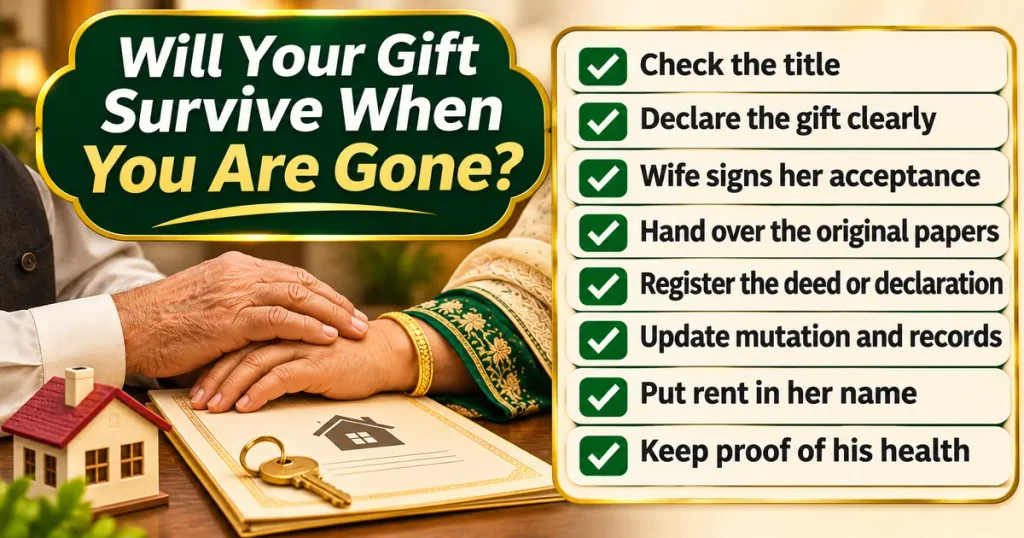
Ask one question first: could this gift be proved 20 years from now, when the donor is no longer here to explain it? Then follow this checklist:
- Check the title: confirm the husband owns the property and it is free of disputes.
- Declare clearly: an immediate, unconditional gift, preferably before two trustworthy adult witnesses.
- Record her acceptance in writing, signed by her.
- Hand over the original title papers to the wife, the kind of overt act the Court mentioned.
- Put it on record: a registered gift deed (hiba nama), or a registered declaration of an oral Hiba as in this case. Where a written deed itself makes the gift, the Registration Act, 1908 applies. Ask the Sub-Registrar about current stamp duty and fees in your province.
- Update records: mutation for land, society or authority transfer, and tax and utility records. See our guide on inheritance mutation in Pakistan.
- Paper the rent: tenancy in her name, or written authority for him to collect it for her.
- Protect capacity evidence: if the husband is elderly or unwell, get a medical certificate near the date.
Avoid these mistakes: keeping the originals in the husband’s locker, him later selling or mortgaging the property as owner, a later will that contradicts the gift, and calling it “only on paper” before relatives.
If Heirs Challenge or Occupy the Gifted House
For heirs who want to challenge: the forum is the civil court, through a suit for declaration, cancellation and injunction under Sections 39, 42 and 54 of the Specific Relief Act, 1877. Act quickly. For cancelling a document, Article 91 of the Limitation Act, 1908 generally allows three years from when the plaintiff learns the facts.
Our guides on a civil suit for declaration and gift deed law in Pakistan explain the process and how courts treat very old gift deeds.
For a wife whose gifted house is occupied: she can sue for declaration, possession and mesne profits, as Feroza Begum did. Keep certified copies of the deed, transfer records, bills and rent papers. Also read our guide on women’s inheritance rights.
For both sides: challenge a decision through the proper appeal, not a writ or a complaint against the judge. You can check case status on the Supreme Court of Pakistan website.
Frequently Asked Questions
Is a husband’s gift to his wife valid if he keeps living there?
Yes, if the gift is otherwise complete. In PLD 2025 SC 339, the Supreme Court held that where husband and wife live together in the gifted house, he does not have to move out. What matters is a clear declaration, her acceptance, and proof that he truly gave up ownership and control. That is the core gift for wife Pakistan rule from this judgment.
Can the husband’s children cancel the gift after his death?
Not simply because they expected to inherit the house. Muslim law does not treat the hope of inheritance as a property right. Children can still challenge a gift for forgery, fraud or the donor’s incapacity, but they must prove it. Here, the son proved neither illness nor forgery, and his challenge failed at every level.
Is an oral gift of a house to a wife valid in Pakistan?
Yes. Under the Muslim law principles the Supreme Court applied, a Hiba can be made orally, and neither writing nor registration is essential. But an oral gift is harder to prove later. That is why the husband in this case confirmed his oral gift through a registered deed a month later, and that deed decided the case.
Does a gift deed to a wife need registration?
A registered document is the safest proof, and where a written deed itself transfers immovable property, registration law applies. A memorandum recording an earlier oral Hiba is treated differently. Registration alone does not make a gift valid; the three essentials must still exist. Fees and procedure differ by province, so check with the Sub-Registrar first.
Can a husband take back a gift from his wife?
Generally, no, once the gift is complete. Under the Hanafi rules in Mulla’s Principles (Section 167), a gift between husband and wife is among the gifts that cannot be revoked after possession is delivered. PLD 2025 SC 339 did not decide revocation, and fraud or coercion can still be raised in court. He cannot cancel a registered gift on his own.
Does a lifetime gift to a wife reduce the other heirs’ shares?
In practice, yes. A completed lifetime gift takes the property out of the husband’s estate, so it is not divided among heirs after his death. The one-third limit applies to wills, not to genuine lifetime gifts. A gift made during death-illness (marz-ul-maut) is treated differently and can be tested like a will.
How long do heirs have to challenge a gift deed?
There is no single deadline for every case. For a suit to cancel a document, Article 91 of the Limitation Act, 1908 generally gives three years from when the plaintiff learns the facts. The right article depends on the relief claimed. Here, the High Court counted it against the challengers that they waited four years after learning of the gift.
What evidence should a wife keep to protect a gifted house?
Keep the registered deed or declaration, her signed acceptance, the original title papers, the mutation or transfer record, and tax and utility bills in her name. If the house is rented, keep tenancy papers and rent receipts. If the husband was old or ill, a medical certificate from that time helps. Store certified copies outside the house.
Conclusion
A gift for wife Pakistan courts will respect does not depend on who walks out of the door. In PLD 2025 SC 339, the husband never left his house, yet his wife’s ownership survived 20 years of court battles. It survived because the gift was clear, she accepted it, and the registered deed recorded that he had given up control.
Husbands should complete and document a gift while everyone is alive and talking. Heirs should remember that hope of inheritance is not ownership. For more judgments like this, explore our gift and Hiba disputes section.
Disclaimer: This article is for legal awareness only and is not legal advice. Every case depends on its own facts, documents and evidence. For your specific matter, consult a qualified lawyer.