

A marriage may break emotionally in a single day, but the law does not always end it on the same day. A spoken talaq, a WhatsApp message, a private divorce deed, a Family Court decree and an official divorce certificate are not the same legal document. One wrong notice, the wrong Union Council or an incomplete record can create problems years later when a person wants to remarry, travel abroad, claim dower, update family records or prove marital status.
This guide explains Divorce Procedure in Pakistan in simple English for Muslim marriages. It covers a husband’s talaq, a wife’s delegated right of divorce, judicial khula, dissolution under the Dissolution of Muslim Marriages Act, mutual divorce, the 90-day rule, overseas cases, correct jurisdiction, documents, divorce certificates, NADRA records, dower, maintenance, children and the latest important judgments.
The first rule is simple: never start Divorce Procedure in Pakistan by asking only, “How do I get divorced?” First ask:
Which legal route actually applies to this marriage?
Important: This guide mainly explains Muslim family law. Divorce laws for Christian, Hindu, Parsi or other personal-law marriages may follow different statutes and procedures.
Table of Contents
Divorce Procedure in Pakistan at a Glance
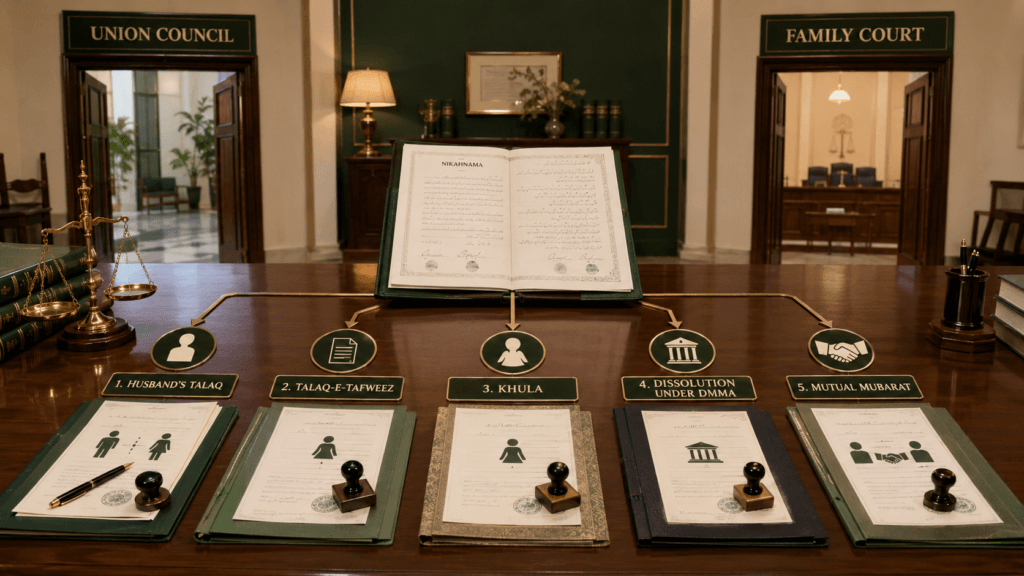
| Situation | Main Legal Route | Main Forum |
|---|---|---|
| Husband wants to divorce wife | Talaq under Section 7, MFLO 1961 | Competent Chairman/Union Council or other competent authority |
| Wife has delegated right in Nikahnama | Talaq-e-Tafweez under Section 8 read with Section 7 | Competent local authority |
| Wife wants judicial Khula | Khula through Family Court | Family Court |
| Wife proves cruelty, non-maintenance or another statutory ground | Dissolution under DMMA 1939 | Family Court |
| Husband and wife both agree to separate | Mubarat / mutual dissolution | Written settlement plus applicable statutory and registration process |
| One spouse lives abroad | Depends on route and residence | Family Court, competent Council or Pakistan Mission as applicable |
The basic statutory framework comes from the Muslim Family Laws Ordinance, 1961 and the Dissolution of Muslim Marriages Act, 1939. Provincial adaptations and administrative procedures may affect individual cases.
1. Divorce Procedure in Pakistan Starts With the Correct Legal Route
Many legal problems begin because people use the word “divorce” for every kind of separation. Pakistani Muslim family law recognises different legal routes, and they should not be mixed together.
A husband’s talaq normally begins with his pronouncement and then follows the statutory notice procedure under Section 7 of the Muslim Family Laws Ordinance, 1961.
A wife may exercise Talaq-e-Tafweez if the husband delegated the right of divorce to her, commonly through Clause 18 of the Nikahnama.
A wife may also approach the Family Court for Khula when she genuinely cannot continue the marital relationship and seeks judicial separation.
But Khula is not the same as a suit based on a statutory ground such as cruelty, prolonged non-maintenance or another ground recognised by the Dissolution of Muslim Marriages Act, 1939.
Finally, if both spouses agree that the marriage should end, they may choose Mubarat or mutual dissolution, but they should still complete the legal record rather than relying only on a private piece of paper.
This distinction makes Divorce Procedure in Pakistan safer because the legal route may affect jurisdiction, evidence, dower and the documents needed later.
For a detailed wife-focused court process, read our guide on Khula Process in Pakistan.
2. Divorce Procedure in Pakistan When the Husband Gives Talaq
The most misunderstood part of Divorce Procedure in Pakistan is the belief that saying “talaq” immediately completes every legal requirement.
That is not the statutory position.
Step 1: Pronouncement Is Only the Beginning
Section 7 of the Muslim Family Laws Ordinance deals with a husband’s talaq.
After pronouncing talaq in any form whatsoever, the husband must give written notice to the Chairman of the competent authority and supply a copy to the wife.
The law does not make a specific value of stamp paper, two private witnesses or three separate written divorce deeds a universal statutory condition under Section 7. Good documentation may still be sensible, but a lawyer’s preferred drafting practice should not be confused with a requirement actually written into the statute.
The Supreme Court’s recent ruling in Muhammad Hassan Sultan v. Chairman Union Council, Civil Petition No. 5364 of 2024, reported as 2025 SCP 449 / 2026 SCLR 24, reaffirmed the central importance of Section 7.
For a broader explanation of Sections 6, 7 and 8, also read our Muslim Family Laws Ordinance guide.
Step 2: Send the Notice to the Correct Authority
This is where Divorce Procedure in Pakistan can go seriously wrong.
A common assumption is:
“Send the talaq notice to the Union Council where the Nikah was registered.”
That is not a safe universal rule for Section 7 jurisdiction.
Under the relevant Rules, jurisdiction for a Section 7 talaq notice is generally connected with where the wife was residing at the time the talaq was pronounced.
The Supreme Court gave this issue major importance in Muhammad Hassan Sultan. In that case, when the husband’s later divorce proceedings were initiated, the wife was residing in New York. The Supreme Court held that the Karachi authority used by the husband lacked jurisdiction on those facts and dealt with the role of the Pakistan Mission abroad.
Therefore, before serving a notice, confirm:
- where the wife was actually residing when talaq was pronounced;
- whether she was living in Pakistan or abroad;
- which statutory rules apply to that territory;
- whether a special overseas procedure is involved; and
- whether the selected authority genuinely has jurisdiction.
A beautifully drafted notice sent to the wrong authority may create a much bigger dispute than a simply drafted notice sent to the correct one.
Step 3: A Copy Must Also Reach the Wife

The wife is not merely a spectator in Divorce Procedure in Pakistan.
Section 7 requires a copy of the written notice to be supplied to her. Preserve reliable evidence showing what was sent, where it was sent and when.
Useful records may include postal receipts, courier tracking, acknowledgement, council diary numbers and copies of the documents actually served.
The wife’s signature or consent is not itself the legal condition that gives a husband the power to pronounce talaq. However, lawful notice and statutory procedure should not be replaced with secrecy.
What if the Wife’s Address Is Unknown?
The law does not mean that a husband can invent an address and then claim that service has been completed.
Where the wife’s whereabouts genuinely cannot be discovered despite due diligence, Rule 3-A provides a controlled alternative procedure. With the Chairman’s permission, service may be made through her father, mother, adult brother or adult sister. If those persons also cannot be found, authorised newspaper publication may become available in the manner permitted by the Rules.
For a hard-to-locate spouse, Divorce Procedure in Pakistan therefore requires proof of genuine attempts to locate the person—not a fictional address or casual newspaper advertisement.
Step 4: The Arbitration Council Process Begins
Once a valid Section 7 notice reaches the competent Chairman, the statutory reconciliation process starts.
The Arbitration Council framework exists to create an opportunity for reconciliation before the divorce becomes effective.
The Rules also regulate nomination of representatives and service of notices. Non-cooperation by one side does not automatically allow the entire statutory process to be ignored.
This part of Divorce Procedure in Pakistan is important because the law deliberately creates a cooling-off period rather than treating every private statement as the end of all legal consequences.
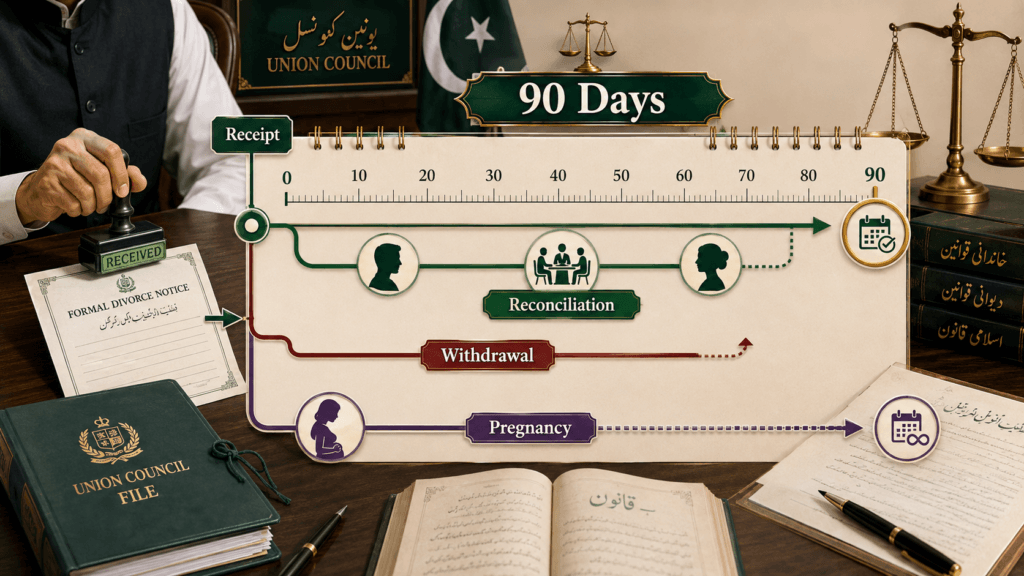
Step 5: The 90-Day Rule Is Critical
This is one of the most important rules in the entire article.
Under Section 7, talaq does not become effective until 90 days have expired from the date the notice is delivered to the Chairman, unless the talaq is revoked earlier.
The clock is therefore not safely calculated merely from:
- the date written on a private talaq deed;
- the date of an argument between husband and wife;
- the date a WhatsApp message was sent; or
- the date relatives were told about the separation.
The Supreme Court in Muhammad Hassan Sultan reaffirmed that the statutory 90-day framework applies even to a talaq described as Talaq-e-Bidat. A claim that three talaqs spoken together automatically bypass Section 7 was not accepted as a way around the statutory period.
That judgment is one of the most important recent authorities for understanding Divorce Procedure in Pakistan.
Step 6: Can Talaq Be Withdrawn During the 90 Days?
Yes, the recent Supreme Court judgment gives this issue particular significance.
The law states that talaq takes effect after 90 days unless it is revoked earlier, expressly or otherwise.
In Muhammad Hassan Sultan, the wife had exercised a delegated right of divorce and later withdrew her notice within the statutory period. The Supreme Court accepted that the statutory framework allowed that withdrawal before effectiveness.
Because Section 8 applies the Section 7 framework with necessary modifications to delegated divorce, the ruling is also important for a wife exercising Talaq-e-Tafweez.
If reconciliation occurs, do not rely only on a verbal family understanding. Record the withdrawal/reconciliation properly with the relevant authority so that future records do not tell a different story.
Step 7: What if the Wife Is Pregnant?
Pregnancy creates a special timing rule.
Where the wife is pregnant when talaq is pronounced, Section 7 provides that the divorce does not become effective until the later of:
- the statutory 90-day period; or
- the end of the pregnancy.
This means Divorce Procedure in Pakistan cannot be calculated by looking at a calendar alone when pregnancy is involved.
3. What Is Talaq-e-Tafweez?
A Muslim wife does not always need to begin with Khula.
A husband may have delegated the power of divorce to his wife. This is commonly checked in Clause 18 of the Nikahnama.
The Nikahnama should be read carefully because delegation may be unconditional or may contain conditions.
Where a valid delegated power exists and the wife exercises it, Section 8 of the Muslim Family Laws Ordinance makes the Section 7 framework applicable with necessary modifications.
That means Divorce Procedure in Pakistan through Talaq-e-Tafweez is legally different from ordinary judicial Khula.
The 2025 Supreme Court ruling in Muhammad Hassan Sultan is especially important because the marriage in that case involved an unconditional delegation of the right of divorce to the wife, and the Court addressed both withdrawal during the 90-day period and jurisdiction.
Before filing Khula automatically, a wife should therefore inspect:
- the original Nikahnama;
- Clause 18;
- any conditions attached to delegation; and
- the legal consequences of the route she chooses.
The correct route may protect rights that could otherwise become unnecessarily disputed.
4. Mutual Divorce or Mubarat: Agreement Is Not the End of Documentation
Sometimes both husband and wife agree that the marriage should end.
This is generally described as Mubarat or mutual dissolution.
Because both sides agree, the emotional dispute may be smaller—but the documentation should still be careful.
A written settlement may record matters such as:
- confirmation that separation is mutual;
- dower already paid or still disputed;
- return of personal belongings;
- dowry articles;
- maintenance arrears;
- children’s expenses;
- custody arrangements;
- visitation arrangements;
- pending court cases; and
- responsibility for completing official divorce registration.
However, a private agreement should not be mistaken for the entire public legal record.
Section 8 addresses dissolution otherwise than by a husband’s talaq and applies Section 7 with necessary modifications. The exact administrative steps should therefore be completed under the law applicable to the parties and their jurisdiction.
A careful Divorce Procedure in Pakistan plan asks not only, “Have we signed the agreement?” but also:
“What official record will prove this separation five years from now?”
5. Divorce Procedure in Pakistan Through Khula
Khula is a judicial route generally used when a Muslim wife seeks release from a marriage she cannot continue.
A husband cannot create an unlimited veto merely by refusing to say, “I agree.”
The Family Court must still possess jurisdiction, serve the husband lawfully, provide an opportunity to respond, attempt reconciliation as required and decide the case according to law.
A practical Khula case may involve the following stages:
- choosing the correct Family Court;
- preparing and filing the plaint;
- attaching relevant documents;
- lawful service upon the husband;
- written statement or ex parte proceedings where legally justified;
- reconciliation proceedings;
- recording the wife’s voluntary position;
- deciding connected financial claims according to the pleadings and evidence;
- passing the decree; and
- completing applicable post-decree registration formalities.
Our detailed article on Khula Process in Pakistan explains these stages separately.
If the concern is specifically whether a husband can permanently block Khula by withholding consent, also see our guide on Khula without husband consent.
A safe Divorce Procedure in Pakistan should never tell every woman simply to “file Khula” without first checking whether she actually has a stronger statutory dissolution claim.
6. Khula Is Not the Same as Dissolution Under the DMMA 1939

This distinction can affect valuable legal and financial rights.
The Dissolution of Muslim Marriages Act, 1939 gives a Muslim wife statutory grounds on which she may seek dissolution of marriage.
Depending on the facts, these can include grounds relating to:
- prolonged disappearance of the husband;
- failure to provide maintenance for the statutory period;
- imprisonment meeting the statutory conditions;
- failure to perform marital obligations;
- certain conditions affecting marital capacity;
- cruelty;
- contracting an additional marriage in contravention of the Muslim Family Laws Ordinance; and
- other grounds recognised by Muslim law.
The exact ground must be pleaded and proved according to the applicable law.
The Supreme Court Warning: Do Not Turn Every Wife’s Case Into Khula
The distinction became extremely important in Dr. Seema Hanif Khan v. Waqas Khan and others, 2025 SCP 392, reported as PLD 2026 Supreme Court 91.
Dr. Seema had approached the Family Court relying on statutory grounds including cruelty, non-maintenance and the husband’s additional marriage.
Instead of deciding the statutory dissolution she sought, the lower court granted Khula without her asking for it and attached financial consequences to that route.
The Supreme Court held that Khula is a distinct remedy based on the wife’s autonomy and voluntary choice. A court should not simply convert a statutory dissolution claim into Khula without her consent. The Court also stressed the proper civil standard for evaluating evidence rather than demanding criminal-style proof in family disputes.
This judgment changes the practical way Divorce Procedure in Pakistan should be planned for women.
The first question should not be:
“How quickly can we get Khula?”
It should be:
“Is this actually a Khula case, or does the evidence establish a statutory ground that protects additional legal rights?”
Read our related guide on Grounds for Khula in Pakistan for further explanation.
7. What Happens to Haq Mehr After Divorce?
There is no responsible one-line answer saying:
“Every wife must return the entire dower after Khula.”
Nor is it safe in 2026 to apply an old fixed percentage formula automatically to every Punjab case.
The legal result may depend on:
- whether the marriage ended through husband’s talaq;
- whether the wife exercised delegated divorce;
- whether she voluntarily sought Khula;
- whether she proved a statutory ground under the DMMA;
- what the Nikahnama says;
- whether dower was prompt or deferred;
- whether it was actually paid;
- provincial law and amendments; and
- the court’s findings.
Section 5 of the Dissolution of Muslim Marriages Act protects the wife’s dower rights from being automatically destroyed merely because the Act is used for dissolution.
The Federal Shariat Court’s PLD 2022 FSC 25 Khula judgment is also important when assessing older fixed statutory formulas. The Court’s official leading-judgments database lists the Khula decision dated 17 February 2022.
More recently, the Lahore High Court’s reported judgment database lists Arslan v. Nisha Shahid etc., W.P. No. 20300/2023, decided 1 July 2026, reported as 2026 LHC 4758. The case addresses dissolution, Khula and dower and reinforces the importance of treating the ground of dissolution and dower entitlement as separate legal questions rather than automatically using the label “Khula” to remove property rights.
For this reason, Divorce Procedure in Pakistan should protect the Nikahnama and financial pleadings from the very first day.
8. Documents You Should Preserve Before Starting the Process
A legally correct case can still become difficult when documents disappear.
Before beginning Divorce Procedure in Pakistan, prepare a route-specific file.
Basic Marriage Documents
Keep:
- CNIC copies;
- Nikahnama;
- computerized marriage registration certificate, if available;
- correct names and addresses;
- children’s B-Forms where children are involved; and
- any relevant passport or NICOP details in overseas cases.
For Husband’s Talaq
Preserve:
- written talaq notice;
- copy sent to wife;
- postal/courier receipts;
- tracking record;
- acknowledgement from competent authority;
- Arbitration Council notices;
- reconciliation correspondence;
- any revocation/withdrawal communication; and
- final certificate or registration record.
For Khula or Statutory Dissolution
Depending on the case, preserve:
- plaint;
- Nikahnama;
- dower evidence;
- maintenance record;
- bank transfers;
- messages and emails;
- medical documents where genuinely relevant;
- complaints or protection proceedings where relevant;
- evidence relating to second marriage;
- witness details;
- court orders;
- certified decree; and
- subsequent registration certificate.
Do not manufacture evidence merely because a dispute has reached court.
What if the Original Nikahnama Is Lost?
A lost original does not necessarily mean the marriage record has disappeared.
Check with the Nikah Registrar, relevant Union Council/local authority or record office for the registered marriage record and a certified copy where legally available.
Do this before litigation wherever possible.
An organised evidence file can make Divorce Procedure in Pakistan significantly safer than depending on screenshots stored on one mobile phone.
9. Divorce Certificate, Union Council and NADRA: They Are Not the Same Thing
This is one of the most common online misunderstandings.
People often search for a “NADRA divorce certificate.”
But the issuing authority and the role of NADRA should be distinguished.
In Punjab, the Local Government & Community Development Department states that the divorce certificate is issued by the concerned Union Council or Municipal Committee where the marriage/Nikahnama was registered. Punjab’s e-Khidmat service also lists Union Council/Arbitration Council registration or a court order among relevant documentary requirements.
NADRA, on the other hand, maintains identity and family-registration services and provides processes affecting identity records, including divorce-related cancellation/update services through PakID.
Therefore, Divorce Procedure in Pakistan should distinguish between:
1. The authority that handles the statutory divorce notice;
2. The Family Court where judicial relief is required;
3. The local authority that records/issues the relevant divorce certificate; and
4. NADRA-related identity or family-record updates.
These offices may not always be the same.
A Very Important Punjab Example
For a husband’s Section 7 notice, jurisdiction may turn on the wife’s residence at the time of pronouncement.
But Punjab’s administrative guidance for issuing the divorce certificate refers to the Union Council or Municipal Committee where the Nikahnama was registered.
Those are two different legal questions.
Do not automatically assume that the office receiving the Section 7 notice and the office handling every later civil-registration function must always be identical.
Also remember that local government structures and procedures can differ between provinces and territories. Verify the current procedure for the relevant location.
10. Divorce Procedure in Pakistan for Overseas Pakistanis

Overseas cases need extra care because there may be two different jurisdiction questions:
- Which authority can process a Section 7/Section 8 notice?
- Which Family Court can hear a judicial dissolution or Khula suit?
These are not automatically answered in the same way.
Supreme Court 2025: Wife Living in New York
In Muhammad Hassan Sultan, the Supreme Court dealt directly with an overseas jurisdiction dispute. When the husband’s later notice was initiated, his wife was residing in New York. The Supreme Court held that the Karachi forum used in that situation lacked jurisdiction and discussed the applicable Pakistan Mission mechanism.
This means a Pakistani passport or an old Karachi/Lahore address does not automatically solve every jurisdiction question.
Supreme Court 2024: An Overseas Wife and a Pakistani Family Court
A different issue arose in Sohail Ahmed v. Mst. Samreena Rasheed Memon, 2024 SCMR 634.
The marriage had been solemnized in New York, and the wife was a dual Pakistani-US citizen. The Supreme Court considered the Family Court jurisdiction rules and upheld the Pakistani Family Court’s jurisdiction on the particular facts, emphasising the special jurisdictional protection available to a wife in a dissolution/dower action.
You can read our detailed explanation of that judgment in Marriage in Pakistan: Supreme Court Lessons for Overseas Couples.
Overseas Checklist
Before starting Divorce Procedure in Pakistan from abroad, verify:
- where each spouse actually lives;
- the route being used;
- Nikahnama and delegation clauses;
- passport/NICOP details;
- correct local authority;
- Pakistan Mission requirements where applicable;
- whether a valid Power of Attorney is required;
- attestation requirements;
- service abroad;
- the Family Court’s territorial jurisdiction; and
- how the final Pakistani record will be completed.
Do not copy another overseas couple’s procedure merely because both marriages were registered in Pakistan.
11. What Divorce Does Not Automatically Decide
Ending the marriage does not automatically settle every dispute between former spouses.
A complete Divorce Procedure in Pakistan plan must separately consider connected rights.
Haq Mehr
Unpaid dower may remain a separate financial claim depending on the route and facts.
Wife’s Maintenance
Past or other legally recoverable maintenance claims should be specifically examined rather than assumed to disappear with the marriage.
Child Maintenance
A child’s right to maintenance is not automatically lost because the mother obtained Khula or because the father gave talaq.
Custody and Visitation
Divorce does not automatically mean that one parent permanently “wins” the children.
Custody and guardianship questions are decided separately under the applicable legal framework, with the welfare of the child being central.
Rigid internet claims such as “the father automatically gets a boy at age seven” should not replace an actual welfare assessment.
Dowry Articles and Personal Property
Jewellery, belongings, dowry articles and other property disputes may also require separate proof.
Second Marriage Issues
If an existing husband contracted another marriage during subsistence of the first marriage, additional legal consequences may arise depending on the facts and compliance with Section 6 of the Muslim Family Laws Ordinance.
Read our complete guide on Second Marriage Law in Pakistan.
Where marital breakdown involves violence, threats or coercive behaviour, separate protective remedies may also be relevant. See our guide on Domestic Violence Law in Pakistan.
12 Common Mistakes That Can Damage a Divorce Case
Even where the marriage has genuinely ended, these mistakes can turn Divorce Procedure in Pakistan into years of unnecessary litigation:
- Treating a spoken talaq as the complete legal process.
- Sending Section 7 notice to an authority without checking jurisdiction.
- Counting 90 days from the wrong date.
- Assuming three talaqs spoken together bypass Section 7.
- Failing to send a copy of the notice to the wife.
- Using a false address when the spouse cannot be found.
- Failing to preserve postal and council receipts.
- Assuming every wife’s case must be filed as Khula.
- Ignoring Clause 18 of the Nikahnama.
- Assuming Khula always means complete surrender of dower.
- Treating a private Mubarat deed as the only record ever needed.
- Confusing a Family Court decree, Union Council record and NADRA identity update.
The safest practice is to identify the legal route before drafting the first document.
The 90-Day Divorce Timeline in Simple Words
Here is a simplified timeline for an ordinary Section 7 case. Individual cases can differ.
| Stage | What Happens |
|---|---|
| Day 0 | Talaq is pronounced |
| Immediately after | Written notice should be sent to competent Chairman and copy supplied to wife |
| After receipt | Authority begins statutory reconciliation/Arbitration Council process |
| During 90 days | Reconciliation or lawful revocation may still occur |
| Day 90 | Talaq may become effective if statutory conditions are satisfied and it was not revoked |
| Pregnancy | If pregnancy ends later than 90 days, the later date controls |
| After legal completion | Obtain and preserve the relevant official divorce record/certificate |
The key lesson from the Supreme Court is that Divorce Procedure in Pakistan should not treat the private date of pronouncement as the only date that matters. The statutory notice process is central to legal effectiveness.
Before Remarriage: Do Not Guess Your Legal Status
A new Nikah should never begin with uncertainty about whether the previous marriage legally ended.
Before remarriage, verify:
- which legal route ended the previous marriage;
- whether the correct authority had jurisdiction;
- whether the statutory notice was received;
- whether the 90-day period actually expired;
- whether any revocation occurred;
- whether a pregnancy affected the effective date;
- whether a Family Court decree requires further local registration steps;
- whether the official divorce/dissolution certificate has been obtained;
- whether identity/family records need updating; and
- whether an appeal, stay or other unusual proceeding affects the case.
This verification is one of the most important safety checks in Divorce Procedure in Pakistan.
A second marriage should not rest on the sentence:
“Everyone in the family knows that we divorced.”
It should rest on a legally verifiable record.
Important Pakistani Judgments on Divorce and Khula
1. Muhammad Hassan Sultan v. Chairman Union Council
2025 SCP 449 / 2026 SCLR 24 — Supreme Court of Pakistan
This is one of the most important recent judgments on Divorce Procedure in Pakistan.
The Supreme Court clarified that:
- Section 7 applies to talaq in any form;
- the 90-day statutory period cannot simply be bypassed through Talaq-e-Bidat;
- a delegated divorce notice may be withdrawn within the statutory period;
- Section 8 applies the Section 7 framework to delegated divorce; and
- correct jurisdiction becomes critical when a spouse resides abroad.
Read the full judgment: Muhammad Hassan Sultan v. Chairman Union Council
2. Dr. Seema Hanif Khan v. Waqas Khan and Others
2025 SCP 392 / PLD 2026 Supreme Court 91
The Supreme Court held that a Family Court should not impose Khula when the wife sought statutory dissolution and did not voluntarily choose Khula.
The case is especially important for:
- cruelty;
- non-maintenance;
- unauthorized additional marriage;
- the standard of proof in family disputes;
- women’s autonomy; and
- protection of financial rights.
Read the detailed case report: Dr. Seema Hanif Khan v. Waqas Khan
3. Sohail Ahmed v. Mst. Samreena Rasheed Memon
2024 SCMR 634 — Supreme Court of Pakistan
This judgment is particularly useful for overseas Family Court jurisdiction and the meaning of a wife’s ordinary residence in a dissolution case.
Read Qanooni Dastak’s explanation of 2024 SCMR 634
4. Khula Judgment
PLD 2022 Federal Shariat Court 25
The Federal Shariat Court’s Khula judgment is important when dealing with statutory provisions that attempted to impose fixed dower-return consequences.
Official Federal Shariat Court Leading Judgments
5. Arslan v. Nisha Shahid etc.
2026 LHC 4758 — Lahore High Court
This recent reported judgment deals with dissolution of marriage, Khula and dower and is important when distinguishing the legal basis for ending the marriage from a wife’s proprietary dower entitlement.
Official Lahore High Court Reported Judgments Database
Frequently Asked Questions About Divorce Procedure in Pakistan
What is the legal Divorce Procedure in Pakistan for a husband?
A husband normally pronounces talaq and then follows Section 7 of the Muslim Family Laws Ordinance, 1961 by giving written notice to the competent Chairman and supplying a copy to the wife. The statutory 90-day period is then relevant before the talaq becomes effective, subject to revocation and the pregnancy rule.
Does the wife have to sign the husband’s talaq notice?
The wife’s signature or consent is not what creates the husband’s power to pronounce talaq. However, Divorce Procedure in Pakistan requires the statutory notice process and a copy of the notice for the wife. Proper service evidence should be preserved.
Are three talaqs spoken together immediately final in Pakistan?
The Supreme Court in Muhammad Hassan Sultan held that Section 7 applies to talaq in any form, including Talaq-e-Bidat. The statutory 90-day process cannot simply be bypassed by claiming that three pronouncements created immediate legal effectiveness.
From which date are the 90 days counted?
For the Section 7 statutory process, the critical period runs from delivery of the notice to the competent Chairman, not merely from the date typed on a private divorce deed.
Can a divorce notice be withdrawn during the 90 days?
The law recognises revocation before effectiveness, and Muhammad Hassan Sultan specifically dealt with withdrawal of a delegated divorce notice during the statutory period. The withdrawal should be properly recorded rather than left as an informal family understanding.
Which Union Council should receive a husband’s talaq notice?
Do not assume that it must always be the Union Council where the Nikah was registered. Under the jurisdictional framework considered by the Supreme Court, the wife’s residence at the time of pronouncement can determine the competent forum. Overseas residence may require a different route.
What happens if the wife’s address is unknown?
A person should first make genuine efforts to locate her. The applicable Rules allow controlled alternative service with the Chairman’s permission, including specified close relatives and, where legally authorised, newspaper publication. Divorce Procedure in Pakistan does not justify knowingly using a false address.
What if the wife does not attend Arbitration Council proceedings?
Her absence does not automatically erase the statutory process. The authority must still comply with applicable service and procedural rules. A party should preserve evidence showing that lawful notice and an opportunity to participate were provided.
Can a wife get Khula if the husband refuses?
A husband’s refusal alone does not create a permanent veto. The Family Court can proceed according to law after jurisdiction, lawful service, reconciliation and the wife’s voluntary request are properly addressed.
Must a woman always return her complete Haq Mehr for Khula?
No single blanket answer should be applied to every case. Financial consequences depend on the legal route, facts, Nikahnama, evidence, applicable provincial law and current case law. Statutory dissolution on proven grounds must also be distinguished from voluntary Khula.
Can a Family Court convert a statutory dissolution case into Khula?
Not simply because the wife wants the marriage to end. In Dr. Seema Hanif Khan v. Waqas Khan, the Supreme Court held that Khula is a distinct remedy involving the wife’s voluntary choice and should not be imposed in place of the statutory dissolution she actually sought.
Is a Family Court decree the same as a Union Council divorce certificate?
No. A court decree is a judicial order. Civil-registration and certificate formalities are separate administrative steps. The exact post-decree process should be verified for the relevant province or territory.
Does NADRA issue the ordinary Punjab divorce certificate?
Punjab’s Local Government Department identifies the concerned Union Council or Municipal Committee as the authority for the divorce certificate. NADRA has a separate role in identity and family-record services.
Can an overseas Pakistani complete divorce proceedings?
Yes, but jurisdiction must be checked carefully. Depending on the route and the spouse’s residence, a Pakistan Mission abroad, a Pakistani Family Court, a competent local authority or a properly authorised representative may become relevant. The Supreme Court’s 2024 and 2025 overseas family-law judgments show why the facts matter.
What is Clause 18 of the Nikahnama?
Clause 18 commonly records whether the husband delegated a right of divorce to the wife and, if so, on what conditions. It should always be examined before assuming that Khula is the wife’s only possible route.
Does divorce automatically decide child custody?
No. Divorce ends the marital relationship; custody, guardianship, visitation and child maintenance involve separate legal questions. The child’s welfare remains central to custody adjudication.
Can a person remarry immediately after sending a divorce notice?
Do not treat sending the notice as the final legal event. The applicable statutory period, pregnancy rule, effectiveness date, official record and any pending judicial issue should be checked first.
Final Takeaway: End the Marriage Legally, Not Just Emotionally
The most dangerous mistake in Divorce Procedure in Pakistan is believing that ending the relationship and completing the law are the same thing.
They are not.
A legally safe process should answer all of these questions:
- Who is ending the marriage?
- Which legal route applies?
- Which authority has jurisdiction?
- Was the notice lawfully served?
- When did the statutory clock begin?
- Was the divorce revoked?
- Is pregnancy relevant?
- Is this Khula or statutory dissolution?
- What happens to dower and maintenance?
- Are children’s rights separately protected?
- Has the correct certificate been obtained?
- Are overseas or NADRA-related records involved?
The 2025 and 2026 superior-court developments give one powerful lesson: labels matter, jurisdiction matters, procedure matters and financial rights matter.
A marriage may be over in the hearts of two people, but future legal peace depends on completing Divorce Procedure in Pakistan correctly and preserving proof that can still speak years later.
Disclaimer
This article provides general legal awareness about Divorce Procedure in Pakistan for Muslim marriages. It is not a substitute for legal advice on an individual case.
Family-law procedure may differ because of provincial or territorial adaptations, the wording of the Nikahnama, sect-specific personal-law questions, residence, overseas status, court orders, the type of dissolution and later amendments or judgments.
A qualified Pakistani family-law lawyer should examine the original documents and current law before a talaq notice, Khula suit, statutory dissolution claim, Mubarat agreement, remarriage or overseas proceeding is initiated.